Review: Anatomy of a Massacre: The Destruction of Gnadenhutten, 1782, by Eric Sterner

Emerging Revolutionary War welcomes back guest historian Gabe Neville.

In his first book, Anatomy of a Massacre: The Destruction of Gnadenhutten, 1782, Eric Sterner has taken on a difficult subject. Racial violence is something many writers would shy away from while others might delight in the chance to condemn the perpetrators. Mr. Sterner, laudably, does neither. Instead, he seeks to understand what happened.

It is worth noting that the first known massacre of Indians by white men in what is now the United States occurred long before the events in the book. It happened near Jamestown, Virginia in 1610 when Virginia’s governor, Thomas West, 3rd Baron de la Warr, ordered an attack on the Paspahegh Band of Powhatans. Seventy men attacked the village, killing between 65 and 75 Paspaheghs and kidnapping the village leader’s wife and children. Rowing away, the colonists decided to kill the children, “w[hi]ch was effected by Throweinge them overboard and shoteinge owtt their Braynes in the water.” Three centuries of violence ensued.[1]
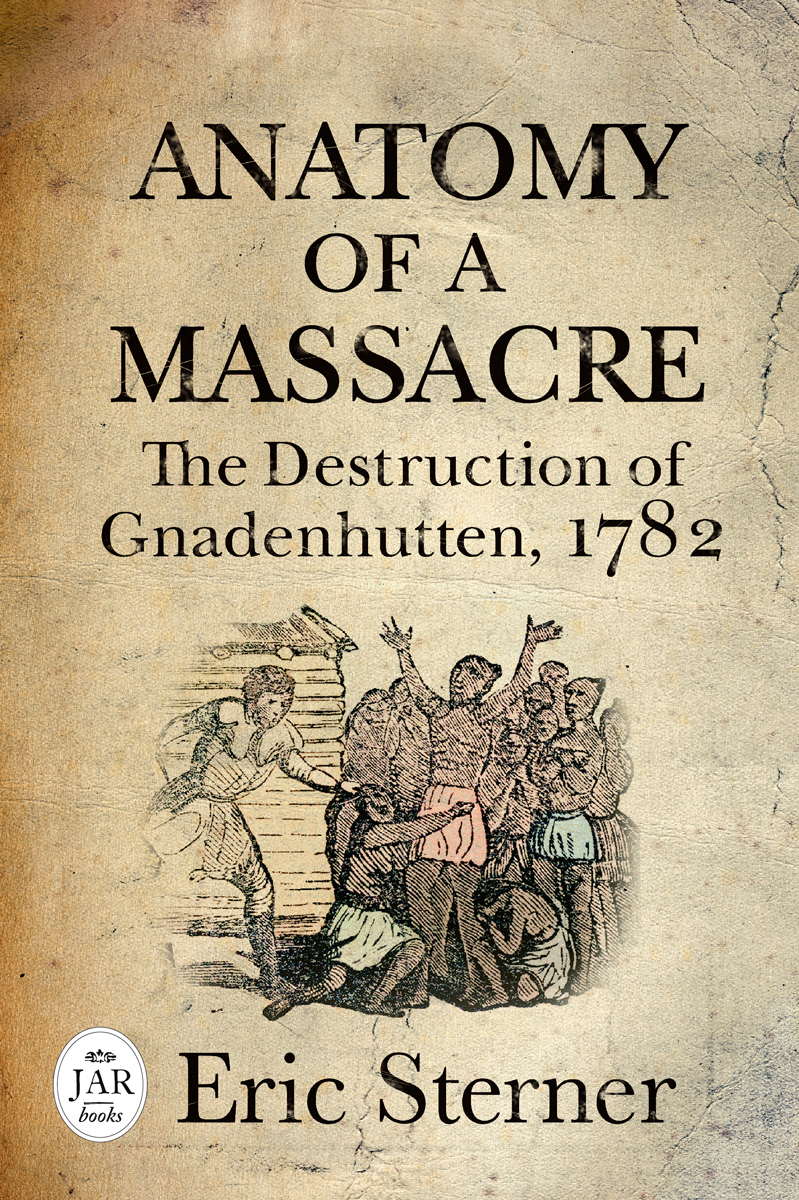
Lord de la Warr’s name appears frequently in Mr. Sterner’s story. His name was given to the Delaware River, which in turn lent its name to the Lenape people who have long been known to English speakers as the Delaware Tribe. Mr. Sterner has provided the definitive account of the worst atrocity of the Revolutionary War. In 1782 more than eighty white settlers clubbed, killed, and scalped ninety-six peaceful, Christian Indians as they prayed and sang hymns. The attack on the Moravian mission town of Gnadenhutten (Ohio) was intended as both a punitive and preemptive strike, conducted by settlers whose families and farms had been targeted by other Indians acting as proxies of the British. It is a horrific story that has defied understanding until now.

Histories of conflict between Native and European Americans have often served us poorly, reducing one or both sides to caricatures. Earlier histories, written by white men, put a finger on the scale of historical interpretation such that Indian atrocities were called “massacres” while white atrocities were called “battles” or “raids.” In the last half of the 20th century, the finger moved to the other side of the scale. Territorial expansion, the introduction of Old World diseases, missionary activity, the presumption of Manifest Destiny, and acts of violence large and small were braided together into a narrative of premeditated genocide.

These approaches reveal the eras and ideologies of their writers. More problematic is both schools tendency to gloss over of the complexity of frontier culture. The Gnadenhutten Massacre is not a cowboys-and-Indians story of “white” and “red” men exchanging bullets and arrows. It is far more complicated than that, with many of its actors desiring little more than their own survival. Though never stated, Mr. Sterner’s approach seems inspired by the axiom: “Don’t judge a man until you have walked a mile in his shoes.” The original expression, appropriately enough, referred to walking “a mile in his moccasins.”

The people in Mr. Sterner’s story can certainly be categorized as “whites” and “Indians,” and for narrative purposes two of the book’s chapters align with these groupings. Still, though racism is an important element of the story, there is plenty to suggest that skin color was not the only matter at issue. The two most prominent white characters –John Heckewelder and David Zeisberger—were Moravian missionaries who lived for decades among the Indians and were wholly dedicated to their welfare. Other whites, British agents, were Indian allies. The killers at Gnadenhutten were white, but acted independently and in defiance of government authority. On the Native American side, the Delaware, Shawnee, Wyandot, and Iroquois tribes were distinct political entities with different alliances, histories, and leaders. Even within these tribes, individual bands (what the author calls “phratries”) disagreed with each other, sometimes sharply, on military and political questions. Some were allied with the British and some with the Americans. The victims at Gnadenhutten were—though Indians—also pious, hymn-singing Christians. The white perpetrators behaved in a decidedly un-Christian manner despite their heritage. History, it turns out, was just as full of contradictions as the present is.

European-American settlers could indeed be brutal, as the events at Gnadenhutten show. Indians could also be ruthless. The first known massacre perpetrated by North American Indians was committed long before Europeans arrived on the continent. The tactic later employed by American armies of destroying villages and burning crops was first used by Indians against the colonists around Jamestown in 1622. Further complexity is found in the fact that even the line between “whites” and “Indians” was sometimes blurred. The Indian victims of the Gnadenhutten Massacre were Christians who dressed and lived much as Europeans did. Conversely, Indian armies—notably at the 1774 Battle of Point Pleasant—sometimes had white warriors among them. These were typically men who had been kidnapped as children and adopted into Indian society.

Mr. Sterner takes a dispassionate, investigatory approach to his work. It is refreshingly free of grand economic or social theories. He seeks to comprehend the events as those involved comprehended them and shows little interest in passing judgment. Instead, he seeks to “walk” a mile in their shoes and moccasins. In doing so, he respectfully refers to Natives by the Indian names, uncynically takes the faith of the Moravians at face value, and justly illustrates the terrors experienced by settlers on the frontier. Each of these groups is examined in its own chapter. Then, in his fourth and final chapter, Mr. Sterner tells us what happened at Gnadenhutten. By then the reader is left struggling to reconcile his or her outrage with the realization that what happened was likely inevitable.

The chance to experience this tension between the world that was and the world that ought to have been is a gift to Mr. Sterner’s readers. Conceiving of a world as it ought to have been is easy. Understanding it as it actually was is much harder. Period accounts indicate that even the perpetrators of the massacre wrestled with this tension in real time. One of them, after executing a dozen Moravian Indians, “sat down and cried because he found in it no satisfaction for his murdered wife and children.” Another whose family had been killed by Indians sat down by the river bank and burst into tears, crying, “You know I couldn’t help it!”[2]

Anatomy of a Massacre could have had an epilogue. Shortly after the events at Gnadenhutten, Col. William Crawford was captured and cruelly tortured to death by Delaware tribesmen as payback for the massacre. Crawford had played no part in the earlier atrocity, but men under his command had. Mr. Sterner has written about Crawford’s death for Emerging Revolutionary War and no doubt made a considered decision to let the Gnadenhutten story stand on its own.

The last “massacre” of American Indians occurred in 1911 in Nevada, when state police killed eight members of Mike Daggett’s Band of Shoshones, whom they were pursuing for horse theft and murder. This “Battle of Kelly Creek” occurred three hundred and one years after the massacre of the Paspahegh Band of Powhatans near Jamestown and closed the book on three centuries of racial violence between Native and European Americans. It is a cringe-inducing history, to be sure.

Mr. Sterner’s book suggests two lessons. First is that we should not blame atrocities so much on the perpetrators’ culture and demographics but rather on the killers themselves and on human nature. Culture matters, but people in every culture will do terrible things in terrible circumstances. Second is that we cannot substitute a cartoonish caricature of history for the nuanced reality of what really happened. The consequence of dumbed-down history is not a partial understanding but rather a false understanding. The Moravian Indians and missionaries lived in villages that were both physically and figuratively between two cultures. Though neutral, family and social ties to the war’s combatants remained and neither side could accept or understand them as a unique group. That led the Wyandots and British-allied Delaware to forcibly relocate them, and it motivated the settlers led by David Williamson to kill them.

An analogous refusal to understand the past for what it really was does a different kind of “violence” to history. Mr. Sterner’s book provides hope that historians can in fact focus on real history, avoiding the polemics and theorizing that characterizes so much academic writing. Like Glenn Williams, author of Dunmore’s War, Mr. Sterner seeks to trace the course of events and to understand the subjects of his work as they understood themselves. It’s good history.


Sources:

[1] George Percy, “’A Trewe Relaycon:’ Virginia from 1609 to 1612,” Tyler’s Quarterly, 3 (1921-1922): 259-282, 272. “Weroance” was a title for a “sub-chief” or a village leader.

[2] Eric Sterner, Anatomy of a Massacre: The Destruction of Gnadenhutten, 1782 (Yardley, Pa: Westholme, 2020), 148.
2021 Symposium Highlight: Vanessa Smiley

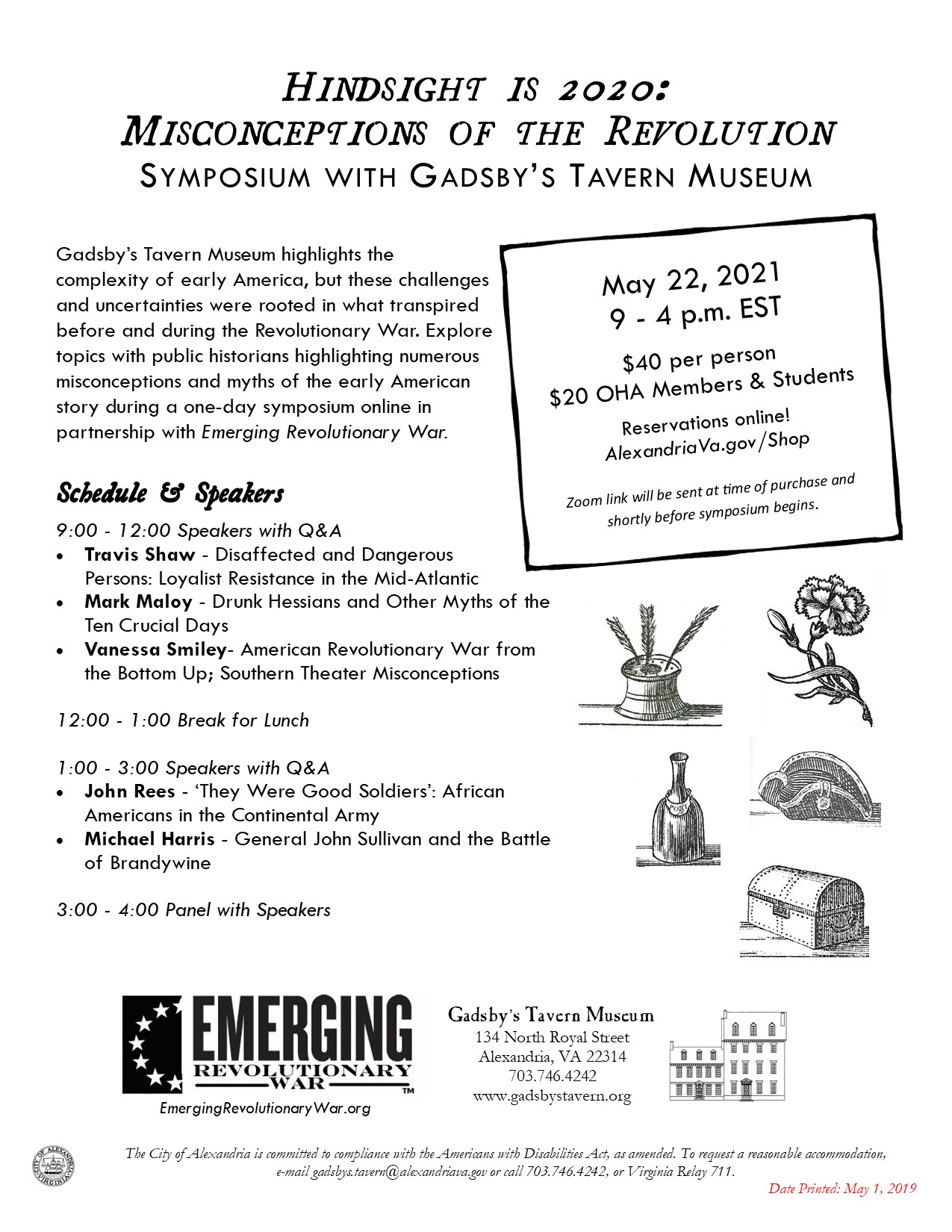
Over the next few months, we will be highlighting the speakers and topic for our 2021 Symposium, Hindsight is 2020: Revisiting Misconceptions of the Revolution, taking place on May 22nd .

Today we continue with historian Vanessa Smiley who will be covering the myths and misconceptions of the Southern Campaigns during the American Revolution.  

See Vanessa as she discusses an aspect of the Southern Campaign on March 7 at 7p.m. on Emerging Revolutionary War’s Facebook Live as part of the “Rev War Revelry” historian happy hour!

Vanessa Smiley is an historian and interpreter whose roots began at National Park Service Civil War and Rev War sites. Her Rev War park experience includes serving as the Chief of Interpretation at the Southern Campaign of the American Revolution Parks Group in South Carolina, an acting assignment as Superintendent at Guilford Courthouse NMP, and Chief of Interpretation at Morristown NHP. Vanessa is currently the Project Manager of Interpretive Media Development for the National Capital Area at Harpers Ferry Center. She received her undergraduate degree in Historic Preservation from the University of Mary Washington and her Master’s degree in Resource Interpretation from Stephen F. Austin State University.

Outside of her work with the NPS, Vanessa enjoys researching family histories, studying material and social culture of the 18th and 19th centuries, listening to podcasts, reading true crime, drinking craft beer, and attempting to make the perfect sangria. She and her husband live in Morgan County, West Virginia on their small farm where they run a nonprofit animal sanctuary.

She will be presenting her talk From the Bottom Up: Myths and Misconceptions of the Southern Theater at the May symposium.

 Why do you believe the Southern Campaigns were so significant to the outcome of the American Revolution?

The simplest way to describe why I believe the Southern Campaigns were so significant to the War’s outcome is: it was a grassroots effort. What I mean is that while the Continental Army shouldered plenty, it was the combination of local efforts of the militia and determined civilians who turned the tide of the war when the British looked to the southern colonies, especially in the second half of the war. All one has to do is to look at two key battles, Kings Mountain and Cowpens, to see the impact of militia integrity, courage, and resolve.

Some point to the politics of Boston and New York as a driving force behind the start of the war. But the taverns and town halls of Charleston and Savannah were no less significant in adding fuel to the revolutionary fire. There is also the added dichotomy of our first true American civil war that played out in the backcountry of the Carolinas. Here were literal neighbors, brothers, cousins, and friends taking up arms to serve their respective causes and finding themselves on opposite sides. These dynamics were one driving force behind the militias that had such an impact during the Southern Campaigns.

What first attracted you to the study of early American history? What keeps you involved in the study of this history? Do you find these things are the same or different?

I give credit to my love of history to my high school history teacher, who embodied the archetype of the quintessential eccentric and genius history connoisseur striving to bring history alive. He immersed us in the history of the 18th and 19th century through first person accounts, visits to historical sites, and the dramatics of storytelling. He also armed me with the intellectual tool of piecing out the relevancy of events and people of the past, and that’s what has kept me interested in studying history for the past two decades.

While my work at historic sites for the National Park Service provided an easy outlet for my historian brain, I sought those historical connections and resources even outside of work because of that drive to understand the past. It’s a little bit different now than before though. I don’t get to be as immersed as I once was (no traipsing through cemeteries at night to feel the chill and terror of the Underground Railroad) and instead my mind goes to educating the public on the importance of our history. That’s why I’m so appreciative for Emerging Revolutionary War!

What is the biggest myth about the war in the South? How do you think it came about?

That the war was won in the north and not the south! I’ll go into more detail on this one during my presentation, but I’ll tease a little bit here. One part of the answer to the second question might lie with our public education system. In studying the state education curriculums of various states, I found that there is a stronger emphasis on the beginnings of the war than the war’s end. And so the Southern theater gets very little, if any, attention when kids study the war in school. The exception used to be in certain states like South Carolina, where the battles of Cowpens and Kings Mountain were directly referenced in the state standards. Since the standards updated in 2020, this no longer seems to be the case.

You’ll have to wait for my presentation to dive a little deeper into this myth with me!

Do you think there are common misconceptions of the era of the American Revolution among the American people? If so, what are they and have they ever affected your work?

There certainly are, and the ones that have affected my work the most center around that idea of the often-overlooked Southern Campaigns for most Americans. Ask any random person to name a Revolutionary War battle or event and the majority will name something from the northern colonies. Every now and then you get a Charleston, and if you consider Virginia part of the south, then a Yorktown for sure. But as I’m sure has become obvious already, I strive to educate about the rich history of the Rev War in the south.

Why do you think it is important for us to study the Revolutionary Era? 

No matter which political, social, or economic side you’re on nowadays, we can all agree we are living in our own revolutionary time. And we find ourselves looking back to our nation’s founding for understanding and guidance, namely things like our national ideals and governmental processes. But we are a different people and a different nation than what we were then. We should not take everything from 240 years ago at face value. By studying and investigating the past, we can understand how and why decisions were made at the time. And perhaps we can extract an element, or life lesson, that can be applied to our modern times.

I believe that while history does not repeat itself, it does rhyme. By understanding the past, we may know our future.

Join us for our SECOND annual Emerging Revolutionary War Symposium. Due to the COVID 19 pandemic, we postponed the 2020 Symposium to May 22, 2021 with the same topics and speakers. Co hosted by Gadsby’s Tavern Museum, speakers and topics include:


Michael Harris on Misconceptions of Battle of Brandywine
Vanessa Smiley on Myths of the Southern Campaigns
Travis Shaw on American Loyalists
John U Rees on African American Continental Soldiers
Mark Maloy on myths of the Battle of Trenton

Stay tuned as we highlight our speakers and their topics in future blog posts.

UPDATE: The 2021 Symposium will now be virtual. Though conditions with the pandemic are improving, we do not believe we will be able to have the event in person by May, so we have decided to be virtual. Due to this shift, we are also dropping the price! Now the full day symposium is $40 per person and $20 for students. This allows for guests from all across the country to learn about African American soldiers, Loyalists, and Drunken Hessians. Buy your ticket today!

To register visit: https://shop.alexandriava.gov/Events.aspx

2021 ERW Symposium Update

Though the current health conditions are improving as they relate to the COVID-19 pandemic, we decided that our 2021 symposium will have to be virtual. We felt that by May, restrictions for groups will still be limited and we wanted to make a decision soon so that our speakers and registrants can plan accordingly. The date is still set for May 22, 2021 but time for some good news. Our registration fee is now only $40 per person and $20 for students. This will allow us to broaden our audience with the virtual program. We hope that 2022 will allow us to come together again in Alexandria for our third annual symposium.

More information on our speakers, topics and how to register is below!

“Rev War Revelry” Author Interview: John Maass

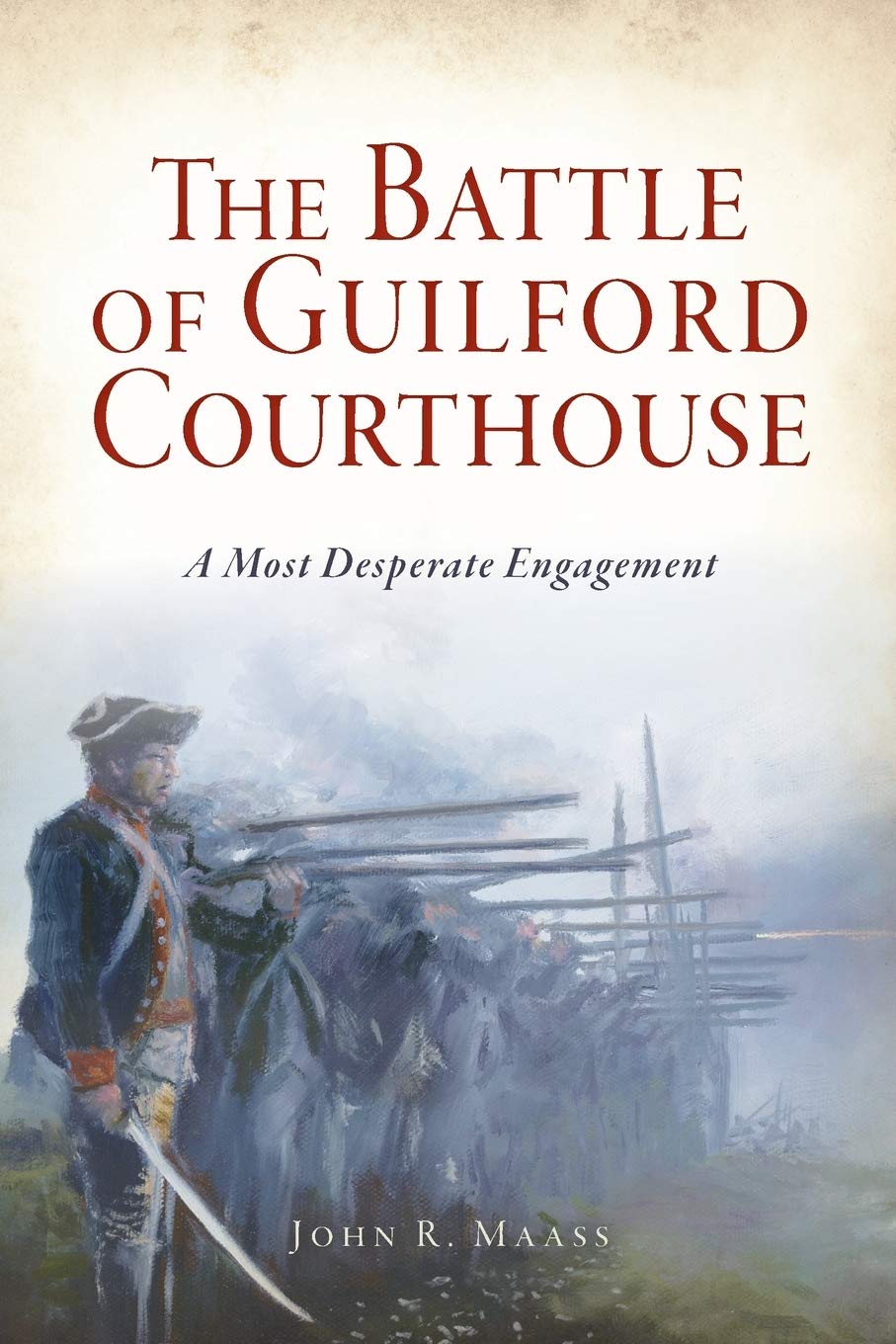
In March 1781, General Charles Lord Cornwallis finally caught up with his antagonist, General Nathanael Greene and his joint Continental and militia forces in North Carolina. On March 15, 1781, the British scored a pyrrhic victory over the American forces, securing the field but losing approximately 25% of their field force in the process.

With the victory, Cornwallis was forced to retreat to the North Carolina coast, to Wilmington, where he could rest and refit. He then led his forces north and into Virginia, to his destiny at Yorktown.

Yet, the road to Guilford Court House, for both sides, started in South Carolina, across the entire breadth of North Carolina, and into the southern reaches of Virginia before returning to the Old North State. This road and the history of the campaign, along with the March 15th engagement, unfolds in a new history by Dr. John Maass, author and historian, currently at the U.S. Army Center of Military History in Washington D.C.

His book, The Battle of Guilford Court House, A Most Desperate Engagement will be the focus of this week’s “Rev War Revelry.” The book is now available from book retailers and online. We hope you can join us this Sunday, at 7 p.m. EST, for our next installment of a historian happy hour.

To access, just head to Emerging Revolutionary War’s Facebook page, go to the “Events” tab and follow the prompt at 7 p.m.

Leveling, Pointing, and Elevating Field Guns

Emerging Revolutionary War welcomes back guest historian Karl G. Elsea

If you want to know the process of how field guns were fired in a battle such as Trenton or Monmouth, watching the National Park Service or re-enactors fire a cannon, you will only get part of the story. Important parts of the procedure are almost always missing. Here is a more complete presentation of the process; and, how leveling, pointing (aiming), and elevating a field gun were performed.

Major William Congreve said it best in his instructional training works at the Royal Military Repository in the late 1700’s: “It is of the utmost Consequence to the Service to fire so as to do Execution, for Shot flying over the Enemies head only hardens them and discourages your own Troops.” “Rounds must never be fired with-out pointing the Gun carefully each time and paying great attention to the Elevation.”[i]

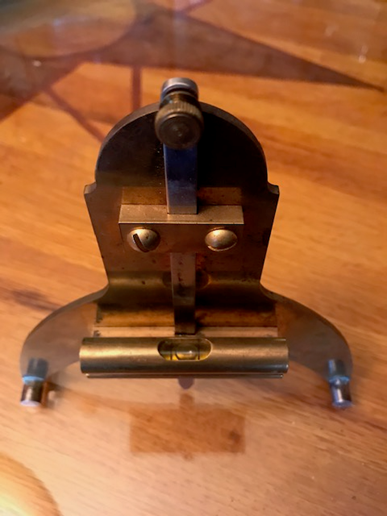
After the commands, unlimber piece (un-attach the gun from the limber), take off apron (remove the vent cover), take out tompion (remove the “plug” at the muzzle of the gun), the gunners would perform the following activity with-out a specific command. This was a critical function and is not usually shown when firing a gun. It was to level the piece. As stated in their training, “and which ever Wheel stands too high, the Earth must be loosened in the rear, and the Gun drawn gently back until the Bubble rest in the Center of the Tube.”[ii] The science was simple, the trunnions on the barrel must be level or the barrel will move in a non-vertical plane and thus be off target. Leveling the gun was of great importance. The Artillerist’s Companion 1778 states it was an artillerist’s function, “Quadrating a piece [barrel] mounted, is to see whether it be directly placed, and equally poised in the carriage, which may be found by a gunner’s instrument called a level or perpendicular.”[iii]

The following picture shows what was called the Gunner’s level or the Spirit Level. It was the quintessential instrument carried by gunners to level the gun. In a cylinder in the middle of the gunner’s level was a vial and when the trunnions are level the bubble in the vial will be in the middle. At that point the gun was leveled.

(Author’s Level and Photograph)

The next activity was sometimes required to point the gun and it also required the Gunner’s Level. The level could be used to place a noticeable mark indicating the top of the base ring and the top of the muzzle ring. These two marks constitute what was called the “centre” [center] line of the cannon. The activity of marking the “centre” line was performed immediately after leveling the cannon unless the points or the line were already marked on the cannon. This line on the barrel was called the “gun metal line.” On many of the guns of the period the metal line marks were discretely engraved into the design on the barrel. For example, on this patriot cast Byers’ gun the base ring line, touch hole, and liberty pole mark one end of the “gun metal line.”

After these tasks (leveling and marking) were complete the gun was ready for pointing (aiming).  With regards to the Patriot’s drill, there was a distinct difference between the primary source drills of William Stevens and Louis de Tousard. Stevens records that “Take Aim” happens after the command “Prime.”[iv] In Tousard’s drill “Take Aim” takes place before “Prime.”[v] There was a reason for these differences, and it depended on how the gun was primed. The use of a priming tube, whether tin, reed, or quill, could potentially block the sighting line. Tousard’s drill avoided this problem by sighting before the priming tube was inserted. It should be noted the centre line passed over the touch hole. It was noteworthy that the British drill specifically mentions pointing before the tube was inserted into the touch hole. The British drills for a six-pounder stated, “The man who serves the Vent … not put the tube in until the Gun is pointed.”[vi] With regards to Steven’s drill, the priming likely consisted of using powder to touch off the charge, thus the “take aim” command could take place after priming. Using powder only to prime did not block the sighting line. Tousard’s drill assumed tubes were used in priming. British and Patriots used tubes as the preferred manor in priming field guns.

(Author’s Photograph)

Last came the task of elevating the gun barrel. The need for proper elevation of the barrel was demonstrated by noting the psychological impact of cannon fire as shown in the following contemporary quote, “it having been often proved that Soldiers have been more alarmed and put in confusion, by seeing Shot hopping to them, than by having double the Number of their Comrades killed by their sides without seeing it.”[vii] That quote showed the importance for shot to land and bounce somewhat in front of the soldiers. Elevation was adjusted to accomplish that task.

For elevation the gunners would know their individual piece and the characteristics concerning how the various types of shot with varying powder charges would fall. The Officers would likely have some recordation measuring the needed elevation for the distance to first graze. First graze was the range at which the shot would first touch the ground. That recordation would allow the gunners to know what elevation to use for their barrel.

The gunners would also know what the dispart (half the difference between the diameter of the base ring and muzzle ring) was for their individual gun. Dispart was the key to understanding that aiming the gun on the centre line automatically elevates the barrel. Dispart could be quickly measured in the field by placing the vent pick into the touch hole until it reached the bottom, and then subtract that measurement taken at the muzzle from the bottom of the tube to the top of the muzzle ring. As noted above, when the cannon was aimed using the centre line (“gun metal line”) then the resulting cannon ball strike on level ground was called the “Common range.”  Common range was different from “point blank range” which was the distance when a cannon ball first touches ground when fired from a level barrel on level ground.

There was an exception to aiming and elevating the gun. The exception was if a gun were to be overrun. British training materials stated, “Case Shot may be fired as quick as the Dragropemen can draw the Gun up to its proper Position in the Interval again, which will allow the Non Commissioned Officer a sufficient time to direct the Gun nearly to the Center of the Enemies Battalion and give a pretty good guess at the Elevation.”[viii]


[i] Adrian B. Caruana, The Light 6-Pdr. Battalion Gun of 1776, (Alexandria Bay, NY: Museum Restoration Service, 1993), 27.

[ii] Caruana,33.

[iii] T. Fortune, The Artillerist’s Companion 1778, (London: Whitehall, 1993), (Alexandria Bay, NY: Museum Restoration Service, 1992), 9.

[iv] William Stevens, A System for the Discipline of the Artillery of the United States of America, (New York: William A. Davis, 1797), 68.

[v] Louis de Tousard, Artillerist’s Companion on Elements of Artillery, (Philadelphia: C and A Conrad and Co., 1809), 140-141.

[vi] Adrian B. Caruana, The Light 6-Pdr. Battalion Gun of 1776, (Alexandria Bay, NY: Museum Restoration Service, 1993), 29.

[vii] Caruana, 27.

[viii] Caruana, 27.

Inspiration

Merriam-Webster’s two two definitions of inspiration are “an aspiring agent or influence” and “the quality or state of being influenced.” Being a military historian that has spent a portion of his graduate school and adult life studying the American Revolution, there are a multiple examples of people, events, or circumstances that would fit that Merriam-Webster definition.

The 56-men who affixed a signature to the Declaration of Independence in the summer of 1776 and the gravity of what that meant.

Thomas Paine’s The American Crisis comes to mind during the bleak December 1776 days as George Washington’s army hurriedly moved through New Jersey.

George Washington’s personal heroics, at Princeton in January of 1777 and Monmouth Court House in June 1778, defying his own personal demise to rally the troops he led.

The tales of suffering, at Valley Forge, Morristown, and through the heat of a Carolinas campaign by the common soldier, many whose names are lost to history.

Recently, I have been looking for inspiration, I think most of us are, with how 2020 ended and the beginning of 2021, but this post is not about straying into current politics, viewpoints, or stances on the pandemic. This is more personal.

The pandemic has afforded me the opportunity to read more, as I am sure my fellow history enthusiasts and bookophiles can relate to. Those readings reawakened a question I tried to tackle as a graduate student a decade ago at George Mason University.

What inspired the men from Maryland to fight for American independence?

Or more accurately:

What did not inspire the men from Maryland to fight for American independence?

I ruled out pay, patriotism (at the start), and other tangible benefits. I gleaned from some of the primary sources that have survived, the chance to create a new life, for the soldiers themselves or their loved ones at home was a major motivator to serve. Family was the spark of inspiration.

On this date, that is something I can really relate to. My father, who will be celebrating his 71st trip around the sun, is battling dementia. He will know that this date, February 8, is his birthday, but will struggle to remember anything else. Yet, he was surprised to see his name in a book recently, one that I sent to him, one that I had helped in the editorial process. To see him reading it, cherishing it, and tearing up with happiness at the simple recognition of his name and mine, is an inspiration to myself.

So, he was and is an inspiration, half the duo of sparking my passion of American history (any guesses on the other half)?

What or who is your inspiration as we enter the second month of 2021?

Happy Birthday Dad, from the history enthusiast you helped create.

If curious, he is reading A Handsome Flogging: The Battle of Monmouth, June 28,1778 by William R. Griffith IV

“Rev War Revelry” Big Game Halftime Historian Happy Hour

This Sunday, a football game will be played in Tampa, Florida between a team named after pirates and another as the name given to Native American leaders. There will be a halftime entertainment. Just slightly different than previous years.

No, we are not talking about the pandemic restrictions that will limit access to the stadium and change the landscape of the halftime show there.

Emerging Revolutionary War is the change. When the whistle blow for the end of the second quarter, change your view from the television screen to the computer screen, click onto our Facebook site and tune into the Big Game Halftime Historian Happy Hour where our historians will discuss the connections between the teams, locales, and who is the GOAT of early American history.

This shortened historian happy hour will still pack the same level of camaraderie, entertainment, and historical tales that you are used to with “Rev War Revelry.”

See you Sunday, 7pm EST, and remember your drink of choice!

“Rev War Revelry” Light Horse Harry Lee Discussion

On January 29, 1756, Henry Lee III is born at Leesylvania Plantation in Prince William County, Virginia. Part of the prestigious Lee family of Virginia, his father was a cousin of Richard Henry and Francis Lightfoot Lee, two brothers who signed the Declaration of Independence.

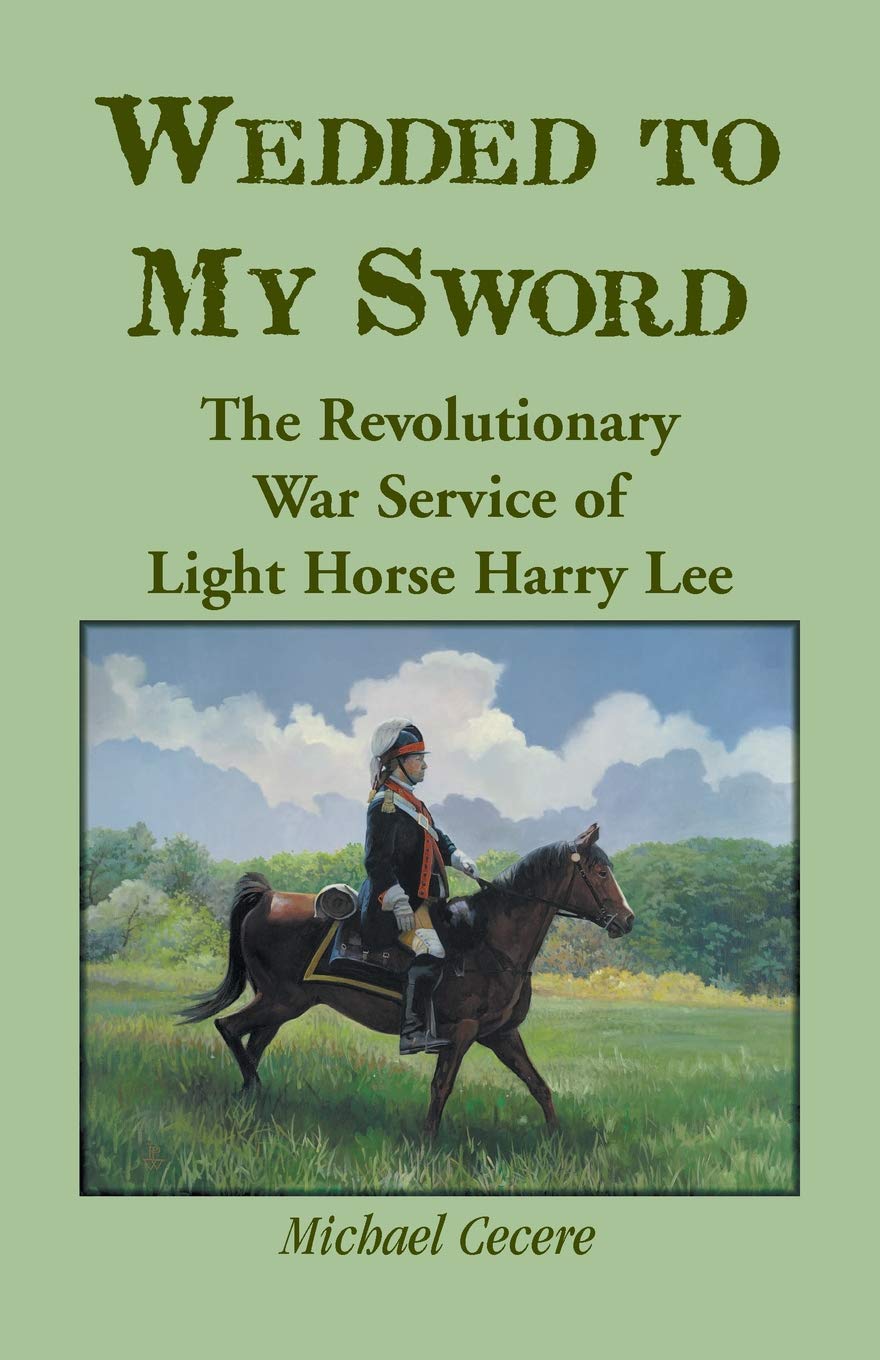
Henry Lee would blossom into one of the better cavalry commanders in the American Revolution, earning the nickname, “Light Horse Harry” Lee because of his accomplishments. With January being his birth month, Emerging Revolutionary War welcomes historian and author Mike Cecere, who will discuss his book, “Wedded to my Sword, The Revolutionary War Service of Light Horse Harry Lee.”

Cecere, former high school and community college history teacher is the author of thirteen books on the American Revolution, most focused on aspects of the colony of Virginia and/or her native sons.

This Sunday we hope you spend some time joining us on the next installment of “Rev War Revelry’ as we discuss the Lee that was born in January and became a military hero of the American Revolution. This historian happy hour will be live on our Facebook page at 7 pm EST.

(Yes, we do know there is another Lee that is born in January and plays a prominent role in history).

“Rev War Revelry” A Cigar Chat with John Adams

Join Emerging Revolutionary War historians this Sunday, at 7 p.m. EST on our Facebook page for the next historian happy hour. This week we will be joined by John Adams…no that is not a mistype.

John Adams is the founder and owner of Liberty Cigars, which “was founded to reacquaint men and women with the simple pleasure of respite and leisure. Lasting bonds, whether among one or many, are more easily formed when wrought in a relaxed and convivial atmosphere.”

Liberty Cigars

That “convivial atmosphere” will be recreated during the next installment of “Rev War Revelry” as ERW historians will discuss tobacco, cigars, and the founding generation of the United States.

“In the time to come we will share the incredible stories of our great republics’ illustrious history with the hope that through you, it will long endure. Our premium cigars are named for a seminal person, event or entity in history so that we may honor them, as we should, across the ages” according to Adams.

Liberty Cigars is part of the American History Guild, founded over a decade ago to “rekindle and stoke the sacred fire of liberty.”

We hope you can set aside an hour of your weekend to join us in “the simple pleasure of respite and leisure” with John Adams. If weather permits, there may be another twist to the “Revelry” on Sunday evening.

The third Artillery Engagement at the Battle of Trenton: December 26, 1776

Emerging Revolutionary War welcomes back guest historians Karl G. Elsea and William W. Welsch for the final installment of their three part series

1770 drawing of Hessian three-pounder gun and limber
(courtesy of Kriegskarten from Hessisches Staatsarchiv Marburg, Germany at
http://www.digam.net/?str=177)

The v. Lossberg Artillery detachment:

Bombardier Conrad Volprecht was about 44 years old with over 27 years of service. He led the v. Lossberg artillery detachment consisting of another bombardier, 13 gunners and 3 matrosses, with two three-pounder guns and associated horses, harness, and limber.[i]

Over two years after the battle and being a prisoner Bombardier Volprecht gave testimony that indicated the sequence of battle for his detachment was roughly as follows: First went to field, second fired north, third ordered south, and fourth got stuck in the mud till the end of the battle. There is a problem though, the sequence that better fits the data from the battle was as follows: first went to field, second ordered south, third fired west, and fourth got stuck in the mud.

 John Adams wrote “Facts are stubborn things. They cannot be altered by our wishes, our inclinations, or the dictates of our passions.” In studying firsthand accounts of the battles in the Revolutionary War they are sometimes not correct or even true. For example, there is an enjoyable firsthand account (written many years later) by a patriot Sergeant White (The Good Soldier White) that is often quoted in accounts of the battle. Parts of his story are no doubt true. The problem is that when Sgt. White states he was with “Lieut. Munroe, our late President of the U. States” and “I was the first that reach them [cannons],” and “They had all left it, except one man tending vent,” those specific parts of the story cannot be true. Hessian Lt. Englehardt would not have time to do all that he did and then cross the Assunpink bridge before the Jagers if artillery men from Sullivan’s column were that far up King Street. Facts from the battle mean that part of that story does not work.

The most important place in all the 13 states fighting for independence on December 26, 1776 from 8:00 am to 9:00 am was the long, narrow bridge over the Assunpink creek. It was held by Hessian Sergeant Muller and 18 men. Sgt. Muller was about 50 years old with about 32 years of service. The importance of this place was not fully realized by the Hessians, but the Patriots knew it had to be closed, and General Washington had two full brigades, Sargent’s and Glover’s, tasked with taking, as quickly as possible, and then holding the bridge.

At about 8:03 am Patriot General Sullivan was about one mile from Trenton center along the River road when he attacked the outlying Jager pickets. General Sullivan had the artillery fire several canister shots at the Jagers. This firing also served as a signal to General Washington so he would know his other wing was attacking. It was to be recalled that General Washington started his attack about 8:00 am on the Pennington road and he also was about a mile from Trenton center. This cannon firing was also a signal to General Ewing so he knew when to start his distraction. General Ewing heard the three cannon shots and he quickly followed with his guns and howitzers firing ten shots from across the Delaware River. General Ewing kept up his firing until he could make out that Patriots were approaching. The v. Knyphausen regiment was forming on Second Street and was the logical unit to resist any attack coming from the River Road.

Volprecht’s detachment with its two guns followed Lt. Fischer’s detachment east on Fourth Street from the Methodist church into the field north and east of the Quaker lane. Lt. Fischer’s detachment was falling back from its earlier engagement and picked up the v. Lossberg detachment as it passed by. It took longer for the v. Lossberg artillery detachment to prepare for the battle because the horses had to be collected, harnessed, hitched, and the guns limbered. Fischer testified that the “cannon were unhorsed, and the horses unharnessed and brought back again into the stable” from the cancelled early morning patrol.[ii] For the morning patrol the horses had been hitched and guns limbered at 4:00 am but the patrol was cancelled so the men/horses/limber/guns were brought back to the Methodist church and waited for sunrise to unhorse.  

The infantry of the v. Lossberg and Rall regiments followed Volprecht’s detachment into the field. It was in this field that these two regiments would form a line for battle. While waiting for the v. Lossberg regiment to form Volprecht was ordered by Lt. Weiderhold, “Artillery men, come here with the cannon” meaning they were to join the v. Knyphausen regiment.[iii]  The v. Knyphausen regiment was on Second Street heading to the open field just east of Trenton and away from the Assunpink bridge. Volprecht and his v. Lossberg artillery detachment moved south on Quaker lane, linked up with the v. Knyphausen regiment, and set up his gun position facing threats coming from Trenton. The following map presents Trenton as it was in 1776.[iv]

While this was happening on the Hessian side, the right wing of the Patriot forces was moving east on River Road. General Sullivan rushed two of his brigades toward the Assunpink bridge. Neil’s battery with Sargent’s brigade and Sargent’s battery with Glover’s brigade made it to the bridge and across. Glover’s brigade with Sargent’s battery continued along the Assunpink creek to cut off possible exits for the v. Knyphausen regiment. St Clair’s brigade was moving east on Second Street with Moulder’s (three four-pounders) and Hugg’s artillery (two three-pounders).

Hessian Bombardier Volprecht testified that he fired his gun five times and the other gun fired one time.[v] One of those six shots hit the fore horse of one of Hugg’s three-pounder guns as they advanced in support of Patriot St. Clair‘s brigade. John Greenwood, a fifer in the 15th Continental, recorded that one of Hugg’s guns had the fore horse shot by a Hessian three-pounder gun, ”the ball from which struck the fore horse that was dragging our only piece of artillery, a 3-pounder. The animal, which was near me … was struck in its belly and knocked over on its back. While it lay there kicking the cannon was stopped.”[vi]  That was the only hit scored by the Hessian artillery that day. St. Clair’s brigade with Col. Stark’s infantry in the lead applied great pressure causing the v. Knyphausen regiment to pull back farther east. Volprecht’s artillery detachment pulled back with the regiment.

As the Hessian artillery detachment pulled back east disaster struck both guns. Volprecht had been ordered into a valley without the ground being checked. Both guns got stuck in the mud. The rest of the battle the men of the artillery, with some aid from nearby infantry, was spent trying to extract the guns from the mud. One gun was extracted just before the surrender, the other gun was extracted after the battle was over.

Mud ended the third artillery engagement. The battle at Trenton was over. The Patriots had a great victory. What is shocking was the limited number of shots from the Hessian artillery. The Rall artillery detachment fired twelve solid shot and one grape, the v. Knyphausen artillery detachment fired “seven or eight shots,” and the v. Lossberg artillery detachment fired six shots.[vii] These few shots lend support for how quickly the Patriots won the Battle of Trenton.

Sources:

[i] William S. Stryker, The Battles of Trenton and Princeton (The Riverside Press, Cambridge, 1898), 388

[ii]Hessian Documents of the American Revolution, Morristown National Historical Park, ML, The Affair at Trenton Dec. 26, 1776, English Translation, ML 337

[iii] Hessian Documents of the American Revolution, Morristown National Historical Park, ML, The Affair at Trenton Dec. 26, 1776, English Translation, ML 277

[iv] Information taken from The Trenton Mapping Project located at www.trentonhistory.org/Documents/Trentonin1775.pdf  With the information available it is likely more buildings are shown rather than less.

[v] Hessian Documents of the American Revolution, Morristown National Historical Park, ML, The Affair at Trenton Dec. 26, 1776, English Translation, ML 277

[vi] John Greenwood, Revolutionary Services of John Greenwood of Boston and New York, 1775-1783, 40-41. “the first intimation I received of our going to fight was the firing of a 6- pound cannon at us, the ball from which struck the fore horse that was dragging our only piece of artillery a 3-pounder.” Retrieved from https://archive.org/details/revolutionaryser00gree/page/38/mode/2u

[vii] Hessian Documents of the American Revolution, Morristown National Historical Park, ML, The Affair at Trenton Dec. 26, 1776, English Translation, ML 341