Fredericktown, Maryland, August 1, 1775, a gentleman on business wrote to his contact in Philadelphia the following observation of a company of volunteers answering the call to head north to Boston to join what would become the Continental Army
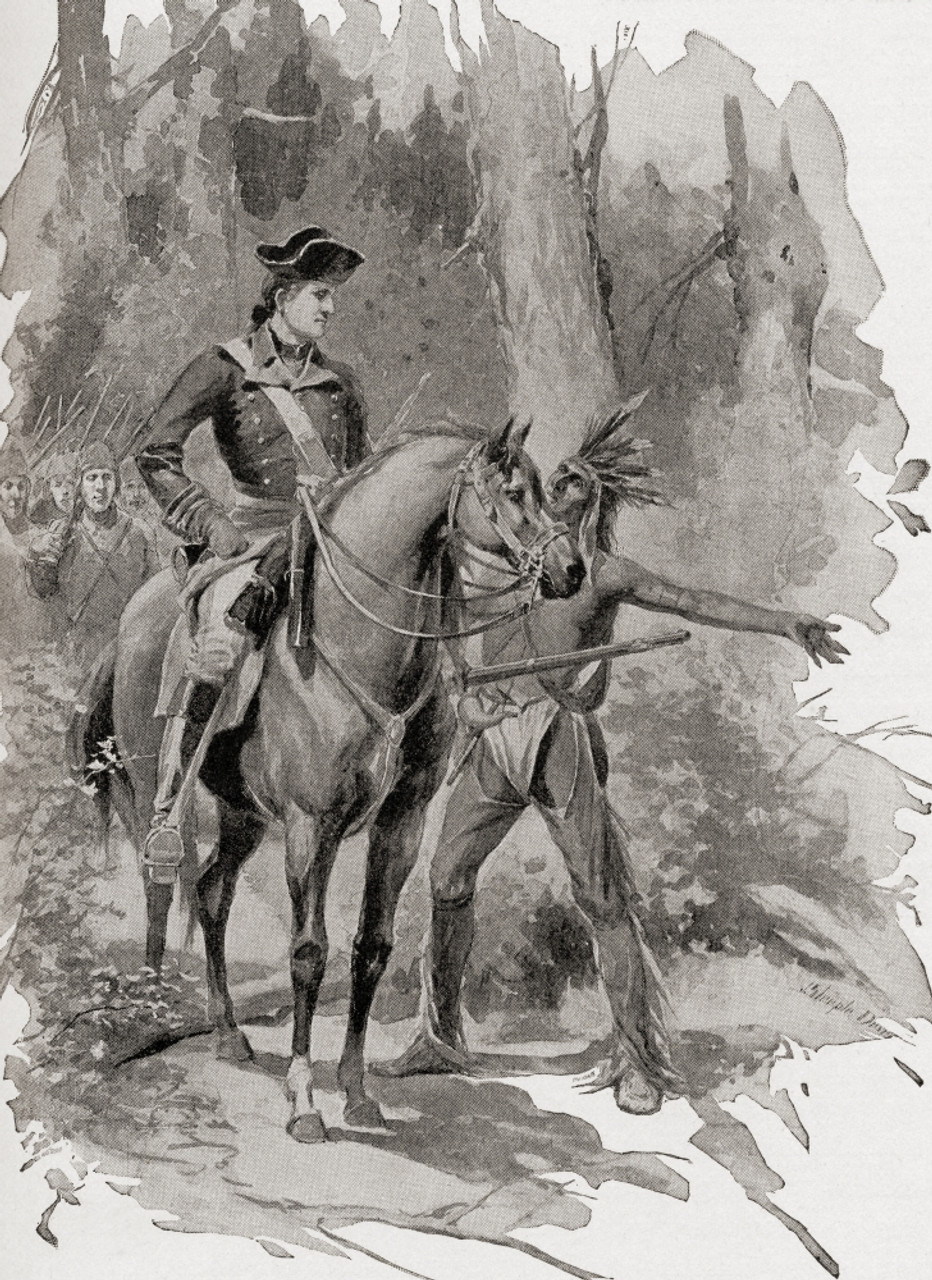
“Notwithstanding the urgency of my business, I have been detained three days in this place by an occurrence truly agreeable. I have had the happiness of seeing Captain Michael Cresap marching at the head of a formidable company of upwards of 130 men, form the mountains and backwoods, painted like Indians, armed with tomahawks and rifles and dressed in hunting shirts and moccasins, and though some of them had travelled near eight hundred miles from the banks of the Ohio, they seemed to walk light an easy and not with less spirit than at the first hour of their march. Health and vigour, after what they had undergone, declared them to be intimate with hardships and familiar with danger. Joy and satisfaction, were visible in the crowd that met them. Had Lord North been present, and been assured that the brave leader could raise thousands of such to defend his country, what think you, would not the hatchet and block had intruded upon his mind? I had an opportunity of attending the Captain during his stay in Town, and watched the behavior of his men, and the manner in which he treated them; for it seems that all who go out to war under him do not only pay the most willing obedience to him as their commander, but in every instance of distress look up to him as their friend or father. A great part of his time was spent in listening to and relieving their wants, without any apparent sense of fatigue and trouble. When complaints were before him he determined with kindness and spirit, and on every occasion condescended to please without losing is dignity.”
esterday the Company were supplied with a small quantity of powder from the magazine, which wanted airing, and was not good for rifles ; in the evening, however, they were drawn out to show the gentlemen of the town their dexterity at shooting. A clap board, with a mark the size of a dollar, was put up ; they began to fire at it off band, and the bystanders were surprised, few shots being made that were not close to or in the paper. When they had shot for a time in this way, some lay on their backs, some on their breast or side, others ran twenty or thirty steps, and firing, appeared to be equally certain of the mark. With this performance the company were more than satisfied, when a young man took up a board in his hand, not by the end, but by the side, and holding it up, his brother walked to the distance, and very coolly shot into the white ; laying down bis rifle, he took the board, and holding it as it was held before, the second brother shot as the former had done. By this exercise I was more astonished than pleased. But will you believe me, when I tell you, that one of the men took the board, and placing it between hia legs, stood with his back to the tree while another drove the centre. What wonld a regular army of considerable strength in the forests of America do with one thousand of these men, who want nothing to preserve their health and courage but water from the spring, with a little parched corn, with what they can easily procure in hunting ; and who wrapped in their blankets, in the damp of night, would choose the shade of a tree for their covering, and the earth for their bed.”
Although a depiction of the 1st Maryland at Guilford C.H in 1781 some of these men are dressed similar to the riflemen mentioned above (wikipedia)
*Account is in “Papers Relating Chiefly To the Maryland Line During the Revolution” Thomas Balch, editor. pgs. 6-7.
Emerging Revolutionary War welcomes guest historian Evan Portman
Overlooking the Grand Parade at Valley Forge National Historical Park is a statue almost as solid as the man it portrays. Baron von Steuben helped transform the American army into an effective and efficient fighting force in the winter of 1777-1778, but he also aided the country nearly a century and a half later. Yes, Baron von Steuben helped the United States through World War I—or at least the social turmoil on the home front.
Friedrich Wilhelm August Heinrich Ferdinand Steuben was born in Prussia (modern day Germany) in 1730 and served in the Prussian army through the Seven Years’ War. By 1775, Steuben had accrued a considerable amount of debt (despite his stature within the aristocracy), so he sought a foreign military appointment. Failing to catch the eye of the British, French, or Austrians, the Baron set his sights on the fledgling American government. Congress arranged for Steuben to be paid, depending on the outcome of the war, and sent him to the winter encampment at Valley Forge. There, he began drilling the Continental army and instituted better hygiene and sanitation practices. He also wrote a drill manual, which he published in 1779 as Regulations for the Order and Discipline of the Troops of the United States. After the encampment at Valley Forge, Steuben participated in the Southern Campaign of the Revolutionary War. After the Siege of Yorktown, Congress awarded the Baron a tract of land in New York where he died in 1794.
On this date 167 years ago, the infamous siege of Fort William Henry raged along the southern shore of Lake George, New York. For nearly a week the British and Colonial garrison inside the fort and outside its walls had endured through a near hopeless situation. Casualties had mounted, guns and mortars had burst from incessant firing, and the French siege lines had crawled to within 150 yards of the northwest bastion. Reinforcements were not coming to relieve the defenders. The following day, Lieutenant Colonel George Monro had little choice but to surrender his force under honorable terms to the French commander, General Montcalm. On August 10, the column marched out of the fort and nearby entrenched camp in route to Fort Edward. French-allied Indians fell upon the soldiers, and the women and children who accompanied them, and the “massacre” of Fort William Henry ensued.
The following letter with news relating to the siege, was written to George Washington on August 8, 1757. The author was Beverley Robinson, a Virginian who through marriage inherited a large swath of land in the Hudson Highlands of New York. During the Revolution, Robinson remained loyal to the Crown and was made colonel of the Loyal American Regiment in 1777. He was directly involved in the plot to turn Benedict Arnold. Through reasons not clear, Robinson and Washington became acquainted enough beforehand that during the French and Indian War, the former wrote the young Virginia soldier frequently.
“New York 8th Augt 1757
Dr Sir
The inclosed Lettrs came to my hands Yesterday by a Vassill from Halifax, they will I suppose give you all the News from that Quarter. Except the Arriva⟨l of⟩ the Highlanders wh. has been since they were wrote, all well and in good Order Lord Loudoun had not Left Halifax a fortnight ago.
we are now under the greatest apprehensions for fort Wm Henry having Certain Accots that it is Besieged by a Large Body of French & Indians & Mr Mont Calm himself at the head of them. a fryday Last the Express came away from fort Edward & they were then Very hotly Engaged—our Liut. Governer went up Last week to forward the Militia. Genl [William] Johnson was gone up with two thousand Militia & 100 Indians, and the Militia was going up from the adjacent Counties. Col. Young Command at Wm Henry he had Just got into that place with a Reinforcement of 1000 men. we hope the Best. I am Dr Sir Yr Humble Sert
[1] “To George Washington from Beverley Robinson, 8 August 1757,” Founders Online, National Archives, https://founders.archives.gov/documents/Washington/02-04-02-0239. [Original source: The Papers of George Washington, Colonial Series, vol. 4, 9 November 1756 – 24 October 1757, ed. W. W. Abbot. Charlottesville: University Press of Virginia, 1984, pp. 367–368.]
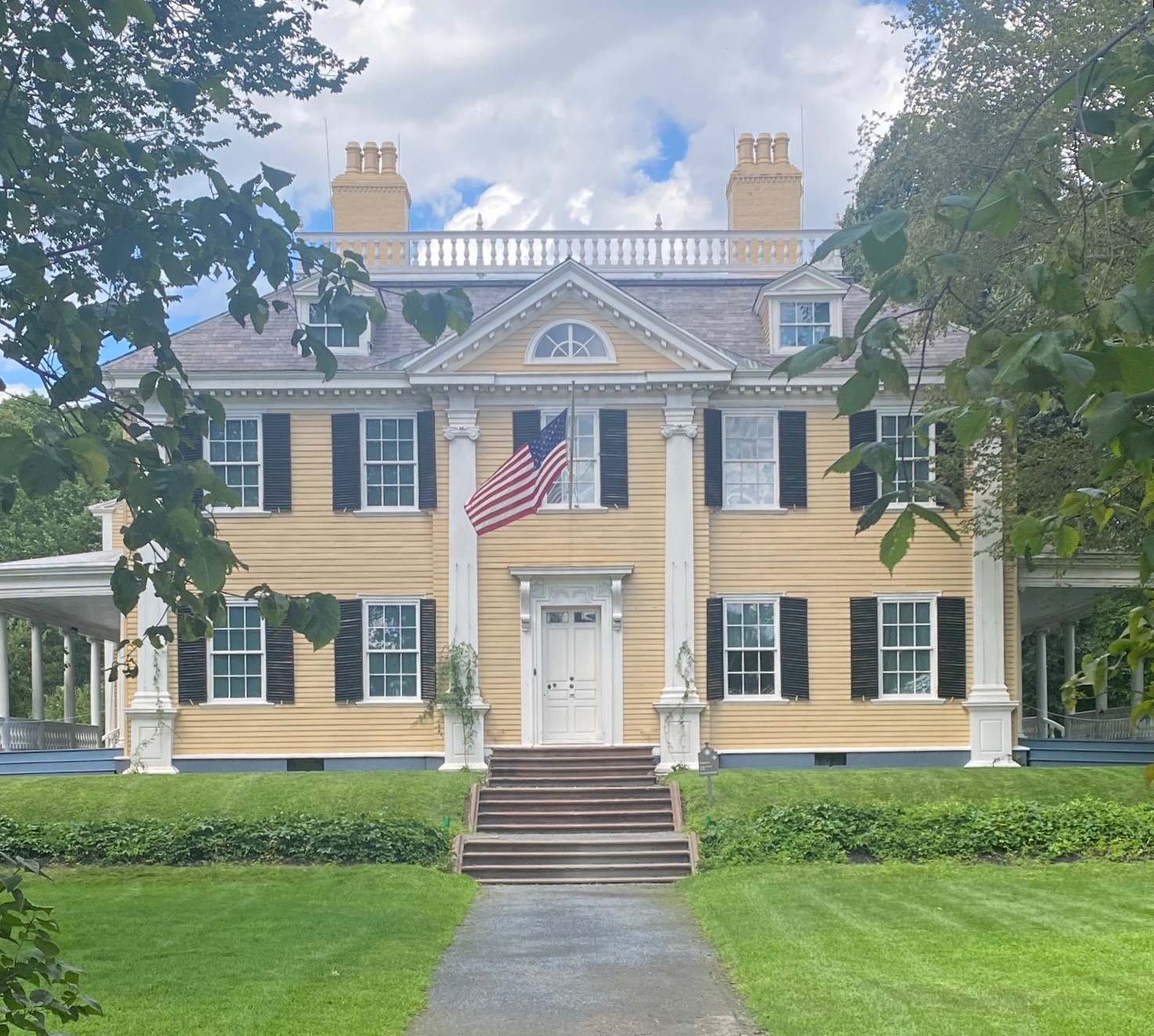
On June 15, 1775, George Washington was appointed by the Second Continental Congress as commander-in-chief of the Continental Army. Approximately a month later he rode into Cambridge, Massachusetts, to the house below, to assume command over that army. After he met the officers at Jonathan Hastings House near Harvard College campus, learning about operations and the siege. He was then directed toward an opulent residence standing about a mile away. Named the Vassall-Craigie-Longfellow residence, this place would become the focal point of the effort against the British in Boston. Washington moved in. He spent the next nine months in residence, overseeing the Siege of Boston and the British evacuation.
From this house, Washington began putting his footprints on the army and met some of the officers that became instrumental in securing American independence. This included the Rhode Islander Nathanael Greene and Massachusetts native and bookseller Henry Knox among others. Martha Washington, in December 1775, traveled over 440 miles from Mount Vernon to Cambridge to winter with her husband in this house. The making of Washington, the general, started here.
The power of place.
Today, the house preserved by the National Park Service today can be toured, click here for information.
On this date in 1754, a young George Washington penned the letter below to Thomas Cresap explaining the difficulties of procuring supplies for the Virginian’s expedition to the Ohio River Valley. His main objective was to fortify the land at the confluence of the Allegheny, Monongahela, and Ohio Rivers – the “Forks of the Ohio.” The several hundred mile expedition would have to be made over treacherous terrain and through vast wildernesses, which meant a road needed to be cleared that could carry men, animals, and wagons. Years before, Cresap, while serving as an agent for the Ohio Company, had widened an old Indian trail leading to the west. Washington planned to utilize and improve this same route. That same day, he and 159 men under his command departed Winchester, Virginia, and began their march. Over a month later, they would fire the first shots of the French and Indian War at Jumonville Glen.
“Sir
The difficulty of getting Waggons has almost been insurmountable, we have found so much inconvenience attending it here in these roads that I am determined to carry all our provisions &c. out on horse back and should be glad if Capt. Trent with your Assistance would procure as many horses as possible against we arrive at Wills Creek that as little stoppage as possible may be made there. I have sent Wm Jenkins with 60 Yrds of Oznabrigs [Osnaburg] for Bags and hope you will be as expeditious as you can in getting them made and fill’d.
Majr Carlyle acquainted ⟨me⟩ that ⟨a number of kettles, tomhawks, best gun flints, and axes might be had⟩ from the Companys Store which we are much in ⟨want and s⟩hould be glad to have laid by ⟨for us, Hoes we sh⟩all also want, and several pair of Hand cuffs.
I hope all the Flower [flour] you have or can get you will save for this purpose and other provisions and necessary’s which you think will be of use (that may not occur to my memory at present) will be laid by till our Arrival which I expect will be at Job Pearsalls [20 miles from Wills Creek] abt Saturday night or Sunday next, at present I have nothing more to add than that I am Yr most Hble Servt
[i] “From George Washington to Thomas Cresap, 18 April 1754,” Founders Online, National Archives, https://founders.archives.gov/documents/Washington/02-01-02-0042. [Original source: The Papers of George Washington, Colonial Series, vol. 1, 7 July 1748 – 14 August 1755, ed. W. W. Abbot. Charlottesville: University Press of Virginia, 1983, pp. 82–83.]
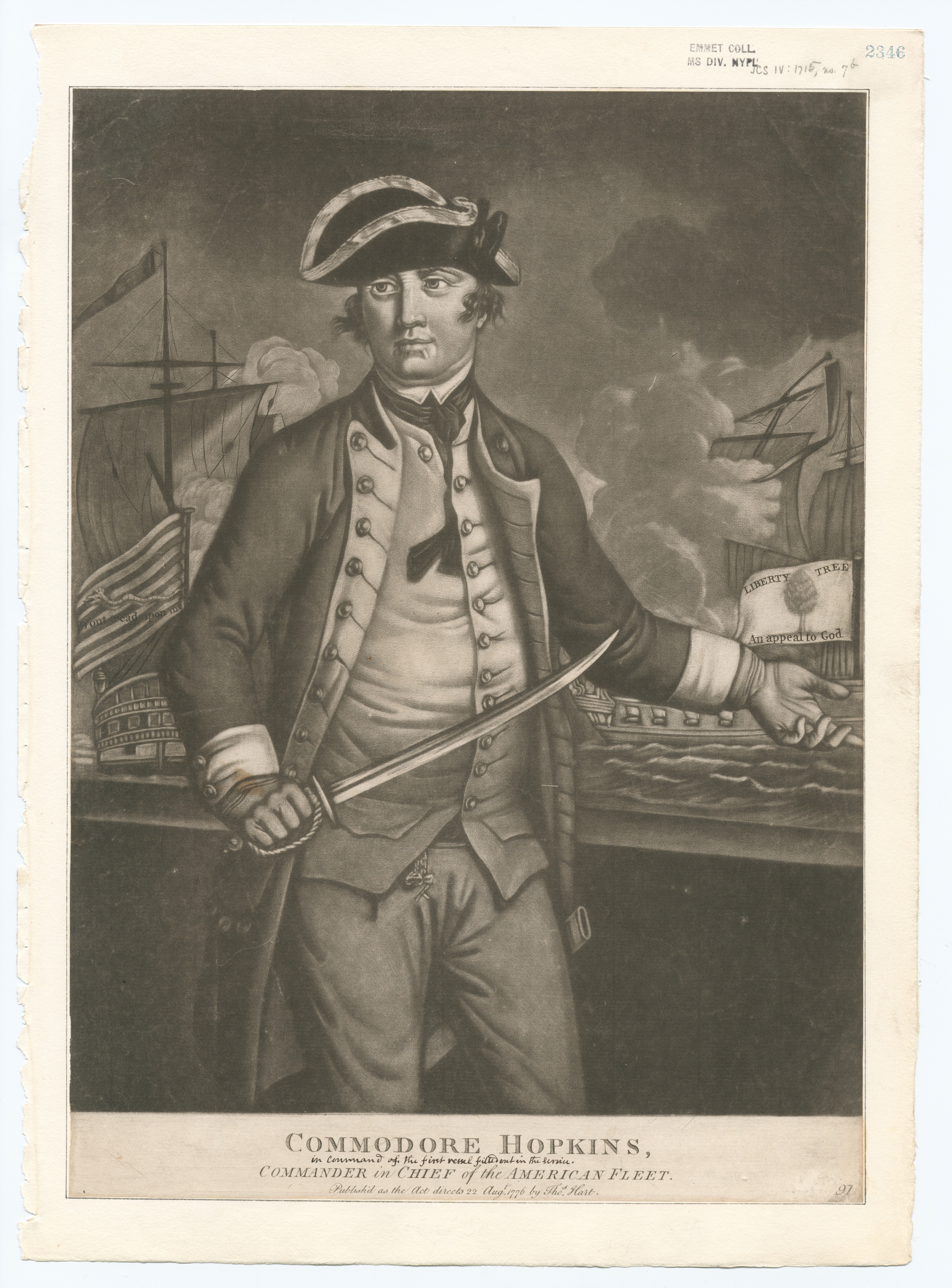
In March, 1776 Commodore Esek Hopkins led the bulk of the Continental Navy on a raid to the Bahamas, where it occupied the town of New Providence on Nassau Island for two weeks. Hopkins and his captains were drawn by a report of gunpowder stored in the town, which the patriot cause desperately needed.[1] Unfortunately for Hopkins, the colony’s governor had spirited away some 150 barrels the night before the American flotilla’s arrival. Not all was lost as the Marines quickly demanded and received the surrender of two small forts defending the town and its harbor. With those in hand, Hopkins and his men quickly got to work removing artillery, military stores, and other useful supplies.
While the American Marines and sailors managed to recover just 24 casks of powder, their haul in sizeable artillery pieces and mortars was impressive: 88 cannon ranging from 9- to 36-pounders; 15 mortars from 4-11 inches; 5,458 shells; 11,071 roundshot; 165 chain & double shot, plus fuses, rams, sponges, carriage trucks, mortar beds, copper hoops, and various stores not required for artillery.[2] It was a boon to be sure. The curious part of Hopkins’ inventory of captured war material, however, is that he sent it to Connecticut Governor Jonathan Trumbull, not a representative of the Naval Committee that had issued his orders. To John Hancock, president of the Continental Congress, he sent a report of his mission, but only mentioned “I have taken all the Stores onboard the fleet.”[3] Indeed, his report of the armaments aboard the British schooner Hawke, which the fleet captured on its return to American waters, was more complete. It took another day, until April 9, for Hopkins to forward the inventory of seized cannon. Congress merely resolved that an extract of his letter should be published for delegates to peruse.[4] Perhaps inadvertently, Hopkins exacerbated regional political conflicts and undermined his own command.
Approximately 5,000 African-American or Black soldiers fought for the patriot cause in the American Revolution. Some joined state militias, some joined the Continental Army, and some sailed the seas with the fledgling navies of the United Colonies. William and Benjamin Frank were two of those 5,000. Both were free Blacks from Rhode Island who enlisted in the 2nd Rhode Island Regiment in 1777. Their father was a veteran of the French and Indian War, so the family was well-established in military tradition.
The 2nd Rhode Island fought and defended Fort Mercer during the campaigns of 1777 and survived harsh winters at Valley Forge and Morristown before returning to Rhode Island to literally defend the hearth and home from the British. Author and historian Dr. Shirley L. Green, adjunct professor at the University of Toledo, a 26-year veteran of the law enforcement community, and current Director of the Toledo Police Museum in Ohio, “takes the reader on a journey based on her family’s history, rooted in its oral tradition.”
Her book Revolutionary Blacks, Discovering the Frank Brothers, Freeborn Men of Color, Soldiers of Independence was published by Westholme Publishing in November 2023.
Furthermore, Dr. Green puts “together the pieces of the puzzle through archival research, interviews, and DNA evidence” to authenticate and expand the family history. The end result is a very readable and needed addition to the historiography of the American Revolution. Her ability to tell “a complex account of Black life during the Revolutionary Era demonstrates that free men of color…demonstrates that free men of color shared with white soldiers the desire to improve their condition in life and to maintain their families safely in postcolonial North America.”
Emerging Revolutionary War looks forward to an engaging and informative discussion with Dr. Green, this Sunday, at 7 p.m. EDT on our Facebook page. We hope you can tune in for this next episode of Emerging Revolutionary War’s “Rev War Revelry.”
For more information about the book and to order a copy, click here.
If not for his connections to some of the most famous commanders and events of 18th-century military history, British general Charles O’Hara might only get a passing mention in many history books. He still hardly gets more than that.
Charles O’Hara
Charles O’Hara came into this world unceremoniously as the illegitimate son of James O’Hara, a British baron. The younger O’Hara cut his teeth in military matters at the young age of 12 in the 3rd Dragoons before receiving an officer’s appointment in the Coldstream Guards. He served in an officer’s capacity in Germany, Portugal (with Charles Lee), and Africa. O’Hara was strict but liked by the men who served under him.
O’Hara’s years of military service brought him to North America in July 1778. Lieutenant General Henry Clinton appointed him to command the troops at Sandy Hook, New Jersey, to protect New York City because of his engineering skills and a recommendation from Admiral Richard Howe. Two years later, O’Hara wound up under the command of Lord Charles Cornwallis in the Southern theater. He performed ably there, leading the pursuit of Cornwallis’ army toward the Dan River in early 1781 and leading the British counterattack at the Battle of Guilford Courthouse. O’Hara led from the front and received two wounds to show for it. His nephew died during the battle.
At Yorktown, O’Hara drew the duty of surrendering Cornwallis’ army to General George Washington and Comte de Rochambeau. As the surrendering British columns approached the Allied lines, O’Hara asked to see Rochambeau. Whether this was a slight against Washington or not is unclear, but Rochambeau referred him to Washington. O’Hara apologized to Washington and explained why Cornwalls was not in attendance. Then, O’Hara handed Cornwallis’ sword to Washington, who refused it and passed O’Hara along to Benjamin Lincoln. O’Hara handed the sword to Lincoln. He looked it over, held it for a brief moment, and returned it to O’Hara. The surrender of the British army then began.
After dining with Washington following the surrender proceedings at Yorktown, O’Hara became Washington’s prisoner until receiving his exchange on February 9, 1782. He returned to England with Cornwallis’ praise and a promotion to major general. Back home in England, O’Hara fell into hard financial times from a gambling debt and ran away from them to mainland Europe. In stepped his old friend and commander Charles Cornwallis, who helped O’Hara offset the debts.
O’Hara received another promotion in 1792 to lieutenant general and lieutenant governor of Gibraltar, a post he long desired. There, misfortune found him once more when he faced the young Napoleon Bonaparte on the battlefield of Toulon. On November 23, 1793, the defeated O’Hara surrendered to Napoleon.
Labeled an insurrectionist, O’Hara found himself in prison in Luxembourg. During his nearly two years there, he befriended American Thomas Paine until his exchange in August 1795. Ironically, the man exchanged for him was the Comte de Rochambeau. He once again took the post of Governor of Gibraltar, where he died in 1802 from the effects of his war wounds suffered two decades earlier.
Despite taking part in one of the most famous events of the Revolutionary War, O’Hara has faded into general obscurity even though he bears the distinction of being the only person to surrender to both Washington and Napoleon.
He is featured regularly on the screen in The Patriot, but most people likely do not even know the character’s name or backstory. There is plenty more to be told in his story.
“Given the order to defend the American withdrawal from Long Island, the Maryland Line saved the Continental Army from annihilation in the first major battle of the war.” wrote historian Ryan Polk.
Tench Tilghman, staff officer to George Washington and a native Marylander wrote about his fellow soldiers, “bore the palm…by behaving with as much Regularity as possible.”
Furthermore, if you Google “Battle of Guilford Court House” the image used by Wikipedia depicts an artist’s rendition of the 1st Maryland defending Nathanael Greene’s last line during the March 1781 engagement. The particular image is below.
The Continental Maryland Line was one of the preeminent stalwarts of the American army, both in the northern and southern theaters of the war. Join Emerging Revolutionary War historians in a discussion about the men from the Old Line State and their military acumen during the American Revolutionary War. The discussion will also highlight their memory and memorialization. We hope you can join us Sunday at 7 p.m. EST on the Facebook page of Emerging Revolutionary War.
The Battle of Bunker Hill is routinely mentioned in the pantheon of memorable American military victories. Although myths of the engagement have obscured some of the history, much like the smoke of battle, the patriot victory on June 17, 1775, was another pivotal moment in the early stages of what became the American Revolutionary War.
To discuss the engagement, ramifications, and interpretation of the battle, Emerging Revolutionary War welcomes historian Dr. Paul Douglas Lockhart, Professor of History at Wright State and author of “The Whites of Their Eyes, Bunker Hill, the First American Army, and the Emergence of George Washington.” A full biography of Dr. Lockhart, including his other works, is at the bottom of this post.
As a teaser, this may be the first time in “Rev War Revelry” history that we mention Artemas Ward, who according to Dr. Lockhart is the “unsung hero of the battle (and indeed of 1775).” Come hear why! And full disclosure, I agree.
We hope you can join us on Sunday, January 21 at 7 p.m. EDT on Emerging Revolutionary War’s Facebook page for the next installment of the popular “Rev War Revelry.” Be ready to ask questions as you sip your favorite beverage during this historian happy hour.
Biography of Dr. Lockhart
“Paul Douglas Lockhart is Professor of History at Wright State University in Dayton, Ohio, where he has taught since earning his PhD in 1989. A native of Poughkeepsie, New York, Lockhart completed the PhD at Purdue University, where he studied military history with the late Gunther Rothenberg, the renowned Napoleonic scholar, and early modern European history with Charles Ingrao. He has seven single-author books to his credit. Four of them deal with the history of Scandinavia during the “Age of Greatness,” including Denmark, 1513-1660: The Rise and Decline of a Renaissance Monarchy, published by Oxford University Press in 2007. He is probably better known for his books on military history: The Drillmaster of Valley Forge: The Baron de Steuben and the Making of the American Army (2008), The Whites of Their Eyes: Bunker Hill, The First American Army, and the Emergence of George Washington (2011), and most recently his study of the parallel evolution of warfare and firearms: Firepower: How Weapons Shaped Warfare (2021). Wright State has awarded him the Brage Golding Distinguished Professorship and the Trustees’ Award for Faculty Excellence, the University’s highest academic honor. The Ohio Academy of History named him Distinguished Historian for 2020-21, and in 2021 he was elected to membership in The Royal Society for Danish History for his contributions to the history of Denmark, an honor rarely accorded to foreigners. He lives in Centerville, Ohio, with his family.”






 Emerging Revolutionary War Era