There are arguably many moments along the road towards war with England that greatly shaped that road’s trajectory. Perhaps among the top contenders on that list would be the Boston Tea Party. Join historian Benjamin Carp and ERW’s Dan Welch as we dig in with the author of one of the best books on that pivotal moment. Dr. Benjamin L. Carp is the author of The Great New York Fire of 1776: A Lost Story of the American Revolution, and Defiance of the Patriots: The Boston Tea Party and the Making of America (2010), which won the triennial Society of the Cincinnati Cox Book Prize in 2013; and Rebels Rising: Cities and the American Revolution (2007). His book, Defiance of the Patriots, will be the focus of Sunday’s book chat.
With Richard D. Brown, he co-edited Major Problems in the Era of the American Revolution, 1760-1791: Documents and Essays, 3rd ed. (2014). He has written about nationalism, firefighters, Benjamin Franklin, and Quaker merchants in Charleston. He has also written for Colonial Williamsburg, the Wall Street Journal and the Washington Post. He previously taught at the University of Edinburgh and Tufts University. He was born and raised in New York State and each of his parents earned two CUNY degrees. See you Sunday at 7 p.m. EDT on Emerging Revolutionary War’s Facebook page!
Emerging Revolutionary War welcomes a guest post from historian Keith J. Muchowski. Keith is a librarian and professor at New York City College of Technology (CUNY) in Brooklyn. He blogs at thestrawfoot.com.
The plaque dedicated King Juan Carlos I in June 1976 today tucked in a corner of the visitor center. Courtesy Author
King Juan Carlos I arrived in Brooklyn’s Fort Greene Park on Saturday June 5, 1976 to great fanfare. The thirty-eight-year-old monarch had ascended to the Spanish throne just seven months previously, two days after the death of Francisco Franco. The new leader was determined to reform his nation after three and a half decades of strongman rule. Juan Carlos I’s ancestor, King Carlos III, had helped the colonists achieved their independence nearly two centuries previously with his supply of money, matériel, and men. Many of those Spaniards made the ultimate sacrifice; well over one hundred of them alone perished in British prison ships moored off Brooklyn Wallabout Bay during the war.[i] Now King Juan Carlos I was in the outer borough to recognize them, dedicate a tablet to his fallen countrymen, and help his American hosts celebrate the bicentennial of their independence. The entombed Spaniards were among the over 11,500 men commemorated by the Prison Ship Martyrs Monument. The king’s visit in the mid-1970s was the latest in a series of public commemorations of the prison ship dead dating back over a century and a half. Some of the institutions that did so much to recognize the martyrs, such as the Society of St. Tammany, are today long gone. Others however very much remain. The Society of Old Brooklynites, a civic organization founded in 1880 when Brooklyn was still an independent municipality, has been holding events since the late nineteenth century.
Emerging Revolutionary War welcomes back guest historian Kate Bitely.
In the heart of Fredericksburg, Virginia, you will find a well-preserved, Georgian-style home that once belonged to Betty Washington Lewis, the sister of George Washington. Historic Kenmore, as the home is known today, was constructed in the 1770s and originally sat on 861 acres near downtown Fredericksburg. Today, the historic house museum is open for daily tours where guests can explore the gardens, the main living floor of the home, several historic structures on the priority, and a visitor center filled with riveting artifacts and information.
Nearly 290 years ago, Betty Washington was born at Pope’s Creek in Westmoreland County, Virginia. As a young child, she lived in a few properties owned by the Washington family before relocating to Ferry Farm, located in Stafford County, Virginia, where Betty, George and their siblings grew up. On February 22, 1750, Betty married Fielding Lewis, a widowed distant cousin, and a father of two young children. In 1752, the family purchased 1300 acres in the Fredericksburg area and allocated a portion of the land as the future site for their home Millbrook, which was eventually renamed to Kenmore in the 1800’s. In total, Betty and Fielding welcomed eleven children, but only six survived to adulthood.
Fielding Lewis was a well-known member of his community. He built his wealth initially as a merchant, but was later elected as a member of the House of Burgesses and served as a colonel in the Revolutionary War. During the war, however, Lewis used his finances to personally pay for munitions and supplies for Patriot troops which ultimately drained much of the family’s resources.
The Lewis family were staunch Patriots. In 1775, when the Lewis’s were moving into their home, the spirit of independence was strong throughout the colonies. Given the Washington’s status, heritage and devotion to service, Betty and her family would become one of the biggest supporters for the Patriot cause, willing to risk their home, finances, reputation, and their safety in favor of breaking away from England. The impressive residence served as a visual representation of their wealth, which became significantly more important during the Revolutionary War.
“The Shot Heard Round the World” on April 19, 1775, put the American colonies into a fever pitch and a war footing, but 18th-century travel limitations naturally caused that word to spread slowly. It did not reach the town of Mecklenburg, in Berkeley County, Virginia (now Shepherdstown, in Jefferson County, West Virginia) for 21 days. On May 10, Mecklenburg’s citizens learned of the fights between colonists and British soldiers at Lexington and Concord. Coupled with news of Virginia royal governor Lord Dunmore’s removal of powder from the magazine in Williamsburg, Mecklenburg’s citizens prepared to offer whatever aid they could to their fellow beleaguered colonists.
The rallying point for the Beeline March
The militia in Mecklenburg strapped on their accouterments and began to drill. On June 10, the drilling militia was welcomed to the property of Colonel William Morgan, just outside town, for a barbecue. Songs were sung and all those present made a pledge that they would return to the same spot in Morgan’s Grove fifty years from that day.
Following the patriotic fanfare, the men returned to drilling, wondering if they might have the chance to face the British. A decision made in far-off Philadelphia soon promised Berkeley’s militiamen that chance. On June 14, the Continental Congress declared that “six companies of expert riflemen, be immediately raised in Pennsylvania, two in Maryland, and two in Virginia.” Once formed and equipped, “each company…shall march and join the army near Boston, to be there employed as light infantry, under the command of the chief Officer in that army.”
The Virginia companies went to Daniel Morgan, who organized his company in Winchester, and Hugh Stephenson, the leader of the company rendezvousing at Mecklenburg. Joining soldiers signed one-year enlistments. Henry Bedinger, one of Stephenson’s men, recorded that “none were received but young men of Character, and of sufficient property to Clothe themselves completely, find their own arms, and accoutrements, that is, an approved Rifle, handsome shot pouch, and powder-horn, blanket, with such decent clothing as should be prescribed.” It took less than seven days to raise each company to the strength of 100 men. Only the delay in getting enough rifles to arm the entire Mecklenburg company prevented them from leaving immediately after filling the ranks.
Once mustered, Stephenson and Morgan agreed to meet in Frederick, Maryland, and march to Boston together. On July 15, Morgan’s men marched first, stealing a step on the Mecklenburg men, who left Morgan’s Grove on July 17. “Morgan having the start we used every exertion to overhaul him, in Vain, altho’ we marched (always in single file) from 30 to 36 miles a number of days,” said Bedinger.
Food and cheering citizens greeted Stephenson’s men along the march and kept their marching feet moving at the blistering pace needed to catch Morgan. Only two men failed to make the entire march (one was court-martialed, and the other was accidentally wounded). On August 11, after a march of over 500 miles in 25 days and just behind Morgan’s men, Stephenson’s company halted in front of General George Washington in Cambridge. When the Mecklenburg riflemen saw the general, they “presented their arms to him as he slowly rode by us looking attentively and affectionately at the soldiers from his native state. When he shook hands with our captain, it was said they both shed tears.”
Stephenson’s Company reporting to General Washington at Cambridge (My Ride to the Barbecue)
The march has gone down in history as the Beeline March due to the quick and direct nature of the expedition to augment the Continental forces in front of Boston. Fifty years later, the pledge made on June 10, 1775, was kept, though the numbers of Stephenson’s company were considerably smaller. Five decades after the march, only five participants still lived; just two returned to Morgan’s Grove to commemorate the feat. One of them was Michael Bedinger, who recorded his experiences in the Beeline March. At the anniversary ceremony, he sang “two patriotic songs…the very same that had been sung at that spot fifty years before.”
Today, two markers commemorate the Beeline March’s genesis. In Morgan’s Grove Park, a marker dedicated in 1988 marks the “Shepherdstown Rally Point” (Mecklenburg was later renamed Shepherdstown). Down the road from the park in Elmwood Cemetery, a 1932 monument erected by the Daughters of the American Revolution sits with the names of the commissioned and non-commissioned officers of Stephenson’s company.
For a burgeoning armed force that was seeking to stand up to one of the world’s most powerful military forces, the Beeline March showed the spirit of the American soldier in the early days of the Revolutionary War.
Parson Weems’ Fable; by Grant Wood, Amon Carter Museum of American Art, Fort Worth, Texas
George Washington’s lifetime family associations, primarily his Ball family relations, were relied on byWashington’s first biographer Parson Weems. James Bish’s new book “I Can’t Tell A Lie” looks into the Washington and Ball family associations, along with Weems’ family associations. Relying on these close associations, he identifies the sources for Weems’ many anecdotes regarding Washington. Mr Bish will also focus on the many Revolutionary War connections including The Prayer at Valley Forge, Dr James Craik, Col. William Grayson, John Cadwalader, Henry Lee II and Henry Lee lll.
Be sure to grab a drink, join us to learn a new theory about the Cherry Tree, Washington’s Prayer at Valley Forge and other Parson Weems’ anecdotes, in this interesting work about Parson Mason Weems and George Washington.
Young George Washington’s performance in the French and Indian War is largely viewed as one of failure and recklessness. His actions in the Ohio River Valley ignited a conflict in North America that in turn lit the world ablaze. He could boast of no great military laurels, other than that he had emerged unscathed from the bloody battle of the Monongahela, and that he had commanded colonial provincials in Gen. John Forbes’ successful campaign against Fort Duquesne. He left military service following the latter event, with his hopes of receiving a commission in His Majesty’s Army worthy of his merit dashed years before.
“Young George Washington” by Pamela Patrick White, White Historic Art (whitehistoricart.com)
However, one aspect of Washington’s service in the French and Indian War has been widely neglected. The commander of the Virginia Regiment was tasked with defending the western frontier from enemy raiding parties. It was an unenviable position that he tackled with limited resources. It was during this period that Washington began to develop the leadership qualities that would inspire others to follow him into the depths of Hell some twenty years later. On the last day of 1758, as Washington prepared to pursue a life outside of military greatness, the officers of the Virginia Regiment drew-up a heartfelt petition to urge the now 26 year-old colonel they had grown to admire to rescind his resignation. Below is that document:
“To George Washington Esqr. Collo. of the Virginia Regiment & Commander of all the Virginia Forces The humble Address of the Officers of the Virginia Regiment
Fort Loudoun, Dec. 31st 1758
Sir,
We your most obedient and affectionate Officers, beg Leave to express our great Concern, at the disagreeable News we h⟨ave received⟩ of your Determination to resign the Command of that Corps, in which we have under you long ⟨served⟩.
The ⟨happine⟩ss we have enjoy’d and the Honor we have acquir’d, together with the m⟨utua⟩l Regard that has always subsisted between you and your Off⟨icers,⟩ have implanted so sensible an Affection in the Minds of us all, that we cannot be silent at this critical Occasion.
In our earliest Infancy you took us under your Tuition, train’d us up in the Practice of that Discipline which alone can constitute good Troops, from ⟨the⟩ punctual Observance of which you never suffer’d the least Deviation.
Your steady adherance to impartial Justice, your quick Discernment and invarable Regard to Merit, wisely intended to inculcate those genuine Sentiments, of true Honor and Passion for Glory, from which the great military Atcheivements have been deriv’d, first heighten’d our natural Emulation, and our Desire to excel. How much we improv’d by those Regulations, and your own Example, with what Alacrity we have hitherto discharg’d our Duty, with what Chearfulness we have encounter’d the severest Toils, especially while under your particular Directions, we submit to yourself, and flatter ourselves, that we have in a great Measure answer’d your Expectations.
Judge then, how sensibly we must be Affected with the loss of such an excellent Commander, such a sincere Friend, and so affable a Companion. How rare is it to find those amiable Qualifications blended together in one Man? How great the Loss of such a Man? Adieu to that Superiority, which the Enemy have granted us over other Troops, and which even the Regulars and Provincials have done us the Honor publicly to acknowledge! Adieu to that strict Discipline and order, which you have always maintain’d! Adieu to that happy Union and Harmony, which has been our principal Cement!
It gives us an additional Sorrow, when we reflect, to find, our unhappy Country will receive a loss, no less irreparable, than ourselves. Where will it meet a Man so experienc’d in military Affairs? One so renown’d for Patriotism, Courage and Conduct? Who has so great knowledge of the Enemy we have to deal with? Who so well acquainted with their Situation & Strength? Who so much respected by the Soldiery? Who in short so able to support the military Character of Virginia?
Your approv’d Love to your King and Country, and your uncommon Perseverance in promoting the Honor and true Interest of the Service, convince us, that the most cogent Reasons only could induce you to quit it. Yet we with the greatest Deference, presume to entreat you to suspend those Thoughts for another Year, and to lead us on to assist in compleating the Glorious Work of extirpating our Enemies, towards which so considerable Advances have been already made. In you we place the most implicit Confidence. Your Presence only will cause a steady Firmness and Vigor to actuate in every Breast, despising the greatest Dangers, and thinking light of Toils and Hardships, while lead on by the Man we know and Love.
But if we must be so unhappy as to part, if the Exigencies of your Affairs force you to abandon Us, we beg it as our last Request that you will recommend some Person most capable to command, whose Military Knowledge, whose Honor, whose Conduct, and whose disinterested Principles we may depend upon.
Frankness, Sincerity, and a certain Openness of Soul, are the true Characteristics of an Officer, and we flatter ourselves that you do not think us capable of saying anything, contrary to the purest Dictates of our Minds. Fully persuaded of this, we beg Leave to assure you, that as you have hitherto been the actuating Soul of the whole Corps, we shall at all times pay the most invariable regard to your Will and Pleasure, and will always be happy to demonstrate by our Actions, with how much Respect and Esteem we are, Sir, Your most affectionate & most obedt humble Servants.”[i]
[i] “Address from the Officers of the Virginia Regiment, 31 December 1758,” Founders Online, National Archives, https://founders.archives.gov/documents/Washington/02-06-02-0147. [Original source: The Papers of George Washington, Colonial Series, vol. 6, 4 September 1758 – 26 December 1760, ed. W. W. Abbot. Charlottesville: University Press of Virginia, 1988, pp. 178–181.]
The Mary Ball Washington Monument and grave site, Fredericksburg, VA
Happy Mother’s Day to all the moms out there! In honor of Mother’s Day, Emerging Revolutionary War welcomes will be welcoming historians and staff from the Washington Heritage Museums to tonight’s Rev War Revelry. WHM manages and operates the home and grave site of Mary Ball Washington, the mother of George Washington located in Fredericksburg, VA.
The relationship between George Washington and his mother has been of interest in historians. Their relationship was complicated and much debated by Washington contemporaries and historians today. Mary never remarried when her husband passed (rare for the time period) and mostly lived on her own in Fredericksburg. She also was not afraid to complain about her lack of resources and once applying to the Virginia General Assembly for financial support (to much frustration from George Washington). We will cover many of the myths and interpretations of Mary and her relationship with her son.
So grab a drink and join us as we discuss Mary Ball Washington, her relationship with her son George and what the Washington Heritage Museums are doing today to interpret and preserve her story. Our revelry tonight is previously recorded so we could spend time with the mom’s in our life, but as always we will respond to any comments and questions posted.
Tell me I am not the only one that randomly goes on a car ride to a random town in their home state to just “see what is there?”
Regardless, that is what I decided to do on a sunny late April Sunday afternoon. I ended up in Rockville, Maryland. The town astride I-270 today was also on a major thoroughfare during both the 18th and 19th centuries that brought armies from the area, like General Edward Braddock’s in 1755 or General Jubal Early’s in 1864.
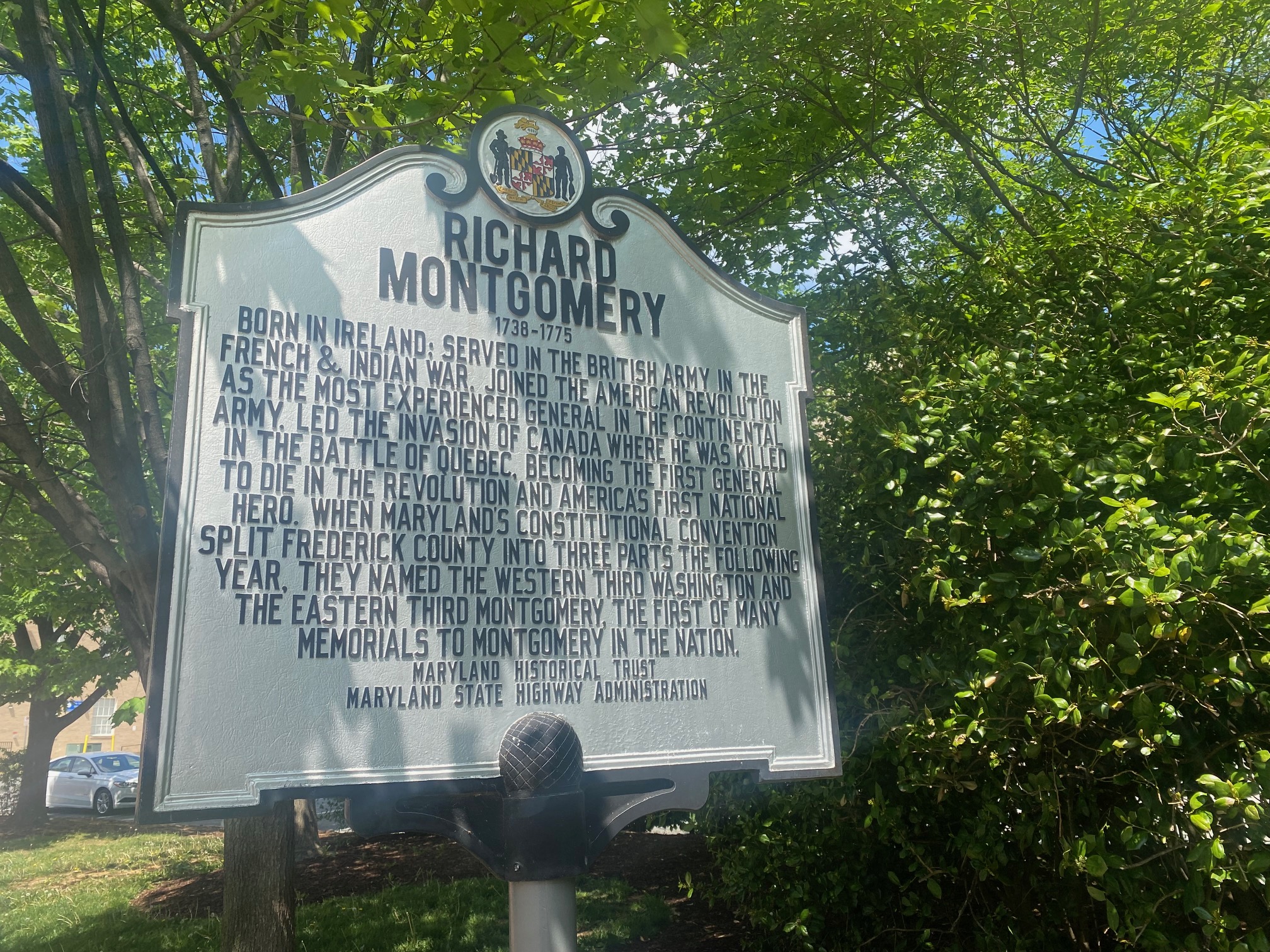
However, a different historical sign attracted my attention on this excursion.
I read the title and the first line, Richard Montgomery…Born in Ireland. Served..” Which was all I could read as I slowly drove by, since it is near the court house and county government buildings. Even though it was a Sunday still not wanting to speed through. So…Naturally, I pulled over, as evidenced by the vehicle you see in the background!
I knew Montgomery, as the sign reads, died at the Battle of Quebec in a futile attempt to take the city for the American cause. He was the first general–Continental–to die in the cause of American independence.
On September 6, 1776 Thomas Sprigg Wootton, who hailed from Rockville, introduced legislation in the Maryland Constitutional Convention to separate the Frederick County into three. The upper or most western half, to become Washington County, named in honor of George Washington and the lower half, or most eastern, to be named Montgomery, in honor of Richard Montgomery. The remaining middle portion would retain the name Frederick. This may be the first recorded instance in the rebellious British colonies of names of counties, towns, or cities that did not refer to something in British history or famous persons. Another act of defiance at the beginning of the American Revolution!
With a random Sunday excursion one never knows what one will find. History is all around us, beckoning to be explored.
Emerging Revolutionary War welcomes guest historian Christopher of The British-American Historian blog.
Almost two years after debating a joint French-American assailment of Lord Cornwallis’ precarious position in Yorktown, Virginia over Washington’s grand plan to recapture New York long after being swept from the city and its environs as independence was officially declared in 1776, the implacable Washington prepared to reenter New York in triumph.
Eight years after making New York the center of the British war effort in the American Revolution, the massive garrison was greatly reduced and preparing for its final retirement from the new nation. The new commander in chief of North America, Sir Guy Carleton, arrived in New York on May 5, 1782[1] to relieve Sir Henry Clinton. Carleton won accolades for holding Quebec City when the Continental Army struck during a late night blizzard, an accomplishment that was all the more vaunted now that the British were losing territory that did not include Canada. Carleton lost no time in notifying Washington of his arrival in an affable letter sent on May 7th, 1782 in which Carleton wrote “if the like pacific disposition should prevail in this country, both my inclination and duty will lead me to meet it with the most zealous concurrence”[2].
A notable disruption in the growing amity was the unresolved Asgill Affair. Exasperated with wanton assailments of loyalists in New Jersey, a prominent rebel militia commander named Joshua Huddy was plucked from the provost in New York by an American member of the Associated Loyalists[3]. The Associated Loyalists were presided over by William Franklin, the loyalist son of Benjamin who had endured arduous captivity before being exchanged[4]. In response to the wanton execution of Joshua Huddy, Washington ordered a British officer to await reprise. Charles Asgill was selected, but pleas from the French along with Washington’s honorable disposition prevailed and the captain was spared[5].
The city and Long Island were swarming with thousands of loyal “Refugees” who had fled from every rebellious colony to seek the king’s protection. Ranging from itinerant tenant farmers to some of the largest landlords in America such as Beverly Robinson and Frederick Philipse, Carleton’s task of evacuating the troops could not be fulfilled until such persons were safely resettled in the empire. While many of the men joined provincial regiments that saw combat in the south (playing a pivotal role defending Savannah and being routed at Kings Mountain) and performed prodigious woodcutting on Lloyd Neck for the insatiable demand for firewood[6], flocks of women and children crowded the city. A subset of the refugees were former slaves who had flocked to the British cause for the promise of freedom under Dunmore’s Proclamation and the Philipsburg Proclamation, a promise Washington would vigorously contest in negotiations.
Emerging Revolutionary War welcomes guest historian Werther Young.
I’m Too Sexy for My…Bavarian Fly
By Werther Young
Of all of the unique things that have managed to make it to the internet, a concise history of colonial men’s pants flies is surprisingly not one of them.
Our story begins in the Renaissance in, where else, France. King Henry III of France eschewed the old-fashioned dress and hose and embraced a new fashion, culottes, now known as “knee breeches.”
Henry III in his dress and hose
Henry III in his tony new culottes.
The fly of Henry’s pants was a simple affair, a rectangular panel sewn to the left side with buttonholes that buttoned over the right. This simple and practical design became known as the “French fly” and became almost universal in Western Europe over the next 60 years.
Ann Bonny the pirate, in French fly trousers, ca. 1721.
Over time, Ann Bonny’s “long” French fly was perfected into the “short” French fly. Anne’s fly extends from the inseam to the waistband. By merely sewing a few inches of the front seam together, the fly can be made shorter, removing a buttonhole and button or two.
These fly designs apparently did not reach into Eastern Europe, where presumably leather pants were as expensive as wool ones but lasted much longer, because they were never washed. Translating the French Fly into leather posed some problems, and so these leather pants had a different fly, essentially a hole in the center front with a panel buttoned over it that flipped or dropped up and down as necessary. This design caught on in the Alpine areas of central Europe, and especially in Bavaria under the label of “Lederhosen,” which is German for “leather pants.”
“Short” French Fly Breeches, ca. 1750.
The Bavarian fly migrated further north, as in the Deutsches Museum in Berlin can be found a pair of enlisted trousers from the mid-1700s, with a half drop front fly; that is, it opens only the right side. This is essentially a cheaper fly, because it needs only one button to close, and does the same thing.
By the middle 1700s, the French fly had been around for over 150 years, and someone in France started a different fashion (and outdoing the Huns) by putting the two -opening Bavarian fly on culottes, thus making the culottes “a la Bavarois,” French for “like the Bavarians.” This was runway level high fashion for the time, and quickly spread among the well to do as the latest thing, with a new name, the “drop front” or “fall front” fly. Unfortunately, translating the design from leather, which does not unravel, to fabric, which does, made the Bavarian fly extremely complicated and therefore expensive. This of course added to its cachet, so much so that by 1775, it had reached the aristocracy even in the backwater of Colonial America.
Lederhosen
Colonial Williamsburg has a fabulous collection of high-status men’s pants from the 18th century. A survey thereof shows the number of French flies waning into the 1770s, and the number of Bavarian drop front flies waxing beginning in 1775, reaching a height about 1800. Unfortunately, these are all very high-status garments, such as a pair of “button front breeches of cream-colored silk velvet, with repeat of small pink and green flowers self-covered buttons, those at knee embroidered with metallic silver thread. Silver galloon strap at knee.” But did the states and Continent really issue enlisted soldiers what amounts to hand made Givenchy trousers? Of course not.
The false idea that they did partially comes from a series of paintings done by Charles M. Lefferts in the early 1900s, later published as Uniforms of the Armies in the War of the American Revolution, 1775–1783. in 1926.
A Lefferts rendering of trousers a la Bavarois, 2d Maryland 1777.
Measuring this man’s height against the known length of his musket makes him about 6’4 inches tall, the height of actors Clint Walker, Chuck Connors, Clint Eastwood, and the average NBA basketball player. If you look below the point of his vest, he is wearing drop front pants over his massive thighs. Curiously, he is also wearing a 1760s style skirted vest and long regimental coat. Are we to believe that Maryland issued its men old fashioned vests and coats, but high fashion breeches? Since Lefferts was born in 1873, he had no first-hand knowledge of his subject, we must look to period images.
Alas, these are of little help. It is difficult to discern whether any of the men in period paintings are wearing French Fly pants, Bavarian drop front pants, or anything else. The most informative images, the von German drawings, are unfortunately from the side, and of no help.
Von German “American Soldier” New York Hist Soc.
Amerikanische Scharfschutz, Brown University
Since information is so scarce, we must turn to the other reason we believe that rev war soldiers wore drop front pants. Klinger’s Sketchbook ’76. Page 9 shows a pair of Bavarian drop front breeches, based on George Washington’s uniform in the Smithsonian, and Lt. Col. Tench Tilghman’s uniform from the Maryland Historical Society. This is odd, because Washington’s uniform is from the 1794, 15 years after the war and at the height of the drop front craze. Tilghman was the scion of a blue blood family, owned half of Baltimore, was an aide to Washington, and hobnobbed with Lafayette. Even if his uniform can be dated to the war years, it is not only a high-status uniform, but one of the highest status possible in America at the time; his not wearing Bavarian trousers would be of greater note. Neither are evidence that any of the 13 colonies nor the Continent paid to make their enlisted men such high fashion trousers.
On Sketchbook page11, Klinger bases his Bavarian drop front overalls on unspecified plates in “Bernard’s History of England” and the images above. While these may establish Bavarian drop front flies supplied by the King George, it certainly does not necessarily mean that the colonies were doing so.
Surprisingly, two pairs of enlisted overalls are known to exist, mistakenly labelled as “Pantaloons,” and residing in the Metropolitan Museum of Art’s Costume Department. These are exquisitely made, and probably military examples, but unfortunately European, and from 1793 and later.
No credible evidence exists that any of the 13 colonies nor the Continent issued its troops Bavarian drop front pants. This makes sense, as that design is difficult to make, does the exact same thing as the simple French fly, and fashionable pants do not really contribute much extra to Liberty. Additionally, with all but the highest status clothiers making French fly pants, retraining them to cut out and make the new design would seriously impede production, even assuming that patterns and training could be somehow provided from Georgia to Vermont at a time when the men could barely be supplied a musket or shirt. In the War of the Revolution, the colonists were by all indications wearing French fly breeches and overalls, not drop front ones a la Bavarois.







 Emerging Revolutionary War Era