Coming Soon: A Dear-Bought Victory: The Battle of Bunker Hill and the Siege of Boston 1775-1776

We’re excited to share one of the 2026 new releases in the Emerging Revolutionary War Series. Published by Savas Beatie, a sneak peek, including the cover, is below.
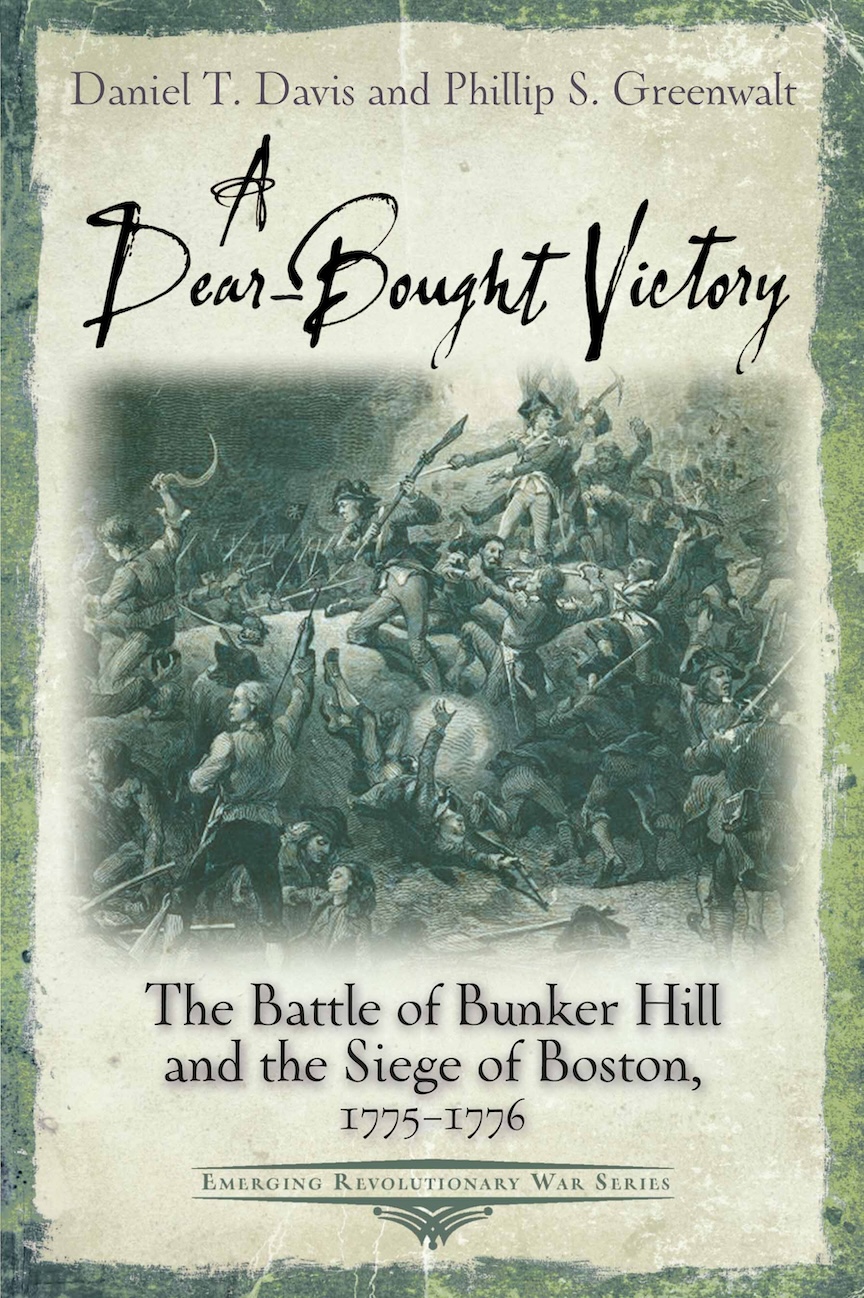
About the Book:

“I wish we could sell them another hill at the same price we did Bunkers Hill,” Nathanael Greene wrote to the governor of Rhode Island after the battle of June 17, 1775.

Actually fought on Breed’s Hill outside Boston, Massachusetts, the battle of Bunker Hill proved a pyrrhic victory for British forces. Confident in their ability to overwhelm the New England militia that opposed them, long lines of neatly uniformed British infantry and marines swept uphill toward a quickly built earthen redoubt defended by a motely collection of farmers, shopkeepers, and tradesmen.

“Don’t fire until you see the whites of their eyes!” the colonials urged each other—or did they?

By the end of the fight, the British gained the summit and Colonial forces scattered. One of the patriot leaders, Dr. Joseph Warren, lay dead—one of the first martyrs of the American Revolution. But for the British, the scene was far, far worse: it would be the greatest number of casualties they would ever suffer in any battle of the American Revolution. As British General Henry Clinton commented afterward, “A few more such victories would have surely put an end to British dominion in America.”

The siege of Boston would continue, but the sobering lesson of Bunker Hill changed British strategy—as did the arrival soon thereafter of a new commander-in-chief of Continental forces: General George Washington.

In A Dear-Bought Victory, historians Daniel T. Davis and Phillip S. Greenwalt separate the facts from the myths as they take readers to the slopes of Breed’s Hill and along the Boston siege lines as they explore a battle that continues to hold a place in popular memory unlike few others.

About the Authors:

Daniel T. Davis is the Senior Education Manager at the American Battlefield Trust. He is a graduate of Longwood University with a bachelor’s degree in public history. Dan has worked as a Ranger/Historian at Appomattox Court House National Historical Park and Fredericksburg and Spotsylvania National Military Park. He is the author or co-author of numerous books on the American Civil War. This is his first co-authored book in the Emerging Revolutionary War Series. Dan is a native of Fredericksburg, Virginia.

Phillip S. Greenwalt is the co-founder of Emerging Revolutionary War and a full-time contributor to Emerging Civil War. He is a graduate of Wheeling Jesuit University with a bachelor’s degree in history along with graduate degrees in American History and International Studies and Leadership from George Mason University and Arizona State University, respectively. He is the author of co-author of seven books on the American Revolutionary and Civil Wars. Phill has worked for the National Park Service for the last 17 years at numerous natural and cultural sites. He is a native of Baltimore, Maryland.
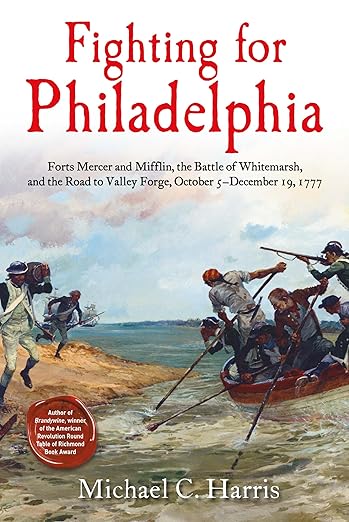
“Rev War Revelry” Fighting for Philadelphia

Fort Mercer. Fort Mifflin. The Whitemarsh Campaign. Names of battles and maneuvers that “receive but scant attention in the literature of the American Revolution.” Until now. Award-winning author and historian Michael C. Harris returns to Emerging Revolutionary War to discuss his latest book.

Finishing the trilogy, started with Brandywine, continued with Germantown, and now Fighting for Philadelphia. Just released by Savas Beatie this month!

Enjoy this pre-recorded “Rev War Revelry” and get a synopsis of why this book is needed on your bookshelf. Join Emerging Revolutionary War Sunday at 7 p.m. EDT.

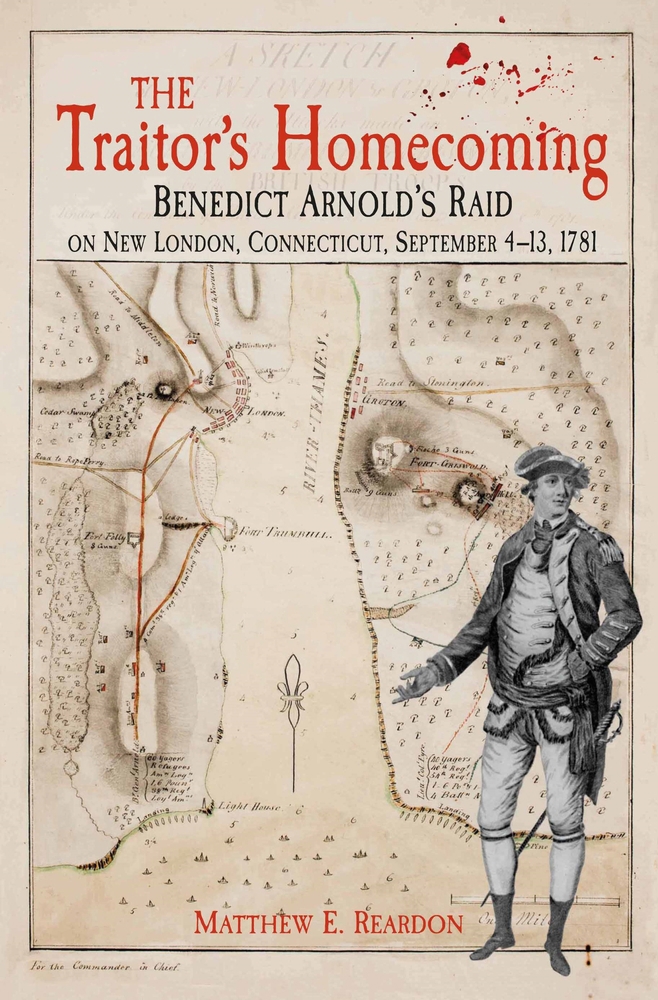
Review: Matthew E.  Reardon, The Traitor’s Homecoming: Benedict Arnold’s Raid on New London, Connecticut, September 4-13, 1781.

Emerging Revolutionary War welcomes guest historian Riley Sullivan, Professor of History at San Jacinto College in Houston, Texas.

While many might be familiar with famed engagements at places like Bunker Hill, Saratoga, and Yorktown during the Revolutionary War, few are familiar with the actions that took place near New London, Connecticut in September of 1781. However, for the people of Connecticut, the battles that took place near Groton Heights and New London have been immortalized as a campaign highlighted by treachery and massacre. Largely, this interpretation has been adopted due to the commander of the British forces who engaged in this raid, Benedict Arnold.

Perhaps no other name in American History brings about more scorn than that of Benedict Arnold. Having defected to the British cause late in the Revolutionary War, for Americans at the time–and even today–he is viewed as a modern day Judas. However, with such infamy ultimately comes much misinterpretation of this historical figure and the events he was involved in. In Matthew E. Reardon’s recent study The Traitor’s Homecoming, he attempts to undo much of this misinterpretation. Drawing on previously unused primary sources, Reardon constructs an engaging argument that challenges the traditional view of Arnold’s conduct in the New London raid.

To construct this narrative of the New London raid, Reardon attempts to place into context the setting of the New London raid. By this stage in the war, the conflict in New York had been a state of stalemate for the previous few years. However, with Generals Washington and Rochambeu’s combined Franco-American forces on the move, the British commander in the region, Henry Clinton—informed by faulty intelligence as Reardon demonstrated—was convinced that an attack on New York was imminent. As a result, to divert Washington’s attention away from a possible attack on New York, Clinton authorized Arnold to lead a contingent of British troops to attack the vulnerable Connecticut coastline.

New London made the ideal target for a British raid as it had been a hotbed for commerce and privateering for the Patriot cause. To conduct such a raid, Clinton turned to Arnold as he was both a native of Connecticut and familiar with the New London area. Largely only being contested by militia behind a number of forts that guarded approaches to both the town and the Thames River, Arnold’s combined force of Loyalists, Hessian Jaegers, and British regulars made quick work of the Patriot militia throughout the campaign. Even with New London in their hands, outside events–notably Clinton’s realization that Washington was moving on Cornwallis at Yorktown–led to Arnold having to relinquish his gains. However, with the high casualties suffered by both sides during the raid, coupled with the burning of much of the town, the events “cemented Benedict Arnold’s reputation for villainy.” (x)

When considering the traditional interpretation of Arnold’s raid on New London, Reardon makes it clear throughout his work that a “distorted interpretation” of the events had emerged (ix). From veterans to the Groton Battle Monument at Fort Griswold Battlefield State Park, the events that took place in Connecticut in 1781 have been enshrined as a massacre of Connecticut militia at the hands of Arnold. However, when looking at contemporary letters, diaries, and later pension records, Reardon demonstrates that there are some noticeable gaps within the traditional account of this campaign. In particular, when examining the death of Colonel William Ledyard–who was alleged to have been killed while attempting to surrender–Reardon concluded that through these sources, the traditional accounts accepted proved to be inconsistent with contemporary accounts of the campaign.

But, even with these inconsistencies, this is not to say that the fighting at Fort Griswold and the subsequent burning of New London was less than brutal. Reardon wrote that “the immediate reaction of the community was shock” and that “for many it was beyond comprehension.” (339) To no surprise, this sheer shock of the fighting coupled with Arnold’s involvement led to this distorted narrative of the campaign.

Through the examination of contemporary letters, diaries, and later pension applications, Reardon is able to reconstruct in great detail the events of Arnold’s New London raid and offer an unbiased narrative. By providing these fresh sources in The Traitor’s Homecoming, Reardon effectively builds on the existing literature of the subject and demonstrates how public perception can lead to the misinterpretation of historical events like that of the New London raid.

Details:

Matthew E.  Reardon, The Traitor’s Homecoming: Benedict Arnold’s Raid on New London, Connecticut, September 4-13, 1781. Published by: Savas Beatie LLC. Summer 2024. 448 Pages.

*Check out Emerging Revolutionary War’s YouTube page as well for a “Rev War Revelry” interview with author Matthew E. Reardon.*

“Rev War Revelry” Author Matthew E. Reardon, “A Traitor’s Homecoming…”

Although 1781 is most known for the pivotal and successful victory at Yorktown, action in the American Revolution unfolded throughout the eastern seaboard. In early September 1781, Benedict Arnold returned to the land of his birth to lead a raid on New London and the port that harbored preying privateers.

During this raid, the American militia under Lieutenant Colonel William Ledyard especially, stoutly defended Fort Griswold until overcome by superior numbers. The town of New London was also torched and saw a rarity like the battle of Trenton, in that combatants fought through the very streets of the town.

Capturing all this and uncovering new primary sources, Matthew Reardon weaves a narrative that balances military history, from the fighting to the strategies, with the impact on New London and Connecticut. His book, “The Traitor’s Homecoming, Benedict Arnold’s Raid on New London, Connecticut, September 4 – 13, 1781” was recently published by Savas Beatie, LLC. Matthew is a native of northeastern Connecticut and is a public educator along with being a command historian for the Connecticut Military Department. He can be reached for inquiries on speaking engagements or how to purchase the book here.

The book will be the focus of this week’s “Rev War Revelry.” We hope you can join us on our Facebook page on Sunday, 7 p.m. EDT.

*Note*
This “Rev War Revelry” will be recorded in advance as the Emerging Revolutionary War crew will be in Lexington and Concord, Massachusetts for the 4th Annual Emerging Revolutionary War bus tour.

Looking toward May and warmer weather…

For those in certain geographical areas of the United States winter weather and temperatures are upon us. The barometer fluctuates between highs and lows and wind whips through open spaces. Similar to the winter encampment at Valley Forge in 1777-1778. Much like the soldiers of the Continental army, looking toward warmer weather in the spring so should you! And it includes a visit to Valley Forge as well!

Join Emerging Revolutionary War historian Phillip S. Greenwalt and other historians in the Pursuit of History: Forging the Continental Army as part of the HistoryCamp.org event weekend. Starting on May 19, 2023 the event rolls through the weekend, Check out the full event page, including the book package where you can secure a copy of The Winter that Won the War, the Winter Encampment at Valley Forge 1777-1778, a volume in the popular Emerging Revolutionary War Series published by Savas Beatie, LLC.

To learn more and book your spot, click here.

The March in…on this date in 1777

Beginning on December 8, 1777, General George Washington and his Continental army left the environs of White Marsh to begin the movement toward their winter encampment. The rank-and-file crossed over the Schuylkill River and headed westward. Within three days the soldiers had trudged into an area called the Gulph on a December Thursday morning.

During this sojourn Washington wrote a a flurry of orders and letters, finally selecting Valley Forge. His reasoning was explained in the general orders for that day while also observing another delay in order to honor a day of fasting and thanksgiving decreed by the Continental Congress. Washington began that general order on December 17, 1777 by acknowledging the thousands of men that were braving the weather, lack of sustenance, and the rigors of the 1777 campaigning season.

“The Commander-in-Chief with the highest satisfaction expresses his thanks to the officers and soldiers for the fortitude and patience with which they have sustained the fatigues of the Campaign. Altho’ in some instances we unfortunately failed, yet upon the whole Heaven hath smiled on our Arms and crowned them with signal success; and we may upon the best grounds conclude, that by a spirited continuance of the measures necessary for our defence we shall finally obtain the end of our Warfare, Independence, Liberty and Peace.

The march resumed around 10 a.m. on December 19, a Friday, as the Continental army trudged out of the Gulph Mills area and on to their final destination for 1777; Valley Forge. The army would soon spread out to occupy over 7,800 acres of Pennsylvania countryside and spend the next six months resting, recuperating, surviving, and training.

To read more about the end of the 1777 campaign and the winter spent at Valley Forge, check out the book, by yours truly, Winter that Won the War, part of the Emerging Revolutionary War Series, published by Savas Beatie, LLC.

Valley Forge Documentary

244 years ago this week is when the Continental army, under the command of George Washington, marched into what would become their winter encampment as the year turned from 1777-1778. Recently, Phillip S. Greenwalt, one of the Emerging Revolutionary War historians was a “talking head” on a documentary about the Valley Forge encampment and what the soldiers and civilians faced during the ensuing six-month cantonment.

The documentary which features historians and park rangers is airing on Fox News Nation, the streaming service that is part of the Fox News network. Below is a screen shot of Phillip, who is also the author of Winter that Won the War, the Winter Encampment at Valley Forge, 1777-1778, which is part of the Emerging Revolutionary War Series published by Savas Beatie LLC.

So, if you need a break from the holiday specials that are airing, tune in for your history fix and learn more about the history at Valley Forge. If you want to dive even deeper into this period of the American Revolution, check out the link above labeled “2022 Bus Tour” and secure your tickets to join ERW at our second annual bus tour next November, which will include Valley Forge.

“Rev War Revelry” Author Interview: Christian McBurney

The hottest part of the hotttest temperature engagement in the American Revolution happened on June 28, 1778 at Monmouth Court House in New Jersey. The portion that gets the most attention out of this entire battle was the supposedly heated exchange between General George Washington and his second-in-command, General Charles Lee.

What ensued was the end of an American military career, as Lee would face a court martial, a suspension from duty, and a fall into obscurity. Historians have sorted through the primary sources of the time period to reconstruct what exactly happened on that balmy June day.

Yet, for the first time, a dedicated study, from the lens of both a historian and a practicing attorney, brings into focus the details of that fateful day in New Jersey. That topic, his new book, and historian Christian McBurney will be the focal point of this week’s “Rev War Revelry” as a Facebook live, this Sunday at 7 p.m. EST.

McBurney, an attorney in Washington D.C. and president of the George Washington American Revolution Round Table of Washington D.C. will speak on his latest publication, George Washington’s Nemesis, The Outrageous Treason and Unfair Court Martial of Major General Charles Lee during the Revolutionary War. This book is one of five that McBurney has written on the subject of the American Revolution.

For more information on those books, click here. To read up or read the synopsis of the book at the center of the historian happy hour this Sunday, click here.

We look forward to welcoming you this Sunday; whether you read the book or on the fence about adding this volume to your expanding library or just want to know the history behind this last major battle in the northern theater in the American Revolution. Or all three! Remember to bring your comments, questions, and a favorite beverage to sip on as you tune in.

“Rev War Roundtable with ERW” Brandywine Campaign

The largest, in terms of military forces deployed, engagement in the American Revolutionary War occurred on September 11, 1777 in southeastern Pennsylvania. The Battle of Brandywine was a pivotal moment in the British campaign that captured the patriot capital in Philadelphia. With the anniversary of the engagement happening the Friday before, the Emerging Revolutionary War crew will make this engagement and campaign the focal point of Sunday’s “Rev War Roundtable with ERW.”

Joining the “Rev War Revelry” this Sunday, at 7pm on Emerging Revolutionary War’s Facebook page will be Michael C. Harris, historian and author of Brandywine: A History of the Battle that Lost Philadelphia but Saved America, September 11, 1777, which was published and is available for purchase by Savas Beatie. Click here to order.

Besides authoring the history mentioned above, Harris has an upcoming release, on another important battle in Pennsylvania, Germantown, fought on October 4, 1777. Rumor on the street has it that he will be joining ERW at a future date to discuss this important battle and talk about his new book.

A bit of a background on Harris. He is a graduate of the University of Mary Washington and the American Military University. He has worked for the National Park Service in Fredericksburg, Virginia, Fort Mott State Park in New Jersey, and the Pennsylvania Historical and Museum Commission at Brandywine Battlefield. He has conducted tours and staff rides of many east coast battlefields. Michael is certified in secondary education and currently teaches in the Philadelphia region. He lives in Pennsylvania with his wife, Michelle and son, Nathanael.

Although the battle lost Philadelphia for the patriots, Harris does not hold back on the culprit for the setback:

“Washington failed the army, the army did not fail Washington.”

To hear the reasoning behind that emphatic quote we hope you join us this Sunday!

“Rev War Roundtable with ERW” Author Interview: William “Billy” Griffith

This Sunday, at 7 p.m. join Emerging Revolutionary War on our Facebook page as we interview William “Billy” Griffith, author of the latest volume in the Emerging Revolutionary War Series.

His book, A Handsome Flogging, The Battle of Monmouth, June 28, 1778 was just released by Savas Beatie, LLC this month. The book is so new that Amazon still has it listed for pre-sale, but don’t worry, you can purchase the book directly from Savas Beatie by clicking here.

Billy Griffith is a full-time contributor to ERW and is also the author of The Battle of Lake George: England’s First Triumph in the French and Indian War, which was released in 2016 by HistoryPress. A native of Branchburg, New Jersey, he has a family connection to the the Monmouth area; he graduated with a degree in history from Shepherd University and holds a graduate degree in military history from Norwich University. He currently works as a full-time Gettysburg Licensed Battlefield Guide. We would be remiss if we did not include his other passion, besides American military history, the New York Yankees. Feel free to join the Facebook Live to disparage his love of the Evil Empire!

ERW looks forward to seeing you, hearing your questions, comments, and what personalized message you want inscribed on your copy of Billy’s latest publication. Although this happy hour historian discussion centers on an author interview, it is still a “happy hour” so bring your favorite brew; we can guarantee the two historians on the program will be imbibing theirs!