

Emerging Revolutionary War welcomes back guest historian Drew Palmer. He is the founder of Revolutionary Maryland; click here to learn more about that blog.
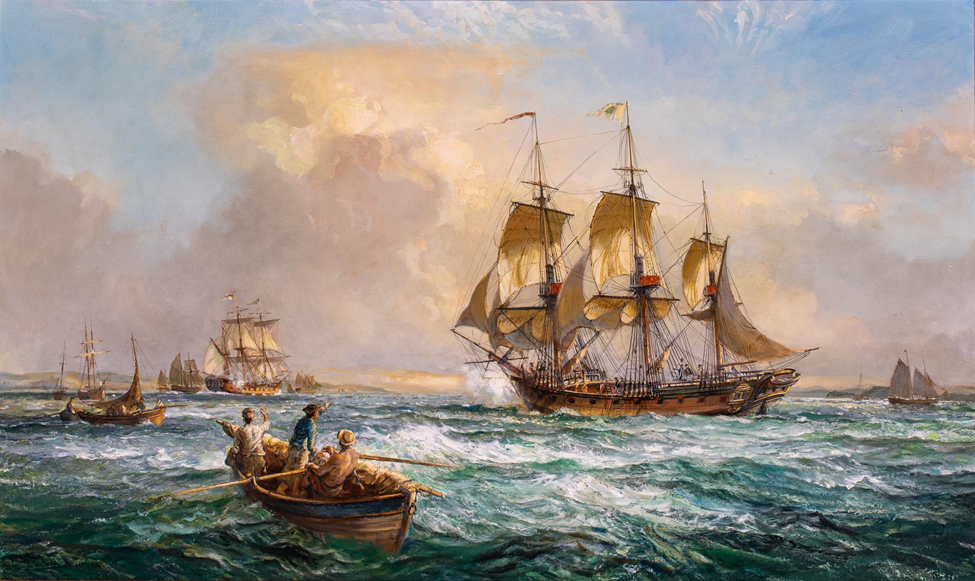
In the early evening of March 5, 1776, two armed boats left Annapolis to patrol the Chesapeake Bay. Captain John Pitt and Joseph Middleton were patrolling to prevent any British ships nearby from entering Maryland’s waters. As they patrolled, they discovered an alarming sight: three British warships heading directly towards Annapolis. Middleton and Pitt rushed off to the Maryland Council of Safety’s chambers in Annapolis to report the startling news.1 In the coming days, Maryland was tested for the first time in the growing Revolutionary conflict.
The American rebellion had become a full-scale war by the spring of 1776. In early March, the siege of British-held Boston was about to end. Hundreds of miles south in Philadelphia, the Declaration of Independence was only four months away. In Maryland, politicians worked hard to maintain Maryland’s isolation from the worst of the conflict. In Virginia, a raiding war had already begun. Only two months before, the town of Norfolk, Virginia, was bombarded, leading to the destruction of the town. Along with Norfolk’s destruction, British attacks and raids were carried out throughout the lower Chesapeake Bay, along with a blockade. 2
Participating in British operations in the lower Chesapeake was Captain Mathew Squire of the British Royal Navy. For several months, Squire’s vessel, the Otter, served as the headquarters of the exiled Virginia Governor, Lord Dunmore. From the Otter, British attacks and raids were launched on Patriot strongholds in the lower Chesapeake. By March, Squire had gained a reputation as a competent officer and ruthless raider of American shipping.3 Squire was heavily involved in the bombardment of Norfolk and an attempted attack on Hampton, Virginia. Though Squire’s area of operation had been centered on the lower Chesapeake, new intelligence pulled him northward into Maryland.
Reliable Intelligence leads Squire into Maryland
In late February 1776, Squire was ordered to conduct a raid into the upper Chesapeake and Maryland. Squire’s new mission was prompted by intelligence provided by Maryland’s deposed Loyalist Governor, Robert Eden. In a letter to Lord Dunmore, Eden reported that “three well armed vessels are being fitted out for that province [Maryland].” 4 After this initial intelligence was received, lookouts gave a more detailed picture of, “two armed vessels belonging to the rebels which lately escorted some flower down the Chesapeake Bay and our now supposed to be lying off Baltimore.” Squire was directed to, “use all possible dispatch….and proceed immediately up the bay to Baltimore in search of the pirates and pursue them wherever you may get intelligence on them, and to use every means in your power to take or destroy them.” If met with resistance, Squire was authorized to give Baltimore the same treatment given to Norfolk. To prevent the escape of the Patriot vessels, Squire was ordered to seal off Baltimore harbor and take, “any vessels you may suspect to be laden with any kind of provision or that have the appearance of being proper for arming. 5 On his way to Baltimore, Squire was told to clear the waters of Patriot shipping and find provisions in Maryland, “particularly fresh meat.” 6 Squire soon departed for Baltimore aboard the Otter along with two smaller vessels, the Edward and the Samuel. 7
The Otter was the largest of Squire’s vessels at his disposal. The vessel was three-masted and mounted sixteen six-pounder carriage guns. The ship was ninety-seven feet long and twenty-seven feet wide with a crew of 125 men. The Samuel carried mounted swivel guns while the Edward was armed with four swivel guns and six cannons. Due to the Otter being considerably slower and less maneuverable than vessels it could encounter on the Chesapeake, the Samuel and Edward were added for their decreased size and ability to chase down enemy vessels in coves and small rivers. The decision to bring the smaller vessels with Squire and the Otter initially proved successful. As Squire approached Annapolis, the Samuel and Edward had already captured a handful of prizes on the Chesapeake.8
As Squire’s British force moved closer to Annapolis, the first reports of its approach sparked panic. In Annapolis and Baltimore, families packed up and fled, stores were closed, and town leaders ordered the county records evacuated. Throughout early March, militias and regulars were called up throughout Maryland due to initial panic.9 In Baltimore, the two vessels Squire was ordered to destroy or capture based on Eden’s intelligence were the Scorpion and Falcon, which had been refitted and armed in a Baltimore shipyard. Both vessels were under contract with the Continental Congress and were constructed for the infant Continental Navy. Unfortunately for Squires, both the Scorpion and Falcon had left Baltimore in December to join a Continental squadron on the Delaware River.10
However, two new ships, larger and stronger than the Scorpion and Falcon, were nearly complete in Baltimore. The first was one of the vessels Eden mentioned in his intelligence report to Lord Dunmore, called the Defence. The Defence was eighty-five feet in length and mounted twenty cannon. The ship was purchased by the Maryland Council of Safety to protect Maryland’s ports and shipping from British raids. When the Otter was first spotted on March 5, the Defence sat at Fell’s Point with no cannons mounted and still without a crew. Accompanying the Defence was the Virginia, which mounted twenty-eight guns and was under construction for the Continental Navy at the Fell’s Point shipyard.11
The Otter Arrives
After passing Annapolis on their way to Baltimore, the Otter had just made it to the Patapsico River when it struck a shoal on Friday, March 8. It took hours to free the vessel from the shoal, as its crew tried to shift its weight. With the Otter stuck, the Edward and Samuel continued and sailed further on the Patapsico. Along the way, the British vessels discovered a large ship aground at the mouth of the river. The ship was owned by merchant Isaac Hudson and carried flour and wheat purchased by the Continental Congress. After hearing of the approaching British flotilla, Hudson attempted to flee Baltimore before the British arrived. As Hudson’s ship passed North Point, fifteen miles from Baltimore, it struck a sandbar, becoming trapped and leaving its anxious owner in a dangerous predicament. After seeing Hudson’s ship on their way to Baltimore, the Edward and Samuel moved in and seized the ship along with Hudson. Within a few hours, several other ships were seized by the British vessels, creating a long line of captured prizes.12
American lookouts began to learn of captured prizes and of the Otter’s location. With it being a matter of time until the Otter was free from the shoal, Robert Eden, responsible for the British presence in the first place, approached the British with an offer to communicate with Squire. Though a Loyalist, Eden remained a respected leader for his character and efforts to prevent bloodshed. Eventually, he was forced into hiding by radical Revolutionaries; however, at this early stage of the conflict, Eden could still actively participate in political matters, including negotiations. Unaware to the Maryland Council of Safety was that Eden had given the British the information on Patriot vessels in Baltimore. William Eddis, a close associate of Eden, was granted permission to meet Squire on board the Otter, where he was given a packet of messages to take to Eden. After returning to Annapolis, Eden and Eddis reported to the Council Squire’s reasoning for being in Maryland and that he demanded the surrender of Patriot vessels in Baltimore’s harbor. Squires also demanded that Annapolis should supply him with meat and provisions. In the letter given to the Council by Eddis and Eden, Squire warned the Council that, “I am under an absolute necessity to seize whatever might come within my power.” Squire also stated that if his orders were followed, “not the least damage should ensue to any individual or the town of Baltimore.”13
Eden and Eddis attempted to persuade the Council that Maryland’s leaders were loyal to Great Britain and wished to avoid a confrontation. Eddis said that Maryland was “as agreeable in nature as the times would admit. The Council president added when discussing Squire that “Was he to come here in peaceable times, I should be glad to show him the civility due to a gentleman.”14 However, the two sides were at an impasse. Squire would not back down, and the Council was unwilling to meet his demands. As negotiations broke down, it was clear that the war had come to Maryland.
Maryland Goes to War
As peaceful solutions fell apart, leaders in Baltimore focused on preparing to defend against the British flotilla. Militia began to pour into Baltimore while earthen breastworks were constructed and improved at Fells Point and Whetstone Point. Cannons were rushed to Fells Point to be mounted on the Defence. On the docks and shipyards around Baltimore and in Fells Point, sailors from merchant ships volunteered to serve on the Defence and other smaller vessels. Samuel Purviance Jr. was the chairman of the Baltimore Committee of Observation and was responsible for organizing the defense of Baltimore. On March 8, Purviance reported that “The cannon for the Defence are just now arrived and alongside, and [the ship] will be in a very good posture of defense by sunrise tomorrow. We have hove up a breastwork at Fells Point near the ship and shall get several cannon mounted on it by 8 o’clock. Major Gist and the regulars are all marching to Whetstone to entrench tonight.”15 By March 8, a wide variety of citizen soldiers and professional soldiers had mobilized for a confrontation with the British flotilla. Captain Samuel Smith held the overall command of the militia and coordinated closely with Purviance. At Whetstone Point, Captain Nathaniel Smith commanded artillery batteries manned by Maryland State Matrosses. Fort Whetstone, as it became known, was particularly important in the event of an enemy incursion into Baltimore. Fort Whetstone sat on a narrow peninsula that jutted out into the Patapsco Bay. The fort also sat at the entrance to Baltimore harbor, making it the first line of defense in the event of a British threat.
Purviance originally wanted the Otter to get close to the town so that the gun batteries in Baltimore would be in range. However, Purviance decided to tow the Defence to a location where it could better support the new batteries at Fells Point and Whetstone Point. To prevent the British ships from entering the inner harbor, a handful of vessels were anchored across the channel near Whetstone Point to be sunk if the British attacked. In the scenario of an aggressive British raid on Baltimore harbor, the sinking of vessels was intended to prevent British ships from accessing Baltimore’s commercial hub.
Early on Saturday morning, March 9, Purviance’s defensive plans changed after further intelligence indicated that the British flotilla had been separated. The Otter was still stuck on the shoal while the smaller vessels, the Edward and Samuel, remained mostly idle, guarding Hudson’s ship along with the other captured prizes. Purviance saw that the smaller vessels were isolated and vulnerable to a surprise attack. He ordered Captain James Nicholson, commander of the Defence, to attack.16
Nicholson was appointed to command the Defence in 1775. He was born in Chestertown, Maryland, and had served for many years in the British Royal Navy. Nicholson had gained a reputation as a heroic naval leader by March 1776 and was much revered for his actions defending commercial shipping around Baltimore and Annapolis. Nicholson’s future command, the Virginia, sat unfinished in the Fells Point shipyard as he sailed the Defence towards the British flotilla early in the morning on March 9, 1776. Ironically, in the near future, Nicholson surrendered the Virginia along with another Continental frigate to British forces. For now, though, he was determined to turn away Squire’s flotilla. 17
Purviance ordered Nicholson to first re-take Hudson’s ship, which had been captured by the Edward and Samuel. Purviance reminded Nicholson that his main goal was to protect Baltimore. He told Nicholson that if the British warships appeared, “to attack you, it would be most advisable for you to return to Whetstone Point or Fells Point to be ready to protect the town.” As Nicholson prepared to depart, many shipowners volunteered their vessels to assist him in his mission. The Resolution was offered to Nicholson and immediately deemed suitable. Cannon and ammunition, as well as a crew, were quickly loaded onto the Resolution. Early in the morning, the Defence, Resolution, and other small vessels left Baltimore, moving east on the Patapsco towards the British flotilla.18 In a matter of days, Baltimore had organized a military squadron sufficient in size to meet the British threat.
A thick fog hovered over the Patapsico as Nicholson’s small squadron approached the location of Hudson’s captured ship. On board, the Defence consisted of 220 armed militia and marines crowded on deck, expecting to see combat. In the days prior to Purviance’s recruitment, men from the docks and taverns in Baltimore volunteered to help rescue Hudson’s ship; many of them became the Resolution’s temporary crew. The squadron was fully expecting to do battle, and Nicholson left Baltimore with the intention “to grapple at once.” Due to the thick fog, Nicholson’s squadron got within less than two miles of the Samuel and Edward. When the fog thinned, the marines aboard the Defence “gave three loud cheers,” the echo of the cheers “made the very air ring.” The noise of the cheers startled the crews of the Samuel and Edward, as for the first time, they could see the Defence and the rest of the small American squadron through the thin fog approaching their position. The Samuel and Edward immediately “made sail, and left all of their prizes in our possession.” The small British vessels quickly made their way back to the safety of the Otter’s guns. In the meantime, the Defence moved in and recaptured vessels previously captured, along with Hudson’s grain ship.19
As the Samuel and Edward fled Nicholson’s squadron, they fired a signal gun to alert the Otter. Squire and the crew were still attempting to release the ship from the shoal. Finally, Squire’s crew released the vessel from the shoal in time to be operational if Nicholson attacked. Meanwhile, the crews of American supporting vessels boarded the recently retaken American vessels, perhaps four or five of them.20 To protect the rest of Nicholsons’ squadron, the Defence, “stretched backward and forward below her prizes and at length, seeing the Otter get under way, came to, close by Hudson’s vessel and prepared for battle.” To the surprise of Nicholson and his officers, the Otter turned around and “bore away.” Once it became clear that the British flotilla did not want to challenge the Defence, cheers broke out from the American vessels. However, once the adrenaline of the moment wore off, many troops were disappointed that a direct confrontation had not taken place. One American officer wrote that, “Though our ship was inferior to that of the enemy, we were much disappointed in not attacking them, for some time before night the British made sail, and we have not seen them since.” As Nicholson returned to Baltimore with his small squadron and retaken American vessels, the citizens of Baltimore greeted them as heroes.21
Squire was surprised by the coordination and force of Baltimore’s response to his mission. He decided that remaining in the area posed too much risk, as Baltimore clearly had the men and resources to challenge him. He noted that the Patriots had made the area too dangerous to justify his staying, writing that, “all the marked trees [navigation aids] were cut down, and that there were chains across the river, and large guns were fixed upon the point [Whestone Point].” Interestingly, Squire’s report of the incident makes no mention of having lost any prizes to Nicholson’s squadron. His version was that two American vessels saw him and left, writing that he, “Found the two sail to be privateers who got under weigh, and were working up.” Regardless of the versions, it is clear that Squire failed his primary mission. He sailed his flotilla a short distance and anchored off Annapolis harbor. 22
Annapolis’s Turn
As Baltimore celebrated its victory, the capital of the province, Annapolis, now had to meet Squire’s threat. Squire wrote that “I am well informed that a New England vessel loaded with corn and flour is up the river,” and “must hope the inhabitants [of Annapolis] will not molest the tenders [Samuel and Edward]” when they entered the river “to get her out.” 23 The Council now had to consider whether to allow Squire to take the vessel or make a defense similar to that of what recently transpired in Baltimore. After negotiations and face-to-face meetings among Loyalist Robert Eden, the Council, and British representatives, the Council decided to take a risk and concluded that Squire was bluffing. They outright rejected Squire’s letter and refused to surrender the vessel. Throughout the negotiations, some Council members came to believe that the British had a spy supplying information to the British, as “they [British] no everything which is transacted here and to the northward.”24 Nevertheless, the Council still did not suspect Eden, who was the one outspoken Loyalist who had been involved in Council meetings and negotiations. After all, Eden’s intelligence to Lord Dunmore had led Squire to Baltimore in the first place. After Eden’s correspondence with the British was discovered months later, Maryland made him leave the state in June of 1776.
At around noon on Sunday, March 12, the Otter, Samuel, Edward, along with its remaining prizes, dropped their sails and moved down the Chesapeake. Squire briefly noted his departure, “Sunday, March 10: at 2 past 11 A M weighed and came to sail, in company the tenders and prizes. Little wind and hazy. At 8 P M anchored off Sharpes Island.”25
Outcome
In terms of romantic military tales of heroic charges and costly battles, the defense of Maryland from the British flotilla has been remembered as a minor event. However, the British raid into the upper Chesapeake had awakened and mobilized a province that had been largely untouched since the beginning of hostilities in early spring 1775. The British raid had shown Marylanders that they, too, not just Boston and Virginia, were a legitimate target; most fully expected the British to return in the future. The realization that Maryland was potentially at risk of further British attacks inspired Baltimore to strengthen its defenses. At Whetstone Point, empty ships were scuttled in the narrow channel, followed by a log chain boom. At Fells Point, the artillery breastworks were enlarged. Fells Point and Whetstone Point received additional cannons, more power, muskets, and shot. The Baltimore Committee of Observation made sure the Defence was fully outfitted and armed for patrols on the bay. The fear of the Otters’ return drove the spirited preparations. 26
In Annapolis, the British raid sparked a string of spirited anti-British activism and pro-Patriot sentiment. Anti-British protests popped up throughout Annapolis, as well as protests and outrage against British interests within the Council, like Eden. In Baltimore and Annapolis, protests raged on. Citizens turned their anger on Maryland’s politicians, accusing them of failing to adequately prepare the province for war. Citizens felt they had been misled by assurances from Eden and other moderate politicians that Maryland was a province quarantined from hostilities. However, after the events with the Otter, Marylanders sought to feel prepared and defended, rather than assured of the province’s isolation from the conflict. Baltimore leaders loudly criticized Maryland’s politicians for being overly cautious and cowardly. 27
In the end, the British raid into the upper Chesapeake did not achieve its goals. Baltimore’s rapid mobilization and aggressive pursuit of Squire’s flotilla forced Squire to abandon his goals at Baltimore. In Annapolis and Baltimore, the realization that the war had come to Maryland and that there was no escaping it hardened and motivated the province’s people to hold their leaders more accountable, ensuring that key towns such as Annapolis and Baltimore were better prepared and defended in the event of a return of British forces. The event showed that Maryland could respond quickly and effectively to a military threat, something that Maryland’s leaders were quite proud of. Rather than intimidation and submittance, Squire’s raid did the exact opposite: it energized Annapolis and Baltimore and pushed them towards a stronger commitment to the Patriot cause as the war progressed.
Endnotes
1. Robert Tinder, Shattered Isolation: The Raid of the Otter and Maryland’s Chaotic Turn to Independence, March-July, 1776, Maryland Historical Magazine 99, no. 4 (Winter 2004), 429.https://msa.maryland.gov/megafile/msa/speccol/sc5800/sc5881/000001/000000/000397/pdf/msa_sc_5881_1_397.pdf
2. Tinder, Shattered Isolation, 432.
3. Ernest McNeill Eller, Chesapeake Bay in the American Revolution ( Tidewater Publishers, 1981), 64-67.
4. Captain Henry Bellew to Philip Stephens, January 11, 1776, Naval Documents of the American Revolution, Naval History and Heritage Command, 3: 737-738, https://www.navydocs.org/.
5. Captain Andrew Snape Hamond, R.N. to Captain Matthew Squire, February 26, 1776, NDAR, 4:92,93.
6. Captain Andrew Snape Hamond, R.N. to Captain Matthew Squire, February 26, 1776, NDAR, 4: 93.
7. Robert Gardiner, Navies and the American Revolution, 1775-1783 (Naval Institute Press, 1996), 56; Eller, American Revolution, 217.
8. Journal of H.M. Sloop Otter, February 28-March 8,1776, NDAR, 4:112, 271.
9. Council Orders to Colonels John Hall, Thomas Dorsey, and John Weems, March 5, 1776, Archives of Maryland, 201.
10. Charles Steffen, The Mechanics of Baltimore: Workers and Politics in the Age of Revolution, 1763-1812 (University of Illinois Press, 1984), 53-61.
11. Eller, Chesapeake Bay in the American Revolution, 21, 22, Dimensions, Maryland Ship Defence Inventory, Lux and Bowley, Agents, March 1, 1776, NDAR, 3:1371-1374
12. Journal of H.M. Sloop Otter, Captain Matthew Squire, March 8, 1776, NDAR, 271, 272, Maryland Council of Safety to Committee of Safety of Virginia, March 9, 1776, Archives of Maryland, 217.
13. William Eddis, Letters from America, ( Belknap Press of Harvard University Press, 1969), 139-140.
14. Jenifer and Council to Charles Carroll Barrister, March 8, 1776, Archives of Maryland, 11:218, Captain Andrew Snape Hamond to Captain Matthew Squire, February 26, 1776, NDAR, 4:92-98.
15. Baltimore Committee to Maryland Council of Safety, March 8, 1776, Archives of Maryland, 218-19.
16. Council to the Deputies in the Maryland Congress, Archives of Maryland, 236-237.
17. Eller, Chesapeake Bay in the American Revolution, 148,164.
18. Baltimore Committee of Observation, March 8 and 9,1776, NDAR, 4:239, 268.
19. Joseph Smith to Nathaniel Smith, March 20, 1776, NDAR, 4:20,26.
20. Council of Safety to the Deputies of Maryland in Congress, March 11, 1776, Archives of Maryland, 11:237.
21. Dunlap’s Maryland Gazette, March 12, 1776, NDAR, 4:310,313.
22. Journal of H.M. Sloop Otter, Captain Matthew Squire, NDAR, 4:271-272.
23. Captain Matthew Squire, to Governor Robert Eden, March 9, 1776, NDAR, 4:273.
24. Council of Safety to the Deputies of Maryland in Congress, March 11, 1776, Archives of Maryland, 11:237.
25. Journal of H.M. Sloop Otter, Captain Matthew Squire, March 10, 1776, NDAR, 4:425.
26. Minutes of the Baltimore Committee of Observation, Tuesday, March 12, 1776, NDAR, 4:312-314, Baltimore Committee of Observation to the Council of Safety, March 16, 1776, Archives of Maryland, 11:255, Dunlap’s Maryland Gazette, March 19, 1776, NDAR, 412.
27. Steffen, The Mechanics of Baltimore, 62-63, Ronald Hoffman, A Spirit of Dissension: Economics, Politics, and the Revolution in Maryland ( Johns Hopkins University Press, 1973),164-165. https://archive.org/details/spiritofdissensi0000hoff.
 Emerging Revolutionary War Era