
Emerging Revolutionary War welcomes back guest historian Drew Palmer for Part III of his Maryland Loyalist series (for Part II, click here).
Return to New York and Mass Exile
After the Marylanders returned to New York, the regiment’s muster rolls declined sharply. William Augustus Bowles remained with the regiment. However, he appears to have grown bored. He tried to entertain himself by joining theater productions. In one play, Bowles played a Native American, wearing attire similar to what he had worn in Florida just a short time earlier. His performance was full of ironies. His character, Zanga, hated the Spanish. In the years following the Revolution, Bowles would again fight the Spanish.52
Maryland Loyalists had every right to be hesitant about returning home. As the conflict came to a close, thousands of loyalists were trapped in New York, and many feared Patriot retribution.53 Though punishment was light for Marylanders who did not fight and stayed quiet during the conflict, Marylanders who fought for the king faced guaranteed hardships. Many Marylanders in the First Battalion had to make a challenging decision. If they returned to Maryland, they could expect their property to have already been confiscated and to be targeted for revenge. Or, they could leave the United States and try to start a new life in another British colony. As you’d expect, most chose the latter choice. The Maryland Loyalists joined the mass exodus of loyal colonists who left New York for the Canadian frontier of Nova Scotia.
In early September 1783, the Maryland Loyalists and their families boarded the Martha, a transport ship bound for Saint John in Nova Scotia. Some of the First Battalion’s officers, such as Phillip Barton Key and James Chalmers, had already left for England. It appears Nova Scotia was not ideal for men like Key and Chalmers; they had already lost fortunes when the Patriots confiscated their property in Maryland. 54
The Martha
Packed on the Martha were the remnants of the First Battalion companies. Patrick Kennedy, now in command of the regiment in Chalmers’s absence, described the voyage in his diary. The Martha’s passengers were relieved to be out of the Patriots’ grasp and hopeful for a better life in Canada. The voyage had been moving along relatively smoothly until bad luck struck the First Battalion on September 23, as it often did. The captain of the Martha left New York with a series of old sails. It is unknown why the captain chose to take the risk instead of replacing the aging sails. He would regret the decision. Near Cape Sable and the southern tip of Nova Scotia, the Martha ran into a severe storm. The ship was rocked back and forth by the strong waves and heavy wind. A crew of only twelve struggled for hours to set up a new topsail to replace the old sail, which the heavy winds had ripped to pieces. With everyone focused on fixing the sail, no one seemed to notice how close the Martha had drifted to shore because of the strong currents. Around 4 A.M. in the morning, the ship hit a pair of rocks. Water poured into the Martha as the crew pleaded with the captain to launch lifeboats and abandon ship. After initially refusing, the captain finally agreed to evacuate after the water level kept rising. As the captain ordered the boats over the side, he promised he would be one of the last to leave the Martha. Instead, Patrick Kennedy wrote that the captain “jumped into her [the lifeboat] as she went over the side, rowed to the cutter, which lay off, [and] got into her.”55 In a desperate attempt to escape the sinking ship, many Maryland Loyalists and seamen swam out to the cutter the captain was safely on and climbed on board.
Meanwhile, hundreds of passengers, including men, women, and children, were trapped on the Martha. Desperate passengers cried out to the captain, drifting away on the small craft, to “come towards the stern of the ship and concert some plan for the general safety and to comfort the unhappy souls on board.”56 However, the captain disappeared from sight. Soon, the ship broke apart under the weight of the water, leaving the unfortunate passengers scrambling to hold on to parts of the wreck. Many of the passengers floated at sea for days. Young William Williams could no longer bear the freezing water and died. Lieutenant James Henley and Surgeon William Stafford of the First Battalion shared a piece of wreckage for two days and nights before drifting onto an island on the third day. The island was no reprieve, however. They had no food and no way to make a fire. Stafford and Henely were marooned for seven days before being spotted and rescued.57 Samuel and Elizabeth Woodward were rescued holding their youngest child. Upon reaching shore, Elizabeth Woodward discovered that one of her sons had perished.58
Fifty-seven Marylanders are believed to have died when the Martha sank. One Lieutenant, six sergeants, two corporals, one ensign, twenty-seven privates, seven women, nine children, and four servants.59 The survivors arrived in Saint John after French settlers rescued them. Kennedy stated to the Nova Scotia Gazette that, “We are here in a truly pittiable situation, having lost everything we had in the world; Majore Prevost has, indeed , exerted every endeavor for our comfort and accommodation, and has purchased blankets to cover the men; but the loss of our ammunition, arms, accoutraments, with that of our stores, bedding, and utensils, is very severely felt, as we are anxious to get up the river to our lands.”60 Thanks to the captain of the
Martha’s negligence, the Maryland Loyalists lost everything. The land Great Britain promised the Marylanders for their service was now their only source of hope.
Settlement in the Wilderness
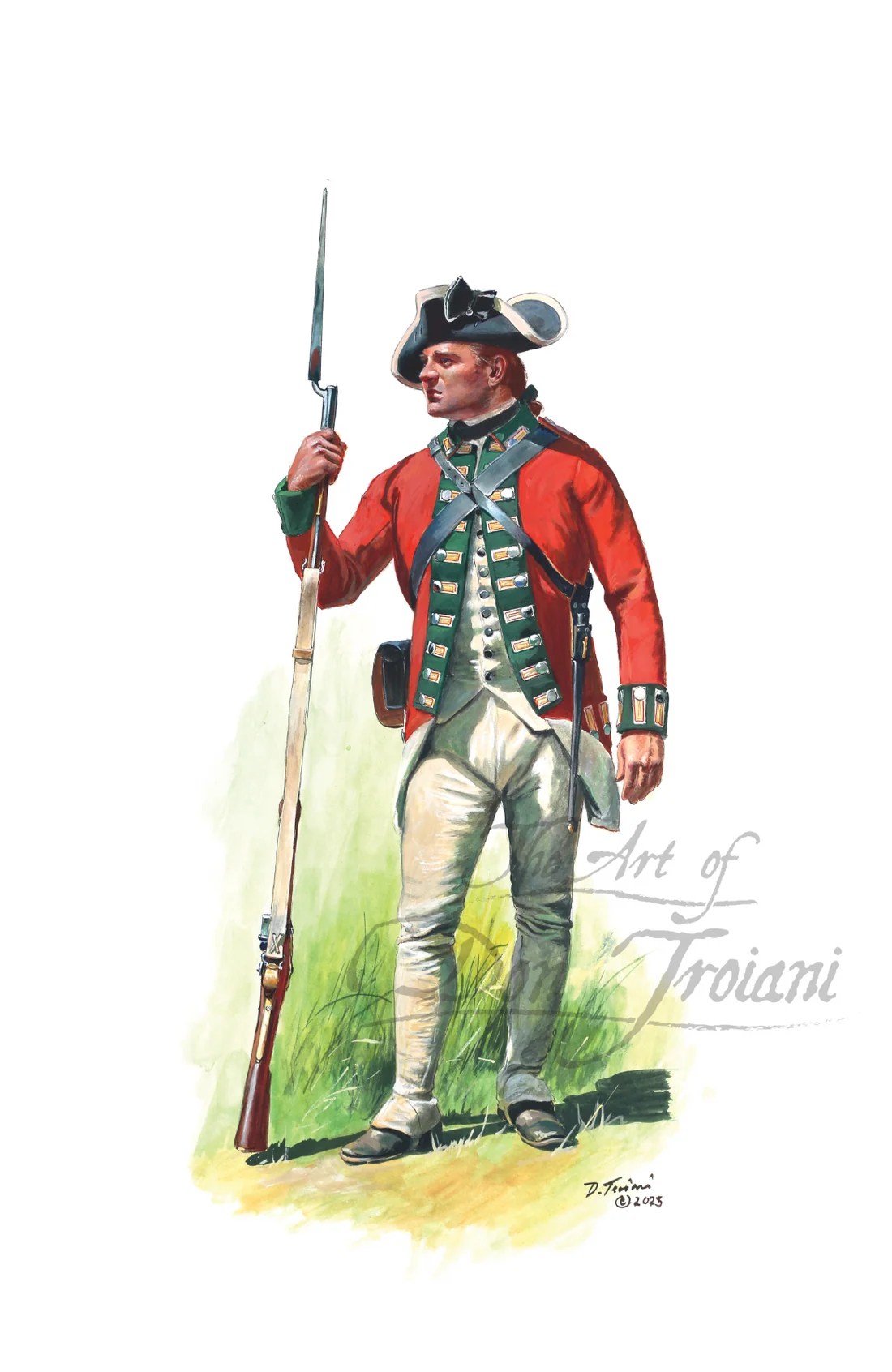
Nova Scotia was a culture shock for the Marylanders; it would have felt similar to the first time the First Battalion set foot in Pensacola during the war. Wilderness life and freezing temperatures were unforgiving, and the Marylanders found it an immense challenge to survive. One loyalist described with frustration that, “all our golden promises are vanished with smoke. We were taught to believe that this place was not barren and foggy, as had been represented, but we find it ten times worse. We have nothing but his Majesty’s rotten pork and unbaked flour to subsist on…. It is the most inhospitable climate that ever mortal set foot on.”61 Another loyalist woman described the feeling of isolation in Nova Scotia, stating, “I watched the sail disappearing in the distance, and such a feeling of loneliness came over me that, although I had not shed a tear through all the war, I sat down on the damp moss with my baby in my lap and cried.”62 The feeling of isolation was compounded by dangerous supply shortages. Many Marylanders initially lived in tents. Efforts were made to improve housing to log houses and huts, but the harsh winter killed a number of women and children due to lack of food and exposure. 63 The Marylanders were left to fend for themselves in a remote, unfamiliar land.
Amid poor conditions and a lack of support, they tried their best to adapt to frontier life. Patrick Kennedy and the remaining Maryland Loyalists under his command finally received their grant of 13,750 acres in July 1784. The land became known as “Block 1”. The block lay on the west side of the Saint John River near the town of St. Ann’s. However, conditions at Block 1 did not improve, with the biggest issue being a lack of food rations. Miraculously, most Marylanders made it through the winter of 1784. 64 Kennedy was convinced of the need to create a new province on the other side of the Saint John River. Eventually, Kennedy got his wish when the Maryland Loyalists received more land allotments in the new province of New Brunswick.65 Even with his wishes granted, Kennedy was not satisfied and returned to his native Ireland for the rest of his life.66 Some Marylanders never made it to New Brunswick, deciding to venture out on their own and start new lives. Some quietly returned to Maryland.
James Chalmers spent the rest of his life bickering with the state of Maryland over land and property confiscated during the war. Chalmers eventually settled in England, where he rejoined the military in 1806 as inspector general in the West Indies. For the rest of his days, he continued to publish pamphlets critiquing Thomas Paine’s revolutionary works. A true loyalist till the end, Chalmers passed away in 1806.67 William Augustus Bowles lived the adventurous life he had always hoped for after the war. Bowles’ story after the Revolutionary War is its own story, and the author encourages readers to explore it. His story, as they say, is truly straight out of a movie, and it began with his service as a Maryland Loyalist.
Maryland Loyalist officers Phillip Barton Key and Walter Delaney both returned to Maryland once tempers had cooled. However, Delaney found tensions still high in Bladensburg, Maryland, where he settled, and decided to move to Delaware. Key was perhaps the most successful at rebuilding his reputation in Maryland and re-establishing himself as a patriot. Key returned to Maryland in 1785 after spending time in England. He found that Maryland had confiscated his lands and property. Phillip Barton’s brother, John Ross Key, divided his lands and supported his brother until he found his footing again. While most loyalists who returned to the U.S. after the war lived quiet lives, Key continued to practice law and moved to Annapolis, where he gained respect as a lawyer and won a seat in the Maryland legislature as a Federalist.
Moving into the 1790s, Key’s nephew, Francis Scott Key, seemed to always be at his side, mostly learning law and picking up Phillip Barton’s passions. Key soon moved to Washington, D.C., and took his nephew, Francis Scott, with him. There, Key took Francis Scott on as his assistant and eventual partner. Phillip Barton ran for Congress as a Federalist and won. Most considered his time in Congress respectable. When his election to Congress was contested due to his siding with the British during the Revolutionary War, Key responded that, “I returned to my country like a prodigal [son] to his father, felt as an American should feel, was received and forgiven, of which the most convincing proof is my election.”68 Predictably, Key voted against going to war wth Great Britain in 1812. Only around two years later, Francis Scott Key jotted down poetic notes aboard a British ship in Baltimore Harbor as he witnessed the British bombardment of Fort McHenry. Key’s poem, “The Defense of Fort McHenry,” later became the U.S. national anthem. Francis Scott gave the eulogy at Phillip Barton’s funeral on July 18, 1815.69
In Closing
Since the First Battalion of Maryland Loyalists fought on the wrong side, their memory in the U.S. has been largely forgotten, and their role minimized as unimportant. More broadly, Maryland’s loyalist connection has also been overshadowed by better-known examples of loyalism, as well as by states with larger numbers of loyalist sympathizers. The story of Maryland loyalism and the First Battalion’s struggles reminds us that the Revolutionary War was not simply a war between Americans and the British, but a deeply complicated and divisive civil war that split communities and altered lives. While Maryland’s Patriots ultimately shaped the state’s legacy and secured a place of honor in its historical memory, thousands of Marylanders sincerely believed that loyalty to the crown offered the surest path to stability and prosperity.
Men such as James Chalmers and the soldiers of the First Battalion of Maryland Loyalists sacrificed their homes, fortunes, and, in many cases, their futures for a cause they believed was just. Their service carried them from Maryland’s Eastern Shore to the battlefields of Florida and ultimately into exile on the Canadian frontier. Though they fought on the losing side of the Revolution, their experiences remain an essential part of Maryland’s history. By remembering Maryland’s Loyalists alongside Maryland’s Patriots, we gain a fuller understanding of the Revolution’s human cost and the profound choices that confronted Marylanders during one of the most turbulent and transformative periods in American history.
Endnotes
- Robert Purviance, Narrative of Events Which Occurred in Baltimore Town During the Revolutionary War: To Which Are Appended, Various Documents and Letters, the Greater Part of Which Have Never Been Heretofore Published, pub. J. Robinson, 1849, Accessed May 19, 2026. Library of Congress.
- Ibid.
- Ibid.
- M. Christopher New, Maryland Loyalists in the American Revolution (Tidewater Publishers, 1996), 10.
- Peter Force, American Archives: Consisting of a Collection of Authentick Records, States Papers, Debates, and Letters and other Notices of Public Affairs, Fourth Series, 6 vols. Washington D.C.
- Letters of Reverend Jonathan Boucher, Maryland Historical Magazine, March-December 1913, 184.
- Charles Truitt, Breadbasket of the American Revolution: Delmarva’s Eight Turbulent War Years (Historical Books, 1975), 184.
- Ibid, 112.
- New, Maryland Loyalists, 17.
- The Gentleman’s Magazine, August 8, 1802, (London: Nichols and Son).
- James Chalmers [“Candidus”], Plain Truth; Addressed to the Inhabitants of America, Containing Remarks on a Late Pamphlet entitled “Common Sense,” (Philadelphia: Robert Bell, 1776), 5-6. https://www2.umbc.edu/che/tahlessons/pdf/historylabs/Should_the_Colo_student:RS07.pdf
- Ibid. 16-17.
- Chalmers, Plain Truth, 16-17.
- Ibid. 36.
- James Chalmers [“Candidus”], Additions to Plain Truth; Addressed to the Inhabitants of America, Containing Further Remarks On a Late Pamphlet entitled “Common Sense.” Philadelphia: Robert Bell, 1776. 122.
- William Browne, Archives of Maryland XI, Journal of the Maryland Convention, July 26- August 14, 1775, Journal and Correspondence of the Maryland Council of Safety, August 29, 1775 to July 6, 1776, Maryland Historical Society, 189, XVI. 122-125.
- New, Maryland Loyalists, 36-7.
- Browne, Archives, 175-77.
- Browne, Archives, 349.
- New, Maryland Loyalists, 44
- Hugh Edward Egerton, The Royal Commission on the Losses and Services of American Loyalists, 1783-1785 (Burt Franklin, 1971), 387.
- Browne, Archives, 241.
- New, Maryland Loyalists, 47.
- Muster Rolls, 1777–1783, The Loyalist Collection, University of New Brunswick Libraries, https://loyalist.lib.unb.ca/record/muster-rolls-1777-1783; New, Maryland Loyalists, 49.
- Paul Leicester Ford, Orderly Book of the Maryland Loyalists Regiment, June 18th, 1778 to October 12th, 1778, (New York: Historical Printing Club, 1891),7.
- Ibid, 15.
- New, Maryland Loyalists, 62.
- Ford, Orderly Book, 82.
- Burton J. Starr, Tories, Dons, and Rebels: The American Revolution in British West Florida (University Presses of Florida, 1976), 82.
- Edward Winslow Papers, 1695–1866, The Loyalist Collection, University of New Brunswick Libraries, 40.
- National Archives of Canada Publication, Maryland Loyalist Muster Rolls, Vols. 1904-1905.
- Starr, Tories, Dons, and Rebels, 132.
- Ibid.
- Ibid.
- Starr, Tories, Dons, and Rebels, 134-38.
- William L. Clements Library, Chalmers to Lord Rawdon, The Clinton Papers, May 21, 1779.
- Ibid, July 26, 1779.
- New, Maryland Loyalists, 87.
- Ibid, 87.
- Starr, Tories, Dons, and Rebels, 183.
- Ibid., 183.
- J. Leitch Wright Jr, William Augustus Bowles, Director General of the Creek Nation, University of Georgia Press, 1967.
- Robert Farmar, “Bernardo de Galvez’s Siege of Pensacola,” Vol. 26, No.2, April 1942 (reprint), 10.
- Winston De Ville, Yo Solo, The Battle Journal of Bernardo de Gálvez during the American Revolution, 16.
- De Ville, Battle Journal, 18.
- Ibid, 20.
- Farmar, Bernardo De Galvez Siege, 16.
- N. Orwin Rush, The Battle of Pensacola, Florida State University Press, 1966, 107.
- The Carleton Sentinel and Family Journal, pub., James S. Segee, 1850.
- De Ville, Battle Journal, 31.
- Starr, Tories, Dons and Rebels, 214.
- Wright, William Augustus Bowles,17.
- Claude Halstead Van Tyne, Loyalists in the American Revolution, 297-299.
- Christopher Moore, The Loyalists, Revolution, Exile, Settlement. 144-49.
- Kennedy Journal, quoted in William Raymond’s The Winslow Papers, A.D. 1776-1826. 138-142. https://ia600406.us.archive.org/33/items/winslowpapersad101raym/winslowpapersad101raym.pdf
- Ibid, 138.
- Lorenzo Sabine, Loyalists of the American Revolution, 1979 reprint of 1864 volumes, 530.
- Carleton Sentinel and Family Journal, Sept. 17, 1850.
- New, Maryland Loyalists,105, Nova Scotia Gazette, October 28, 1783, The Free Library, Account of a Shipwreck on the Coast of Nova Scotia. http://www.thefreelibrary.com/Account+of+a+Shipwreck+on+the+Coast+of+Nova+Scotia.-a086470790
- Ibid, October 28, 1783.
- Sabine, Loyalists, Vol. 2, 26.
- Moore, Loyalists, 183.
- Ibid, 185.
- Raymond, Winslow Papers, 283-285.
- Ibid, 211.
- New, Maryland Loyalists, 110.
- Richard Arthur Overfield, The Loyalists of Maryland during the American Revolution, 415, 420.
- New, Maryland Loyalists, 122.
- Victor Weybright, Spangled Banner, 178.

