The Crawford Campaign, 1782: American Strategy in Ohio, 1781-1782

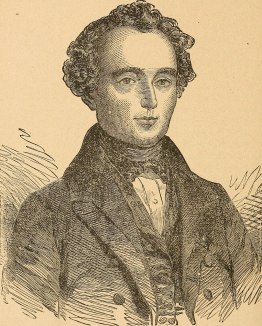
General William Irvine
General William Irvine (Wikimedia Commons)

(part one of five)

War on the American frontier was generally brutal, but few incidents inflamed American passions in the country’s early history as much as the torture and execution of Colonel William Crawford in June 1782 in Northwestern Ohio.  Crawford’s death marked the emotional climax of another patriot attempt to neutralize British power at Detroit, generally exercised through Native American proxies who had their own reasons for fighting the Americans, and halt the raids against American settlers on the frontier.  The Huron and Wyandot who lived about the Sandusky River, and the Shawnee to their South on the Scioto and Miami Rivers, both occasionally aided by various clans of the Delaware and Mingo tribes, were particularly troublesome in the Ohio River valley.  Colonel Crawford’s campaign, which resulted in his death, was meant to punish the tribes for past raids to forestall future raids.

Continue reading “The Crawford Campaign, 1782: American Strategy in Ohio, 1781-1782”
Burning Colonel Crawford

Last year I came across Dr. John Knight’s account of the torture and execution of Colonel William Crawford by members of the Delaware Indian tribe in 1782.  It was a vicious execution, but not unheard of in the wars on the American frontier, where violence and brutality from both sides were common.

Wiliam Crawford at 40 (Wikimedia Commons)
Crawford at about 40, twenty years before his execution (Wikimedia Commons)

Born in 1722, Crawford was a long-time business partner of George Washington, particularly in the acquisition of land in the Ohio River valley.  A veteran of frontier conflicts, during the Revolution he had served as the Lieutenant Colonel of the 5th Virginia Regiment, commanded the 7th Virginia in the east, and then returned to the Pittsburgh area to raise the 13th Virginia.  Sidelined during the war’s last years, he commanded local Pennsylvania militia and was largely retired by 1782.  For years, settlers in the Ohio Valley had agitated for punitive raid against the Ohio Tribes along the Sandusky River in today’s northwestern Ohio.  Their goal was to retaliate for Indian raids across the Ohio and spoil future raids.  By the spring of 1782, they could not be restrained.  After the militia massacred defenseless Christian Indians at Gnadenhutten in March, Brigadier General William Irvine, the Continental Commander at Pittsburgh, arranged for Colonel Crawford to lead the inevitable militia expedition, likely in hopes that Crawford could prevent a repeat.  (Crawford had taken no part in the Gnadenhutten Massacre).

Continue reading “Burning Colonel Crawford”

Visiting a Tragedy: Gnadenhutten, OH

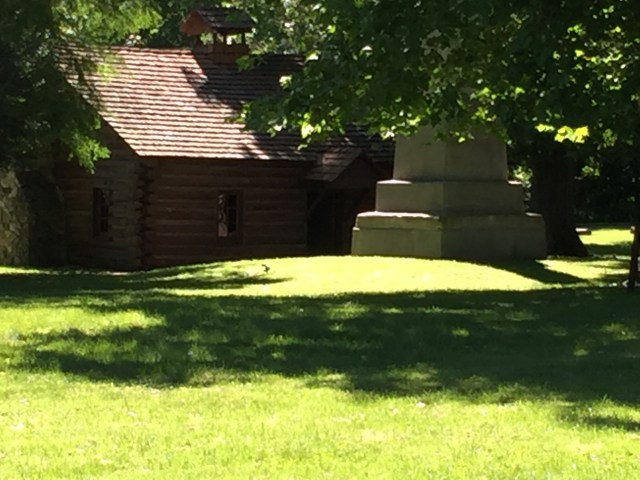
Few places in the American Revolution evoke sorrow like Gnadenhutten, Ohio.  There, in March 1782, militia from Western Pennsylvania bludgeoned, scalped, and burned to death some ninety-six bound Indians who had adopted the Christian faith preached by missionaries from the church of the United Brethren.  Thirty-four of the victims were children.  Benjamin Franklin called the killings “abominable murders.”[1]

IMG_2540
The Chapel at Gnadenhutten with the 1872 memorial.  The Cooper’s Hut is to the right.  (ES Photo)

Continue reading “Visiting a Tragedy: Gnadenhutten, OH”

Visiting Carlyle House

IMG_2250
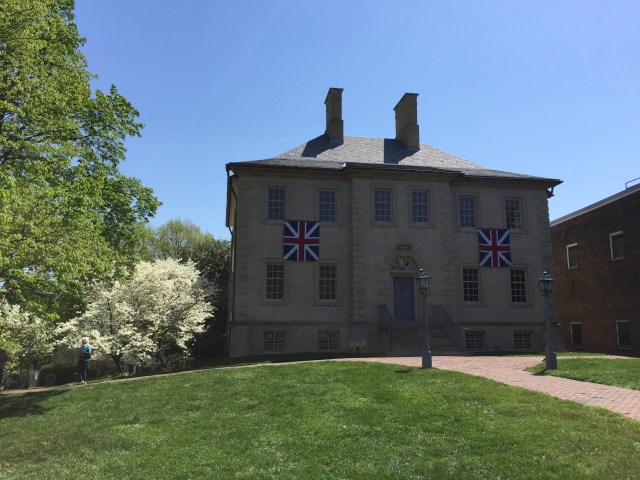
Carlyle House from the Front (Author Photo)

William Griffith’s examination of the Carlyle House Congress last month (The Carlyle House Congress and Britain’s Military Objectives for 1755) reminded me that I had been remiss in not visiting the site.   So, the family and I set off for Alexandria, VA and a visit to John Carlyle’s home.

Continue reading “Visiting Carlyle House”

George Mason’s Gunston Hall

IMG_2236
Gunston Hall River Entrance (Author Photo)

Gunston Hall’s River Entrance (Author Photo)

George Washington’s estate on the Potomac River is one of the most-visited places in the greater Washington, DC area, as befits the home of the Father of his Country.  Just twelve miles south (by road), however, sits an equally impressive 18th century plantation home.  Gunston Hall was the estate of George Mason IV (1725-1792).  Best known as one of the delegates to the Constitutional Convention who in the end opposed the Constitution’s ratification, Mason doesn’t always get his due in the stories of America’s founding fathers.  But, he was a critical and thoughtful voice in forming the early United States government and enshrining its first ten amendments, the Bill of Rights.  Fortunately, his home is open to the public and easily accessible from the metropolitan Washington area.

Continue reading “George Mason’s Gunston Hall”

Chief Cornstalk’s American Revolution (part two)

Fort Randolph (Wikimedia Commons).jpg

Modern Replica of Fort Randolph in Point Pleasant, WV (Wikimedia Commons)

At Fort Randolph, erected on the old Point Pleasant battlefield, Captain Matthew Arbuckle decided to take matters with the Shawnee into his own hands.  He was already suspicious of the Shawnee in general, and Cornstalk in particular.  In 1776, he reported that Cornstalk had traveled to Detroit and was “Treating with the English.”[i]  Of course, this was William Wilson’s attempt to preserve the neutrality of tribes nearer Detroit by inviting them to a pace conference.  Cornstalk had gone on the mission to lend weight to Wilson’s voice with those tribes.  Arbuckle did not know that.  Continue reading “Chief Cornstalk’s American Revolution (part two)”

Chief Cornstalk’s American Revolution (part one)

Chief Cornstalk (Wikimedia Commons).jpg

Chief Cornstalk after an 1870 rendering (Wikimedia Commons)

The American Revolution on the frontier was brutal.  Neutrality was difficult position to maintain, but some Native American tribes attempted it.  In the Ohio River Valley, it was particularly challenging.  But, for a time the Shawnee and Delaware tribes in modern-day Ohio sought to navigate their way between British power in Detroit and the Americans in Pittsburgh.  Chief Hokoleskwa, known as Cornstalk among the whites, was a leader of the pro-peace factions of the Shawnee.  Unfortunately, it got him killed. Continue reading “Chief Cornstalk’s American Revolution (part one)”

Winning the Battles and Losing the War: A Review of Whispers Across the Atlantick: General William Howe and the American Revolution, by David Smith

General William Howe Color (Wikimedia Commons).jpeg

(William Howe, Wikimedia Commons)

David Smith, Whispers Across the Atlantick: General William Howe and the American Revolution, (NY: Osprey Publishing, 2017).

If it’s true that George Washington lost all his battles, but won the war, then it’s equally true that Sir William Howe won all his battles and lost the war.  Of course, neither premise is accurate, but they pithily sum up the conventional interpretation of each commander’s accomplishments on the battlefield, wrong as they may be.  Washington’s role as Commander-in-Chief has come under increased scrutiny as Americans revisit their history.  His chief adversary, however, Sir William Howe, has largely escaped focused study.  David Smith set out to rectify that shortfall in his doctoral dissertation, which became the basis of Whispers Across the Atlantick.  Historians should thank him for it.  Continue reading “Winning the Battles and Losing the War: A Review of Whispers Across the Atlantick: General William Howe and the American Revolution, by David Smith”