Action At Charles City Courthouse-January 8, 1781

By the evening of January 6, 1781, much of the small town of Richmond, newly appointed capital of Virginia, was in flames. Brig. Gen. Benedict Arnold and his force of British regulars and loyalist provincial troops, to the tune of around 800, were east of the city, heading toward Westover Plantation, in Charles City County. It was the home of Mary Willing Byrd, widow of the late William Byrd III. She was also a cousin to Arnold’s wife, Peggy Shippen Arnold. The British transports had landed at Westover back on January 4 and it was there that Arnold finished planning his march on Richmond, 25 miles away.

Westover Plantation

With the arrival of Arnold’s forces at Portsmouth, on the Virginia coast, Gov. Thomas Jefferson believed the target of the raid was Williamsburg. Baron Friedrich von Steuben, the Continental Army’s military commander in the area, believed Petersburg was at risk. Both men were surprised when Arnold landed at Westover, showing his target clearly to be Richmond. Caught off guard, Jefferson nevertheless swung into action, calling out local militia companies. Von Steuben, likewise, sent Continental forces he had on hand to the north side of the James River, to relieve the capital. With a price on his head, the traitor Benedict Arnold couldn’t afford to linger too long in the area. Were he to be captured, he knew it would mean the gallows for him. After spending a mere 24 hours in the city, destroying Westham Foundry, located six miles above Richmond, burning public buildings & filling 42 small craft with tobacco, rum, and any other commodity worth cash money he could find, he gave the order to return to Westover and his troop transports.

Arriving there on January 7, the bulk of Arnold’s troops immediately bivouacked & began cooking rations. With Jefferson’s call, though, Patriot militiamen from the lower counties had been gathering throughout the area of Charles City. Many were seen on the high ground in back of Westover Plantation. Arnold became desperate for intelligence. Among his provincial forces were the Queen’s Rangers, Lt. Col. John Graves Simcoe, commanding. Made up mostly of loyalists from New York, the Queen’s Rangers were comprised of well trained and equipped light infantry and cavalry troops. Back on January 5th, it had been Simcoe who had led the troops who destroyed Westham Foundry. Born in England, Simcoe had served throughout the war, beginning with the siege of Boston back in 1775. He was a very competent officer who would go on after the war to serve as the first lieutenant governor of Upper Canada & to be elected a member of Parliament. He kept a journal throughout the war which he first published in 1787. In this journal Simcoe described the action in Charles City, after the raid on Richmond.

Screenshot

Lt. Col. John Graves Simcoe

Gen. Arnold ordered him to lead a patrol, he said, “to be made on the night of the eighth of January towards Long Bridge (on the Chickahominy River) in order to procure intelligence.” Simcoe detached 40 of his cavalrymen for the patrol. For the most part, he said, his men were “badly mounted, on such horses as had been picked up in the country.” The patrol had not proceeded beyond 2 miles on the main road, presumably the River Road (Modern Virginia State Route 5) before Simcoe’s vidette, a Sergeant Kelly, was challenged by two Patriot militiamen. Kelly kept up a friendly demeanor until he came close, then he rushed the Patriot scouts. He captured one while the other fled. Along with one prisoner, Simcoe said he also freed “a Negro who had been taken on his way to the British army.” From the rebel prisoner he learned that Patriot general Thomas Nelson, Jr had a large party of militiamen encamped at Charles City Courthouse, about 6 miles to the east. The corps of militiamen that had been seen at Westover were an advance party, the captured Patriot had said, and numbered around 400.

Upon learning this, Simcoe says he immediately ordered his troopers to the “right about”, off the road. A Lt. Holland, “who was similar in size to the vidette who had been taken” led the Ranger’s advance. The African American man Simcoe liberated offered to guide his force to the courthouse by an obscure pathway, off the main road. Simcoe’s intention was to attack or, in his words, “beat up” the main body of militia at the courthouse, believing their guard would be lowered owing to the presence of the large advance party on the main road. If repulsed, he planned to retreat along the same path. If successful against the main body, though, he knew he had the option of attacking that advance party of 400 men. 

img_9491

Charles City Courthouse, built ca 1730

As they moved to the east that evening, Simcoe wrote that the patrol “passed through a wood”, where it halted “to collect”. They had scarcely resumed their march on this back road when the column was immediately challenged by a Patriot picket or vidette. Answering the challenge, Lt. Holland, riding in the van, immediately called out… “A friend”; he then gave the countersign for the challenge which the Patriot prisoner had told them. “It is I, me, Charles.”, which apparently was the name of the Patriot militiamen whom Lt. Holland was impersonating. Holland continued leading the column, past the first picket. Riding beside him was the irrepressible Sergeant Kelly, who immediately grabbed the militiaman. Holland himself lunged for a second militiaman who was sitting his horse nearby, but Simcoe said, grabbing hold of him the man was too strong and got free. That second man whirled and, “presented, and snapped his carbine.” For Lt. Holland it was a lucky misfire. The militiaman then galloped off a distance, re-primed his piece & fired off a warning shot.

Simcoe’s patrol had been spotted; the element of surprise was now lost. He gave the immediate order to advance as rapidly as possible and very quickly his force reached the grounds of the courthouse where several companies of Patriot militiamen were encamped. To these men, this had always been a place of safety; where men of Charles City County came to join the militia and, many years later, this is where many old veterans would file their depositions in hopes of obtaining a pension for their service. Now, they were under attack. According to militiaman William Seth Stubblefield, his company was “taken on surprise” about midnight. Simcoe said his men rushed on and immediately a confused and scattered fire began, on all sides. His troopers, attacking from out of the darkness, were nonetheless heavily outnumbered. Thinking quickly, however, Simcoe used his cunning.

Screenshot

Queen’s Rangers

He immediately sent his two “bugle horns”, buglers, men he called French and Barney, over towards his right. They had orders to “answer his challenging, and sound when he ordered.” The night air was quickly becoming filled with lead as both sides exchanged fire. As a ruse, Simcoe called out in a loud voice for the “Light Infantry to form”; then he gave the order to “sound the advance”. The buglers on the right responded, and sounded their horns. In a matter of seconds, the Patriot militiamen, caught off guard and now apparently fooled into thinking they were outnumbered and being flanked, immediately started falling back. As John Graves Simcoe described it, “the enemy fled on all sides, scarcely firing another shot.” And just like that, the skirmish was over. But the night was dark, and the Queen’s Rangers were unfamiliar with the country. Some of the Patriots were captured while others were wounded. Simcoe said a few of the fleeing militiamen drowned in a nearby mill dam. In his 1833 pension application, militiaman Irby Phillips likewise referenced men “drowning in a mill pond”. Simcoe said that he himself stepped in to save three armed Patriots from “the fury of the soldiers (Rangers)”. He said the militiamen were frightened and presented their loaded pieces, directly at his breast. In their agitated state, they easily could have pulled the triggers, but, luckily for Simcoe, they didn’t.

From these three prisoners he learned that he had earlier been deceived; that he had fallen for a ruse himself. The story he had been told of the 400-man Patriot advance party near the main road was false; there was no advance party. What Simcoe had been calling the main party consisted of between 150 and 200 militiamen, all encamped with cookfires going. General Nelson was not among them but, apparently, was in camp some miles away, back towards Williamsburg with a force of around 700 or 800. Many of the fleeing militiamen headed in that direction.

Simcoe ordered his troopers to mount immediately. Many of them wanted to search the buildings and homes near the courthouse, where several of the militiamen had fled, but were not permitted. Simcoe wrote that his troopers were “plainly distinguished by the fires which the enemy had left.” Silhouetted in this way, the commander believed his small numbers could have easily been discerned, possibly inviting a dangerous counter attack.

In this brief action, the Queen’s Rangers lost one man, a Sergeant Adams, who was mortally wounded. Simcoe described the sergeant’s last moments: “This gallant soldier, sensible of his situation, said: ‘My beloved Colonel, I do not mind dying, but for God’s sake, do not leave me in the hands of the rebels.” French, one of the buglers, and two other troopers were wounded in the engagement and about a dozen of his horses had been captured. The Patriots, in Simcoe’s estimation, suffered around 20 or so casualties, including several captured.

The Rangers left Charles City Courthouse and headed west, back towards Westover, with their prisoners. Simcoe said the enemy made no threat against his rear. The patrol arrived at Westover the next morning, January 9. There, Sergeant Adams died and was buried with honors. On January 10, Benedict Arnold’s transports shoved off into the James River and began their trip back towards Portsmouth.

By 1781, Virginia was a major supply depot and logistical hub for the Southern American army operating in the Carolinas. While Arnold’s strategic strike against Richmond was brief, it was yet overwhelmingly successful. Ironically though, the final chapter of this event wasn’t written in Richmond at all but, rather, in Charles City. The old county courthouse, which still stands today along historic and scenic Virginia State Route 5, was a witness to it all.
“Fight and Be Strong” Battle of Point Pleasant October 10, 1774

The ground fog was thick off the Ohio; the air was chilly on that early October morning. Two groups of hunters moved north along the river in the pre-dawn darkness, hoping to shoot a deer for their breakfast. Instead, they stumbled across something unexpected: Shawnee warriors! The battle of Point Pleasant was on.

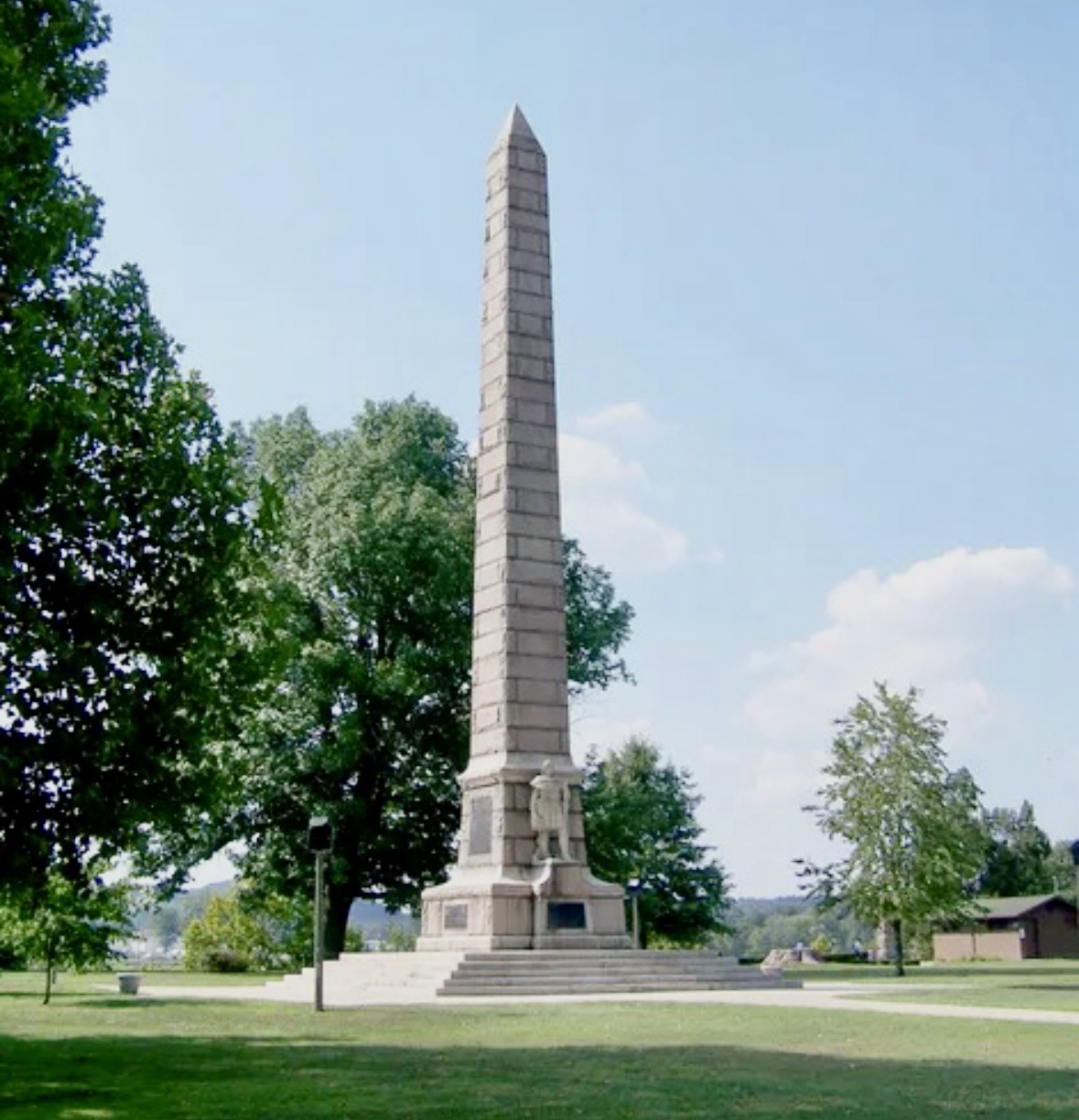
Point Pleasant Monument

In the summer of 1774, exactly 250 years ago and on the very eve of the American Revolution, the Virginia Colony went to war, but not with the British. In fact, the colonists at this stage still considered themselves to be British. Virginia went to war that summer against the Shawnee, Mingo, Wyandot, and other Native American tribal nations west of the Appalachian Mountains. As wars go, this wasn’t much of one, lasting barely six months and with only one decisive battle.

It stemmed from what one side called emigration and what the other considered encroachment. Bodies of English settlers, in ever increasing numbers, were crossing the mountains in hopes of settling land in the Ohio River Valley. This was territory that had been claimed by the French and transferred over to the British at the end of the Seven Year’s War. To the tribal nations in the Ohio Valley, like the powerful Shawnee, it was an affront. The settlers were looked upon as invaders, encroaching upon ancestral hunting grounds. Inevitably, the stage was set for violent and bloody clashes between these two peoples.

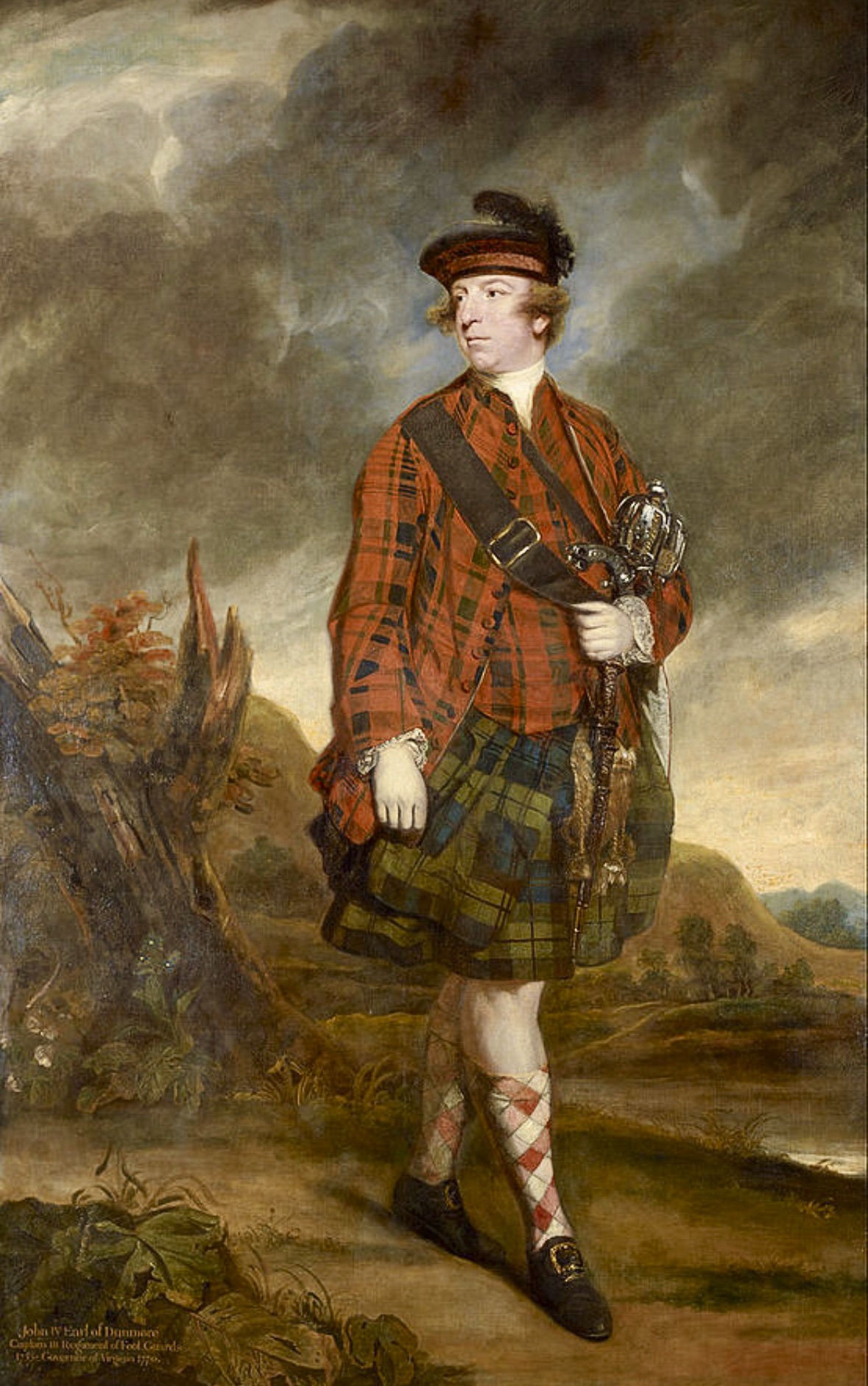
Hoping to pacify the frontier and establish once and for all Virginia’s jurisdiction over the Ohio Valley, the colony’s royal governor, John Murray, 4th Earl of Dunmore, asked the House of Burgesses to declare war and he called out the Virginia militia. In the years to come, many of the men serving in these militia companies would go on to distinguish themselves as officers and soldiers in the Continental army during the Revolution. For them, the fighting on Virginia’s frontier, in what came to be called Dunmore’s War, would serve as a dress rehearsal. This would be the last time in our nation’s history that a colonial American militia would march to war under the banner of the British crown.

John Murray, 4th Earl of Dunmore

At the Treaty of Fort Stanwix in 1768, the Iroquois peoples of the powerful Six Nations sold lands south of the Ohio River to the British, from Fort Pitt (modern-day Pittsburgh) down to the Louisa River (now the Kentucky River). This was territory the Iroquois believed to be part of their domain. For money and gifts totaling around £10,000, the Six Nations ceded to the Crown lands making up the modern states of Kentucky and West Virginia. The Shawnee and other western tribes in the Ohio Valley were outraged as white hunters, surveyors, land agents and settlers began to pour over the mountains. A trade-off of terror began, with both sides viciously attacking the other.

In the late summer of 1773, the first planned emigration into the new territory of Kentucky was undertaken. A prominent leader of this enterprise was Captain William Russell, a substantial landowner in southwestern Virginia and a magistrate of the newly created Fincastle County. Another organizer and the man who would act as guide for this first emigration attempt, made up of his and several other families from the Yadkin River Valley in North Carolina, was an obscure hunter named Daniel Boone. Boone led a party of 50 men, women and children through Powell’s Valley in southwestern Virginia, hoping to pass through Cumberland Gap into Kentucky. On October 10, just three miles behind Boone’s main party, his 17-year-old son James, 17-year-old Henry Russell, and a small group of young men, bringing up cattle and other supplies, were attacked by 19 Shawnee, Cherokee, and Delaware warriors. Both Boone and Russell were shot and hideously tortured to death. Word of the attack spread, causing the elder Boone’s party to turn back, abandoning all hopes of settling in Kentucky. 

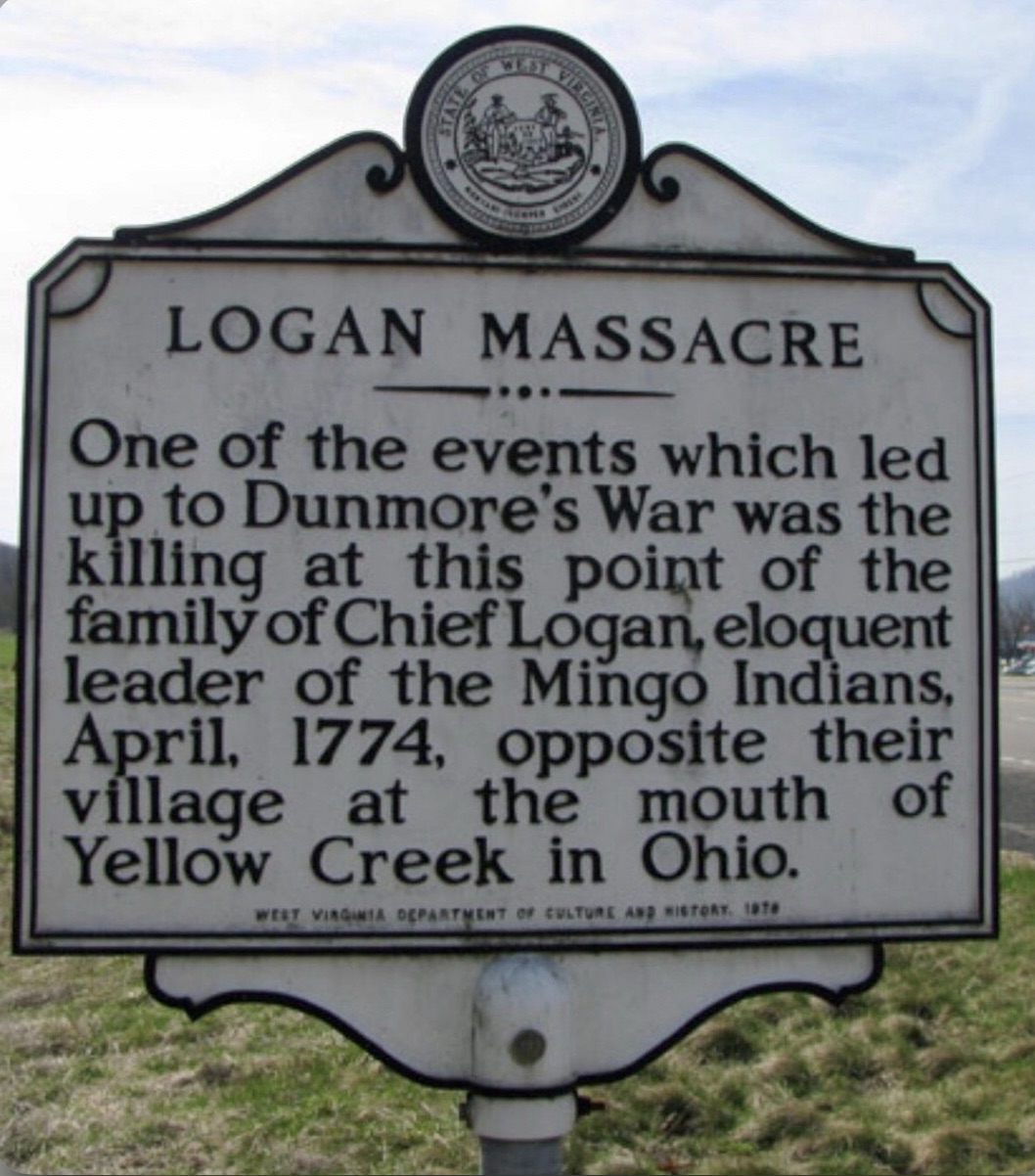
In late April of 1774, at a white trading post on the south bank of the Ohio River called Baker’s Bottom, several peaceful men and women of the Mingo tribe were murdered and scalped by white settlers believed to be under the leadership of a man named Daniel Greathouse. Among the victims were family members of a Mingo leader named Talgayeeta; he was known to the English as John Logan. As a result of the attack, the once peaceful Logan swore vengeance and, accepting help from the Shawnee, began indiscriminately attacking isolated white farmsteads along the Monongahela River throughout the summer.

Screenshot

With word of the atrocities reaching Williamsburg, Governor Dunmore sent out a circular letter to all county lieutenants to be on the alert, build small forts and blockhouses for more security and to send out rangers to watch the trails. He was growing frustrated with the Virginia House of Burgesses for not creating regular, provincial military units to defend the frontier. The burgesses were preoccupied with the political unrest in the east, mainly due to parliamentary taxation. They passed a resolution to observe a day of humiliation, fasting, and prayer in response to the Boston Port Bill, which had resulted from the Boston Tea Party in December 1773. On May 26, Lord Dunmore dissolved the House of Burgesses and under his authority as royal governor, mobilized the Virginia Militia.

In late July came the first action of the militia. An expedition against an important Shawnee village on the Muskingum River, Wakatomika, was led by Major Angus McDonald. At Fort Fincastle, near modern-day Wheeling, WVA, McDonald’s battalion of 400 men pushed off in canoes and small boats on the Ohio River. Among his company commanders were two future Patriot leaders of the Revolutionary War, George Rogers Clark and Daniel Morgan. Combat with the Shawnee was minimal, although McDonald’s force did suffer some casualties. Wakatomika was plundered and burned, along with several other villages before the militiamen returned to Fort Fincastle. On the whole, the expedition had accomplished very little and, instead of curbing the Native American attacks on settlers, actually caused the attacks to increase. Lord Dunmore now knew that overwhelming force would be needed.

In the late summer of 1774, Dunmore authorized the creation of two divisions of his militia, north and south. At Winchester, he mustered around 700 men from Virginia’s eastern counties. The Governor was disappointed, however, to learn that his invitation to join the division, made to a retired British army officer living in Berkeley County, was turned down. He was Horatio Gates, future major general in the Continental army, victor at the battle of Saratoga in 1777, and the man who suffered a devastating loss to the British at Camden in August 1780.

To the south, at Staunton, VA, militia Colonel Andrew Lewis, a future brigadier general during the Revolution, mustered ultimately around 1,100 men from the western counties of Augusta, Botetourt, Fincastle, Bedford, and Culpepper. With negotiations failing, by late August, Lord Dunmore put the Northern and Southern Divisions into motion. Their plan was to rendezvous on the Ohio River and march on the upper Shawnee villages on the Scioto River, in modern-day Ohio. Dunmore’s Northern Division marched west from Winchester to Fort Pitt, then down the Ohio to Fort Fincastle. There, 500 more men joined the division. Many of Dunmore’s troops had no weapons so he sent back to Williamsburg for 300 stands of arms. Dunmore’s second-in-command was Colonel Adam Stephen, another future major general in Washington’s Continental army. On October 2, the division moved farther south down the Ohio, to Fort Gower on Hockhocking Creek.

Screenshot

Colonel Andrew Lewis

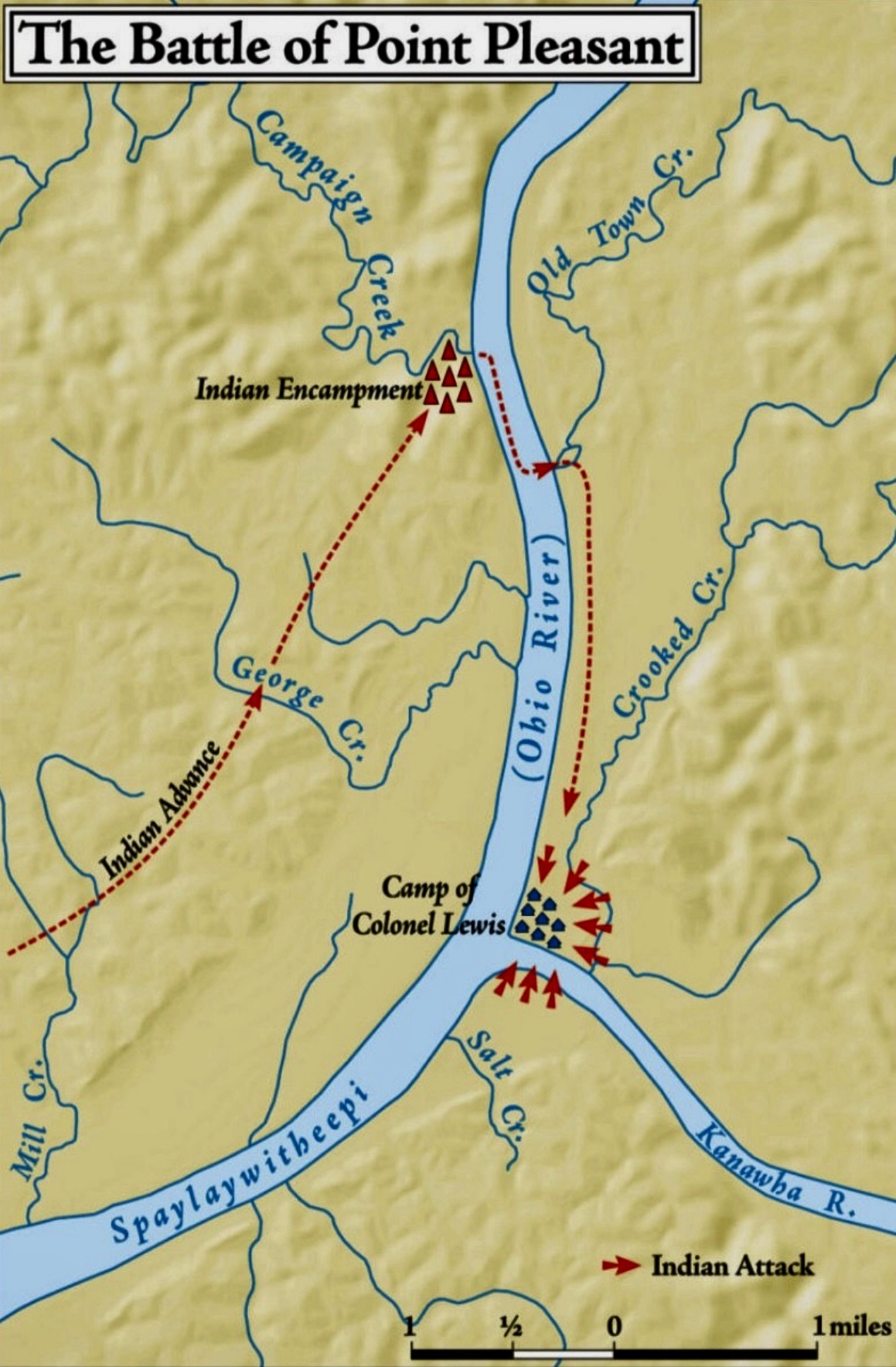
From Staunton, Andrew Lewis marched his Southern Division west to a place called Great Levels, on the Greenbriar River. He named it Camp Union, on the site of modern-day Lewisburg, WVA. He then headed south, hitting the Kanawha River and following it west to where it empties into the Ohio at a place called Point Pleasant. Lewis’ lead elements arrived there on October 6 and began building barricades from the Ohio River on their left around to the Kanawha, which was at their backs. They also built pens and corrals for the livestock that would feed Lewis’ companies.

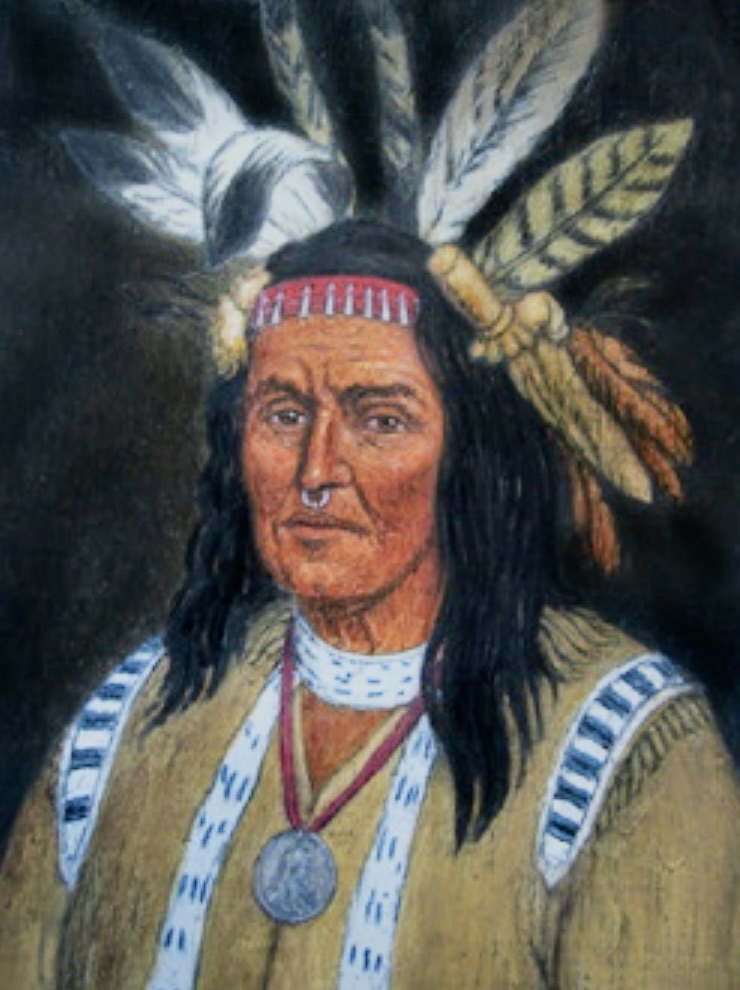
Leading the Shawnee and several other allied tribes as head war chief was a man named Hokoleskwa, also called Cornstalk. He commanded a force of around 1,000 warriors, which possibly included the future Shawnee war chief, Blue Jacket. Though his army was equal in size to both of the Virginia militia divisions individually, Cornstalk would be greatly outnumbered were those divisions to rendezvous, as planned. He decided, then, to attack each division separately and destroy them in detail. Being closer to the Southern Division, he chose to attack it first. On the night of October 9, Cornstalk rafted his army across the Ohio River at Old Town Creek, about five miles above Col. Lewis’ encampment. They then marched south to within two miles of the militia.

Shawnee Chief Cornstalk

In camp, Lewis issued a rather unpopular order. Feeding his troops from the livestock he had brought along from Camp Union, Lewis ordered the oldest and poorest quality beeves butchered first. Not having a taste for stringy beef, two separate, two-man hunting parties set out before dawn on the foggy morning of October 10, moving north along different paths, looking for deer. After walking nearly two miles, both hunting parties stumbled upon Cornstalk’s warriors. Shots were fired and one of the hunters, Pvt. Joseph Hughey of Fincastle, was killed. The other three made their escape and brought news of the enemy presence back to Col. Lewis.  

Thinking this was possibly a large scouting party, Lewis ordered two detachments of 150 men each to move up and reconnoiter. On the left, close to the Ohio River, were men from Botetourt County, commanded by Col. William Fleming. On the right, farther inland, were Augusta County militiamen commanded by Lewis’ own brother, Col. Charles Lewis. Around sunrise, Cornstalk’s warriors attacked, opening a brisk fire on the Virginians. Charles Lewis was hit almost immediately, in the abdomen. While being helped back to the encampment, he called to his men: “I am wounded, but go on and be brave.” Fleming’s Botetourt men also came under fire. The militiamen were outnumbered and the Shawnee attack was so fierce that both Virginia detachments faltered and were forced to fall back, ultimately around 200 yards. William Fleming was likewise hit, with wounds to the head and left arm. He continued to direct his men, though, until weakening from his wounds. Under his own power, he walked back to the encampment. A gap in the line separated the militia detachments. Warriors began rushing forward to exploit that breach. Directing the battle from the encampment, Andrew Lewis ordered Col. John Field of Culpepper forward with 200 men to assume command on the right, with orders to extend his left flank to link up with the Botetourt contingent. Lewis sent another 200 troops to join the Botetourt men, with orders for Captain Evan Shelby to assume command on the left. With more Virginia troops becoming engaged, Cornstalk’s initial superiority in manpower was starting to fade. The tide was turning.

Battle Map – Point Pleasant

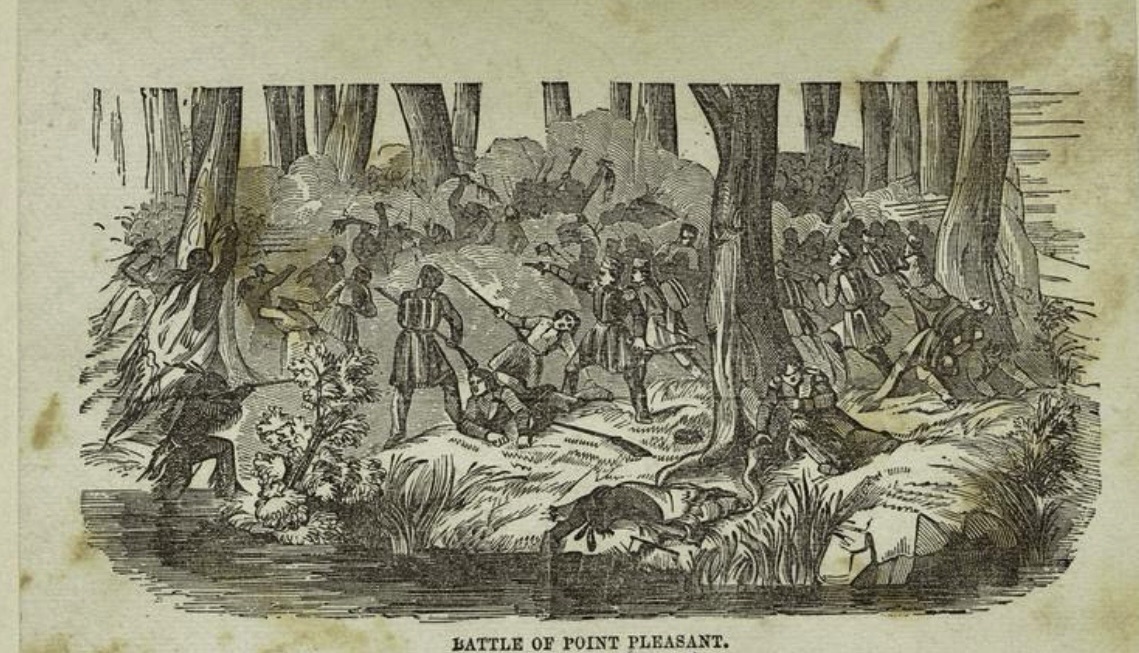
Under sustained fire, the militia detachments were finally able to link up. With their flanks no longer in the air, the battle line now stretched from the Ohio River over to Crooked Creek, making a flanking maneuver by the warriors next to impossible. John Field was killed; Evan Shelby took command of the entire line of battle. The fight had turned hand-to-hand. For several hours the bloody contest continued. Those Virginians who understood the Shawnee dialect afterwards claimed they had heard the sound of Cornstalk’s voice over the din of battle encouraging his warriors to “Fight and be strong”. Hand-to-hand combat, by its very nature, can be brutal and bloody. Both sides were suffering severe losses as the contest continued but Cornstalk made the decision to stay in the fight at Point Pleasant in order to inflict more damage to Lewis’ men. Withdrawing from the battle in order to fight another day put Cornstalk’s forces under a decided disadvantage. It would allow the wings of the Virginia militia to combine, closer to the Shawnee villages. He had to continue to fight as long as possible. But after so many hours, the allied warriors were beginning to falter, falling back under the pressure from the militia. The long rifles of the Virginians were now taking a heavy toll.

Battle of Point Pleasant, October 10, 1774

Col. Lewis sent orders to Capt. Shelby to advance his troops. With this surge, Cornstalk’s braves began to give more ground. Lewis earlier had ordered three companies of Augusta militia to move to the right, along the heights above Crooked Creek in order to flank the enemy. Now they opened fire, surprising the warriors on Cornstalk’s left. With knowledge that more militiamen were coming up from Camp Union, Cornstalk had no choice but to disengage at this point. Close to sunset, after hours of bloody combat, Cornstalk’s army began to withdraw, hoping to get back across the Ohio. They largely carried off their dead, throwing some of the bodies into the river to hide their losses. They were successful, however, and made the north bank of the river but Chief Cornstalk’s attempt to destroy the Southern Division had failed.

The Virginia militia had won the field, but at a terrible cost. Andrew Lewis lost around 75 men killed in the engagement with 140 more wounded. It’s believed that Cornstalk’s casualties were similar. Just before the battle, Lord Dunmore had moved his division inland, closer to the Shawnee villages, and established Camp Charlotte at Pickaway Plains. With his allied warriors not willing to engage further, Cornstalk had no choice but to initiate peace talks. His decision did, however, save the upper Shawnee towns from destruction.

With the subsequent Treaty of Camp Charlotte, Lord Dunmore’s War came to an end, but peace on the frontier would be fleeting. Within six months, shots were fired at Lexington and Concord, plunging America into war with Great Britain. More settlements were established in Kentucky and Shawnee raids would continue throughout the next twenty years.

With the coming of the American Revolution, Lord Dunmore himself would eventually be forced out of Virginia, pursued by some of the same militia officers he had commanded in the war that took his name.

For more about Point Pleasant and Dunmore’s War, check out our Rev War Revelry with Dr. Glenn Williams on our Facebook page or You Tube Channel.

Now At Rest

Not long ago, a good friend of mine found himself in Henry County, Va. Located southwest of Richmond, the county was named for the patriot, Patrick Henry, in 1777. Touring a local cemetery there, my friend came upon a very interesting headstone. It was the grave marker for a soldier of the American Revolution; a man named Thomas Pearson.

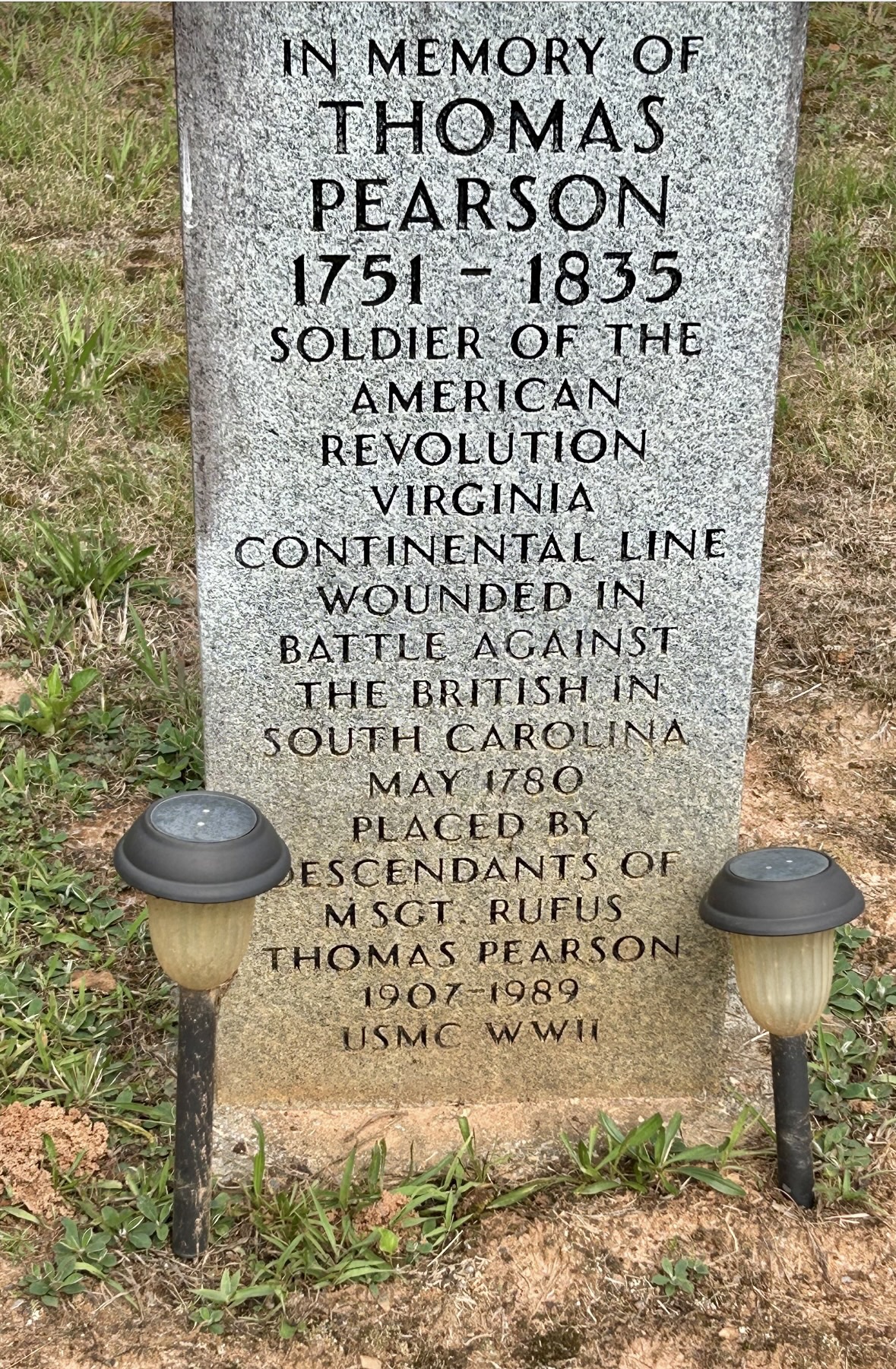
Grave of Thomas Pearson

According to the headstone, Thomas Pearson had served in the Virginia Continental Line and in May 1780, was wounded in battle against the British in South Carolina. My friend sent me a photograph of the headstone. Based on the place and date, he was hoping this Thomas Pearson had perhaps served at the battle of Camden. As a co-author of a book on Camden, I have to admit that I was quite intrigued myself.

But, based on my research for the book, I knew immediately that certain pieces of information on the man’s epitaph didn’t correspond to details of the Camden fight. First off, it indicates that Thomas Pearson served in the Virginia Continental Line. The Virginians engaged at Camden were actually not part of the Continental Line but, rather, state militia forces commanded by Gen. Edward Stevens. In fact, most of the troops of the Virginia Continental Line were captured by the British at the fall of Charleston on May 12, 1780.

The epitaph also reads that Pearson was wounded in May 1780, in South Carolina. The battle of Camden occurred later, on August 16, so most likely this gentleman wasn’t there. Still, the gravestone intrigued me. I decided to do a little research into Thomas Pearson and sadly, I was to discover that his story was a tragic one.

On November 30, 1812, at the age of 61, Thomas Pearson applied for a pension for his services in the Revolutionary War from the Commonwealth of Virginia. According to his application, he was “a soldier in the revolutionary war, belonging to the VA Line on continental establishment, and attached to the regiment commanded by Col. Abraham Buford.” Clearly, he was a veteran of the southern campaign.

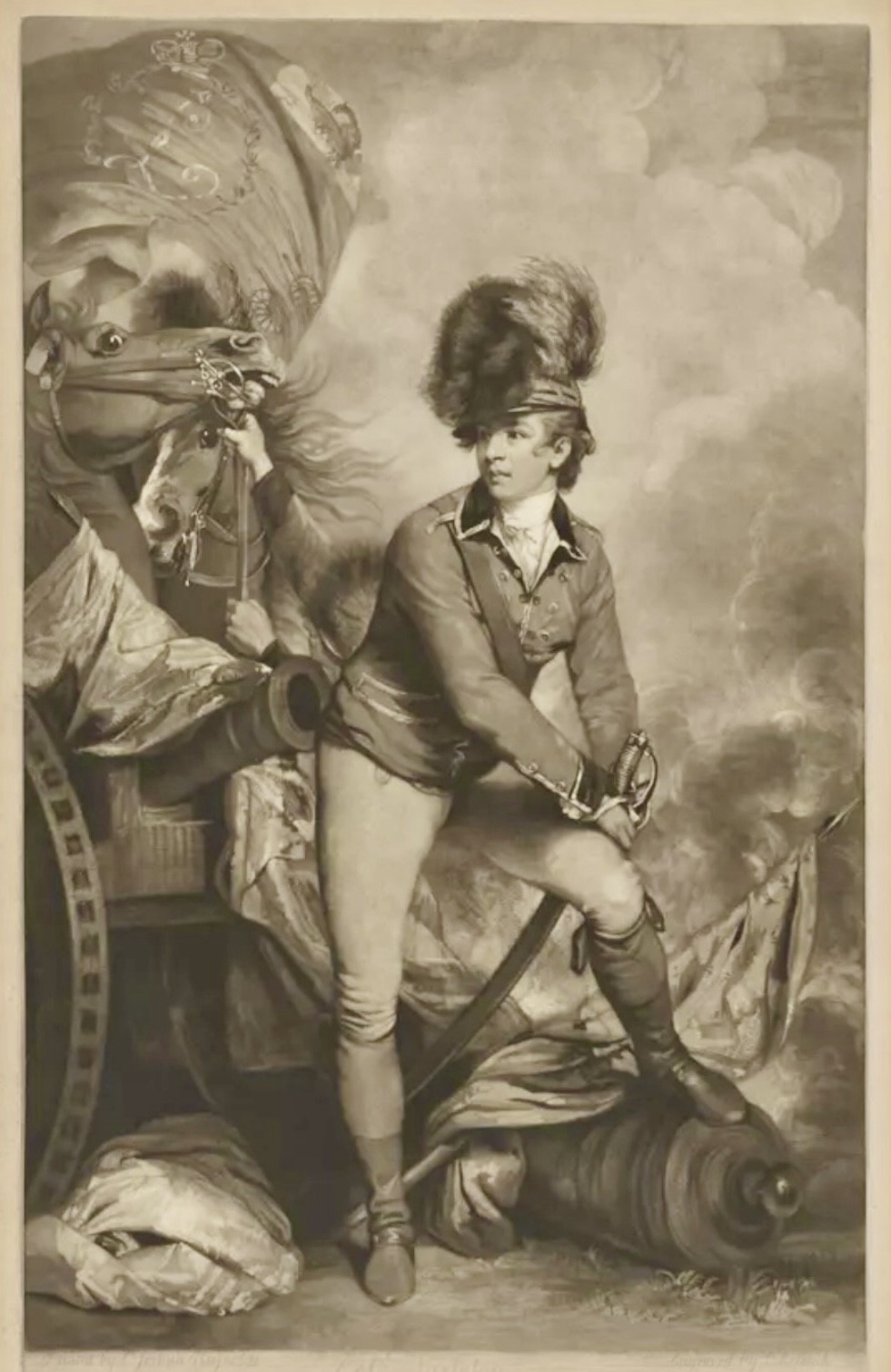
In May 1780, he was indeed serving in the Virginia Continental Line, as an officer of the 3rd Virginia Detachment of Scott’s Virginia Brigade. Commanded by Col. Abraham Buford of Culpepper County, VA, the 3rd Detachment, nearly 400 strong, was marching into South Carolina to the relief of the City of Charleston, which was under siege by the British. The city fell before Buford’s column could reach it, however. Afterwards, Buford received orders from Brig. Gen. Isaac Huger to fall back to Hillsborough, NC. In Charleston, British Lt. Gen. Charles, Earl Cornwallis, who would soon assume command of all British forces in the south, learned of the existence of these Patriot reinforcements. On May 27, he sent troops in pursuit. They were mounted troops of the British Legion, mostly loyalists under the command of the infamous Lt. Col. Banastre Tarleton. Throughout the southern campaign, the 26-year-old Tarleton would establish for himself a reputation for cruelty and blood lust that was unsurpassed. Some of the acts attributed to him during this period were true and some were not, but his dubious reputation would become cemented in the minds of many Americans during this episode.

Lt. Col. Banastre Tarleton

Tarleton set out in pursuit of Abraham Buford’s troops on May 27, leading around 300 of his Legion dragoons, some mounted infantry, and a detachment of the 17th Light Dragoons. Having a reputation for driving his forces unmercifully, Tarleton’s troops were able to quickly catch up, and closed in on Buford’s Virginians on May 29, on the border of North and South Carolina. It was farming country here, known as the Waxhaws.

When the two forces were still some miles apart, Tarleton issued a call for surrender, under a white flag of truce. In his message he wrote: “Resistance being vain, to prevent the effusion of human blood, I make offers which can never be repeated.” After conferring with his officers, Col. Buford made the decision to refuse Tarleton’s offer. He replied: “I reject your proposals, and shall defend myself to the last extremity.”  The Patriot force then continued its march north towards Hillsborough, with Tarleton’s troopers continuing the pursuit.

By mid-afternoon of the 29th, Tarleton’s lead elements caught up with Buford’s column, attacking and destroying the small rear guard. Commanding that rear guard was Lieut. Thomas Pearson. Witnesses said that Pearson was sabered and knocked from his horse. While he lay on the ground, he continued to receive wounds; his face was mangled and there were cuts across his nose, lips, and tongue. Col. Buford halted his column, deploying his infantry in a single line across an open field, east of the Rocky River Road. He then issued a questionable order: his men were told to hold their fire until the dragoons were almost on top of them and then unleash a volley at point-blank range. When the charge came, the Virginians followed orders; they held their fire until the British were about 10 yards away. While their one volley did manage to empty a few enemy saddles, it wasn’t nearly enough and now the Virginians had no time to re-load their muskets. In a flash, Tarleton’s troopers were in among the Continentals, hacking men down with their sabers, wholesale.

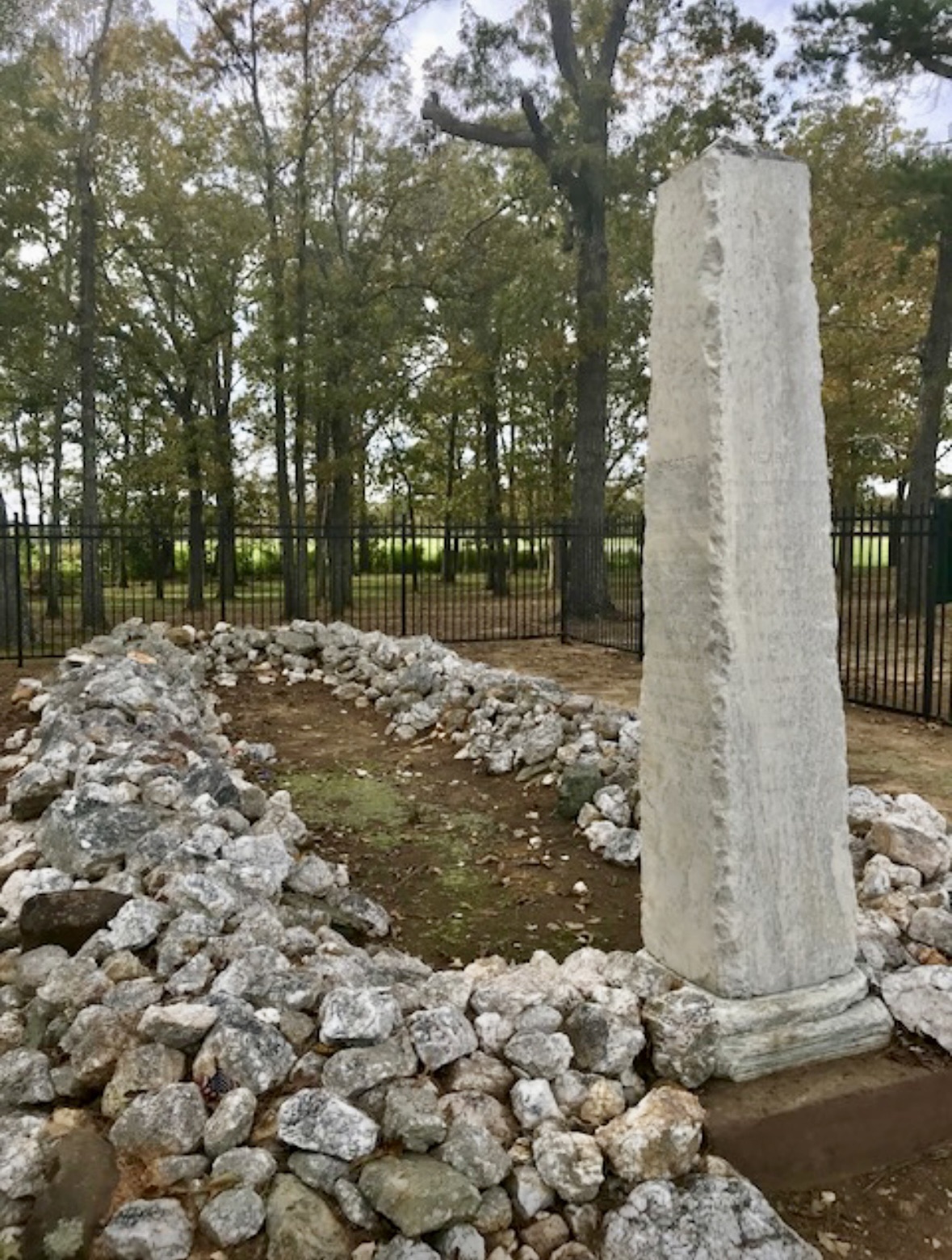
Quickly realizing the battle was lost, Buford sent forward a white flag of surrender. About this time, Tarleton’s horse was killed, going down and momentarily trapping its rider. Some of his nearby troops became enraged, believing the Patriots were not honoring their own white flag. These troops are said to have continued sabering Patriot soldiers as they tried to surrender. Abraham Buford and some of his troops did manage to escape the field but his command was destroyed. Continental casualties totaled around 113 killed, 147 wounded, and 50 captured. Two Patriot 6-pounder artillery pieces and 26 baggage wagons were likewise captured. Compared to this, Tarleton’s losses were negligible. The battle would long be remembered as “Buford’s Massacre” and many of the Patriot dead lie today in a mass grave at the battlefield site. 

Mass Grave at the Waxhaws battle site

Banastre Tarleton’s reputation for cruelty was established at the Waxhaws. Nicknames like “Bloody Ban” and “Bloody Tarleton” began to be used to describe him and the phrase “Tarleton’s Quarter” would become a Patriot battle cry.    

Even though severely wounded in this action, Lieut. Thomas Pearson managed to survive his injuries, living until 1835. He was 84 when he died; his last years were hard on him. According to his pension application, he “received sundry wounds in his head and arms, which have rendered him, in his present advanced stage of life, incapable of maintaining himself by labour (sic).” On January 12, 1813, the Commonwealth of Virginia granted Pearson’s request for relief. He received an immediate payment of $50, with an annual pension payment of $60.

Today, this Revolutionary War veteran lies at rest in a quiet cemetery in Henry County, VA.

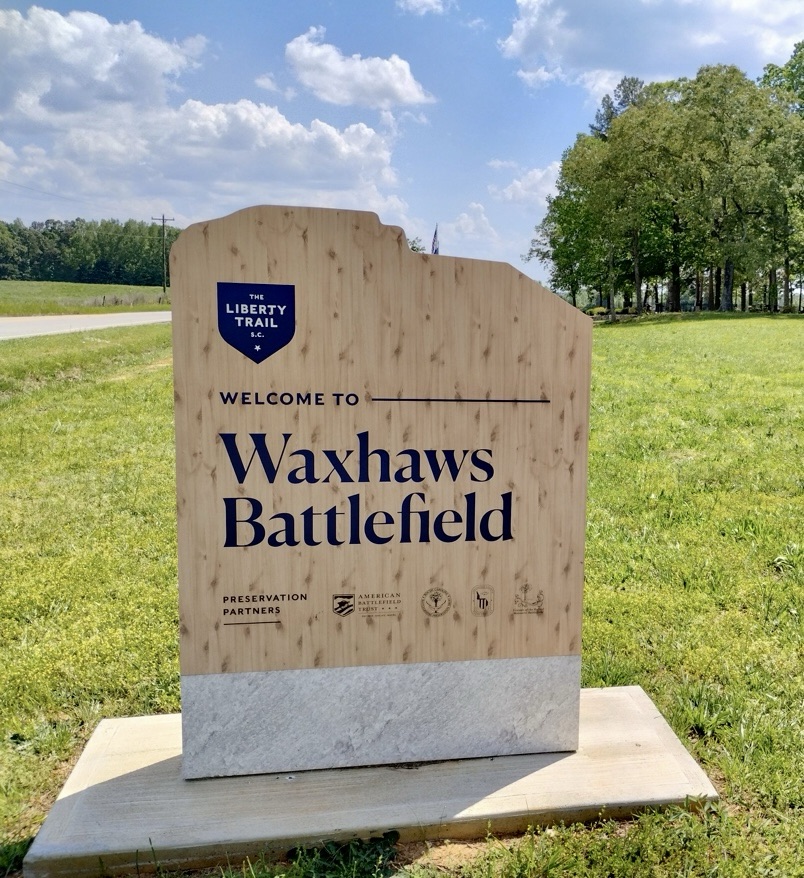
The Waxhaws Battlefield Site, in Lancaster, SC

“Let’s All Sit Down Now and Have a Hearty Cry”

The summer of 1776 was tense on the Kentucky frontier. Since the spring, Shawnee raids from north of the Ohio had increased, with tribesmen raiding the white settlements with the intention of driving the settlers east, back across the mountains.

By the late spring, hardly more than 200 Americans remained in Kentucky, most forting up in the settlements south of the Kentucky River at Harrodsburg, Logan’s Station, and Boonesborough as war parties ranged nearby. Years later, an old settler remembered the rancid conditions of long confinements in “a row or two of smoky cabins, among dirty women and men with greasy hunting shirts.” By the summer, conditions in the forts were almost unbearable as supplies of salt and meat began to run low.

On the quiet Sunday afternoon of July 14, 1776, 13-year-old Jemima Boone, daughter of frontiersman Daniel Boone, slipped out of the log gates of Boonesborough with her friends Elizabeth (Betsy) and Frances (Fanny) Calloway. Tired of the confinement of the fort, the three girls untied the lone canoe of the settlement and pushed out into the Kentucky River for an old-style joy ride. Jemima would remember years later that her father had warned her to stay near the cabins and never cross to the other side of the river.

Betsy Calloway, 16, guided the canoe but it was soon caught up in the current and taken downstream toward the northern bank. A small mixed war party of Shawnees and Cherokees were watching the settlement from the woods across the river. They had been in the area for at least a week when they spotted the girls in the canoe. As the craft got close to the shore a warrior jumped into the river and grabbed the towline. Understanding immediately the danger they were in all three girls began to scream. The warriors brought the canoe to shore and quickly made signs to the girls of what would happen if they continued screaming. But the sounds had already alerted the settlers in the fort.

It was Sunday, the Sabbath and, as was his normal custom, Daniel Boone was lying down for his Sunday afternoon nap when he heard the commotion from out in the fort. Running out of his cabin in his bare feet, Boone joined with Richard Calloway, father of Betsy and Fanny, and several other men of the settlement as they eventually made their way to the opposite shore of the river and began tracking the war party as it made its way towards the crossing of the Licking River at the upper Blue Licks.

One of the Cherokee men in the party was named Scolacutta but known to the Americans as Hanging Maw. He knew Daniel Boone and his family and spoke a bit of English. He recognized Jemima as Boone’s daughter. Hanging Maw laughed at the joke they were playing on old Boone, Jemima remembered many years later, and confirmed they were headed for the Shawnee towns north of the Ohio. If the party managed to get across the big river, the rescue of the girls would most likely become impossible. As they were forced along the trail, the three girls dug their heels into the earth or dropped bits of material from their clothing; anything to give signs to anyone who may be following that they were on the right path.

By the morning of the second day, Boone and his party were roughly 10 miles behind the kidnappers. Now with a pretty good idea of where the war party was heading and understanding that, continuing to follow the tracks would slow them down considerably, Daniel Boone made the decision to break from the trail and speedily head for the Blue Licks. It was certainly a gamble but the men with Boone trusted his judgment. The Kentuckians moved out, setting a jogging pace.

As they got closer to the war party, the rescuers began finding the signs left for them by the kidnapped girls. They also came across muddled waters at a creek crossing, a dead snake along the trail and finally the carcass of a recently butchered buffalo calf. They knew they were getting close. Boone figured the warriors would stop to cook at the next water they came across. At a branch known today as Bald Eagle Creek, east of the current town of Sharpsburg, KY, the trail ended. Boone divided his party, with four men going up stream and four heading down.

After two days of hard travel with no sign of pursuit, the warriors began relax a bit. They would soon cross the Licking River and link up with other war parties so they began feeling confident. They made camp and began to roast the buffalo meat. The terrified girls were exhausted by being on the march. The camp was in a small, open glen. As the warriors lolled about the girls were sitting near the cook fire. Suddenly, Jemima Boone heard a noise in the brush. The sound caught the attention of one of the Shawnees who looked up but, seeing nothing, returned to his work. Glancing up along the nearby ridge, Jemima suddenly caught sight of her father. The girl remembered he was “creeping upon his breast like a snake.” Around 100 yards or so apart, the father and daughter locked eyes. Boone gave a quick signal for the girl to remain quiet.

The rest of Boone’s party were gathered up on the ridge when, in a fit of excitement, one of them fired his rifle down into the camp. Before she heard the shot, Fanny Calloway saw blood spurt from the chest of the warrior standing next to the campfire. He managed to hobble off into the brush. “That’s Daddy!” Jemima cried as she and the other girls hit the ground with shots filling the air from the rescue party above. Boone’s party rushed down into the camp among the startled warriors. Those tribesmen not hit by rifle fire managed to escape into the woods. All at once the terrible ordeal was over, for both father and daughter. “Thank Almighty Providence, boys,” Boone said, “for we have the girls safe. Let’s all sit down by them now and have a hearty cry.” Jemima Boone would long remember that “there was not a dry eye in the company.”

The story of the kidnapping and rescue would be retold in the Boone and Calloway families for generations. In the 19th century, historian Lyman Draper collected accounts of the story from at least forty people. This would become one of the most famous episodes in the life of Daniel Boone and provide the inspiration for author James Fenimore Cooper in his novel “The Last of the Mohicans”.

A Congregation on the Pennsylvania Frontier

In 1729, along the Susquehanna River in central Pennsylvania, Derry Township was formed. Populated by the numerous Scots-Irish people who had emigrated from Northern Ireland, in 1729 Derry Township, near present-day Hershey, was very much a frontier settlement; part of the gateway to the American West.

Historic Marker in Derry Township

That same year, in a little grove, the Derry Presbyterian Church was officially established. Tradition has it that the Presbyterians were meeting for worship in the grove, near a fresh-water spring, as early as 1724. In 1732, the Congregation called its first pastor, the Scotsman, Reverend William Bertram, who would pastor the churches in both Derry and Paxtang (Paxton) Townships. At this time, the Derry congregation erected its first Session House. This building was a small affair, built of rough, hand-hewn logs. Its sole source of heat in the winter was a stone fireplace situated along one of the walls. The Session House was never used for worship, per se, but, among other things it would serve as a pastor’s study, a place for Sunday School classes, and other types of church meetings. Also, this small, unassuming log building was used as the first schoolhouse in this area of Pennsylvania where the main course of study was reading.  

In 1741, the land on which the current Derry Presbyterian Church building stands was deeded to the church congregation by John, Thomas, and Richard Penn, who were the sons of William Penn, the founder of the Pennsylvania Colony.

In the 1740’s, a new pastor stepped into the pulpits at Derry and Paxton Church, the Reverend John Elder. Like his predecessor, Rev. Bertram, John Elder was likewise educated in Scotland at the University of Edinburgh. With the outbreak of what is known in America as the French and Indian War, and increased conflict between the Scots-Irish settlers and local Native Tribes, Rev. Elder organized a company of local militia from Paxton Township, known as the Paxton Boys. Like most men in the area at the time, it is remembered that Rev. Elder brought his rifle, powder horn, and shot pouch to church services and was known as the “Fighting Parson”. The end of the war brought a tenuous peace to the frontier, but it was fleeting. Tensions between the frontiersmen and Native tribesmen were renewed in earnest in 1763 when Pontiac’s Rebellion spread into Pennsylvania, leading to depredations on both sides. Frustrated by what they apparently felt was a lack of action taken by Pennsylvania’s Colonial Government, Rev. Elder’s company, the Paxton Boys, are best remembered as a vigilante force who murdered around 20 peaceful Susquehannock men, women, and children in attacks that are remembered collectively as the Conestoga Massacre.

Derry Presbyterian Church Cemetary

A colonial-era cemetery stands on the property of modern Derry Presbyterian Church. According to the church records, the earliest grave here dates back to 1735. Within the stone wall surrounding this cemetery can be found the graves of at least forty American veterans; soldiers of the frontier and of the American Revolution. Their graves are marked with small American flags and metal plaques denoting their military service.

Revolutionary War Grave Marker

Over the centuries, other buildings have been erected on the property of Derry Presbyterian Church, but ever faithful, the original Session House, the small log building that played such a prominent role in the early days of the frontier congregation, built in the same year of George Washington’s birth, continues to stand watch. In the early 20th Century, the Session House was recognized as the oldest structure in Derry Township. In order to preserve the building, in 1929, chocolate magnate Milton Hershey had it enclosed in a glass structure that protects it to this day.

1732 Session House

An Advantageous Situation

Not long after the American surrender of Charleston, SC in May 1780, British infantry and cavalry detachments began moving inland, deploying across South Carolina. Hoping to create a defensive perimeter, they occupied various towns such as Camden and Ninety-Six. After Charleston fell, Patriot hopes in South Carolina rested almost solely on a few partisan fighters.

Prior to the surrender, however, General George Washington yet had hopes of lifting the British siege and raising the spirits of the southern people. From his post in the North, he dispatched a force of Maryland and Delaware Continental brigades to South Carolina. Under the overall command of Major General Johann von Robais, Baron de Kalb, the regiments making up these brigades contained some of the toughest combat troops to ever see action in the Continental Army. And their commander, the German-born, 59-year-old de Kalb, was himself a seasoned veteran of many European battlefields.

By mid-July, and after a difficult march through Virginia, de Kalb’s regulars reached Buffalo Ford in North Carolina where they halted to await orders and much needed supplies. Joining them in camp a few days later was the newly appointed commander of the Southern American Army, Major General Horatio Gates. Sent by Congress, the “Hero of Saratoga” brought news that a large force of Virginia militia was on its way to join them.

Major General Horatio Gates

At Buffalo Ford, Gates took stock of what he would term his “Grand Army”. The 1st Maryland Brigade was commanded by General William Smallwood. The 2nd Maryland, which included Colonel David Vaughn’s venerable Delaware Regiment, was under the command of General Mordecai Gist. There were three companies of Continental Artillery, with Lieutenant Colonel Charles Armand Tuffin, Marquis de la Rouerie’s Legion of approximately 120 infantry and cavalry troops on its way. Expecting militia troops from Virginia and North Carolina, Gates made the decision to focus his energies on Camden. To the dismay of his officers, he ordered his tired and hungry troops to prepare to march.

On August 13, 1780, by what some officers considered to have been an unnecessarily circuitous route, the Patriot army, which now included around 100 Virginia State troops under Lieutenant Colonel Charles Porterfield and the North Carolina militia commanded by General Richard Caswell, straggled into Rugeley’s Mills. Located around thirteen miles from Camden, the site was owned by loyalist, Colonel Henry Rugeley, and consisted of his home, barn, and mills. The next day, August 14, saw the arrival of the long-awaited Virginia militia, 700 strong, under General Edward Stevens.

At about this time, Horatio Gates made the dubious decision to detach around 300 regulars from the 5th Maryland Regiment, along with two field pieces, to join the partisan forces of General Thomas Sumter. Known as the Gamecock, Sumter was operating on the west side of the Wateree River and hoped to capture a British supply train heading to Camden from the post at Ninety-Six.

Almost immediately upon his arrival, General Gates made the determination that Rugeley’s Mills was not a secure and defensible position and sought information regarding sites closer to the British garrison which was now consolidated within the defenses at Camden. On August 15, he sent his capable engineering officer, the European Colonel John Christian Senf, along with Lieutenant Colonel Charles Porterfield, south along the Great Wagon Road towards Camden to reconnoiter. Returning from the scout, Senf recommended a defensible spot about halfway between Rugeley’s Mills and the town. In his later report to Congress regarding the affair, Gates indicated that, upon receiving the engineer’s report, he resolved to “…take post in an Advantageous Situation, with a deep creek in front, about seven miles from Camden.” 

It was believed by some at the time that Gates’ intention, in moving the army closer to the British, was to use what he believed to be his numerical superiority to attack and overwhelm a smaller enemy force. In a communication to his acting deputy adjutant general, the Marylander, Colonel Otho Holland Williams, General Gates relayed to him “a rough estimate of the forces under his command, making them upwards of 7,000.”  British strength was, at the time, estimated to be around 2,500, with several hundred ill and unfit for duty. Based on these troop figures, or what he believed them to be, an argument could reasonably be made that, at least initially, Gates was indeed contemplating a surprise attack on the British on the night of August 15, 1780. According to his Aide-de-Camp, Major Thomas Pinckney of South Carolina, a staunch supporter of the General, it was actually not Gates’ desire with this move to attack the enemy, however, “but for the purpose of occupying a strong position so near him as to confine his operations, to cut off his supplies of provisions, and to harass him.”  Such a move, therefore, to confine and harass the British is more logical, as it would be reminiscent of the strategy that had worked so well for Gates against British General John Burgoyne, at Bemis Heights, during the fighting at Saratoga in 1777.

On the afternoon of the 15th, Gates called “all the general officers in the army, to a council, to be held in Rugeley’s Barn.” Gates presented his plan to march south, with no objections voiced by the officers in attendance. According to the engineer, Colonel. Senf, “It was unanimously agreed upon to march that night the army to that creek, by which means they could get a more secure encampment, come nearer Genl Sumter, occupy the road on the east side of Wateree River, and would be able to get nearer intelligence of the enemy.” Otho Holland Williams would later write that, while there were no dissenting votes by the officers present, there were a few who harbored misgivings on the possible success of an American army comprised of so many green, untested militiamen. Still, the orders were issued; the army would “march at 10 PM at Night.” 

Upon learning of General Gates’ questionable estimate of his army’s troop strength, Colonel Williams had gone about the business of ascertaining a more reliable return from the field officers. In a lengthy description by Williams, he “busied himself in collecting these returns and forming an abstract for the general’s better information. This abstract was presented to the general just as the council broke up…He (Gates) cast his eyes upon the numbers of rank and file present fit for duty, which was exactly three thousand and fifty-two.” When learning that he commanded an army, not of 7,000 troops but, rather, an army of just over 3,000, placing them more on even terms with the British, the General seemed not to be deterred. He stated to Williams that “these are enough for our purposes.” But what exactly were those “purposes”?

Setting up a defensive position on the opposite bank above “a deep creek” made good sense. Based on Senf’s recommendation then, it was Gates’ apparent intension to march his army south along the Great Wagon Road to the ford at Sanders Creek where he would prepare a defensive line in hopes of luring the British into an attack. The location was well chosen as it was the only fordable spot along the creek for several miles.

The American Army began to prepare for the night’s march. According to General Gates, he ordered all heavy and excess baggage north, along with all remaining camp followers, to the safety of the Waxhaws. Ammunition wagons and other necessary baggage would make the march to Camden. The army, tired, hungry, and constantly without adequate supplies, needed to be fed. Before the march, Gates made another dubious decision: he would feed his hungry and depleted troops a full meal out of the hospital stores. This would include a gill (4 ounces) of molasses in place of rum, of which the Army had none. Otho Holland Williams would write: “As there were no spirits yet arrived in camp; and as, until lately, it was unusual for troops to make a forced march, or prepare to meet an enemy without some extraordinary allowance, it was unluckily conceived that molasses, would, for once, be an acceptable substitute.”  The effect on the men’s digestive systems was almost immediate. According to Williams: “The troops of General Gates’ army, had frequently felt the bad consequences of eating bad provisions; but, at this time, a hasty meal of quick baked bread and fresh beef, with a desert of molasses, mixed with mush, or dumplings, operated so cathartically, as to disorder very many of the men, who were breaking the ranks all night, and were certainly much debilitated before the action commenced in the morning.” Sergeant William Seymour of the Delaware Regiment would likewise write: “You must observe that instead of rum we had a gill of molasses per man served out to us, which instead of enlivening our spirits, served to purge us as well as if we had taken jallap.”

Thus, Horatio Gates, after a series of questionable decisions, put his weak, exhausted, and ill army on the road to Camden around 10 PM on August 15, 1780. The stage, as it would turn out, was set for disaster; 242 years ago today.

Mark Wilcox is the co-author (along with Rob Orrison) of a forthcoming book on the Battle of Camden titled “All That Can Be Expected” The Battle of Camden, August 16, 1780; published by Savas Beatie Publishing. The book is due out summer 2023.

The French Cavalryman

   “Colonel Armand’s dragoons and militia displayed a good countenance, but were soon borne down by the rapid charge of the legion. The chase again commenced…” So wrote British Lieutenant Colonel Banastre Tarleton in his work, “A History of the Campaigns of 1780 and 1781, in the Southern Provinces of North America” regarding his pursuit of retreating American militiamen from the disastrous battlefield at Camden, SC in August 1780, and the gallant effort of one Patriot cavalry commander, a foreign officer, who sought desperately to reform the panicked militia and make a stand. He was Lieutenant Colonel Charles Armand Tuffin, Marquis de la Rouerie.

Lieutenant Colonel Charles Armand

   French by birth, Armand was one of many European soldiers to come to America in the 1770’s with hopes of obtaining high ranking commissions in the fledgling Continental Army during the Revolution. Arriving in 1776, Armand’s service in the war would generally become overshadowed by that of his more famous countryman, the younger Marquis de Lafayette, who would arrive a year later.

Continue reading “The French Cavalryman”

Along The Way

   It’s nearly 25 years ago now. I was driving through western North Carolina, on my way south to Cowpens National Battlefield located in Gaffney, SC, scene of the January 17, 1781, battle.

   These were the days before the internet or GPS. Travelers of the day, such as I, depended solely on our wits and a good old-fashioned state map. I had recently finished reading a wonderful biography on the life of American frontiersman, Daniel Boone by John Mack Faragher. So, when I crossed a bridge over the Yadkin River, I knew I was in Boone country.

   The Boone family had migrated south from Exeter Township, in Berks County, PA in 1750. The father of Daniel, Squire Boone, Sr, had purchased land in the Yadkin Valley. It’s where young Daniel Boone took his bride, Rebecca Bryan, and where the couple would be domiciled longer than anywhere else they would live during their long marriage. This is where they would start a family of their own.

   After consulting my map and the copy of Faragher’s book, I knew I was near the small community of Mocksville, south of Winston-Salem, not far off I-40. There in the old Joppa Burial Ground, can still be found the graves of Squire and Sarah Morgan Boone; the parents of the famous frontiersman.

   It’s almost 25 years now since I first pulled up to this ancient cemetery; I parked in a small strip mall adjacent to it. Souvenir hunters had chipped off pieces of the grave stones over the years, so they were later encased in a small masonry wall for protection. I had almost forgotten this impromptu stop; that is until quite recently when I found myself heading south again, this time on my way to visit the Guildford Courthouse battlefield in Greensboro. Remembering the area, I decided to stop off again to pay my respects to the Boones.

Continue reading “Along The Way”

A Citizen of the World

   The air was stifling on the morning of August 16, 1780. It was made worse by the acrid smoke from the musket and artillery fire that hung low under the canopy of tall, Long Leaf pines that grew on either side of the Great Wagon Road leading to the small town of Camden, South Carolina. The battle fought on that morning between the forces of American Major General Horatio Gates and British Lieutenant General Charles, Earl Cornwallis was short; less than an hour.

   Most of the militia troops on the American left flank fled from the field shortly after the first shots were fired but the hard-bitten Continentals on the right, men from Maryland and Delaware, stood fast and paid a severe price, holding against the British regular and loyalist infantry until cavalry forces under the dreaded Lieutenant Colonel Banastre Tarleton swept in on their rear. Then, for the American regulars, it became a game of escape and survival. 

   For the American commander, Horatio Gates, the loss at Camden would be a nightmare. Having been swept from the field early in the battle with the retreating militia, he would ultimately leave his Continental troops to fend for themselves as he made his escape. Thus, the reputation of the former “Hero of Saratoga” would be marred forever. One officer who would not make his escape from this field, however, was the commander of the American right wing, Major General Baron Johann de Kalb.

Baron de Kalb

He was a seasoned veteran of many European battlefields. Commanding the Maryland and Delaware Continental troops at Camden, the German-born 59 year-old de Kalb would continue leading his troops, fighting valiantly throughout the battle until wounds brought him down, forcing him out of action. He would be later found on the battlefield by the British, having suffered 11 wounds in the engagement. According to his Aide-De-Camp, le Chevalier de Buysson, the Baron “having had his horse killed under him, fell into the hands of the enemy, pierced with eight wounds of bayonets and three musket balls.” The two officers were taken to Camden where de Kalb was treated by Lord Cornwallis’ own surgeon; he died on August 19. Of their captivity, de Buysson would write: “Lord Cornwallis and Rawdon treated us with the greatest civility. The baron, dying of his wounds two days after the action, was buried with all the honors of war, and his funeral attended by all the officers of the British army.”

   Reportedly buried alongside British officers likewise killed in the battle, Baron de Kalb’s original grave site was located in a field near Meeting Street, between Broad and Church Streets “in the southwestern part of the town.” On his tour of the southern states in 1791, President George Washington visited the grave of the gallant Baron de Kalb. Over time though, the exact location of this site was forgotten. In the early 1820’s, an extensive search was begun to locate the grave. Leading the way in the search were the Masons of South Carolina who were intent upon finding the original resting place of this brother in freemasonry.

   Baron de Kalb had come to America from France in 1777 to help in the fight for independence. Having fought with the French Army in the War of Austrian Succession and the Seven Years War, he’d had a distinguished military career in Europe. He traveled to America with the wealthy young French aristocrat, the 20-year-old  Marie-Joseph Paul Yves Roch Gilbert du Motier, Marquis de Lafayette. These two men couldn’t have come from more different backgrounds. Lafayette was genteel and extremely well educated, having been born into a family known for their vast wealth. Johann de Kalb was a farmer’s son. But, along with his military accomplishments, he’d married well and amassed a fortune of his own. By all accounts, these two very different men had a mutual respect for one another and at least one thing in common; they were both Freemasons.

   With the rediscovery of Baron de Kalb’s grave site in the early 1820’s, it was decided that his remains would be carefully removed to the yard of Bethesda Presbyterian Church in the center of Camden where a proper monument would be erected. The people of South Carolina contributed handsomely to the design of the monument and the accompanying dedication ceremony. The monument was designed by artist Robert Mills, who had likewise designed the church where it would be erected along with the United States Treasury Building and the Washington Monument in Washington City.  The ceremony was planned and the cornerstone for the new monument to Baron de Kalb would be laid in March 1825. Laying the cornerstone would be none other than his brother Freemason, the Marquis de Lafayette.

   Now in his late 60’s, the aged hero had made a triumphant return to the United States in August 1824 and begun a grand tour of the country. As part of his tour, the Marquis and his party arrived in Camden on March 8, 1825. On behalf of the Baron de Kalb Monument Committee, General Lafayette was invited to lay the cornerstone of the new monument to which he readily agreed. He was escorted into Camden with military honors; banquets and speeches would follow. On March 9, a procession bearing the remains of Baron de Kalb formed and marched to the monument site, in the yard of Bethesda Presbyterian Church. After an invocation, the remains were laid to rest in a vault. With members of the Kershaw Lodge offering appropriate Masonic honors, the Marquis de Lafayette laid the cornerstone. The final work on the marble monument that would be erected over the vault was completed in 1827. Inscribed on the monument are these words: “Here lie the remains of Baron De Kalb, German by birth, but in principle, citizen of the world”.

Grave of Baron de Kalb

   After laying the cornerstone, nearly 50 years after the two men had first arrived together in America, Lafayette offered a few noble remarks about his friend. “His able conduct, undaunted valor, and glorious fall in the first battle of Camden, form one of the remarkable traits of our struggle for independence and freedom. He was cordially devoted to our American cause, and while his public and private qualities have endeared him to his contemporaries, here I remain to pay to his merits on this tomb, the tribute of an admiring witness, of an intimate companion, of a mourning friend.” It was certainly a fitting tribute.

   In modern times, Baron de Kalb’s legacy continues. After nearly 200 years, a new statue bearing his likeness was unveiled in October 2021. Created by sculptor Maria J. Kirby-Smith, the new statue stands on the grounds of the Revolutionary War Visitor Center in Camden, SC. This will be one of the many stops along The Liberty Trail, a “unified path of preservation and interpretation across South Carolina” that will tell the story of the Revolutionary War in the South. The Liberty Trail is currently under development  through a partnership between the American Battlefield Trust and the South Carolina Battleground Preservation Trust.

New Statue of Baron de Kalb

The Traitor Returns

Westover Plantation, the beautiful Georgian-style colonial home once owned by Virginia’s Byrd family, sits atop a high bank, overlooking the James River. Located in Charles City County, Westover is a mere 25 miles from the Virginia state capital of Richmond. It was here, on January 4, 1781, that a visitor would arrive who ultimately would set Richmond “on its ear”; he was the infamous traitor, Benedict Arnold.

Westover Plantation

Throughout January 2021, Richmond National Battlefield Park, in partnership with Historic St. John’s Church Foundation, will commemorate what has come to be remembered as Arnold’s Raid through a series of three virtual presentations that will premiere on the Facebook channels of both organizations as well as on YouTube. The presentations will air on January 5, 10, and 17, all at 1:00PM. 

In his first assignment as a general officer in His Majesty’s service, the newly minted Brigadier General, Benedict Arnold, sailed south from New York in late December 1780, heading to the Chesapeake Bay. The force he commanded numbered around 1,600 and was quite impressive, being comprised of both regular and loyalist troops. Upon reaching the Chesapeake, Arnold seized smaller craft that would take his strike force up the James River. Ultimately, his target would be Richmond, the new state capital of Virginia. Thus far in the Revolution, Virginia had played a critical role in the war effort in terms of supplying men and material. Knocking Virginia out of the war, therefore, could greatly aid Britain in ending the conflict. The destruction of its capital city could hasten that end. On January 4, 1781, Arnold would land his troops at Westover Plantation and begin the 25-mile march to Richmond.

Back in the 21st Century, Rangers of Richmond National Battlefield Park came to the site of beautiful Westover Plantation on the frigidly cold morning of December 26 to begin filming the presentation called “The Raid”, which will air on January 10.  This video will center on Arnold’s activities before, during, and after his visit to Richmond and feature several sites around the city that figured prominently in the story. Joining the Rangers at Westover, in the icy wind from off the river, was professional living historian, Beau Robbins, who would be portraying an officer of the 60th Regiment, Royal American Legion. As Robbins, joined by his wife, walked through the main gate of Westover, his scarlet cape fluttered about him in the wind like a comic book superhero. A few visitors roamed the site as well, at a distance; the sight of an officer in scarlet certainly turned a few heads.

Living Historian, Beau Robbins

Other sites involved in “The Raid” include Chimborazo Park, where around 200 or so local militia fired a volley and fled before Arnold’s troops on January 5, 1781, St. John’s Church, where a good portion of Arnold’s command bedded down that evening in the churchyard, and the corner of 19th and Main Streets, where once stood the prosperous City Tavern and where Arnold himself would quarter. Other living historians would likewise join us, representing the local militia, British infantry, and the German (Hessian) Jaeger Corps. Social distancing was certainly the order of the day for this specific filming.

It goes without saying that 2020 was an incredibly different and challenging year due to the appearance of the COVID-19 pandemic. Individuals and businesses alike have been hard-pressed to re-think how lives should be lived, and business conducted amid the ever-tightening restrictions on social gatherings and the importance of social distancing. The history/museum world is no different. What has changed, though, for many history-based organizations is a new dependence on virtual programming in order to meet the needs and interests of our audience. This comes as somewhat of a contrast with other years as, in the past, there seemed to be an aversion by some to utilizing virtual programs. For many, the idea persisted that visitors would choose to not visit a site in person if they had already seen that site virtually. “That’s hogwash.” Beau Robbins said as we discussed this topic at Westover. “Seeing a video of an historic site only whets my appetite to go there; to see that site for myself.” As a life-long student of American history, I tend to agree.  

Honestly speaking, nothing can replace the personal touch and connection with visitors that in-person history programs provide. For those who are able to visit a battlefield, an historic building or home, walking along with a guide and hearing the stories of that site is certainly a wonderful form of education and, hopefully, an experience to be remembered. But, what about those people on the other side of the country perhaps; people who may long to see those sites but who, realistically, will never be able to make the trip? There, I think, lies the true niche of the virtual program. It allows an historic site to share its storytelling with all who are interested. In some cases, as well, virtual programming may mean the difference between reaching hundreds vs. perhaps thousands. It’s certainly something to think about as we move forward into whatever our new “normal” will be.