As a young history buff, I remember well wearing out the pages of the original A Battlefield Atlas of American Revolution by Craig Symonds. Though I have no idea where that well worn out book is today, I am happy to see that Symonds has revised and re-released his encompassing atlas, published by Savas Beatie Publishing.
Symonds, using his experience as a lifelong teacher, approaches the war from the viewpoint of an educator. Breaking the war into four parts chronologically, Symonds provides a short narrative at the beginning of each section giving an overview of the action in each region and year. The battle descriptions for each map are thorough and give a great account of the action and the impact each event had on the overall campaign or war effort.
Symonds should be commended for covering lesser known campaigns and battles of the American Revolution such as Valcour Island, Fort Stanwix, Oriskany, Newport, Penobscot Bay and others. This enhances the work as it shows where these battles took place and speaks to the depth that Symonds took to comb the entire continent to include these minor yet important engagements in the atlas. For many readers, this will be the first time these actions have been visualized through maps.
As in his previous work, cartographer William Clipson provides easy to read and clear maps. The maps provide a good mix of detail and broadness to appeal to the casual history buff and dedicated researcher. As in his other atlases, the text flows well with the map as Symonds has numbers in the text that relate to specific parts of the map.
Though I enjoyed this book, there are two critiques of this volume. First, the size of the text which is very small and condensed. The font style and size selected could prove to be hard for some people to read. Secondly, a few of the maps have been cropped to the point where parts of the maps and text have been cut off, making them incomplete.
This book is a great addition to any library or better yet, in the glove box of your car as you visit these battlefields. It is a perfect companion in the field that allows one to understand the action and provides just enough of an overview to fill in for those battlefields that do not have any signage or interpretation. The information is detailed enough to give you a clear understanding of the battle and campaigns and the maps provide a great visualization of the action.
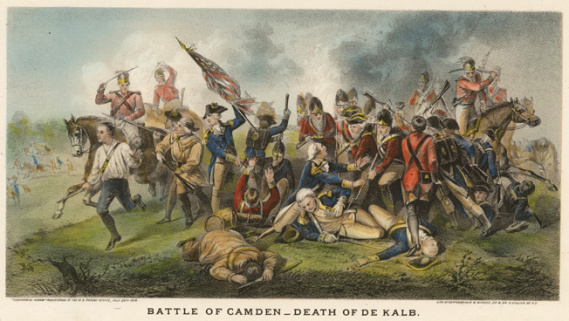
238 years ago today the United States military suffered one of its worst defeats. The Battle of Camden, fought on August 16, 1780 just a few miles north of Camden, SC was a total defeat for the American “Grand Army” under popular General Horatio Gates. The British under Lord Cornwallis inflicted nearly 1,900 casualties (out of 4,000) at a loss of only 300. One of the biggest losses was the death of General Baron Johann de Kalb, a popular foreign general in the American army. Though a strategic defeat for Gates, it was the retreat that would lead to Gates’ demise. As the militia broke and ran, Gates was caught up in the panic and fled the field as half of his army was still fighting.
Writing several days later from Hillsborough, NC Gates submitted his account of the battle to Congress. Already, reports of cowardice were starting to spread about Gates’ conduct during the battle. Gates decision to fight and his decision to leave the field during the battle have been debated ever since that August day in 1780. Below is a portion of Gates’ letter.
“In the deepest distress and anxiety of mind, I am obliged to acquaint your excellency with the defeat of the troops under my command. I arrived with the Maryland line, the artillery, and the North-Carolina militia, on the 13th instant at Rugeley’s, thirteen miles from Camden; and took post there, and was the next day joined by General Stevens, with seven hundred militia from Virginia…. Having communicated my plan to the general officers in the afternoon of the 15th, it was resolved to march at ten at night, to take post in a very advantageous situation, with a deep creek in front, seven miles from Camden; the heavy baggage, &c. being ordered to march immediately by the Waxhaw road. At ten the army began to march in the following order: Colonel Armand’s legion in front, supported on both flanks by Colonel Porterfield’s regiment, and the light infantry of the militia; the advanced guard of infantry, the Maryland line, with their artillery, in front of the brigades, the North-Carolina militia, the Virginia militia, the artillery, &c. and the rear guard. Having marched about five miles, the legion was charged by the enemy’s cavalry, and well supported on the flanks, as they were ordered, by Colonel Porterfield, who beat back the enemy’s horse, and was himself unfortunately wounded; but the enemy’s infantry advancing with a heavy fire, the troops in front gave way to the first Maryland brigade, and a confusion ensued, which took some time to regulate. At length the army was ranged in line of battle, in the following order: General Gist’s brigade upon the right, with his right close to a swamp, the North-Carolina militia in the center, and the Virginia militia, with the light infantry and Porterfield’s corps, on the left; the artillery divided to the brigades; and the first Maryland brigade as a corps de reserve, and to cover the can non in the road, at a proper distance in the rear. Colonel Armand’s corps were ordered to the left, to support the left flank, and oppose the enemy’s cavalry. At daylight the enemy attacked and drove in our light party in front, when I ordered the left to advance and attack the enemy; but to my astonishment, the left wing and North -Carolina militia gave way. General Caswall and myself, assisted by a number of officers, did all in our power to rally the broken troops, but to no purpose, for the enemy coming round the left flank of the Maryland division, completed the rout of the whole militia, who left the continentals to oppose the enemy’s whole force. I endeavoured, with General Caswall, to rally the militia at some distance, on an advantageous piece of ground, but the enemy’s cavalry continuing to harass their rear, they ran like a torrent, and bore all before them. Hoping yet, that a few miles in the rear they might recover from their panic, and again be brought into order, I continued my endeavour, but this likewise proved in vain. The militia having taken the woods in all directions, I concluded, with General Caswall [sic], to retire toward Charlotte.”
In honor of April being National Poetry Month, we share the connection of the literary icons of Concord (MA) and its American Revolution heritage. Concord historian Jayne Gordon wrote about these connections in an appendix in our recent release “A Single Blow.” Below is part of that text.
None of the eighteenth-century Concord authors lived through the American Revolution, yet reminders of that eighteenth-century war abounded in Concord in their lifetimes. Their neighbors were the grandchildren of the minutemen; veterans of the war were still among the townsfolk. Buildings, gravestones, old roads, and other landmarks evoked that part of the past, and they were surrounded by the stories of the fateful day of April 19, 1775. They each drew on their interpretations of the Revolution’s symbolic meaning, and incorporated those ideas into both their private and public writings.
The “Old Manse” next to the North Bridge in Concord
In the case of RALPH WALDO EMERSON (1803-1882), there was a direct historical link to a grandfather who had played a significant role in the beginnings of the Revolution. Sixty years after colonial militiamen confronted the British troops at the North Bridge within sight of the Old Manse, the grandson of patriot minister Reverend William Emerson would come to his ancestral home to stay, writing in his journal, “Hail to the quiet fields of my fathers! . . . Henceforth I design not to utter any speech, poem, or book that is not entirely & peculiarly my work.”Continue reading “THE AUTHORS AND THE AMERICAN REVOLUTION IN CONCORD”→
When one studies British General Thomas Gage and his performance leading up to Lexington and Concord you must step back and put yourself in Gage’s position. A man that believed not only in Royal authority over the American colonies, but also in the basic rules of law. Gage was not anti-American by any means.
In November 1763, Gage was placed in overall command of British forces in the American colonies and settles in New York. At this time Gage was well respected by most American colonists. Of course, this all changed in 1774 when Gage was sent north to Boston to become the Royal-appointed Governor of Massachusetts and enforce the highly unpopular Port Bill that closed the port of Boston among other harsh actions. He was walking into a situation that most historians today argue was a no-win situation. Continue reading ““Acts of a Rude Rabble…” General Gage, Lord Dartmouth and Ignorant Orders”→
We look forward to our time in Lexington, Concord and Boston on Patriots Day Weekend 2018! We will be at the Cary Memorial Library in Lexington on Sunday, April 15th at 1:30pm. We will also be posting FB live videos throughout the weekend…stay tuned!
Meet the Author event
Sunday April 15th, 1:30 PM
Cary Memorial Library
Historians Phillip Greenwalt and Robert Orrison launch their new book “A Single Blow: The Battles of Lexington and Concord and the Beginning of the American Revolution, April 19, 1775” with a presentation, Q & A, and book signing event. This book, the first in a new Revolutionary War series, uncovers the amazing history that this pivotal spring day ushered in for the fate of Massachusetts and thirteen of Great Britain’s North American colonies. The event is co-sponsored by the Lexington Visitors Center, Cary Memorial Library, and Lexington Historical Society
As British General Thomas Gage and his American Whig (or Patriot) antagonists squared off in Boston and the surrounding towns, information gathering became the key to success. Both sides had created networks of spies, but the advantage was clearly in favor of the Whigs. During the winter 1774-1775, groups such as the Sons of Liberty had established a complex spy network within Boston comprised of a system of riders that spread information and “alarms’ quickly. The Committee of Safety and the Massachusetts Provincial Congress relied on this network to stay informed of what was going on in Boston and the British intentions. Continue reading “Two Riders….Gage Gathers Information”→
19th century print of the Battle of Harlem Heights. The image shows the Americans attacking the British right flank.
After the Battle of Long Island, American forces evacuated to Manhattan Island. But with the British in command of the waters around New York, they easily could land their forces anywhere along Manhattan Island. On September 15th, the British crossed the East River north of New York City and landed at Kip’s Bay, easily pushing aside the American forces there. American forces in New York City were nearly cut off, but quickly retreated up Manhattan Island to Harlem Heights and began to dig in. On the morning of the next day, British troops arrived in front of the American lines at Harlem Heights. Washington expected an attack and decided to take the initiative.
Washington ordered a small party of 150 men called “The Knowlton Rangers” under the command of Lt. Col. Thomas Knowlton to move out and reconnoiter the British position. Knowlton quickly recognized the British were not planning a major assault but his force had brought about the attention of the British light infantry, soon the Knowlton Rangers were outnumbered and quickly retreated back to the American lines. When Knowlton reached safety, the British light infantry paused, placing them out in front of their main lines. Washington seized the opportunity and ordered an assault on their rear by Knowlton’s men and a reinforcement of 200 Virginia riflemen from the Third Virginia under Major Leitch.
Though the American attack was supposed to be in the rear of the British light infantry, but because of confusing terrain and attacking too soon, the flanking column instead hit the British in their flank. The effect still had an adverse effect on the British light infantry as they began to fall back. The Americans fought with determination and bravery. Knowlton went down mortally wounded. Colonel Griffith wrote of Leitch “He conducted himself on this occasion in a manner that does him the greatest honor, and so did all of his party.” Washington wrote the next day that “The General most heartily thanks the troop commanded yesterday by Major Leitch, who first advanced upon the enemy, and the officer who so resolutely supported them.”
At the head of the attacking column both Knowlton and Leitch led their men forward to attach the British flank. Early in the attack both men went down wounded. Knowlton died on the battlefield, Leitch took three musket balls to the abdomen and was carried off the field. At first most reported his condition as improving and he was thought to survive his ordeal. Washington wrote “Majr Leitch of Weedons Regiment (Third Virginia) had three balls through his side, and behaved exceedingly well – he is in fair way of recovery.”
Soon the British began to retreat back to their main line. Washington then ordered an attack along his line and the British light infantry fell back to the main line in confusion. Soon the entire British line began to give way. After about a 90 minute fight, Washington learned that more British forces were arriving on the field and ordered his men back to the main line. Though not a major victory, the American army had finally stood up to the British and even for a moment, pushed them off the field in combat. The British suffered 14 killed and an estimated 154 wounded, with the Americans suffering 30 killed and 100 wounded.
Though most believed that Leitch was recovering from his wounds, by September 20th Gen. Horatio Gates wrote “Major Leitch of Maryland was wounded and despaired of.” As his condition worsened, there was little for regimental surgeon David Griffith could do but to try to ease Leitch’s pain. Griffith wrote to Leitch family friend Richard Henderson on October 3rd that “[I] disagreeable duty of informing Mrs. Leitch through you, of the death of her husband is imposed upon me. He expired yesterday morning at Hackinsack Bridge where he had been removed for his better accommodation…But on the 28th Sept he was seized by lock’d jaw – with spasms about his neck and throat so violent as to baffle every effort to minister to him by medicine.” It seems the death of Leitch was a tough and unexpected blow to his fellow officers in the Third Virginia Regiment.
Where Major Leitch’s remains are today is a mystery. Captain John Chilton wrote on
Commemorative Plaque showing the wounding of Knowlton and Leitch
October 4, 1776 that “the brave Major Leitch who died of his wounds received the 16th was interred yesterday by the side of Major Henly.” We know the general area of the American camps in the fall of 1776, but this burial location is long lost to history. In 1897, historian Henry Johnston wrote in his account of the Battle of Harlem Heights that Knowlton and Leitch are probably buried somewhere “on St. Nicholas Avenue, between 135th St and 145th St.” in New York City. Of course the land has changed a lot since then and whatever remains were left were destroyed by modern development.
Today the area of the Harlem Heights battlefield is now under the campus of Columbia University in New York City. Today there is a simple plaque on the wall on the eastside of Broadway north of 117th Street. This plaque commemorates the Battle of Harlem Heights and depicts Major Andrew Leitch as well as Lt. Col. Thomas Knowlton (who was mortally wounded in the same attack as Leitch). Near here is where Leitch was mortally wounded turning the flank of the British line.
The search for Andrew Leitch continues. His contribution to the American Revolution is well documented through the letters of George Washington and others. When he moved to Dumfries, VA and where he lived is still unknown. We do know that he was influential enough to be elected to Prince William County’s Committee of Correspondence in 1774 and involved in the efforts to raise men and funds for local companies of troops. Continued research in his widow’s pension cases as well as researching contemporary archives may turn up new information. For now, he is honored with a plaque in New York City and a small park here in Virginia. My hope is that this story will end with an appropriate understanding and remembrance of a man who gave his life for our nation’s independence.
Entry in George Washington’s Papers for March 16, 1775: “Went to Dumfries to review the Independent Company there, Dined and Lodged with Mr. Leitch…”
For Further Reading:
Johnson, Henry. The Battle of Harlem Heights. New York: Macmillan Company, 1897.
Peters, Joan. The Third Virginia Regiment of Foot, 1776-1778, Volumes 1-2. Westminster (MD): Heritage Books, 2008.
After his first battlefield victory at the Battle of Harlem Heights on September 16, 1776, General George Washington wrote “The General most heartily thanks the troop commanded yesterday by Major Andrew Leitch, who first advanced upon the enemy, and the others who resolutely supported them.” The battle was a small victory for the American army, but instilled some confidence in the men who had suffered many defeats since August on Long Island and lost New York City to the British. One of the main players in this action was Major Andrew Leitch. A little known Continental officer who at the time was considered a rising star, but today is mostly forgotten.
But my connection with Andrew Leitch goes beyond my love and interest of the American Revolution, it is more personal than that. In 2008 I met the woman that became my wife. At the time, she ran a park locally named Andrew Leitch Park. Having worked here locally for a few years, I was not aware of who the park was named after. I did a quick search of the name Andrew Leitch and realized we had a Revolutionary War hero. In my ignorance thinking everyone was as interested in history as I was, I assumed my future wife knew this fact. Of course…she didn’t. But now I had an “in” to keep talking to this young lady. And of course…she saw through it and had little interest in Andrew Leitch but it worked out and now we are married and have two great young kids. So, I partly owe all of this to Mr. Andrew Leitch.
Who was this little known hero and why did have a park named after him in Prince William County, VA? In 1774 Andrew Leitch moved to Virginia from Maryland and began a new life in Northumberland County. He and his wife Margaret had three children and Leitch must have had influence because he was able to secure a commission as Captain in the 3rd Virginia Regiment on February 6, 1776. In this capacity he recruited men from Prince William County and led the Prince William Battalion (which also included men from Loudoun County). The Prince William Battalion joined the rest of the 3rd Virginia in Williamsburg in late February. Soon though Leitch received a promotion on June of the same year to Major in the 1st Virginia Regiment (though there is one source that places his promotion to Major on March 18th). As Washington moved his Continental Army from Boston to New York City in March 1776, he called for reinforcements. Men of the 1st Virginia and 3rd Virginia were called to join Washington in New York. For reasons unknown, the 1st Virginia was slow to get to New York. Leitch seemed to be a man of action as he joined his former men in the 3rd Virginia on their march to New York as they were a few weeks ahead of the 1st Virginia.
The 3rd Virginia did not arrive in New York in time for the disastrous Battle of Long
The Third Virginia flag captured at the Battle of Waxhaws on May 29, 1780. The flag is in a private collection.
Island, arriving in early September to join the American army on Harlem Heights. Washington was happy to see his fellow Virginians and he needed the reinforcements. The Americans had lost New York City and were pushed off of Long Island, all the way up to the northern tip of Manhattan Island. The Americans needed something to encourage them, a battlefield victory. Major Andrew Leitch played a crucial role in delivering that victory, though at a horrible cost.
Part 2 will cover Andrew Leitch’s role in the Battle of Harlem Heights and his once forgotten legacy.
Emerging Revolutionary War welcomes guest historian Paige Gibbons Backus to the blog. This Weekend marks the 244th anniversary of the Boston Tea Party.
We all know the holidays are some of the heaviest travelled times of the year and over my Thanksgiving holiday, I had the opportunity visit Boston for a day. When in the city for only one day, what do we go and see? Do you go to the U.S.S. Constitution, Bunker Hill, Faneuil Hall, or the Paul Revere House? Do you go to the colonial meetinghouses, the historic cemeteries, or just walk around the historic sections of the city? One of the sites that I decided to visit was the Boston Tea Party Ships & Museum. I heard many good things about it from online reviews and professional colleagues about the interactive exhibits and experiences available there. Working at an immersive historic site myself, I was definitely curious to see what they had done to make their history exciting to audiences, and despite the museum’s shortcomings, make it interesting they did.
One of the highlights of the Boston Tea Party Ships is that they did a decent job creating an interactive experience for visitors. After purchasing tickets outside, visitors receive an identity card and a feather, and are then invited into a room meant to replicate the South Meetinghouse. From there, first-person actors serving as tour guides take visitors through the planning, implementation, and effects of the Boston Tea Party. For example, Sam Adams rallied the crowd weaving in the events leading to the Boston Tea Party, even teaching visitors how to show approval or displeasure in a public setting, (to which I was hissing before it was cool). He even called on visitors with various identity cards to voice their opinion, bringing in interesting, albeit reluctant, audience participation. After the visitors were riled up, we donned our feathers in our hair and were lead onto the ships to commence tossing the tea. Continue reading “Emerging Revolutionary War Weekender: The Boston Tea Party Ships & Museum”→
The stacks of books reflect Knox’s role as a bookseller before the war.
If you have not made a trip to the new American Revolution Museum at Yorktown (the former Yorktown Victory Center) then you are missing out. Not only does the museum great exhibits on the causes of the war and the events leading up to Yorktown (with great technology), there is a changing exhibit gallery that allows for short term exhibits. The first exhibit opened in June and features the lives of four prominent Revolutionaries after the American Revolution. Continue reading “AfterWARd, the new exhibit at the American Revolution Museum at Yorktown. A visit with Curator Kate Gruber”→