With British soldiers pouring into the fort, Colonel Ledyard ordered a ceasefire, and prepared to surrender Fort Griswold to the victorious British. However, the British disregarded the ceasefire and continuing pouring fire into the American garrison, killing or wounding nearly all of the fort’s defenders. “I believe there was not less than five or six hundred men of the enemy on the parade in the fort,” claimed American soldier Rufus Avery. “They killed and wounded nearly every man in the fort as quick as they could.”
Maj. Stephen Bromfield, the ranking British officer after Montgomery fell, called out, “Who commands this fort?” Ledyard stepped forward and responded, “I did, sir, but you do now.” Another American, Jonathan Rathbun, watched Bromfield run Ledyard through the heart and lungs with Ledyard’s own sword:
“…the wretch who murdered him [Ledyard], exclaimed, as he came near, “Who commands this fort?” Ledyard handsomely replied, “I did, but you do now,” at the same
moment handing him his sword, which the unfeeling villain buried in his breast! Oh, the
hellish spite and madness of a man that will murder a reasonable and noble-hearted officer, in the act of submitting and surrendering!”
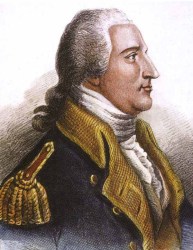
After turning coat, Benedict Arnold received a commission as a brigadier general in the British army as part of the deal that he made in order to betray his country.
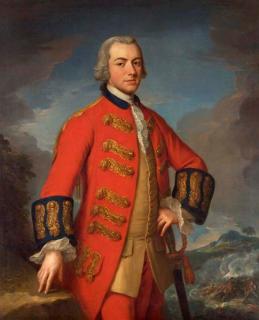
In August 1781, George Washington decided to shift forces in order to attack the army of Lt. Gen. Lord Charles Cornwallis in Virginia. Washington began pulling troops from the New York area. Lt. Gen. Sir Henry Clinton, the British commander-in-chief in America, realized on September 2 that Washington’s tactics had deceived him, leaving him unable to mobilize quickly enough to help Cornwallis. Further, there was still a significant force of Continentals facing him in front of New York, and Clinton did not feel that he could detach troops to reinforce Cornwallis as a result.
Instead, Clinton decided to launch a raid into Connecticut in the hope of forcing Washington to respond. Clinton intended that this be a raid, but he also recognized that New London could be used as a permanent base of operations into the interior of New England. Clinton appointed Arnold to command the raid because he was from Connecticut and knew the terrain.
Arnold commanded about 1,700 British solders, divided into two battalions. Lt. Col. Edmund Eyre commanded a battalion consisting of the 40th and 54th Regiments of Foot and Cortland Skinner’s New Jersey Volunteers, a Loyalist unit. Arnold himself commanded the other battalion, made up of the 38th Regiment of Foot and various Loyalist units, including the Loyal American Regiment and Arnold’s American Legion. Arnold also had about 100 Hessian Jägers, and three six-pound guns. This was a formidable force anchored by the three Regular regiments. Continue reading “The Battle of Groton Heights, September 6, 1781: The Fort Griswold Massacre”→
Daughter’s of the American Revolution (D.A.R.) Monument, Eutaw Springs Battlefield (author collection)
In many ways, the battle of Eutaw Springs was a disappointment for both commanders. Greene’s troops at one point broke through the British lines, but they recovered, and the Americans failed to drive them off the field. Stewart, in a letter to Cornwallis, wrote that there were two things he would regret the rest of his life: the loss of an early morning supply gathering party and his lack of cavalry. Having them, he felt, would have enabled him to decisively defeat Greene. Probably both commanders, and many of their officers, reflected upon these events and second guessed themselves for the rest of their days. Although both armies fought well at Eutaw Springs, a clear cut victory eluded both of them. Continue reading “After Eutaw Springs”→
During the spring and summer of 1754, conflict over colonial possessions in North America erupted in western Pennsylvania. England’s military influence was ousted from the Ohio River Valley, and before the year was over the Captain-General of His Majesty’s Forces, the Duke of Cumberland, planned to dispatch regular troops to the colonies. Major General Edward Braddock, along with a thousand men of the 44th and 48th Regiments of Foot, was ordered to Virginia to organize a four-pronged summer offensive against the French at the Forks of the Ohio River, in Nova Scotia, the Great Lakes region, and along Lake Champlain. The two British regiments with Braddock had served primarily in Ireland, and possessed minimal experience in combat (Colonel Sir Peter Halkett’s 44th Regiment was lightly engaged at Culloden in 1746). Historian David Preston described the experience carried to North America by the senior and junior officers of Braddock’s expeditionary force:
While there was a growing sense of professionalism in the mid-eighteenth-century British Army, most younger officers had formed whatever expertise they possessed through studying manuals, guidebooks, and historical works by ancient and modern authors such as Thucydides, Caesar, Vegetius, and Humphrey Bland, whose Treatise of Military Discipline, first published in 1727, was the unofficial guide to basic drill and maneuver for young officers. The officers’ own lack of formal training, along with their mechanistic daily regimens, prevented them from achieving competency much beyond the level of basic training that they were expected to perfect in their soldiers. While some senior officers had tasted battle, the first test of combat leadership for many of the junior officers or subalterns came on the banks of the Monongahela.[1]
Despite the lack of battlefield experience, King George II, the Duke of Cumberland, and Braddock were confident that the “professionalism” of the regular troops would be enough to oust French forces (Troupes de la Marine, Canadian militia, and Native American auxiliaries from the Ohio River Valley and Great Lakes) from Fort Duquesne.
The first break from Vegetius’s influence and British army doctrine in the Age of Enlightenment occurred before the campaigns of 1755 even commenced. The 44th and 48th Regiments of Foot were understrength and carried with them to North America roughly 500 men each. To raise their numbers to full battalion strength – 700 men – the units were augmented with colonial levies from Maryland, Pennsylvania, and Virginia. Already lacking in experience, the addition of colonial militiamen (militias were the largest recruiting pools in the colonies) did nothing but delegitimize the “professionalism” of the two regiments. The levies, who previously only drilled once every few months or so with their respective militias, were expected to conduct themselves like British regular soldiers.
Along with the colonists augmented into the regiments of foot, the task of capturing the various French strongholds in Nova Scotia and along Lakes Champlain and Ontario that summer was given to non-regular troops. To subdue the French garrisons, small armies of colonial provincial soldiers were recruited in New England, New Jersey, and New York. Braddock’s army, too, was supplemented with provincials from Maryland, Pennsylvania, Virginia, and the Carolinas. The expeditionary force ordered to bag Fort Saint-Frédéric (Crown Point) along Lake Champlain was composed of 3,000 provincial troops with only one British regular, Captain William Eyre of the 44th Regiment of Foot, serving among them.[2] Again, these provincial regiments were entirely green (other than some veterans of various frontier services and the Louisbourg Expedition of 1745) and made up of levies and volunteers drawn predominantly from local militias. Also, attached to these armies were Native American auxiliaries, whose style of warfare was completely foreign to regular troops and far from professional. Service against and alongside these “savages” was the first exposure to irregular warfare in North America that His Majesty’s soldiers would receive. Vegetius believed that heavy reliance on auxiliaries, in this case Native Americans, colonial provincials, and colonial troops on the British military establishment, was detrimental to the performance and survival of professional units and overall cohesion.[3]
For the most part, the colonial provincials held their own on the battlefield against French forces, more so than the British regulars did early in the French and Indian War. They obtained victories in Nova Scotia, along the southern shore of Lake George in New York, and diligently defended the frontier against French and Indian raids. However, the colonists could never truly mesh with the regulars from Great Britain. British officers held them in contempt. “The Americans,” Brigadier General James Wolfe declared, “are in general the dirtiest most contemptible cowardly dogs that you can conceive. There is no depending on them in action. They fall down dead in their own dirt and desert by battalions, officers and all. Such rascals as those are rather an encumbrance than any real strength to an army.”[4]
Officers serving in North America and British authorities in London, like William Pitt, began to recognize the importance in 1758 of separating from the seemingly arrogant professionalism that the British Army had so dearly held on to. The conflict being fought in the colonies was not a conventional European war. Even as a world war was being waged elsewhere around the globe, it became evident that something needed to change if His Majesty King George II was to claim North America as his own. William Pitt, Leader of the House of Commons and Secretary of State for the Southern Department, put forth and instituted an agenda that shifted the sole focus on winning with professional soldiers in North America to building a substantial military force consisting of a majority of colonists. He ordered 20,000 colonists to be levied or recruited into provincial units. The crown would supply them the required arms, ammunition, tents, and provisions, and would reimburse the colonial assemblies for the costs of raising, clothing and paying the men. In response to this proposal, the colonies mustered over 23,000 troops for the upcoming 1758 campaigns.[5] These men complimented the 20,000 British regulars dispatched to the colonies that year. At close glance, the measure instituted by Pitt’s administration resembled France’s levée en masse in 1793 on a smaller scale.[6] This was an early example of the departure from Vegetius’s classical reliance on professional soldiers in favor of larger armies consisting of men serving shorter terms of enlistment. Discipline for these men was mild and their training was limited. “Men,” one of Vegetius’s general maxims read, “must be sufficiently tried before they are led against the enemy.”[7] Quality was displaced by quantity. This was not the only aspect of the British Army that was transforming in the wilderness of North America. The nature of the conflict was forcing a change in the way the war was being waged as well.
Edward Braddock’s expeditionary force of regulars and provincials crossed the Monongahela River on the morning of July 9, 1755 and precipitated a departure from Vegetius and Humphrey Bland’s strategic, operational, and tactical influence. Less than ten miles outside of Fort Duquesne, the 1,400-man column engaged and was easily defeated by a smaller force of Canadians and Indians fighting in an irregular manner. Braddock’s Defeat signaled an end to England’s classical style of linear warfare – it had officially met its match and was countered. Vegetius and Bland’s disciplined closed-rank formations had faltered. Vegetius wrote that, “The nature of the ground is often of more consequence than courage.”[8] However, this referred to terrain and its effect on the seven linear formations that Vegetius had presented. General engagements in Europe did not take place in thick vegetation. Maneuvering, let alone fighting, in closed-ranks was nearly impossible to accomplish smoothly in North America. As Braddock’s army had learned along the banks of the Monongahela, His Majesty’s Forces needed to adapt to the current conditions and nature of warfare in the colonies. To do so, officers needed to adjust tactically and borrow from the colonists and their Native American auxiliaries who were accustomed to loose formations and irregular warfare. Adapting meant completely altering preconceived tactical doctrine.
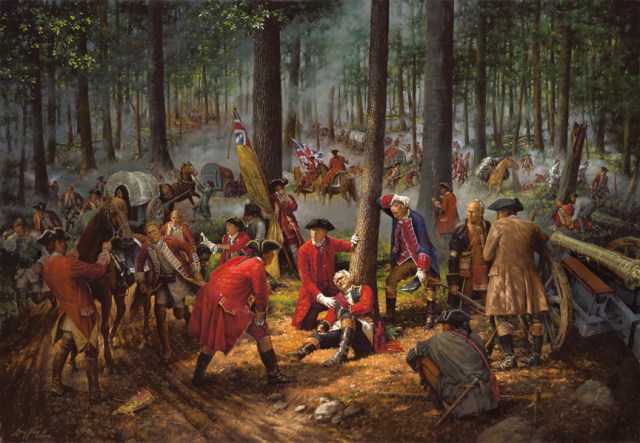
The Wounding of Edward Braddock at the Battle of the Monongahela, July 9, 1755
No other classical text had more of an influence on princes and young officers of the 18th century than Flavius Vegetius’s De Re Militari. For centuries, the ancient Roman manual on the art of war inspired men to professionalize the militaries of Europe. Standing armies were formed to fight for King and Country. Officers whipped their men into shape, drilling and disciplining by the book. As conflicts erupted throughout the world, the British armies took to the field waging war over royal successions. They emerged as a dominant force on the European continent. Vegetius continued to influence the conduct of His Majesty’s Forces and it appeared as if his principles were to become a mainstay in British military doctrine. Then, as the second half of the 18th century began, tension between England and France over colonial possessions in North America boiled over. By the spring of 1754, armed conflict had ignited an undeclared war in western Pennsylvania. Less than a year later two royal regiments (the 44th and 48th Regiments of Foot) had left Ireland and disembarked in the colony of Virginia.[1] In North America they were confronted by a different way of war – an unconventional one. Would Vegetius’s principles and the doctrine he influenced continue to remain true? Or could only a departure from his art and science of war prepare England’s forces to combat the new threat? War does not change, but warfare does, and Vegetius’s classical influence began to fall out of favor.
This two-part essay will demonstrate that Vegetius’s military influence on the British Army officially began to diminish during the French and Indian and American Revolutionary Wars (1754-1783). To do so, this essay will analyze Vegetius’s initial influence on England’s military thinkers and officers during the Age of Enlightenment. It will then examine why the departure from this classical military theory and science was necessary and how it transformed the way that the British Army approached war at the moral and physical levels. It will then summarize and conclude.
Flavius Vegetius Renatus was a high-ranking official in the Roman Empire during the 4th century. It is quite possible that he served in some sort of financial position for the court which would have given him insight into military matters.[2] He was not a soldier, and he approached the art of war as a historian. When compiling his most famous work on Roman military institutions he desired to write a treatise, “for public use, [regarding] the instructions and observations of our old historians of military affairs, or those who wrote expressly concerning them … to exhibit in some order the peculiar customs and usages of the ancients….”[3] Vegetius began writing in the late 4th century during a time of decline for the Roman military. He had hoped that the Emperor would accept his work as a set of mere suggestions, or precedents demonstrated by the “ancients.” While it had not been used widely by his contemporaries, his treatise, On Roman Military Matters (De Re Militari), became a crucial piece of military thought and theory in Europe centuries later.
Flavius Vegetius’s field manual, On Roman Military Matters, written around 386 A.D., offered its readers a glimpse into the discipline and organization, and weapons and tactics utilized by the Roman Legions.[4] Through the medieval period in Europe, Vegetius’s book on the art of war served as an essential part of any prince’s military education. According to Dr. Charles S. Oliviero of Norwich University, “Until Clausewitz’s Vom Kriege appeared in 1832 to guide those who would understand the nature of Napoleonic warfare, no single writer in the West was more influential than Roman historian and writer Flavius Vegetius Renatus.”[5]On Roman Military Matters laid the groundwork for maintaining a professional standing army through discipline, organization, training, and administration. It also provided 26 chapters on strategy, tactics, and the principles of war, which were widely read and implemented by rulers and officers. The various tactical movements listed greatly influenced linear formations and battlefield maneuvering, which evolved to accommodate new weapons technology as time went on. Following the Renaissance, his influence widely reemerged in the 18th century at the onset of the Age of Enlightenment in Europe.
The Age of Enlightenment brought on a period in Europe known as the Military Enlightenment as well. According to historian John Lynn, “The Military Enlightenment followed the program of the broader Enlightenment, which sought to pattern study and knowledge after the natural sciences. By doing so it hoped to provide simple but fundamental, almost Newtonian, empirical truths, even in the realms of human psychology and conduct. Science seemed basic to all understanding.”[6] Military thinkers and officers turned to classical texts for direction in organization and tactics. Operating in compact linear formations, the geometric nature of a 18th century battlefield was perceived to be scientific. The commanding officer was required to possess a certain type of genius, but nearly everything on a battlefield could be measured and predicted. Antoine-Henri Jomini carried this belief into the 19th century, but before his famous theories presented in The Art of War were published, European officers turned to earlier works in order to better understand the principles of war and warfare.
It was believed by many military reformers in Europe that Vegetius offered these tactical principles. “Vegetius,” John Lynn described, “… inspired such military advances as battalion organization, firing by countermarch, and marching in step. This process was a later phase of that earlier intellectual phenomenon, the Renaissance.”[7] Book III of On Roman Military Matters offered guidance in tactics for linear style formations (seven possible tactical formations to be exact). The closed ranks that the Roman Legions maneuvered in were meant to instill discipline by not allowing any room for men to turn and run or fall out of order. Again, these formations influenced a geometrical view of the battlefield. From afar a battlefield would resemble a series of thick and thin lines moving back and forth against each other. These lines could be turned at various angles and degrees to meet threats coming from any direction. It became easier for officers to control and command their men if they could remain in a tight-packed linear formation. This was not a simple task, but with properly educated men at the helm, and disciplined troops on the ground, it became more easily quantifiable and predictable. In the 18th century, war and warfare were viewed as a profession in their own right.
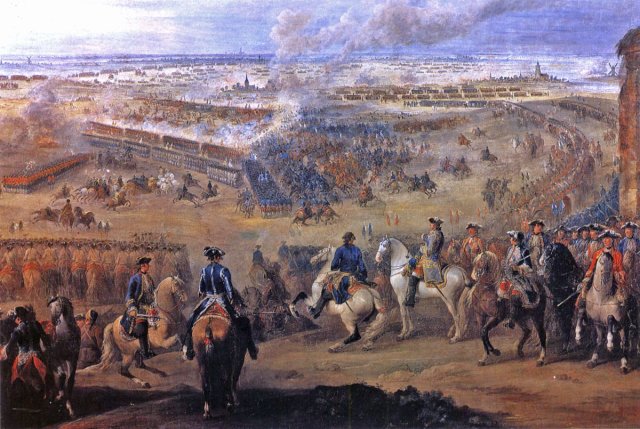
Battle of Fontenoy, 1745, a classic example of a linear engagement
I was recently reading the superb book by Patrick O’Donnell on Washington’s Immortals, which brought me back to a talk I did about the same Marylanders in the American Revolution a few years back. Below is an excerpt of that talk and highlights the second last stand for a regiment with a tradition of being steadfast when deadly duty called.
On March 15, 1781, approximately 20 men stood in the 1st Maryland Continental Regiment staring at the an eerie and familiar scene. It must have seemed that history was cruelly repeating itself once again. These men had survived the forlorn assault in New York in 1776, the ugly repulse at Camden in 1780, and now stood on third line of General Nathanael Greene’s defense at Guilford Court House.
Famous painting of the 1st Maryland at the Battle of Guilford Court House by H. CHarles McBarron, Jr.
Besides the 20 men who could be traced back to that fateful day in New York, the men that shouldered muskets in line with them were all veterans of indefinite periods of service as well.
The 1st Maryland and the men they confronted, 2nd Guards Battalion of Guards, were very similar, according to historian Lawrence Babits, who states that “the 1st Maryland was arguably one of the finest regiments produced by the Continental Army.
What ensued next was the defining moment of the battle and in essence the campaign. As the Guards officers gathered their men into a new line, the Marylanders came on at a rush. The Guards responded largely without specific commands…facing the oncoming Continentals, who fired several platoon volleys as they came. At a range of less than 12 yards, both lines fired again, so close that muzzle flashes overlapped into a wide sheet of flame and the heat from the volley could be felt.
Casualties mounted and at close range the musket balls shattered bone and even passed through the bodies of their targets.
Modern view from the location of Greene’s Third Line which the 1st Maryland held. Coming up the slight rise toward the photo was how the British approached.
The two sides then resorted to the bayonet and Williams recounted “the first Regiment embraced the opportunity…bayoneted and cut to pieces a great number of the British.”
Although the melee only lasted a few minutes, the Marylanders had checked the advance and with the dragoons of William Washington, allowed for Greene to begin to pull back and start the retreat. In another important position, Williams helped lead the rear-guard away from Guilford C.H. The Marylanders lost 15 killed, 42 wounded and 97 missing. Most of the missing could have came from the 2nd Maryland which broke in disorder on the left flank of the 1st Maryland.
Not only did the Marylanders suffer on that fateful March day in 1781, they did so with a lack of, well, everything. According to one inventory report, the entire regiment, numbering little over 300 men had not a single jacket, two-thirds were without proper footwear, and every man was destitute of a full complement of clothing. In addition, the men had served, fought courageously, and bled tremendously, without receiving one cent as pay.
A remarkable “band of brothers” that “held the line for independence.”
Which, in case you were wondering, was the name of the talk.
*Guilford Court House National Military Park is now preserved by the National Park Service, to plan your visit, click here.
*For information on Mr. O’Donnell’s book, click here.
Emerging Revolutionary War is honored to welcome guest historian Daniel Welch to the blog. A brief biography of Mr. Welch is at the bottom of the post.
Several weeks ago I decided to take my usual weekend off of visiting American Civil War battlefields to take a moment to explore some American Revolutionary War historic sites just several hours down the road. Since it was a rather last minute decision, I was not completely prepared before visiting other than some basic historical context and a vague idea of operating hours and things to do while at these historic sites. So, if you want to follow the Continental Army during their experiences in the fall and winter of 1777-1778 read on to help plan a great weekend day trip.
Battle of Brandywine
Sandy Hollow, Brandywine Battlefield
If you want to follow these events as they happened, and in chronological order, began your day at the Brandywine Battlefield Park Associates site. Walking the site is free, but there is a charge if you want to go through the museum or on a tour of one of two historic homes on the property. Their hours are constantly changing so make sure you check their website. (click here), before you plan your visit. To go on a house tour, view the film, and go through the museum there is an $8.00 charge; the museum and film alone is $5.00. I would suggest, if you have the time, to take in the film and museum. The film lasts approximately twenty minutes while a thorough look of the museum could take one an additional forty minutes. Between the film and museum, a firm foundation to the events of September 11, 1777 will be in place before you head out to other locations associated with the battle. The house tour is a guided tour through Washington’s headquarters on the property and is conducted by a volunteer at the site. The tour took over an hour and a half, and considering that the home had burned to the ground nearly 100 years ago and has been rebuilt and filled with modern reproductions, your time would be better spent going to other sites associated with the battle.
Birmingham Friend’s Meeting House plaque
Before leaving, make sure you pick up driving directions from the employees at the counter to get to Birmingham Friend’s Meeting House, and Sandy Hollow, the American’s second line of defense during the battle. Also, make sure to purchase the driving tour map of the battle of Brandywine. This map will take you to numerous other historic sites and homes within the Brandywine Valley that witnessed the events of that day. The cost is a mere $2.95. Plan an additional three to four hours to complete the driving tour.
Ultimately the battle proved to be an American defeat. Although he was defeated on the field, Washington and his generals were able to get large portions of the army to the rear through Polish General Pulaski’s assistance in covering the retreat. Despite the best maneuvers to save his army, Washington was unable to save Philadelphia and the city fell to the British just two weeks later on September 26, 1777. The British remained until June 1778.
Lunch
By now a late lunch would be in order. A great spot is the Black Powder Tavern. A tavern since 1746, it has a great Revolutionary War history, including a supposed visit by Washington himself. The restaurant’s name is related to a historical legend that none other than Von Steuben had ordered the tavern turned into a secret black powder magazine during the army’s pivotal winter at Valley Forge. The food here was great, as was the service and beer selection.
Valley Forge National Historical Park
Following the defeat at Brandywine in September, and another engagement at White Marsh in early December, General Washington looked to put his army into a more secure camp for the coming winter. Active military campaigning for 1777 in Pennsylvania was over. Just twenty miles northwest of Philadelphia, the Continental Army faced numerous challenges here including a lack of food and shelter. Disease also spread during their time at Valley Forge. By February 1778, approximately 2,500 soldiers had perished.
General Anthony Wayne Statue, Valley Forge National Historical Park
To begin your visit here, start at the visitor center. The museum has its challenges. There is no discernible narrative to the exhibits; rather, numerous cases with laminated pieces of paper hanging on the side with corresponding images and item descriptions. Although there are some unique items on display, if it is busy you could wait at a particular case for the laminated cards to know what you are looking at. After a perusal of the museum, take in the free film. Although it is rather dated it provides a great overview of the winter encampment, its challenges, and outcomes. Between the film and museum, plan on spending an hour at the visitor center.
If you have additional time, take in the one and only National Park Service Ranger program offered. It is a rather short program, in length and walking distance, from the visitor center to the reconstructed Muhlenberg Hut sites. The program also echoes what is presented in the film. Before leaving the visitor center, I recommend getting the auto tour cd, as well as any updates on road closures. The park is currently under a significant amount of construction that has closed some roads and altered the driving tour route. The suggested driving tour cd is two hours in length. This would be a time allotment for those visitors who do not stop at each site, get out of the car, and explore all the stops along the route. You will want to get out and explore monuments such as those to the New Jersey troops, National Memorial Arch, von Steuben, and Patriots of African American Descent. You will also want to explore the several historic homes within the park that were used during the encampment, such as Varnum’s Quarters, Washington’s Headquarters, and the Memorial Chapel. My explorations, coupled with the driving tour cd, lasted nearly five hours.
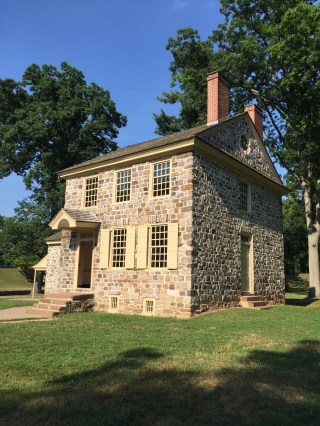
George Washington’s Headquarters (Isaac Potts House) at Valley Forge National Historical Park
Although it would be a long day, it can be done in one; however, if you wish to slow the pace of your visit, each site could be done on a separate day during your weekend. There is plenty of lodging in the area to accommodate this schedule. By visiting both of these historic areas and learning about the events of the fall through early spring 1777-1778, a greater picture can be viewed gleaned of military situation during the time period, as well as the tough composition of the Continental Army despite their defeats.
*Dan Welch currently serves as a primary and secondary educator with a public school district in northeast Ohio. Previously, Dan was the education programs coordinator for the Gettysburg Foundation, the non-profit partner of Gettysburg National Military Park, as well as a seasonal Park Ranger at Gettysburg National Military Park for six years. During that time, he led numerous programs on the campaign and battle for school groups, families, and visitors of all ages.
Welch received his BA in Instrumental Music Education from Youngstown State University where he studied under the famed French Hornist William Slocum, and is currently finishing his MA in Military History with a Civil War Era concentration at American Military University. Welch has also studied under the tutelage of Dr. Allen C. Guelzo as part of the Gettysburg Semester at Gettysburg College. He currently resides with his wife, Sarah, in Boardman, Ohio.
Emerging Revolutionary War is honored to welcome guest historian David A. Powell to the blog. A biography of David is at the bottom of this post.
The Hudson Valley in upstate New York is one of my favorite historical places – which might come as a surprise to some, given that my usual historical beat is the 1861-1865 time-frame. There are a handful of Civil War related sites along the Hudson, but not many.
But for two centuries before our war between the states, the region was the pathway for commerce, settlement, and conflict. The banks of the Hudson, Lakes George and Champlain, and the St. Lawrence are all dotted with crucial reminders of a violent historical past.
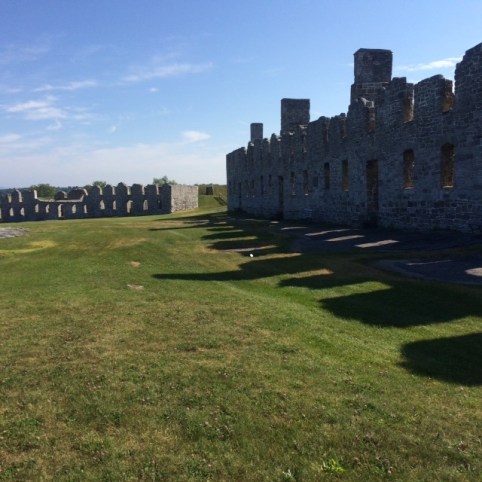
Ruins of Crown Point
I’ve been to most of these sites; West Point, Bennington and Saratoga battlefields, the site of Fort William Henry, Crown Point, and plenty of other locations. One of them, however, fixes my attention beyond all others:
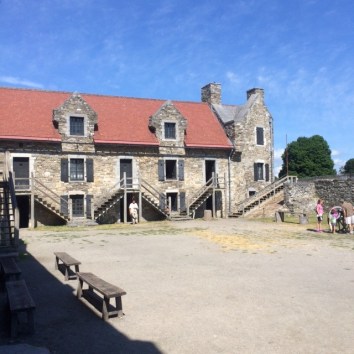
Interior of Fort Ticonderoga
Fort Ticonderoga.
The fort occupies a strategic place on Lake Champlain, were a land portage connects Champlain to Lake George, and ultimately, the Hudson River.
<Lake Champlain from Fort, looking south>
Originally called Carrillon by the French, who built it in 1755; the fort changed hands several times during the ensuing 25 years. It was unsuccessfully attacked by the British in 1758, and finally captured the next year, part of the British “Annus Mirabilis,” that string of decisive triumphs over the French that reached their crescendo with Wolfe’s victory at Quebec. Two decades later, it figured in the American Revolution; it was wrested from British control by Ethan Allen and Benedict Arnold in 1775. Its heavy artillery was sledged across many miles of Wilderness snow and ice to reinforce the Rebel army besieging Boston by Henry Knox, which forced the British to abandon that city. In 1776 Ticonderoga was a bulwark of the Patriot defenses on Lake Champlain. In 1777, it was easily re-captured by the British under Burgoyne, but returned to American control after Burgoyne’s disasters of Bennington and Saratoga.
Ticonderoga is fully restored now, owned and maintained by a private foundation that has done an outstanding job of presenting and preserving the Fort’s history. The town and the fort grounds are also dotted with interesting monuments, many erected by British regiments, mainly placed to honor their troops who fought in the Fort’s bloodiest single battle, that of 1758.
British General James Abercrombie led 17,000 troops – colonials and British regulars – against a much smaller garrison of between 4,000 and 5,000 French, Canadian Militia, and Indian Allies. The French, under the Marquis de Montcalm, defended an entrenched line outside of the fort walls, which Abercrombie obligingly assaulted. The British lost 2,000 men, and Abercrombie retreated.
My favorite monument at Ticonderoga is actually paired with another monument erected by the American Colonists in Westminster Abbey (left to right in picture below). They both commemorate the death of Lord George Howe, a Brigadier General in Abercrombie’s army (and elder brother to the Howes of Revolutionary War fame) who embraced irregular warfare.
Lord Howe Monument at Fort Ticonderoga
Memorial to George Augustus, Viscount Howe, in Westminster Abbey, London, England
Go spend an afternoon at Ticonderoga. You won’t be disappointed.
*David A. Powell is a graduate of the Virginia Military Institute (1983) with a B.A. in history. He has published numerous articles in various magazines, and more than fifteen historical simulations of different battles.
For the past decade, David’s focus has been on the epic battle of Chickamauga, and he is nationally recognized for his tours of that important battlefield. The result of that study was his first published book, The Maps of Chickamauga (Savas Beatie, 2009).
His latest book is Failure In The Saddle: Nathan Bedford Forrest, Joe Wheeler, and the Confederate Cavalry In the Chickamauga Campaign (Savas Beatie, 2011). He is currently working on a full length monograph of the battle of Chickamauga. The first volume of that work, entitled The Chickamauga Campaign: A Mad Irregular Battle, is scheduled for a 2014 release.
David and his wife Anne live and work in the northwest suburbs of Chicago, Illinois. He is Vice President of Airsped, Inc., a specialized delivery firm.
As we have seen, two untrained, amateur, but very effective soldiers perfected the concept of the defense in depth during the campaigns of 1781. Morgan was the first to experiment with the concept, and he did so with great effect at Cowpens, thoroughly defeating Tarleton’s Legion and sending “Bloody Ban” flying in a wild panic. Greene then adopted the tactic and applied it on a much larger scale at Guilford Courthouse. Even though he lost the battle, he scored a major strategic victory by punishing Cornwallis’ army and inflicting enormous losses on it for little gain—Greene’s army escaped to fight another day. His stand at Guilford Courthouse set the stage f Continue reading “Defense in Depth as a Revolutionary War Battlefield Tactic”→



 Instead, Clinton decided to launch a raid into Connecticut in the hope of forcing Washington to respond. Clinton intended that this be a raid, but he also recognized that New London could be used as a permanent base of operations into the interior of New England. Clinton appointed Arnold to command the raid because he was from Connecticut and knew the terrain.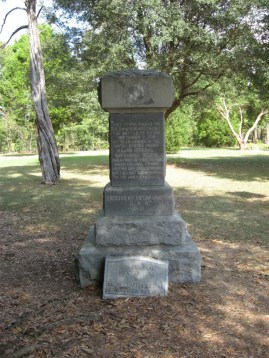




 Emerging Revolutionary War Era