

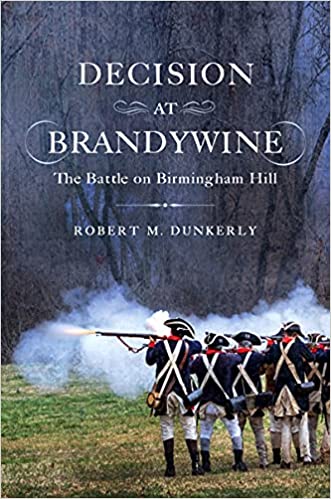
“Rev War Revelry” Author Spotlight  Decision at Brandywine: The Battle on Birmingham Hill with Robert Dunkerly

This Sunday on the Emerging Revolutionary War’s Facebook page, Robert Dunkerly will join the “Rev War Revelry” to discuss his newest publication, Decision at Brandywine: The Battle of Birmingham Hill.

The Battle of Brandywine, fought on September 11, 1777, saw the defeat of the American forces in southeastern Pennsylvania. The victory by the British opened the road to Philadelphia, which fell to Sir William Howe’s forces on September 26, fifteen days after the battle.

Dunkerly, a park ranger with Richmond National Battlefield Park and a contributing historian for Emerging Revolutionary War will discuss the pivotal action that happened around Birmingham Hill on that Thursday in 1777. The engagement at Brandywine was the largest and longest battle in the entire American Revolution and the third bloodiest. This new publication examines the action near Birmingham Hill and Meeting House where the action that day turned against George Washington’s forces.

Thus, this Sunday, at 7 p.m. EDT, tune into ERW’s Facebook page for the next historian happy hour as the popular “Rev War Revelry” series continues with this author spotlight.

Prelude to Guilford Courthouse: Weitzel’s Mill

This March brings the 241st Anniversary of the pivotal battle of Guilford Courthouse, NC. While this battle is of immense importance to the Southern Campaign, several smaller battles leading up to it have been largely overlooked. Through February and early March of 1781, detachments of the American and British armies maneuvered across the modern-day counties of Alamance, Guilford, Orange, Chatham, and Caswell. The is the third in a series of three articles.  

            The last of the skirmishes occurred at Weitzel’s Mill, also spelled as Wetzel’s, and Wiley’s. Cornwallis was becoming more determined to strike at the Americans to either force a general battle, which he felt his veteran army could win, or destroy the isolated detachments operating near him. 

Continue reading “Prelude to Guilford Courthouse: Weitzel’s Mill”

Prelude to Guilford Courthouse: Clapp’s Mill

This March brings the 241st Anniversary of the pivotal battle of Guilford Courthouse, NC. While this battle is of immense importance to the Southern Campaign, several smaller battles leading up to it have been largely overlooked. Through February and early March of 1781, detachments of the American and British armies maneuvered across the modern-day counties of Alamance, Guilford, Orange, Chatham, and Caswell. The is the second in a series of three articles.  

            Pyle’s Defeat on February 25, 1781 was a public relations disaster for the British. The next skirmish fought between the opposing forces was at Clapp’s Mill on March 2nd and has also been called the Battle of Alamance. On February 27th, Cornwallis’ army moved from Hillsborough to the Haw River, camping on the south side of Alamance Creek at an important crossroads.

Continue reading “Prelude to Guilford Courthouse: Clapp’s Mill”

Prelude to Guilford Courthouse: Pyle’s Defeat

This March brings the 241st Anniversary of the pivotal battle of Guilford Courthouse, NC. While this battle is of immense importance to the Southern Campaign, several smaller battles leading up to it have been largely overlooked. Through February and early March of 1781, detachments of the American and British armies maneuvered across the modern-day counties of Alamance, Guilford, Orange, Chatham, and Caswell. This is the first of a series of three articles.

Having unsuccessfully chased General Nathaniel Greene’s small, ragged army across North Carolina, British forces under Lord Charles Cornwallis moved to the state capital at Hillsborough to announce their liberation of the state and call Loyalists to come forward and support them. Greene’s army retreated across the Dan River into Virginia, where he awaited supplies and reinforcements.

Continue reading “Prelude to Guilford Courthouse: Pyle’s Defeat”

“Rev War Revelry” Battle of Cowpens

On January 17, 1781, General Daniel Morgan and his mixed force of Continental soldiers and militia defeated the British under the command of Lieutenant Colonel Banastre Tarleton. This victory for the patriots in northwestern South Carolina had major implications on the southern theater and the main British force under General Lord Charles Cornwallis. The battle, named after the use of the fields in which it was fought, Cowpens, also included one of the only instances in American history of a successful double envelopment.

On Sunday, at 7 p.m. EDT, Emerging Revolutionary War will be joined by American Battlefield Trust’s Kristopher White, Deputy Director of Education and Daniel Davis, Education Manager, in a discussion about the history and preservation of the Battle of Cowpens.

Round out your January weekend by joining us on our Facebook page for this live historian happy hour.

Washington’s First Valley Forge Abode Location

As the Continental Army marched into Valley Forge on December 19, 1777, staff officers under the commanding general had scoured the local area for a residence suitable for George Washington that winter. While discussions and negotiations were taking place, since the Continental Congress had decreed that the army had to ask and could not just commandeer private residences which was a chief complaint of the British policy prior to the war, Washington spent five nights in his marquee.

Afterwards Washington and his military family, later joined by Martha Washington, the general’s wife, moved into the Isaac Potts House for the remainder of the winter encampment.

This tent, called a marquee and served as headquarters, sleeping quarters, and dining area, was pitched in a field in the valley. The site is now marked by a stone monument and within the boundaries of Valley Forge National Historical Park.

On the second annual Emerging Revolutionary War Bus Tour, “The Rise of the American Army: Valley Forge and the Battle of Monmouth” from November 11 -13, 2022, this site, where Washington’s marquee tent was hoisted, will be one of the sites shown to tour participants.

To secure your spot, click here or the link on the banner at the top of this page.

The March from White Marsh

From November 2, 1777 until early-December, General George Washington and the Continental Army occupied a defensive position at White Marsh, approximately 13 miles northwest of Philadelphia. In early December, a series of small skirmishes erupted along the American lines in the last actions of the campaigning season of 1777. Frustrated by Washington’s refusal to emerge from his entrenchments, Sir William Howe led his British columns back to their winter abode in Philadelphia.

Washington moved the army shortly thereafter toward Valley Forge and their winter cantonment, arriving in that vicinity on December 19. As Washington prepared for the winter of 1777-1778 you can also start the preparations to follow this route with Emerging Revolutionary War on the weekend of November 11 – 13, 2022 on the Rise of the American Army: Valley Forge and the Battle of Monmouth Bus Tour. To secure your spot and further information, click here (or the link on the banner at the top of this page).

Americana Corner

Our monthly recap of what our good friend and fellow historian Tom Hand has written on his blog, AmericanaCorner.

The Legacy of Paul Revere
November 2, 2021

Paul Revere began his famous ride from Boston to Concord, around 11:00pm on April 18, 1775, informing the residents and militiamen that the British were on the march. He arrived in Lexington, a town about 10 miles from Boston, around midnight. Read more here.

Lexington and Concord: Minutemen in Arms
November 9, 2021

The Battles of Lexington and Concord, fought on April 19, 1775, marked the start of America’s war for independence from England. The story of that fight is an inspiring account of how everyday Americans came together to resist the power of Great Britain. Read more here.

Lexington and Concord: The Shot Heard Round the World
November 16, 2021

The fight between our Minutemen and the British regulars at Lexington was over in a matter of minutes, and the British began the seven-mile march to Concord. By now, reports of the shooting had reached the minutemen in the surrounding area, and they began to assemble. A bad day for the British was about to begin. Read more here.

The Battle of Bunker Hill
November 23, 2021

The Battle of Bunker Hill, fought on June 17, 1775, is one of the most iconic and familiar events in American history. It was our first pitched battle against the British army and, although technically a defeat, the efforts of the American militiamen were inspirational. Read more here.

“Rev War Revelry” Spends an Evening on Lake George Battlefield

With the turkey eaten, Black Friday shopping completed, and a slate of American football watched, and prior to cyber Monday beginning, Emerging Revolutionary War invites you to tune in for a historian happy hour. This week “Rev War Revelry” returns to the French and Indian War and welcomes as guests Lake George Battlefield Park Alliance President John DiNuzzi and the Board of Trustee Member Lyn Hohmann.

The discussion will entail their organizations effort to preserve and interpret one of the America’s most historical places and hallowed ground.

“The Lake George Battlefield Park was the scene of major battles during the French and Indian War and American Revolutionary War, and the home of Fort George, a key anchor of first British and then American military strategies in those world-changing conflicts. Enveloped by the natural beauty of the Adirondack Mountains in the town of Lake George, the site’s history reflects its prominence as part of the crucial Hudson River-Lake George-Lake Champlain corridor in the mid-to-late 18th Century.”

The Lake George Battlefield Park Alliance’s effort to commemorate the ground is so invaluable to telling the overall story. Joining the two guest historians and preservationists will be ERW historian Billy Griffith who is an author on a book with the HistoryPress on the actions around Lake George.

Grab that last remaining beer, tune in to our Facebook page this Sunday, at 7 p.m. EDT, and hear the amazing work being done in New York. How else would you want to round out the holiday weekend?

“Rev War Revelry” The Battle of Iron Works Hill and the Thirteen Crucial Days

When one thinks of December 1776 in American Revolutionary War history, one’s mind immediately goes to Washington crossing the Delaware River and the Battle of Trenton, fought on December 26th. Historians refer to that engagement as the beginning of the “Ten Crucial Days” that culminated with the American victory at the Battle of Princeton on January 3, 1777.

However, days prior, American militia under Colonel Samuel Griffin fought an engagement with Hessian troops under the command of Colonel Carl von Donop. The actions occurred on December 22 and 23, 1776. Although the American forces were pushed out of their positions, the end result was the occupation of Bordentown by Donop and his troops, approximately 10 miles from their fellow Hessian comrades at Trenton.

To discuss these engagements, collectively known as the Battle of Iron Works Hill, Emerging Revolutionary War welcomes historian Adam Zelinski to “Rev War Revelry.” Zelinski is a writer and published historian and has worked on various projects with the American Battlefield Trust and the American Revolution Museum in Philadelphia. He will also speak on some exciting news coming out of the Iron Works battlefield too.

Emerging Revolutionary War looks forward to you tuning in, this Sunday, at 7 p.m. EST on our Facebook page as we discuss another component of the 1776 campaign season as we prepare for our inaugural bus tour of the Trenton and Princeton battlefields next month (only 4 tickets left!). If you can’t make it on Sunday night, you will be able to find it later (along with all our videos) on our YouTube page.