Emerging Revolutionary War is honored to welcome guest historian Zach Whitlow. Zach’s biography is at the bottom of this post.
August marks the 202nd anniversary of the Burning of Washington. On the heels of their astounding victory at Bladensburg, a British incursionary force under Major General Robert Ross and Rear Admiral George Cockburn occupied the American capital for about 24 hours on August 24th & 25th, 1814. Besides a small ambush at the Sewall House on Capitol Hill, in which two corporals and General Ross’ horse was killed, the British encountered no resistance in the city whatsoever. The Union Jack was triumphantly raised: Washington had fallen. Soon it would burn.
The burned out shell of the White House following the British occupation of Washington. (The President’s House, by George Munger, 1814-1815)
What followed were events that literally burned themselves into the American psyche. To remember this bleak moment in history, rangers from the National Mall & Memorial Parks are leading a series of walking tours in the month of August. Beginning at the newly designated Belmont-Paul Women’s Equality National Monument (the site of the ambush), visitors walk a total of 2.5 miles and retrace the British advance down Pennsylvania Avenue. Through the program, the rangers will sift through the modern paved environment and tell the stories of long gone places, such as the newspaper offices of the National Intelligencer and Barbara Suter’s tavern. The tour will also feature some of the surviving remnants of that time, such as the Octagon Museum.
The walking tour begins at Belmont-Paul Women’s Equality National Monument (144 Constitution Ave NE, Washington, DC 20002) every Saturday in August at 3:00 pm. There will also be programs on Wednesday, August 24th and Thursday, August 25th at 3:00 pm. Please bring comfortable shoes and plenty of drinking water.
*Zach Whitlow has an M.A. in Museum Studies from the George Washington University, a B.A. in History from California State University, Long Beach, and three A.A. degrees from Fullerton College. A lifelong historian, he currently works for the National Park Service at the National Mall & Memorial Parks in Washington, DC and the Office of Historic Alexandria in Alexandria, VA. Prior to this, Zach worked at the National Archives, George Washington’s Mount Vernon, and the Queen Mary in Long Beach, CA. He currently lives in Alexandria, VA with his girlfriend Teresa and their two cats, Max and Lizzie.
As we have seen, two untrained, amateur, but very effective soldiers perfected the concept of the defense in depth during the campaigns of 1781. Morgan was the first to experiment with the concept, and he did so with great effect at Cowpens, thoroughly defeating Tarleton’s Legion and sending “Bloody Ban” flying in a wild panic. Greene then adopted the tactic and applied it on a much larger scale at Guilford Courthouse. Even though he lost the battle, he scored a major strategic victory by punishing Cornwallis’ army and inflicting enormous losses on it for little gain—Greene’s army escaped to fight another day. His stand at Guilford Courthouse set the stage f Continue reading “Defense in Depth as a Revolutionary War Battlefield Tactic”→
Part Three (click here for first two installments)
Determined to avenge his embarrassing defeat at Cowpens, Lt. Gen. Charles Lord Cornwallis set his army out in a determined pursuit of the American army. Knowing that he was too weak to face Cornwallis in a pitched battle, Maj. Gen. Nathanael Greene, the Southern Department commander, retreated northeastward from Salisbury, North Carolina toward the Virginia state line, where he hoped that additional militia troops would reinforce his army and he would receive supplies. The British chased Greene to the Dan River, near the Virginia border, but Greene wisely put the river between his army and the enemy. Cornwallis and his weary soldiers arrived at the rain-swollen river on February 15, too late to catch Greene’s army, which had finished crossing earlier that day. Frustrated, Cornwallis withdrew to Hillsborough, North Carolina.
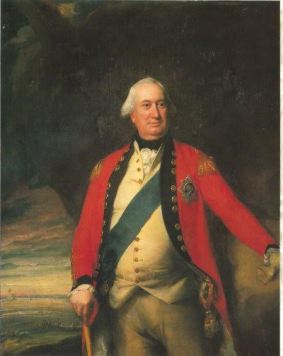
Lord Charles Cornwallis
After receiving both the expected supplies and reinforcements, and after an opportunity to rest his command, Greene soon marched back into North Carolina to face Cornwallis’ tired and poorly supplied army, which now numbered less than 2000 men. After several weeks of skirmishing with Loyalist militiamen and a great deal of maneuvering Greene assumed a defensive position around Guildford Courthouse (near modern Greensboro, North Carolina) on March 14, 1781. Greene had more than 4000 Continentals, militiamen and cavalry, meaning that his army outnumbered Cornwallis’ by more than twice their strength. Continue reading “Defense in Depth as a Revolutionary War Battlefield Tactic”→
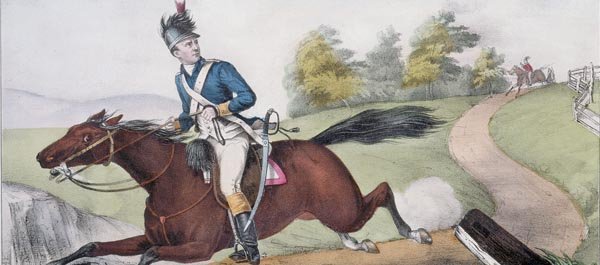
The past few months of John Champe’s life were probably the most memorable. In the fall he was asked to go on a mission to capture the recent traitor Benedict Arnold. The mission was ordered by George Washington himself and only known to Washington and “Lighthorse” Harry Lee. Champe, a trusted member of Lee’s Legion, was promised a promotion for undertaking the daring mission. He successfully fled from the American camp, gained the trust of British General Sir Henry Clinton and Arnold and was given a commission in Arnold’s Loyalist regiment. He worked with patriots in New York and recruited others to help him in his plan to kidnap Arnold. Now it was December and the next day was the day to kidnap Arnold and return him to Washington.
Then the day before the kidnapping was planned, Clinton set into motion a plan to finally use Arnold militarily. Arnold would take his Loyalist troops and some British regulars and invade the Virginia Capes. Virginia had largely dodged the hardships of war and Clinton believed this would be a great opportunity for Arnold to prove himself. With only Virginia militia located in the colony, Arnold should have no problem wreaking havoc on the Commonwealth.
These new developments ruined Champe and Lee’s plans. When Arnold got orders from Clinton, he moved his headquarters – one day before Champe was to carry out his plan. Furthermore, Champe was also moved to another part of New York and was not able to get word to Lee that the plan was off. Lee and his dragoons waited and waited at Hoboken with no sight of Champe. Soon Lee returned to camp without any word on what happened to Champe. Lee and Washington worried that the worst had happened and Champe was “discovered.”[i]
Grave at John Champe, Prickett Cemetery, Fairmont, WV
Champe soon found himself on a transport in New York harbor with Arnold’s “American Legion.” The destination was unknown to most of the men. Soon though Champe learned that he was to be part of an invasion force against his native state! The thoughts that must have gone through his mind; he had risked everything to capture Arnold – labeled a deserter and now he would have to go into battle against his fellow Virginians. The two week trip to the Virginia Capes must have afforded Champe plenty of time to ponder how close he was coming to succeeding and now what he was called upon to do.
Champe was involved in most of Arnold’s campaign against Virginia. He was part of the force that captured Richmond and found himself in several battles and skirmishes against his fellow Virginians. Arnold was replaced by Gen. William Philips and soon Cornwallis’s army joined Philips in Virginia in May 1781. Sometime after this, Champe was able to “escape” the British army and headed west to the Blue Ridge Mountains. Champe then worked his way south and finally by July he was back with Lee who was then with Nathaniel Greene’s army in the Carolinas. Lee was delighted to see his devoted cavalryman. Surely Champe and Lee had a lot to discuss.
Though Champe was promised a promotion, it was believed by Lee and Washington that it would be too dangerous for Champe to take the field again. If he was captured, the British would surely execute him as a spy. Champe was offered an unknown sum for a reward and headed back home to Loudoun County. His legendary adventure was over.
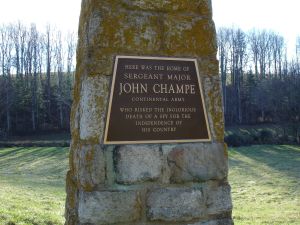
Sergeant Major John Champe Memorial, Aldie, VA
After the war, Champe did not seek fortune or fame from his exploits. He led a simple life and was a middle class farmer. He struggled to support his family and continuously looked for cheaper and more fertile land to the west. It was due to his desire for new land that he was on a trip looking at land near Morgan Town (modern day Morgantown, WV) in 1798 where he became ill and died. Washington did not forget Champe. In 1798 Washington was appointed by President John Adams commander of the American army in preparation for war with France. Washington called on Champe to be an officer in his army, only finding out that he had recently died.[ii]
Though Champe disappeared mostly from the history books in 1781, his family fought for nearly 100 years to gain the compensation that was due to Champe. Champe was never paid a pension nor given bounty lands that were owed to him for his service. Plus, his promised promotion was never given and they argued that the owed pension should be based off of the rank that was promised him personally by Washington. Unfortunately, the mission was so secret, that very few could confirm it. In petitions filed with Congress in 1818 and 1839, Champe’s widow was finally given a life time pension, though in an amount not reflecting his rank. Finally in 1847, a Congressional act provided for compensation in the amount of $1,200 to the heirs of John Champe and granted him the promotion that was promised to him by Washington. [iii]
Champe has remained a local hero in Loudoun County. In 1861, a local Confederate unit went off to war as the “Champe Rifles” (8th VA Infantry). In the early 20th century, the location of his home was marked with a small obelisk (reportedly made by stone from the foundation of the home). Today the monument sits on the south side of Route 50 a few miles west of Aldie.
In 2001, his grave was finally properly marked with a head stone and a full ceremony. Most recently Champe has been bestowed the highest honor a local hero can be given, a high school in his honor. John Champe High School was opened in Aldie in 2012 and one hopes that his name and legacy will be no longer be forgotten.
Lyrics from Sergeant Champe, ca. 1781
Come sheathe your swords! My gallant boys, And listen to the story, How Sergeant Champe, one gloomy night, Set off to catch the tory
[i]The Revolutionary War Memoirs of General Henry Lee; DeCapo Press, 1998, 409.
Emerging Revolutionary War is honored to share the open letter below from the Society of Cincinnati. This open-letter has not been shared with the public. Thank you to Meg Martin, of Civil War Trust / Campaign 1776 for passing it to ERW.
Symbol of the Society of the Cincinnati, est. 10 May 1783, by Continental officers of the American Revolution. (Courtesy of the George Washington Papers).
Members of the Society of the Cincinnati — the nation’s oldest historical society, whose members are descendants of the officers of the American and French forces that won the Revolutionary War — are calling on the Institute for Advanced Study of Princeton, New Jersey, to halt the development of a critical part of the Princeton battlefield. They are appealing to the Institute to work with the Society and the Civil War Trust, which are working together to preserve the remaining battlefields of our War for Independence.
Eight hundred and fifty members of the Society have signed an Open Letter to the Board of Trustees of the Institute for Advanced Study appealing for the Institute to halt construction that will destroy the site of the charge personally led by George Washington that won the battle. The victory was a turning point in the Revolutionary War.
The signers of the Open Letter include descendants of George Washington, Nathanael Greene and other generals, colonels and other officers of the Continental Army.The signers include men whose ancestors were killed at the Battle of Princeton and others who were wounded in that turning point of the Revolutionary War.
The Institute for Advanced Study, an independent scholarly organization, owns the land over which George Washington led the charge that won the battle and saved the American cause from imminent defeat. “Defeat at Princeton would probably have spelled the end for Washington’s army and with it, our bid for independence,” says Jonathan Woods, president general of the Society of the Cincinnati. “The Declaration of Independence, which the nation will celebrate in a few weeks, would have become a footnote in the history of the British Empire.”
The Society of the Cincinnati, which has its international headquarters in Washington, DC, has allied itself with the Civil War Trust and other members of the Save Princeton Coalition in an effort to save the Princeton battlefield and the other endangered battlefields of the Revolutionary War. The Civil War Trust has made repeated overtures to the Institute for Advanced Study to discuss the purchase of the land by the Trust for a price well in excess of its appraised value. More than 20,000 concerned citizens have signed petitions and sent letters to Institute officials and Governor Chris Christie, urging that the Institute for Advanced Study find alternatives to destruction of this hallowed battlefield site. A copy of the Open Letter is attached.
CONTACT: Jack D. Warren, Jr. Executive Director, The Society of the Cincinnati Office: 202-785-1716 Cell: 202-531-9278 jwarren@societyofthecincinnati.org
*From our friends at Civil War Trust and Campaign 1776*
If you have been following the ongoing saga regarding the Institute of Advanced Study’s plans to build 15 faculty houses on the historically hallowed ground of Princeton Battlefield, there is another update to track.
“The British Are Coming.”
Living historians portraying the British 17th Regiment of Foot at the Battle of Princeton. The 17th Regiment, under Lt. Col. Charles Mawhood, bore the brunt of General George Washington’s famous counterattack during the January 3, 1777 Battle of Princeton. Image taken March 2016. (Source: US Civil War Trust).
The rectitude of the decision John Champe made on that October night to “desert” his men and “join” the British must have weighed heavily on his mind as he approached the Hudson River. The mission, offered by “Lighthorse” Harry Lee, to capture the traitor Benedict Arnold was a serious one. The only hesitation Champe felt was how his reputation and honor would be injured by his desertion. No one but Lee and Washington could know the truth, the success of the mission counted on secrecy.[i]
As Champe reached the Paulus Hook area of the Hudson River, the details are murky. Some accounts have Champe jumping into a boat along the shore and pushing off into the river and rowing to a British war ship. Other claims have Champe clearing a British patrol along the river and escorted by the patrol to a nearby ship. [ii] Either way, Champe eluded his American pursuers and accomplished the first goal of his mission, to reach the British lines.
Lee, already having established a spy network, lined up a system of couriers to communicate with Champe. By October 25th, Lee had heard from Champe and wrote to Washington that “my friend got safe to New York; he was before Sir Henry Clinton and has passed all the forms of the garrison; he accidentally met General Arnold in the street which has paved a natural way for further acquaintance; the party entertains high hope of success…”[iii]
Clinton and Arnold expected many other American officers to be inspired by Arnold and
Sir Henry Clinton
join the British army. Champe, a modest officer in a fabled unit was just the kind of man that Clinton wanted to attract. The fact that Champe was fleeing his own men who were in hot pursuit of him made the deception complete. Clinton questioned Champe about the condition of the American army and morale. Champe informed Clinton that other officers were sure to desert and Washington’s ranks were thinning with men heading home. Clinton soon trusted him to be a deserter and attached him to a unit of Loyalists that Arnold was raising.[iv]
Champe became close to Arnold and spent a lot of time with him. Champe spent a lot of time at Arnold’s headquarters at the King’s Arms Tavern on Broadway in New York City. He would take the next several weeks to study Arnold and his habits. Champe also watched for other deserters joining the British army in New York. The fear by Washington was that Arnold was acting with other American officers in defecting. Soon Champe realized that Arnold had acted alone in his treason.
Finally in early December Champe informed Lee that his plan was to kidnap Arnold one night as Arnold took his nightly walk in a garden next to his headquarters. Champe was even able to recruit fellow patriots to assist him in the kidnapping of Arnold. On the selected night, Champe would have a boat waiting for him at a nearby landing. He also had loosened some of the fence boards around the garden area so he could sneak Arnold out of the garden. After getting Arnold onto the boat, Champe would take him to Hoboken (western side of the Hudson River). There Lee and three of his dragoons would wait for Champe and his cargo. Washington insisted to Lee and then to Champe that Arnold was not to be harmed. Champe was sure of his success and spent days and weeks in planning the capture of Arnold. [v]
As the evening approached, everything was in place. He had earned the confidence of Clinton and Arnold. He was now a sergeant in the British army and spent countless hours preparing and making the necessary connections to fellow patriots in New York. The boat was prepared and waiting, Lee would be at Hoboken with his dragoons. Everything was in place to bring home the traitor Arnold.
[i]The Revolutionary War Memoirs of General Henry Lee; DeCapo Press, 1998, pg. 399.
[ii] “Sergeant John Champe and Certain of His Contemporaries”, William and Mary College Quarterly, April 1937, pg. 153.
Along Route 50, west of Aldie, Virginia is a small obelisk in the middle of a cow pasture. Thousands of car drive by the marker, not knowing what it is or who it is for. Most people that come to this area of Virginia for history are interested in the American Civil War. In this region of Virginia the legendary John S. Mosby operated behind Union lines for two years. Also here were the hard fought cavalry battles that preluded the Battle of Gettysburg. But this monument doesn’t refer to anything in the Civil War. This monument commemorates a local American Revolutionary War hero. A man that has been mostly forgotten until recently.
John Champe was born in ca. 1755 from a family that was well established on Virginia’s Northern Neck. His family owned substantial land in King George, Stafford and Prince William Counties. At some point, his family moved to the Aldie region of Loudoun County, where John was born. The men of the Champe family were involved in the local militia and civil office as road builders. Though the family had substantial land holdings and slaves, John was one of many siblings and sought out his future with the military at the outbreak of the American Revolution.
John Champe enlisted as a private in the 1st Regiment, Virginia Light Dragoons in December 1776. Champe’s abilities were quickly noticed and saw himself promoted to corporal by 1778 and then a sergeant by 1779. Champe’s abilities were quickly noticed by his commander, Major “Lighthorse” Harry Lee. Lee described Champe as “rather above the common size – full of bone and muscle; with a saturnine countenance, grave, thoughtful and taciturn – of tried courage and inflexible perseverance.” [i] Though Champe might have quickly risen in the non-commissioned ranks, he desired more. His opportunity for promotion and a date with history came on September 27, 1780 at West Point, NY.
The treachery that took place on September 24th at West Point by once beloved American General Benedict Arnold is well documented. Arnold planned on turning over the fortress at West Point to the British (thus giving up the vital Hudson River). Arnold, receiving command of the post at West Point in August 1780, quickly reduced the viability of the fortifications by neglecting repairs and sending troops away from the post. Arnold’s treachery was not exposed until British officer, Major John Andre was captured, carrying on him copies of letters and Arnold’s plans. Luckily for Arnold, he learned on the morning of September 24th of Andre’s capture and he quickly fled to the HMS Vulture then on to safety in New York City.
Washington also learned of Arnold’s treason on September 24th during his planned visit to West Point. Washington reportedly took the news calmly and began to investigate the depth of treason in his officer corps. Maj. Lee assisted Washington in his investigation, and both found no evidence of other American officers involved in the plot. Washington then turned to the capture of Arnold, and that is where our “hero” comes into the story.
In October of 1780, Washington looked to Lee to find someone in his talented cavalry command that could “defect” to the British and carry out an elaborate plan to capture Arnold. Calling Lee to his headquarters, Washington and Lee discussed the proposition of capturing Arnold and how to carry out such a plan. Lee was tasked with finding someone in his command that could successfully carry out the plan. Lee soon wrote to Washington that he had two men in mind, but his top choice was a sergeant in his cavalry unit
“The chief of the two persons is a sergeant in my Cavalry; to him I have promised promotion…if your Excellency approves of what is done, the sergeant will desert from us tomorrow; the sergeant is a very promising youth of uncommon taciturnity and inflexible perseverance…I have incited his thirst for fame by impressing on his mind the virtue and glory of the act.” [ii]
Washington quickly responded and agreed to Champe’s terms of promotion and soon the mission was hatched. Champe would desert to the British and only Lee and Washington would know about it. He would be labeled a traitor and his family name tarnished. If he was captured by the Americans, he would be executed and if he was exposed as an American spy to the British, he would also be executed. Champe accepted the risk and on the night of October 21st, Champe mounted his horse and made way for the Hudson River where he hoped to find either a British picket line or ship. With him Champe carried his orderly book, saddle bags and five guineas (provided to him by Lee).
Quickly Champe was challenged by an American patrol and he quickly fled,. This is exactly what Champe and Lee wanted, for the British to believe him, his desertion had to seem real. Soon the patrol reported to Lee about Champe’s departure. Lee delayed the pursuit, by first inquiring with other patrol members. Surely a man of Champe’s stature was not defecting. Soon though Lee knew he had to order a pursuit, he just hoped Champe had put enough distance between him and the Americans to make his escape.
“Light Horse” Harry Lee
Though Lee’s delay allowed Champe some time, it was not enough to break away cleanly. As Champe was making his way to the Hudson River, the American patrol was on his heels and calling for his halt. In front of him were British warships in the Hudson River and a British patrol on the banks for the river. Now was the time of decision, he could be shot dead by the British or captured and executed by the Americans. The plan to capture Arnold and punish the traitor was already at its first “Rubicon.”
[i]The Revolutionary War Memoirs of General Henry Lee; DeCapo Press, 1998, pg. 396.
[ii] “Sergeant John Champe and Certain of His Contemporaries”; William and Mary College Quarterly, April 1937, pg. 153.
At the end of last month and the beginning of this, I was in Britain marking the centennial of the Battle of Jutland, World War I’s largest naval battle. My great-grandfather was there as part of the Royal Navy, and it was meaningful in the extreme for me to be present at the commemorations.
The National Museum of the Royal Navy interpreted Jutland as “The Battle that Won the War,” and based its argument on the fact that the battle’s outcome led directly to German resumption of unrestricted submarine warfare, which in turn brought the United States into the war, with all the resulting titanic effects. In other words, a naval battle which didn’t feature a single American had a profound impact on U.S. history.
If that sounds familiar to Revolutionary War scholars, that’s because the same description applies to the 1781 Battle of the Virginia Capes. Let me explain.
On Wednesday, June 8, a signing ceremony marked the beginning of an agreement between First Parish in Concord, owner of the Wright Tavern, and the Concord Museum. Starting this fall, the Concord Museum will provide educational programming to school groups in the Wright Tavern and open the historic building to the public for commemorative events in October and April each year. On hand for the signing were representatives of the Concord Museum and First Parish as well as members of the Wright Tavern Exploratory Committee (WTEC), appointed last fall to develop a sustainable, strategic plan to showcase the Wright Tavern as a National Historic Landmark.
Plaque on the Wright Tavern (ERW collection photo)
“Opening the historic Wright Tavern to public and educational access will provide a true sense of place when learning about the historical events of the American Revolution,” said Mel Bernstein, member of WTEC and Chairman of the American Revolution Round Table of the Minute Man National Historical Park.
No building in this historic community was of greater consequence to the beginnings of the American Revolution than the Wright Tavern, built in 1747. The First Provincial Congress met in Concord at the Wright Tavern in October 1774, electing John Hancock as the Congress’s president and making provision for the collection of taxes. The Second Provincial Congress met there again in March and April 1775. Presided over by John Hancock with Samuel Adams and Dr. Joseph Warren in attendance, the Provincial Congress met in defiance of Royal and Parliamentary authority — creating a Massachusetts army, raising taxes, and performing other roles necessary to form its own government, independent of British authority. Then, in the early hours of April 19, 1775, Concord’s Minute Men assembled in the Wright Tavern before setting off to repel the advancing British troops at the North Bridge.
Since 1886, First Parish in Concord has owned and maintained this historic structure. “The Wright Tavern is certainly one of the most important Revolutionary War-era buildings in Concord,” explained Tim Jacoby, Chair of the First Parish Trustees of Parish Donations. “Although the building is owned by the church, we truly feel it belongs to the people of Concord and to the American people. This agreement with the Concord Museum will establish greater public accessibility to the Tavern.”
In 1961, the Wright Tavern was designated a National Historic Landmark by U.S. Secretary Fred Seaton, declaring it “an historical site of exceptional value in commemorating and illustrating the history of the United States.”
Margaret Burke, Executive Director of the Concord Museum, said: “The Museum is thrilled with this partnership to bring the importance of the Wright Tavern to the fore. Concord is home to invaluable historical and cultural resources, and this is a wonderful example of how organizations within the town are working together to promote this history and make it relevant to residents and visitors.”
Leah Walczak, the Concord Museum’s Director of Education and Public Programs, explained the role the Wright Tavern will play in educating visiting school groups: “The Museum currently provides specialized programming to over 10,000 school children each year. Along with hands-on history education using objects from the Museum’s collections, this agreement will allow us to provide programs within the setting of one of the finest historic buildings in Concord.”
This partnership was brought about through the work of the Wright Tavern Exploratory Committee, which convened from September 2015 through January 2016. Members included: John Boynton, Chair of the Exploratory Committee and a First Parish Trustee; Doug Baker, Sacristan and Curator of First Parish; Mel Bernstein, Chair of the American Revolution Round Table of Minute Man National Historical Park; Jim Cunningham, Project Manager for Barrett Farm Restoration, and Treasurer of Save Our Heritage; Sue Gladstone, Director of Development for the Concord Museum; Jayne Gordon, Public Historian for Robbins House, Thoreau Farm, and the Concord Museum; Tim Jacoby, Chair of the First Parish Trustees; Bob Morris, Chair of the Friends of Minute Man National Historical Park; and Tom Wilson, First Parish Treasurer.
A generous gift to the Museum from John and Johanna Boynton is funding this historic partnership.
*About the Concord Museum The Concord Museum is where all of Concord’s remarkable past is brought to life through an inspiring collection of historical, literary, and decorative arts treasures. Renowned for the 1775 Revere lantern and Henry Thoreau’s Walden desk, the Concord Museum is home to a nationally significant collection of American decorative arts, including clocks, furniture, and silver. Founded in 1886, the Museum is a gateway to historic Concord for visitors from around the world and a vital cultural resource for the town and the region. Visit www.concordmuseum.org.*
*For More Information, contact:
Barbara Rhines, Director of Marketing and Public Relations
978-369-9763, ext. 229
Email: brhines@concordmuseum.org






 went off to war as the “Champe Rifles” (8th VA Infantry). In the early 20th century, the location of his home was marked with a small obelisk (reportedly made by stone from the foundation of the home). Today the monument sits on the south side of Route 50 a few miles west of Aldie.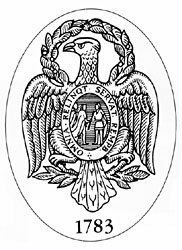


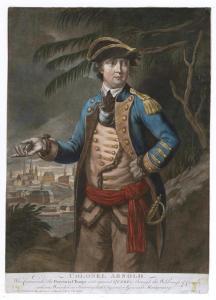 Washington also learned of Arnold’s treason on September 24th during his planned visit to West Point. Washington reportedly took the news calmly and began to investigate the depth of treason in his officer corps. Maj. Lee assisted Washington in his investigation, and both found no evidence of other American officers involved in the plot. Washington then turned to the capture of Arnold, and that is where our “hero” comes into the story.


 Emerging Revolutionary War Era