Ankle Deep In Blood: The Jason Russell House

Emerging Revolutionary War is honored to welcome back historian Katie Turner Getty. Biography of Ms. Getty is below the post. 

On April 19, 1775, the placid farm of fifty-eight-year-old Jason Russell of Menotomy erupted into carnage when he, along with eleven other Americans, were shot and bayonetted by British soldiers in his home and yard.

Image1-KTGetty
Jason Russell House (author collection)

As American militia and minutemen poured in from surrounding towns, the British—fatigued yet furious—found themselves under increasingly heavy musket fire. As they pulled back from Concord and retreated to Boston, the main column passed near Russell’s house which stood near the battle road. Russell had just returned home after secreting his family at a nearby farm. Unbeknownst to him, American minutemen and British soldiers would soon converge upon his property and a desperate battle would occur within the walls of his own house.

Earlier that day, twenty-six-year-old Gideon Foster had set off from Danvers with a company of minutemen. The men had set a scorching pace and made the sixteen mile journey to Menotomy in four hours, running half the way.[1] Upon arriving, Foster’s men joined others from Lynn, Beverly, Salem, Dedham, and Needham.[2]  Some took cover behind trees and others in Russell’s yard, where a breastwork was constructed out of shingles.

Image3-KTGetty
The Fight at the Jason Russell House, bicentennial painting by Ruth Linnell Berry (1974). Appearing with permission from the Arlington Historical Society.

The men focused their attention on the approaching main column of British troops and fired upon them. Capt. Israel Hutchinson, a seasoned French and Indian War veteran, warned that flank-guards would likely be traversing the fields alongside the road[3], helping the main column to pass unmolested. But before the men could reconsider their position or move to a more defensible location, the flank-guard was upon them, trapping the men against the main column.

In a frantic search for cover, many of the men bolted into Russell’s house. Jason Russell, too, attempted to dash inside but was slowed by his lame leg.[4] He was shot twice and fell on his doorstep. The soldiers tore inside the house in hot pursuit of the men, bayonetting Jason Russell’s body eleven times as they passed.

Once inside the house, the Americans had no choice but to fight for their lives in rooms with no egress, in very close quarters, against raging, bayonet-wielding soldiers. It was a bloodbath. With two rooms on the bottom floor, a narrow stairwell, and two rooms on the top floor, Jason Russell’s house offered very little refuge.  Soldiers outside the house hailed musket fire into the windows.

Image2-KTGetty
Sign depicting what happened at the Jason Russell House on April 19, 1775

With nowhere else to go, several men rushed into the cellar. What at first would seem to be an ill-advised hiding spot turned out to be the only sanctuary that Russell’s home could offer. Taking position near the bottom of the stairs, the men raised their muskets and shot dead the first soldier who descended.[5] Any other soldiers who attempted to follow were met with blazing musket fire. Holes left by musket balls are still visible in the stairwell, attesting to the firestorm.

Soon, the house grew quiet. All of the men who had sought safety in the house had been killed, with the exception of the men who took refuge in the cellar. The British ransacked the house then left.[6]

In 1835, sixty years after the bloodbath at Russell’s house, a memorial was erected in Danvers to commemorate the townsmen who lost their lives in Menotomy that day. Danvers lost the second highest number of men, after Lexington[7], and all of them at Jason Russell’s house. Foster, the commander of the company of minutemen who had ran halfway to Menotomy, was by then the last surviving Danvers veteran of the war. Aged eighty-six, he addressed the crowd assembled for the dedication of the monument and recounted the events of April 19th:

On that morning, more than one hundred of my townsmen hastened to the field of battle…ready to offer their lives on the altar of their liberties. Seven of those who thus started in the prime of life and vigor of manhood, ere that day’s sun descended in the west, were numbered with the dead.[8]  

Foster called the dedication of the memorial “One of the happiest days and most pleasing events of my life.”[9]

In total, twelve Americans were killed at Jason Russell’s house.  Jason’s wife, Elizabeth, returned home to find her husband dead. He and the other fallen Americans, their bodies riddled with musket balls and slashed by bayonets, had been laid out on the floor in the kitchen, the blood from their wounds pooling around them. Elizabeth later said that “the blood in the room was almost ankle deep”.[10]

Image4-KTGetty
Musket ball damage to the staircase of the Russell House


*Biography: Katie Turner Getty is a lawyer, history enthusiast, and lifelong resident of Boston. She holds an A.A. from Bunker Hill Community College in Charlestown, Massachusetts, a B.A. in History from Wellesley College, and a J.D. from New England Law Boston. She can often be found exploring historic sites both on and off the Freedom Trail.

*Sources*

The Jason Russell House is located at 7 Jason Street in Arlington, Massachusetts. Their website is http://www.arlingtonhistorical.org/visit/jason-russell-house/ 

[1] Daniel P. King, An Address Commemorative of Seven Young Men of Danvers. (Salem, 1835), 28.

[2] Arlington Historical Society http://www.arlingtonhistorical.org/learn/articles/the-battle-of-menotomy/

[3] J.W. Hanson, History of the Town of Danvers (Danvers, 1848), 107.

[4] Samuel Abbot Smith, West Cambridge 1775, 3rd ed. (Boston, 1864),  38. https://archive.org/details/westcambridge17700smit

[5] Ibid., 38.

[6] Ibid.

[7] Hanson, 91.   

[8] King, Appendix, 27.

[9] King, 28.

[10] Smith, 39.

Eutaw Springs

Emerging Revolutionary War is pleased to welcome back historian Bert Dunkerly, who is the co-author (with Irene B. Boland) of the upcoming book; “Eutaw Springs; The Final Battle of the American Revolution’s Southern Campaign” slated to be released this month. 

Part One

The weather was warm and the men had been marching for days, but their morale was high.  They had been through a lot recently: caught off guard and defeated at Hobkirk’s Hill, a month of grueling siege work – and for naught, at Ninety Six.   Not to mention the engagements that many of them had fought in previously: Kings Mountain, Cowpens, Guilford Courthouse, and dozens of smaller battles.

Yet the army that General Nathanael Greene led forward on the morning of September 8, 1781, was confident and ready to come to grips with its adversary.  Everyone from the private in the ranks on up to the commanding general knew that ahead lay an opportunity.

Battles in the Revolution were, in fact, rare opportunities for commanders.  Engagements were the short, pulse-pounding events that broke up the monotony of marching and maneuvering.  An army spent most of its time in garrison, in camp, or on the road.  In battle the infrequent opportunity came to crush an opponent and influence the outcome of a campaign, or the war.  These chances were few and far between.

Fig 8
“Eutaw Springs” by Benson Lossing

Both commanders at Eutaw Springs appreciated this fact.  General Nathanael Greene’s forces had experienced a series of close calls at Guilford Courthouse, Ninety Six, and Hobkirk’s Hill.  The American army fought well in all of these engagements, save Hobkirk’s Hill, yet they met defeat in every one.  Greene hoped Eutaw Springs would put the finishing touches on his South Carolina campaign, and end it with a clear cut victory.[i]

Eutaw Springs was a rare chance for Greene to pick the time and place of engagement, array his forces to his choosing, and initiate the battle, and control its \tempo.  It was the only set engagement of the campaign, other than Guilford Courthouse, in which Greene chose the ground and initiated the battle.  Commanders do not often have this luxury, and Greene earnestly hoped to make the most of it. Continue reading “Eutaw Springs”

April 19, 1775 – Minute Men vs. Militia

12797-21913
Monument to the “Lexington      Minute Men”

“Minutemen” on April 19, 1775 at Lexington and Concord have always been grouped together in history and textbooks. But, is that completely historically accurate? Well, no. There is a common misperception that most of the Americans that went to arms on the morning of April 19, 1775 were “Minutemen.” This view has become part of American mythology and popular memory, referenced in most histories dealing with this April day. Despite all of this, the fact remains that many of the men who answered the call that day were not “Minutemen” at all.

The British colonies in North America had a long standing tradition of locally based military units. Most men between the ages of sixteen and thirty five were required to be part of the local militia and these units would meet periodically throughout the year for basic training. Many of these occasions became festive events for the local community. The colonial militia was called out often by the colonial governor to defend against Native American attacks or foreign invasions. Frequently, the militia would supplement a professional force for short campaigns.  This was especially common in the French and Indian War, fought between 1756 and 1763.

But the militia was far from a professional and well trained force. Colonies, such as Massachusetts, began to create select companies of men chosen from the local militia regiment. These companies would train more often and be better equipped. They were to be the “elite” force of the militia. Also, these men would be required to respond to an emergency at a short notice. The rise of the “Minuteman” concept can be found as early as 1645. In response to an Indian tribe disturbance, the Massachusetts Council of War created a new regulation. This regulation ordered militia companies to “appoint out and to make choice of thirty soldiers of their companies in ye hundred, who shall be ready at a half an hour’s warning.” The need for a quick response force was already recognized by colonial leaders.

Though the idea of the “Minuteman” can be found in 1645 Massachusetts, the more popular idea of the “Minuteman” came from Worcester, Massachusetts. In 1774 the town was in the forefront of opposing Governor (and General) Thomas Gage’s efforts to enforce Royal authority. The Worcester County Convention passed new militia regulations that highlighted/reinforced how the populace was getting closer and closer to open confrontation with the British Crown. In these new regulations, the Worcester Convention called for “officers in each town of the county, to enlist one third of the men of their respective towns, between sixteen and sixty years of age, to be ready to act at a minute’s warning…” Thus the “Minuteman” was born.

parker
Monument on the Lexington Green marking the place where the “Lexington Minute Men” stood

As events in Massachusetts spiraled into open confrontation between the Whigs (Patriots) and the Crown, every town in Massachusetts ramped up their military training of their militia and created “Minuteman” companies. These units became a source of local pride. Along with the militia forces, towns and counties created a complex network of communication via riders that could notify hundreds if not thousands of militia units of possible threats. As Gage began to use his growing military force in Boston to search for colonial military stores, these riders and “Minutemen” showed their effectiveness.

On the morning of April 19, 1775 riders rode out to a very well prepared countryside west of Boston. Paul Revere, William Dawes and many others connected each town with the news that the British regulars were marching on Concord to capture provincial military stores (and possibly capture colonial leaders). Militia and “Minutemen” by the hundreds began to arrive along the road from Cambridge to Concord.

The first Americans the British confronted on the road to Concord were members of Captain Parker’s Lexington Militia. These men, gathered the night before at Buckman’s Tavern in Lexington after an early warning, were still in the area in the early morning of April 19th as the vanguard of the British column neared Lexington. As they formed up in two lines on the Lexington Green, the British quickly came onto the Green to confront the armed colonials.  What happened next set off a shockwave not just through Massachusetts, but the entire British colonies in North America. These first shots were fired by militia, not the famed “Minutemen.”

It is here in Lexington that the confusion and myth of the “Minutemen” was born. Several of the monuments around the Lexington Green are dedicated to the “Lexington Minutemen.” But the men on the green were typical militia; they ranged in age and skill levels. They were not highly trained like a “Minutemen” company.

davismnt
Isaac Davis Monument in Acton, MA. The Acton Minute Men were one of several Minute Men units to take part in the action at Concord.

As the British made their way to Concord, Militia and “Minuteman” companies began to answer the well-traveled call that the British were marching on to Concord. After the skirmish at the North Bridge in Concord, more and more colonials answered the call and began to confront the British column as it made its way back to Charlestown. Thousands of militia and “Minutemen” made their way to the towns of Lexington, Menotomy, and Cambridge to confront the British. Because of the great response of these men, there was no turning back after April 19th.

The importance of the “Minutemen” cannot be exaggerated but neither can the importance of the militia. They were two distinct colonial military forces, both created with their own specific uses. In modern times, most wanted to attach their local story to that of the famed “Minutemen.” Though it is most likely that more militia turned out on April 19th than “Minutemen.”

Many monuments in Lexington, Concord and along Battle Road mention the “Minutemen” of 1775. Also, many of the sites associated with the events of April 19th are preserved by Minute Man National Park.  I guess “Militia National Park” didn’t have as good of a ring to it.

Recommended Reading:

The Minute Men: The First Fight: Myths and Realities of the American Revolution by John Galvin


1st Maryland’s 2nd Last Stand

I was recently reading the superb book by Patrick O’Donnell on Washington’s Immortals, which brought me back to a talk I did about the same Marylanders in the American Revolution a few years back. Below is an excerpt of that talk and highlights the second last stand for a regiment with a tradition of being steadfast when deadly duty called.

On March 15, 1781, approximately 20 men stood in the 1st Maryland Continental Regiment staring at the an eerie and familiar scene. It must have seemed that history was cruelly repeating itself once again. These men had survived the forlorn assault in New York in 1776, the ugly repulse at Camden in 1780, and now stood on third line of General Nathanael Greene’s defense at Guilford Court House.

Battle of Guiliford Courthouse 15 March 1781.jpg
Famous painting of the 1st Maryland at the Battle of Guilford Court House by H. CHarles McBarron, Jr. 

Besides the 20 men who could be traced back to that fateful day in New York, the men that shouldered muskets in line with them were all veterans of indefinite periods of service as well.

The 1st Maryland and the men they confronted, 2nd Guards Battalion of Guards, were very similar, according to historian Lawrence Babits, who states that “the 1st Maryland was arguably one of the finest regiments produced by the Continental Army.

What ensued next was the defining moment of the battle and in essence the campaign. As the Guards officers gathered their men into a new line, the Marylanders came on at a rush. The Guards responded largely without specific commands…facing the oncoming Continentals, who fired several platoon volleys as they came. At a range of less than 12 yards, both lines fired again, so close that muzzle flashes overlapped into a wide sheet of flame and the heat from the volley could be felt.

Casualties mounted and at close range the musket balls shattered bone and even passed through the bodies of their targets.

SANY2634.JPG
Modern view from the location of Greene’s Third Line which the 1st Maryland held. Coming up the slight rise toward the photo was how the British approached. 

The two sides then resorted to the bayonet and Williams recounted “the first Regiment embraced the opportunity…bayoneted and cut to pieces a great number of the British.”

Although the melee only lasted a few minutes, the Marylanders had checked the advance and with the dragoons of William Washington, allowed for Greene to begin to pull back and start the retreat. In another important position, Williams helped lead the rear-guard away from Guilford C.H. The Marylanders lost 15 killed, 42 wounded and 97 missing. Most of the missing could have came from the 2nd Maryland which broke in disorder on the left flank of the 1st Maryland.

Not only did the Marylanders suffer on that fateful March day in 1781, they did so with a lack of, well, everything. According to one inventory report, the entire regiment, numbering little over 300 men had not a single jacket, two-thirds were without proper footwear, and every man was destitute of a full complement of clothing. In addition, the men had served, fought courageously, and bled tremendously, without receiving one cent as pay.

A remarkable “band of brothers” that “held the line for independence.”

Which, in case you were wondering, was the name of the talk.


*Guilford Court House National Military Park is now preserved by the National Park Service, to plan your visit, click here.

*For information on Mr. O’Donnell’s book, click here.

Union Jack o’er the Capitol: A Burning of Washington Walking Tour

Emerging Revolutionary War is honored to welcome guest historian Zach Whitlow. Zach’s biography is at the bottom of this post. 

August marks the 202nd anniversary of the Burning of Washington. On the heels of their astounding victory at Bladensburg, a British incursionary force under Major General Robert Ross and Rear Admiral George Cockburn occupied the American capital for about 24 hours on August 24th & 25th, 1814. Besides a small ambush at the Sewall House on Capitol Hill, in which two corporals and General Ross’ horse was killed, the British encountered no resistance in the city whatsoever. The Union Jack was triumphantly raised: Washington had fallen. Soon it would burn.

The burned out shell of the White House following the British occupation of Washington. (The President's House, by George Munger, 1814-1815)
The burned out shell of the White House following the British occupation of Washington. (The President’s House, by George Munger, 1814-1815)

What followed were events that literally burned themselves into the American psyche. To remember this bleak moment in history, rangers from the National Mall & Memorial Parks are leading a series of walking tours in the month of August. Beginning at the newly designated Belmont-Paul Women’s Equality National Monument (the site of the ambush), visitors walk a total of 2.5 miles and retrace the British advance down Pennsylvania Avenue. Through the program, the rangers will sift through the modern paved environment and tell the stories of long gone places, such as the newspaper offices of the National Intelligencer and Barbara Suter’s tavern.  The tour will also feature some of the surviving remnants of that time, such as the Octagon Museum.

The walking tour begins at Belmont-Paul Women’s Equality National Monument (144 Constitution Ave NE, Washington, DC 20002) every Saturday in August at 3:00 pm. There will also be programs on Wednesday, August 24th and Thursday, August 25th at 3:00 pm. Please bring comfortable shoes and plenty of drinking water.


*Zach Whitlow has an M.A. in Museum Studies from the George Washington University, a B.A. in History from California State University, Long Beach, and three A.A. degrees from Fullerton College. A lifelong historian, he currently works for the National Park Service at the National Mall & Memorial Parks in Washington, DC and the Office of Historic Alexandria in Alexandria, VA. Prior to this, Zach worked at the National Archives, George Washington’s Mount Vernon, and the Queen Mary in Long Beach, CA. He currently lives in Alexandria, VA with his girlfriend Teresa and their two cats, Max and Lizzie.


The Virginia Capes, Jutland, and American Destiny

At the end of last month and the beginning of this, I was in Britain marking the centennial of the Battle of Jutland, World War I’s largest naval battle. My great-grandfather was there as part of the Royal Navy, and it was meaningful in the extreme for me to be present at the commemorations.800px-BattleOfVirginiaCapes

The National Museum of the Royal Navy interpreted Jutland as “The Battle that Won the War,” and based its argument on the fact that the battle’s outcome led directly to German resumption of unrestricted submarine warfare, which in turn brought the United States into the war, with all the resulting titanic effects. In other words, a naval battle which didn’t feature a single American had a profound impact on U.S. history.

If that sounds familiar to Revolutionary War scholars, that’s because the same description applies to the 1781 Battle of the Virginia Capes. Let me explain.

Continue reading “The Virginia Capes, Jutland, and American Destiny”

Immediate: Concord (MA) Museum Signs Historic Agreement to Operate the Wright Tavern

On Wednesday, June 8, a signing ceremony marked the beginning of an agreement between First Parish in Concord, owner of the Wright Tavern, and the Concord Museum. Starting this fall, the Concord Museum will provide educational programming to school groups in the Wright Tavern and open the historic building to the public for commemorative events in October and April each year. On hand for the signing were representatives of the Concord Museum and First Parish as well as members of the Wright Tavern Exploratory Committee (WTEC), appointed last fall to develop a sustainable, strategic plan to showcase the Wright Tavern as a National Historic Landmark.

IMG_0075
Plaque on the Wright Tavern (ERW collection photo)

“Opening the historic Wright Tavern to public and educational access will provide a true sense of place when learning about the historical events of the American Revolution,” said Mel Bernstein, member of WTEC and Chairman of the American Revolution Round Table of the Minute Man National Historical Park.

No building in this historic community was of greater consequence to the beginnings of the American Revolution than the Wright Tavern, built in 1747. The First Provincial Congress met in Concord at the Wright Tavern in October 1774, electing John Hancock as the Congress’s president and making provision for the collection of taxes. The Second Provincial Congress met there again in March and April 1775. Presided over by John Hancock with Samuel Adams and Dr. Joseph Warren in attendance, the Provincial Congress met in defiance of Royal and Parliamentary authority — creating a Massachusetts army, raising taxes, and performing other roles necessary to form its own government, independent of British authority.  Then, in the early hours of April 19, 1775, Concord’s Minute Men assembled in the Wright Tavern before setting off to repel the advancing British troops at the North Bridge.

Since 1886, First Parish in Concord has owned and maintained this historic structure. “The Wright Tavern is certainly one of the most important Revolutionary War-era buildings in Concord,” explained Tim Jacoby, Chair of the First Parish Trustees of Parish Donations. “Although the building is owned by the church, we truly feel it belongs to the people of Concord and to the American people. This agreement with the Concord Museum will establish greater public accessibility to the Tavern.”

In 1961, the Wright Tavern was designated a National Historic Landmark by U.S. Secretary Fred Seaton, declaring it “an historical site of exceptional value in commemorating and illustrating the history of the United States.”

Margaret Burke, Executive Director of the Concord Museum, said: “The Museum is thrilled with this partnership to bring the importance of the Wright Tavern to the fore. Concord is home to invaluable historical and cultural resources, and this is a wonderful example of how organizations within the town are working together to promote this history and make it relevant to residents and visitors.”

Leah Walczak, the Concord Museum’s Director of Education and Public Programs, explained the role the Wright Tavern will play in educating visiting school groups:  “The Museum currently provides specialized programming to over 10,000 school children each year. Along with hands-on history education using objects from the Museum’s collections, this agreement will allow us to provide programs within the setting of one of the finest historic buildings in Concord.”

This partnership was brought about through the work of the Wright Tavern Exploratory Committee, which convened from September 2015 through January 2016.  Members included:  John Boynton, Chair of the Exploratory Committee and a First Parish Trustee; Doug Baker, Sacristan and Curator of First Parish; Mel Bernstein, Chair of the American Revolution Round Table of Minute Man National Historical Park; Jim Cunningham, Project Manager for Barrett Farm Restoration, and Treasurer of Save Our Heritage; Sue Gladstone, Director of Development for the Concord Museum; Jayne Gordon, Public Historian for Robbins House, Thoreau Farm, and the Concord Museum; Tim Jacoby, Chair of the First Parish Trustees; Bob Morris, Chair of the Friends of Minute Man National Historical Park; and Tom Wilson, First Parish Treasurer.

A generous gift to the Museum from John and Johanna Boynton is funding this historic partnership.

*About the Concord Museum
The Concord Museum is where all of Concord’s remarkable past is brought to life through an inspiring collection of historical, literary, and decorative arts treasures.  Renowned for the 1775 Revere lantern and Henry Thoreau’s Walden desk, the Concord Museum is home to a nationally significant collection of American decorative arts, including clocks, furniture, and silver. Founded in 1886, the Museum is a gateway to historic Concord for visitors from around the world and a vital cultural resource for the town and the region.  Visit www.concordmuseum.org.*

*For More Information, contact:

Barbara Rhines, Director of Marketing and Public Relations
978-369-9763, ext. 229
Email: brhines@concordmuseum.org

Part 2: The Defense in Depth as a Revolutionary War Battlefield Tactic

For part one, click here

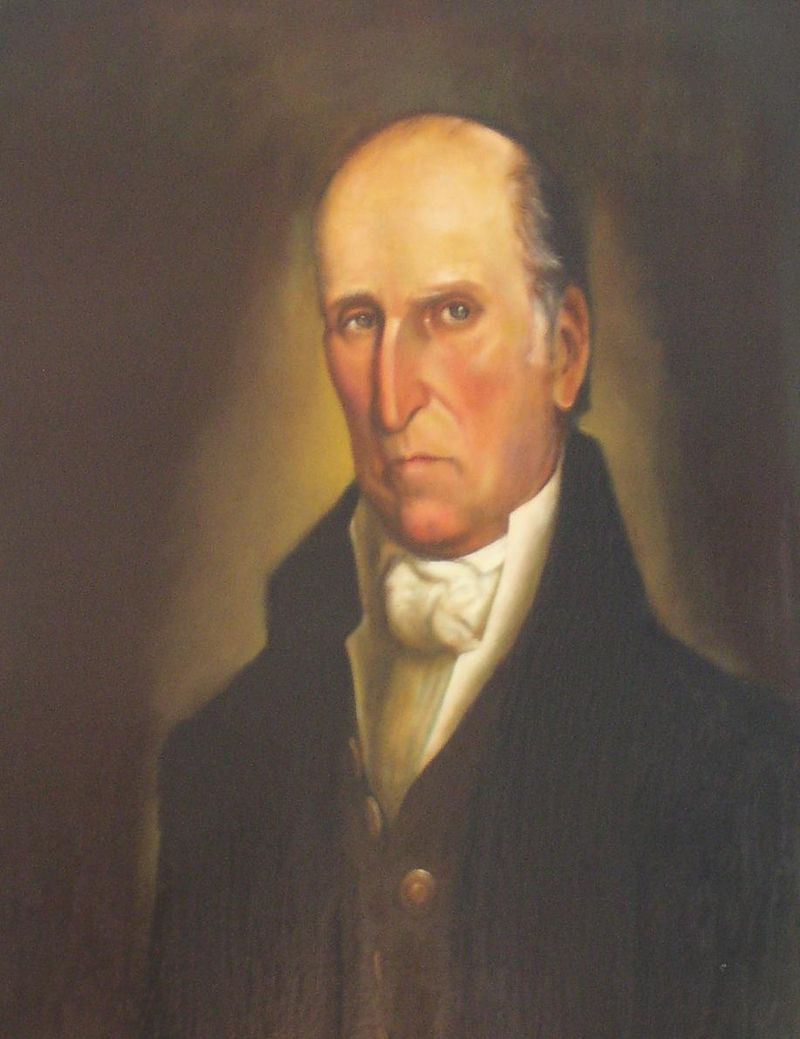
Brig. Gen. Daniel Morgan, the “Old Wagoner,” as he was known, commanded a light infantry corps assigned to Maj. Gen. Nathanael Greene’s southern army. Morgan met with Greene in Charlotte, North Carolina on December 3, 1780.  Implementing a Fabian strategy, Greene split his army to harass the British while buying time to recruit additional soldiers. Greene ordered Morgan to use his 600-man command to forage and harass the enemy in the back country of South Carolina while avoiding battle with Lt. Gen. Charles Lord Cornwallis’ British army.

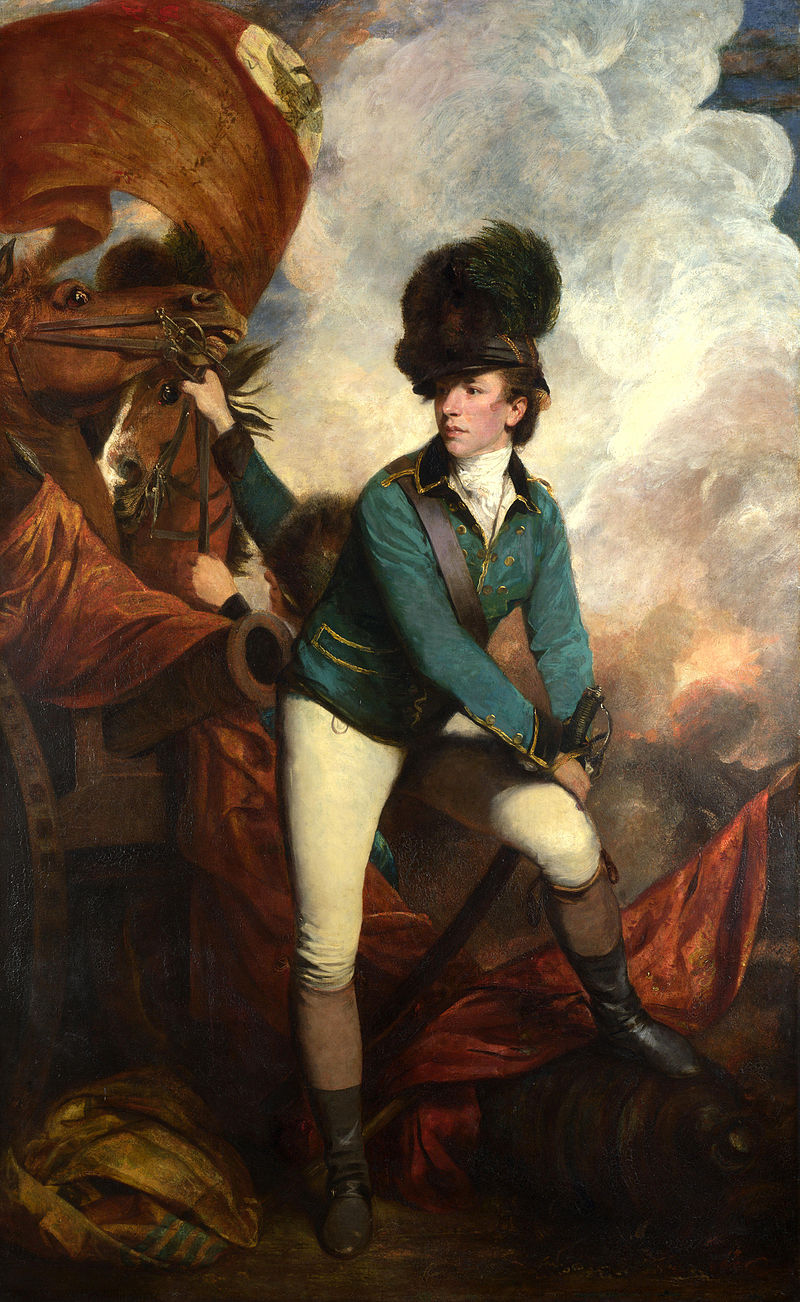
Once Cornwallis realized what was going on he dispatched Lt. Col. Banastre Tarleton’s British Legion to track down Morgan’s command and bring it to battle. Tarleton commanded a combined force of Loyalist American troops. The Legion consisted of fast-marching light infantry and dragoon units. At its peak strength, the Legion numbered approximately 200 infantry and 250 dragoons. It was known for its rapid movements and for its ruthless policy of giving the enemy no quarter. Patriot forces feared Tarleton and his Legion, and for good reason.

By January 12, Tarleton’s scouts had located Morgan’s army in the South Carolina back country, and Tarleton began an aggressive pursuit. Morgan hastily retreated to a position at the Cowpens, a prominent crossroads and pasturing grounds for cattle. The field was about 500 yards long and about as wide, dotted with trees, but devoid of undergrowth, which served as a food source for grazing battle.

Once Morgan learned that Tarleton was pursuing him, he spread the word for local militia units to rendezvous with him at the Cowpens. Through the night, South Carolina militiamen drifted into camp. Morgan visited their camps, encouraging them to stand and fight. Morgan’s words were particularly effective; the grizzled veteran knew how to motivate these men. They would need to be prepared, because they faced a stern task the next day.

January 17, 1781 dawned clear and very cold. After his scouts reported Tarleton’s approach, Morgan rode among his men, crying out, “Boys, get up! Benny’s coming!” Morgan designed a defense in depth that was intended to draw the British Legion in and then defeat them by pouncing on their exposed flanks. He knew that his militia had a reputation of being unreliable, and his ability to maneuver was limited, so he elected to design and implement a defense in depth that took advantage of the terrain features of the Cowpens.

Banastre Tartleton, British commander at Cowpens

Tarleton was overconfident. He believed that Morgan’s command was hemmed in by the nearby Broad River and also believed that the cleared fields of the Cowpens were ideal ground for his dragoons, and concluded that Morgan must be desperate to fight in such a place.

Morgan had prepared three defensive positions. Selected sharpshooters out front and hiding behind trees manned the first line. They picked off a number of Tarleton’s dragoons as they advance, specifically targeting officers. Traditional accounts indicate that they downed 15 of Tarleton’s dragoons this way. Confused, the dragoons retreated.

Having accomplished their initial goal, the sharpshooters then fell back about 150 yards or so to join the second line, which consisted of Brig. Gen. Andrew Pickens’ militiamen. Morgan asked these men to stand long enough to fire two volleys, after which they were to fall back to the third—and main line—manned by Col. John Eager Howard’s Continentals, another 150 yards or so in the rear of the second line. Thus, Morgan had designed a textbook example of a defense in depth.

Andrew Pickens, commanded some of the South Carolina militia at Cowpens

Some of the militia got off two volleys and then most of the militia fell back to a spot behind the third line. Tarleton orders his dragoons to pursue the retreating militiamen, and as the dragoons bore down on them with their sabres drawn, Col. William Washington’s Continental cavalry suddenly thundered onto the field, seemingly from nowhere. They routed the surprised Loyalist dragoons, who fled the field with heavy losses.

The infantry then engaged. With their drums beating and their fifes shrilling, the British infantry advanced at a trot. Recognizing that the moment of crisis had arrived, Morgan cheered his men on, rode to the front and rallied the militia, crying out, “form, form, my brave fellows! Old Morgan was never beaten!”

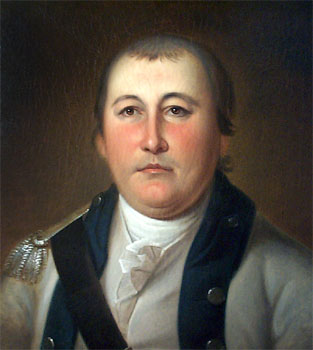
William Washington, commander of American cavalry at Cowpens and a distant relation to George Washington

Tarleton’s 71st Highlanders, a veteran unit made of Scotsmen, which had been held in reserved, now charged the Continental line, their skirling bagpipes adding to the cacophony of battle. Howard ordered his right flank to face slight right to counter a charge from that direction, but in the noise and chaos, was misunderstood as a call to retreat. As other companies along the line began to pull out, Morgan rode up to ask Howard if he had been beaten. Howard pointed at the orderly ranks of his retreat and assured Morgan that they had not been beaten. Morgan then put spurs to his horse and ordered the retreating units to face about and, on his order, to fire in unison. Their deadly volley dropped numerous British soldiers, who, sensing victory, had broken ranks in a determined charge. The combination of this volley and a determined bayonet charge by the Continentals turned the tide of battle in favor of the Americans.

At the moment, the rallied and re-formed militia and Washington’s cavalry attacked, leading to a double envelopment of the British, who began surrendering in masses. Tarleton and some his men fought on, but others refused to obey orders and fled the field in a panic. Finally, Tarleton realized that he had been badly beaten and fled down the Green River Toad with a handful of his men. Racing ahead of his cavalry, William Washington dashed forward and engaged Tarleton and two of his officers in hand-to-hand combat. Only a well-timed pistol shot by his young bugler saved Washington from the upraised saber of one of the British officers. Tarleton and his remaining forces escaped and galloped off to Cornwallis’ camp to report the bad news.

And bad news it was: Tarleton’s Legion lost 110 dead, over 200 wounded and 500 captured. By contrast, Morgan lost only 12 killed and 60 wounded. His perfectly designed and perfectly implemented defense had worked even beyond the Old Wagoner’s wildest dreams and highest hopes.

Knowing that Cornwallis would pursue him, Morgan buried the dead and then withdrew to the north to live and fight another day. Morgan reunited with Greene’s army and the combined force headed for North Carolina. Morgan, whose health was fragile, soon retired from further duty in the field, but he had left his mark. Cowpens was his finest moment, and set a precedent for Greene to follow two months later at Guilford Courthouse.

Battle of Cowpens (Courtesy of Campaign 1776/CWT)
Battle of Cowpens
(Courtesy of Campaign 1776/CWT)

*Suggestions for additional reading: for a superb book-length microtactical treatment of the Battle of Cowpens, see Lawrence E. Babits, A Devil of a Whipping: The Battle of Cowpens (Chapel Hill: University of North Carolina Press, 1998). This book is the primary resource consulted in drafting this article.

The Defense in Depth as a Revolutionary Battlefield Tactic

Part One of Four 

As a general statement, most people don’t think of the Revolutionary War as a testing ground for battlefield tactics. That assumption would not be correct. In fact, the Revolutionary War proved beyond doubt that traditional European set-piece battlefield tactics were largely ineffective against a determined enemy that was not bound by the traditional rules of war.  As just one example, the extremely effective hit and run tactics used by the Minutemen to harass and deplete the British forces that marched to Lexington and Concord that were based on the tactics used by Native American fighters prove this beyond doubt. The British Regulars had no experience or training in dealing with these tactics, and they suffered as a result.

Also, in the European model, wherein gentlemen fought wars and assiduously avoided civilian casualties, it was considered impolite and improper to target the other side’s officers during the course of battle. American forces refused to comply with these rules, causing serious losses among the ranks of British officers, and the British had to adapt to these tactics also.

Another tactic adopted by American officers proved to be incredibly effective during the campaigns in the South in 1781. Brig. Gen. Daniel Morgan and Maj. Gen. Nathanael Greene, in particular, made extremely effective use of the defense in depth in carrying out their Fabian strategy during the Southern Campaigns of the Revolutionary War.

A Fabian strategy—named for its most famous practitioner, the Roman dictator, Quintus Fabius Maximus Verruscosus—avoids pitched battles and frontal assaults in favor of wearing down an opponent through a war of attrition and indirection. While avoided decisive battles, the side employing a Fabian strategy harassed the enemy through skirmishes to inflict losses, disrupt supply, and affect enemy morale. Typically, the employment of this strategy suggests that the side adopting it believes that time is on its side. George Washington was absolutely convinced that a Fabian strategy would ultimately wear down the British, and he was right.

unnamed (1)
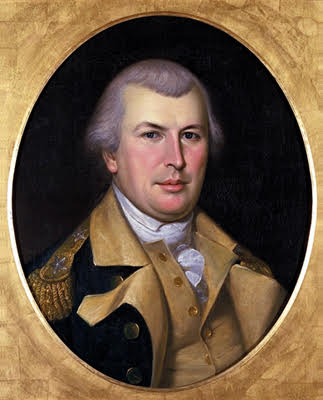
General Nathanael Greene, who mastered the Fabian strategy in the Southern Campaign of 1781

His protégé, Greene, also believed that a Fabian strategy was the way to defeat the British. Faced with the task of defending a large swath of the South with a small army, he had little choice. His subordinate, Brig. Gen. Daniel Morgan, a rough but extremely effective amateur soldier, pioneered the use of a defense in depth at the Battle of Cowpens in January 1781, and Greene then used it on a larger scale at the Battle of Guilford Courthouse about sixty days later. That two untrained amateur soldiers could develop and use such a tactic so effective demonstrates their genius.

A defense in depth, also known as a deep or elastic defense, seeks to delay, rather than prevent, the advance of an attacker, buying time and inflicting additional casualties by trading time for space. Instead of facing an attacker with a single, strong defensive position, a defense in depth relies upon the tendency of an attack to lose momentum and cohesion over time as it covers a larger area. Thus, a defender can yield lightly defended territory in an effort to outstrip an attacker’s logistics or spread out a numerically superior attacking force. Once that attacker has lost momentum, or has become spread out to hold territory, well-planned and well-placed counterattacks can be directed at the attacker’s weak points, with the objective of causing attrition warfare or driving the attacker back to its original starting position.

A conventional defensive strategy concentrates all of a defender’s military resources in a well-defended front line, which, if breached by an attacker, would expose the remaining troops in danger of being flanked, cut off, and surrounded, and leaving lines of supply, communications, and command vulnerable to being cut.

By contrast, a defense in depth requires that defenders deploy their resources, such as prepared fortifications, earthworks, and additional forces at and well behind the front line. Once an attacker breaches the weaker initial position, it continues to meet resistance as it presses on. As the attacker penetrates further, its flanks become vulnerable, and if the advance stalls, the attacking force can find itself completely surrounded and subject to being destroyed or forced to surrender. Thus, a defense in depth is particularly effective against an attacker that can concentrate its force to attack a small number of places along an extended defensive position.

In a well-designed and properly implemented defense in depth, the defending forces fall back to a succession of prepared positions designed to inflict a heavy price on the advancing enemy while minimizing the risk of being overrun or outflanked. By delaying the enemy’s advance, a defense in depth neutralizes manpower advantages and the element of surprise, and buys time for additional forces to be readied for well-timed counterattacks. A well-designed defense in depth will use its forces in mutually supporting positions and in appropriate roles. In this scenario, poorly trained soldiers—such as militiamen—can be used in static positions at the front line, while more experienced and better-trained soldiers can form a mobile reserve, or man the ultimate defensive position to be defended.  Further, a well-designed defense in depth will make good use of the natural advantages offered by terrain features and other natural obstacles such as streams, ponds, etc.

DanielMorgan
General Nathanael Greene, who mastered the Fabian strategy in the Southern Campaign of 1781

There are disadvantages associated with the defense in depth. For one thing, constantly retreating can take a toll on the morale of defending forces. Further, these forces also require a high degree of mobility to accommodate those retreats, and also the space to do so.

Morgan designed and implemented a very effective defense in depth at Cowpens that proved so effective that Greene adopted that tactic and, while he lost the Battle of Guilford Courthouse, the heavy losses his army imposed on Lord Cornwallis’ army prompted Greene to note that the British, “have met with a defeat in a victory.”