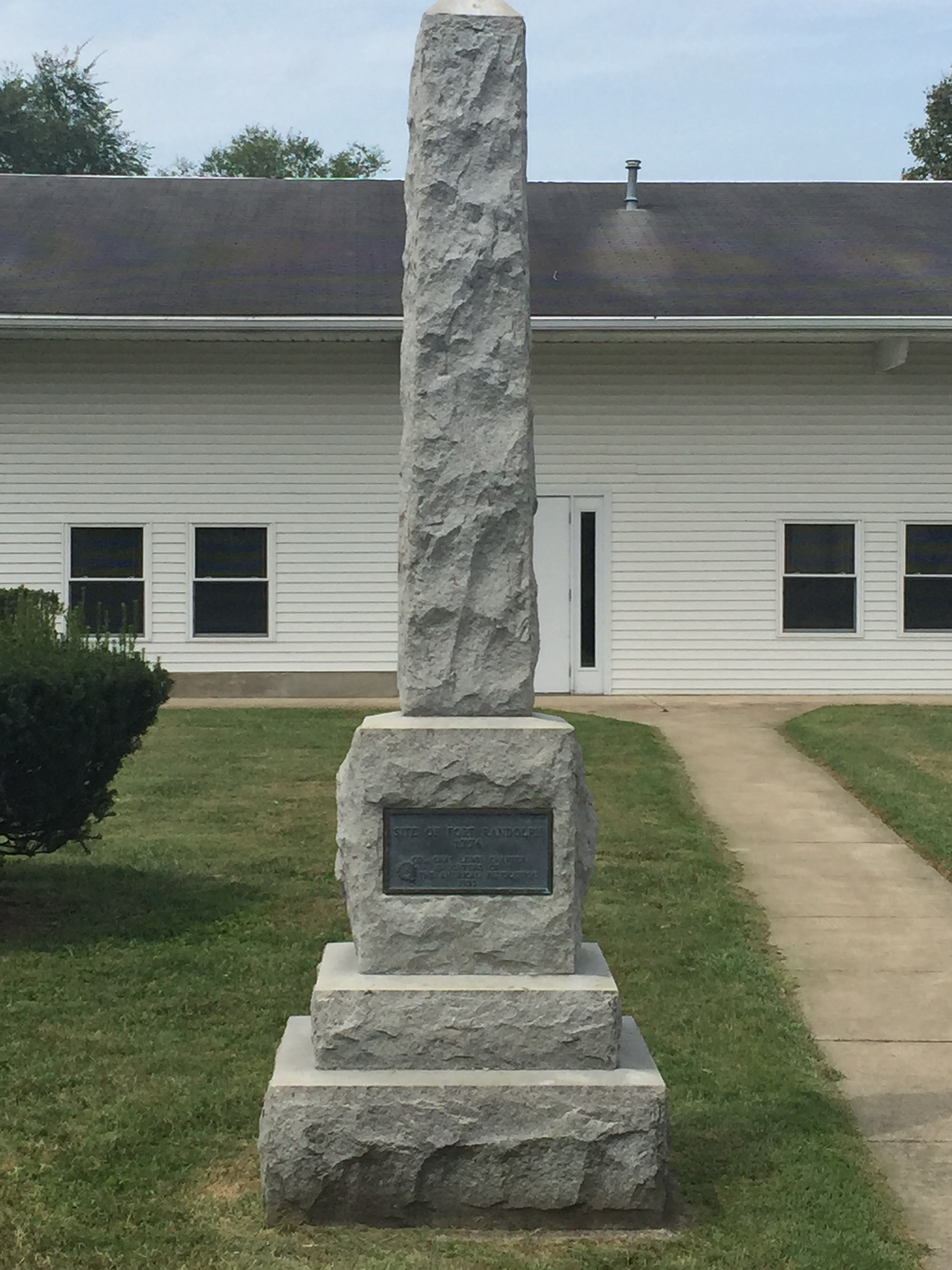
Marker on the site of the 1774 Fort Harrison at Point Pleasant
Today, little of the Point Pleasant battlefield remains. A small park, of about four acres, at the confluence of the Kanawha and Ohio Rivers is the only preserved portion of the battlefield. Known as Tu-Endie-Wei State Park, it commemorates the October 10, 1774 Battle of Point Pleasant. “Tu-endie-wei” means “the point between two waters” in the Wyandotte Indian dialect, a fitting name for the point at the confluence of two great rivers.
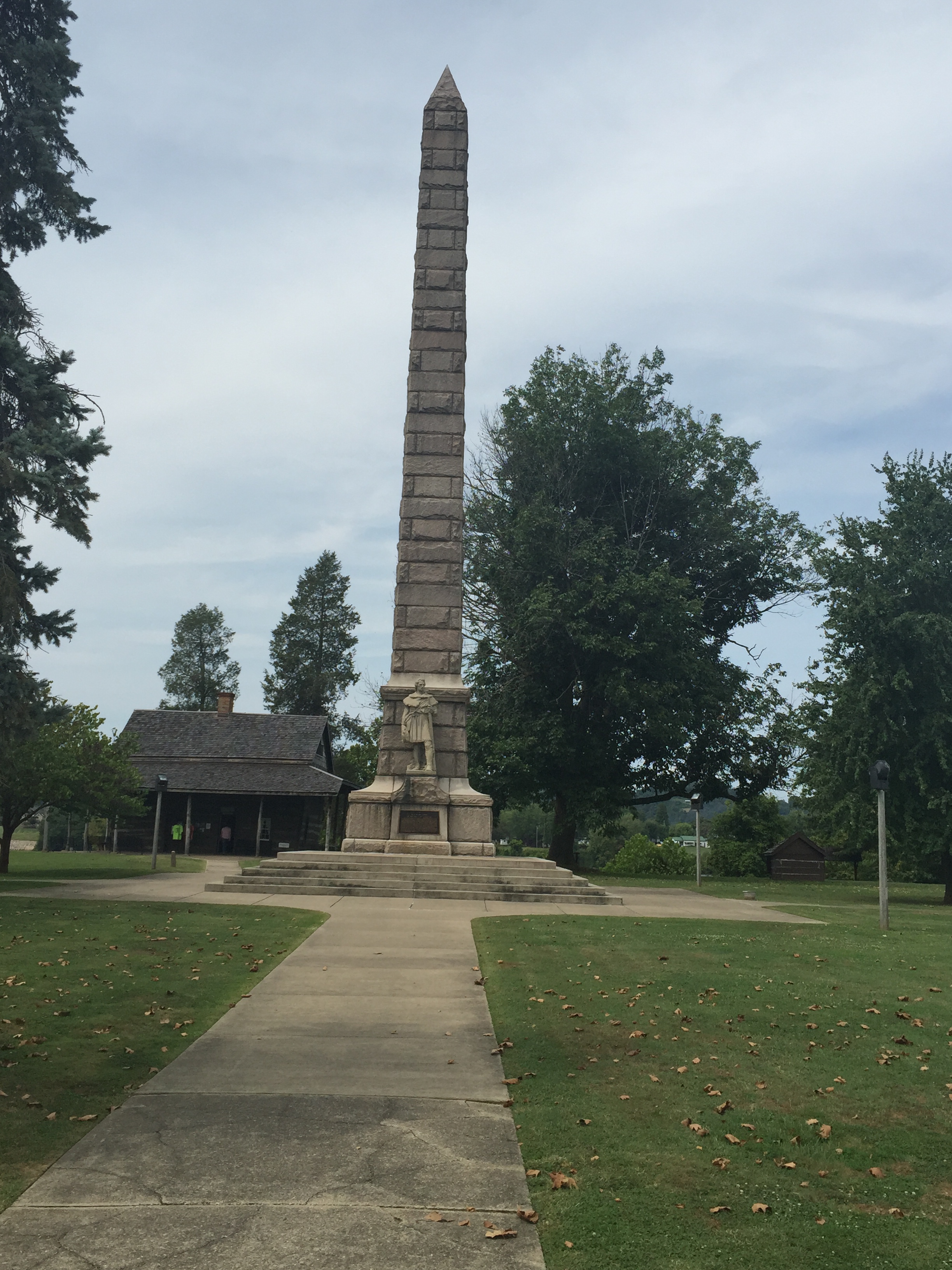
The 84 foot-high obelisk on the site of the mass grave of the Virginia soldiers killed at Point Pleasant
This well-maintained little state park features an 84-foot-granite obelisk that honors
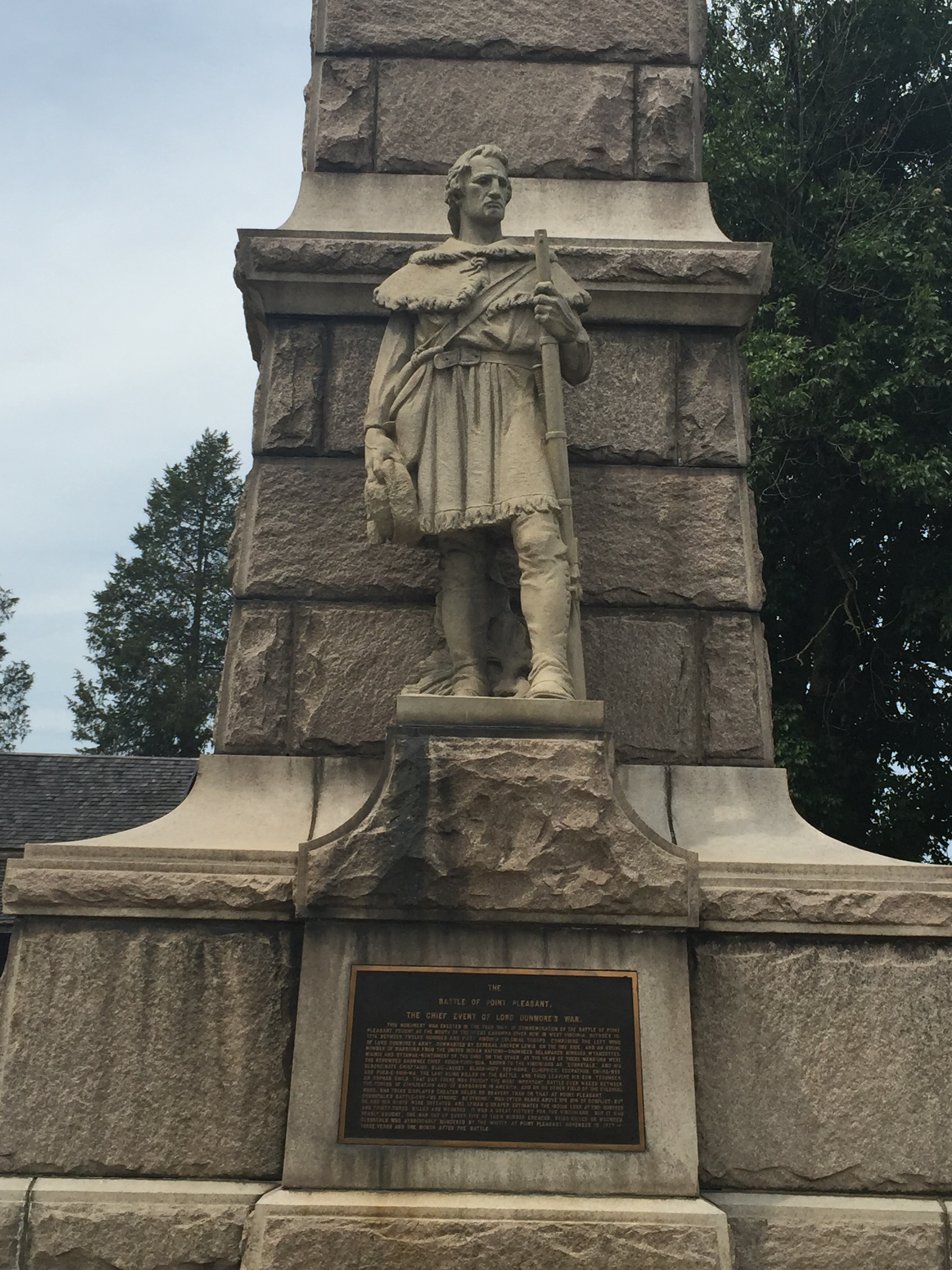
A detail of the frontiersman depicted on the obelisk.
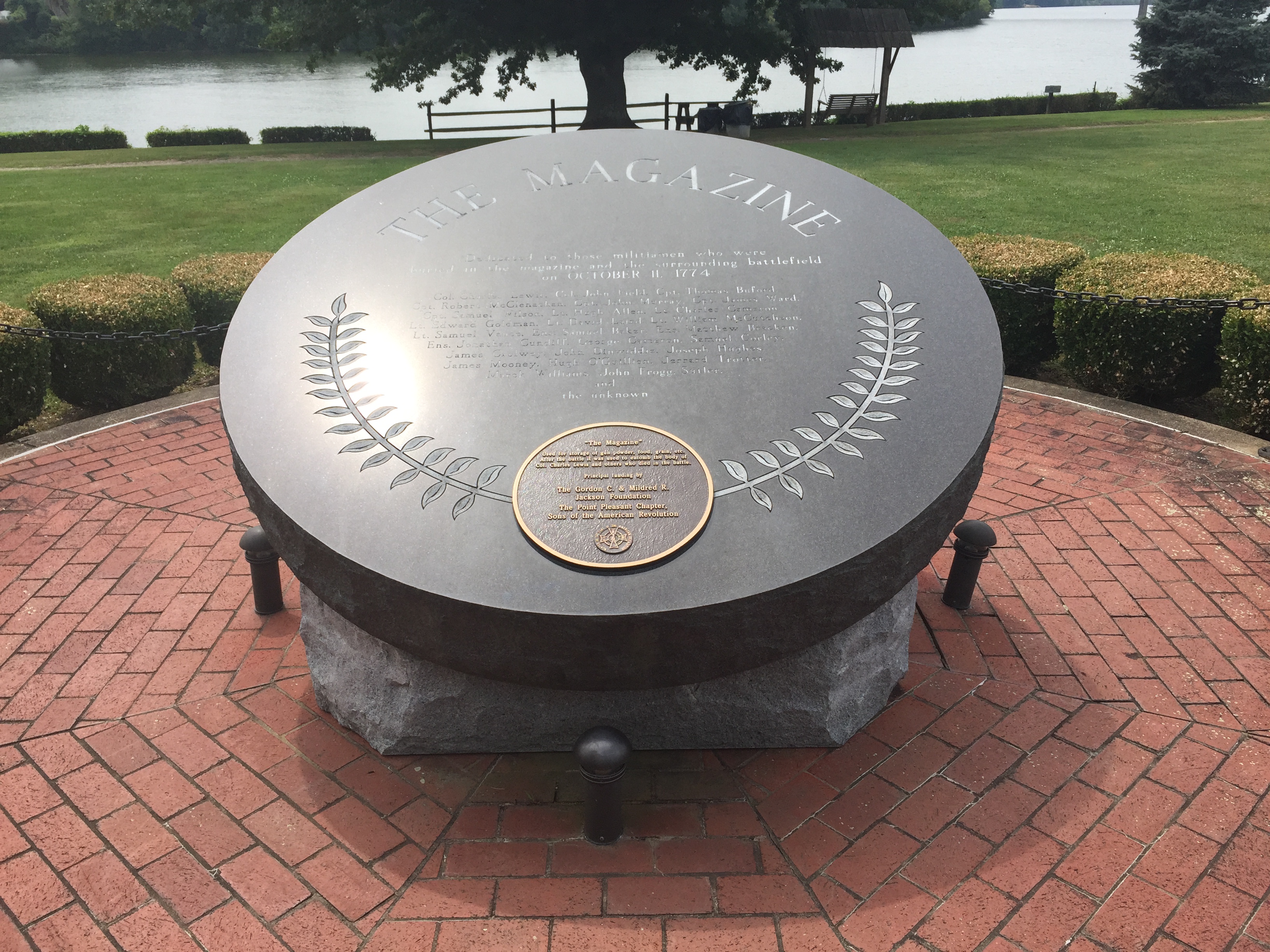
the Virginia militiamen who fought and died at Point Pleasant, and a statue of a frontiersman stands at the base of the obelisk. Smaller memorial tables scattered throughout the park honor Chief Cornstalk and “Mad” Anne Bailey, whose husband was killed in the battle. A large and prominent monument marks the location of Camp Pleasant’s powder magazine. The 1796 Mansion House, erected by Walter Newman as a tavern, while not pertinent to the battle, is the oldest hewn log home in the Kanawha Valley and serves as both museum and visitor’s center for Tu-Endie-Wei State Park.
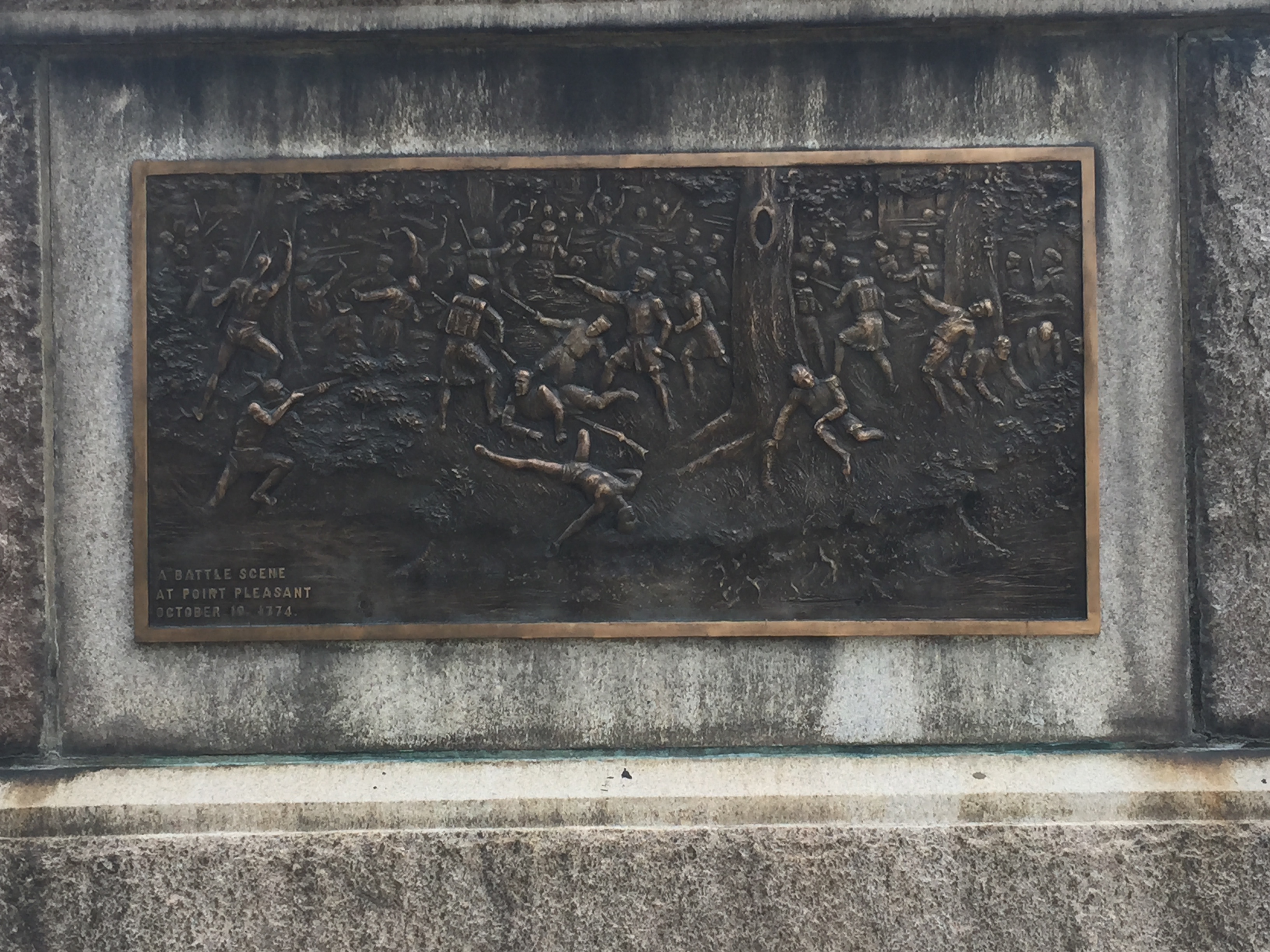
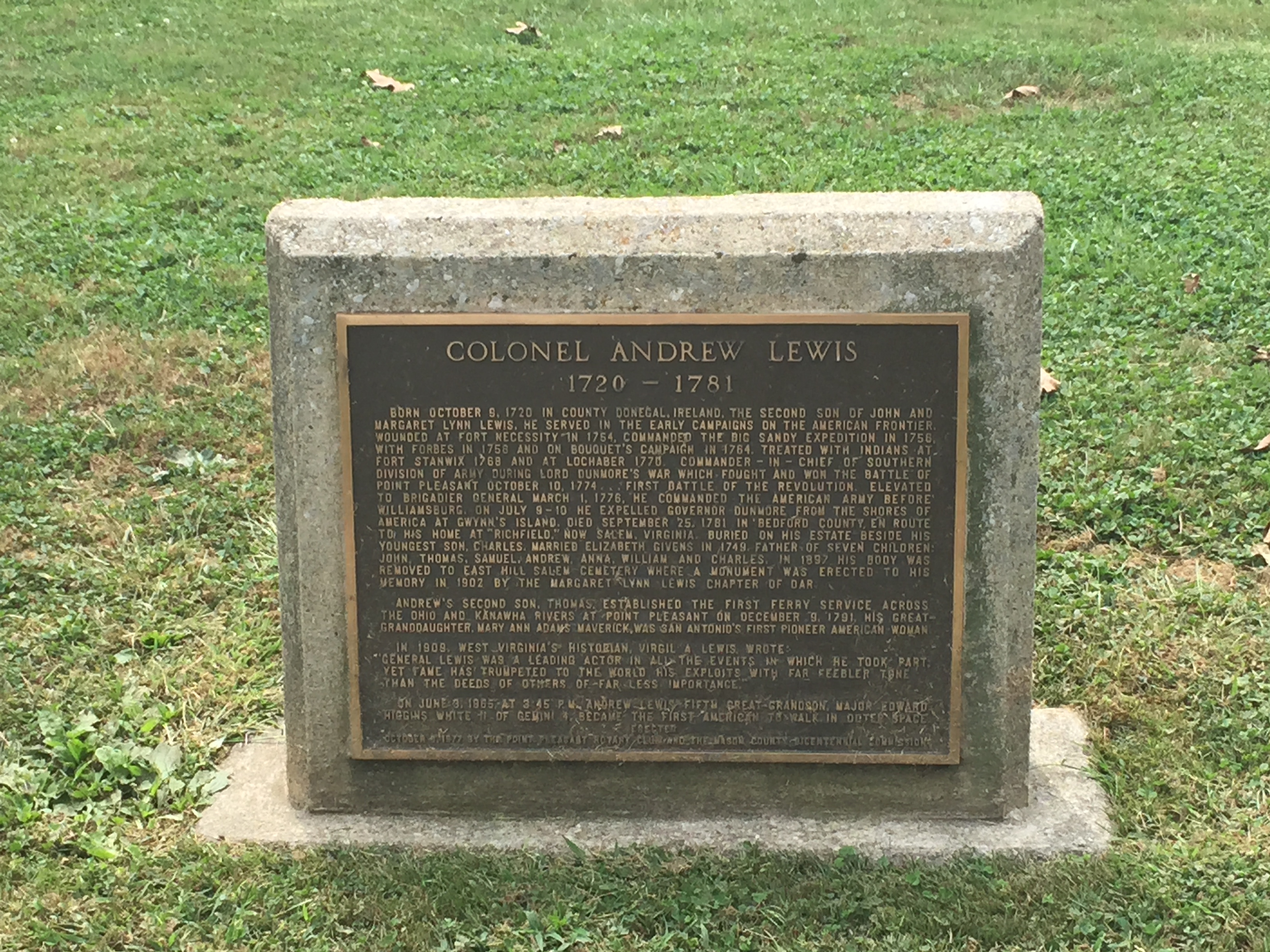
A depiction of the battle on the obelisk.Monument to Col. Andrew Lewis.
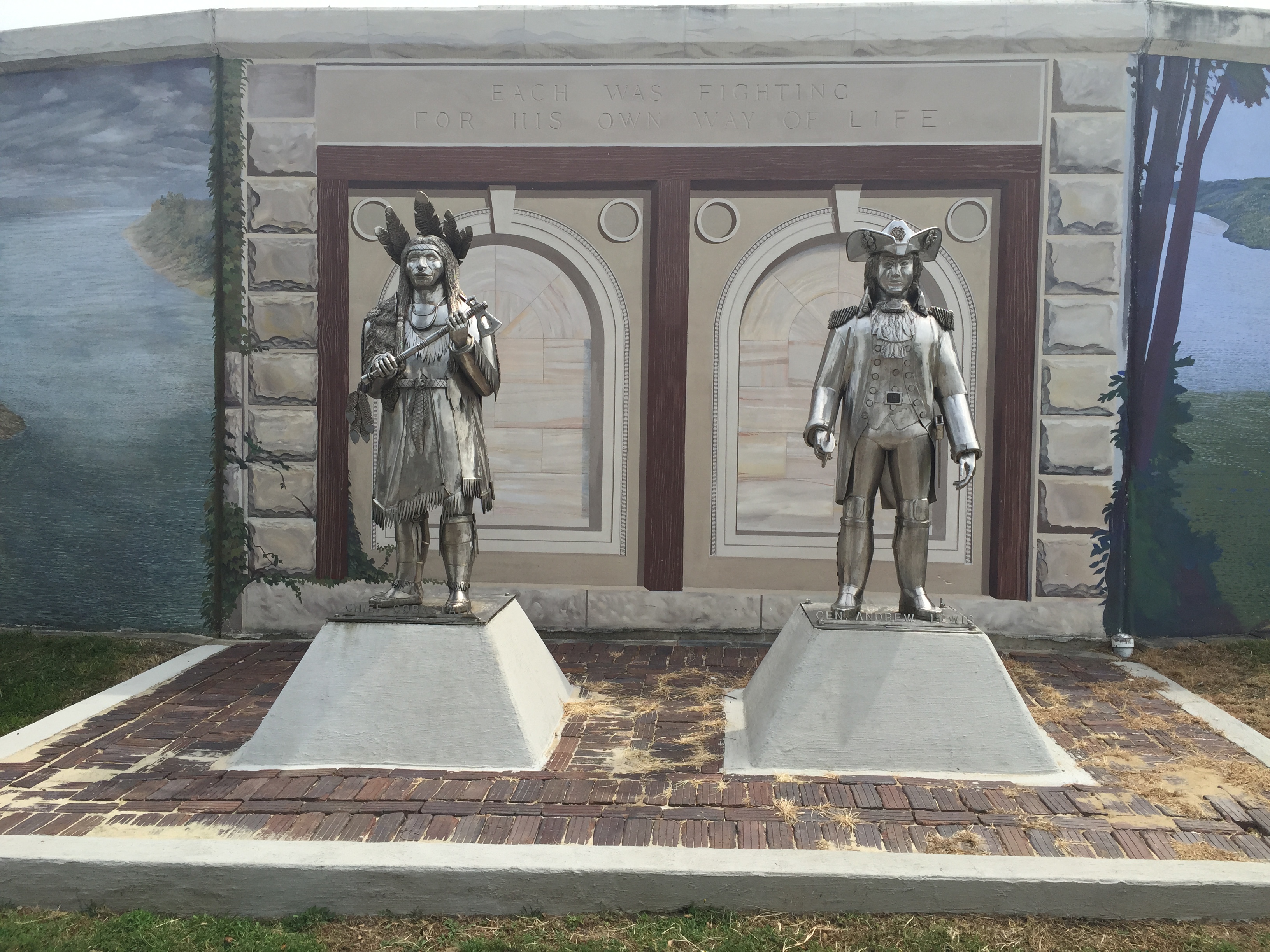
A large Army Corps of Engineers floodwall separates the Ohio River from the town of Point Pleasant. The side of the floodwall facing the river has been adorned with a handsome mural showing the history of the area, and depicting the battle. The mural extends for nearly a mile, and there are a number of odd modern sculptures along the river walk depicting some of the more important figures of the Battle of Point Pleasant, including Lord Dunmore, Chief Cornstalk, and Colonel Lewis. Done in an abstract, modern style, these statues are impressionistic representations of these important historic figures and are probably worth a visit.
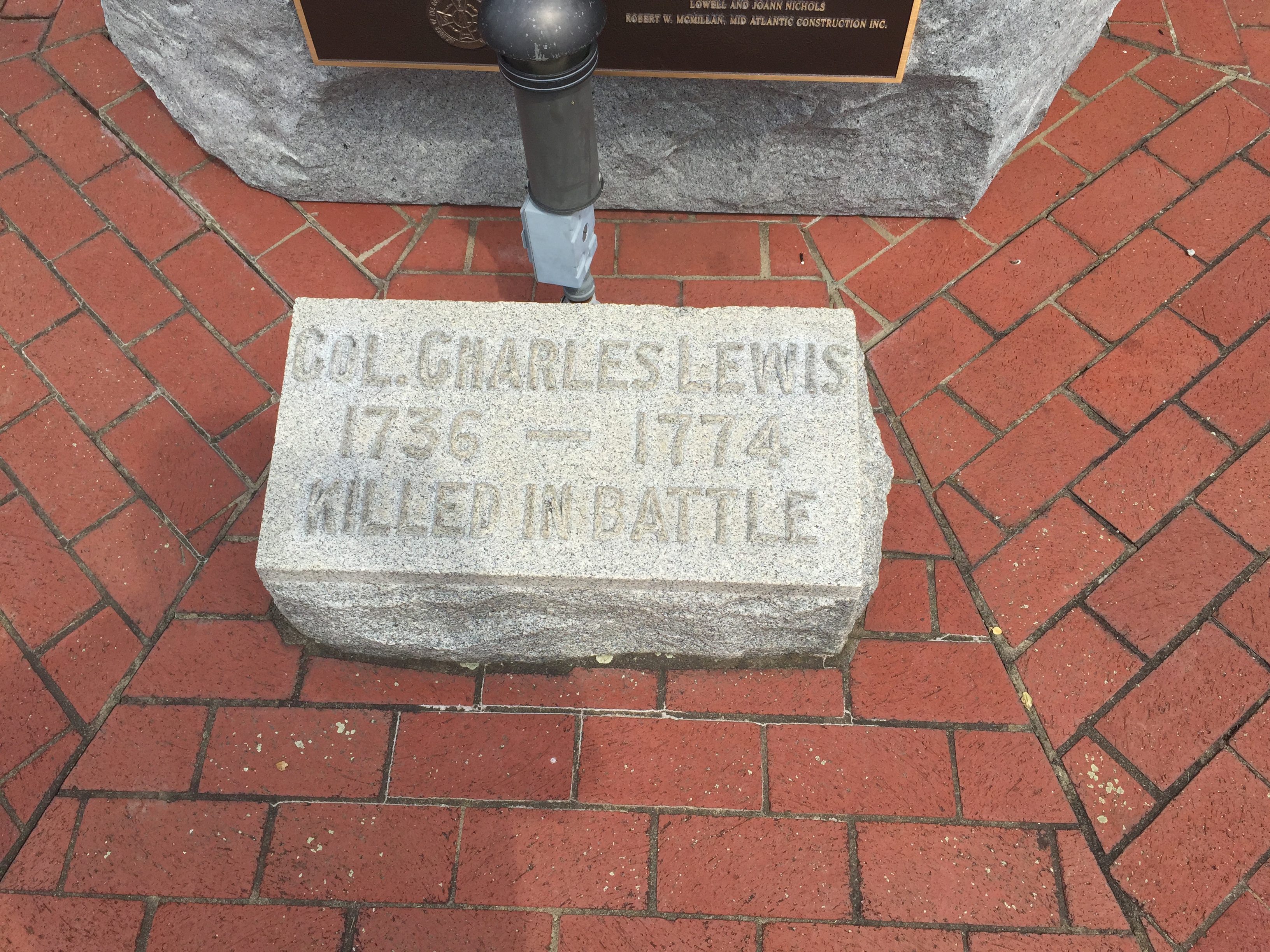
A marker commemorating the death of Col. Charles Lewis at Point Pleasant.
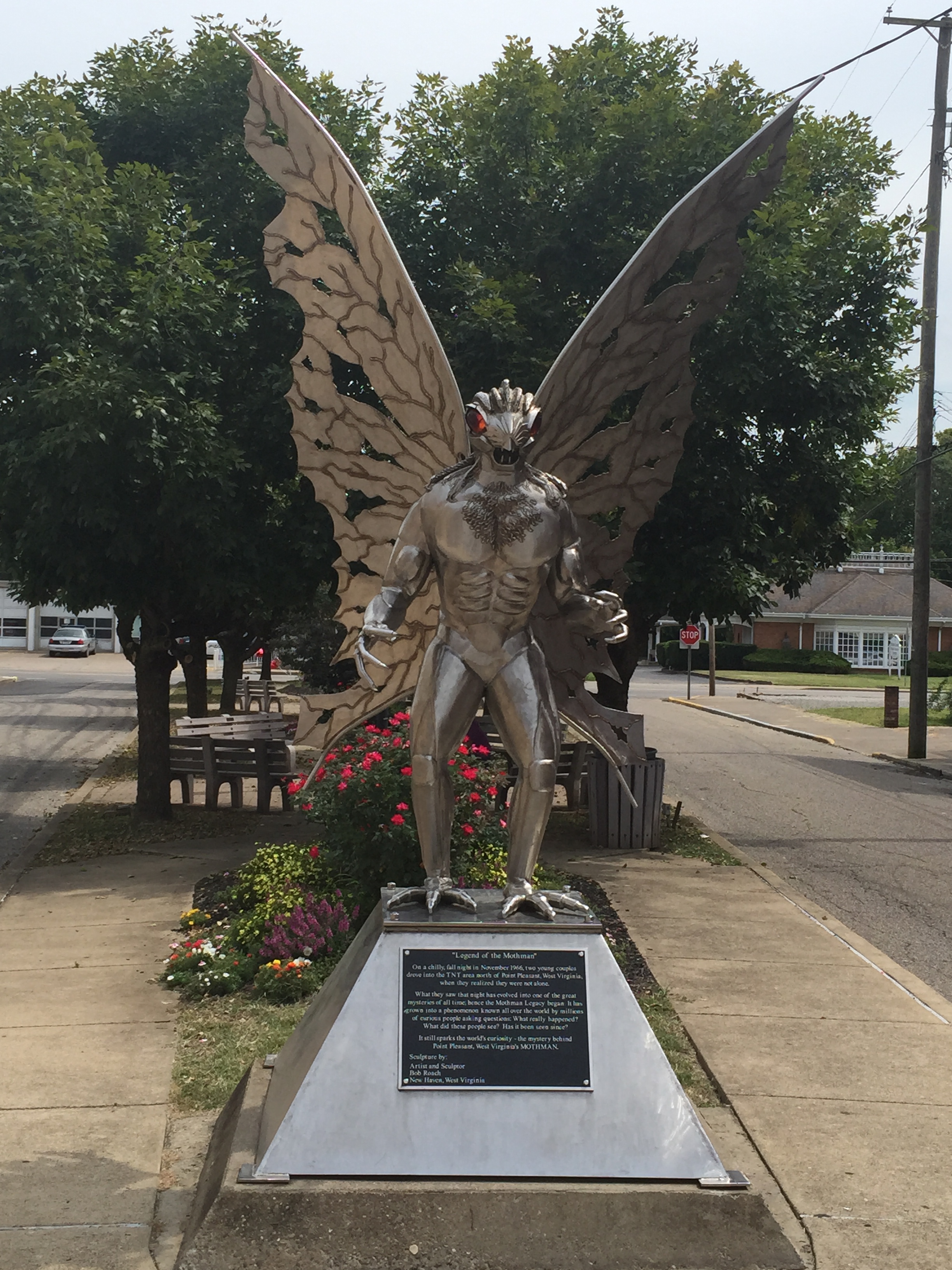
Unfortunately, the history of the Battle of Point Pleasant has been dwarfed by subsequent events. Paranormal enthusiasts flock to Point Pleasant in search of the Mothman, a mythical creature said to be a harbinger of imminent disaster that inhabits an abandoned dynamite factory dating from World War II. In 1975, John Keel published his novel, The Mothman Prophecies, and a bad 2002 movie was made based Keel’s novel. A second film, also loosely based on the legend, was released afterward. There is a Mothman Museum that holds an annual Mothman Festival that offers tours and other silly events that celebrate the Mothman legend. Sadly, none of this focuses on the events of October 10, 1774, which languish largely forgotten.
Marker for the Virginia troops’ powder magazine.
All of the focus on the Mothman diverts attention away from the Battle of Point Pleasant, which can fairly be called the opening engagement of the American Revolution. The Battle of Point Pleasant, as a landmark event, deserves better, and I hope that by focusing on this important battle, you will now appreciate the significance of it, and that you will visit Tu-Endie-Wei State Park if the opportunity ever presents itself.
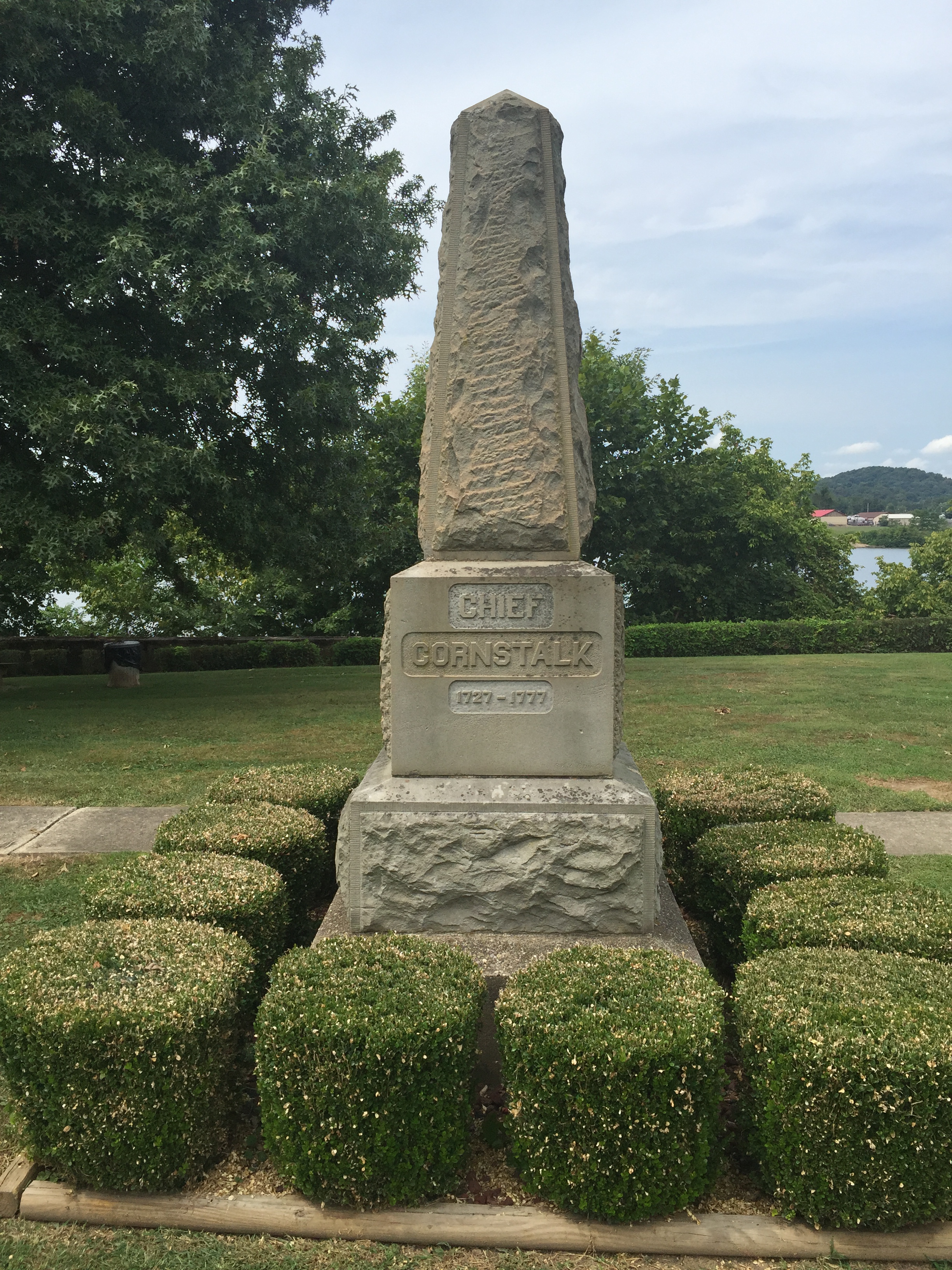
Monument to Chief Cornstalk.
As Eric Hinderaker and Peter C. Mancall described it in their 2003 book, At the Edge of Empire: The Backcountry in British North America:
Statutes of Col. Lewis and Chief Cornstalk.
If Dunmore’s War serves as the epilogue to one story, it is the prologue to another: the story of American independence. The events of the preceding decade amounted to nothing short of a revolution in backcountry affairs, and the military campaign led by Lord Dunmore against the Ohio Indians constituted the opening chapter of a new epoch in American affairs. From the perspective of the backcountry, the shots fired on the Ohio late in 1774, not those at Concord six months later, constituted the beginning of the American Revolution. Though the Ohio campaign was led by a royal governor, its muscle was provided by two thousand men who had waited a decade in mounting frustration and anger while the king neglected their needs. This was their declaration of independence.
As a side note for those looking for more information: there is no good modern monograph in print on Lord Dunmore’s War. I relied upon two very old books for much of information included herein. However, there is a new monograph that is scheduled to be published in the spring of 2016 that I am looking forward to reading.
After defeating Cornstalk, Lewis and his command crossed the Ohio River and advanced to within eight miles of the Shawnee villages at Pickaway Plains (near present-day Circleville, Ohio) on the Scioto River. The built Camp Charlotte on Sippo Creek and began peace negotiations with Cornstalk. On October 19, 1774. They signed the Treat of Camp Charlotte, whereby the Shawnee agreed to cease hunting south of Ohio River and to end harassment of travelers on the river. Logan did not attend, but agreed to cease fighting. However, the Mingo refused to accept the peace terms, and Maj. William Crawford attacked their village at Seekunk (near present-day Steubenville, Ohio), destroying the village.
Lord Dunmore, the final colonial governor of Virginia
With the submission of the Shawnee, Lord Dunmore’s War ended. Dunmore began his return to the colonial capitol of Virginia at Williamsburg, proceeding by Redstone to Fort Cumberland, and on to Williamsburg. By the time that Dunmore and his troops made it back to Williamsburg, the Battles of Lexington and Concord occurred in Massachusetts, opening the Revolutionary War. As colonial governor of Virginia, Dunmore led the British war effort in Virginia, and by the end of 1775, the same militiamen who had fought at Point Pleasant managed to drive Lord Dunmore and the British troops supporting him out of Virginia. Dunmore’s gambit had failed miserably. Before being driven from office, Dunmore sought to form an alliance with the very same Indians he had defeated at Point Pleasant, prompting many Virginians to suspect that he had collaborated with the Shawnee from the beginning.
Lord Dunmore’s War is generally considered to be the opening engagement of the Revolutionary War. As one early historian of the Battle of Point Pleasant put it:
It will be seen by a review of the history of the colonies that prior to the Battle of Point Pleasant, not only the Colonists but England knew, as did Patrick Henry when he made his famous speech that “The War was inevitable.” The British Government seeing the fomentation in the colonies had made repeated concessions; willing to relinquish, if necessary, all but the principle of the Right of England to levy taxes upon the Colonists without giving them representation in the British Government. The Colonists were astir with intense excitement. The tea had been thrown over board in Boston Harbor and the Port had been closed by a bill passed by Parliament in March of that year. Meetings had been and were being held protesting against Royal oppression. That powerful engine of resistance, Committees of Correspondence had been formulating their ideas of resistance and the Virginia Assembly convened at Williamsburg in May, had passed an independent resolution setting forth that June 1st, 1774, should upon the making effective of the Port Bill be made “a day of fasting and prayer to implore the divine interposition for averting the heavy calamity, which threatens the civil right of America;” whereupon, the Earl of Dunmore, then Governor of Virginia, at once dissolved the Assembly. The Continental Congress had already convened and its every breath was ladened with resistance of British oppression.
Is it to be wondered at and is it not the most natural thing in the world, that Dunmore would try to devise ways and means to prevent Virginia from participating in the federation of the Colonies; and what more powerful instrument could he have set in motion to distract their attention from the clouds gathering in the East, than by setting in motion a band of howling Indians on the frontier, making it an absolute necessity that Virginia protect her homes, her women and children and her property rights, and this danger so eminent, could not be delayed. So calling together the flower of the Colonial Army of Virginia, which he promised should be united and together encounter the Indians in their homes, he should cause one branch to alone be attacked, hoping they would thus be destroyed and if only temporarily defeated, they would be so busy protecting the frontier and their homes they would have no time to go into the Colonial Army, confederated as they would be to resist the British Army, already many of whom were camping upon the plains of Boston. But to the surprise of Dunmore the Division of Lewis’ Army was victorious and the tide of American interests was changed.
Without the Army of Lewis, which was the great military training school of the Colony, many of whom went on into the Revolution and became many of them, officers of high rank, it would have been impossible for Virginia to have raised her quota of men and officers to have participated in that struggle for liberty; and without Virginia the Colonists would have thought it impossible, as it would have been, to have undertaken that struggle for independence. Without the entire support that Virginia gave George Rodgers Clark, who was in the Dunmore division, but who later conquered the North West Territory, weakening the otherwise impregnable back ground that constantly threatened the frontier and in whose territory did not close the struggle for American Independence until Wayne’s treaty twenty years later.
We think the opinions of the early writers of history we have quoted, the natural circumstances surrounding Dunmore at and previous to the Battle, makes it plain that although the battle was between the Colonists and Indians it is beyond doubt the first Battle of the Revolution, and the Government of the United States, while it has been tardy, is fully justified in making the declaration that the $10,000 appropriated for the erection of a monument is “An act to aid in the erection of a memorial structure at Point Pleasant, West Virginia, to commemorate the Battle of the Revolution, fought at that point between the Colonial troops and Indians, October 10th, seventeen hundred and seventy four.” While a shaft 82 feet high will stand as a sentinel upon the site where the dead were buried, form whence the battle was directed and subsequently the fort, built, it is a pigmy as compared with the fact that at last, after a lapse of One Hundred and thirty-four years, the Congress of the United States has officially called it as it is a battle of the Revolution, and if a battle of the Revolution it must of necessity be the first, as the hallowed Lexington was not fought, until April 19th, 1775, while that of Point Pleasant, was fought October 10th, 1774.
The battle in its acquisition of territory ceded by the Indians and previously ceded by France to Virginia but literally in control of the Indians until this time, this followed by the ceding of all the vast territory of the Great North West by Virginia to the infant republic.at the close of the Revolution with the cessation of Indian hostilities following the battle, permitting the Colonists to turn their attention to the expulsion of the English army and the overthrow of the British yoke, the moral effect that it had on Virginia, and thus on the Colonies, made it the farthest reaching in its effect an battle ever fought on the American Continent.
While this strong declaration perhaps overstates the case regarding Dunmore’s motivations in commencing the war, there seems little doubt that Lord Dunmore’s War had far-reaching and unforeseen consequences for the success of the American Revolution. As mentioned above, on February 21, 1908, the U.S. Senate passed Senate Bill 160 to erect a monument commemorating the Battle of Point Pleasant that identified Point Pleasant as a “battle of the Revolution.” Unfortunately, the bill failed in the House of Representatives and was never enacted. However, a handsome monument was erected on the Point Pleasant battlefield that specifically states that the battle was the opening of the American Revolution.
Sadly, the peace established at Camp Charlotte did not last long. On March 24, 1775, just before the Battles of Lexington and Concord, a renegade band of Shawnee attacked Daniel Boone along the Wilderness Road in Kentucky. In May 1776, the Shawnee then joined Cherokee chief Dragging Canoe in declaring war on the Virginia colonists, triggering the Cherokee-American Wars of 1776-1794. Little, it seems, was accomplished to secure the peace by Lord Dunmore’s War.
Col. Andrew Lewis, commander of the Virginia forces at Point Pleasant.
Andrew Lewis, another Scot, whose family had founded the town of Staunton, Virginia, led a command of the same Scots-Irish ruffians who later fought and won the 1781 Battle of Kings Mountain during the Revolutionary War. These men were fiercely independent and were known to be hard, determined fighters. They were the right men to pursue the mission laid out by Lord Dunmore.
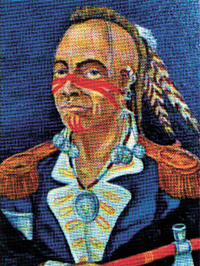
Chief Cornstalk
Chief Cornstalk, the Shawnee leader, led a force to intercept Lewis’ force to prevent Lewis from completing his rendezvous with Dunmore’s army. The Shawnee chief led somewhere between 300-500 warriors, including the future Shawnee war chief, Blue Jacket. If they attacked Lewis’ command, they would do so with less than half the manpower. Cornstalk intended to attack Camp Pleasant, hoping to trap Lewis’ force on a bluff overlooking the Ohio River.
The Indians crossed the river on rafts about three miles upriver from the confluence of the rivers on the night of October 9. They expected to take Lewis’ camp by surprise, and they nearly succeeded. However, half an hour or so before sunrise, two men of Capt. William Russell’s company spotted the Indian war party about a mile from Camp Pleasant. The Indians shot down one of the two men, but the other escaped and brought in the intelligence that an Indian attack was imminent. A few minutes later, two men of Capt. Evan Shelby’s company brought in a similar report.
Shawnee war chief Blue Jacket.
Lewis immediately ordered his brother, Col. Charles Lewis, to take command of a division of 150 men, while Col. William Fleming assumed command of another division of 100 or so men. The following is a contemporaneous account of the battle, written a week later:
Col. Charles Lewis’ division marched to the right, some distance from the Ohio, and Col. Fleming, with his division on the bank of the Ohio, to the left.
Col. Charles Lewis’ division had not marched quite half a mile from the camp when, about sunrise, an attack was made on the front of his division, in a most vigorous manner, by the united tribes of Indians—Shawnees, Delawares, Mingoes, Tawas, and of several other nations—in number not less than eight hundred, and by many thought to be one thousand.
In this heavy attack, Col. Charles Lewis received a wound which, in a few hours caused his death, and several of his men fell on the spot; in fact, Augusta division was obliged to give way to the heavy fire of the enemy. In about a second of a minute after the attack on Col. Lewis’ division, the enemy engaged the front of Col. Fleming’s division, on the Ohio, and in a short time the Colonel received two balls through his left arm, and one through his breast, and, after animating the officers and soldiers in a most calm manner to the pursuit of victory, retired to the camp.
The loss in the field was sensibly felt by the officers in particular; but the Augusta troops, being shortly after reinforced from the camp by Col. Field, with his company, together with Capt. McDowell, Capt. Mathews and Capt. Stewart, from Augusta; Capt. Paulin, Capt. Arbuckle and Capt. McClannahan, from Botetourt, the enemy no longer able to maintain their ground, was forced to give way till they were in a line with the troops, Col. Fleming being left in action on the bank of the Ohio.
In this precipitate retreat. Col. Field was killed. During this time, which was till after twelve, the action in a small degree abated, but continued, except at short intervals, sharp enough till after 1 o’clock. Their long retreat gave them a most advantageous spot of ground, from whence it appeared to the officers so difficult to dislodge them that it was thought most advisable to stand as the line was then formed, which was about a mile and a quarter in length, and had sustained till then a constant and equal weight of the action, from wing to wing.
It was till about half an hour till sunset they continued firing on us scattering shots, which we returned to their disadvantage. At length, the night coming on, they found a safe retreat.
They had not the satisfaction of carrying off any of our men’s scalps, save one or two stragglers whom they killed before the engagement. Many of their dead they scalped, rather than we should have them, but our troops scalped upwards of twenty of their men that were first killed.
It is beyond doubt their loss, in number, far exceeded ours, which is considerable;
The return of the killed and wounded in the above battle, same as our last, as follows:—Killed—Colonels Charles Lewis and John Field, Captains John Murray, R. McClannahan, Samuel Wilson, James Ward, Lieut. Hugh Allen, ensigns Cantiff and Bracken, and forty-four privates. Total killed, fifty -three.
Wounded—Col. William Fleming, Captains John Dickinson, Thomas Buford and I. Skidman Lieutenants Goldman, Robinson, Lard and Vance, and seventy-nine privates. Total wounded, eighty-seven; killed and wounded one hundred and forty.
Steven T. Mitchell, who fought at Point Pleasant, left this 1827 account of the fighting:
We landed about a mile on the left-hand shore of Kanawha, and climbing a large hill, we were saluted by a hundred Indians, encamped upon the top. Our captors told their adventures, no doubt, with every aggravation; for, after the most frantic expressions of grief and rage, I was bound to a tree, a large pine tree, which stands to this day upon the brow of the hill, and the fire was kindled around me. I said my prayers; my time was come; my body felt the scorching heat: but, by a miraculous interposition of Providence, the clouds which had been lowering all day, now burst out in showers, and quenched the flames. The Indians thought the Great Spirit looked over me, and directed the shower for my safety. My bonds were loosened, and I was allowed a little jirk and hommony for my refreshment. The next day I could perceive some great expedition on foot; the Indians were running to and fro in every direction; some grinding paint and some cleaning up their arms; and even the squaws and little boys were providing themselves with hatchets and scalping knives, and strewing themselves from the Ohio river all along the cliffs of Kanawha.
Late in the evening, I saw an uncommon anxiety on the faces of the savages; councils, grand and petty, were held in various places, and so completely were my guards absorbed in the undertaking which was at hand, that they became entirely remiss in their attentions to me. I resolved to seize the propitious moment, and make my escape. I sprang: on my feet and ran as fast as my legs would carry me. A loud whoop proclaimed the event, and in a moment, I could perceive myself closely pursued by half a dozen athletic young fellows, with uplifted tomahawks. Fear added to my limbs the agility of the deer. With my head turned back over one shoulder, I bounded through the pine-trees until my speed had carried me unawares to the brink of a precipice. I tried to stop; it was too late; I gave a piercing shriek and bounded over. A rushing sound in my ears like the roaring of a mill-dam, then the crashing of branches and limbs recalled me to my recollection, and I found myself to my inexpressible delight, breaking my way through the thick branches of a buck-eye tree. I alighted without injury, and looking back upon the cliff above, could see my savage pursuers gaping over the precipice in amazement. I gave not a second look, but darted off towards the point with a heart swelling with praise to the great Creator, who had thus twice rescued me so miraculously from my enemies. Arriving at the mouth of the Kanawha, I shouted aloud for assistance. But, the whites had too often been decoyed by their own people to the savages, to be easily imposed upon. They answered me they could give no assistance. I could not swim, but my ingenuity, never fertile in expedients, befriended me now for the first time in my life. I rolled down a dry log from the bank into the water, and getting astride of it, I managed by great exertion of hands and feet, to row it across the stream, which at that time, from the great height of the Ohio, was as still as a mill-pond I was received by General Lewis, the commandant of the fort, with great cordiality and affection; and, being naked and necessitous, I enrolled myself as a regular in the corps; and, being dressed in militaire, with a tremendous rifle in my hand and a thick breast work before me, I felt as brave as Julius Caesar.
I was in hopes that I might enjoy, within the walls of a fort, some respite from the fears, toils and anxieties which had, for the last two weeks, worn me out both body and mind. But he who undertakes to settle in a new and savage country, must look out for no such respite, until, by hardihood and perseverance, he has leveled the forest, with its inhabitants, to the earth.
On the 10th of October, 1774, about sun-rise, the hunters came in at fall speed, and gave the appalling information that a large body of Indians had spread themselves from river to river, and were advancing by slow degrees, towards the fort; at the same instant, we could observe the women and boys skulking up and down the opposite banks of the Ohio and Kanawha. The position of the fort was peculiarly favourable to a surprise. As I have above mentioned, it was situated at a right angular point formed by the confluence of the Kanawha and Ohio rivers. The country above the fort was covered with a heavy forest and impervious growth of underwood, through which an invading force might penetrate completely undiscovered, to the very walls of the fort. The garrison was composed of about twelve hundred men entirely Virginians, from the counties of Botetourt and Augusta. The Indians consisted of about the same number, the flower of the Shawnee, Wyandotte and Mingoe tribes, who were commanded by the celebrated “Chieftain, Cornstalk.”
From the large force which he had collected for this expedition, and from the secrecy of his movements, it was evident that the Indian Chief, in this desperate attempt to recover the country east of the Ohio river, meditated nothing less than an entire extermination of the garrison. General Lewis ordered out about seven hundred of his rangers, under the command of his nephew, Colonel Charles Lewis; with the remaining part of his troops, about five hundred in number, he determined to act as a reserve and defend the fort to extremities.
I happened to be among those who were ordered out, very much against my will; but it was neck or nothing; we advanced about three hundred yards in front of the fort, toward a deep ravine which intersected the valley at the right angles with the Kanawha. All was still as death; one moment more and a yell mingled with the roar of a thousand rifles, rung from river to river, and at the same moment every bush and tree seemed alive with armed savages. Col. Lewis was killed at the first fire, but the rangers maintained their ground, and a contest commenced more desperate and more rapidly fatal than any which had ever, been fought with the Aborigines, excepting that of Talledaga. The Indian Chief, with that promptness for seizing an advantage, and that peculiar military tact for which he was so much renowned, extended his line from the Ohio as far as it would stretch across to the Kanawha bank, for the purpose of out flanking the opposing forces. But, in the execution of this manoeuvre, he was completely foiled by the superior address and boldness of the whites who, animated with revenge for the loss of their leader and a consciousness of their desperate situation, fought with a fury that supplied the inequality of numbers, and set at defiance every stratagem of the savages.
Finding that his method of outflanking would not succeed, the Indian Chief concentrated his forces, and furiously attacked the centre of the Virginia line. The savages, animated by their warlike and noble Chieftain, Cornstalk, forgot the craftiness of their nature, and rushing from their coverts, engaged hand to hand with their stout and hardy adversaries, until the contest resembled more a circus of gladiators than a field of battle. I became desperate; hide where I would, the muzzle of some rifle was gaping in my face, and the wild, distorted, countenance of a savage, rendered more frightful by paint, was rushing towards me with uplifted tomahawk One fellow in particular, seemed to mark me as his victim; I levelled my rifle at him as he came yelling and leaping towards me, and fired. The ball missed my aim. He rose upon his toes with exultation, and whirling his tomahawk round his head, slung it at me with all his powers. I fell upon my face, and it whizzed harmless over my head and stuck into a sapling. I bounded up and forced it from the tree, but the Indian was on me and rescued the hatchet from my hands. I seized him round the waist, enclosing both his arms at the same time and tripping up his heels, we rolled together upon the ground. I at last grew furious, gouged him with my thumbs in both eyes, and seizing him with my teeth by the nose, I bit the whole of it from his face; he yelled out with pain and rage, and letting loose the hatchet to disengage my teeth, I grasped the handle and buried the sharp point into his brains. He gave one convulsive leap which bounced me from his body, and in a moment after expired. I immediately rose, and gaining a secure position behind a tree, remained there till the close of the fight, and made a thousand resolutions, if I survived this engagement, never to be caught in such a scrape again. I kept my word; for, I have never since encountered the savages, and if Heaven forgives me, I never will. There is no fun in it.
But, to return to the history of this ever memorable battle. There was a peninsula extending from a high range of bills running parallel with the Ohio river, which jutted close to the Kanawha bank, about a half a mile from its mouth. Knowing the importance of securing the narrow pass which ran between its base and the river, the Indian Chief dispatched a picked body of his troops to take possession of it. They entered the dry bed of a small creek which skirted the foot of the hills, and pursued their route unnoticed till they were about to enter the important pass, when a shower of rifle bullets pierced their body and swept down the foremost ranks. A chosen band of rangers at’ the same moment made their appearance, with whom General Lewis in anticipation had guarded the pass. A yell of surprise and rage burst from the savage line, and they seconded their returning fire by an unanimous and desperate charge with the hunting-knife. The contest now assumed all the wild and terrific cast which a personal struggle, conducted with the deadly feelings of hate and revenge then existing between the whites and Indians, could inspire. The air was filled with the screams of the savages and the deep imprecations of the riflemen; every blow brought death, and the ground was soon heaped with the corpses of the combatants. But the disappointed efforts of savage desperation were ineffectual against the unbroken and impenetrable column which was maintained by the whites; and the Indians were driven, with the loss of half their force, back upon the main body. Here, the fight still raged in the extremity of opposition, every inch of ground was contested, from behind every bush and decayed log the murderous flash arose, and the continued roar of a thousand rifles vibrated through the forest.
The savage Chieftain discovered that the chances against him were desperate, yet, by his own personal example of courage and address, was the fight long1 sustained, even after his line had been driven, step by step, from their original position. His voice could at intervals be heard, rising above the din of the fight like the shrill blast of a bugle; at one moment, his dusky form and glittering ornaments could be seen flitting through the trees upon the Ohio bank, and his war cry in the next would fill the echoes of the hill at the farthest extremity of the line. A sheering ejaculation of triumph would one moment escape him, as an advantage was gained by the de voted gallantry of some Shawnee warrior; an imprecation upon some skulking Mingoe, in a short time afterwards, would be recognized in his voice. “Charge high and aim low” was his command incessantly throughout the day; and, it is one of the circumstances remarked of that fatal fight, that most of the bullet wounds received by the whites proved mortal; but few of the wounded ever recovered. Yet, all the efforts of the old warrior were vain; defeated and discouraged, the savage army almost abandoned the fight in the latter part of the day, and it was reduced to a mere straggling fire between individuals of the contending parties.
Night closed upon the scene, yet the ground was still occupied by the two armies. Although victorious, the Virginians could neither press their advantage nor retire to rest. An ambuscade or a night attack was expected from the savages, and their behaviour warranted the latter supposition. For, behind a long line of watch-fires, they could be discovered as if cautiously examining the points most open to attack. The wild scream of a savage warrior, apparently advancing to the fight, would at intervals break upon the death-like stillness of the night, and cause my heart to leap almost out of my mouth. I confidently calculated that every moment was the time for their attack, and fancied divers times could hear them stealing through the bushes upon us. The gleams of the morning sun, however, at length illumined the scene, but not a vestige of the Indian army remained; the living and the dead had alike disappeared, and it was not until then, it was ascertained or even suspected, that the savages had secure themselves from interruption, under pretense of a night attack, had thrown their dead, with weights attached to them, in the river, and retreated across it under cover of darkness.
The next morning, Colonel William Christian marched his men over the battlefield, finding 21 dead Indians in the open, and another 12 hidden by brush and old logs. The dead included Pucksinwah, the father of the great Shawnee war chief, Tecumseh. Christian’s men also captured 40 guns, many tomahawks and other plunder.
So ended the brutal Battle of Point Pleasant. Lewis’ men held the battlefield after repulsing Cornstalk’s determined attacks, but the toll had been frightful. Lewis lost 75 killed and 140 wounded, including his brother, Col. John Lewis. Capt. Thomas Buford of Bedford County was mortally wounded and died several days later. Buford, a veteran of the Braddock Expedition during the French & Indian War, was the older brother of Col. Abraham Buford, who found infamy during the 1781 Battle of Waxhaws during the Revolutionary War. Abraham Buford and his younger brother Simeon both served in the Culpeper Minutemen, and helped to depose Lord Dunmore the next year. Simeon Buford was the grandfather of the great Civil War cavalryman, Maj. Gen. John Buford.
Indian casualties are unknown, since Cornstalk either buried the bulk of his dead, or threw them into the river. His losses had to have been similar to those sustained by Lewis. More importantly, Cornstalk’s bloody defeat at Point Pleasant brought a quick end to what became known as Lord Dunmore’s War.
Although many consider it to be the beginning of the American Revolution, few Americans are familiar with the conflict known as Lord Dunmore’s War. It featured one battle, the Battle of Point Pleasant, fought on October 10, 1774 at Point Pleasant, which is the confluence of the Kanawha and Ohio Rivers in modern-day West Virginia. This series of four blog posts will focus on Lord Dunmore’s War, and will place it in its proper historical context.
John Murray, a Scot who was the fourth Earl of Dunmore, commonly known as Lord Dunmore, was the final colonial governor of the Virginia colony. The conflict that became known as Lord Dunmore’s War was a dispute over who would control the area south of the Ohio River, known as the Ohio Country. The Iroquois Confederacy claimed that land, although other tribes, including the Shawnee, also hunted that land. Disputes over control of this area were among the primary triggers of the French & Indian War (otherwise known as the Seven Years’ War), which cost France control of the region.
When the British claimed control over those lands at the end of the French & Indian War, the Indians refused to cede control of their hunting grounds, and prepared to defend them. The Shawnee were the most powerful of the tribes aligned against the Iroquois, and they organized a large confederacy of tribes opposed to the British and the Iroquois to defend their claims to the Ohio Country. British diplomacy largely isolated the Shawnee, and they soon stood largely alone against the British.
Shortly after the treaty ending the French & Indian War, British settlers and surveyors pouted into the area, immediately bringing them into conflict with the Indians. As early as September 1773, Indians attacked white settled in Kentucky County, Virginia and captured and tortured to death Daniel Boone’s son James and another man. By December, word of this atrocity reached newspapers in Baltimore and Philadelphia. For the next several years, Indian raiding parties regularly attacked settlers, mutilated and tortured the men to death and enslaved their women and children.
Capt. Michael Cresap established a trade post at Redstone Old Fort near present-day Brownsville, Pennsylvania on the Monongahela River. Under Lord Dunmore’s authority, Cresap seized control of land at and below the mouth of Middle Island Creek near present-day Sistersville, West Virginia. In the spring of 1774, he traveled there to settle his holdings. A second group, led by Ebenezer Zane, had established a settlement at the mouth of Sandy Creek, near present-day Ravenswood, West Virginia. A third, and larger, group that included the famous future explorer George Rogers Clark, settled at the mouth of the Kanawha River near modern-day Parkersburg, West Virginia. They were waiting there for other Virginians who intended to settle lands in Kentucky.
Soon, word filtered in that hostile Indians regularly attacked, robbed and killed traders, surveyors and other travelers down the Ohio River. They soon concluded that the Shawnee and their allies were determined to go to war. Consequently, they decided on a preemptive strike: they would strike an Ohio Indian village called Horsehead Bottom near the mouth of the Scioto River at modern-day Portsmouth, Ohio. They chose Cresap, who had military experience, to lead this raiding party.
Cresap talked them out of launching the attack on the Shawnee village because he did not believe that war was inevitable. If they carried out their attack, they would trigger an all-out war and would be blamed for it. He persuaded them to go to Zane’s settlement (present-day Wheeling, West Virginia) wait and see what would happen. However, tales of savagery by the Indians riled up the countryside, and the ranks swelled with men itching to attack the Shawnee.
Capt. John Connolly, the garrison commander at Fort Pitt sent word to Zane’s settlement to wait for a few days because he had sent messages to the local tribes to determine their intentions. Connolly soon sent a message indicating that the Shawnee and their allies intended war. On April 28, 1774, Cresap convened a meeting where he read Connolly’s letter to the assembled group, which then declared war against the Indians.
On April 29, settlers spotted Indian canoes on the river and chased them about fifteen miles downriver to Pipe Creek, where they attacked the Indians. A skirmish occurred, with both sides taking a few casualties. On April 30, Clark’s party abandoned its plan to go to Kentucky, broke camp, and joined Cresa’s men at Redstone Old Fort.
Immediately after the Pipe Creek attack, settlers attacked and killed relatives of the Mingo leader, Logan at their camp on the west bank of the Ohio River at Yellow Creek, near present-day Steubenville, Ohio. Until that moment, Logan had not indicated any intention to go to war. A party of about 30 Mingos, including Logan’s younger brother, known as John Petty and two related women (including one who was pregnant and an infant), crossed the Ohio and visited the cabin of a settler named Joshua Baker. A group of 30 frontiersmen suddenly barged into Baker’s cabin and killed all of the Mingos but the baby.
Logan blamed Cresap for the attack, even though Cresap had nothing to do with it. Realizing that this would now rile up the Indians, most of the area’s settlers sought protection either in blockhouses, or by heading east across the Allegheny Mountains. They had good reason to be alarmed: the Mingos and Shawnee began striking settlers, seeking revenge.
On May 5, 1774, the Shawnee had the following message delivered to Captain Connolly at Fort Pitt:
Brothers:
We have received your Speeches by White Eyes, and as to what Mr. Croghan and Mr. McKee says, we look upon it all to be lies, and perhaps what you say may be lies also, but as it is the first time you have spoke to us we listen to you, and expect that what we may hear from you will be more confined to truth than what we usually hear from the white people. It is you who are frequently passing up and down the Ohio, and making settlements upon it, and as you have informed as that your wise people have met together to consult upon this matter, we desire you to be strong and consider it well. Brethren: We see you speak to us at the head of your warriors, who you have collected together at sundry places upon this river, where we understand they are building forts, and as you have requested us to listen to you, we will do it, but in the same manner that you appear to speak to us. Our people at the Lower Towns have no Chiefs among them, but are all warriors, and are also preparing themselves to be in readiness, that they may be better able to hear what you have to say….You tell us not to take any notice of what your people have done to us; we desire you likewise not to take any notice of what our young men may now be doing, and as no doubt you can command your warriors when you desire them to listen to you, we have reason to expect that ours will take the same advice when we require it, that is, when we have heard from the Governour [sic] of Virginia.
Responding to word that fighting had begun along the Ohio River, Lord Dunmore asked the Virginia legislature to authorize general militia forces and to fund a volunteer expedition to the Ohio River valley to quell these disturbances. He planned to march into the Ohio Valley and force the Indians to accept Ohio River boundary that had been negotiated with the Iroquois as part of the 1768 Treaty of Fort Stanwix, which ended the French and Indian War. Dunmore realized that this expedition presented a prime opportunity to open new lands to expansion of the Virginia colony, a policy he had pursued for years. Dunmore, who vehemently opposed the rebellion brewing in Massachusetts, recognized that this expedition could also help to divert the attention of the Virginia colonists from the crisis growing in Boston. He hoped that the Virginia citizenry would rally around his administration rather than joining the rebels in New England. He also hoped to secure Virginia’s claim to the area around Fort Pitt and also remove the threat of the Indian tribes opposed to the settlement of the Ohio Country and Kentucky. It was a bold gamble that could cost Dunmore his position as governor if it failed.
A large force of Virginia militia mustered and advanced toward the Ohio River. Dunmore split his force into two groups: 1,700 men under Dunmore’s personal command that would move down the Ohio from Fort Pitt and another 800 men under command of Col. Andrew Lewis, which would travel from Camp Union (modern-day Lewisburg, West Virginia), which would rendezvous with Dunmore’s column near Point Pleasant at the mouth of the Kanawha River. Dunmore’s column arrived at Fort Fincastle—at modern-day Wheeling—on September 30, while Lewis’ column—now 1100 strong—arrived at the mouth of the Kanawha on October 6 after a grueling 19 day march through the mountainous wilderness. Lewis established Camp Pleasant there, and sent messengers up the Ohio River to find Dunmore. On October 9, Dunmore sent a dispatch announcing his plan to proceed to the Shawnee towns on the Scioto River, and ordered Lewis to cross the Ohio River and meet him at the Shawnee towns.
The stage was now set for the decisive battle of what became known as Lord Dunmore’s War.
Emerging Revolutionary War and Revolutionary War Wednesday is pleased to welcome back guest historian Drew Gruber.
Part 1
When we think about American militia during the Revolutionary War, the image of an untrained rifle-toting citizen turned soldier comes to mind. This stereotype of the American soldier, popularized by movies like The Patriot is not completely false but such generalizations should give us pause and inspire us to investigate the roll of American militia, independent companies, and ‘irregular’ troops a bit closer. For example, how was it that on October 3, 1781 a group of Virginia militiamen defeated an elite British force? The story of Lieutenant Colonel John Mercer’s Grenadier Militia during the battle at Seawell’s Ordinary has been told and retold since 1781, however the formation of this illustrious group is often ignored and deserves a closer look. Continue reading “Mercer’s Grenadier Militia”→
After abandoning Fayetteville, North Carolina to Maj. Gen. William T. Sherman’s army group, Lieutenant General William J. Hardee withdrew his corps north of the city. Hardee had ordered the Clarendon Bridge over the Cape Fear River destroyed, removing the possibility of a vigorous pursuit by the Federals. The situation for the Confederates, however, remained dire. Hardee’s immediate superior, Gen. Joseph Johnston, was in the process of assembling a makeshift army to delay Sherman’s advance. By the middle of March, the forces that Johnston hoped to consolidate were still scattered throughout the state. More time would be needed for the Confederates to rendezvous. Since Hardee’s corps was naturally positioned to contest the enemy as they left Fayetteville, it would fall to him to engage Sherman once he resumed his march. The veteran officer would prove to be more than equal to the task.
Today, we are pleased to welcome guest author Bert Dunkerly.
General George Washington looks back at us from marble statues or stiff paintings with a grim-faced and determined look. Known for his dignity, resolve, and sound leadership, he seems cold and reserved. Yet he was also quite sentimental. In the midst of a campaign, with a massive British invasion force set to descend on him at New York City in July, 1776, Washington paused to pen these words: “I did not let the Anniversary of the 3rd or 9th of this Inst pas[s] of[f] without a grateful remembrance of the escape we had at the Meadows and on the Banks of the Monogahela. [T]he same Providence that protected us upon those occasions will, I hope, continue his Mercies, and make us happy instruments in restoring Peace & liberty to this once favour’d, but now distressed Country”.
Today, we are pleased to welcome guest authors Drew and Kate Gruber.
Fort Moultrie, Charleston Harbor by A. Vizitelly c.1861. Courtesy of the Library of Congress.
“There appears to be a romantic desire urging the South Carolinians to have possession of this work, which was so nobly defended by their ancestors in 1776…” wrote Major Robert Anderson from Fort Moultrie on November 28, 1860, less than five months before the first shots of the American Civil War. Many historians of American history have looked upon the Civil War as a continuation of the American Revolution. Looking back today, the similarities are not hard to see. According to historian Peter S. Carmichael, confederates “proclaimed their nation to be the keeper of America’s revolutionary heritage.”[1] Similarly, James McPherson notes that “Union volunteers invoked the legacy of the Founding Fathers…if disunion destroyed this nation, the generation of 1861 would prove unworthy of the heritage of republican liberty.”[2] This idea was not lost on Civil War soldiers, and their own connection to the ideals of the American Revolution grew even stronger when their marches and battles brought them close to, and even directly on, the landscapes and landmarks sacred to the memory of the American Revolution—soldiers were quick to identify the cause of the Revolution as their own. As soldiers converged on Mount Vernon, Williamsburg, and Yorktown, the connections they made to the revolutionary past of these locations strengthened their own resolve.






 Emerging Revolutionary War Era