Uncovering the Continental Army in Morristown

Part of an ongoing series of about the Continental Army in Morristown, New Jersey. For the first post, click here.

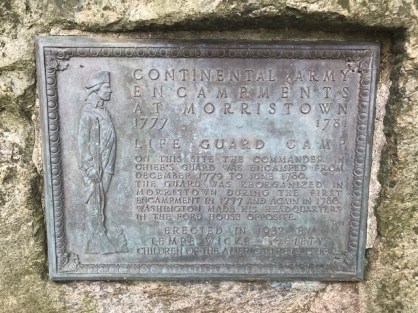
Across the street from the Ford Mansion, the elegant home of the Jacob Ford, Jr. and his family, and the headquarters for George Washington during the winter encampment of 1779-1780, sits a small boulder with a iron plaque plastered on the side.IMG_0027

Erected in 1932 by the Tempe Wicke Society Children of the American Revolution, the monument commemorates the Life Guards that served as Washington’s headquarters command during the American Revolution. Although the unit went by different names and reorganized at least twice, including once during the winter encampment at Morristown, the company, numbering approximately 150 men, would be around for the duration of the war. Continue reading “Uncovering the Continental Army in Morristown”

Uncovering the Continental Army in Morristown

Part of an ongoing series of about the Continental Army in Morristown, New Jersey. For the first post, click here.

“The smallpox has made such head in every quarter that I find it impossible to keep it from spreading thro’ the whole army the natural way.” General George Washington wrote in February 1777.

By the time the Continental Army was encamped in Morrristown, Washington had become a firm believer in the inoculations for smallpox for the entire army. The inoculation process would entail the following: Continue reading “Uncovering the Continental Army in Morristown”

Uncovering the Continental Army in Morristown

Approximately one month ago, I took a temporary detail assignment to Morristown National Historical Park. The national park preserves the winter cantonments of the Continental Army during the American Revolution; including the harshest winter, weather-wise, of the entire war, in 1779-1780.

For parts of multiple winters and even during the campaigning season, Washington’s forces would come to Morristown, situated behind the Watchung Mountains, which provided safety but also a perch to monitor the British in the New York City.

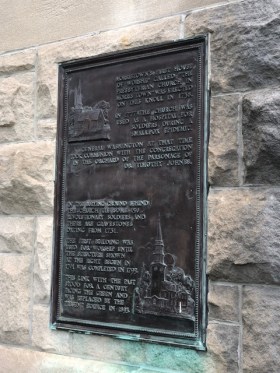
The town still bears witnesses to this rich legacy of housing soldiers, with historic buildings and signs dotted around the spiraling town. On a walk the other day, I came across the house below, with a small plaque situated on the front of the dwelling.

IMG_2771

The home saw soldiers use it for their encampments throughout the majority of the war years. On his return to the United States the Marquis de Lafayette was welcomed with a reception in the building as well, which is in the photo below.

IMG_2772

Morristown is filled with tidbits of history from the American Revolution and I as spend the next few months there as a park ranger, I will share what I come across. So, stay tuned as I uncover the history of the place that “Saved America” according to the park’s unofficial slogan.


Review: European Armies of the French Revolution, 1789–1802 (Campaigns and Commanders Series) Edited by Frederick C. Schneid

ERW Book Reviews (1)

Emerging Revolutionary War welcomes back guest historian Bill Backus

The American Revolution ultimately set in motion a chain of events that transformed not only society in the Americas but also back in the Old World.  Six years after the United States gained independence, revolution broke out across France.  While Americans focused on building a new nation, across the Atlantic the French Revolution sparked a series of wars subsequently known as the French Revolutionary Wars.  Eventually after many years of combat and political chaos, a young army officer named Napoleon Bonaparte emerged as the new Emperor of France.  Led by the Emperor the French army and nation embarked on a series of new wars that spread from Spain to Russia.  From the beginning of the French Revolution to the defeat of Napoleon at Waterloo, Europe was at war for nearly 26 years, or nearly the entire lives of people born during the American Revolutionary period.

51T9s0CvA5L._SX331_BO1,204,203,200_
European Armies of the French Revolution, 1789–1802 (Campaigns and Commanders Series) by Frederick C. Schneid

While Napoleon’s French Empire is widely known on both sides of the Atlantic, the wars that allowed Napoleon’s ascent to power are less prominent.  Concerned that revolution could spread to the rest of continental Europe, Revolutionary France found itself engaged fighting the European status co intent on restoring the Bourbon monarchy in France.  Over the course of years war and peace ebbed and flowed in Europe, with war sometimes sparked by the French in hopes of unifying a splintered public. In “European Armies of the French Revolution, 1789-1802”, historian Frederick Schneid has organized a study exploring the role of some of the prominent European armies in this period.  Collaborating with noted scholars in their respective fields, the essays explore the armies of the nation-states of France, Prussia, Austria, Russia, Great Britain, Spain, and the Ottoman Empire, along side the various German principalities and the armies of the Italian states. Continue reading “Review: European Armies of the French Revolution, 1789–1802 (Campaigns and Commanders Series) Edited by Frederick C. Schneid”

Dr. Prescott, Love & War

Love brought Dr. Samuel Prescott, a practicing physician, to the town of Lexington on the night of April 18, 1775. The young doctor was courting Ms. Lydia Mulliken, when the alarm of the British soldiers marching from Boston went out to the local militia. Lydia’s brother was one of those called to gather.

Love. That emotion also drew Dr. Prescott back toward his hometown of Concord—this time to alert friends, neighbors, and family members of the urgent news of the evening. En route, Dr. Prescott along with Paul Revere and William Dawes, alerted the countryside of the moving British troops. After being vetted and vouchsafed as a true friend of liberty, Dr. Prescott rode posthaste to his hometown, where his word carried greater weight.

paul_revere
A artist’s interpretation of Paul Revere’s (or maybe William Dawes or Dr. Samuel Prescott)’s ride to warn the Massachusetts countryside. (courtesy of VFW)

Continue reading “Dr. Prescott, Love & War”

An Account of April 19, 1775

“the Country was an amazing strong one; full of Hills, Woods, stone Walls, & c., which the Rebels did not fail to take advantage of, for they were all lined with People who kept an incessant fire upon us…”

From the diary of Lieutenant Frederick Mackenzie who was part of the 23rd Regiment–the Royal Welch Fusiliers that survived the ordeal of April 19, 1775. He would keep a diary until the early 1790’s and chronicled his experiences in the American Revolutionary War. His account on April 19, of the retreat from Concord is most descriptive. The British did not just take the brunt of the firing as the marched hurriedly back toward Boston and safety, but;

“as we did too upon them, but not with the same advantage, as they were so concealed there was hardly any seeing them: in this way we marched between 9 and 10 miles, their numbers increasing from all parts…”

The column was led by Lieutenant Colonel Francis Smith and had been tasked by General Thomas Gage, British military leader in North America, to root out the military supplies being stored in Concord by the colonials. The mission, albeit supposedly secretive, did not remain so for long, and the colonials got word out to the countryside. After initial firing at Lexington Green and then at the North Bridge in Concord, the British had to march back through the countryside, facing arriving militia and minute men.

“while ours was reducing by deaths, wounds, and fatigue; and  we were totally surrounded with such an incessant fire as it is impossible to conceive; our ammunition was likewise near expended.”  

IMG_7229
Modern-day view along Battle Road, the route the British column retreated back toward Boston on (author collection)

Luckily, for Mackenzie and the other struggling British officers and rank-and-file, on a rise in the ground, outside the town of Menotomy, was a relief column, ready to provide a few moments’ respite.


Review: The Ghost Ship of Brooklyn, An Untold Story of the American Revolution by Robert P. Watson

ERW Book Reviews (1)

Andersonville. Bataan. Auschwitz. All conjure up images of disillusion, devastation, and death.

All are infamously known as harsh prisoner-of-war camps. When those words are read, images flash through your mind and memory of hollow faces attached to gaunt bodies staring blankly in the direction of the cameraman.GhostShip_300x456

With Robert P. Watson’s new history, The Ghost Ship of Brookly, An Untold Story of the American Revolution, one can add another word to the lexicon of prison camp vernacular.

Jersey.

Or a few more words specifically, the HMS Jersey.  Continue reading “Review: The Ghost Ship of Brooklyn, An Untold Story of the American Revolution by Robert P. Watson”

The Battle of Groton Heights, September 6, 1781: The Fort Griswold Massacre

Part Three
Click here for parts one and two.

With British soldiers pouring into the fort, Colonel Ledyard ordered a ceasefire, and prepared to surrender Fort Griswold to the victorious British. However, the British disregarded the ceasefire and continuing pouring fire into the American garrison, killing or wounding nearly all of the fort’s defenders. “I believe there was not less than five or six hundred men of the enemy on the parade in the fort,” claimed American soldier Rufus Avery. “They killed and wounded nearly every man in the fort as quick as they could.”

battleofgrotonheights_giclee_p3y8

Maj. Stephen Bromfield, the ranking British officer after Montgomery fell, called out, “Who commands this fort?” Ledyard stepped forward and responded, “I did, sir, but you do now.” Another American, Jonathan Rathbun, watched Bromfield run Ledyard through the heart and lungs with Ledyard’s own sword:

     “…the wretch who murdered him [Ledyard], exclaimed, as he came near, “Who
    commands this fort?” Ledyard handsomely replied, “I did, but you do now,” at the same
moment handing him his sword, which the unfeeling villain buried in his breast! Oh, the
hellish spite and madness of a man that will murder a reasonable and noble-hearted
    officer, in the act of submitting and surrendering!”

Continue reading “The Battle of Groton Heights, September 6, 1781: The Fort Griswold Massacre”

ERW Weekender: Bunker Hill Monument & Museum

Emerging Revolutionary War welcomes back guest historian Katie Turner Getty. 

Towering over Charlestown, Massachusetts, its foundation set in sacred battleground soil, the Bunker Hill Monument is a 221 foot obelisk commemorating the Battle of Bunker Hill. The cornerstone of the monument was laid by the Marquis De Lafayette in 1825, fifty years after the battle was fought on June 17, 1775.

BunkerHillMon-KTGetty
Bunker Hill Monument (author collection)

Although the land surrounding the monument has been greatly developed since the battle, visitors today can get still get a sense of the 18th-century landscape just by walking through Charlestown and climbing the hill to reach Monument Square. Approaching visitors are greeted by the statue of Colonel William Prescott, the gray granite of the monument serving as an impressive backdrop behind him. Continue reading “ERW Weekender: Bunker Hill Monument & Museum”

Ankle Deep In Blood: The Jason Russell House

Emerging Revolutionary War is honored to welcome back historian Katie Turner Getty. Biography of Ms. Getty is below the post. 

On April 19, 1775, the placid farm of fifty-eight-year-old Jason Russell of Menotomy erupted into carnage when he, along with eleven other Americans, were shot and bayonetted by British soldiers in his home and yard.

Image1-KTGetty
Jason Russell House (author collection)

As American militia and minutemen poured in from surrounding towns, the British—fatigued yet furious—found themselves under increasingly heavy musket fire. As they pulled back from Concord and retreated to Boston, the main column passed near Russell’s house which stood near the battle road. Russell had just returned home after secreting his family at a nearby farm. Unbeknownst to him, American minutemen and British soldiers would soon converge upon his property and a desperate battle would occur within the walls of his own house.

Earlier that day, twenty-six-year-old Gideon Foster had set off from Danvers with a company of minutemen. The men had set a scorching pace and made the sixteen mile journey to Menotomy in four hours, running half the way.[1] Upon arriving, Foster’s men joined others from Lynn, Beverly, Salem, Dedham, and Needham.[2]  Some took cover behind trees and others in Russell’s yard, where a breastwork was constructed out of shingles.

Image3-KTGetty
The Fight at the Jason Russell House, bicentennial painting by Ruth Linnell Berry (1974). Appearing with permission from the Arlington Historical Society.

The men focused their attention on the approaching main column of British troops and fired upon them. Capt. Israel Hutchinson, a seasoned French and Indian War veteran, warned that flank-guards would likely be traversing the fields alongside the road[3], helping the main column to pass unmolested. But before the men could reconsider their position or move to a more defensible location, the flank-guard was upon them, trapping the men against the main column.

In a frantic search for cover, many of the men bolted into Russell’s house. Jason Russell, too, attempted to dash inside but was slowed by his lame leg.[4] He was shot twice and fell on his doorstep. The soldiers tore inside the house in hot pursuit of the men, bayonetting Jason Russell’s body eleven times as they passed.

Once inside the house, the Americans had no choice but to fight for their lives in rooms with no egress, in very close quarters, against raging, bayonet-wielding soldiers. It was a bloodbath. With two rooms on the bottom floor, a narrow stairwell, and two rooms on the top floor, Jason Russell’s house offered very little refuge.  Soldiers outside the house hailed musket fire into the windows.

Image2-KTGetty
Sign depicting what happened at the Jason Russell House on April 19, 1775

With nowhere else to go, several men rushed into the cellar. What at first would seem to be an ill-advised hiding spot turned out to be the only sanctuary that Russell’s home could offer. Taking position near the bottom of the stairs, the men raised their muskets and shot dead the first soldier who descended.[5] Any other soldiers who attempted to follow were met with blazing musket fire. Holes left by musket balls are still visible in the stairwell, attesting to the firestorm.

Soon, the house grew quiet. All of the men who had sought safety in the house had been killed, with the exception of the men who took refuge in the cellar. The British ransacked the house then left.[6]

In 1835, sixty years after the bloodbath at Russell’s house, a memorial was erected in Danvers to commemorate the townsmen who lost their lives in Menotomy that day. Danvers lost the second highest number of men, after Lexington[7], and all of them at Jason Russell’s house. Foster, the commander of the company of minutemen who had ran halfway to Menotomy, was by then the last surviving Danvers veteran of the war. Aged eighty-six, he addressed the crowd assembled for the dedication of the monument and recounted the events of April 19th:

On that morning, more than one hundred of my townsmen hastened to the field of battle…ready to offer their lives on the altar of their liberties. Seven of those who thus started in the prime of life and vigor of manhood, ere that day’s sun descended in the west, were numbered with the dead.[8]  

Foster called the dedication of the memorial “One of the happiest days and most pleasing events of my life.”[9]

In total, twelve Americans were killed at Jason Russell’s house.  Jason’s wife, Elizabeth, returned home to find her husband dead. He and the other fallen Americans, their bodies riddled with musket balls and slashed by bayonets, had been laid out on the floor in the kitchen, the blood from their wounds pooling around them. Elizabeth later said that “the blood in the room was almost ankle deep”.[10]

Image4-KTGetty
Musket ball damage to the staircase of the Russell House


*Biography: Katie Turner Getty is a lawyer, history enthusiast, and lifelong resident of Boston. She holds an A.A. from Bunker Hill Community College in Charlestown, Massachusetts, a B.A. in History from Wellesley College, and a J.D. from New England Law Boston. She can often be found exploring historic sites both on and off the Freedom Trail.

*Sources*

The Jason Russell House is located at 7 Jason Street in Arlington, Massachusetts. Their website is http://www.arlingtonhistorical.org/visit/jason-russell-house/ 

[1] Daniel P. King, An Address Commemorative of Seven Young Men of Danvers. (Salem, 1835), 28.

[2] Arlington Historical Society http://www.arlingtonhistorical.org/learn/articles/the-battle-of-menotomy/

[3] J.W. Hanson, History of the Town of Danvers (Danvers, 1848), 107.

[4] Samuel Abbot Smith, West Cambridge 1775, 3rd ed. (Boston, 1864),  38. https://archive.org/details/westcambridge17700smit

[5] Ibid., 38.

[6] Ibid.

[7] Hanson, 91.   

[8] King, Appendix, 27.

[9] King, 28.

[10] Smith, 39.