Merriam-Webster’s two two definitions of inspiration are “an aspiring agent or influence” and “the quality or state of being influenced.” Being a military historian that has spent a portion of his graduate school and adult life studying the American Revolution, there are a multiple examples of people, events, or circumstances that would fit that Merriam-Webster definition.
The 56-men who affixed a signature to the Declaration of Independence in the summer of 1776 and the gravity of what that meant.
Thomas Paine’s The American Crisis comes to mind during the bleak December 1776 days as George Washington’s army hurriedly moved through New Jersey.
George Washington’s personal heroics, at Princeton in January of 1777 and Monmouth Court House in June 1778, defying his own personal demise to rally the troops he led.
The tales of suffering, at Valley Forge, Morristown, and through the heat of a Carolinas campaign by the common soldier, many whose names are lost to history.
Recently, I have been looking for inspiration, I think most of us are, with how 2020 ended and the beginning of 2021, but this post is not about straying into current politics, viewpoints, or stances on the pandemic. This is more personal.
The pandemic has afforded me the opportunity to read more, as I am sure my fellow history enthusiasts and bookophiles can relate to. Those readings reawakened a question I tried to tackle as a graduate student a decade ago at George Mason University.
What inspired the men from Maryland to fight for American independence?
Or more accurately:
What did not inspire the men from Maryland to fight for American independence?
I ruled out pay, patriotism (at the start), and other tangible benefits. I gleaned from some of the primary sources that have survived, the chance to create a new life, for the soldiers themselves or their loved ones at home was a major motivator to serve. Family was the spark of inspiration.
On this date, that is something I can really relate to. My father, who will be celebrating his 71st trip around the sun, is battling dementia. He will know that this date, February 8, is his birthday, but will struggle to remember anything else. Yet, he was surprised to see his name in a book recently, one that I sent to him, one that I had helped in the editorial process. To see him reading it, cherishing it, and tearing up with happiness at the simple recognition of his name and mine, is an inspiration to myself.
So, he was and is an inspiration, half the duo of sparking my passion of American history (any guesses on the other half)?
What or who is your inspiration as we enter the second month of 2021?
Happy Birthday Dad, from the history enthusiast you helped create.
If curious, he is reading A Handsome Flogging: The Battle of Monmouth, June 28,1778 by William R. Griffith IV
This Sunday, a football game will be played in Tampa, Florida between a team named after pirates and another as the name given to Native American leaders. There will be a halftime entertainment. Just slightly different than previous years.
No, we are not talking about the pandemic restrictions that will limit access to the stadium and change the landscape of the halftime show there.
Emerging Revolutionary War is the change. When the whistle blow for the end of the second quarter, change your view from the television screen to the computer screen, click onto our Facebook site and tune into the Big Game Halftime Historian Happy Hour where our historians will discuss the connections between the teams, locales, and who is the GOAT of early American history.
This shortened historian happy hour will still pack the same level of camaraderie, entertainment, and historical tales that you are used to with “Rev War Revelry.”
See you Sunday, 7pm EST, and remember your drink of choice!
If you are from a certain geographical area of the United States the title of this post is a saying you have heard numerous times. Heck, you may even use it yourself. I’ll admit that I have found usage of this American style vernacular a few instances in my lifetime.
Did you know that there is one version that connects the popular saying to a figure in American history and has its origin dating back into the 18th century?
While reading a history of Osceola, I came across the mention of Benjamin Hawkins and as many of you know, did some internet research, consulted other books on the Seminoles, Creeks, and other Native Americans and the research took off from there. This is just a brief overview of Hawkins and his possible, albeit tenuous, connection to this saying.
A possible first mention of the saying above is attributed to Hawkins, whose name probably does not ring a bell for a large segment of people, historians included. Hawkins, born in North Carolina on August 15, 1754 into a family of six, was a gifted individual who attended the College of New Jersey, now known as Princeton University with an aptitude for linguistics, which apparently including learning Native American dialects.
On January 29, 1756, Henry Lee III is born at Leesylvania Plantation in Prince William County, Virginia. Part of the prestigious Lee family of Virginia, his father was a cousin of Richard Henry and Francis Lightfoot Lee, two brothers who signed the Declaration of Independence.
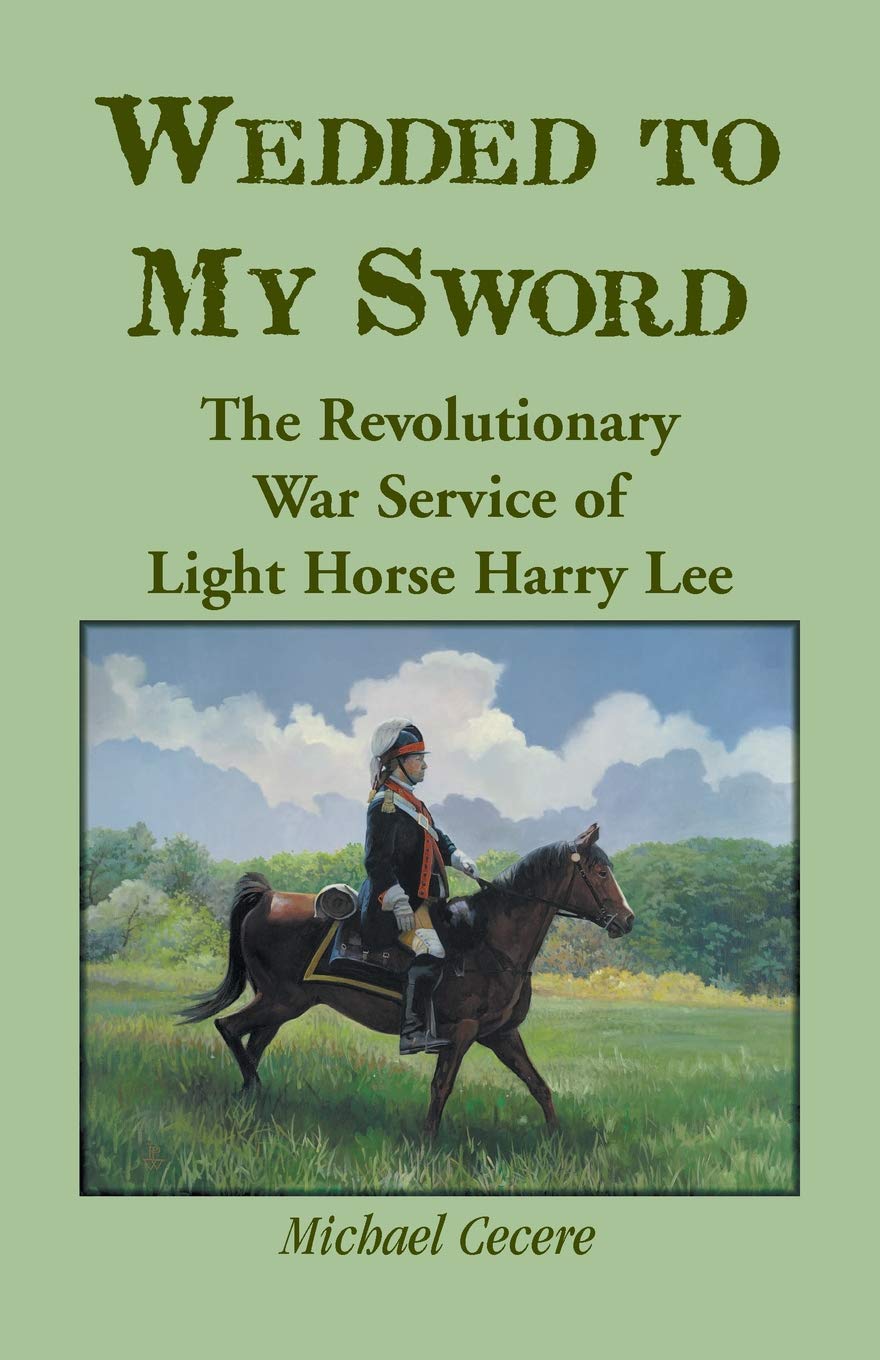
Henry Lee would blossom into one of the better cavalry commanders in the American Revolution, earning the nickname, “Light Horse Harry” Lee because of his accomplishments. With January being his birth month, Emerging Revolutionary War welcomes historian and author Mike Cecere, who will discuss his book, “Wedded to my Sword, The Revolutionary War Service of Light Horse Harry Lee.”
Cecere, former high school and community college history teacher is the author of thirteen books on the American Revolution, most focused on aspects of the colony of Virginia and/or her native sons.
This Sunday we hope you spend some time joining us on the next installment of “Rev War Revelry’ as we discuss the Lee that was born in January and became a military hero of the American Revolution. This historian happy hour will be live on our Facebook page at 7 pm EST.
(Yes, we do know there is another Lee that is born in January and plays a prominent role in history).
Two hundred and forty years ago, January 17, 1781, Brigadier General Daniel Morgan strategically manuevered his Colonial forces to defeat the British, led by Lieutenant Colonel Banastre Tarleton, at the Battle of Cowpens.
What can we learn from the Battle of Cowpens? Military strategy, yes. Historical knowledge, absolutely. But as we near the 250th commemoration of the American Revolutionary War, how do we turn the battle into relevancy for today’s modern society?
As historians, we can find meaning and connection to places and events at their face value. It’s a natural ability we have ingrained in our knowledge-seeking souls. What about those that can’t and don’t? How do we make them relevant to them so that our history is not forgotten?
The answers lie in the stories we tell and how we tell them. Instead of rehashing the specific details of the Battle of Cowpens, I’m going to try something a little different: think of a time when you were able to not only prove that someone’s opinion of you was wrong, you used it to your advantage to achieve a goal. Go ahead, I’ll wait.
Now recall that a key element of Morgan’s strategy was his use of the British underestimation of the Colonial militia forces. Before the Battle of Cowpens, Tarleton, like many British commanders, believed that the militia were mostly untrained or inexperienced civilians that would flee in face of a real battlefield. To be fair, this was witnessed at several battles (Battle of Camden on August 16, 1780 immediately comes to mind) so it’s a fair assessment.
Using this knowledge to his advantage, Morgan set a trap. Putting his militia front and center of his second battle line, he ordered them to fire off two volleys at the oncoming British before falling back. The perspective fueled the British assumption that the militia were fleeing the battlefield, and Tarleton drove his men forward… and right into Morgan’s trap.
Fighting between soldiers from Tarleton’s Legion (British) and Morgan’s Army (American Continental) by Don Troiani. NPS Commissed Artwork.
Perhaps if Tarleton had not underestimated the militia, he would not have found himself in the only successful double envelopment in the American Revolution. But more to the point, Morgan took strategic advantage of the British perception of the militia’s capabilities.
While this battle’s lessons learned are easily applied to modern military education, how can we apply them to our everyday civilian life, particularly the lesson that comes from Tarlton’s mistake and Morgan’s strategy relating to the militia? The motto “never assume” comes to mind first. At the very least, it compels the message “Don’t let what other people may or may not think of you prevent you from achieving what matters most to you.” I personally like the potential of “If someone doesn’t see value in your abilities, prove them wrong.”
What life lesson do you pull from the battle’s story?
Join Emerging Revolutionary War historians this Sunday, at 7 p.m. EST on our Facebook page for the next historian happy hour. This week we will be joined by John Adams…no that is not a mistype.
John Adams is the founder and owner of Liberty Cigars, which “was founded to reacquaint men and women with the simple pleasure of respite and leisure. Lasting bonds, whether among one or many, are more easily formed when wrought in a relaxed and convivial atmosphere.”
Liberty Cigars
That “convivial atmosphere” will be recreated during the next installment of “Rev War Revelry” as ERW historians will discuss tobacco, cigars, and the founding generation of the United States.
“In the time to come we will share the incredible stories of our great republics’ illustrious history with the hope that through you, it will long endure. Our premium cigars are named for a seminal person, event or entity in history so that we may honor them, as we should, across the ages” according to Adams.
Liberty Cigars is part of the American History Guild, founded over a decade ago to “rekindle and stoke the sacred fire of liberty.”
We hope you can set aside an hour of your weekend to join us in “the simple pleasure of respite and leisure” with John Adams. If weather permits, there may be another twist to the “Revelry” on Sunday evening.
Emerging Revolutionary War welcomes back guest historians Karl G. Elsea and William W. Welsch for thefinal installment of their three part series
1770 drawing of Hessian three-pounder gun and limber (courtesy of Kriegskarten from Hessisches Staatsarchiv Marburg, Germany at http://www.digam.net/?str=177)
The v. Lossberg Artillery detachment:
Bombardier Conrad Volprecht was about 44 years old with over 27 years of service. He led the v. Lossberg artillery detachment consisting of another bombardier, 13 gunners and 3 matrosses, with two three-pounder guns and associated horses, harness, and limber.[i]
Over two years after the battle and being a prisoner Bombardier Volprecht gave testimony that indicated the sequence of battle for his detachment was roughly as follows: First went to field, second fired north, third ordered south, and fourth got stuck in the mud till the end of the battle. There is a problem though, the sequence that better fits the data from the battle was as follows: first went to field, second ordered south, third fired west, and fourth got stuck in the mud.
John Adams wrote “Facts are stubborn things. They cannot be altered by our wishes, our inclinations, or the dictates of our passions.” In studying firsthand accounts of the battles in the Revolutionary War they are sometimes not correct or even true. For example, there is an enjoyable firsthand account (written many years later) by a patriot Sergeant White (The Good Soldier White) that is often quoted in accounts of the battle. Parts of his story are no doubt true. The problem is that when Sgt. White states he was with “Lieut. Munroe, our late President of the U. States” and “I was the first that reach them [cannons],” and “They had all left it, except one man tending vent,” those specific parts of the story cannot be true. Hessian Lt. Englehardt would not have time to do all that he did and then cross the Assunpink bridge before the Jagers if artillery men from Sullivan’s column were that far up King Street. Facts from the battle mean that part of that story does not work.
The most important place in all the 13 states fighting for independence on December 26, 1776 from 8:00 am to 9:00 am was the long, narrow bridge over the Assunpink creek. It was held by Hessian Sergeant Muller and 18 men. Sgt. Muller was about 50 years old with about 32 years of service. The importance of this place was not fully realized by the Hessians, but the Patriots knew it had to be closed, and General Washington had two full brigades, Sargent’s and Glover’s, tasked with taking, as quickly as possible, and then holding the bridge.
At about 8:03 am Patriot General Sullivan was about one mile from Trenton center along the River road when he attacked the outlying Jager pickets. General Sullivan had the artillery fire several canister shots at the Jagers. This firing also served as a signal to General Washington so he would know his other wing was attacking. It was to be recalled that General Washington started his attack about 8:00 am on the Pennington road and he also was about a mile from Trenton center. This cannon firing was also a signal to General Ewing so he knew when to start his distraction. General Ewing heard the three cannon shots and he quickly followed with his guns and howitzers firing ten shots from across the Delaware River. General Ewing kept up his firing until he could make out that Patriots were approaching. The v. Knyphausen regiment was forming on Second Street and was the logical unit to resist any attack coming from the River Road.
Volprecht’s detachment with its two guns followed Lt. Fischer’s detachment east on Fourth Street from the Methodist church into the field north and east of the Quaker lane. Lt. Fischer’s detachment was falling back from its earlier engagement and picked up the v. Lossberg detachment as it passed by. It took longer for the v. Lossberg artillery detachment to prepare for the battle because the horses had to be collected, harnessed, hitched, and the guns limbered. Fischer testified that the “cannon were unhorsed, and the horses unharnessed and brought back again into the stable” from the cancelled early morning patrol.[ii] For the morning patrol the horses had been hitched and guns limbered at 4:00 am but the patrol was cancelled so the men/horses/limber/guns were brought back to the Methodist church and waited for sunrise to unhorse.
The infantry of the v. Lossberg and Rall regiments followed Volprecht’s detachment into the field. It was in this field that these two regiments would form a line for battle. While waiting for the v. Lossberg regiment to form Volprecht was ordered by Lt. Weiderhold, “Artillery men, come here with the cannon” meaning they were to join the v. Knyphausen regiment.[iii] The v. Knyphausen regiment was on Second Street heading to the open field just east of Trenton and away from the Assunpink bridge. Volprecht and his v. Lossberg artillery detachment moved south on Quaker lane, linked up with the v. Knyphausen regiment, and set up his gun position facing threats coming from Trenton. The following map presents Trenton as it was in 1776.[iv]
While this was happening on the Hessian side, the right wing of the Patriot forces was moving east on River Road. General Sullivan rushed two of his brigades toward the Assunpink bridge. Neil’s battery with Sargent’s brigade and Sargent’s battery with Glover’s brigade made it to the bridge and across. Glover’s brigade with Sargent’s battery continued along the Assunpink creek to cut off possible exits for the v. Knyphausen regiment. St Clair’s brigade was moving east on Second Street with Moulder’s (three four-pounders) and Hugg’s artillery (two three-pounders).
Hessian Bombardier Volprecht testified that he fired his gun five times and the other gun fired one time.[v] One of those six shots hit the fore horse of one of Hugg’s three-pounder guns as they advanced in support of Patriot St. Clair‘s brigade. John Greenwood, a fifer in the 15th Continental, recorded that one of Hugg’s guns had the fore horse shot by a Hessian three-pounder gun, ”the ball from which struck the fore horse that was dragging our only piece of artillery, a 3-pounder. The animal, which was near me … was struck in its belly and knocked over on its back. While it lay there kicking the cannon was stopped.”[vi] That was the only hit scored by the Hessian artillery that day. St. Clair’s brigade with Col. Stark’s infantry in the lead applied great pressure causing the v. Knyphausen regiment to pull back farther east. Volprecht’s artillery detachment pulled back with the regiment.
As the Hessian artillery detachment pulled back east disaster struck both guns. Volprecht had been ordered into a valley without the ground being checked. Both guns got stuck in the mud. The rest of the battle the men of the artillery, with some aid from nearby infantry, was spent trying to extract the guns from the mud. One gun was extracted just before the surrender, the other gun was extracted after the battle was over.
Mud ended the third artillery engagement. The battle at Trenton was over. The Patriots had a great victory. What is shocking was the limited number of shots from the Hessian artillery. The Rall artillery detachment fired twelve solid shot and one grape, the v. Knyphausen artillery detachment fired “seven or eight shots,” and the v. Lossberg artillery detachment fired six shots.[vii] These few shots lend support for how quickly the Patriots won the Battle of Trenton.
Sources:
[i] William S. Stryker, The Battles of Trenton and Princeton (The Riverside Press, Cambridge, 1898), 388
[ii]Hessian Documents of the American Revolution, Morristown National Historical Park, ML, The Affair at Trenton Dec. 26, 1776, English Translation, ML 337
[iii] Hessian Documents of the American Revolution, Morristown National Historical Park, ML, The Affair at Trenton Dec. 26, 1776, English Translation, ML 277
[v] Hessian Documents of the American Revolution, Morristown National Historical Park, ML, The Affair at Trenton Dec. 26, 1776, English Translation, ML 277
[vi] John Greenwood, Revolutionary Services of John Greenwood of Boston and New York, 1775-1783, 40-41. “the first intimation I received of our going to fight was the firing of a 6- pound cannon at us, the ball from which struck the fore horse that was dragging our only piece of artillery a 3-pounder.” Retrieved from https://archive.org/details/revolutionaryser00gree/page/38/mode/2u
[vii] Hessian Documents of the American Revolution, Morristown National Historical Park, ML, The Affair at Trenton Dec. 26, 1776, English Translation, ML 341
Emerging Revolutionary War welcomes back guest historians Karl G. Elsea and William W. Welsch
1778 sketch-map drawing of Battle of Trenton by Lt. Fischer (courtesy of William S. Stryker, The Battles of Trenton and Princeton, Riverside Press, Cambridge, 1988, page128)
The v. Knyphausen artillery detachment:
Lieutenant Friedrich Fischer was about 37 years old and had about 20 years military experience. He was the senior artillery officer in Trenton. For administrative purposes he saw to the needs of the men, and horses, and equipment for the artillery in Trenton. However, for tactical considerations he was a detachment commander to two three-pounder field guns and crews and horses and equipment assigned to support the v. Knyphausen Regiment. He was to follow their orders unless overridden by the Brigade leader, Colonel Rall. Lt. Fischer never made it to his assigned regiment. The reason was the rapid advance by the Patriots on all fronts.
Each regiment of the Hessians as they came to Trenton in mid-December was assigned a significant building, usually a church, to form its “center of gravity.” The v. Knyphausen regiment was assigned the Presbyterian church, the Jagers were assigned the Old Stone Barracks, the v. Lossberg regiment the English church, the dragoons were assigned the Quaker meeting house, and the Rall regiment several taverns. The Artillery was assigned the Methodist church at the northeast corner of Queen Street and Fourth Street. Thus, the artillery horses, harness, and limbers were at the Methodist church for the three detachments. Three of the neighboring houses to the Methodist church each contained the men for an artillery detachment.
Emerging Revolutionary War welcomes back guest historians Karl G. Elsea and William M. Welsch.
Part I
1770 drawing of Hessian three-pounder barrel (Drawing of Hessian three-pounder gun, dated 1770, at Kriegskarten from Hessisches Staatsarchiv Marburg, Germany at http://www.digam.net/?str=177)
The Rall Artillery Detachment:
It is well known that the Battle of Trenton saved the American Revolution from defeat. What is not well known is the story of two of the three Hessian artillery detachments and the description of their field guns. This series of articles tells the story of the three Hessian artillery engagements at the First Battle of Trenton. These three fights largely determined the victory for the patriots.
The field guns used by the patriots in the artillery engagement at Trenton were fairly well documented. The Patriots used British Armstrong design M1736 six-pounders, British commercial iron four-pounder barrels on Patriot designed carriages, and the Common Pattern British designed three-pounders (looked like scaled down six-pounders).
The Hessian three-pounder field guns were primarily designed to be beautiful, symmetric and fill both the roles of field (light) artillery and garrison (medium) artillery. The “brass” barrel was one caliber (caliber was equal to 3.01 English inch) thick at the breech, one half caliber thick at the muzzle, and was twenty calibers long from breech ring to muzzle. This symmetry came at a price, namely, the barrel alone weighted over 700 pounds. As a comparison, the 1776 designed British Congreve three-pounder barrel had a weight of 212 pounds and was 12.4 calibers long while the “Common” pattern three-pounder barrel used by the Patriots was 287 pounds and 14.5 calibers long.[i] This flaw in the Hessian guns concerning the weight required four horses to pull each gun and made each gun more vulnerable to sinking in mud. Field guns were supposed to be” light,” something these Hessian guns were not.
Part 1 of this article showed that a total of 23 ferry trips were required to move all of Knox’s artillery men, guns, horses, and carts across the Delaware River. In addition, there were other horses needed for the march to Trenton. Many of the likely 35 horses associated with senior officers and aids could fit in with the above 23 trips at a rate of a couple per trip, especially the ferry with only one cart.
There were six ferries operating to move the Continental Army across the river at McKonkey’s ferry site. Each of the six ferries could likely carry a maximum weight of roughly 8,750 pounds. That weight estimate comes from the intelligence report from Capt. Losbiniere on 22 December 1776 concerning the “7 flat-bottom boats which may carry about 50 men each and two ferry Boats, which may carry the like number” that were with Col. Cadwalader at Bristol ferry.[i] There is no reason to believe those ferries were different from those at used at McKonkey’s. If it is assumed a man weighed 150 pounds plus 25 pounds of musket and gear, then the weight for 50 men comes to 8,750 pounds. With those capabilities the Philadelphia Light Horse needed 3 ferries for their unit (8 horses and riders per ferry).
Possibly one more ferry trip for any leftover senior officers and aids horses was necessary. That is 27 trips total needed. With six ferries working that is four trips for all with three additional trips required. Those five round trips by the ferries were estimated by Washington in his plan to require six hours; however, it actually took a nine-hour period (6 pm to 3 am). The additional hours required for the crossing was likely explained by the floating ice and the increased river current driving the ferries out of position.
The question was raised about how difficult it would have been to transport the horses across the river. The somewhat surprising answer may be that it was not as difficult as many assume. No doubt a few horses were a problem; however, the majority of the horses probably presented few problems. How we surmise this is as follows:
Firstly, we can safely speculate that at least some of the horses had participated in earlier ferry crossings during the army’s previous movements and retreats. Those horses would remember that nothing was amiss in the crossing. Secondly, many of the farm horses transferred to pull guns had previous experience pulling carts and wagons across ferries to take produce to market. Thirdly, each team had a driver who knew the horses and he could strategically place the lead horse with a horse who had experience. As for the cavalry, each horse rider likely slowly leads his horse onto the ferry. Horses who see a previous horse move onto a ferry without incident generally lose their fear.
The following picture of a contemporary ferry crossing (1779) shows a typical crossing.[ii] This period ferry appears to measure about 48 feet long (without the two four-foot ramps) by eight feet wide. If one replaces the carriage in the painting with a field gun and limber then the person holding the reins would be the driver. Note the horses are in a pair; whereas, on a gun team there would be a thill horse in front of the limber and additional horse(s) in front of the thill horse.
Many of the campaigns and battles of the Revolutionary War are better understood if a study of horses was included in the analysis. Often, it was all about horses, or the lack thereof. Both General Burgoyne’s march south in the Saratoga campaign and General de Kalb’s march toward South Carolina show that the lack of horses was very important. As for the crossing of the Delaware, General Washington showed his skill in planning. More important, Washington was lucky. It was not the horses that drove the outcome but rather the bad weather and severe river conditions. These bad conditions set in place the delay that assisted the surprise attack.
[i] William S. Stryker, The Battles of Trenton and Princeton (The Riverside Press, Cambridge, 1898), 338





 Emerging Revolutionary War Era