Emerging Revolutionary War invites you to attend our “Rev War Revelry” tonight at 7 p.m. EST as we discuss the beginning of the American Revolution on April 19, 1775, 245 years ago today.
Yet, not only will Emerging Revolutionary War historians be on the call but we have a special guest historian joining us as well.
Stacey Fraser
Stacey Fraser is the Collections and Outreach Coordinator for the Lexington Historical Society. She has overseen new exhibits in the town and has assisted with the annual Patriots Day events. She will be on to share her expertise in this momentous day in American history and about what is happening, both virtually, and in the future with the Lexington Historical Society.
ERW looks forward to welcoming Stacey and all of you to our inaugural Zoom history call tonight!
So, you have a relative that fought in the American Revolution and you want to know more… now what? Joining an organization, such as the Daughters of the American Revolution (DAR), is a lengthy and detail-oriented process. It takes patience and perseverance. Before beginning the process, I attended a research seminar hosted by the local chapter to learn about the specific requirements for applying. If you have any experience with records, the one consistent theme is that records do not consistently capture the same information. Some death records do not list birth-dates, birth records do not always list both parents, and worst-case scenario, many records can be lost, stolen or severely damaged.
As I mentioned in part 1, my grandmother provided me with a box of documents detailing the Bitely heritage. The materials she gave me was helpful for pointing my path forward, but it lacked the necessary vital records for completing the application. Luckily, each chapter has a registrar that guides you through finding the right resources and completing the paperwork accurately. The registrar in my chapter was a seasoned member of DAR and walked me step by step through the process. Together, we reviewed the documents from my box, made a family tree and contacted the Michigan vital records department for appropriate birth, death and marriage certificates for each generation between John and me. Thankfully, both New York and Michigan had the records I needed, in good condition and had the required information on them to meet DAR standards. If you hit a snag in the process, there’s an entire community of DAR women who are trained to help you through this. Reach out, we will help!
Here is a sample of the documents passed down to me in the family history box. This helped start the journey for learning more about my heritage.
George Washington retired from public life at the end of his second presidential term on March 4, 1797. Twenty months and ten days later he died on December 14, 1799. In between Washington was also the first in the United States to be a former president, first to deal with securing his legacy as both a military hero and political figure, and having to see the country he sacrificed so much to create, lurch forward without him having an active part in it.
Until now, these years have been either excluded, glossed over, or an anti-climatic ending to a Washington biography. Until now. Joseph Horn, a former presidential speechwriter and the author of The Man Who Would Not Be Washington lends his talent to a new biography of Washington, examining those last few years in-depth.
The author has a valid point when he argues that, “for too long, the story of Washington’s last years has been squeezed into the margins of manuscripts, if included at all” (pg. 14). Channeling the method of famed Washington biographer Douglas Southall Freeman, Horn writes this biography in the “fog of war” style that affords the reader the opportunity to read the history “through the eyes of those who made it rather than through the hindsight of historians” (pg. 14).
Emerging Revolutionary War welcomes back guest historian Kate Bitely
Part 1
How much do you know about your great-great-great-great-great grandparents? Did your family pass on detailed stories of their past? Perhaps you took a DNA test like ‘23andMe,’ or maybe you know little if anything about your roots. Whatever the case may be, now is a great time to start the journey of learning about your familial past, as it might just lead you to an unexpected destination. For me, I grew up knowing my distant relative, John Biteley Sr., a New Yorker who come to the U.S. from Germany in the 1750’s. His American born son, John Biteley Jr., went on to serve as a patriot in the American Revolution. My grandfather, Ralph Bitely, always told us, “the Bitely’s were at Ticonderoga!” In 2010, my grandfather passed away. A few years after his death, my grandmother gave me a box filled with documents that detail the history of the Bitelys. This box would be the start of my journey back to the 18th century.
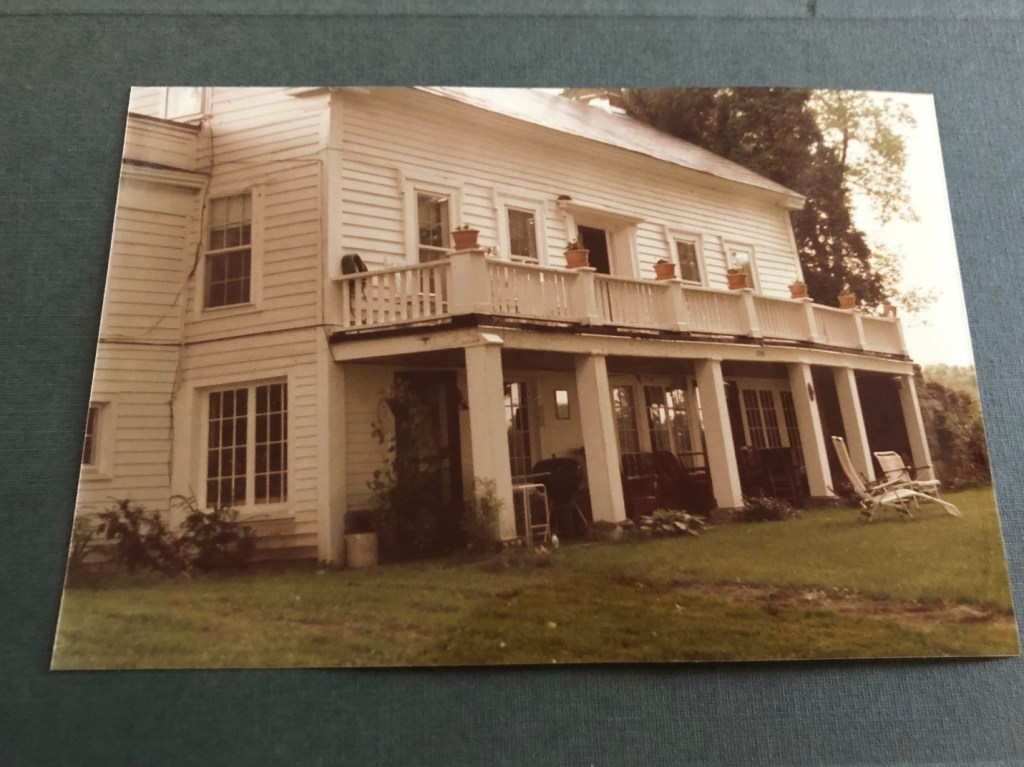
As I dug through the box a few years ago, I recall being filled with excitement as I learned about my family. They were farmers, predominately grape farmers to be exact. (My love for wine is clearly hereditary). As I dug deeper, I found a more modern picture of the “Bitely Homestead,” the home of John Biteley Sr., located in Saratoga County, NY. It was first built before the war around 1770, was burned down by Gen. John Burgoyne in 1777 and was rebuilt in 1779. Nearby remains a family cemetery where many of my relatives remain. While I have not been for a visit yet, I hope to make a trip soon when conditions are safe to do so.
Photo of the “Bitely Homestead” in Moreau, NY rebuilt in 1779 after the British burned down the original structure in 1777 found inside the box from my grandmother.Continue reading “Finding Your Patriot”→
Emerging Revolutionary War welcomes back guest historian Vanessa Smiley
“Beer is living proof that God loves us and wants us to be happy.” – Benjamin Franklin, Poor Richard’s Almanack
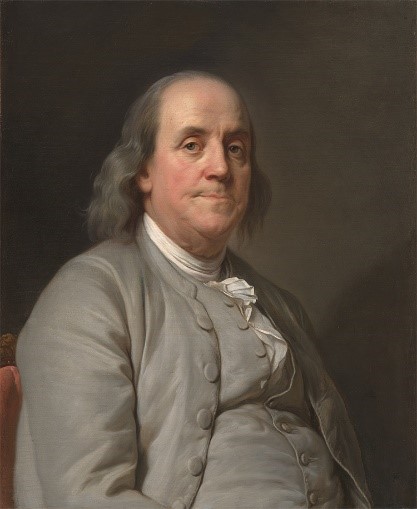
Benjamin Franklin was one of many 18th century beer lovers. (Benjamin Franklin by Joseph Siffred Duplessis, c. 1785)
During the 18th century, Colonial society held three common beliefs about beer drinking:
Drinking beer was healthier than drinking water
Beer and its ingredients were a healthy supplement to the entire family’s diet
It was an accepted way to promote social discourse
A little different from today’s society, except for beer connoisseurs (such as the Emerging Revolutionary War folks), these beliefs were formed from the circumstances of the time.
Though a generation away from understanding the connection between boiling water and sanitation, most folks understood that water could make you deathly ill. And yet, ale and beer drinkers did not seem to have that same risk. They did not know it at the time, but the boiling process to make these alternative drinking options neutralized much of any tainted water’s ill effects. Therefore, many substituted beer, ale, and other alternatives such as hard cider over water, making these a major dietary staple in the colonies.
On this date, in 1775, Virginian Patrick Henry, a delegate to the Second Virginia Convention from Hanover County, Virginia sat in on the ongoing debate at St. John’s Episcopal Church in Richmond, Virginia.
Patrick Henry
The 28-year old then stood to give his defense of his proposed amendments to the petition then being debated. Below is the last few lines of his now famous statement, with the last sentence being the one most remembered;
“If we were base enough to desire it, it is now too late to retire from the contest. There is no retreat but in submission and slavery! Our chains are forged! Their clanking may be heard on the plains of Boston! The war is inevitable and let it come! I repeat it, sir, let it come.
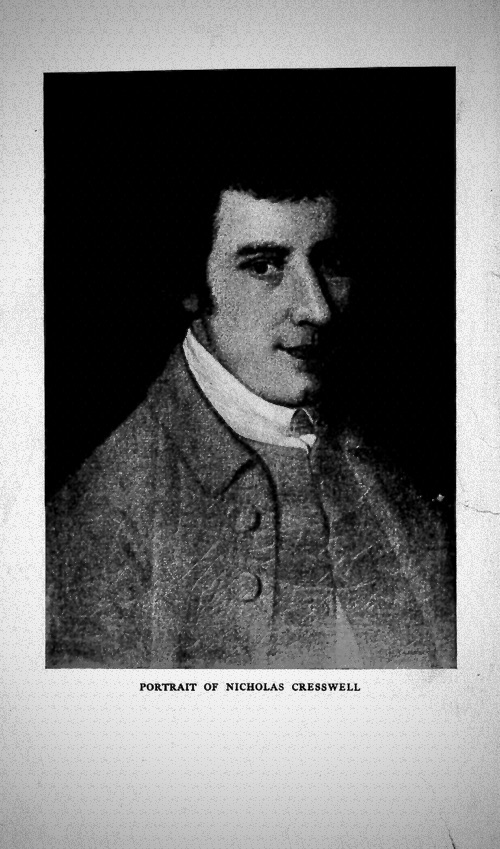
Nicholas Cresswell from the Frontispiece of his Memoir (Library of Congress)
For some Englishman, the political conflict between the United Kingdom and its American colonies was an afterthought that should not interfere with their plans to build a future based on American wealth. Nicholas Cresswell was one such person. He traveled to the colonies on the eve of the American Revolution and returned home in 1777, having kept an extensive diary of his travels, experiences, thoughts, and conditions in America during the war’s first years. Along the way, he met some of the most colorful and interesting people who played prominent roles in the war: George Rogers Clark, Delaware Indian leaders White Eyes and Killbuck, Thomas Jefferson, Patrick Henry, William Howe, Robert Rogers, and Charles Lee to name a few. Since its publication, Cresswell’s journal has become a touchstone for historians looking for insight into those people, how a loyal Englishman like Cresswell saw the world and the Americans around him interpreted events. In particular, he recounts the feelings and treatment of loyalists trapped in America during the war. With that in mind, reviewing Cresswell’s diary might help spread the word about a worthwhile primary resource.
Crispus Attucks. Every American school child learned that name in a social studies or history class in grade school. On the night of March 5, 1770, Attucks, an African-American was one of the six Bostonians that was killed by British soldiers.
Known in American history as the “Boston Massacre” the tragic event was used as fodder by the Sons of Liberty and pro-revolutionary minded individuals to propel the colonies toward rupture with Great Britain.
Emerging Revolutionary War welcomes back guest historian Kevin Pawlak
Every quest for liberty has its first martyr. Two-hundred and fifty years ago this evening, the cause of American liberty gained its first five when British soldiers fired on a crowd of Bostonians in an event immortalized as the Boston Massacre.
Boston Massacre depiction
The first to fall at the end of the British muskets was Crispus Attucks, a mariner of mixed African and Native American heritage. Bostonians paraded Attucks’ remains alongside the four other victims to a common grave but Attucks’ popularity did not grow until the next century when abolitionists used him as a symbol of patriotism. Abolitionists emphasized and stretched Attucks’ role. To supporters of abolition, Attucks was a household name.
Emerging Revolutionary War welcomes guest historian Jon-Erik Gilot. A short bio is attached at the bottom of this post.
Though perhaps more widely known as the birthplace of West Virginia during the Civil War, Wheeling and its environs retains several significant sites associated with the Revolutionary War. The name itself is translated from the Delaware language meaning “place of the skull,” legend having that the severed head of a white settler was placed on a pole by local Native Americans as a warning to others to stay away.
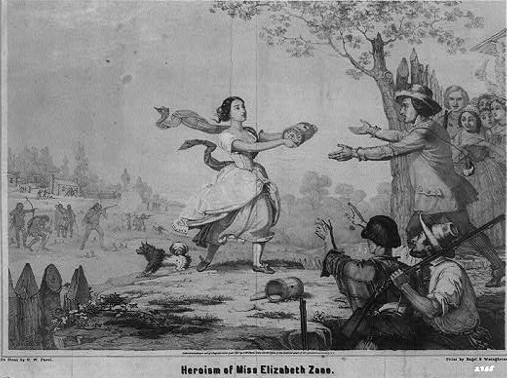
Betty Zane’s Run for Gunpowder during Second Battle of Fort Henry–1782 (image courtesy of Library of Congress)
Wheeling was founded in 1769 by Colonel Ebenezer Zane and his brothers Jonathan and Silas. Five years later in 1774 Fort Henry (originally called Fort Fincastle) was built overlooking the Ohio River to protect the growing numbers of settlers from attack. The fort was twice attacked during the Revolutionary War, first in 1777 and again on September 11 – 13, 1782, when a force of British loyalists (Butler’s Rangers) and Native Americans (under the command of outlaw Simon Girty) attacked the fort’s 47 defenders. The fort was besieged over two days, culminating in Betty Zane’s heroic run for gunpowder in a nearby cabin. The British and natives broke off the battle with the arrival of Virginia militia reinforcements. Fort Henry is acknowledged as one of the final battles of the Revolutionary War.







 Emerging Revolutionary War Era