

The odds are good that you haven’t been able to visit some of your favorite Revolutionary War sites during the Covid-19 pandemic. Many of these locations rely on foot traffic for their annual income and may be struggling to stay afloat amidst various state lockdowns and a smaller number of visitors. (We left out many national, state, and local parks, which sometimes have access to government funds. But, they often have partnerships with non-profit foundations that provide vital support for their activities.) So, we decided to start a list of museums and parks that you can help out now and visit as circumstances allow. No doubt it will grow. The list does not constitute a solicitation or endorsement, but many of our historians visited some of these museums in the past and found them really helpful to our own work. (You may need to copy and paste some links.) If you search our “weekender” posts, there are even more sites to support and visit when you can.
Category: Memory
“Rev War Roundtable with ERW” French and Indian Sojourn
For the past few weeks, Emerging Revolutionary War has, naturally, centered our “Rev War Revelry” on topics associated with the American Revolution. However, our blog is dedicated to the the Revolutionary era and so to live up to that name, our historian happy hour will focus on George Washington, the French and Indian War, and the frontier, especially Western Pennsylvania, and see where the conversation goes from there.
This week, ERW historians will be joined by Dr. Walter Powell, who has been the president of the Braddock Road Preservation Association for the past 30 years and has been very active in French and Indian War events.
Joining Dr. Powell as a guest is John Miller, the Operations Director for Monterey Pass Museum and Battlefield ans the Executive Director of Shippensburg (PA) Historical Soceity.
We look forward to you joining Emerging Revolutionary War on our Facebook page at 7pm EST this Sunday. Along with your favorite beverage, remember to bring with your questions and comments as we embark on this sojourn to the French and Indian War in a history happy hour!
A Connecticut Response to the Coercive Acts
On December 16, 1773, Bostonians dumped 340 chests holding 92,000 pounds or 46 tons of East India Company tea into the harbor. Due to the distance news had to travel across the Atlantic Ocean and then for the gears of government to crank a response, it was not until March of 1774 that Lord Frederick North, his administration, and Parliament passed the Coercive Acts.
The Coercive or Intolerable Acts as they were referred to in the American colonies were actually four acts in total, including the Boston Port Act, which closed the port to all commerce, the Massachusetts Government Act, restricting town meetings and changed the governor’s council to an appointed body, the Administration of Justice Act, which gave immunity to British officials from prosecution in Massachusetts, and lastly the Quartering Act, ordering colonists to house British troops when demanded.
Side note: A fifth act, the Quebec Act extended freedom of worship to Canadian Catholics and this decree was looped into the Intolerable Acts by the colonists.
Understandably the response in Massachusetts was one of defiance, protest, and angst and the acts are credited with promoting momentum toward independence. What was not truly appreciated by the British government was the outcry from other colonies.
On this date in 1774, the town of Farmington, Connecticut showed what the passage of the Coercive Acts meant. On May 19, a handbill, a small printed advertisement or notice, was distributed around the town inviting the inhabitants to a gathering to honor “the immortal Goddess of Liberty.”

“Rev War Round Table with ERW” Talks Turning Points
On Sunday, May 17th sy 7 p.m. EST, join Emerging Revolutionary War on our Facebook page for the next “Rev War Revelry” happy hour round-robin historian discussion.
This week’s theme is “Turning Points” a broad term that will most certainly conjure up an interesting conversation.
Word around the ol’ pub about potential topics that will be discussed include Valley Forge, Ten Crucial Days, Guilford Court House. Maybe a mention even of one of the more obvious, Saratoga?
But, you know how gossip goes! So, tune in on Sunday and bring your favorite drink, give the ERW historians a toast and a “Huzzah.”
We look forward to your comments, counterpoints, and conversation.

The British Perspective….Best Book?
I recently needed to look up a quote from a British politician in the House of Commons during the American Revolutionary War. I went to my personal library (like to call it a study but since I have not found a desk to “study” on in there, I’ll continue to call it my library).
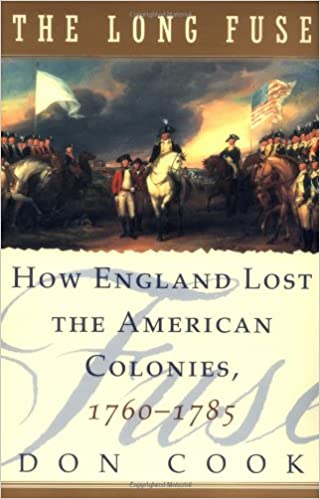
I grabbed Don Cook’s book The Long Fuse, How England Lost the American Colonies. A great read about the opposing side in the American Revolution. I found what I needed, but, as many of you probably do, that took me down a reading tangent.
Disclaimer; those of us under stay-at-home orders have some additional free time to explore more of our personal libraries. Those who can relate know what I am talking about. You pick up a book looking for something specific, which leads you to finish that book, then find one in the same genre or another micro-study of the same topic, until you have consumed multiple tomes within a matter of days, weeks.
Cook’s book led me to The Men Who Lost America: British Leadership, the American Revolution, and the Fate of the Empire. I gained a different appreciation for King George III, Lord Frederick North, and other British leaders from their perspective, filling in the gaps of historical scholarship that more America-centric volumes do not have the word count or inclination to fill.

I then went deeper down the proverbial rabbit-hole. Delving into With Zeal and With Bayonets Only: The British Army on Campaign in North America, 1775-1783, I went on a reading campaign with the British in the colonies.
Which now leads me to this blog post, what else would you recommend? What are your go-to books on the British perspective in the American Revolution?

Side note, I may delve into the loyalist viewpoint histories next, as I came across an interesting fact; the largest diaspora in the 18th century was American citizens that chose loyalty to the British crown who left or were forced to evacuate during and after the end of the American Revolution. So, as any history enthusiast will do, I will do more research….reading I mean.
A Tree as Old as the Country

The coastal redwoods of Muir Woods form as close to a natural cathedral as I’ve ever visited. Tucked in a hidden valley in the Golden Gate Recreation Area, just north of San Francisco, the national park allows visitors to escape from the metropolitan hustle and bustle and step into a primordial landscape.
Some of the trees in the forest are estimated to be more than a thousand years old. One, not near so old, still lays claim to special historical significance: the Bicentennial Tree.
Continue reading “A Tree as Old as the Country”Saving 1862 Battlefield Land But Really Saving Land From the Siege of Yorktown
Emerging Revolutionary War would like to thank Drew Gruber, for bringing this connection to our attention.
During the May 5th, 1862 Battle of Williamsburg as Confederate soldiers ran down into what would be called the bloody ravine they ran headlong into men from New Jersey, New York, and Massachusetts. In an effort to push the Union soldiers out of the ravine and sweep them from the field brigade after brigade was sent into the fight. Among those was four Virginia regiments under AP Hill. After leaving the relative safely of the City they deployed in some form of a line and pitched down into the ravine too.
In the ravine hand-to-hand combat, fallen trees, driving rain, and the thick smoke made communication almost impossible and command fell on company commanders to keep the battle moving in their favor. Among the men in Hill’s brigade fighting down in the bloody ravine was Tipton Davis Jennings of the 11th Virginia Infantry. His account of the fighting here at Williamsburg will be of particular interest to your readers of the ERW blog.
Writing in 1897 his “Incidents in the Battle of Williamsburg” appeared in the Confederate Veteran Magazine. In fact Kate and I covered this in an earlier ERW post titled, Revolutionary Memory. (click here to read that post).
“Just then,” he wrote, “we happened upon what was apparently an ancient line of grass-grown earthworks. We learned afterward that portions of Washington’s line of entrenchment were yet discernible thereabouts. And so it is possible that we ragged ‘Rebs’ were actually defending the same works were [sic] once stood the ragged continental ‘Rebs’ fighting, the hessian of Europe, as we were now, some eighty years later. So doth history repeat itself.”
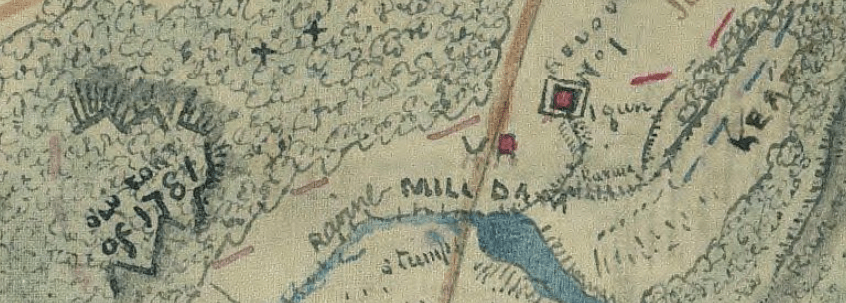
At first glance is this a cool anecdote and yet rather odd. However, when you consult french maps from the Williamsburg region created during the Yorktown Campaign you’ll find references to Mulhenburg’s “lights” camped in this very area. Moreover, almost hidden in plain sight on one of Sneden’s 1862 maps is and “Old Fort of 1781.” Civil War soldiers seemed wholly cognizant of the Revolutionary landscape around them and like Jennings used it to spur on their cause(s).
Yesterday, on the 158th anniversary of the May 5th, 1862 battle the American Battlefield Trust launched a campaign to save the 29 acres over which Jennings charged. Perhaps it is this very same ground where the original cast of “ragged continental ‘Rebs'” also campaigned. Click here to read about that initiative and for further information on how to donate.
“Rev War Roundtable with ERW” Heads to South Carolina (Virtually)
Join Emerging Revolutionary War this Sunday, at 7p.m. EST on our Facebook page as we head, virtually, down to South Carolina to discuss the importance of that colony/state in the American Revolution.
Most are familiar with the larger engagements, such as Cowpens and Kings Mountain or maybe the massacre at the Waxhaws. How about the Siege of Charleston, or the battles of Ninety-Six, or the countless other engagements that made the Palmetto State (which got its nickname from this era) one of the most hotly contested areas of the entire conflict.
Joining the “Rev War Revelry” will be ERW historians Vanessa Smiley, former Chief of Interpretation and Education at the Southern Campaign of the American Revolution National Park Group, which includes Cowpens, Kings Mountain, and Ninety-Six and Bert Dunkerly, former park ranger at Kings Mountain and author of a few histories on South Carolina in the Revolutionary War topics.
We look forward to seeing you for our sojourn into the Southern Theater this Sunday. Oh, and remember to grab your favorite brew for the trip!

(courtesy of ABT)
“Rev. War Roundtable with ERW” Continues this Sunday!
This Sunday, April 26, at 7 p.m. EST, Emerging Revolutionary War invites you to click on and listen to the next installment of our “Rev War Revelry.” This week’s happy hour will focus on the most over-looked battle or engagement from the American Revolution. Each of the historians slated to participate will bring their pick for that category.
Feel free to chime in with yours in the comments here or on the Zoom call on Sunday. The feed will be live on ERW’s Facebook page. So, grab your favorite beverage and join us for a free-flowing conversation to toast off the weekend with.
The Post Script
At 3:00 in the afternoon on April 21, 1781 Virginia militia Colonel James Innes sat down to write a letter near Hickory Neck Church, just shy of the halfway point between Virginia’s old colonial capitol at Williamsburg and its new capitol at Richmond. Perhaps with a heavy heart and a weary hand, Innes picked up his pen to scrawl a letter to Governor Thomas Jefferson. The situation in Virginia was bleak. It had only been a year since, in apprehension of a British attack, the Virginia Assembly voted to move the seat of government from the Peninsula west to Richmond, and along with it the public stores for outfitting, equipping, and otherwise supporting Virginia’s patriot forces in the fifth and sixth years of the war with the British. The gamble hadn’t paid off. January 1781 saw Benedict Arnold’s forces sacking Richmond. Everywhere they went, it seems, a new combined force of British, Hessian, and Loyalist forces left destruction in its wake.

 Emerging Revolutionary War Era