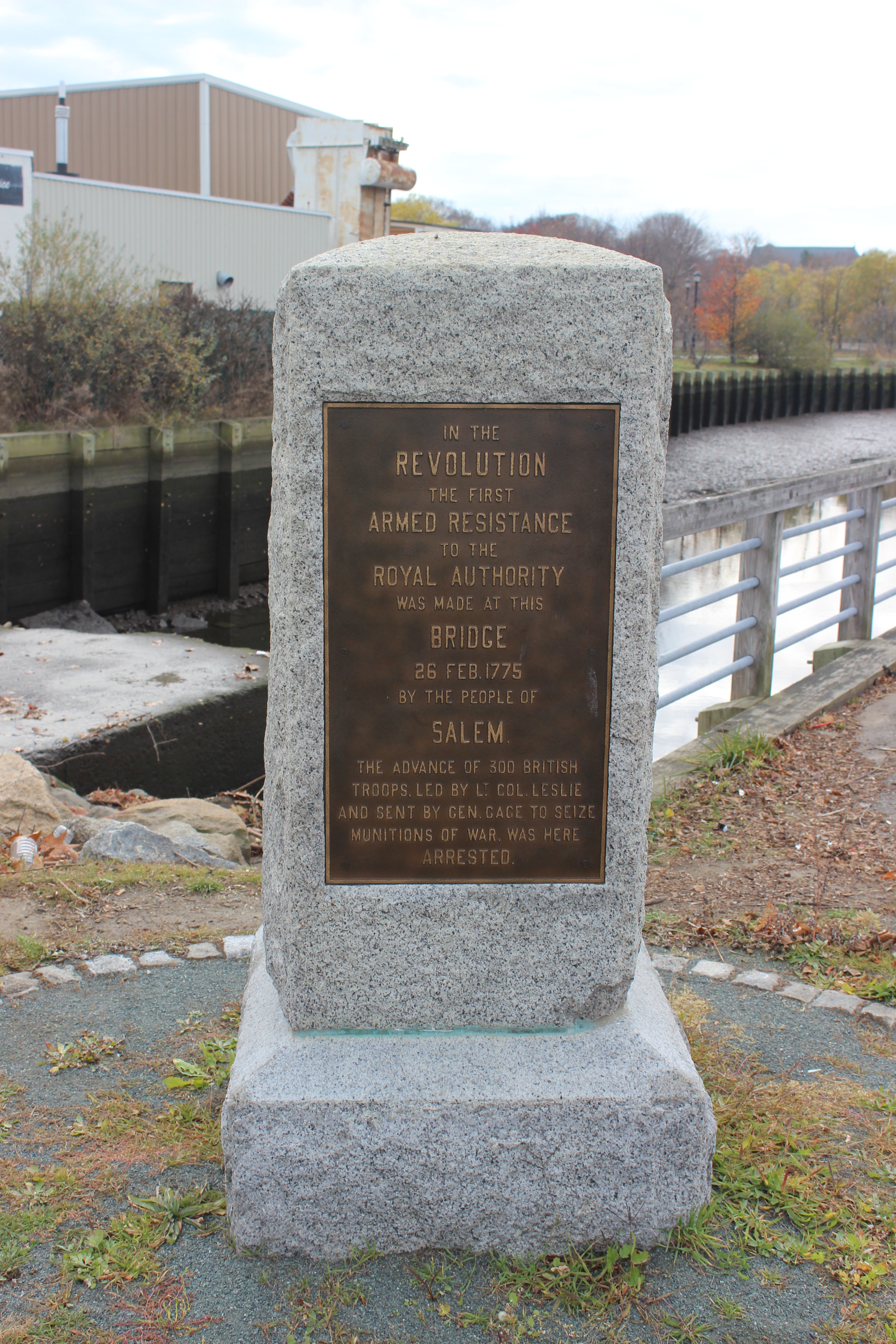
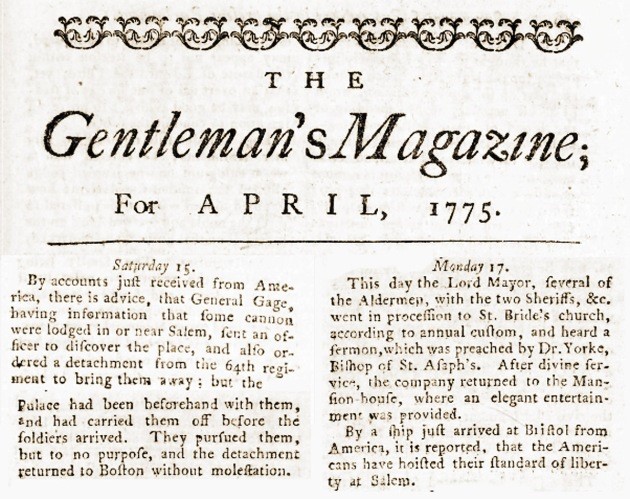
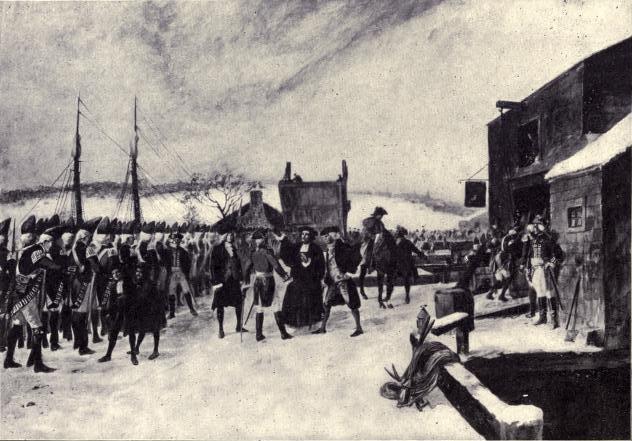
We reshare a post from 2018 about the Salem Alarm also known as “Leslie’s Retreat.” As we approach the 250th anniversary of this important event (February 26, 1775), we will share primary source accounts of the event. This event set the kindling for the spark that lit a war in Lexington a month later.
As events quickly spiraled out of control in the winter and spring of 1774-1775 around Massachusetts, several armed confrontations between local “Patriots” and the British army heightened tensions. On many occasions, both sides adverted open confrontation and were able to diffuse the situation. Understanding these events and how they made an impression on both sides helps explain what happened on the Lexington Common on April 19, 1775.
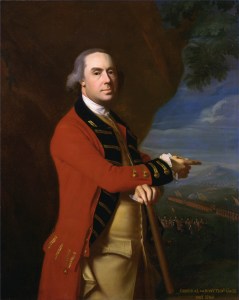
As soon as British General Thomas Gage arrived in Boston in the spring of 1774, he set about enforcing the newly passed “Coercive Acts.” In response to these new laws that restricted many of the rights the people of Massachusetts had grown accustomed too, local groups began to arm themselves in opposition to British authority. Even though Gage was once popular in the colonies, he soon became an enemy to those around Boston who believed the Coercive Acts were an overstep of British authority. Continue reading ““If you Fire, You’ll all be dead men” The Salem Alarm”→
We are excited to welcome historian and author J.L. Bell. Few know more about the events around Boston in 1775 than Bell. His blog, Boston 1775 (https://boston1775.blogspot.com/ ) is the most detailed and researched source on everything Boston 1775 (and before and after 1775). As we approach the 250th anniversary of Lexington and Concord, we will continue our on going discussion about the events leading up to the first shots at Lexington. Topics will include the military build up in Massachusetts including cannon (especially four stolen cannon), creation of minute companies and Gage’s military response. Leslie’s expedition to Salem in February as well as the newly created Provincial Congress and Dartmouth’s orders for Gage.
We have a lot to cover, so grab a drink and join us LIVE on our Facebook page on Sunday, February 2nd at 7pm. This will not be one you want to miss!
Everyone has heard of the “shot heard round the world” at the North Bridge, or the first shots of the war on the early morning of April 19, 1775 at the Lexington Green. But few people know about events that transpired in New Hampshire four months before Lexington and Concord. The events at Fort William and Mary on December 13 and 14 1774 were just as critical to the step toward war as the September Powder Alarm or the later Salem Alarm in February 1775.
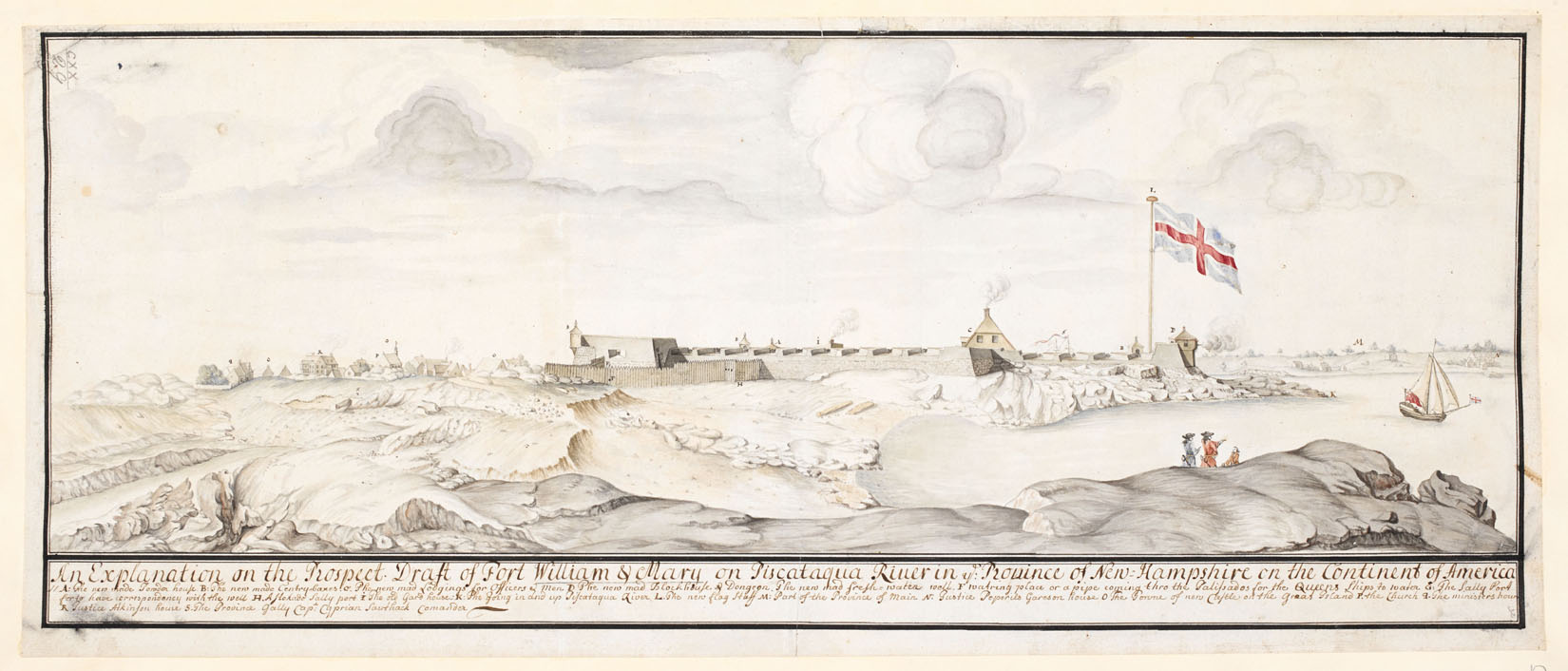
Fort William and Mary, ca. 1705 by Wolfgang William Romer
In response to the Massachusetts Powder Alarm in September 1774, colonial Whig leaders in nearby colonies began to make plans to “capture” local and colonial powder supplies. The crux was the issue of who really owned the gunpowder. Whig leaders believe they owned the power, the colonial militias. Royal leaders, Gen. Gage specifically, believe the powder was the “King’s Powder.” So any attempt to take the powder, was theft and treason. On December 3, 1774 the Rhode Island Assembly ordered the removal of cannons and powder from Fort George in Newport. On December 9, local militia carried out the order without any incident. Gage began to look at larger powder supplies that he believe were vulnerable. One large such supply was located at Fort William and Mary, located near Portsmouth, New Hampshire. This fort was isolated on the island of New Castle, at the mouth of the Piscataqua River. Located here was a small garrison of six men, guarding the fort and its supply of gunpowder.
Paul Revere and his other Patriot leaders in Boston became expert spies and soon received word that Gage was to send a contingent of British marines to Fort William and Mary. On December 13, Revere set out from Boston to Portsmouth to warn them of the coming expedition. Though the British navy was active in the area off of Portsmouth, Gage ironically made no plans to send an expedition to the fort. That would matter little in what happened next.
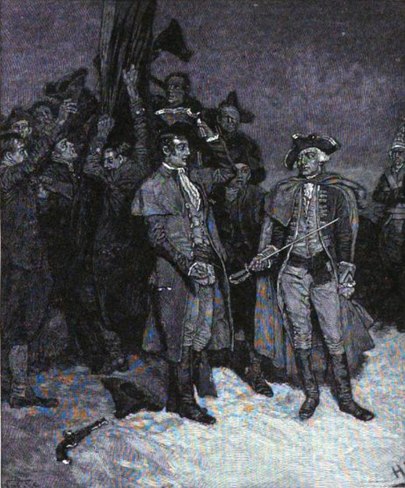
Surrender of Fort William and Mary by Howard Pyle
As Revere arrived in Portsmouth that afternoon, he gave the news of the supposed British expedition to the local Committee of Correspondence. Soon the local militia organized and, on the next day, nearly 400 militiamen assaulted the fort. The six-man British contingent inside the fort refused to surrender. They even fired three of their cannon at the attacking militiamen. For the first time, colonists were in open combat against British troops. The contingent eventually surrendered, having suffered a few injuries but no fatalities. That afternoon, the militia hauled away nearly 100 barrels of gunpowder. The next day nearly a thousand militiamen led by John Sullivan, arrived in Portsmouth due to the rider notification system. With no British to fight, these men assisted in going back to the fort to carry away muskets and cannon. Gage got word of Revere’s presence in Portsmouth and soon sent a small force from Boston to Portsmouth via the British navy. This force arrived the next week and at that point, there was nothing left of substance in Fort William and Mary.
The events at Portsmouth led Gage to be more aggressive in establishing a more coordinated spy network. As the new year began, Gage’s communications with England forced British officials to realize that this opposition was not like those in years past. The Patriots were arming themselves and establishing their own government in an affront to British authority. Former Prime Minister William Pitt, now sitting as a member of the House of Lords, knew the colonies well. He was well liked by the colonists, and he sought a compromise. He predicted the colonials would not back down and soon war would erupt between Great Britain and its colonies. Pitt proposed to remove British troops from Boston to lessen the tensions and to repeal the Coercive Acts. Both ideas were rejected overwhelmingly by Parliament.
In response to the news that the Continental Congress convened, Parliament on February 9, 1775, declared: “We find, that a part of your Majesty’s subjects in the province of the Massachusetts Bay have proceeded so far to resist the authority of the supreme legislature, that a rebellion at this time actually exists within the said province.” Now there was no doubt how the “Patriots” were viewed by Parliament and the King; they were rebels.
The events at Fort William and Mary were part of a succession of tense encounters between British authorities and local Whig leaders. Each one built on the tension from the previous. It is amazing that the “attack” by the New Hampshire militia on the fort, attacking the King’s troops, did not lead directly to war then. It would take four more months before another armed conflict sparked a revolutionary war.
To read more about the events leading up to Lexington and Concord, visit the Savas Beatie website to purchase “A Single Blow: The Battles of Lexington and Concord and the Beginning of the American Revolution” by Phillip S. Greenwalt and Rob Orrison
Many have heard of Paul Revere’s ride to Lexington and the shot heard round the world at Concord (and Lexington) but few know about the December 1774 raid and skirmish at Fort William and Mary in New Castle, New Hampshire. Here, inspired by news from Paul Revere, local militia attacked and captured a small British garrison at Fort William and Mary. Join us as we welcome Dr. Dr. Cynthia Hatch to discuss this much over looked action leading up the American Revolution.
Dr. Hatch is an Oklahoma State University Institute of Technology instructor specializing in Revolutionary War history. With a PhD in History, she explores the intricate political, social, and cultural dynamics of the 18th century, with a particular focus on the colonial legal system and the pivotal role of local narratives in shaping historical interpretations during the Revolutionary Era.
Join us as we discuss the events leading up and during the raid of Fort William and Mary and learn, were these the FIRST shots of the American Revolution? This Rev War Revelry will be pre-recorded and posted to our Facebook page at 7pm on Sunday, December 8th.
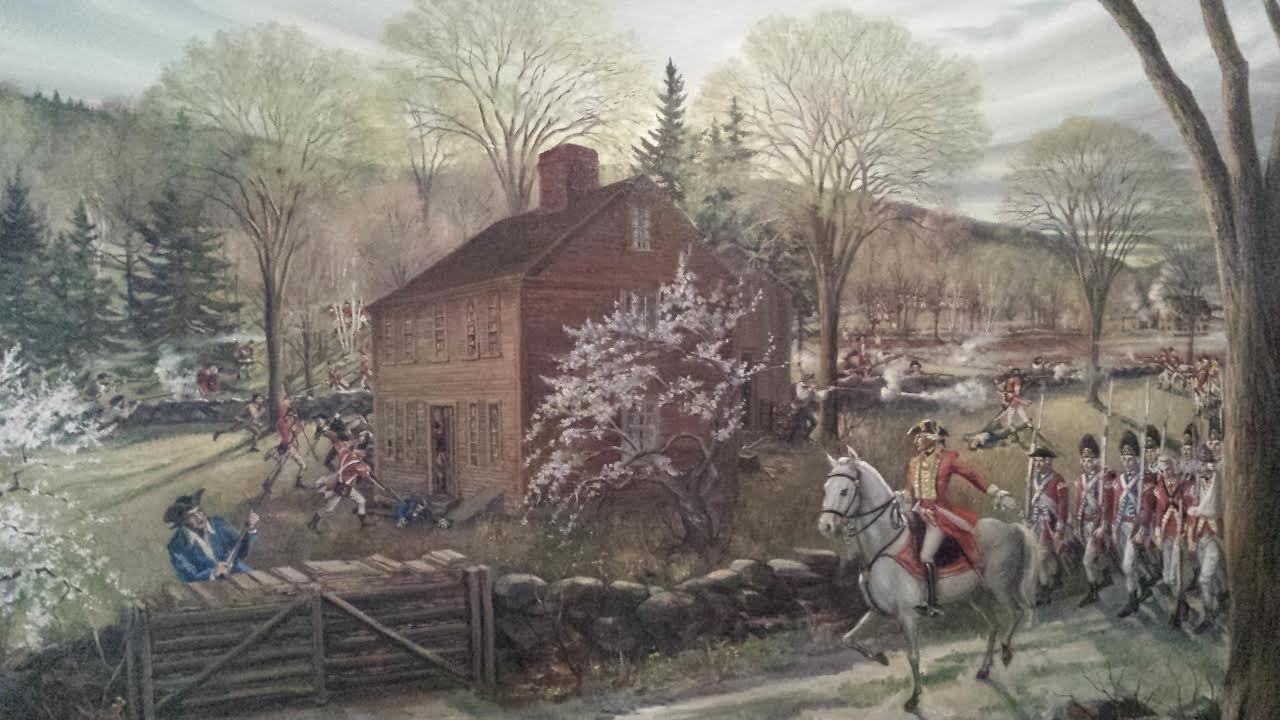
The Fight at the Jason Russell House, bicentennial painting by Ruth Linnell Berry (1974). Appearing with permission from the Arlington Historical Society.
Though the American Revolution started on the green at Lexington and North Bridge in Concord, the bloodiest part of April 19, 1775 took place in the community of Menotomy (modern day Arlington). Join us as we welcome Matt Beres from the Arlington Historical Society. We will discuss the viciousness of the fighting on the afternoon of April 19th along the road back to Boston, including stories like the Jason Russell House, Cooper Tavern and more. Join us as we talk about the much overlooked part of April 19th, 1775 as we move towards the 250th anniversary. This episode is pre-recorded and will be posted on Sunday, November 24th at 7pm on our You Tube and Facebook pages.
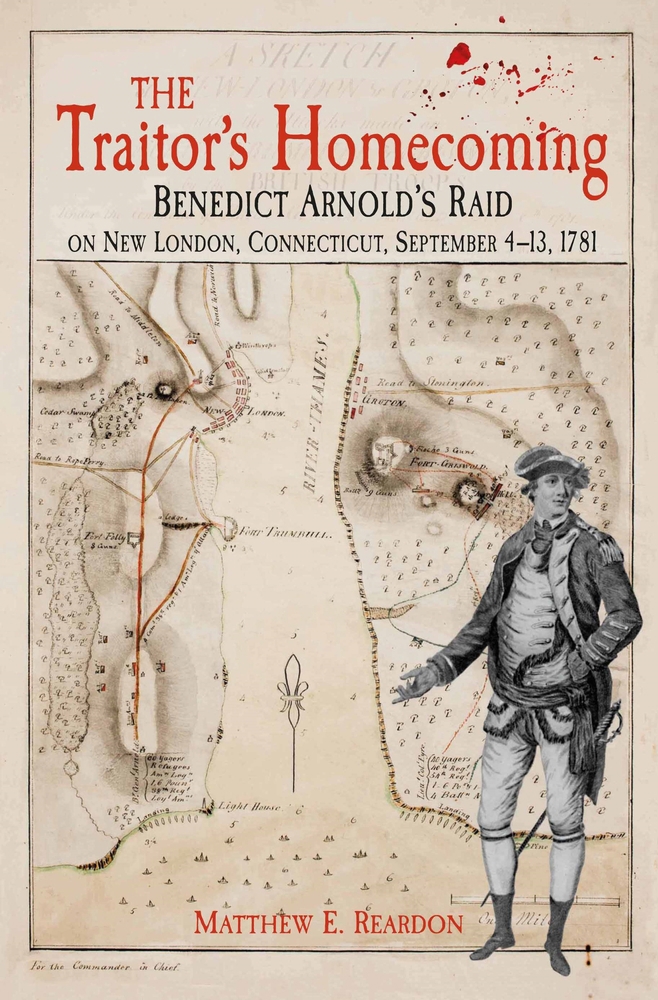
Although 1781 is most known for the pivotal and successful victory at Yorktown, action in the American Revolution unfolded throughout the eastern seaboard. In early September 1781, Benedict Arnold returned to the land of his birth to lead a raid on New London and the port that harbored preying privateers.
During this raid, the American militia under Lieutenant Colonel William Ledyard especially, stoutly defended Fort Griswold until overcome by superior numbers. The town of New London was also torched and saw a rarity like the battle of Trenton, in that combatants fought through the very streets of the town.
Capturing all this and uncovering new primary sources, Matthew Reardon weaves a narrative that balances military history, from the fighting to the strategies, with the impact on New London and Connecticut. His book, “The Traitor’s Homecoming, Benedict Arnold’s Raid on New London, Connecticut, September 4 – 13, 1781” was recently published by Savas Beatie, LLC. Matthew is a native of northeastern Connecticut and is a public educator along with being a command historian for the Connecticut Military Department. He can be reached for inquiries on speaking engagements or how to purchase the book here.
The book will be the focus of this week’s “Rev War Revelry.” We hope you can join us on our Facebook page on Sunday, 7 p.m. EDT.
*Note* This “Rev War Revelry” will be recorded in advance as the Emerging Revolutionary War crew will be in Lexington and Concord, Massachusetts for the 4th Annual Emerging Revolutionary War bus tour.
Fredericktown, Maryland, August 1, 1775, a gentleman on business wrote to his contact in Philadelphia the following observation of a company of volunteers answering the call to head north to Boston to join what would become the Continental Army
“Notwithstanding the urgency of my business, I have been detained three days in this place by an occurrence truly agreeable. I have had the happiness of seeing Captain Michael Cresap marching at the head of a formidable company of upwards of 130 men, form the mountains and backwoods, painted like Indians, armed with tomahawks and rifles and dressed in hunting shirts and moccasins, and though some of them had travelled near eight hundred miles from the banks of the Ohio, they seemed to walk light an easy and not with less spirit than at the first hour of their march. Health and vigour, after what they had undergone, declared them to be intimate with hardships and familiar with danger. Joy and satisfaction, were visible in the crowd that met them. Had Lord North been present, and been assured that the brave leader could raise thousands of such to defend his country, what think you, would not the hatchet and block had intruded upon his mind? I had an opportunity of attending the Captain during his stay in Town, and watched the behavior of his men, and the manner in which he treated them; for it seems that all who go out to war under him do not only pay the most willing obedience to him as their commander, but in every instance of distress look up to him as their friend or father. A great part of his time was spent in listening to and relieving their wants, without any apparent sense of fatigue and trouble. When complaints were before him he determined with kindness and spirit, and on every occasion condescended to please without losing is dignity.”
esterday the Company were supplied with a small quantity of powder from the magazine, which wanted airing, and was not good for rifles ; in the evening, however, they were drawn out to show the gentlemen of the town their dexterity at shooting. A clap board, with a mark the size of a dollar, was put up ; they began to fire at it off band, and the bystanders were surprised, few shots being made that were not close to or in the paper. When they had shot for a time in this way, some lay on their backs, some on their breast or side, others ran twenty or thirty steps, and firing, appeared to be equally certain of the mark. With this performance the company were more than satisfied, when a young man took up a board in his hand, not by the end, but by the side, and holding it up, his brother walked to the distance, and very coolly shot into the white ; laying down bis rifle, he took the board, and holding it as it was held before, the second brother shot as the former had done. By this exercise I was more astonished than pleased. But will you believe me, when I tell you, that one of the men took the board, and placing it between hia legs, stood with his back to the tree while another drove the centre. What wonld a regular army of considerable strength in the forests of America do with one thousand of these men, who want nothing to preserve their health and courage but water from the spring, with a little parched corn, with what they can easily procure in hunting ; and who wrapped in their blankets, in the damp of night, would choose the shade of a tree for their covering, and the earth for their bed.”
Although a depiction of the 1st Maryland at Guilford C.H in 1781 some of these men are dressed similar to the riflemen mentioned above (wikipedia)
*Account is in “Papers Relating Chiefly To the Maryland Line During the Revolution” Thomas Balch, editor. pgs. 6-7.
Join us as we welcome back Dr. Steven Smith as he discusses his new book “The Battles of Fort Watson and Fort Motte, 1781.”
Dr. Smith will discuss the history of four critical weeks from April 12 until May 12, 1781, in which the tide of the Southern Campaign of the Revolutionary War turned in favor of the Americans. Focusing on General Francis Marion’s and Colonel Henry Lee’s capture of two key British forts, Fort Watson and Fort Motte, coordinating with Nathanael Greene in retaking the South Carolina backcountry. These posts defended the supply line between Charleston and the British-occupied villages of Camden and Ninety Six. Although there would be much more fighting to do, once the two forts were lost, the British had to abandon the backcountry or starve. The British would never again be on the strategic offensive and were confined to the Charleston environs until they abandoned the city in December 1782.
Smith will also discuss how archaeological investigations have helped change the interpretation and mythology of both battles. Join us for a livestream on our You Tube channel in what will be a great discussion. The video will be posted to our Facebook page at its conclusion
On September 1, 1774 Massachusetts was on the brink of war. General Thomas Gage, now Governor of Massachusetts was growing more worried about Whig access to gunpowder and weapons. He made a fateful decision to send a small expedition to retrieve the provincial powder stored in Charlestown. This powder in Gages’ mind, was owned by the King. Local leaders felt otherwise and now this grab for powder by Gage nearly sparked war in 1774.
As word of the Boston Tea Party reached the other colonies, the response was mixed. Most colonists believed Bostonians should pay for the ruined tea, but they were also overwhelmingly shocked by the harshness of the Coercive Acts. Support from across the 13 colonies began to pour into Boston. Using an already established “Committee of Correspondence” network created in the early 1770s, colonial leaders began to discuss a proper reaction. Boycotts on imports of British goods and tea especially were accepted broadly. But most importantly, 12 colonies (Georgia abstained) sent representatives to a “Continental Congress” in Philadelphia in September 1774. Unlike the previous Stamp Act Congress, the First Continental Congress was attended by the majority of American colonies. The Congress encouraged boycotts and also petitioned the King and Parliament to rescind the Coercive Acts. In response to their planned attendance, Governor Gage dissolved the Massachusetts Provincial Assembly before the Continental Congress met and called for new elections. This did not deter them from sending representatives (John Adams, Samuel Adams, Thomas Cushing, and Robert Treat Paine) to Philadelphia.
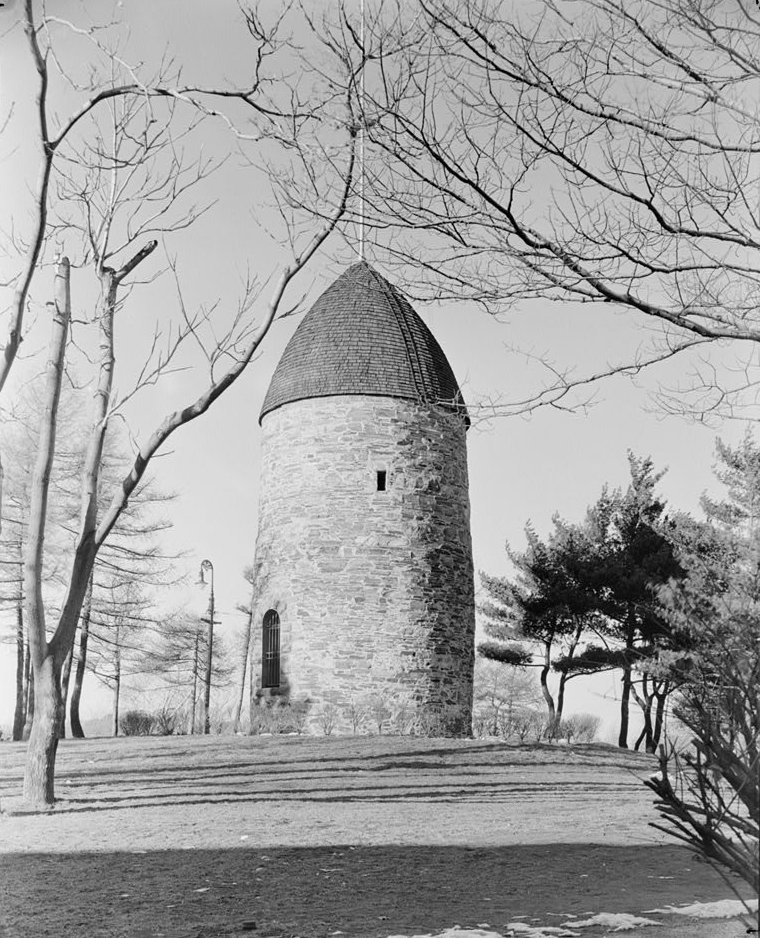
Charlestown (now Somerville) Powder House, ca. 1935
Back in Massachusetts, Gage became wearier of his situation and the possibility of open conflict with colonists. He was active in paying informants and gaining information from local Tories (those loyal to the British government). These sources informed Gage that the people of the countryside were beginning to arm themselves. In an effort to deny them use of the official Royal arms and powder stored across the colony, he began to collect these government-owned supplies. In colonial America, most men served in the local militia. Local towns had powder magazines to store the powder that would be used for training the militia or if the militia was called to defend a portion of the colony. Many of these powder magazines also stored a portion of gunpowder that belonged to the colonial government—the King’s powder.
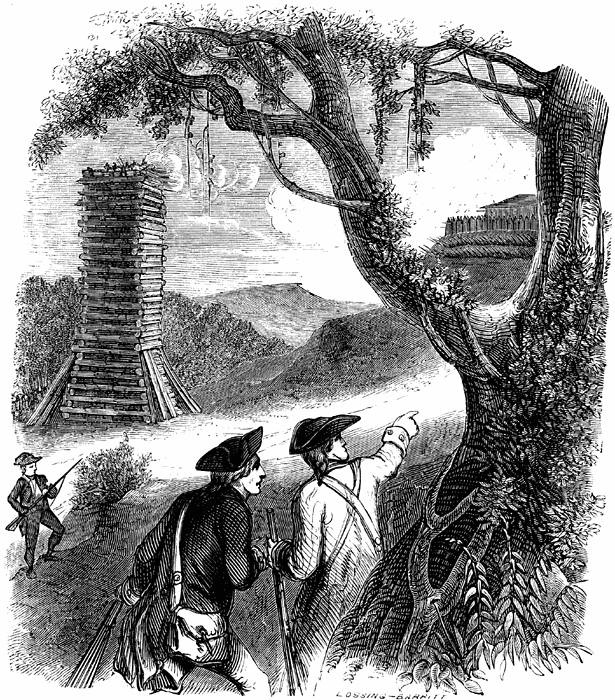
One such large powder magazine that stored a large quantity of British gunpowder was in nearby Charlestown, now known as Somerville. This powder magazine was the largest in the colony. William Brattle, the commander of the Middlesex County militia and a Royal appointee, notified Gage that he believed the local militia were making plans to steal the Royal gunpowder. Gage moved quickly; he ordered the Middlesex County sheriff to secure the keys. Then early on the morning of September 1, nearly 300 British Regulars made their way to the powder house and removed all of the gunpowder that rightfully belonged to the governor and his agents. By that afternoon, the British troops, powder, and two cannon were in Boston at Castle William (a fort on an island in Boston Harbor).
Word spread quickly that the British came and stole the powder and, in the process, had shot and killed colonials. Now Boston was on fire, and the British navy was bombarding the city. All of this of course was not true, but the word spread like wildfire just the same. Misinformation abounded, and now thousands of locals and militia were gathering in Cambridge looking for revenge. Many loyal to the colonial government were forced to flee to Boston for protection. As time went on, it was evident that the rumors of a battle and Boston burning were untrue. The incident, however, showed how quickly the countryside could mobilize against the governor. Word was quickly sent to Philadelphia where the delegates to the First Continental Congress was aghast at the news. They debated on what to do, and the Massachusetts delegation specifically were on edge for more information. Word eventually arrived that the situation that was first reported was not accurate and no fighting had broken out. John Adams wrote;
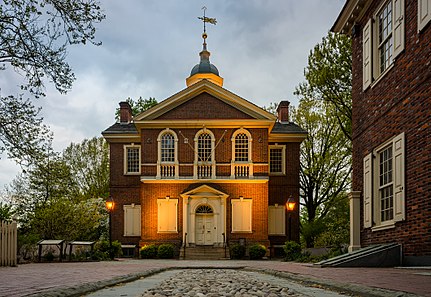
Carpenters Hall, Philadelphia where the First Continental Congress convened on September 5, 1774.
“When the horrid news was brought here of the bombardment of Boston, which made us completely miserable for two days, we saw proofs of both the sympathy and the resolution of the continent. War! war! war! was the cry, and it was pronounced in a tone which would have done honor to the oratory of a Briton or a Roman. If it had proved true, you would have heard the thunder of an American Congress.”
Gage, somewhat shaken by the event, began to concentrate his military strength in the city of Boston and fortified the city against a possible attack. He sent word to England that he needed more men to enforce the Coercive Acts. The “Powder Alarm” proved that, within a day, thousands of armed colonials could assemble. The message he sent London shocked the King: “If you think ten thousand men sufficient, send twenty; if one million is thought enough, give two.” Soon after on September 9th, Whig (Patriot) leaders such as Dr. Joseph Warren and others passed the Suffolk Resolves. These strongly worded resolves called for a boycott of British goods and heavily impacted policies adopted by the First Continental Congress. Parliament badly miscalculated the colonial reaction to the Coercive Acts and the pendulum was beginning to swing to independence. The Powder Alarm quickly taught General Gage that the resistance to Royal authority was not just a small group of rebels, but a growing majority of the population.
You can still today visit the the famous Powder House today. It stands in Nathan Tufts Park at 850 Broadway, Somerville, Massachusetts (GPS: N 42.400675, W 71.116998). There is plenty of street parking available. Take the trails in the park to the Powder House located in the center of the park.
On February 27, 1776 Patriot and Loyalist forces faced off at Moores Creek Bridge in southeastern North Carolina. Loyalist forces anticipated support from a British army arriving along the North Carolina coast and planned to use this combination force to return British authority in North Carolina. Though, when help did not arrive, a mixed bag of North Carolina Patriots turned back an attack at Moores Creek Bridge. Their victory, combined with the Patriot victory at Great Bridge, VA in December 1775, solidified their control of North Carolina. Additionally, the Loyalist defeat served as a major deterrent for Loyalist support until the opening of the Southern Campaign four years later. This small action had long lasting impact on the entire war in the south.
Join us this Sunday night at 7pm on our You Tube Channel ( https://www.youtube.com/@emergingrevolutionarywar8217 ) as we welcome back our own ERW historian Bert Dunkerly. Bert has extensive knowledge on the history of this battle and experience working at the battlefield itself. We will discuss the complex situation leading up to the battle and how this small battle changed the war strategy in the south. Grab a drink and join in on the discussion!