
Lexington Green
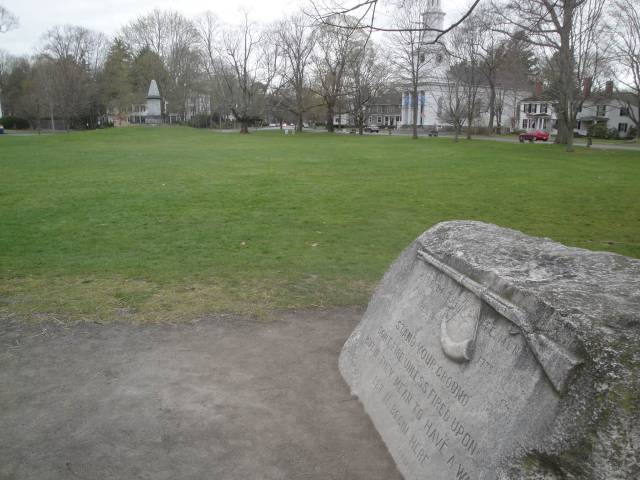
242 years later, the question still remains….
Who fired first?

Lexington Green
242 years later, the question still remains….
Who fired first?
Emerging Revolutionary War welcomes back guest historian Katie Turner Getty
“Fire! Fire! You dare not fire!” “Cowardly rascals!” “Lobsters!”
Shouts pierced the icy stillness of the night as a raucous crowd gathered in Boston’s King Street on the night of March 5, 1770. With their voices carrying through the wintry air all the way to Long Wharf, the crowd hurled insults at eight British soldiers and their captain. The soldiers’ muskets rattled as snowballs, oyster shells, and chunks of ice lobbed by the unruly crowd rained down upon them.

The soldiers shot eleven townspeople that night. Three died in the snow where they stood. Two more would later die from their wounds. The remaining six would survive. All of the victims were male.
Documentary evidence shows that the crowd in King Street on the night of the Boston Massacre was overwhelmingly male. The crowd was variously described as “mostly boys and youngsters”, “near 200 boys and men”, “a parcel of Rude boys”, and “chiefly consisting of boys and lads”.[1] Continue reading “Women Speaking Softly: Female Voices of the Boston Massacre”
Part Two by Malanna Henderson
A hero who championed American independence was Revolutionary War hero James Forten; not particularly for what he did, but for what he didn’t do.

At the tender age of fourteen, Forten became a prisoner of war aboard the notorious British prison ship, the HMS Jersey, anchored in New York. Like nearly all of his fellow inmates who perished or survived the horrific tribulation, he remained loyal to the patriot cause in the face of death. Continue reading “Two Patriots: One Slave and One Free – James Armistead Lafayette and James Forten”
 In Charleston’s Marion Square, an odd chunk of limestone, sand, and oyster shells sits inside a wrought-iron fence just beyond the normal boundaries of the weekend market. While shoppers buy their weekly produce or shop for gifts, the food court along King Street tempts them with just about anything you can image. Someone usually plays live music on the park-side of the market—and there, nearby, sits the hunk of rock. Continue reading “Charleston’s Horn Work Offers Glimpse Into the Walled City’s Colonial Fortifications”
Emerging Revolutionary War is honored to welcome guest historian Derek Maxfield as the author of this post. A biography of Mr. Maxfield is at the end.
A trek to Conesus, NY, to pay my respects to Capt. Daniel Shays – who is buried in Union Cemetery – resulted in a revolutionary discovery: Groveland Ambuscade Park and Monument. Set atop the western ridge overlooking Conesus Lake is an obelisk dedicated to the memory of a group of scouts from Gen. Sullivan’s army who were ambushed there in 1779.
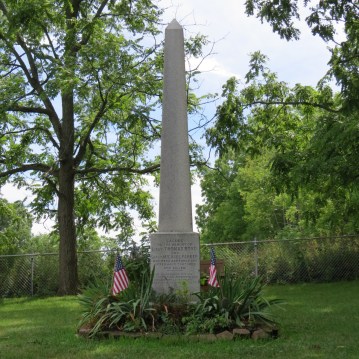
Quite off the beaten track, the park has seen better days. In 1901 The Livingston County Historical Society erected a large monument commemorating the ambush of American troops near that spot. A small park, complete with a pavilion and picnic area was added – though these amenities are no longer present. More recently a wooden stairway was added leading up to the monument, which stands on high ground.
Gen. John Sullivan, under orders from Gen. Washington, mounted a punitive raid against the Iroquois in Western New York in 1779. When Sullivan’s army sought to cross the inlet at the southern end of Conesus Lake, they stalled while engineers worked to create a reliable bridge across the mire. Wishing to know the location of the British and Indian army, under Col. Butler and Chief Joseph Brant, Sullivan sent a scouting party over the western ridge. Leading the scouting party of Lt. Thomas Boyd, who was assisted by a Native American scout named Han Yost.
Boyd and his men were lured into a trap and ambushed on September 13th, 1779. Only a handful survived to bring word back to Sullivan. In subsequent days Boyd’s body was found in a Native American village mangled and mutilated. Boyd and Sargent Michael Parker had been captured and interrogated, but gave up little information. This resulted in their torture – fingers and toes removed, they were disemboweled and beheaded. Finally, their entrails were flung over tree branches. This tree, still standing – nearly 300 years old, now is a monument to the brave Continental soldiers who died at the hands of the Seneca. The “Torture Tree” was designated a National Historic Landmark in 2009.
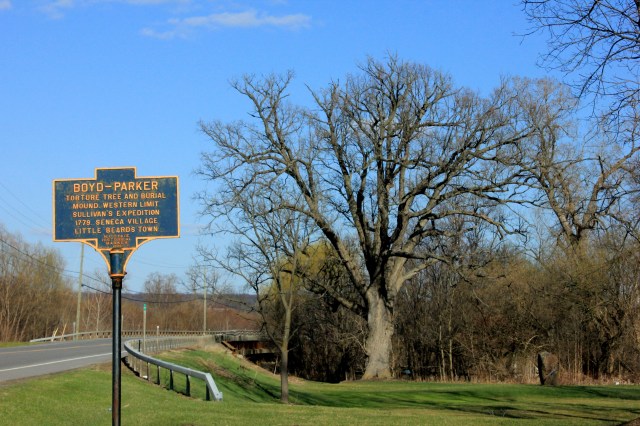
Sixteen of Sullivan’s men were killed at Groveland plus Han Yost, the Native American guide. The scene of the ambush would prove to be the western limit of Sullivan’s penetration into the Iroquois homeland.
Seemingly just a footnote in the history of the Revolution, it is nice to see that this courageous band that died so ingloriously is remembered today.
*Derek Maxfield is an associate professor of history at Genesee Community College in Batavia, NY, where he is also coordinator of the college’s Civil War Initiative. For his work with the Initiative, Maxfield was awarded the SUNY Chancellor’s Award for Excellence in Scholarship and Creative Activities in 2013.
Maxfield holds a Bachelors of Arts degree from SUNY Cortland and a Master of Arts degree from Villanova University. He is also a PhD candidate at the University of Buffalo, where he is ABD (all but dissertation). Among Maxfield’s research interests are 19th century politics and culture, especially Victorian death ways and the Civil War.
Maxfield lives in Churchville, NY, with his wife, Christine, two children—Quincy, 13, and Jesse, 11—a basset hound, three cats and a tortoise.*
Emerging Revolutionary War is honored to welcome guest historian Katie Turner Getty. A short biography is at the bottom of the post.
In terms of historical significance, few American cities rival Boston, where shades and shadows of the Revolution can be found around every corner. By walking the city’s famous Freedom Trail, one can follow in the literal footsteps of the inhabitants who left such an indelible mark on the city. Indeed, many heroes of revolutionary Boston—Revere, Adams, Otis—lie in their eternal repose in burying grounds mere steps from busy thoroughfares.
The presence of those revolutionaries still looms large in Boston and many of their old stomping grounds still stand. Several buildings located on the Freedom Trail played unforgettable parts in the revolution. From the fiery speeches at Old South Meeting House on the eve of the tea party to the blood shed by those massacred outside the Old State House*, these sites are popular and are frequently visited.
But there is one site not located on the Freedom Trail that is yet imbued with great historical import. Indeed, it is the site of the 1768 arrival of British warships in Boston Harbor and the troops who first took those fateful steps into Boston for the purposes of occupying the city.

The name of this site, so often overlooked, is Long Wharf.
Long Wharf has stretched into the Atlantic from Boston for 300 years, serving as the world’s great doorway to the city. It was the longest wharf in Boston, extending 1,586 feet into the deep water of the harbor allowing up to 50 ships to dock at one time[1]. It would have been a place of great bustle—the loading and unloading of cargo by longshoremen, transporting of such cargo to the busy warehouses and shops that lined the wharf, and then the purchase of such goods by local people.

On Friday, September 30, the Beaver, the Senegal, the Martin, the Glasgow, the Mermaid, the Romney**, the Launceston, and the Bonetta anchored in the harbor. On board the ships were “the 14th and 29th Regiments, a detachment from the 59th regiment, and an artillery train”.[2] The next day, Bostonians warily watched as “the war ships maneuvered closer to the town and ranged themselves as if for a siege.”[3] Then, carried off the warships by small boats, British troops stepped onto Long Wharf and into American history.
These ships and troops had arrived in the port of Boston as a response to colonial opposition to the Townshend Acts which were enacted by Parliament in 1767 in an effort to enforce their sovereignty over the colonies and raise revenue. The Townshend Acts imposed a tax on imports such as tea, glass, paper, and paints, as well as instituted a Customs board to help enforce British trade regulations and deter smuggling activity. Many Bostonians were opposed to the Townshend Acts and protested by gathering in mobs and harassing officials.

Paul Revere immortalized the landing of the troops in an engraving entitled “A View Of Part of the Town of Boston In New England And Brittish [sic] Ships of War Landing Their Troops! 1768”. The image depicts the eight British ships of war arrived in the harbor, with smaller boats carrying red-coated soldiers to Long Wharf. Some troops are already amassed on the wharf, gathering into formation.


When standing at the wall safe, take a few steps to the right and look out the front windows of the building. Look down to the ground level to see the path of the troops as they passed right by Hancock’s Counting House, “with insolent parade, drums beating, fifes playing, and colours flying, up King Street” as they headed down the wharf and into the town. The soldiers were marching to the Town House, at the base of King Street. And beyond that, to Boston Common.

Long Wharf at the time (as it is today) was really just an extension of King Street, which ran all the way from the Town House (later to become the site of the Boston Massacre), down to the shoreline, then continued along in the form of a wharf, out into the harbor. After the Revolution, King Street was (perhaps appropriately) renamed State Street and is known by that decidedly more American moniker today.
The soldiers’ route may be traced today by any perambulating history enthusiast. Walk out past Hancock’s Counting House, to the terminus of Long Wharf and stand where the British soldiers disembarked. As you gaze out across the cold gray Atlantic, feel the stiff sea breeze rolling in off the water just as they did. Then turn your gaze away from the Atlantic and look back toward the city. The view is the same as in 1768—the Town House will be in your direct line of sight. As the soldiers marched down the wharf in a straight line, they too would have seen the Town House quite clearly.
A pamphlet published by the Boston Redevelopment Authority in the 1980s reveals that although the wooden timbers of Long Wharf are experiencing decay, the 17th and 18th century granite bulkheads beneath the wharf are still intact.[4] It is a thrill for any revolutionary history enthusiast to walk out to the end of Long Wharf, knowing that deep beneath his or her feet are the very same granite blocks, impervious to time and history, that bore silent witness to the arrival of the British soldiers who stepped onto Long Wharf and into history when they came to occupy Boston.
*The building known today as the Old State House was known in the 1770s as the Town House.
**The Romney actually arrived in Boston Harbor in May 1768 to help enforce customs and discourage the flouting of trade regulations, attempting to seize John Hancock’s ship, Liberty.
*Katie Turner Getty is a lawyer, history enthusiast, and lifelong resident of Boston. She holds an A.A. from Bunker Hill Community College in Charlestown, Massachusetts, a B.A. in History from Wellesley College, and a J.D. from New England Law Boston. She can often be found exploring historic sites both on and off the Freedom Trail.
Sources:
[1] National Park Service, “Long Wharf and Custom House Block,” Maritime History of Massachusetts, accessed October 28, 2016, http:// https://www.nps.gov/nr/travel/maritime/lon.htm%20
[2] Paul Revere, A View of Part of the Town of Boston in New England and Brittish [sic] Ships Landing Their Troops! 1768, circa 1770, engraving, 26 x 40.5 cm, American Antiquarian Society, Worcester, Massachusetts http://www.americanantiquarian.org/Inventories/Revere/b2f1.jpg
[3] Richard Archer, As If An Enemy’s Country (Oxford: Oxford University Press 2010), xiv.
[4] Boston Public Library, “Long Wharf”, Sasaki Associates, Boston Redevelopment Authority, 1980, accessed October 24, 2016 https://archive.org/details/longwharf00sasa
Recently, I had the chance to head to New England to take photos for an upcoming publication in the Emerging Revolutionary War Series. While there I ventured to Salem, Massachusetts and New Castle, New Hampshire. Two great places filled with American history and also what could have been even more American history.
The shooting war that became the American Revolution began in Lexington and Concord, Massachusetts on April 19, 1775. Yet, these two places; Salem, Massachusetts and Fort William and Mary in New Hampshire, almost, caused the war to begin.
Here is what happened.
On December 14, 1774, local militia raided the British post garrisoned by six men at Fort William and Mary near Portsmouth, New Hampshire. Faced with over 400 militiamen the garrison proved obstinate and did not accept surrender and when faced with an assault, actually fired three cannon shots at the charging militia. Open combat ensued but no deaths occurred before the militia gained the fort.

During the afternoon, the militia would deprive the fort of over 100 barrels of precious gunpowder. By the next day, over 1,000 militiamen had arrived to lend support and within a few days, British General Thomas Gage had dispatched a small force on a British naval vessel but by the time they arrived, the commotion at Fort William and Mary had subsided.
Three months later and located approximately 50 miles south of Fort William and Mary is Salem where the following incident took place. Thomas Gage ordered 240 men of the 64th Foot Regiment under Lt. Col. Alexander Leslie on February 27, 1775 by water to the town. Upon arrival the force hovered off the coast waiting for the residents to attend their regular Sunday sermon. Soon after, the 64th Foot began to make the five mile march to Salem. A column of nearly 250 British regulars brought a lot of attention and soon riders were riding ahead to Salem to warn them of the approaching British. The men in Salem began to remove the cannon and hide them in the countryside. The main objective for Leslie was a blacksmith shop on the north side of the North River. Here is where it was reported that the ship cannons were being refitted for field use.

The issue at the river was a draw bridge was the only way across and as the British approached, several men raised the drawbridge so the British could not cross. By this time militia was on the opposite banks of the North River. An armed confrontation, one of many this winter, between colonials and Royal troops ensued. Leslie demand that the bridge be lowered so he could cross but the militia would not budge. Meanwhile, the cannons Leslie was looking for were being dispersed. Leslie threatened to fire on the militia, but Leslie’s senses got the best of him as he recognized hundreds of townspeople were now turned out and watching. He did not want to have blood on his hands this day. Plus the safety of his own men became in doubt as the day was getting long and he knew he had to extricate himself somehow.
Soon a local minister proposed a compromise, the bridge would be lowered and the British could cross and march to the blacksmith forge just a hundred yards beyond the bridge. If no cannon were found (which by now, they were all removed) then Leslie would turn around and march his men back to the ships on the shore. To Leslie, this was an honorable compromise as his orders were to cross the river and investigate the blacksmith forge and shop. Soon after the British crossed the North River, they re-crossed and marched back to their ships. Open rebellion was again thwarted. But a deadly precedent was set, the militia learned that the British did not intend to fire on them and such the bravery of each militia unit at each alarm was amplified.
Both of these affairs did not start the war. Both could have. We may never know why. But, what we do know is that they were example of how close the war was to starting. Lexington and Concord became the tipping point.
On this date, in 1781, the British army marched out of their entrenchments at Yorktown and surrendered to General George Washington and the combined Continental and French armies.

Although the victory did not conclusively end the war, the victory prompted British Prime Minister, Lord Frederick North, to exclaim,
“Oh, God, it is all over!”
Approximately two years later, with the signing of the Treaty of Paris on September 3, 1783, the American Revolutionary War was truly over.
What is not truly over is the efforts to preserve, interpret, and educate the current and future generations about the importance of Yorktown and the American Revolution. In the spring, the new American Revolution Museum of Yorktown will open its doors, updating the Victory Center at Yorktown Museum.
From the Jamestown-Yorktown Foundation website, the museum’s goals are to;
“Through comprehensive, immersive indoor exhibits and outdoor living history, the American Revolution Museum at Yorktown offers a truly national perspective, conveying a sense of the transformational nature and epic scale of the Revolution and the richness and complexity of the country’s Revolutionary heritage.”
For more information about the museum, what it entails, and the opening date, click here.


“Minutemen” on April 19, 1775 at Lexington and Concord have always been grouped together in history and textbooks. But, is that completely historically accurate? Well, no. There is a common misperception that most of the Americans that went to arms on the morning of April 19, 1775 were “Minutemen.” This view has become part of American mythology and popular memory, referenced in most histories dealing with this April day. Despite all of this, the fact remains that many of the men who answered the call that day were not “Minutemen” at all.
The British colonies in North America had a long standing tradition of locally based military units. Most men between the ages of sixteen and thirty five were required to be part of the local militia and these units would meet periodically throughout the year for basic training. Many of these occasions became festive events for the local community. The colonial militia was called out often by the colonial governor to defend against Native American attacks or foreign invasions. Frequently, the militia would supplement a professional force for short campaigns. This was especially common in the French and Indian War, fought between 1756 and 1763.
But the militia was far from a professional and well trained force. Colonies, such as Massachusetts, began to create select companies of men chosen from the local militia regiment. These companies would train more often and be better equipped. They were to be the “elite” force of the militia. Also, these men would be required to respond to an emergency at a short notice. The rise of the “Minuteman” concept can be found as early as 1645. In response to an Indian tribe disturbance, the Massachusetts Council of War created a new regulation. This regulation ordered militia companies to “appoint out and to make choice of thirty soldiers of their companies in ye hundred, who shall be ready at a half an hour’s warning.” The need for a quick response force was already recognized by colonial leaders.
Though the idea of the “Minuteman” can be found in 1645 Massachusetts, the more popular idea of the “Minuteman” came from Worcester, Massachusetts. In 1774 the town was in the forefront of opposing Governor (and General) Thomas Gage’s efforts to enforce Royal authority. The Worcester County Convention passed new militia regulations that highlighted/reinforced how the populace was getting closer and closer to open confrontation with the British Crown. In these new regulations, the Worcester Convention called for “officers in each town of the county, to enlist one third of the men of their respective towns, between sixteen and sixty years of age, to be ready to act at a minute’s warning…” Thus the “Minuteman” was born.
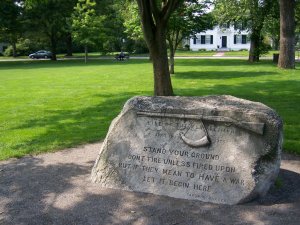
As events in Massachusetts spiraled into open confrontation between the Whigs (Patriots) and the Crown, every town in Massachusetts ramped up their military training of their militia and created “Minuteman” companies. These units became a source of local pride. Along with the militia forces, towns and counties created a complex network of communication via riders that could notify hundreds if not thousands of militia units of possible threats. As Gage began to use his growing military force in Boston to search for colonial military stores, these riders and “Minutemen” showed their effectiveness.
On the morning of April 19, 1775 riders rode out to a very well prepared countryside west of Boston. Paul Revere, William Dawes and many others connected each town with the news that the British regulars were marching on Concord to capture provincial military stores (and possibly capture colonial leaders). Militia and “Minutemen” by the hundreds began to arrive along the road from Cambridge to Concord.
The first Americans the British confronted on the road to Concord were members of Captain Parker’s Lexington Militia. These men, gathered the night before at Buckman’s Tavern in Lexington after an early warning, were still in the area in the early morning of April 19th as the vanguard of the British column neared Lexington. As they formed up in two lines on the Lexington Green, the British quickly came onto the Green to confront the armed colonials. What happened next set off a shockwave not just through Massachusetts, but the entire British colonies in North America. These first shots were fired by militia, not the famed “Minutemen.”
It is here in Lexington that the confusion and myth of the “Minutemen” was born. Several of the monuments around the Lexington Green are dedicated to the “Lexington Minutemen.” But the men on the green were typical militia; they ranged in age and skill levels. They were not highly trained like a “Minutemen” company.
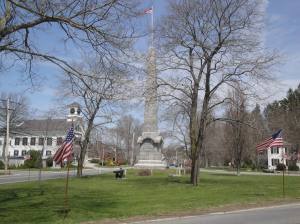
As the British made their way to Concord, Militia and “Minuteman” companies began to answer the well-traveled call that the British were marching on to Concord. After the skirmish at the North Bridge in Concord, more and more colonials answered the call and began to confront the British column as it made its way back to Charlestown. Thousands of militia and “Minutemen” made their way to the towns of Lexington, Menotomy, and Cambridge to confront the British. Because of the great response of these men, there was no turning back after April 19th.
The importance of the “Minutemen” cannot be exaggerated but neither can the importance of the militia. They were two distinct colonial military forces, both created with their own specific uses. In modern times, most wanted to attach their local story to that of the famed “Minutemen.” Though it is most likely that more militia turned out on April 19th than “Minutemen.”
Many monuments in Lexington, Concord and along Battle Road mention the “Minutemen” of 1775. Also, many of the sites associated with the events of April 19th are preserved by Minute Man National Park. I guess “Militia National Park” didn’t have as good of a ring to it.
Recommended Reading:
The Minute Men: The First Fight: Myths and Realities of the American Revolution by John Galvin
Emerging Revolutionary War welcomes back historian Bert Dunkerly. The accounts below come from Mr. Dunkerly’s book on the battle.

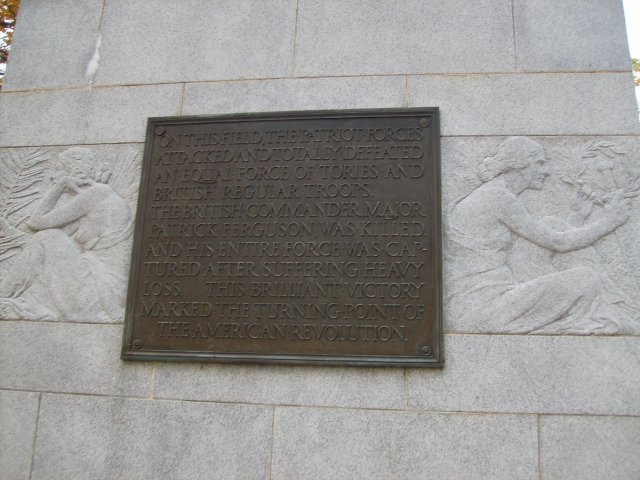
The battle of Kings Mountain was an intense, one-hour battle fought just below the North Carolina-South Carolina border. The October 1780 engagement pitted about 900 American militia from five states (Virginia, the two Carolinas, Georgia, and modern-day Tennessee) against 1,100 Loyalists under Maj. Patrick Ferguson. With Ferguson’s wounding late in the action, command fell to his subordinate, Captain Abraham DePeyster. As the Americans closed in, the Loyalists surrendered.
Eyewitness accounts provide details of the battle, especially its lesser known aspects like the conclusion of the battle and subsequent Loyalist surrender. Here are a few detailed accounts, presented with original spelling and grammar.
Virginia militiaman Leonard Hice had quite an experience in the battle, being wounded four times. He would spend two years recovering:
“I was commanded by Captain James Dysart where I was dreadfully wounded, I received two bullets in my left arm and it was broken. We were fighting in the woods and with the assistance of my commander who would push my bullets down, I shot 3 rounds before I was shot down. I then received a bullet through my left leg. The fourth bullet I received in my right knee which shattered the bone by my right thigh and brought me to the ground. When on the ground I received a bullet in my breast and was bourne off the ground to a doctor.”
Andrew Cresswell was a militiaman from Virginia who found himself too far in front during the final phase of the battle. He also was fortunate to witness the surrender and provided one of the only accounts of Captain Abraham DePeyster surrendering to Colonel William Campbell. His account also speaks to the brutal nature of the fighting between Loyalist and Whig.
“I saw the smoke of their guns and as I saw but one man further round than myself I spoke to him and told him we had better take care least we might make a mistake. I retreated about ten paces where I discharged my gun. About that moment they began to run. I waited for nobody. I ran without a halt till I came to the center of their encampment at which moment the flag was raised for quarters. I saw Capt. DePeyster start from amongst his dirty crew on my right seeing him coming a direct course towards me. I looked round to my left I saw Col. Campbell of Virginia on my left DePeyster came forward with his swoard hilt foremost. Campbell accosted him in these words “I am happy to see you Sir. DePeyster, in answer swore by his maker he was not happy to see him under the present circumstances at the same time delivered up his sword – Campbell received the sword, turned it round in his hand and handed it back telling him to return to his post which he received. Rejoining these words, God eternally damn the Tories to Hell’s Flames and so the scene ended as to the surrender.”
Lt Anthony Alliare was a New York Loyalist in Ferguson’s command. He recounts the experience of the New York detachment, which launched a series of unsuccessful bayonet charges early in the battle. His reference to the “North Carolina regiment” refers to local Loyalist troops fighting alongside his men.
“The action continued an hour and five minutes, but their numbers enabled them to surround us. The North Carolina regiment seeing this, and numbers being out of ammunition, gave way, which naturally threw the rest of the militia into confusion. Our poor little detachment, which consisted of only seventy men when we marched to the field of action, were all killed and wounded by twenty, and those brave fellows were soon crowded as close as possible by the militia.’
Ensign Robert Campbell of Virginia also witnessed the close of the battle, and recounts a white flag being raised.
“It was about this time that Colonel Campbell advanced in front of his men, and climbed over a steep rock close by the enemy’s lines to get a view of their situation and saw they were retreating from behind the rocks that were near to him. As soon as Captain Dupoister observed that Colonel Ferguson was killed, he raised flag and called for quarters. It was soon taken out of his hand by one of the officers on horseback, and raised so high that it could be seen by our line, and the firing immediately ceased. The Loyalists, at the time of their surrender, were driven into a crowd, and being closely surrounded, they could not have made any further resistance.”
Isaac Shelby, from the Carolina frontier (modern Tennessee) was a militia commander in the battle. He also provides insights in the battle’s final moments.
“They were ordered to throw down their arms; which they did, and surrendered themselves prisoners at discretion. It was some time before a complete cessation of the firing, on our part, could be effected. Our men, who had been scattered in the battle, were continually coming up, and continued to fire, without comprehending in the heat of the moment, what had happened; and some, who had heard that at Buford’s defeat the British had refused quarters to many who asked it, were willing to follow that bad example. Owing to these causes, the ignorance of some, and the disposition of other to retaliate, it required some time, and some exertion on the art of the offices, to put an entire stop to the firing. After the surrender of the enemy, our men gave spontaneously three loud and long shouts.”
In one hour, the entire Loyalist force of 1,100 was killed, wounded, or captured. October 7 marks the anniversary of this battle which, in the words of Thomas Jefferson, was the “turn of the tide of success.”
Robert M. Dunkerly (Bert) is a historian, award-winning author, and speaker who is actively involved in historic preservation and research. He holds a degree in History from St. Vincent College and a Masters in Historic Preservation from Middle Tennessee State University. He has worked at nine historic sites, written eleven books and over twenty articles. His research includes archaeology, colonial life, military history, and historic commemoration. Dunkerly is currently a Park Ranger at Richmond National Battlefield Park. He has visited over 400 battlefields and over 700 historic sites worldwide. When not reading or writing, he enjoys hiking, camping, and photography.
 Emerging Revolutionary War Era
