The Bloody Battle Road: Battle of Menotomy

ERW Welcomes Matt Beres, Executive Director of the Arlington Historical Society

On the morning of April 19, 1775, the first shot of America’s War for Independence was fired on the Lexington Green. Later that morning, Major John Buttrick, commanding the local Provincial forces, gave the order to fire on the British Regulars at the North Bridge. This act would later be remembered as the “Shot Heard ‘Round the World,” a phrase immortalized by Ralph Waldo Emerson.

As Lt. Col. Smith’s British Regulars began their retreat back to Boston, Governor Thomas Gage sent a relief column of Regulars, led by General Hugh Percy. Meanwhile, Provincial militias and minute companies from surrounding towns marched toward the conflict, firing on both sides of the main road leading back to Boston. The Battle was just beginning.

While Lexington is famous as the site of the “first shot” and Concord for the “Shot Heard ‘Round the World,” Menotomy (present-day Arlington) is known as the site of the largest battle of the day, where fierce fighting erupted between the retreating British forces and the growing Provincial forces. The following stories are from this Battle.

David Lamson

Earlier that day, a convoy of provisions and supplies, protected by a detachment of British Regulars, arrived behind the main force heading toward Lexington and faced difficulties crossing the Brighton Bridge. Before their arrival, the Committee of Safety had removed the planks, and the combination of heavy wagons and repairs to the bridge caused the convoy to become separated from the main force, rendering it vulnerable.

An alarm rider from Cambridge alerted locals, prompting men from the ‘exempt’ or ‘alarm’ list—those unfit for regular Militia or Minute companies—to gather at Cooper’s Tavern to plan to capture the convoy. Among them was David Lamson, a biracial French and Indian War veteran, whose experience and bravery made him a natural leader. The group quickly appointed him as their Commanding Officer.

According to a story derived from Lamson himself, they positioned themselves behind a stone wall near the First Parish Meeting House. As the convoy approached, they ordered it to surrender. When the drivers urged their horses forward, Lamson’s men fired, killing the driver and several horses, and wounding two Regulars. In panic, the remaining six Regulars fled toward Spy Pond, and discarded their weapons.

It is said they then surrendered to an old woman, Mother Bathericke, who was in the field picking flowers. The old woman forced them to the house of Ephraim Frost, Captain of the Menotomy Militia, and stated, “… you tell King George that an old woman took six of his grenadiers prisoners.”

Samuel Whittemore
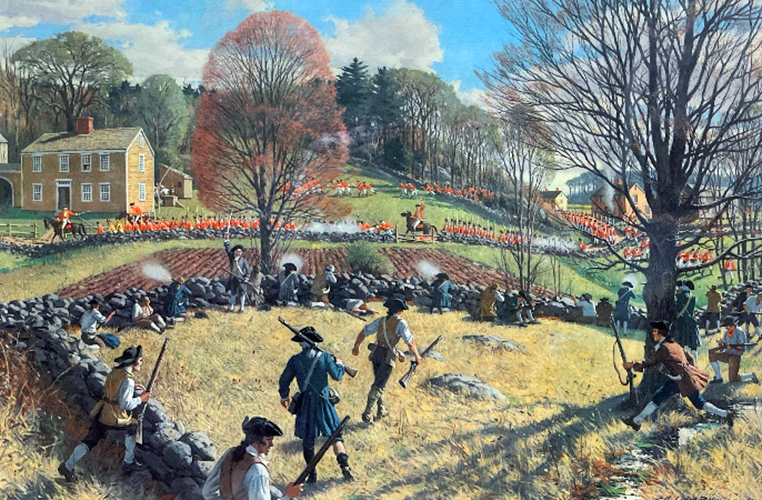
Aiden Lassell Ripley (1896-1969), Retreat from Lexington at the Foot of the Rocks. A.2.509. Arlington Historical Society Collections

Around 4:00 pm, the retreating British Regulars arrived at the village Menotomy. It was here where Samuel Whittemore, the oldest known combatant of the Revolutionary War, earned his fame. During the conflict, Whittemore took cover behind a stone wall. He reportedly fired at five soldiers but was soon overwhelmed. He suffered a gunshot wound to the cheek and a bayonet stab wound. When the Regulars continued their retreat, the locals carried him to Cooper’s Tavern, where Dr. Tufts of Medford treated his injuries.

Remarkably, Whittemore survived for another 18 years after suffering these life-threatening wounds. He lived long enough to see the birth of a new and independent nation.

Jason Russell

Later during their retreat, Gen. Percy ordered his men to enter the residences along Concord Road (now Massachusetts Avenue) to eliminate the Provincials who were firing from inside these houses. One notable example was the site of Jason Russell House.
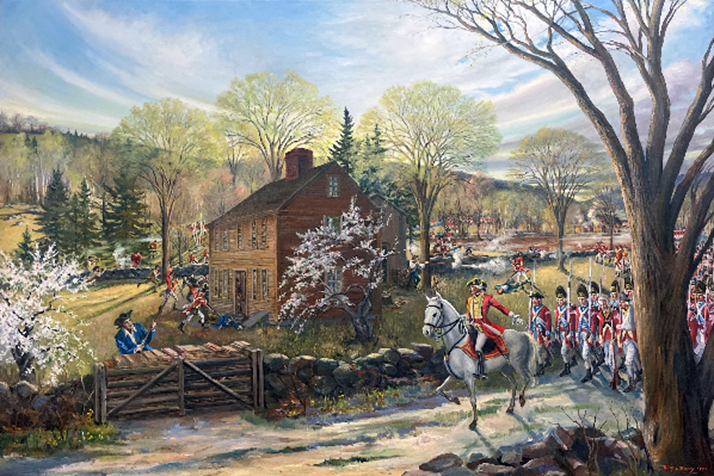
Ruth L. Berry, 1975. Jason Russell House in Battle With British Soldiers 1990.19.1. Arlington Historical Society Collections

Jason Russell was a middle-aged farmer who reportedly had a leg disability. He barricaded his property and refused to leave, asserting, “An Englishman’s house is his castle.”

As British Regulars surrounded his home, several Provincials from different towns sought refuge inside. Tragically, Jason Russell and several others lost their lives on his property.

Today, the c. 1740 house, still bearing musket ball holes in the remaining structure from the fight, is at the heart of the Arlington Historical Society’s regional history museum, offering guided tours and engaging exhibits that highlight the lasting impacts of the American Revolution and Arlington’s broader history.

Explore more at: https://arlingtonhistorical.org/

Matt Beres

Executive Director

Arlington Historical Society
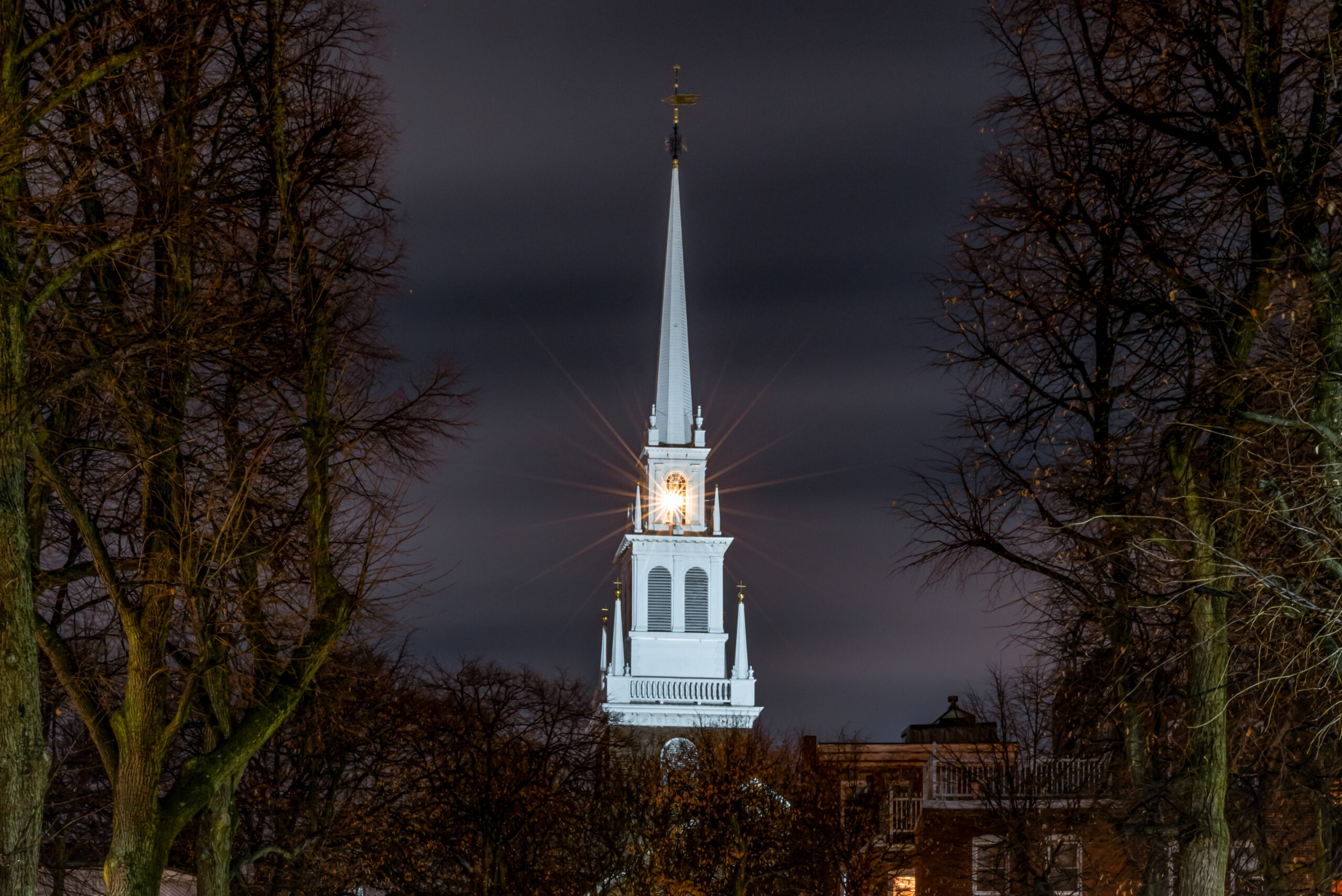
Rev War Revelry: Old North Church; Paul Revere and Two Lanterns

“He said to his friend, “If the British march
By land or sea from the town to-night,
Hang a lantern aloft in the belfry arch
Of the North Church tower as a signal light,–
One, if by land, and two, if by sea;”

These famous words from Henry Wadsworth Longfellow’s poem about Paul Revere’s ride recount the important role the Old North Church played in the events leading up to the first shots of the Revolutionary War. Join us just a few weeks before the 250th anniversary as we sit down with Emily Spence, Director of Education at Old North Church in Boston. We’ll discuss the history of the church, what occurred on April 18, 1775 and what happened during the war. We’ll also discuss the exciting events the Old North Church will be doing on the 250th anniversary. This will be a pre-recorded video and you will be able to watch it when we post it at 7 p.m. on our Facebook page.

Captain John Brown and Ensign Henry De Berniere’s March 20, 1775 Excursion to Concord

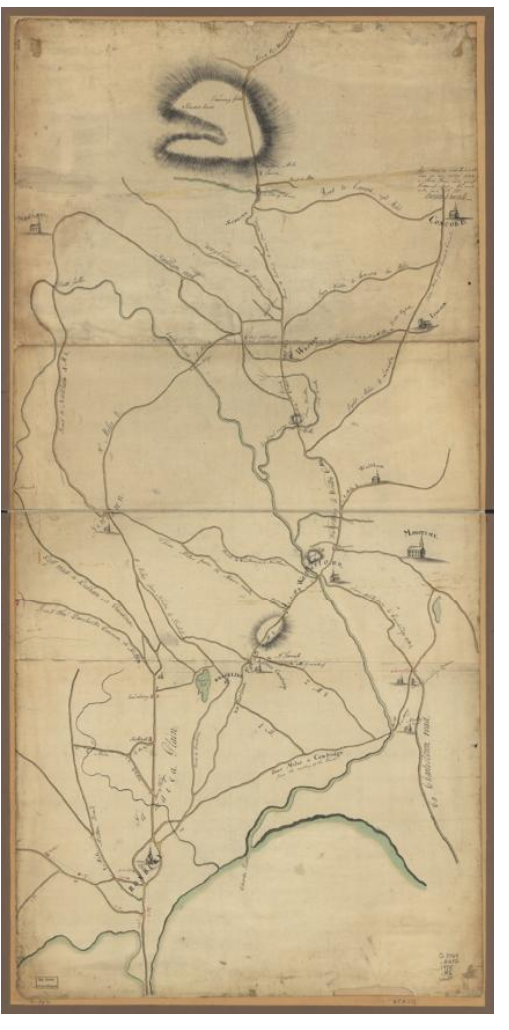
The spy network of Dr. Joseph Warren and the Sons of Liberty is well documented and written about. Few things happened in and around Boston that Warren, Paul Revere or Sam Adams were not aware of. In the winter of 1775, British General Thomas Gage also established a spy network (one of the more famous British spies was supposed “Patriot” Dr. Benjamin Church was not revealed as spy until October 1775). Gage was using all the resources at his disposal to figure out what the Whigs were doing and to find out where weapons (and four cannon that were stolen from the British in Boston) were located.  On February 22nd, Gage sent out two officers, Captain John Brown and Ensign Henry De Berniere, to covertly ride out towards Worcester to locate stores and to map the road network for a possible British excursion. A few weeks later, on March 20th Gage sent out Brown and De Berniere again to map out routes towards Concord. Keeping in mind of potential geographic features that could endanger the future British column.

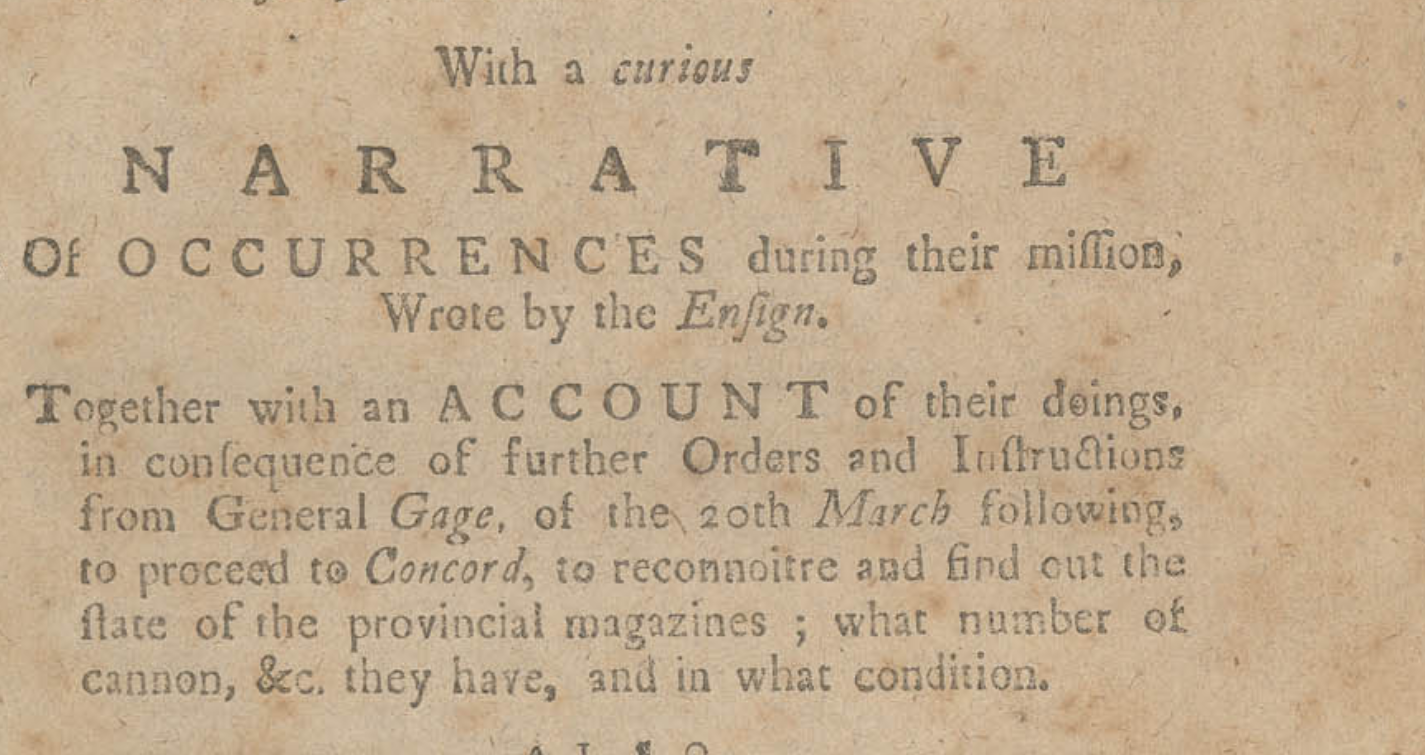
The following is an account of the March 20th mission by Ensign De Berniere. This account was found in Boston after the British evacuated and published by Boston printer J. Gill in 1779. Today it is located in the Massachusetts Historical Society. This mission was the precursor for the April 18-19th British raid to Concord that ignited the war.

Map, Roxbury to Concord. Roads & distances; by Brown and De Berniere, Library of Congress

Account of the proceedings of the aforesaid officers, in
consequence of further orders and instructions from
General 
Gage, of the 20th March following ; with
occurrences during their mission.

Scan of the original print by J. GILL, in Court Street.
1779, Massachusetts Historical Society

THE twentieth of March Captain Brown and
myself received orders to set out for Concord,
and examine the road and situation of the
town ; and also to get what information we
could relative to what quantity of artillery and provi-
sions. We went through Roxbury and Brookline, and
came into the main road between the thirteen and four-
teen mile-stones in the township of Weston ; we went
through part of the pass at the eleven mile-stone, took
the Concord road, which is seven miles from the main
road. We arrived there without any kind of insult
being offered us, the road is high to the right and low
to the left, woody in most places, and very close and
commanded by hills frequently. The town of Concord
lies between hills that command it entirely ; there is
a river runs through it, with two bridges over it, in
summer it is pretty dry ; the town is large and co-
vers a great tract of ground, but the houses are not
close together but generally in little groups. We were
informed that they had fourteen pieces of cannon (ten

iron and four brass) and two cohorns, they were mounted but in so bad a manner that they could not elevate them more than they were, that is, they were fixed to one
elevation ; their iron cannon they kept in a house in town, their brass they had concealed in some place behind the town, in a wood. They had also a store of flour, fish, salt and rice ; and a magazine of powder and cartridges. They fired their morning gun, and mounted a guard of ten men at night. We dined at the house of a Mr. Bliss, a friend to government ; they had sent him word they would not let him go out of town alive that morning ; however, we told him if he would come with us we would take care of him, as we were three and all well armed, — he consented and told us he could shew us another road, called the Lexington road. We set out and crossed the bridge in the town, and of consequence left the town on the contrary side of the river to what we entered it. The road continued very open and good for six miles, the next five a little inclosed, (there is one very bad place in this five miles) the road good to Lexington. You then come to Menotomy, the road still good ; a pond or lake at Menotomy. You then leave Cambridge on your right, and fall into the main road a little below Cambridge, and so to Charlestown ; the road is very good almost all the way.

In the town of Concord, a woman directed us to Mr. Bliss‘s house ; a little after she came in crying, and
told us they swore if she did not leave the town, they would tar and feather her for directing Tories in their road.

[Left in town by a British Officer previous to the evacua tion of it by the enemy, and now printed for the
information and amusement of the curious.]

BOSTON
Printed, and to be sold, by J. GILL, in Court Street.
1779.

Massachusetts Historical Society

Rev War Revelry: The Battle of Menotomy and the Jason Russell House, April 19, 1775

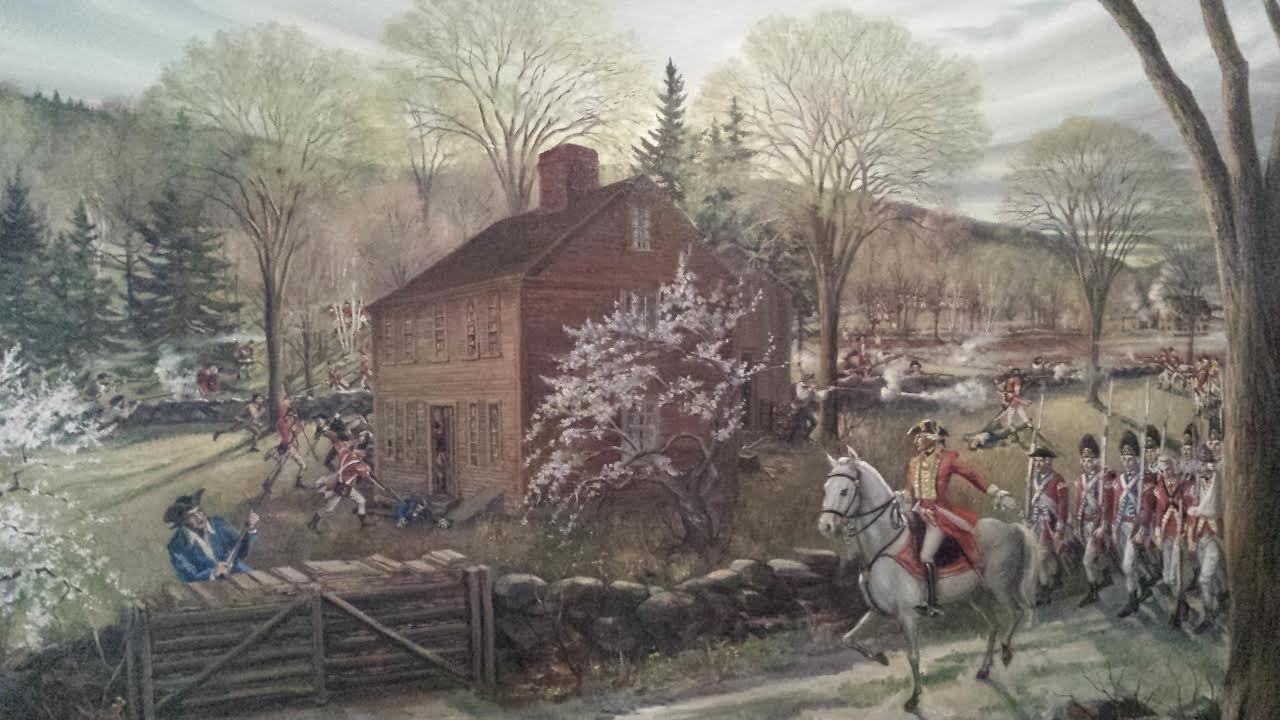
The Fight at the Jason Russell House, bicentennial painting by Ruth Linnell Berry (1974). Appearing with permission from the Arlington Historical Society.

Though the American Revolution started on the green at Lexington and North Bridge in Concord, the bloodiest part of April 19, 1775 took place in the community of Menotomy (modern day Arlington). Join us as we welcome Matt Beres from the Arlington Historical Society. We will discuss the viciousness of the fighting on the afternoon of April 19th along the road back to Boston, including stories like the Jason Russell House, Cooper Tavern and more. Join us as we talk about the much overlooked part of April 19th, 1775 as we move towards the 250th anniversary. This episode is pre-recorded and will be posted on Sunday, November 24th at 7pm on our You Tube and Facebook pages.

Rev War Revelry: The Road To Lexington with Alex Cain

This Sunday, August 3rd at 7pm we welcome back to Rev War Revelry historian and author Alex Cain. Alex is a well known expert on everything Lexington, MA (among many other topics) and hosts a well researched blog: https://www.historicalnerdery.com/ . Alex’s book, We Stood Our Ground: Lexington in the First Year of the American Revolution is highly recommended by ERW for a detailed account of Lexington and its role in the beginning of the American Revolution.

The events of Boston leading up 1775 are well documented, but it was in the countryside around Boston where the populace became militarized. Towns such as Lexington was just as influential in the push to revolution as Boston. Join us as we discuss the role of Lexington, Massachusetts before it was made famous in April 1775.

Be sure to visit our Facebook page or You Tube Channel this Sunday at 7pm as we release this prerecorded Rev War Revelry. Alex will also be joining us this October for our ERW Bus Tour of Lexington and Concord, there a few tickets left so be sure to register to experience Lexington with Alex!

2024 ERW Bus Tour Announcement – Lexington and Concord!

We are excited to announce our 2024 (fourth annual!) bus tour location will be Lexington and Concord on October 11-13, 2024. Join historians Phillip Greenwalt, Rob Orrison and Alex Cain as we tour the sites associated with the beginning of the American Revolution on April 19, 1775. The tour will cover events in Lexington, Concord and sites along the “Battle Road.” Tickets are $250 per person and includes a Friday night lecture, all day tour on Saturday and half day tour on Sunday (bus tour transportation and Saturday lunch included in cost).

Lodging is not included in the ticket fee. Our host hotel is the Courtyard Marriott – Waltham, a room block is set aside for $239 a night. For reservations contact 781-419-0900 or visit https://www.marriott.com/events/start.mi?id=1699298201894&key=GRP

Join us for our FOURTH annual tour as we take on the beginning of the American Revolution just a few months before the 250th anniversary. Learn about the dramatic events that led to the first shots for the Revolution and the bloody aftermath. We will visit Lexington Green, Buckman’s Tavern, North Bridge in Concord, Battle Road including Merriam’s Corner, Parker’s Revenge and the Jason Russell House. There is no better way to experience history than to stand in the footsteps of where it happened!

To register, visit: https://www.eventbrite.com/e/760200178197?aff=oddtdtcreator

For more questions, please email emergingrevolutionarywar@gmail.com.

Rev War Revelry: Old South Meeting House and the Boston Tea Party

Join us this Sunday, October 15th at 7pm as we welcome Matthew Wilding, Director of Education and Interpretation at Revolutionary Spaces. Revolutionary Spaces manages the Old South Meeting House and the Old State House in historic Boston. We will discuss the history of the Old South Meeting House and its important role in the revolutionary movement in Boston (especially during the Boston Tea Party). We will also cover their plans for the 250th anniversary of the Boston Tea Party, including their new exhibit on the destruction of property in public protests.

Grab a drink and follow along as we start to gear up for the 250th anniversary of the Boston Tea Party with Emerging Revolutionary War!

“Acts of a Rude Rabble…” General Gage, Lord Dartmouth and Ignorant Orders

Thomas_Gage_John_Singleton_Copley
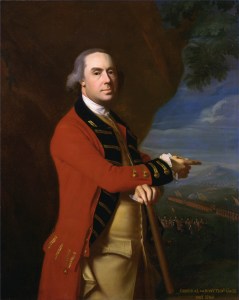
General Thomas Gage

When one studies British General Thomas Gage and his performance leading up to Lexington and Concord you must step back and put yourself in Gage’s position. A man that believed not only in Royal authority over the American colonies, but also in the basic rules of law. Gage was not anti-American by any means.


In November 1763, Gage was placed in overall command of British forces in the American colonies and settles in New York. At this time Gage was well respected by most American colonists. Of course, this all changed in 1774 when Gage was sent north to Boston to become the Royal-appointed Governor of Massachusetts and enforce the highly unpopular Port Bill that closed the port of Boston among other harsh actions. He was walking into a situation that most historians today argue was a no-win situation. Continue reading ““Acts of a Rude Rabble…” General Gage, Lord Dartmouth and Ignorant Orders”

Emerging Revolutionary War Weekender: The Boston Tea Party Ships & Museum

Emerging Revolutionary War welcomes guest historian Paige Gibbons Backus to the blog. This Weekend marks the 244th anniversary of the Boston Tea Party.

boston-museum-about-museum-experience

Boston Tea Party Ships and Museum

306 Congress St., Boston, MA 02210

http://www.bostonteapartyship.com

We all know the holidays are some of the heaviest travelled times of the year and over my Thanksgiving holiday, I had the opportunity visit Boston for a day. When in the city for only one day, what do we go and see? Do you go to the U.S.S. Constitution, Bunker Hill, Faneuil Hall, or the Paul Revere House? Do you go to the colonial meetinghouses, the historic cemeteries, or just walk around the historic sections of the city? One of the sites that I decided to visit was the Boston Tea Party Ships & Museum. I heard many good things about it from online reviews and professional colleagues about the interactive exhibits and experiences available there. Working at an immersive historic site myself, I was definitely curious to see what they had done to make their history exciting to audiences, and despite the museum’s shortcomings, make it interesting they did.

One of the highlights of the Boston Tea Party Ships is that they did a decent job creating an interactive experience for visitors. After purchasing tickets outside, visitors receive an identity card and a feather, and are then invited into a room meant to replicate the South Meetinghouse. From there, first-person actors serving as tour guides take visitors through the planning, implementation, and effects of the Boston Tea Party. For example, Sam Adams rallied the crowd weaving in the events leading to the Boston Tea Party, even teaching visitors how to show approval or displeasure in a public setting, (to which I was hissing before it was cool). He even called on visitors with various identity cards to voice their opinion, bringing in interesting, albeit reluctant, audience participation. After the visitors were riled up, we donned our feathers in our hair and were lead onto the ships to commence tossing the tea. Continue reading “Emerging Revolutionary War Weekender: The Boston Tea Party Ships & Museum”

Remembering Patriots Day

Leading up to the anniversary of April 19, 1775, we will be sharing some short remembrances from a few people who are from Lexington and Concord. Our first installment is by Alex Merenyi. Alex grew up in Lexington and moved to the Washington, DC area to attend college. He shares with us how he looks back on Patriots Day..

Patriots’ Day was always weird for me growing up.

Lexington’s Tourist Season would begin with a bang on Patriots Day – one specific bang, at 5:36-ish in the morning a Monday  – and carry through until the snow would scare the tour busses back home for the winter. (Ironically, it meant that the foot and a half of standing snow made getting around a lot easier.) It wasn’t until I moved to DC that I realized nobody else knew what Patriots Day was.

What it was for us, in addition to being of the part of the year where tour busses blocked off the best way to Starbucks, was two discrete parts; the historical, which was the reenactment of the Battle of Lexington; and the festival, which was that the center was shut down for a carnival-like opening of the tourist season. (There was also a 5k, which I remember my Father running once. It always seemed odd that they’d run a race that day through the heart of town, but so it went.)

You couldn’t live in Lexington and not know about The Reenactment. Every year, on the third Monday in April, a bunch of Americans would stand up to the Regulars and be cut down in a single volley of fire. I went once, when I was young enough to ride on my Father’s shoulders, and watched my dentist and his friends get shot on the Battle Green. Two minutes later we began walking home, wanting to beat the crowds that had gathered there. A second volley of fire went off, and I remember asking my Dad if that meant the British had shot the wives that ran out to their fallen husbands. (He explained they fired to clear their rifles. I was maybe seven – by this point, ‘The British Were Evil” was pretty engrained; I remained suspicious.) All told, it took us longer to walk to and from the event than watch it. Even as a kid, I had to ask myself what all the fuss was about – a fifteen minute re-enactment of, let’s call it what it is – the first American defeat – seemed rather odd.

I mention my dentist not just as an anecdote, but to illustrate how deeply The Reenactment went – the men and women who would come together at the pre-dawn hours in April and fall over, year after year, were celebrities in Lexington. It was all over my dentist’s office, photos of him marching in the 4th of July parades, scenes of him at the then-standing Foxboro Stadium firing a musket for the other Patriots’ having scored. (Back in the pre-Brady days, those were fewer and further between). Schools would give extra credit for interviewing reenactors, and of course, every student had the requisite “Go to the re-enactment and write a paper on how important it is.” As a child growing up in Lexington, it had an aura effect that made all of the rest of American History seem rather… well, underwhelming – nobody was making a huge fuss about re-enacting the signing of the Constitution. (Adding to that of course was that my Mother is quite British; her answer to my asking about how the Battle of Lexington was covered for her in school? “It wasn’t.”) Until I left Lexington, I never really appreciated why all the fuss was made about The Reenactment, or why these few people were given such a disproportionate amount of attention; It was more than just “this is a thing that we do once a year”, it was a recognition of something that nobody ever dared point out:

“If it weren’t for these guys, Lexington wouldn’t be on the map.”