Emerging Revolutionary War thanks historian Christian Di Spignafor the picture.
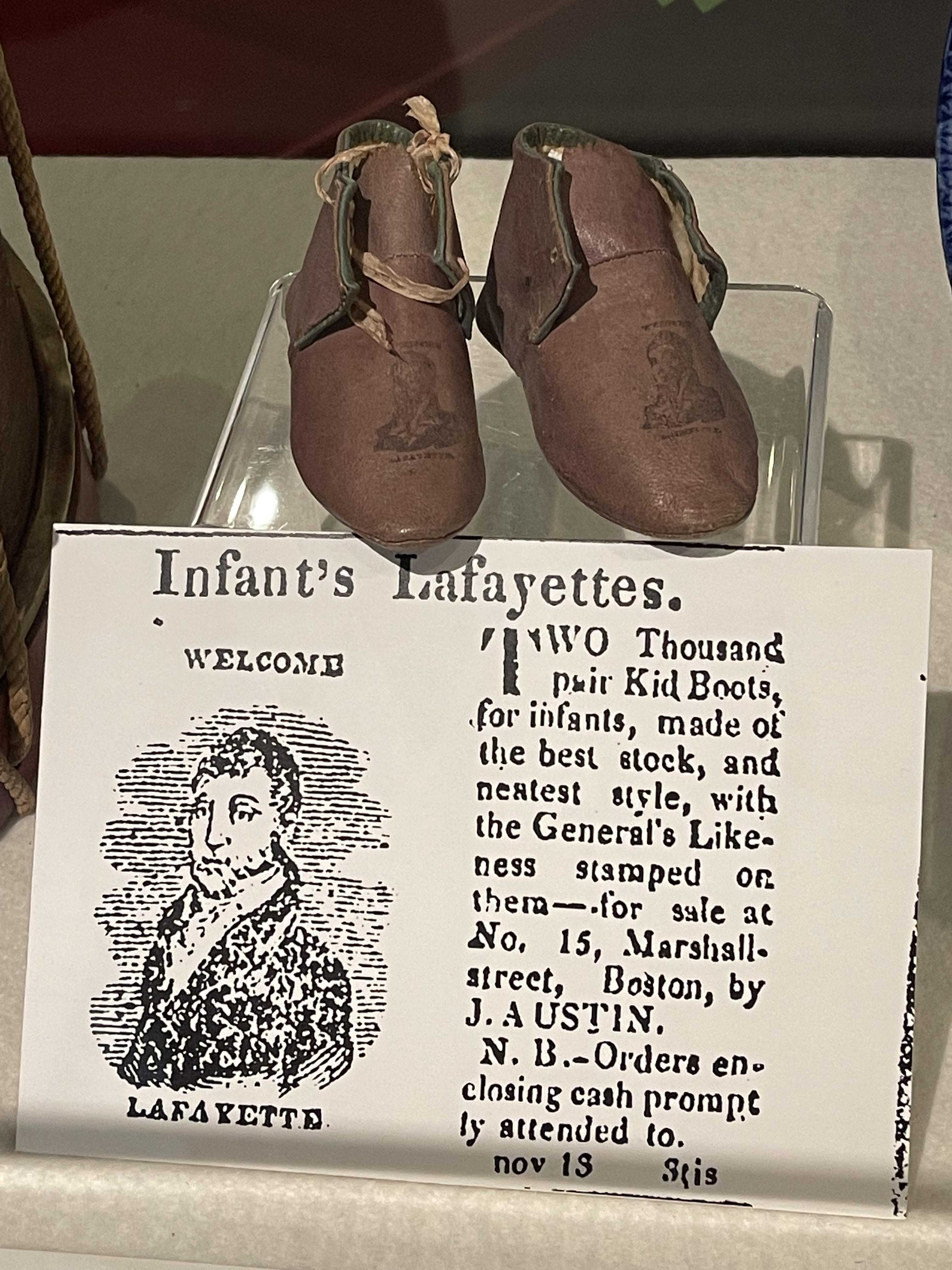
With the release of the motion picture, Air, about the recruitment to Nike of Michael Jordan in the 1980s, Emerging Revolutionary War wanted to bring our readers attention to an older model of a shoe. That predates Nike by a century and a half. But, who knows, could come into vogue again right?
The Marquis de Lafayette returned to the United States in August 1824 to September 1825 and toured all 24 states at the time. Feted as a living link to the American Revolution and the independence movement, he was dined, celebrated, and asked to speak at many, many events. Commemorative items were created in his image and likeness, including, apparently a pair of shoes.
These shoes can be viewed today at Old Sturbridge Village in Massachusetts. A link to their website and to plan a visit can be found here.
Emerging Revolutionary War welcomes guest historian Werther Young.
I’m Too Sexy for My…Bavarian Fly
By Werther Young
Of all of the unique things that have managed to make it to the internet, a concise history of colonial men’s pants flies is surprisingly not one of them.
Our story begins in the Renaissance in, where else, France. King Henry III of France eschewed the old-fashioned dress and hose and embraced a new fashion, culottes, now known as “knee breeches.”
Henry III in his dress and hose
Henry III in his tony new culottes.
The fly of Henry’s pants was a simple affair, a rectangular panel sewn to the left side with buttonholes that buttoned over the right. This simple and practical design became known as the “French fly” and became almost universal in Western Europe over the next 60 years.
Ann Bonny the pirate, in French fly trousers, ca. 1721.
Over time, Ann Bonny’s “long” French fly was perfected into the “short” French fly. Anne’s fly extends from the inseam to the waistband. By merely sewing a few inches of the front seam together, the fly can be made shorter, removing a buttonhole and button or two.
These fly designs apparently did not reach into Eastern Europe, where presumably leather pants were as expensive as wool ones but lasted much longer, because they were never washed. Translating the French Fly into leather posed some problems, and so these leather pants had a different fly, essentially a hole in the center front with a panel buttoned over it that flipped or dropped up and down as necessary. This design caught on in the Alpine areas of central Europe, and especially in Bavaria under the label of “Lederhosen,” which is German for “leather pants.”
“Short” French Fly Breeches, ca. 1750.
The Bavarian fly migrated further north, as in the Deutsches Museum in Berlin can be found a pair of enlisted trousers from the mid-1700s, with a half drop front fly; that is, it opens only the right side. This is essentially a cheaper fly, because it needs only one button to close, and does the same thing.
By the middle 1700s, the French fly had been around for over 150 years, and someone in France started a different fashion (and outdoing the Huns) by putting the two -opening Bavarian fly on culottes, thus making the culottes “a la Bavarois,” French for “like the Bavarians.” This was runway level high fashion for the time, and quickly spread among the well to do as the latest thing, with a new name, the “drop front” or “fall front” fly. Unfortunately, translating the design from leather, which does not unravel, to fabric, which does, made the Bavarian fly extremely complicated and therefore expensive. This of course added to its cachet, so much so that by 1775, it had reached the aristocracy even in the backwater of Colonial America.
Lederhosen
Colonial Williamsburg has a fabulous collection of high-status men’s pants from the 18th century. A survey thereof shows the number of French flies waning into the 1770s, and the number of Bavarian drop front flies waxing beginning in 1775, reaching a height about 1800. Unfortunately, these are all very high-status garments, such as a pair of “button front breeches of cream-colored silk velvet, with repeat of small pink and green flowers self-covered buttons, those at knee embroidered with metallic silver thread. Silver galloon strap at knee.” But did the states and Continent really issue enlisted soldiers what amounts to hand made Givenchy trousers? Of course not.
The false idea that they did partially comes from a series of paintings done by Charles M. Lefferts in the early 1900s, later published as Uniforms of the Armies in the War of the American Revolution, 1775–1783. in 1926.
A Lefferts rendering of trousers a la Bavarois, 2d Maryland 1777.
Measuring this man’s height against the known length of his musket makes him about 6’4 inches tall, the height of actors Clint Walker, Chuck Connors, Clint Eastwood, and the average NBA basketball player. If you look below the point of his vest, he is wearing drop front pants over his massive thighs. Curiously, he is also wearing a 1760s style skirted vest and long regimental coat. Are we to believe that Maryland issued its men old fashioned vests and coats, but high fashion breeches? Since Lefferts was born in 1873, he had no first-hand knowledge of his subject, we must look to period images.
Alas, these are of little help. It is difficult to discern whether any of the men in period paintings are wearing French Fly pants, Bavarian drop front pants, or anything else. The most informative images, the von German drawings, are unfortunately from the side, and of no help.
Von German “American Soldier” New York Hist Soc.
Amerikanische Scharfschutz, Brown University
Since information is so scarce, we must turn to the other reason we believe that rev war soldiers wore drop front pants. Klinger’s Sketchbook ’76. Page 9 shows a pair of Bavarian drop front breeches, based on George Washington’s uniform in the Smithsonian, and Lt. Col. Tench Tilghman’s uniform from the Maryland Historical Society. This is odd, because Washington’s uniform is from the 1794, 15 years after the war and at the height of the drop front craze. Tilghman was the scion of a blue blood family, owned half of Baltimore, was an aide to Washington, and hobnobbed with Lafayette. Even if his uniform can be dated to the war years, it is not only a high-status uniform, but one of the highest status possible in America at the time; his not wearing Bavarian trousers would be of greater note. Neither are evidence that any of the 13 colonies nor the Continent paid to make their enlisted men such high fashion trousers.
On Sketchbook page11, Klinger bases his Bavarian drop front overalls on unspecified plates in “Bernard’s History of England” and the images above. While these may establish Bavarian drop front flies supplied by the King George, it certainly does not necessarily mean that the colonies were doing so.
Surprisingly, two pairs of enlisted overalls are known to exist, mistakenly labelled as “Pantaloons,” and residing in the Metropolitan Museum of Art’s Costume Department. These are exquisitely made, and probably military examples, but unfortunately European, and from 1793 and later.
No credible evidence exists that any of the 13 colonies nor the Continent issued its troops Bavarian drop front pants. This makes sense, as that design is difficult to make, does the exact same thing as the simple French fly, and fashionable pants do not really contribute much extra to Liberty. Additionally, with all but the highest status clothiers making French fly pants, retraining them to cut out and make the new design would seriously impede production, even assuming that patterns and training could be somehow provided from Georgia to Vermont at a time when the men could barely be supplied a musket or shirt. In the War of the Revolution, the colonists were by all indications wearing French fly breeches and overalls, not drop front ones a la Bavarois.
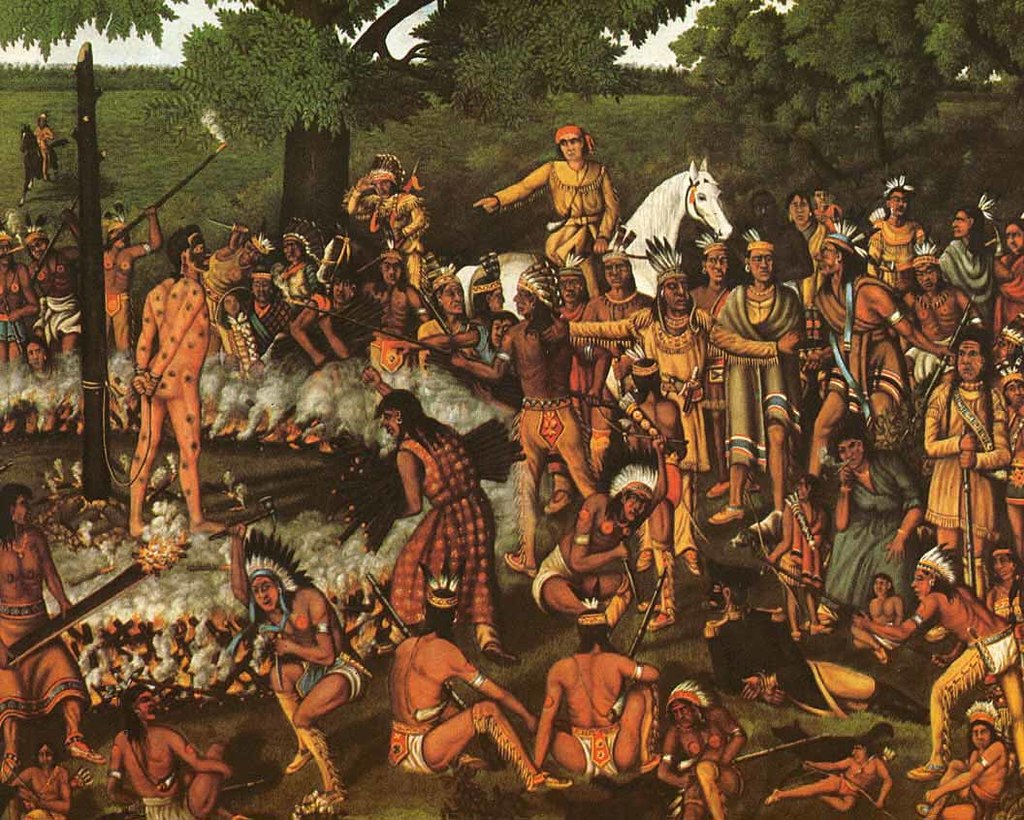
In May 1782, Colonel William Crawford led over 450 volunteers across Ohio to attack British-allied Native Americans who had been raiding the frontiers of Pennsylvania and Virginia for years. An experienced yet reluctant commander, Crawford and his men clashed with a similarly sized force of British Rangers and Wyandot, Delaware, and Shawnee Indians on the Sandusky River in early June. After three days, the Americans were routed in one of the worst defeats American arms suffered on the frontier during the American Revolution. During the retreat, Native American warriors captured dozens of men, including Colonel Crawford. Many were horrifically tortured to death in revenge for the Gnadenhutten massacre earlier that spring, when American volunteers bludgeoned nearly one hundred unarmed and unresisting Delaware Indians to death.
Join us on our Facebook page this Sunday at 7pm for a recorded talk with historian and author Eric Sterner as he discusses Crawford’s Campaign and his new book “The Battle of Upper Sandusky, 1782” due out this spring. The talk will be availble on our You Tube page next week.
My recent comments about Stacy Schiff’s The Revolutionary Samuel Adams got me thinking about some of John Adams’s thoughts about his second cousin. In particular, John shared a neat story about Sam’s secretiveness—a problem that has bedeviled biographers, including Schiff, because Sam didn’t leave behind a trove of documentary evidence the way other Founders did.
“I have seen him . . .” said John, “in Philadelphia, when he was about to leave Congress, cut up with his scissors whole bundles of letters, into atoms that could never be reunited, and throw them out at the window, to be scattered by the winds. This was in summer, when he had no fire. In winter he threw whole handfuls into the fire. As we were on terms of perfect intimacy, I have joked him, perhaps rudely, upon his anxious caution. His answer was, ‘Whatever becomes of me, my friends shall never suffer by my negligence.’”[1]
John admired Sam, 13 years his senior, a great deal. The two were hardly acquainted growing up, but as John started off his legal career in Boston, Sam—a great cultivator of talent—pegged him as someone to develop. As tensions in Boston grew between the Sons of Liberty, British officials, and far-off Parliament, Sam brought John into the inner circle because of John’s sharp legal mind. The decision paved John’s eventual path to national politics.
“Mr. Adams was an original,” John said of Sam, saying he was “born and tempered a wedge of steel. . . .”[2]
In his common appearance, he was a plain, simple, decent citizen, of middling stature, dress and manners. He had an exquisite ear for music, and a charming voice, when he pleased to exert it.—Yet his ordinary speeches in town meetings, in the house of representatives and in congress, exhibited nothing extraordinary; but upon great occasions, when his deeper feelings were excited, he erected himself, or rather nature seemed to erect him, without the smallest symptom of affectation, into an upright dignity of figure and gesture, and gave a harmony to his voice, which made a strong impression on spectators and auditors, the more lasting for the purity, correctness and nervous elegance of his style.[3]
John spoke on several occasions of Sam’s “an air of dignity and majesty.” He admired Sam’s “harmonious voice and decisive tone” and his “self-recollection, a self-possession, a self-command, a presence of mind that was admired by every man present. . . .”[4] He also listed “his caution, his discretion, his ingenuity, his sagacity, his self-command, his presence of mind, and his intrepidity” as traits that “commanded the admiration” of friend and foe alike—friends who applauded him and foes who could not help but respect Sam Adams’s considerable populist powers.[5]
It is little doubt why John later said, “Without the character of Samuel Adams, the true history of the American Revolution can never be written.”[6]
I’m currently reading Stacy Schiff’s new biography The Revolutionary Samuel Adams. It’s a snappy-to-read, deeply researched book—all the more challenging to write because Sam Adams made careful effort not to leave much of a paper trail about himself.
Schiff uses her introduction to sketch out this fundamental problem, and in doing so, she creates a compelling flash portrait of Adams that the rest of the book fleshes out. Adams the historiographical sphinx is well served by this portrait. Sam Adams simultaneously led from the front yet operated in the shadows, an apparent contradiction that Schiff nonetheless portrays fully and effectively.
As the book goes on, Schiff manages to pull from a deep well of primary sources, even if there’s not a mountain from Sam himself. She handles those sources adroitly and comfortably, plucking this bit from here and that bit from there the way a conductor works an orchestra.
The result is an admiring but not fawning portrait of Adams—a man without whom, said cousin John, “the true history of the American Revolution can never be written.”[1]
Troubling to me in the text is that, in the late 1760s and early 1770s, the Adams-led Sons of Liberty often employed mob violence—real and threatened—to achieve their aims. Propaganda efforts were often tethered to reality by only thinnest of meager threads, if at all. Men were intimidated, bullied, tarred and feathered, humiliated, assaulted, and run out of town for opposing or even just disagreeing with them. Houses were ransacked. Livelihoods destroyed. Reputations ruined. I could not help but think of the Klan in the Reconstruction-era South—a comparison no-doubt tantamount to sacrilege when talking about a group of Bostonians popularly and fondly remembered as patriots.
Yet Schiff merrily skates over such rough terrain, sharing vivid details about incidents without exploring the moral morass this tension suggests. Her hero acts in decidedly less-than-heroic ways, arguing that the ends justify the means. We as readers are left to ponder this ambiguity ourselves. Such work on the reader’s part isn’t a bad thing, but it does strike me as somewhat of an abdication on the biographer’s part when the rest of the narrative is so cheerfully pro-Adams.
Overall, The Revolutionary Samuel Adams is an excellent work so far, and I highly recommend it for anyone who wants a fuller understanding of how the wheels of Revolution started turning—and who started them.
John Adams woke on the morning of May 21, 1777, feeling light of heart. A spell of bad weather had finally broken, and the bright spring dawn cheered his spirits. He took a few minutes before beginning his day to pen a letter to his “Dearest Friend,” his wife, Abigail.[1]
“The Charms of the Morning at this Hour, are irresistible,” he told her. “The Streakes of Glory dawning in the East: the freshness and Purity in the Air, the bright blue of the sky, the sweet Warblings of a great Variety of Birds intermingling with the martial Clarions of an hundred Cocks now within my Hearing, all conspire to chear the Spirits.” Adams’s letters are filled with such descriptions, which are one of the many reasons they’re a delight to read. But then he got down to business.
As the Second Continental Congress’s de facto Secretary of War, he had spent the previous evening, May 21, at the War Department meeting with General Benedict Arnold. Arnold had been embroiled in controversy with several lower-level officers, one of whom claimed “Money is this man’s God, and to get enough of it he would sacrifice his country.” (The charge was untrue at the time but proved ironically prophetic.)
Adams told Abigail that he’d heard Arnold “fought like Julius Caesar” and came to believe Arnold’s side of the tale. “He has been basely slandered and libeled,” Adams concluded.
His political perch gave Adams a view of the Continental Army that might surprise us today. In his usual candor, he told Abigail:
“I am wearied to Death with the Wrangles between military officers, high and low. They Quarrell like Cats and Dogs. They worry one another like Mastiffs. Scrambling for Rank and Pay like Apes for Nutts.”
As he continued, he made an observation that touched close to home. Adams was notoriously vain—a vice he recognized and continually struggled with—so he was deeply familiar with the human tendency to compare oneself with one’s peers. Particularly early in his legal career, Adams measured himself against other young lawyers and pined for the chance to distinguish himself. It was, he said to Abigail, a “Passion for Superiority”:
“I believe there is no one Principle, which predominates in human Nature so much in every stage of Life, from the Cradle to the Grave, in Males and females, old and young, black and white, rich and poor, high and low, as this Passion for Superiority …. Every human Being compares itself in its own Imagination, with every other round about it, and will find some Superiority over every other real or imaginary, or it will die of Grief and Vexation[. . . .] I never saw it operate with such Keenness, Ferocity and Fury, as among military Officers. They will go terrible Lengths, in their Emulations, their Envy and Revenge, in Consequence of it.”
Adams had seen that sort of cattiness “among Boys and Girls at school, among Lads at Colledge, among Practicers at the Bar, among the Clergy in their Associations, among Clubbs of Friends, among the People in Town Meetings, among the Members of an House of Reps. [Representatives], among the Grave Councillors, on the more solemn Bench of justice, and in that awfully August Body the Congress, and on many of its Committees — and among Ladies every Where. . . . .” No where was it worse than among the “Mean Girls” of the army’s officer corps.
“So much for Philosophy,” Adams decided, and then inquired about his children and Abigail’s asparagus. Then he concluded with a note that resonates with all of us here at Emerging Revolutionary War:
“I would give Three Guineas for a Barrell of your Cyder — not one drop is to be had here for Gold. And wine is not to be had under Six or Eight Dollars a Gallon and that very bad. I would give a Guinea for a Barrell of your Beer. The small beer here is wretchedly bad. In short I can get nothing that I can drink, and I believe I shall be sick from this Cause alone. Rum at forty shillings a Gallon and bad Water, will never do, in this hot Climate in summer where Acid Liquors are necessary against Putrefaction.”
Cheers!
[1] All quotes from: Letter from John Adams to Abigail Adams, 22 May 1777 [electronic edition]. Adams Family Papers: An Electronic Archive. Massachusetts Historical Society. http://www.masshist.org/digitaladams/
Sitting down to write on September 9, 1786 from Mount Vernon, George Washington addresses his letter to Virginian, veteran of the late revolution, and plantation owner John Francis Mercer. Mercer’s family had strong ties to Virginia and the Washington family, John’s father was Washington’s attorney for many years during the eighteenth-century. Even though John had married, moved, and settled in Maryland, the two continued to correspond, although this most recent response by Washington took much longer usual. When Mercer’s letter arrived to Mount Vernon several weeks earlier, Washington was able to do little as he was fighting a “fever.” Now, he sat down to reply, and although there were many topics on his mind in which he wished to discuss with Mercer, Washington’s feelings toward slavery were first on his mind.
At the time Washington composed his thoughts to Mercer, particularly on his plan to never purchase another slave, Washington owned approximately 277 slaves. Yet, he expressed his desire to slavery abolished through the gradual abolition of slavery. Washington was a man of principle, displayed time and again during the war, and his aversion to the institution only grew as Washington the man grew as well. And, his was not alone. Many founders of era, including many from the upper South, looked for gradual solutions to ending the institution, despite the modern historical narrative. In the end, Washington ensured the emancipation of his slaves following his wife’s death in his will.
Gov. John F. Mercer, circa 1803.
Mount Vernon 9th. Sep 1786
Dear Sir,
Your favor of the 20th. ulto. did not reach me till about the first inst. – It found me in a fever, from which I am now but sufficiently recovered to attend to business. – I mention this to shew that I had it not in my power to give an answer to your propositions sooner. –
With respect to the first. I never mean (unless some particular circumstances should compel me to it) to possess another slave by purchase; it being among my first wishes to see some plan adopted by, [inserted: The Legislature by] which slavery in this Country may be abolished by slow, sure, & imperceptable degrees. – With respect to the 2d., I never did, nor never intend to purchase a military certificate; – I see no difference it makes with you (if it is one of the funds allotted for the discharge of my claim) who the the purchaser is [2] is. – If the depreciation is 3 for 1 only, you will have it in your power whilst you are at the receipt of Custom – Richmond – where it is said the great regulator of this business (Greaves) resides, to convert them into specie at that rate. – If the difference is more, there would be no propriety, if I inclined to deal in them at all, in my taking them at that exchange.
I shall rely on your promise of Two hundred pounds in five Weeks from the date of your letter. – It will enable me to pay the work men which have been employed abt. this house all the Spring & Summer, (some of whom are here still). – But there are two debts which press hard upon me. One of which, if there is no other resource, I must sell land or negroes to discharge. – It is owing to Govr. Clinton of New York, who was so obliging as to borrow, & become my security for £2500 to answer some calls of mine. – This sum was to be returned in twelve [3] twelve months from the conclusion of the Peace. – For the remains of it [struck: this sum], about Eight hundred pounds york Cy. I am now paying an interest of Seven prCt.; but the high interest (tho’ more than any estate can bear) I should not regard, if my credit was not at stake to comply with the conditions of the loan. – The other debt tho’ I know the person to whom it is due wants it, and I am equally anxious to pay it, might be put of a while longer. – This sum is larger than the other
Jack Jouett was Thomas Jefferson’s Paul Revere, most famous for riding pell mell through the night to warn Virginia’s governor in 1781 that Banastre Tarleton and his men were on their way to Charlottesville to capture the governor and Virginia’s General Assembly. Given Tarleton’s reputation for speed, surprise, and route, Jouett had to ride down back roads and country lanes with low hanging-trees, cattle paths, and foot paths to get ahead of the British officer with enough time to warn Virginia’s government-in-exile. https://emergingrevolutionarywar.org/2016/08/02/jack-jouett-midnight-rider-of-the-south/ Unlike Revere, whom the British famously captured, Jouett arrived in Charlottesville with enough time for Jefferson and most legislators to escape.
Jack Jouett House with earlier stone kitchen visible at the rear
It’s a great story and Jouett makes it into standard biographies of Jefferson, histories of the war in Virginia, or campaign studies of Cornwallis and Tarleton. But, Jouett’s story doesn’t end there. Like many veterans—Jouett served in the Virginia militia—he headed west, over the Appalachians, in search of land and new opportunities. The next year found Jouett in Kentucky County, Virginia. Despite the bloodletting that went on in Kentucky during the Revolution, families continued to flock there. Shortly after his arrival, he married, eventually fathering twelve children. Given Kentucky’s exploding growth, the Virginia legislature divided Kentucky County into Lincoln, Jefferson, and Mercer counties and the people of Lincoln county elected Jouett as their representative in the Virginia General Assembly. But, at heart, he remained a Virginia farmer, raising crops and livestock. Sadly, he continued the practice of slavery, eventually owning twenty-five people.
Historical Marker at Jack Jouett House in Versailles, Kentucky
In 1797, Jouett and his family bought a 530-acre farm in Woodford County and built one of Kentucky’s earliest brick homes, a step up from the log and stone buildings many settling the frontier built on their arrival. Reflecting the period, it adopted design features from Virginia with a central hall and parlor and bedrooms in a half-floor attic. The building included an earlier stone-walled kitchen built in the 1780s. Jouett eventually moved away to Bath County in 1809 and died in 1822. The house 1797 house, however, remains and was restored between 1972-1978 and opened for public tours in 1978. Many of the interior contents are from the period and a small museum telling Jouett’s story in Virginia and Kentucky is in a separate building nearby. It is not far from Lexington or some of Kentucky’s other Revolutionary War sites like Harrodsburg or Boonesborough. It can be visited at:
Jack Jouett House Historic Site 255 Craig’s Creek Road Versailles, Kentucky 40383 (859) 873-7902
It is best to visit the location’s website (http://jouetthouse.org) or call ahead for operating hours.
We are happy to welcome Norman Desmarais to our Third Annual Symposium on the American Revolution, co-hosted with Gadsby’s Tavern Museum, The Lyceum and Emerging Revolutionary War. This year’s theme is “The World Turned Upside: The American Revolution’s Impact on a Global Scale. We asked Norm to answer a few questions about their talk and their passion for history.
Mr. Desmarais is the author of The Guide to the American Revolutionary War series (six volumes about the war on land and seven volumes about the war at sea and overseas), as well as America’s First Ally: France in the American Revolutionary War and Washington’s Engineer: Louis Duportail and the Creation of an Army Corps. He is the former editor-in-chief of The Brigade Dispatch, the Journal of the Brigade of the American Revolution.
Norm translated the Gazette Françoise, the French newspaper published in Newport, Rhode Island by the French fleet that brought the Comte de Rochambeau and 5,800 French troops to America in July 1780. He also translated and annotated Louis-François-Bertrand du Pont d’Aubevoye, comte de Lauberdière’s journal, published as The Road to Yorktown: The French Campaigns in the American Revolution, 1780-1783 (Savas Beatie 2021). He has also completed the translation and annotation of Journal of a French Quartermaster on the March to Yorktown June 16—October 6, 1781 which hopefully will find a publisher before the conference.
Norm was inducted into the American French Genealogical Society French-Canadian Hall of Fame in 2015 and received the Albert Nelson Marquis Lifetime Achievement Award in 2019 and 2020.
What first attracted you to the study of early American history?
Watching the Walt Disney television miniseries The Swamp Fox and Davy Crockett with Fess Parker and Buddy Ebsen as a youngster captured my interest. Later, during the nation’s bicentennial, I attended some reenactments and my interest blossomed in a different direction.
When I was going through a period of writer’s block and looking for a project for my first sabbatical, I was speaking with one of my friends who suggested I consider following one of my interests and that brought me into the Revolutionary Era.
What keeps you involved in the study of this history?
Continually learning about our nation’s history. The best way to learn is by doing, so I’m involved with reenacting which feeds my research and gives me opportunities to share my knowledge with the public and other historians. It’s an educational experience like no other.
Do you find these things are the same or different?
I think they’re different, but they are related. They use the same sources in different ways for different objectives—sort of a repurposing of information.
Why do you think it is important for us to study the Revolutionary Era?
People today go to great effort to do their family genealogy to discover their roots. Going back to the Revolutionary Era is sort of like doing our national genealogy and going back to our national roots. If we don’t know where we come from, we can’t understand where we’re going as family members or as a nation.
What do you think was the most significant foreign impact on the American Revolution?
The entry of France in the war. France began providing covert aid to support the war effort right from the beginning. However, once she officially entered the war, she could provide military assistance along with a lot of materiel the Continental Army needed so badly. French artillery helped win the battle of Saratoga which was key to France joining the war. Without French involvement, we could not have won at Yorktown. Three quarters of the allied force at Yorktown was French (army and navy).
What are some of the important lessons of the American Revolution do you think are still relevant today?
Logistics: Supplying and maintaining an army across an ocean is extremely difficult. Consider our experience in Vietnam, Syria and Afghanistan among others.
Morale: An army that has a will to fight for its independence, homeland or whatever can sometimes defeat a better supplied and trained army that has a lesser will to fight.
National support: Think of this as morale on the home front. If the populace of a nation doesn’t support the war effort, it’s going to be very difficult to win. Consider our experience in Vietnam and what Russia is experiencing in the Ukraine.
What was it about the American Revolution that elicited such global interest?
First of all, it was inspired by the ideological principles of the Enlightenment which introduced some novel ideas and ways of thinking that inspired Europeans.
Second, there was great resentment about the increasing expansion of the British empire and its dominance in world politics and economy.
Third, Britain pretty much controlled the trade routes between Europe and the West and East Indies, in other words, the lucrative sugar trade and the tea and spice trade. The rest of Europe wanted to minimize Britain’s power and to obtain a share of that trade. Then there were the lucrative fishing rights off the coast of North America.
Fourth, People began to realize that the power of the monarchy resided in the willingness of the people to be governed by the monarchy. As they realized this and acted upon it, there arose a series of revolutions for independence and changes of government.
Join us for our Third annual Emerging Revolutionary War Symposium on September 24, 2022. Emerging Revolutionary War is excited to continue our partnership with Gadsby’s Tavern Museum and The Lyceum of Alexandria, VA to bring to you a day-long Symposium focusing on the American Revolution.
Registration fee is now only $60 per person and $50 for OHA members and students. If you feel more comfortable attending virtually, the fee is $30. To register visit: https://shop.alexandriava.gov/EventPurchase.aspx
We are happy to welcome Eric Sterner to our Third Annual Symposium on the American Revolution, co-hosted with Gadsby’s Tavern Museum, The Lyceum and Emerging Revolutionary War. This year’s theme is “The World Turned Upside: The American Revolution’s Impact on a Global Scale. We asked Eric to answer a few questions about their talk and their passion for history.
Eric Sterner is a writer focusing on American history, particularly the Revolutionary War and Civil War. He writes frequently for the Journal of the American Revolution (http://allthingsliberty.com) and blogs regularly at the Emerging Revolutionary War Era (http://emergingrevolutionarywar.org) in addition to contributing to other publications over the years. Westholme Publishing released his book: Anatomy of a Massacre: The Destruction of Gnadenhutten, 1782 in 2020. He is currently working on a micro history of the Crawford Campaign (1782) and a survey of George Rogers Clark’s Illinois Campaign (1778-1779).
In his prior life, Eric worked in the fields of national security and aerospace, holding senior staff positions for two different Congressional committees and serving at the Department of Defense and NASA. In the private sector, he worked in the fields of national security policy analysis and telecommunications and then held fellowships at the George C. Marshall Institute and the American Foreign Policy Council. At both places, his work focused on national security, cyber-power, and space policy and appeared in the academic, trade, and popular media. He also taught graduate courses in cyber power at Missouri State University, Georgetown, and George Washington University. He holds a Bachelor’s Degree in Soviet and International Studies and
What first attracted you to the study of early American history? What keeps you involved in the study of this history? Do you find these things are the same or different?
I was born in the Land of Lincoln, but as a kid, we often visited our grandparents outside Philadelphia, touring the local sites. My great-grandfather sometimes took us on walks through Valley Forge and the memories stuck. History became a hobby after that, but stories about real people and events always held more fascination than fiction. So, when the opportunity came later in life to pursue that interest with intensity, it was only natural to take it.
Why do you think it is important for us to study the Revolutionary Era?
We still wrestle with many of the same questions as the founding generation: what conditions warrant rebellion, how to prevent the abuse of power, how to secure individual liberty, how to determine and enact the majority’s will, etc. Despite their limitations, that generation’s answers to those questions are still relevant and illuminating.
What do you think was the most significant foreign impact on the American Revolution?
France’s declaration of war and alliance with the United States, followed by Spain’s declaration of War on Great Britain, transformed the Revolution into a global struggle. The stakes grew exponentially from an imperial and philosophical perspective and Britain immediately had to change its strategy.
What are some of the important lessons of the American Revolution do you think are still relevant today?
Warfare always exacerbates a tendency towards extremism, dehumanization, and excess, often reducing people to the most base instincts. Somehow, the Revolutionary War generation managed to overcome—in the main—the disastrous effects of these tendencies. While they failed to adhere to their ideals in many ways, principally by in leaving the institution of slavery in tact, the the fact that they managed to bridge differences, compromise, and create a republic in the aftermath of a war with so many facets is remarkable. Understanding how they did that and what it might require of us would serve the United States well 250 years later.
What was it about the American Revolution that elicited such global interest?
It is easy to focus on the effects of a colonial rebellion on European states with colonies all over the world. Clearly, a successful rebellion had implications for those colonies. But, Enlightenment ideas also popular in Europe ranged from the rationalization and efficiency of government institutions to more well-known and celebrated concepts of human individuality and the sources of sovereign authority. In many ways, the American Revolutionary Era was the first real-world test of those ideas. Thus, whether one opposed the Revolution for imperial reasons or supported it for philosophical ones, it could not help but fascinate the world.
Join us for our Third annual Emerging Revolutionary War Symposium on September 24, 2022. Emerging Revolutionary War is excited to continue our partnership with Gadsby’s Tavern Museum and The Lyceum of Alexandria, VA to bring to you a day-long Symposium focusing on the American Revolution.
Registration fee is now only $60 per person and $50 for OHA members and students. If you feel more comfortable attending virtually, the fee is $30. To register visit: https://shop.alexandriava.gov/EventPurchase.aspx






 Emerging Revolutionary War Era