Stepping Onto Long Wharf and Into History: The Day the British Came To Boston

Emerging Revolutionary War is honored to welcome guest historian Katie Turner Getty. A short biography is at the bottom of the post. 

In terms of historical significance, few American cities rival Boston, where shades and shadows of the Revolution can be found around every corner. By walking the city’s famous Freedom Trail, one can follow in the literal footsteps of the inhabitants who left such an indelible mark on the city. Indeed, many heroes of revolutionary Boston—Revere, Adams, Otis—lie in their eternal repose in burying grounds mere steps from busy thoroughfares.

The presence of those revolutionaries still looms large in Boston and many of their old stomping grounds still stand. Several buildings located on the Freedom Trail played unforgettable parts in the revolution. From the fiery speeches at Old South Meeting House on the eve of the tea party to the blood shed by those massacred outside the Old State House*, these sites are popular and are frequently visited.

But there is one site not located on the Freedom Trail that is yet imbued with great historical import. Indeed, it is the site of the 1768 arrival of British warships in Boston Harbor and the troops who first took those fateful steps into Boston for the purposes of occupying the city.

katieturnergettyphoto1
East-facing view of Long Wharf and John Hancock’s office and counting house, built in 1763, and now the Chart House restaurant.

The name of this site, so often overlooked, is Long Wharf.

Long Wharf has stretched into the Atlantic from Boston for 300 years, serving as the world’s great doorway to the city. It was the longest wharf in Boston, extending 1,586 feet into the deep water of the harbor allowing up to 50 ships to dock at one time[1]. It would have been a place of great bustle—the loading and unloading of cargo by longshoremen, transporting of such cargo to the busy warehouses and shops that lined the wharf, and then the purchase of such goods by local people.

katieturnergettyphoto2
West-facing view toward Boston, from the end of Long Wharf. The Town House (now known as the Old State House), built in 1713, is in the distance.

On Friday, September 30, the Beaver, the Senegal, the Martin, the Glasgow, the Mermaid, the Romney**, the Launceston, and the Bonetta anchored in the harbor. On board the ships were “the 14th and 29th Regiments, a detachment from the 59th regiment, and an artillery train”.[2]  The next day, Bostonians warily watched as “the war ships maneuvered closer to the town and ranged themselves as if for a siege.”[3] Then, carried off the warships by small boats, British troops stepped onto Long Wharf and into American history.

These ships and troops had arrived in the port of Boston as a response to colonial opposition to the Townshend Acts which were enacted by Parliament in 1767 in an effort to enforce their sovereignty over the colonies and raise revenue. The Townshend Acts imposed a tax on imports such as tea, glass, paper, and paints, as well as instituted a Customs board to help enforce British trade regulations and deter smuggling activity. Many Bostonians were opposed to the Townshend Acts and protested by gathering in mobs and harassing officials.

katieturnergettyphoto3
View of the Atlantic Ocean from the very end of Long Wharf.

Paul Revere immortalized the landing of the troops in an engraving entitled “A View Of Part of the Town of Boston In New England And Brittish [sic] Ships of War Landing Their Troops! 1768”. The image depicts the eight British ships of war arrived in the harbor, with smaller boats carrying red-coated soldiers to Long Wharf. Some troops are already amassed on the wharf, gathering into formation.

katieturnergettypaulrevereengraving
“A View of Part of the Town of Boston In New England And Brittish [sic] Ships of War Landing Their Troops! 1768” (courtesy of American Antiquarian Society http://www.americanantiquarian.org/Inventories/Revere/b2.htm )
Revere’s engraving also shows many buildings running along the north side of Long Wharf in an uninterrupted line toward the town. They were warehouses, counting houses, shops, and dwellings. One of these buildings was John Hancock’s Counting House, which still stands on Long Wharf today. Currently incarnated as a restaurant called the Chart House, it is the oldest extant building on Long Wharf, built in 1763. John Hancock’s original wall safe is actually still set in the red brick wall of the second floor dining room. The safe is not off-limits; visitors may freely open and close the safe’s inner and outer doors or even run a hand over the smooth metal.

katieturnergettyphoto4
John Hancock’s original safe, still fixed in the wall of his Counting House.

When standing at the wall safe, take a few steps to the right and look out the front windows of the building. Look down to the ground level to see the path of the troops as they passed right by Hancock’s Counting House, “with insolent parade, drums beating, fifes playing, and colours flying, up King Street” as they headed down the wharf and into the town. The soldiers were marching to the Town House, at the base of King Street. And beyond that, to Boston Common.

katieturnergettyphoto5
View out a second floor window of Hancock’s Counting House, a few steps from the wall safe. The viewer is looking down at Long Wharf where the British troops marched past on October 1, 1768.

Long Wharf at the time (as it is today) was really just an extension of King Street, which ran all the way from the Town House (later to become the site of the Boston Massacre), down to the shoreline, then continued along in the form of a wharf, out into the harbor. After the Revolution, King Street was (perhaps appropriately) renamed State Street and is known by that decidedly more American moniker today.

The soldiers’ route may be traced today by any perambulating history enthusiast. Walk out past Hancock’s Counting House, to the terminus of Long Wharf and stand where the British soldiers disembarked. As you gaze out across the cold gray Atlantic, feel the stiff sea breeze rolling in off the water just as they did. Then turn your gaze away from the Atlantic and look back toward the city. The view is the same as in 1768—the Town House will be in your direct line of sight. As the soldiers marched down the wharf in a straight line, they too would have seen the Town House quite clearly.

A pamphlet published by the Boston Redevelopment Authority in the 1980s reveals that although the wooden timbers of Long Wharf are experiencing decay, the 17th and 18th century granite bulkheads beneath the wharf are still intact.[4] It is a thrill for any revolutionary history enthusiast to walk out to the end of Long Wharf, knowing that deep beneath his or her feet are the very same granite blocks, impervious to time and history, that bore silent witness to the arrival of the British soldiers who stepped onto Long Wharf and into history when they came to occupy Boston.

*The building known today as the Old State House was known in the 1770s as the Town House.

**The Romney actually arrived in Boston Harbor in May 1768 to help enforce customs and discourage the flouting of trade regulations, attempting to seize John Hancock’s ship, Liberty.
*Katie Turner Getty is a lawyer, history enthusiast, and lifelong resident of Boston. She holds an A.A. from Bunker Hill Community College in Charlestown, Massachusetts, a B.A. in History from Wellesley College, and a J.D. from New England Law Boston. She can often be found exploring historic sites both on and off the Freedom Trail.


Sources:

[1]  National Park Service, “Long Wharf and Custom House Block,” Maritime History of Massachusetts, accessed October 28, 2016, http:// https://www.nps.gov/nr/travel/maritime/lon.htm%20

[2] Paul Revere, A View of Part of the Town of Boston in New England and Brittish [sic] Ships Landing Their Troops! 1768, circa 1770, engraving, 26 x 40.5 cm, American Antiquarian Society, Worcester, Massachusetts http://www.americanantiquarian.org/Inventories/Revere/b2f1.jpg

[3] Richard Archer,  As If An Enemy’s Country (Oxford: Oxford University Press 2010), xiv.

[4] Boston Public Library, “Long Wharf”, Sasaki Associates, Boston Redevelopment Authority, 1980, accessed October 24, 2016  https://archive.org/details/longwharf00sasa

Six Signers Signing

Part Three of Six

His name might not be too familiar, but he has the distinction of signing three of the most important documents of the American Revolutionary period; the petition to King George III of 1774, the Declaration of Independence, and the United States Constitution. His name?

George Read.read


Born in the colony of Maryland on September 18, 1733 in the county of Cecil, the young Read was shortly thereafter on the move. His family, while George was an infant, resettled in New Castle, Delaware. When of school age, he attended Reverend Francis Allison’s Academy in New London, Pennsylvania, and one of his classmates was Thomas McKean, a future Signer of the Declaration of Independence as well. George moved on to study law in Philadelphia under the tutelage of John Moland. In 1753, George was admitted to the bar and the next year had settled back in New Castle, Delaware to practice. Continue reading “Six Signers Signing”

Defense in Depth as a Revolutionary War Battlefield Tactic

Part Three (click here for first two installments)

Determined to avenge his embarrassing defeat at Cowpens, Lt. Gen. Charles Lord Cornwallis set his army out in a determined pursuit of the American army. Knowing that he was too weak to face Cornwallis in a pitched battle, Maj. Gen. Nathanael Greene, the Southern Department commander, retreated northeastward from Salisbury, North Carolina toward the Virginia state line, where he hoped that additional militia troops would reinforce his army and he would receive supplies. The British chased Greene to the Dan River, near the Virginia border, but Greene wisely put the river between his army and the enemy. Cornwallis and his weary soldiers arrived at the rain-swollen river on February 15, too late to catch Greene’s army, which had finished crossing earlier that day. Frustrated, Cornwallis withdrew to Hillsborough, North Carolina.

LC
Lord Charles Cornwallis

After receiving both the expected supplies and reinforcements, and after an opportunity to rest his command, Greene soon marched back into North Carolina to face Cornwallis’ tired and poorly supplied army, which now numbered less than 2000 men. After several weeks of skirmishing with Loyalist militiamen and a great deal of maneuvering Greene assumed a defensive position around Guildford Courthouse (near modern Greensboro, North Carolina) on March 14, 1781. Greene had more than 4000 Continentals, militiamen and cavalry, meaning that his army outnumbered Cornwallis’ by more than twice their strength. Continue reading “Defense in Depth as a Revolutionary War Battlefield Tactic”

Finding The “Correct” Image of General Washington

I handed over a couple of one dollar bills to pay for my coffee. The image of George Washington caught my eye, and I smiled. It would be nice to relax for a moment and pick-up Valiant Ambition by Nathaniel Philbrick, the Revolutionary War history book I was reading. Settling into a comfortable chair, I soon immersed myself in the drama of the Battle of Princeton. Guided by the book’s text, my imagination created a vivid image of the unfolding conflict. George Washington – looking splendid on a large horse – galloped along, leading his men and shouting “It’s a fine fox-chase, my boys.”[i]

Startled, I closed the book. It seemed too difficult to accept that the “Father of His Country”, the dignified George Washington, and the reserved and diplomatic leader of the 1790’s could be riding recklessly, shouting in a full, commanding voice, and – on other occasions – struggling to keep his temper controlled when dealing with difficult subordinates. Then I felt foolish. My image of George Washington was based on the Gilbert Stuart presidential painting from 1797 that we’d studied in high-school art class!

Photo 1 Continue reading “Finding The “Correct” Image of General Washington”

“The whole story soon became known to the corps” The Unknown Legend of John Champe

Part III of III

The past few months of John Champe’s life were probably the most memorable. In the fall he was asked to go on a mission to capture the recent traitor Benedict Arnold. The mission was ordered by George Washington himself and only known to Washington and “Lighthorse” Harry Lee. Champe, a trusted member of Lee’s Legion, was promised a promotion for undertaking the daring mission. He successfully fled from the American camp, gained the trust of British General Sir Henry Clinton and Arnold and was given a commission in Arnold’s Loyalist regiment. He worked with patriots in New York and recruited others to help him in his plan to kidnap Arnold. Now it was December and the next day was the day to kidnap Arnold and return him to Washington.

Then the day before the kidnapping was planned, Clinton set into motion a plan to finally use Arnold militarily. Arnold would take his Loyalist troops and some British regulars and invade the Virginia Capes.  Virginia had largely dodged the hardships of war and Clinton believed this would be a great opportunity for Arnold to prove himself. With only Virginia militia located in the colony, Arnold should have no problem wreaking havoc on the Commonwealth.

These new developments ruined Champe and Lee’s plans. When Arnold got orders from Clinton, he moved his headquarters – one day before Champe was to carry out his plan. Furthermore, Champe was also moved to another part of New York and was not able to get word to Lee that the plan was off. Lee and his dragoons waited and waited at Hoboken with no sight of Champe. Soon Lee returned to camp without any word on what happened to Champe. Lee and Washington worried that the worst had happened and Champe was “discovered.”[i]

OLYMPUS DIGITAL CAMERA
Grave at John Champe, Prickett Cemetery, Fairmont, WV

Champe soon found himself on a transport in New York harbor with Arnold’s “American Legion.” The destination was unknown to most of the men. Soon though Champe learned that he was to be part of an invasion force against his native state! The thoughts that must have gone through his mind; he had risked everything to capture Arnold – labeled a deserter and now he would have to go into battle against his fellow Virginians. The two week trip to the Virginia Capes must have afforded Champe plenty of time to ponder how close he was coming to succeeding and now what he was called upon to do.

Champe was involved in most of Arnold’s campaign against Virginia. He was part of the force that captured Richmond and found himself in several battles and skirmishes against his fellow Virginians. Arnold was replaced by Gen. William Philips and soon Cornwallis’s army joined Philips in Virginia in May 1781. Sometime after this, Champe was able to “escape” the British army and headed west to the Blue Ridge Mountains.  Champe then worked his way south and finally by July he was back with Lee who was then with Nathaniel Greene’s army in the Carolinas. Lee was delighted to see his devoted cavalryman. Surely Champe and Lee had a lot to discuss.

Though Champe was promised a promotion, it was believed by Lee and Washington that it would be too dangerous for Champe to take the field again. If he was captured, the British would surely execute him as a spy. Champe was offered an unknown sum for a reward and headed back home to Loudoun County. His legendary adventure was over.

Sergeant Major John Champe Memorial
Sergeant Major John Champe Memorial, Aldie, VA

After the war, Champe did not seek fortune or fame from his exploits. He led a simple life and was a middle class farmer.  He struggled to support his family and continuously looked for cheaper and more fertile land to the west.  It was due to his desire for new land that he was on a trip looking at land near Morgan Town (modern day Morgantown, WV) in 1798 where he became ill and died. Washington did not forget Champe. In 1798 Washington was appointed by President John Adams commander of the American army in preparation for war with France. Washington called on Champe to be an officer in his army, only finding out that he had recently died.[ii]

Though Champe disappeared mostly from the history books in 1781, his family fought for nearly 100 years to gain the compensation that was due to Champe. Champe was never paid a pension nor given bounty lands that were owed to him for his service. Plus, his promised promotion was never given and they argued that the owed pension should be based off of the rank that was promised him personally by Washington.  Unfortunately, the mission was so secret, that very few could confirm it. In petitions filed with Congress in 1818 and 1839, Champe’s widow was finally given a life time pension, though in an amount not reflecting his rank.  Finally in 1847, a Congressional act provided for compensation in the amount of $1,200 to the heirs of John Champe and granted him the promotion that was promised to him by Washington. [iii]

Champe has remained a local hero in Loudoun County. In 1861, a local Confederate unit15_magnet_9 went off to war as the “Champe Rifles” (8th VA Infantry).  In the early 20th century, the location of his home was marked with a small obelisk (reportedly made by stone from the foundation of the home).  Today the monument sits on the south side of Route 50 a few miles west of Aldie.

In 2001, his grave was finally properly marked with a head stone and a full ceremony. Most recently Champe has been bestowed the highest honor a local hero can be given, a high school in his honor. John Champe High School was opened in Aldie in 2012 and one hopes that his name and legacy will be no longer be forgotten.

Lyrics from Sergeant Champe, ca. 1781

Come sheathe your swords!                                                                                                                      My gallant boys,                                                                                                                                          And listen to the story,                                                                                                                             How Sergeant Champe, one gloomy                                                                                                   night,                                                                                                                                                                 Set off to catch the tory

[i] The Revolutionary War Memoirs of General Henry Lee; DeCapo Press, 1998, 409.

[ii] Ibid., 410.

[iii] Pension Application of John Champe W4153, National Archives and Records Administration

“The whole story soon became known to the corps” The Unknown Legend of John Champe

Part II of III

600x265xChampe_fight.jpg.pagespeed.ic.feACjOFSnb
John Champe’s “desertion”

The rectitude of the decision John Champe made on that October night to “desert” his men and “join” the British must have weighed heavily on his mind as he approached the Hudson River. The mission, offered by “Lighthorse” Harry Lee, to capture the traitor Benedict Arnold was a serious one. The only hesitation Champe felt was how his reputation and honor would be injured by his desertion.  No one but Lee and Washington could know the truth, the success of the mission counted on secrecy.[i]


As Champe reached the Paulus Hook area of the Hudson River, the details are murky. Some accounts have Champe jumping into a boat along the shore and pushing off into the river and rowing to a British war ship. Other claims have Champe clearing a British patrol along the river and escorted by the patrol to a nearby ship. [ii]  Either way, Champe eluded his American pursuers and accomplished the first goal of his mission, to reach the British lines.

Lee, already having established a spy network, lined up a system of couriers to communicate with Champe. By October 25th, Lee had heard from Champe and wrote to Washington that “my friend got safe to New York; he was before Sir Henry Clinton and has passed all the forms of the garrison; he accidentally met General Arnold in the street which has paved a natural way for further acquaintance; the party entertains high hope of success…”[iii]

Clinton and Arnold expected many other American officers to be inspired by Arnold and

Sirhenryclinton2
Sir Henry Clinton

join the British army. Champe, a modest officer in a fabled unit was just the kind of man that Clinton wanted to attract. The fact that Champe was fleeing his own men who were in hot pursuit of him made the deception complete. Clinton questioned Champe about the condition of the American army and morale.  Champe informed Clinton that other officers were sure to desert and Washington’s ranks were thinning with men heading home. Clinton soon trusted him to be a deserter and attached him to a unit of Loyalists that Arnold was raising.[iv]


Champe became close to Arnold and spent a lot of time with him. Champe spent a lot of time at Arnold’s headquarters at the King’s Arms Tavern on Broadway in New York City. He would take the next several weeks to study Arnold and his habits. Champe also watched for other deserters joining the British army in New York. The fear by Washington was that Arnold was acting with other American officers in defecting. Soon Champe realized that Arnold had acted alone in his treason.

Finally in early December Champe informed Lee that his plan was to kidnap Arnold one night as Arnold took his nightly walk in a garden next to his headquarters. Champe was even able to recruit fellow patriots to assist him in the kidnapping of Arnold. On the selected night, Champe would have a boat waiting for him at a nearby landing. He also had loosened some of the fence boards around the garden area so he could sneak Arnold out of the garden. After getting Arnold onto the boat, Champe would take him to Hoboken (western side of the Hudson River). There Lee and three of his dragoons would wait for Champe and his cargo.  Washington insisted to Lee and then to Champe that Arnold was not to be harmed. Champe was sure of his success and spent days and weeks in planning the capture of Arnold. [v]

As the evening approached, everything was in place. He had earned the confidence of Clinton and Arnold. He was now a sergeant in the British army and spent countless hours preparing and making the necessary connections to fellow patriots in New York.  The boat was prepared and waiting, Lee would be at Hoboken with his dragoons.  Everything was in place to bring home the traitor Arnold.


[i] The Revolutionary War Memoirs of General Henry Lee; DeCapo Press, 1998, pg. 399.

[ii] “Sergeant John Champe and Certain of His Contemporaries”, William and Mary College Quarterly, April 1937, pg. 153.

[iii] Ibid., 154.

[iv] The Revolutionary War Memoirs of General Henry Lee; DeCapo Press, 1998, pg. 405.

[v] Ibid., 409.

“The whole story soon became known to the corps” The Unknown Legend of John Champe

Part I of III

Sergeant Major John Champe Monument

Along Route 50, west of Aldie, Virginia is a small obelisk in the middle of a cow pasture. Thousands of car drive by the marker, not knowing what it is or who it is for. Most people that come to this area of Virginia for history are interested in the American Civil War. In this region of Virginia the legendary John S. Mosby operated behind Union lines for two years. Also here were the hard fought cavalry battles that preluded the Battle of Gettysburg.  But this monument doesn’t refer to anything in the Civil War.  This monument commemorates a local American Revolutionary War hero.  A man that has been mostly forgotten until recently.

John Champe was born in ca. 1755 from a family that was well established on Virginia’s Northern Neck. His family owned substantial land in King George, Stafford and Prince William Counties. At some point, his family moved to the Aldie region of Loudoun County, where John was born. The men of the Champe family were involved in the local militia and civil office as road builders. Though the family had substantial land holdings and slaves, John was one of many siblings and sought out his future with the military at the outbreak of the American Revolution.

John Champe enlisted as a private in the 1st Regiment, Virginia Light Dragoons in December 1776. Champe’s abilities were quickly noticed and saw himself promoted to corporal by 1778 and then a sergeant by 1779. Champe’s abilities were quickly noticed by his commander, Major “Lighthorse” Harry Lee. Lee described Champe as “rather above the common size – full of bone and muscle; with a saturnine countenance, grave, thoughtful and taciturn – of tried courage and inflexible perseverance.” [i] Though Champe might have quickly risen in the non-commissioned ranks, he desired more.  His opportunity for promotion and a date with history came on September 27, 1780 at West Point, NY.

The treachery that took place on September 24th at West Point by once beloved American General Benedict Arnold is well documented.  Arnold planned on turning over the fortress at West Point to the British (thus giving up the vital Hudson River).  Arnold, receiving command of the post at West Point in August 1780, quickly reduced the viability of the fortifications by neglecting repairs and sending troops away from the post.  Arnold’s treachery was not exposed until British officer, Major John Andre was captured, carrying on him copies of letters and Arnold’s plans.  Luckily for Arnold, he learned on the morning of September 24th of Andre’s capture and he quickly fled to the HMS Vulture then on to safety in New York City.

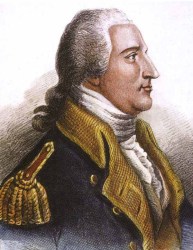
Benedict_Arnold_1colorWashington also learned of Arnold’s treason on September 24th during his planned visit to West Point.  Washington reportedly took the news calmly and began to investigate the depth of treason in his officer corps.  Maj. Lee assisted Washington in his investigation, and both found no evidence of other American officers involved in the plot.  Washington then turned to the capture of Arnold, and that is where our “hero” comes into the story.

In October of 1780, Washington looked to Lee to find someone in his talented cavalry command that could “defect” to the British and carry out an elaborate plan to capture Arnold. Calling Lee to his headquarters, Washington and Lee discussed the proposition of capturing Arnold and how to carry out such a plan.  Lee was tasked with finding someone in his command that could successfully carry out the plan. Lee soon wrote to Washington that he had two men in mind, but his top choice was a sergeant in his cavalry unit

“The chief of the two persons is a sergeant in my Cavalry; to him I have promised promotion…if your Excellency approves of what is done, the sergeant will desert from us tomorrow; the sergeant is a very promising youth of uncommon taciturnity and inflexible perseverance…I have incited his thirst for fame by impressing on his mind the virtue and glory of the act.” [ii]

Washington quickly responded and agreed to Champe’s terms of promotion and soon the mission was hatched. Champe would desert to the British and only Lee and Washington would know about it.  He would be labeled a traitor and his family name tarnished.  If he was captured by the Americans, he would be executed and if he was exposed as an American spy to the British, he would also be executed.  Champe accepted the risk and on the night of October 21st, Champe mounted his horse and made way for the Hudson River where he hoped to find either a British picket line or ship. With him Champe carried his orderly book, saddle bags and five guineas (provided to him by Lee).

Quickly Champe was challenged by an American patrol and he quickly fled,.  This is exactly what Champe and Lee wanted, for the British to believe him, his desertion had to seem real.  Soon the patrol reported to Lee about Champe’s departure.  Lee delayed the pursuit, by first inquiring with other patrol members.  Surely a man of Champe’s stature was not defecting. Soon though Lee knew he had to order a pursuit, he just hoped Champe had put enough distance between him and the Americans to make his escape.

H-Lee-10_11_07-600
“Light Horse” Harry Lee


Though Lee’s delay allowed Champe some time, it was not enough to break away cleanly. As Champe was making his way to the Hudson River, the American patrol was on his heels and calling for his halt. In front of him were British warships in the Hudson River and a British patrol on the banks for the river.  Now was the time of decision, he could be shot dead by the British or captured and executed by the Americans.  The plan to capture Arnold and punish the traitor was already at its first “Rubicon.”


[i] The Revolutionary War Memoirs of General Henry Lee; DeCapo Press, 1998, pg. 396.

[ii] “Sergeant John Champe and Certain of His Contemporaries”; William and Mary College Quarterly, April 1937, pg. 153.

Thomas Blackburn: Forgotten Patriot

Emerging Revolutionary War is honored to share the post below by guest historian Kerry Mitchell

Thomas Jefferson, George Washington, Richard Henry Lee, George Mason, Patrick Henry…when thinking about the period before and during the American Revolution these names come up as some of the great Virginians who were involved in the founding of our nation. While these men were great on their own accounts, there were other Virginian men who helped shaped our nation. Thomas Blackburn of Prince William County is one of these who history tends to glance over even though during the 1760s and 1770s, he was an important figure in American history.

DSC_5537
Rippon Lodge in Prince William County, Virginia, home of Colonel Thomas Blackburn

Thomas was born in Prince William County around 1742 to Richard and Mary (nee Watts) Blackburn. Richard Blackburn was a native from Ripon, England who came over in the early 1700s and settled in Gloucester County, Virginia before moving to Prince William County in 1733. In addition to being a carpenter and farmer, Richard was involved in Prince William County politics and served as a Justice of the Peace. Not much is known about Thomas’s early childhood. He inherits his family home and farm, Rippon Lodge in 1760. That same year he marries Christian Scott with whom he has six children with.  By 1762, Thomas receives a captain’s commission from the governor. With the French and Indian War ending it is unclear to what extent he served. We do know that in September 1766 he was serving as a Justice of the Peace for Prince William County. In 1772, Thomas was elected to be one of the Prince William representatives to the House of Burgesses.

RL Interior Jan09 028
A photo of the interior of one of the rooms of Rippon Lodge

Thomas’s election to the House coincided with the brewing unrest brewing between the colonists and Great Britain. After the Boston Tea Party and Britain’s passage of the intolerable Acts, Thomas was amongst the group of members who drafted the resolution that would call for a day of prayer and fasting for the people of Boston.  Lord Dunmore believed the resolution was an insult to King George III and he dissolved the House on My 26th. Thomas was among the 22 ex-members who met at Raleigh Tavern and decided they would support a continental boycott of British goods. He went back to Prince William County to have the resolution passed by county leaders (which they did on June 6th). From 1774-1776, Thomas served in the first four Virginia conventions and involved himself in many committees dealing with the unrest. He was part of the committee offering George Washington the command of Virginia’s militia and as well as the committee with George Mason and Henry Lee II raising troops to defend Virginia. In the spring of 1776, Thomas lost his seat to attend the 5th Virginia Convention to Cuthbert Bullitt.

IMG_0093
Gravestone and D.A.R. marker for Colonel Thomas Blackburn

After losing his seat to Bullitt, Thomas was appointed as a Lt. Colonel of the 2nd Virginia State Regiment. After being passed over for a promotion, Thomas gave in his resignation on June 10, 1777. While he was out of the army officially, Thomas did not stay out of the fight for long. He rejoined the Virginia Militia as a volunteer. He fought at the battle of Germantown, Pennsylvania in October 1777. During this battle, he was wounded in the leg which ended his military career. He returned to Rippon Lodge in Woodbridge, Virginia to continue farming and entertaining his many friends. This included George Washington whom Thomas became related to through marriage when his daughter, Julia Ann, married George’s nephew, Bushrod Washington.  On July 7, 1807, Thomas passed away at Rippon Lodge where he is buried in the family cemetery.

Thomas Blackburb Obituary Virginia Gazette Aug 29th 1807
Thomas Blackburn Obituary, Virginia Gazette, August 29, 1807

*Originally from New York, Kerry Mitchell is currently the Historic Interpreter at Rippon Lodge Historic Site, part of Prince William County’s Historic Preservation Division. She has a B.A. in Historic Preservation from the University of Mary Washington, a M.A. in American History from George Mason University and a graduate certificate in Museum Collection Care and Management from The George Washington University. She has previously worked at the National Museum of the Marine Corps, Reston Historic Trust, and the Fire Island National Seashore.*

The Defense in Depth as a Revolutionary Battlefield Tactic

Part One of Four 

As a general statement, most people don’t think of the Revolutionary War as a testing ground for battlefield tactics. That assumption would not be correct. In fact, the Revolutionary War proved beyond doubt that traditional European set-piece battlefield tactics were largely ineffective against a determined enemy that was not bound by the traditional rules of war.  As just one example, the extremely effective hit and run tactics used by the Minutemen to harass and deplete the British forces that marched to Lexington and Concord that were based on the tactics used by Native American fighters prove this beyond doubt. The British Regulars had no experience or training in dealing with these tactics, and they suffered as a result.

Also, in the European model, wherein gentlemen fought wars and assiduously avoided civilian casualties, it was considered impolite and improper to target the other side’s officers during the course of battle. American forces refused to comply with these rules, causing serious losses among the ranks of British officers, and the British had to adapt to these tactics also.

Another tactic adopted by American officers proved to be incredibly effective during the campaigns in the South in 1781. Brig. Gen. Daniel Morgan and Maj. Gen. Nathanael Greene, in particular, made extremely effective use of the defense in depth in carrying out their Fabian strategy during the Southern Campaigns of the Revolutionary War.

A Fabian strategy—named for its most famous practitioner, the Roman dictator, Quintus Fabius Maximus Verruscosus—avoids pitched battles and frontal assaults in favor of wearing down an opponent through a war of attrition and indirection. While avoided decisive battles, the side employing a Fabian strategy harassed the enemy through skirmishes to inflict losses, disrupt supply, and affect enemy morale. Typically, the employment of this strategy suggests that the side adopting it believes that time is on its side. George Washington was absolutely convinced that a Fabian strategy would ultimately wear down the British, and he was right.

unnamed (1)
General Nathanael Greene, who mastered the Fabian strategy in the Southern Campaign of 1781

His protégé, Greene, also believed that a Fabian strategy was the way to defeat the British. Faced with the task of defending a large swath of the South with a small army, he had little choice. His subordinate, Brig. Gen. Daniel Morgan, a rough but extremely effective amateur soldier, pioneered the use of a defense in depth at the Battle of Cowpens in January 1781, and Greene then used it on a larger scale at the Battle of Guilford Courthouse about sixty days later. That two untrained amateur soldiers could develop and use such a tactic so effective demonstrates their genius.

A defense in depth, also known as a deep or elastic defense, seeks to delay, rather than prevent, the advance of an attacker, buying time and inflicting additional casualties by trading time for space. Instead of facing an attacker with a single, strong defensive position, a defense in depth relies upon the tendency of an attack to lose momentum and cohesion over time as it covers a larger area. Thus, a defender can yield lightly defended territory in an effort to outstrip an attacker’s logistics or spread out a numerically superior attacking force. Once that attacker has lost momentum, or has become spread out to hold territory, well-planned and well-placed counterattacks can be directed at the attacker’s weak points, with the objective of causing attrition warfare or driving the attacker back to its original starting position.

A conventional defensive strategy concentrates all of a defender’s military resources in a well-defended front line, which, if breached by an attacker, would expose the remaining troops in danger of being flanked, cut off, and surrounded, and leaving lines of supply, communications, and command vulnerable to being cut.

By contrast, a defense in depth requires that defenders deploy their resources, such as prepared fortifications, earthworks, and additional forces at and well behind the front line. Once an attacker breaches the weaker initial position, it continues to meet resistance as it presses on. As the attacker penetrates further, its flanks become vulnerable, and if the advance stalls, the attacking force can find itself completely surrounded and subject to being destroyed or forced to surrender. Thus, a defense in depth is particularly effective against an attacker that can concentrate its force to attack a small number of places along an extended defensive position.

In a well-designed and properly implemented defense in depth, the defending forces fall back to a succession of prepared positions designed to inflict a heavy price on the advancing enemy while minimizing the risk of being overrun or outflanked. By delaying the enemy’s advance, a defense in depth neutralizes manpower advantages and the element of surprise, and buys time for additional forces to be readied for well-timed counterattacks. A well-designed defense in depth will use its forces in mutually supporting positions and in appropriate roles. In this scenario, poorly trained soldiers—such as militiamen—can be used in static positions at the front line, while more experienced and better-trained soldiers can form a mobile reserve, or man the ultimate defensive position to be defended.  Further, a well-designed defense in depth will make good use of the natural advantages offered by terrain features and other natural obstacles such as streams, ponds, etc.

DanielMorgan
General Nathanael Greene, who mastered the Fabian strategy in the Southern Campaign of 1781

There are disadvantages associated with the defense in depth. For one thing, constantly retreating can take a toll on the morale of defending forces. Further, these forces also require a high degree of mobility to accommodate those retreats, and also the space to do so.

Morgan designed and implemented a very effective defense in depth at Cowpens that proved so effective that Greene adopted that tactic and, while he lost the Battle of Guilford Courthouse, the heavy losses his army imposed on Lord Cornwallis’ army prompted Greene to note that the British, “have met with a defeat in a victory.”