Artistic License and the French Artillery Park at Yorktown, A Case Study

Emerging Revolutionary War welcomes back guest historian Karl G. Elsea

It is common for artists to use “artistic license” when painting historic events including American Revolutionary War art. The problem is this practice also

aids inaccuracies persisting. Here is one case study of one picture involving an historic event that is presented by the National Park Service (NPS) at Yorktown. Please note the staff is helpful and the grounds are beautiful. As for the severity of the problem, the reader can decide after reading the information.

The following picture is from the field at Yorktown where the French Artillery Park was located. The picture illustrates the idea of what an artillery park was.

The problem is this picture contains a number of images that are wrong. For example, the carriages, wagons, carts, and limbers should be painted light blue. The French Army artillery had been painted light blue prior to 1750. There is a lot of confusion to this day concerning gun and limber carriage colors. This confusion may have been generated by a current belief there was one French artillery color. The French used the color of the items to assist which department owned the material. The French Navy department [Ministry of Marine] was responsible for the colonies, including North America, and their cannon were on red carriages with, in all most all cases, iron barrels. The French Quartermaster’s department had their wagons were painted a brighter red. The French Army artillery was painted light blue with bronze barrels. Thus, the French Army barrels shown should appear to be “brass.”

Continue reading “Artistic License and the French Artillery Park at Yorktown, A Case Study”

Peter Carried a Cannon, The Real Story

Emerging Revolutionary War welcomes back guest historian Karl G. Elsea

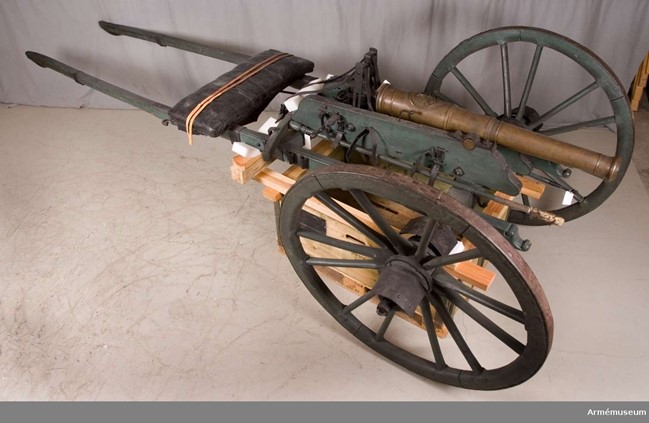
History can be fun; for example, when a war trophy in Sweden and the popular television series “Antiques Roadshow” can be combined to explain an American Revolutionary War legend. There are a number of books, articles, an actor impersonator, and even an U. S. Postal stamp from 1975 showing Peter Francisco carrying a cannon barrel to save it from falling into British hands at the Battle of Camden. Sadly, their stories of Peter carrying a barrel weighting 600 pounds, or even an amazing 1,100 pounds, are not close to true. Here is the likely story. The kind of barrel Peter actually carried is shown in the next picture. The barrel likely weighed between 200 and 300 pounds.

An original amusette is located at the Armémuseums’s magazine in Stockholm. This amusette was constructed in 1768 and captured by the Swedes in the battle at Berby in 1808. The following picture shows this amusette:

Continue reading “Peter Carried a Cannon, The Real Story”

“Rev War Revelry” Author Interview: Andrew Waters

Like a modern-day Nathanael Greene or Edward Carrington, Andrew Waters spends his days trekking the waterways of the Carolina high country. Just like those famous military leaders, Andrew Waters does the surveying of these waterways and their tributaries for his day job; as a land and water conservationist.

During this career, Waters first learned about the “Race to the Dan” the pivotal retrograde movement in 1780 that saved Greene’s army from the pursuing British force under Lord Charles Cornwallis. Having the unique perspective from his training and an interest in the history of the time period, he had the perfect combination to pen a complete history of the “Race to the Dan.” Published by Westholme Publishing in October 2020, the title, To The End of the World, Nathanael Greene, Charles Cornwallis, and the Race to the Dan fills a much needed gap in the historiography of the the American Revolution in the southern theater.

This Sunday, at 7p.m. EDT, on Emerging Revolutionary War’s Facebook page, join us in an interview with Waters, discussing this book, Nathanael Greene’s leadership, and any questions you may have about this subject. Remember that favorite beverage and we look forward to you tuning as we welcome historian and author Andrew Waters to the next installment of the “Rev War Revelry.”

“No body ever heard of a quarter Master, in History”

In the spring of 1778, General George Washington chose Major General Nathanael Greene to be the quartermaster general of the Continental army, replacing General Thomas Mifflin who had resigned the previous November. Greene was hesitant and wrote the quote that graces the title of this post. He was leery of giving up a field command to take a thankless job that faced a mountain of difficulties and was more administrative. From the start of his tenure in this important post, Greene brought about effective change. His never ending responsibilities included allocating resources, installing the right people into positions, and untangling contracts, transportation woes, and developing a concept, such as supply depots on potential campaign routes were vast improvements over what his predecessor accomplished.

Nathanael Greene

Greene though yearned to return to an active field command and through his close connection to Washington along with his due diligence as quartermaster, he was assigned command in the southern theater. His assignment was to replace Major General Horatio Gates as the head of Continental forces after the latter’s defeat at Camden, South Carolina in August 1780. Greene’s role in this position is well-documented and outside the scope of this post. One of the decisions he made, early on in his tenure as commander, paid huge dividends and is usually relegated to a passing few lines in most histories of the southern campaigns. What Greene wrote years earlier about “quartermaster in history” the quote that gives this piece its title, holds true in this instance as well.

On December 4, 1780, Greene wrote to Edward Carrington, then on assignment scouting the rivers and topography through North Carolina and southern Virginia, offering him a new assignment; that of quartermaster general for the southern army. After finishing his surveying of the rivers and water transportation, Carrington was ordered to head toward Greene’s forces, bringing supplies that had been gathered with him as well.

This decision, to place an officer of the caliber of Edward Carrington, in that position was a wise move. One that passes largely unheralded. A decision, though, that ultimately leads to success and eventual victory. In this case the momentous “Race to the Dan” that saved Continental forces, fatigued Lord Charles Cornwallis’ British forces, and played an early role in the latter’s move toward Virginia.

Continue reading ““No body ever heard of a quarter Master, in History””

There Will Be Bloody Bill

Emerging Revolutionary War welcomes guest historian Andrew Waters

Appearing this month at the Journal of the American Revolution (JAR) is an article I wrote on William “Bloody Bill” Cunningham and his infamous raid known as the “Bloody Scout.” The article attempts to provide a single-source narrative of the Bloody Scout and some of the contexts for it, although it is based on a previous article I wrote (though never published) that attempted to explore more deeply its sociological implications.

            Anyone who comes to western South Carolina and has any interest in the American Revolution will soon encounter Bloody Bill. As I attempted to explain over at JAR, “without veering too deeply into sociological speculations, I can only say that his (Cunningham’s) presence is still palpable here, embedded in the cultural DNA. Though he may be only a curiosity in other parts of the United States, if he is known at all, in the South Carolina Upstate, it seems there will always be Bloody Bill.”

Continue reading “There Will Be Bloody Bill”

Henry Clinton and “A Miracle on Sullivan’s Island”

By the Red Sea the Hebrew host detained

Through aid divine the distant shore soon gained;

The waters fled, the deep passage a grave;

But thus God wrought a chosen race to save.

Though Clinton’s troops have shared a different fate

‘Gainst them, poor men! Not chosed sure of heaven,

The miracle reversed is still as great—

From two feet deep the water rose to seven.[6]

–St. James Chronicle

While delegates to the Second Continental Congress debated the matter of Independence in 1776, the British brought the war to Charleston, South Carolina.  Defense of the city focused on Fort Sullivan, on Sullivan’s Island at the northern mouth of Charleston Harbor.  Major General Henry Clinton, commanding an Army expedition against the Americans, was determined to exploit the fort’s vulnerabilities.  He ultimately failed, but his effort, or lack thereof, prompted a British newspaper to craft a little ditty taunting the poor general.

Fort Sullivan
The Attack on Fort Sullivan, June 28, 1776 from Edward McCrady, The History of South Carolina in the Revolution, 1775-1780
Continue reading “Henry Clinton and “A Miracle on Sullivan’s Island””

Review: To The End of the World, Nathaniel Greene, Charles Cornwallis, and the Race to the Dan by Andrew Waters

Writing over thirty years after the fact, Henry “Light Horse Harry” Lee summed up the events of February 14, 1780 with the line, “Thus ended, on the night of the 14th of February, this long, arduous, and eventful retreat” (190). Upon hearing of General Nathanael Greene’s exploits in this movement, General George Washington wrote, “You may be assured that your Retreat before Lord Cornwallis is highly applauded by all Ranks and reflects much honor on your military Abilities.” (198).

What Lee would remember as “eventful” and Washington and fellow military ranks “highly applauded” is remembered today as the “Race to the Dan.” This retrograde movement, undertaken by Greene’s forces from South Carolina to the Dan River in southern Virginia, is sandwiched between the engagements at the Battle of Cowpens in January 1781 and the British pyrrhic victory at Guilford Court House in March 1781. Yet, this retreat may be on the turning points in the southern theater that led the British, under Lord Charles Cornwallis to his eventual demise at Yorktown in October 1781.

Great historians, such as John Buchanan is his monumental work The Road to Guilford Court House have covered with broad strokes this period of time but a dedicated study was much needed in the historiography of the American Revolution. Insert Andrew Waters, writer, editor, and conservationist, whose name may be familiar from previous works such as The Quaker and the Gamecock: Nathanael Greene, Thomas Sumter, and the War for the Soul of the South. His latest book, To The End of the World, Nathanael Greene, Charles Cornwallis, and the Race to the Dan, captures this important military movement while providing an expose on the leadership of Greene woven in. The title of the book is pulled from a quote by Brigadier General Charles O’Hara, Cornwallis’s second-in-command during this campaign. With a background in land conservation with a focus on river corridors and watersheds, Waters found a connection with Greene, who studied the various waterways—or ordered subordinates—to study the various rivers, to better understand the topography for military campaigns.

After a stint in Salisbury, North Carolina, Waters became fascinated with the Race to the Dan story and decided to plunge in to understanding this period of the American Revolution. He found that “the Race to the Dan is a remarkable tale, fit for cinema or an epic novel, and not only for its accounts of four narrow escapes across its four rivers” (xv). He was drawn “to its story” (xx) and any reader of the book is the beneficiary of that discovery.

Along with weaving in the innate leadership qualities of Greene, Waters brings to light the importance of military leaders not as well-known such as William Lee Davidson, William R. Davie, and Edward Carrington with more household names of Lee, Daniel Morgan, and Otho Holland Williams. Throw in the names of Cornwallis, O’Hara, and Banastre Tarleton, and the pantheon of American Revolutionary personas is complete.

In this approximate month-long retreat, Greene saved the American Revolution in the southern theater and set in motion the events that led to the climactic victory at Yorktown. Waters, with his 2020 publication, has now helped save the story of the Race to the Dan from its unintended lapse into obscurity.

Information:

Published: 2020 (Westholme Publishing)

264 pages, including index, footnotes, images, and maps

The First American Civil War

Emerging Revolutionary War welcomes guest historian Sean Chick

On October 7, 1780, Britain’s attempt to regain at least part of the rebellious North American colonies was dealt a major blow at King’s Mountain. The rebels rejoiced, since it was their first major victory since 1777 and it came after the twin disasters at Charleston and Camden. Thomas Jefferson, then governor of Virginia, considered it the decisive battle of the war. Years later, Theodore Roosevelt echoed that sentiment. In 1930, when the site was set to become a national park, Herbert Hoover gave a speech. For the embattled president, it was an attempt to shore up his falling support and vindicate his strategy to peel southern states away from the Democratic Party. Hoover said “This is a place of inspiring memories. Here less than a thousand men, inspired by the urge of freedom, defeated a superior force entrenched in this strategic position. This small band of Patriots turned back a dangerous invasion well designed to separate and dismember the united Colonies.”

Hoover, understandably, never mentioned the atrocities committed. Many were executed after the battle. Nor did he mention that King’s Mountain was not a contest between redcoats and rebels, but brother against brother. The only British man present was Major Patrick Ferguson. His command was made up entirely of Loyalists. His second in command, Captain Abraham de Peyster, was from New York City.

Joseph Galloway
(courtesy of NYPL)

Few groups in American history are as forgotten as the Loyalists and few were as complex. They were a varied lot, often making up the highest in colonial society, including wealthy merchants and colonial officials. They often included the very lowest in the society, such as recent immigrants, slaves, indigenous, and subsistence farmers. Their ideology was in many ways not radically different from those who rebelled. They were generally not in favor of absolute monarchy or the supremacy of Parliament but simply favored union with Britain and slow reform. A few, such as Joseph Galloway, were part of early protests against British colonial policy, but were unwilling to jump into the chasm of revolution. Some, such as South Carolina merchant David Fanning, were merely aggrieved and sought to settle scores. Others were on the margins of society and saw the colonists, or at least the revolutionary colonial elite, as their real oppressors.

The Loyalists were at first spurned by the British high command. Major General William had over 30,000 men under his command in 1776 and Loyalists would have added to the logistical strain. He also thought a soft war policy that he hoped would induce the colonies to return, and therefore it was reasonable to avoid civil war. Yet, by 1777 the British were using some Loyalist regiments. They would fight in John Burgoyne’s ill-fated drive on Albany and served as rangers at Brandywine.

Continue reading “The First American Civil War”

2021 Symposium Highlight: Vanessa Smiley

Over the next few months, we will be highlighting the speakers and topic for our 2021 Symposium, Hindsight is 2020: Revisiting Misconceptions of the Revolution, taking place on May 22nd .

Today we continue with historian Vanessa Smiley who will be covering the myths and misconceptions of the Southern Campaigns during the American Revolution.  

See Vanessa as she discusses an aspect of the Southern Campaign on March 7 at 7p.m. on Emerging Revolutionary War’s Facebook Live as part of the “Rev War Revelry” historian happy hour!

Vanessa Smiley is an historian and interpreter whose roots began at National Park Service Civil War and Rev War sites. Her Rev War park experience includes serving as the Chief of Interpretation at the Southern Campaign of the American Revolution Parks Group in South Carolina, an acting assignment as Superintendent at Guilford Courthouse NMP, and Chief of Interpretation at Morristown NHP. Vanessa is currently the Project Manager of Interpretive Media Development for the National Capital Area at Harpers Ferry Center. She received her undergraduate degree in Historic Preservation from the University of Mary Washington and her Master’s degree in Resource Interpretation from Stephen F. Austin State University.

Outside of her work with the NPS, Vanessa enjoys researching family histories, studying material and social culture of the 18th and 19th centuries, listening to podcasts, reading true crime, drinking craft beer, and attempting to make the perfect sangria. She and her husband live in Morgan County, West Virginia on their small farm where they run a nonprofit animal sanctuary.

She will be presenting her talk From the Bottom Up: Myths and Misconceptions of the Southern Theater at the May symposium.

 Why do you believe the Southern Campaigns were so significant to the outcome of the American Revolution?

The simplest way to describe why I believe the Southern Campaigns were so significant to the War’s outcome is: it was a grassroots effort. What I mean is that while the Continental Army shouldered plenty, it was the combination of local efforts of the militia and determined civilians who turned the tide of the war when the British looked to the southern colonies, especially in the second half of the war. All one has to do is to look at two key battles, Kings Mountain and Cowpens, to see the impact of militia integrity, courage, and resolve.

Some point to the politics of Boston and New York as a driving force behind the start of the war. But the taverns and town halls of Charleston and Savannah were no less significant in adding fuel to the revolutionary fire. There is also the added dichotomy of our first true American civil war that played out in the backcountry of the Carolinas. Here were literal neighbors, brothers, cousins, and friends taking up arms to serve their respective causes and finding themselves on opposite sides. These dynamics were one driving force behind the militias that had such an impact during the Southern Campaigns.

What first attracted you to the study of early American history? What keeps you involved in the study of this history? Do you find these things are the same or different?

I give credit to my love of history to my high school history teacher, who embodied the archetype of the quintessential eccentric and genius history connoisseur striving to bring history alive. He immersed us in the history of the 18th and 19th century through first person accounts, visits to historical sites, and the dramatics of storytelling. He also armed me with the intellectual tool of piecing out the relevancy of events and people of the past, and that’s what has kept me interested in studying history for the past two decades.

While my work at historic sites for the National Park Service provided an easy outlet for my historian brain, I sought those historical connections and resources even outside of work because of that drive to understand the past. It’s a little bit different now than before though. I don’t get to be as immersed as I once was (no traipsing through cemeteries at night to feel the chill and terror of the Underground Railroad) and instead my mind goes to educating the public on the importance of our history. That’s why I’m so appreciative for Emerging Revolutionary War!

What is the biggest myth about the war in the South? How do you think it came about?

That the war was won in the north and not the south! I’ll go into more detail on this one during my presentation, but I’ll tease a little bit here. One part of the answer to the second question might lie with our public education system. In studying the state education curriculums of various states, I found that there is a stronger emphasis on the beginnings of the war than the war’s end. And so the Southern theater gets very little, if any, attention when kids study the war in school. The exception used to be in certain states like South Carolina, where the battles of Cowpens and Kings Mountain were directly referenced in the state standards. Since the standards updated in 2020, this no longer seems to be the case.

You’ll have to wait for my presentation to dive a little deeper into this myth with me!

Do you think there are common misconceptions of the era of the American Revolution among the American people? If so, what are they and have they ever affected your work?

There certainly are, and the ones that have affected my work the most center around that idea of the often-overlooked Southern Campaigns for most Americans. Ask any random person to name a Revolutionary War battle or event and the majority will name something from the northern colonies. Every now and then you get a Charleston, and if you consider Virginia part of the south, then a Yorktown for sure. But as I’m sure has become obvious already, I strive to educate about the rich history of the Rev War in the south.

Why do you think it is important for us to study the Revolutionary Era? 

No matter which political, social, or economic side you’re on nowadays, we can all agree we are living in our own revolutionary time. And we find ourselves looking back to our nation’s founding for understanding and guidance, namely things like our national ideals and governmental processes. But we are a different people and a different nation than what we were then. We should not take everything from 240 years ago at face value. By studying and investigating the past, we can understand how and why decisions were made at the time. And perhaps we can extract an element, or life lesson, that can be applied to our modern times.

I believe that while history does not repeat itself, it does rhyme. By understanding the past, we may know our future.

Join us for our SECOND annual Emerging Revolutionary War Symposium. Due to the COVID 19 pandemic, we postponed the 2020 Symposium to May 22, 2021 with the same topics and speakers. Co hosted by Gadsby’s Tavern Museum, speakers and topics include:


Michael Harris on Misconceptions of Battle of Brandywine
Vanessa Smiley on Myths of the Southern Campaigns
Travis Shaw on American Loyalists
John U Rees on African American Continental Soldiers
Mark Maloy on myths of the Battle of Trenton

Stay tuned as we highlight our speakers and their topics in future blog posts.

UPDATE: The 2021 Symposium will now be virtual. Though conditions with the pandemic are improving, we do not believe we will be able to have the event in person by May, so we have decided to be virtual. Due to this shift, we are also dropping the price! Now the full day symposium is $40 per person and $20 for students. This allows for guests from all across the country to learn about African American soldiers, Loyalists, and Drunken Hessians. Buy your ticket today!

To register visit: https://shop.alexandriava.gov/Events.aspx

The Battle of Moores Creek Bridge: How Three Minutes Affected Three Years of War Strategy

Did the Battle of Moores Creek Bridge help keep the British away from the southern colonies during the first half of the war?

Months before its colonies officially adopted their Declaration of Independence, the British army was reaching a critical juncture in its war strategy: with the colonies in rebellion, where should they focus their attentions? The war was picking up steam and the British were looking for a stronghold in the colonies that would gain them resources such as men and supplies. They turned their eyes south.

The general impression of the southern colonies was that they were poorer and weaker than their sister colonies in the north. They also had been receiving word of heavy Loyalist sympathies in both the backcountry of South Carolina and the coastal areas of North Carolina, where large populations of German and Scottish immigrants had settled. Indeed, by the fall of 1775, Loyalist recruitment seemed to be quite successful. One evidence of this was at the First Battle of Ninety Six in November 1775, when nearly 2,000 Loyalists met a paltry force of not quite 600 patriots. Though this first Revolutionary War battle south of New England ended in a truce, British confidence was high.

The Royal Governor of South Carolina, Lord William Campbell, had fled the colonies by September 1775, leaving the colony mostly in the hands of the Patriots. That made the ultimate goal at this point in the southern colonies to capture the wealthy and strategic port of Charleston, South Carolina. Meanwhile, the Royal Governor of North Carolina, Josiah Martin, convinced British commanders to target key points along their route through his colony as they advanced on their mission. And as 1775 turned into 1776, plans were set in motion.

On January 10, Martin issued a proclamation calling on all subjects loyal to the Crown to take up arms against the rebellion in the colony. Authority was given to Loyalist leaders throughout the colony to recruit militia and gather all necessary provisions to muster in Brunswick, NC.

A copy of Josiah Martin’s Proclamation from January 10, 1776.
Library of Congress.

By mid-February, a contingent of several thousand loyalists was gathered at Cross Creek, NC, preparing to march towards their goal. Among those recruited were the famed Scotch Highlanders. Though not all joined the Loyalist cause, the Highlanders’ reputations as fierce warriors preceded the impending war in the colonies. This reputation may have stemmed from the Jacobite rebellion in the 1740s as well as British assumptions at the time that the HIghlands were a lawless land due their clan-based culture.

Loyalists weren’t the only militias stirring along the Carolina coast. Patriot militias had begun forming at the first news of Loyalists gathering as early as August 1775. In fact, some of those militias formed in Wilmington, NC became the foundation of the 1st North Carolina Regiment of the Continental Army and in February 1776, they were led by Colonel James Moore. At that time, they were joined by additional militiamen from the surrounding area, led by Alexander Lillington and Richard Caswell. Their goal was two-fold: protect Wilmington and prevent the Loyalist forces from reaching the coast.

By February 20, 1776, a clash between the British and Patriot forces was inevitable. British commander Donald MacDonald began to move his 1,600 men from Cross Creek towards his rendezvous point at Brunswick, only to find his way impeded along the Black River by Caswell’s blockade. On February 25, MacDonald had managed to get across the river and Caswell moved his 1,000 Patriots back to Moores Creek Bridge. There they set up defensive earthworks, prepped their two artillery pieces, and prepared for battle.

A map of the Moores Creek campaign, February 1776.
NPS/Moores Creek National Battlefield.

At 1:00 am on February 27, 1776, MacDonald’s second-in-command, Donald McLeod, led the British troops on their march towards the Patriot position. Arriving at an abandoned camp on the west side of the bridge around 5:00 am, a brief exchange of fire alerted the Loyalists to the Patriot sentries guarding the bridge, and ultimately, the Patriot forces lying in wait. 

McLeod with 50 men attempted to cross the bridge and attack the Patriot defensive position, but the attempt was futile and disastrous. Heavy musket fire coupled with a barrage of two artillery units killed 30 almost immediately, including McLeod. The remaining Loyalists quickly retreated and the battle was over almost as quickly as it had begun.

Bill Ballard’s drawing of the decisive moment during the Battle of Moores Creek Bridge.
NPS/Moores Creek National Battlefield.

So how important were these three approximate minutes of battle? This Patriot victory struck a huge blow to Loyalist recruitment in North Carolina – so much so that two months later, North Carolina’s delegates to Continental Congress were the first to vote for independence. And it created a rippling effect throughout the southern colonies, as one by one the royal governors were displaced and revolution took hold. 

No longer could the British see the Carolinas as easy targets. They abandoned this initial southern strategy to focus their resources on the war in the northern colonies. For the next three years, significant battles and events that we learn about today took place, thanks in part to the dominating Patriot showing at the Battle of Moores Creek Bridge.


If you’re interested in learning more about the Battle of Moores Creek Bridge, I strongly encourage you to visit Moores Creek National Battlefield’s website as well as their very active Facebook page. Both offer a wealth of information and additional resources for folks to explore.