Thirteen of the Great Britain’s North American colonies moved toward independence in 1775, declaring the fact officially the following year with the issuance of the Declaration of Independence. Perched below these thirteen rebellious provinces was the colony of East Florida. Earned after the Seven Year’s War by Great Britain from Spain, the most populous city an oldest permanently established European metropolis was St. Augustine, which was also the capital of the colony. This colony, through the eight years of the American Revolutionary War, had a tenuous connection with their neighbors to the north. Largely forgotten in the pantheon of history describing this period, from the time of Britain gaining possession in 1763 through the end of the Revolutionary era in this historian’s estimation, in 1785.
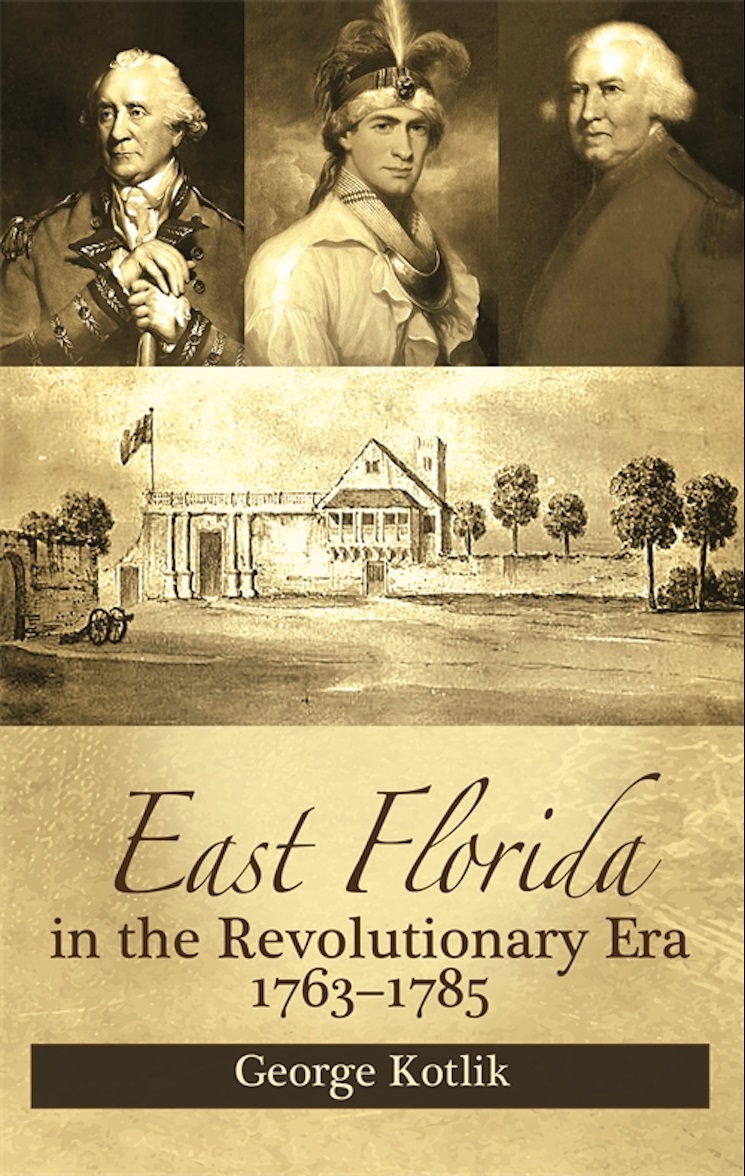
Entitled, East Florida in the Revolutionary Era, 1763-1785 and penned by George Kotlik, a historian specializing in 18th century North American history, the publication offers “an accessible and detailed narrative of the East Florida during the American Revolution.” (pg. 8).
What ensues in the following pages is a brief yet complete overview of the military, political, social, and economic history within those years of East Florida. Some of the names in the pages are well known to enthusiasts of the American Revolutionary War era whereas others will be new names to add to the repertoire for further study. From Governor Patrick Tonyn, British general and last governor for England of East Florida to bringing attention to the William Augustus Bowles, a Maryland born Loyalist, sympathetic to the Muscogee Native Americans of East Florida who tried in vain from the last decade of the 18th century, to establish an independent state for the tribe, with British support. These are just two of the historical personas that Kotlik discusses in his narrative, the rest await you within the pages of the book!
Although no major military actions happened within the confines of the colony that does not mean the role of East Florida in relation to the American Revolution should not be marginalized. “Militias were raised, a general assembly was postponed, St. Augustine experienced a heightened British troop presence, planters between the St. Johns and St. Marys Rivers suffered at the hands of George raiding parties, and a constant threat of a Spanish or American invasion” all affected the psyches and lives of East Floridians. (pg. 104-105).
The hope from Kotlik is to provide the launching point for further discussion into the role of East Florida specifically and Florida in general during the revolutionary period. “Such a lack of coverage is a reminder for scholars to to emphasize East Florida’s presence in the war that made America.” (pg. 111). With this history in hand, Kotlik has provided the necessary overview for further exploration.
Publisher: NewSouth Books, University of Georgia Press, 2023 156 pages plus images
Lieutenant General Henry Clinton, New York Public Library
With the Charleston in British hands, Clinton believed that all he had to do was establish outposts in South Carolina stationed with British regulars. This be believed would put down what was left of the rebellion in the state. These posts assisted the recruitment and training of the thousands of Loyalist troops he believed would now rally around the King’s Colors. To take the best advantage of his Regular troops, Clinton determined to establish three major outposts in the South Carolina backcountry. Clinton established these posts at Augusta (Georgia), Ninety-Six, and Camden. While these posts were to be centers for the British army, the local Loyalist militias were to serve as the pacification forces in South Carolina while the main British force was freed up for larger strategic goals.
To recruit, enlist, and train the large, expected influx of Loyalist militia, Clinton named Maj. Patrick Ferguson as Inspector of Militia. Ferguson was ordered to enlist younger men, preferably unmarried, into companies that would form battalions. He was instructed to recruit from Georgia to North Carolina and offer short enlistments if necessary. Clinton believed that having the colonists maintain their own law and order (via Great Britain’s authority) would cause less apprehension with those that were mostly undecided about to whom they should throw their support, the Patriots or the British.
By mid-May, the British army set out for their destinations in the back country. Clinton’s second in command, Lieut. Gen. Charles Lord Cornwallis, marched to Camden while Ferguson moved to Ninety-Six. Without much resistance, Clinton’s plan to conquer South Carolina was working perfectly. Patriot leaders scrambled to find ways to organize their resistance. The only organized Continental force remaining in South Carolina was a small force of Virginians under Col. Abraham Buford that was on its way to Charleston when the city surrendered. Ordered by Brig. Gen Isaac Huger to reverse course and make his way north toward Hillsborough, North Carolina. There along with the North Carolina militia, he could be the core of American defense in North Carolina.
On May 27, Cornwallis ordered Lieut. Col. Banastre Tarleton with 300 of his dragoons and mounted infantry in pursuit of Buford. Tarleton’s British Legion was mostly composed of Loyalist recruits, so many in his force were from America. Tarleton pushed him men and horses hard, many horses falling out along the way. Buford was aware of a possible British pursuit but underestimated the speed in which Tarleton closed the gap. On May 29, Tarleton caught up with Buford in a region near the South and North Carolina border called the “Waxhaws.”
Lieutenant Colonel Banastre Tarleton, New York Public Library
The events that took place next are still debated today. Tarleton under a flag of truce tried to get Buford to surrender. Writing to Buford, Tarleton wrote “Resistance being vain, to prevent the effusion of human blood, I make offers which can never be repeated.” Tarleton was already creating an image of himself as an aggressive and brutal fighter. Buford, however, refused, replying, “I reject your proposals, and shall defend myself to the last extremity.” With that, Buford continued his march north towards North Carolina as did Tarleton’s pursuit. Around 3:00 p.m. the lead elements of Tarleton’s force wiped out Buford’s small rearguard, forcing Buford to stop and deal with Tarleton.
Buford decided to create a single battle line east of the Rocky River Road. Tarleton, ever the aggressive commander, ordered his horsemen to charge the Virginians. Here, Buford made what would be a devastating blunder. He ordered his men to not fire until the British cavalry was within ten yards of the American line. This would not allow the Americans a chance to fire another volley before the British charge was upon them. The Virginians fired, taking out some of the British dragoons and horses (Tarleton himself became briefly trapped under his horse), but most charged through Buford’s line, wielding their sabers and cutting down the Virginians. Total chaos ensued, and many of Buford’s men attempted to flee. Some tried to surrender by throwing their arms to the ground, but American accounts state that the British were offering “no quarter” and killing everyone that tried to surrender. Other accounts report that Buford sent a white flag to Tarleton, but probably because he was injured, it was never received, and the fighting continued. Accounts differ widely between the Americans and British on the fighting, but the fact cannot be argued that Buford’s command was destroyed.
Waxhaws Grave and Monument, photo and flags courtesy of the author
American casualties were estimated at 350, 113 men killed, 147 wounded, 50 captured, and 2 six-pound artillery pieces and 26 wagons captured. Buford himself was able to escape the field. Tarleton only suffered 5 killed and 12 wounded, a complete victory. What has become known as “Buford’s Massacre” was not referred to as a massacre at all in many period accounts. Tarleton himself blamed the “slaughter” on the fact that his men thought he was killed in the battle and sought revenge. The disparity in numbers and the reports of indiscriminate British slaughter of Americans led to the creation of “Tarleton’s Quarter.” Patriot leaders quickly pounced on this and began to spread stories about Tarleton’s brutal tactics. This proved to be a public relations coup for the Patriot cause, as it energized their side and led to a more robust recruitment of militia and partisan forces to take on the British who now faced no organized opposition in South Carolina or Georgia.
Stay Tuned for the Emerging Revolutionary War Series newest book releases “To the Last Extremity: The Battles for Charleston, 1776-1782” by Mark Maloy and “All That Can Be Expected: The Battle of Camden and the British High Tide in the South, August 16, 1780” by Rob Orrison and Mark Wilcox to learn more abou the 1780 Southern Campaign. Both releases are published by Savas Beatie Publshing: https://www.savasbeatie.com/american-revolution/
The Battle of Waxhaws, fought on May 29, 1780, was a lopsided British victory by Lieutenant Colonel Banastre Tarleton’s British cavalry over American Colonel Abraham Buford’s Continental forces in Waxhaws South Carolina. Buford lost 316 of 350 men with the British losing less than 20. Known popularly as “Buford’s Massacre,” Continental leaders used the battle as a propaganda tool against the Crown forces in the south. But, was it really a massacre?
Join us as we welcome historian and author Dr. Jim Piecuch as we discuss his research and theory about the Battle of Waxhaws and its aftermath. Dr. Piecuch has written several books on the Southern Campaign of the American Revolution including his book “Blood Be Upon Your Head: Tarleton and the Myth of Buford’s Massacre.” This Rev War Revelry will be pre-recorded and posted on May 28th at 7pm. Grab a drink and a good seat and enjoy this great presentation on one of the most controversial battles of the American Revolution.
Charleston, South Carolina is one of the most beautiful and historic cities in the United States. Numerous sites, battlefields, and buildings from the period of the Revolution still exist.
Join us this Sunday at 7pm as we discuss ERW’s newest release “To The Last Extremity: The Battles for Charleston” by Mark Maloy. In To the Last Extremity: The Battles for Charleston, historian Mark Maloy not only recounts the Revolutionary War history of Charleston, he takes you to the places where the history actually happened. He shows you where the outnumbered patriots beat back the most powerful navy in the world, where soldiers bravely defended the city in 1779 and 1780, and where thousands suffered under occupation. Through it all, brave patriots were willing to defend the city and their liberty “to the last extremity.”
We will talk to Mark about his research, his favorite and most compelling stories and why this book is a “must have” for any history buff. Join us this Sunday, April 16 at 7pm on our Facebook page to join in on the conversation. As always, if you can not join us live you can catch the talk at any time on our You Tube or podcast channel.
Join us this Sunday, March 5, at 7:00 p.m. on our Facebook page for our latest installment of the Rev War Revelry series. This weekend’s chat will focus on the exploits of British General Benedict Arnold in Virginia during 1781, including the capture and burning of Richmond. We will be joined by Virginia historians John Pagano and Mark Wilcox, who will help bring to life the story of when Arnold turned his sword against the people he once called his comrades and countrymen. We hope to see you there!
Emerging Revolutionary War welcomes this guest submission by historian Werther Young, aka Elmer Woodard
Not THAT Lee. And not at Stratford Hall, Leesylvani, nor Shirley plantations. No rustle of silk, silver platters from the kitchen, obsequious servants bowing and scraping, no twitter of conversation, nor the tinkling of crystal. Our repast was much less spectacular. In his Memoirs, Henry “Light Horse Harry” Lee told of a dining experience during the Race to the Dan on or about February 11, 1781. We tried to recreate that meal.
Lee’s Legion had been assigned By Maj. Gen. Nathanael Greene to Col. Otho William’s Light Division, which had in turn been tasked with luring the British away from Greene’s main army on its retreat to Boyd’s Ferry (now South Boston, Virginia). Williams apparently roused his men at 3 a.m. at Guilford Courthouse (modern Greensboro, N.C.), drew rations, and marched north to collect his Delaware company at an outpost near Brice’s Crossroads (now Summerfield, North Carolina). He then marched northeast on the road to Dix’s Ferry (now US Rt. 158 towards Reidsville, North Carolina and Danville, Virginia) as far as Rodes’ House, six miles almost due north of Guilford Courthouse, and four miles northeast of Brice’s Crossroads. With Lee’s cavalry rearguard at Rodes’ House, Williams’ infantry was probably spread out along the present Scalesville Road northeast towards Troublesome Iron Works and modern Reidsville. A Lt. Harrington commanded cavalry patrols southeast towards Salem, North Carolina on the Scalesville Road, the direction of the last reported location of the British. In the cool and drizzly morning, everything was quiet, so quiet that Williams’ men had started the slow process of cooking their rations.
The latest intelligence put the British somewhere towards Salem (present Winston-Salem, North Carolina), some twenty-four miles away. Unfortunately, that information was stale. The British had marched early, passing through Dobson’s Crossroads (present day Kernersville, North Carolina) and by early morning were near present Oak Ridge, North Carolina just nine miles away from Rodes’ House and coming on hard, while Williams and his men were enjoying a “comfortable meal.”
On paper, Revolutionary War infantry regiments were made up of companies of fifty men each. Generally, cavalrymen counted each horse as a man, so their “company” was only about twenty-five men, and was called a “troop.” For ration purposes, each company/troop was further divided into subgroups of five or six men each, called a “mess.” In practice, a company could be anywhere from fifteen to seventy men, but let us stay with a typical size of fifty. By 1781 in North Carolina, with many, many exceptions, army rations were essentially a pound of protein and a pound of carbohydrate per day, roughly four Quarter Pounder hamburgers per day.
“Protein” in the 1781 south was meat, usually pork, fresh or salted. Carbohydrate was usually ground corn, and was packaged from the mill in barrels of about 200 pounds. Rations were usually issued in three day lots to the company, although six day lots were not unheard of. Indeed, the British 1768 warrant specified that the men’s haversacks were to be large enough for six days’ rations. Williams’ “Light” Division was ‘Light’ because it did not contain wagons, so the men had to carry everything, including rations, themselves. Stopping to distribute rations would certainly lose the Race to the Dan, so the men were probably issued six days rations (two pounds per man per day, or twelve pounds per man) beforehand.[1] Our theoretical fifty-man company would receive about 600 pounds of food for six days; the horsemen about the same because they had to feed the horse. One whole (500 man) regiment would receive about 3,000 pounds of food. Williams had about a regiment and a half, so his six days’ ration weight would approach 5,000 pounds.
Rations were issued raw, and it was the messes’ responsibility to cook them. One of the most essential pieces of equipment was therefore something to cook them in. This item was so important that four iron kettles were among of the few items specifically mentioned by the Williamsburg Public Store on the very day it opened, October 12, 1775.[2] Kettles were sometimes cast iron, like a witch’s cauldron, but most often were sheet iron with soldered joints, holding about four gallons. Many were made in Fredericksburg, Virginia. Each mess received one kettle, which someone in the mess had to carry where ever they went.[3]
By 11 a.m. or so, somewhat delayed by the difficulties of igniting wet wood, Williams’ Light Division was happily cooking their rations. Lee described the fare as “the meat was on the coals and the corn cakes in the ashes.”[4] Apparently, it also was pretty far along in the process, as Lee referred to having had (past tense) a “comfortable meal” at that time. For one five-man infantry mess with six days’ rations, this meant that they were boiling thirty pounds of meat and making thirty pounds of corn cakes per man.
Earlier this year my son Patrick and I decided to try some applied archaeology and figure out just how the corn and pork ration system in the 1781 south worked. We had found a first-person account from an Overmountain man who went through the Smoky Mountains from Sycamore Shoals (now Elizabethton, Tennessee) to King’s Mountain, North Carolina in ten days on twenty pounds of “parched corn,” about two pounds per day. While we had heard of parched corn, no one really knew what it was, because no one eats it anymore. Additional research showed that it’s just corn meal that has been browned over heat. It was usually mixed half and half with a sweetener of some sort. So, we browned some corn and mixed it with table sugar. It tastes like sweet cornmeal-flavored sand. We tried to make parched corn molasses bars, but this degenerated into a sticky mess, and we were … requested … to absent ourselves from the kitchen, permanently ending that part of that experiment.
The next project would be to figure out how Colonel Lee and his men prepared their February repast. Having thirty years’ experience as a Civil War reenactor with the 44th Virginia and 5th New York Zouaves, I knew that cooking meat on coals in a hurry results most of the time in semi-raw, inedible meat, and corn cakes made in the ashes are just gritty yellow discs that taste like burned dirt. Given that Lee’s Legion moved about sixty miles in five days, they weren’t eating raw meat and burned dirt.
Happily, I have a four-gallon mess kettle, and so the experiment began. As it turned out, a friend had recently killed his wife’s pet hog, and he generously donated ten pounds of frozen pork. In 1781, pork was either on the hoof or salted, the only way of preserving it at the time. Since Mr. Hogg was no longer on the hoof, our friend salted it. Finding a watertight oak barrel difficult to come by, he dry-salted it in a food safe plastic bucket, with a layer of pickling salt, then a layer of meat, and so on until the bucket was full, with the top layer being salt. It then sat for several months, during which time we turned to the carbohydrate issue.
Corn meal is a much more complex article than one would imagine. Back then in the South it was not just a staple, but THE staple. Farmers planted corn, which generated about twenty-six bushels (approximately 1500 pounds) per acre. When harvested in the fall, the stalk was cut and then a dozen or so stalks tied together and set upright into a “shock” to dry. Once dried, the ears went into the corn crib and the stalks fed the animals. Periodically the farmer removed the kernels from the cobs, placed them in a log bucket or a cloth bag, and took them to the mill to be ground. The miller ground the corn, taking a percentage, and returned the rest to the farmer. This would last a family of four for about two months before it became musty, at which time the farmer would shuck more corn and go back to the miller.
The mill was water powered and contained two mill stones which ground the corn kernels into meal. Nowadays, most “corn meal” is for baked corn bread, and is superfine, almost like powdered sugar. Back then, this was almost unheard of. The finer the grind, the higher the miller’s toll (grinding fee), so the grinds were usually much coarser. Fine meal, meal, and grits were what humans generally ate. One coarseness level below grits was “Indian grind,” which only Indians would buy, because it was the cheapest grind but still fit for humans, rather than animals. Soldiers received it, too. We managed to find a local mill that was happy to make us some Indian grind but we had to buy fifty pounds of it. Ten bucks later, we had a about eight gallons of Indian grind.
We were not too thrilled about eating burned, dirt flavored disks, so we decided not to make ash cakes. A bit of research revealed that non-ash corn cakes were often made on a flat rock, or even a shovel blade. We decided to use a spade blade with the edges bent up. Spades these days are surprisingly expensive, but a case of beer delivered to a pal at the local machine shop soon had us a brand-new steel spade blade with turned up edges and an integral handle, just as shown in the Collectors Encyclopedia.[5]
Rummaging through the pile of rarely-used reenacting gear produced a foot long “flesh” fork for manipulating the chunks of pork, a small kettle to mix in, a ladle, and a spatula for flipping, although these items could technically be considered cheating. Ten pounds of salt pork has its own unique needs, so we scrubbed out a cooler, put Mr. Hogg’s remains on ice, and set forth.
As members of the re-created 7th Virginia Regiment, we attended their annual living history event at the Gloucester Museum of History in Gloucester Courthouse, Virginia, where the 7th was initially mustered in April 1776. Since fires were not allowed, one of the members brought a charcoal brazier. Not exactly wet wood from February 1781, but it would do. Once the coals were going, the first task was to put the pork on. This was pretty simple, in that you put the pork in the kettle, fill it with water, and put it on the fire. The point of this is to remove the salt and cook the meat. Ten pounds of salt pork half-filled the kettle. With the pork simmering, we reviewed the next phase of the plan. When lard formed on the top of the water, we’d skim it off. When the pork was done, we’d use the salty pork water (the “liquor”) to make batter for the corn cakes, and then fry them in the lard on the spade.
Of course, the plan went awry almost from the beginning. Despite a lot of boiling, there was not much lard, and nothing was going to get fried without any lard. One of the kind folks at the museum had to run and errand and agreed to pick up a pound of lard for us. Of course, as soon as she left, the kettle hit critical lard mass, and we were up to our smallclothes in it. We needed a way to get rid of the lard, so my son Patrick used the small kettle to go ahead and mix water with the Indian grind, and I greased up the shovel. In the meantime, we were fighting a lard tsunami that threatened to boil over into the fire. We took turns using the spatula to skim, but had no place to put it, except my drinking cup. Hot lard is much like sand at the beach—it gets into everything. The cup was too hot to handle, so we had to use a rag. Which was soon hot and slippery, because it was full of lard. Soon our hands were covered with a layer of lard, which at least made everything else slippery.
We must have gotten the triple expansion Indian grind, because soon we had half a gallon of batter and a hot shovel, so we started frying. The soupy batter just ran all over the shovel and over and out the sides in a giant boondoggle, but over time the water soaked into the grind, stiffening it up. A three-inch portion, one-half inch thick, was enough to fry in place and we soon learned to flip it just as the visible top side began to tan, not brown, about five minutes for the first side, and four for the second.
We soon had it going like gangbusters, cranking out five shovelcakes every ten minutes. Surprisingly, the only thing that Indian grind likes to absorb more than water is – lard. All of the lard we had skimmed was soon gone, but we avoided disaster by fishing nice fatty chunks of pork out of the kettle and greasing the shovel with that. In no time, we had gone through two pounds of Indian grind and had a plate of thirty to forty shovel cakes to go with our salt pork. The moment of truth had arrived. Someone had to try it. This whole thing being my idea, this duty fell to me.
Honestly, it was pretty good. The boiled salt pork tasted exactly like boiled pork, now known as “pork loin.” We had accidentally used water in the Indian Grind instead of the kettle liquor from the pork, so the shovel cakes needed salt, but they were still really good, being essentially a crunchy corn pancake. Everyone was eating them like potato chips. We purloined some honey from the surgeon, and the shovelcakes became REALLY good. Shovelcakes differ from potato chips in that the former, like the parched corn, are immensely filling. After three or four each, everyone was stuffed, and we still had plenty of them, so we tossed them in a haversack, and turned to stopping car traffic to interrogate the drivers as to whether they were a friend of American Liberty or vile traitors in league with the pernicious Lord Dunmore. Most of the drivers had clearly never heard of Lord Dunmore, but they got it when we used somc…historical license… and changed the vile traitor to the pernicious Benedict Arnold. To our great surprise, the shovelcakes survived the trip home largely without crumbling, and we munched on shovelcakes while scrubbing out the kettles. We rustproofed the inside with lard. We cleaned the guns and oiled them with lard. And we still have a great deal of lard.
In summation, we had duplicated how Lee and his men fed themselves on the Race to the Dan. Each mess had cooked its six days ration of thirty pounds of meat and made dozens of ash/shovelcakes out of their thirty pounds of Indian grind for their “comfortable meal” on that cold drizzly day in February. What they didn’t eat hot went into their haversacks, and though we haven’t quite yet confirmed this, probably turned that item into a lard-soaked corny gritty pork mess. Since it was already fully cooked, they could reach in and munch at any time, and all they needed to do for the next meal was to reheat it over the fire.
Recipe for stovetop Gateaux de la Pelle (shovel cakes):
1 cup water
½ cup Indian grind
¾ teaspoon salt
4 tablespoons butter
Boil water and add salt. When hot, add butter. Once the butter has melted, combine this mixture with the Indian grind, adding small amounts of grind until the batter is stiff. Spoon onto well lard/bacon greased griddle/frying pan. Turn when the top side is just tan, just about to brown. Condiments include honey, butter, molasses, more butter, powdered sugar, and/or more butter.
Regular store-bought corn meal probably won’t work, as it is too fine. Uncooked yellow or white grits might work, but we haven’t tried that. Yet.
Returning to 1781, while “the meat was on the coals and the corn cakes in the ashes,” a citizen galloped into Williams’ camp at Rodes’ House. The man had found one of Lt. Harrington’s patrols and had been rushed to headquarters in the emergency. The British had evaded detection and were now only four miles away, approaching Brice’s Crossroads. It was all mess kettles and elbows. No doubt shocked that he had been so badly surprised, Williams ordered his men to stop cooking, fall in, and escape northeast. Lee and his men rode south to fight – and delay – Banastre Tarleton and his Legion.
[1] The British accounts reveal that they had to forage during the Race, and were nevertheless starving. In contrast, the American account mention extreme fatigue, but little hunger.
[2] Gregory B. Sandor, Journal of the Public Store at Williamsburg (privately published, 2015), 1. See also 9, 10.
[4] Henry Lee, Memoirs of the War in the Southern Department of the United States (Miami, FL: Hardpress, 2017), ebook location 4523-4542. No mention is made of any campfire grates, fire irons, dining flies, etc.
[5] Spade converted into a frying pan by soldiers, from the collections of Morristown National Historical Park. Pictured in George C. Neumann and Frank J. Kravic, Collector’s Illustrated Encyclopedia of the American Revolution, (Harrisburg, Pa.: Stackpole Books, 1975), 94.
Wether Young is a graduate of Norfolk Academy, Washington and Lee University, and Campbell University School of Law. He has practiced law in Virginia for 35 years. . Beginning in 1987, he has been a member or the 44th Virginia, Coppens’ Zouaves, Brian Pohanka’s 5the New York Duryees’ Zouaves (First Sergeant), the Life Guard, King Charles I, 151er Regiment de l’Armee de France, His Majesty’s Marines, and the 7th Virginia Regiment. Publications include “Evolutions of the Color Guard in the Cam Chase Gazette,” and “Johnson & Dow Waterproof and Combustible Cartridges” in the magazine of the Company of Military Historians. He is also the author of “A Bloody Day at Gaines’ Mill “ (McFarland, 2019).
On August 19, 1780 the United States lost one of the most influential foreign officers that fought for the new nation during the American Revolution. Johann von Robais, Baron de Kalb migrated to the United States along with the Marquis de La Fayette in 1777. A Prussian born solider who fought in the Seven Years War, de Kalb quickly became a respected leader. In the summer of 1780, de Kalb was commanding the Maryland and Delaware Continental Line in Maj. Gen. Horatio Gates’ southern army. One of the best trained and disciplined units in the Continental Army, de Kalb commanded the left of Gates’ line at the Battle of Camden on August 16, 1780. The battle was more of a rout, as the British rolled up the Virginia and North Carolina militia on the field, leaving the Continentals in a desperate fight for survival. After being shot three times and bayoneted several times, de Kalb was taken from the battlefield to Camden. His wounds were mortal and he died three days later.
Baron de Kalb monument in Annapolis, MD
The reaction to his death was immediate and the respect everyone had for him was evident. Cornwallis and other British officers showed great respect for de Kalb and gave him a proper military burial. Washington, Gates and other Continental officers mourned the loss of the Prussian officer. Soon after the war a movement began to move de Kalb’s remains to another place in Camden with a larger monument. In 1825, Lafayette laid the cornerstone for a new monument above his new interment in front of the Bethesda Presbyterian Church. This memorial was designed by Robert Mills, a noted architect of the time.
De Kalb grave site in Camden, SC
Maryland especially took an interest in remembering de Kalb. His command of the Maryland Line and his bravery leading the men at Camden were important to Marylanders after the war. In 1780, Congress authorized a monument to be built in Annapolis to honor de Kalb, but it was not until 1886 that it was finally constructed on the grounds of the Maryland state house. In the early 20th century, the Daughters of the American Revolution placed a memorial stone on the Camden battlefield marking de Kalb’s death (supposedly marking the spot but this is still debated today). Recently in 2021, Camden unveiled a new statue to de Kalb at the new Revolutionary War Visitor Center.
The memory of de Kalb extended beyond memorials and monuments. In the late 18th century and early 19th century, states started to honor de Kalb naming counties and towns after him. A total of six counties in the United States are named after Baron de Kalb, located in Alabama, Georgia, Illinois, Indiana, Missouri and Tennessee. There are six towns/cities in the United States named for de Kalb located in Illinois, Mississippi, Missouri, New York, Ohio, Texas and West Virginia.
New statue to de Kalb at the Revolutionary War Visitor Center in Camden, SC
But one of the most recognizable memorials to de Kalb and his Maryland Continentals is one that most people don’t even know as a memorial. In southern Baltimore where the large railroad yards were located, many of the streets were named after battles and individuals in the Southern Campaign of the American Revolution. Streets such as Washington, Lee, Howard, Eutaw and Camden. The large rail yard in this area was known as Camden Yards. In 1992, the Baltimore Orioles opened their new baseball stadium in the area of the old railyards next to the old B and O Railroad warehouse. The name was hotly debated, but then Maryland Governor William Donald Schaefer wanted to keep “Camden Yards” in the stadium name and eventually won out. The stadium today is called Oriole Park at Camden Yards, but most people now refer to it as “Camden Yards.” Though de Kalb would not recognize the game being played, he would recognize the name of the stadium and the state that was the home of so many of the men that followed him into battle at Camden. So next time you watch a baseball game at Camden Yards, think of de Kalb and those men at the Battle of Camden.
Opportunity knocked for Horatio Gates with the fall of Charleston, South Carlina in May 1780. A devastating loss for the Americans, with nearly 6,000 men of the Southern Army under Benjamin Lincoln surrendered to Sir Henry Clinton. Unless something wasn’t done soon, the entire southern colonies could fall and the revolution along with it. Congress needed someone who could inspire men to join the war effort and a trusted leader with a positive record. Washington put Nathaniel Greene’s name forward, but Congress in a rare move went against Washington’s wishes and appointed Horatio Gates as commander of the Southern Department on June 13th.
Major General Horatio Gates, ca. 1794 by Gilbert Stuart
The road from his victory at Saratoga to the Southern Department wasn’t an easy one for Gates. He sought independent field command and many believe he wanted Washington’s position as commander in chief. His allies in Congress and the Continental Army lobbied heavily on Gates’ behalf and were able to have Gates appointed to the powerful Board of War (the defacto Department of Defense). Though an important role (and serving as Washington’s civilian superior), Gates believed he belonged in the field. Though his role in the famous “Conway Cabal” is still debated today, he was implicated via letters in criticizing Washington’s leadership. Whether his involvement was real or not, the relationship between him and Washington (and Washington’s inner circle) was seriously damaged. Due to the situation, Gates resigned from the Board of War and accepted appointment as department commander of the Northern Department. In this role he was responsible to look after the New York Highlands and watch from British incursions from Canada or New York city. Gates was unhappy in this role and proposed another American invasion of Canada. Washington and Congress disagreed and rejected his plans. He disliked his task of dealing with enemy native tribes in the region and dragged his feet in following orders. Finally, that fall, Gates took command of American forces in New England with his headquarters in Boston. Though excited by this appointment, he quickly realized that this post was not where the action would be. The British left Boston in 1776 and since the city was peaceful and not a welcome place for a man seeking glory and military action. Finally, after much frustration, Gates asked to return to his farm in Virginia and arrived there by December 1779. Gates found himself a hero without an army and continued to brood over his situation.
“Colonel Armand’s dragoons and militia displayed a good countenance, but were soon borne down by the rapid charge of the legion. The chase again commenced…” So wrote British Lieutenant Colonel Banastre Tarleton in his work, “A History of the Campaigns of 1780 and 1781, in the Southern Provinces of North America” regarding his pursuit of retreating American militiamen from the disastrous battlefield at Camden, SC in August 1780, and the gallant effort of one Patriot cavalry commander, a foreign officer, who sought desperately to reform the panicked militia and make a stand. He was Lieutenant Colonel Charles Armand Tuffin, Marquis de la Rouerie.
Lieutenant Colonel Charles Armand
French by birth, Armand was one of many European soldiers to come to America in the 1770’s with hopes of obtaining high ranking commissions in the fledgling Continental Army during the Revolution. Arriving in 1776, Armand’s service in the war would generally become overshadowed by that of his more famous countryman, the younger Marquis de Lafayette, who would arrive a year later.
A few weeks back, you may have noticed a video on Emerging Revolutionary War’s Facebook page about the Marquis de Lafayette and his independent command during the spring and summer of 1781 in Virginia. Along with good pal, Dan Davis, we located a site of where Lafayette encamped while he maneuvers to protect the iron furnaces of the Fredericksburg area, keep a distance from British forces under General Lord Charles Cornwallis, and await reinforcements being sent south under General Anthony Wayne.
He continued to keep his commander-in-chief, General George Washington updated on affairs in the latter’s native state. From a camp in central Virginia the Frenchman penned the following letter.
“Camp Betwen Rappaahonock and North Anna June 3d 1781
My Dear General
Inclosed you will find the Copy of a letter to General Greene. He at first Had-Requested I would directly write to you, Since which His orders Have Been different, But He directed me to forward you Copies of My official Accounts. So many letters are lost in their Way that I do not Care to Avoid Repetitions. I Heartly wish, My dear General, My Conduct may Be approved of particularly By You. My Circumstances Have Been peculiar, and in this State I Have Some times Experienced Strange disappointements. Two of them the Stores at Charlotte’s Ville, and the delay of the [Pensylva] Detachement Have given me Much Uneasiness and May Be attended with Bad Consequences. There is great Slowness and Great Carelessness in this part of the world—But the Intentions are good, and the people want to Be Awakened. Your presence, My dear General, would do a Great deal. Should these deta[chments] Be Increased to three or four thousand, and the french Army Come this way, leaving One of our generals at Rhode island and two or three about New York and in the Jersays you Might be on the offensive in this Quarter, and there Could Be a Southern Army in Carolina. Your presence would do Immense good, But I would wish you to Have a large force—General Washington Before He personally appears must Be Strong enough to Hope Success. Adieu, My dear general, With the Highest Respect and Most Tender affection I Have the Honor to be Yours
Lafayette
If you persist in the idea to Come this Way you may depend upon about 3000 Militia in the field Relieved every two months. your presence will induce them to turn out with great Spirit.“
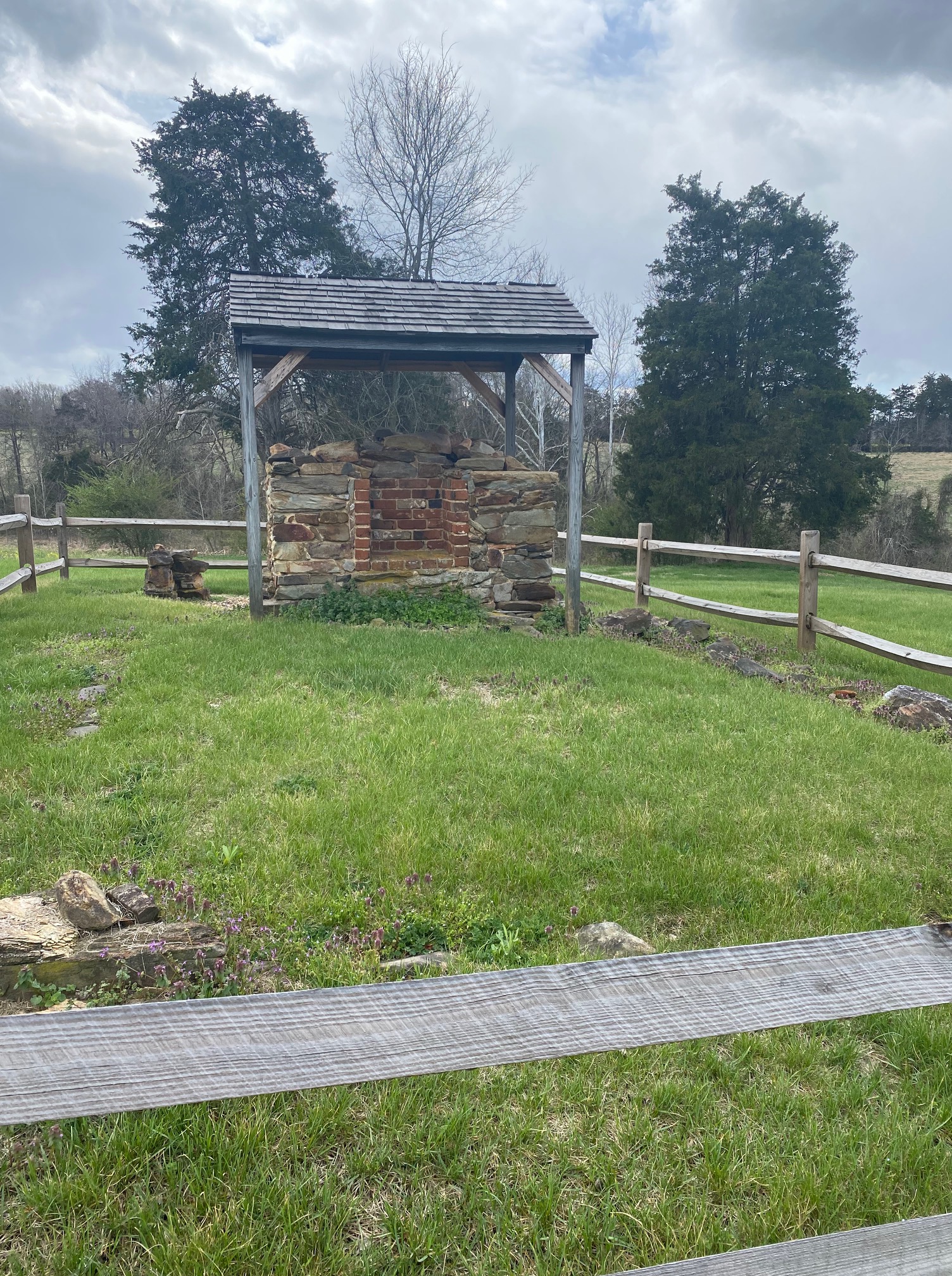
That letter may have been written somewhere around the terrain you see in the photos below. You never know what you can stumble into touring central Virginia!
Wilderness Tavern Ruins, the tavern was built after the American Revolution in 1810 View of the rolling terrain that made the encampment near Wilderness Run, which is in between the two hillsides, defensible View of where Lafayette’s forces were camped







 Emerging Revolutionary War Era