This March brings the 241st Anniversary of the pivotal battle of Guilford Courthouse, NC. While this battle is of immense importance to the Southern Campaign, several smaller battles leading up to it have been largely overlooked. Through February and early March of 1781, detachments of the American and British armies maneuvered across the modern-day counties of Alamance, Guilford, Orange, Chatham, and Caswell. The is the third in a series of three articles.
The last of the skirmishes occurred at Weitzel’s Mill, also spelled as Wetzel’s, and Wiley’s. Cornwallis was becoming more determined to strike at the Americans to either force a general battle, which he felt his veteran army could win, or destroy the isolated detachments operating near him.
This March brings the 241st Anniversary of the pivotal battle of Guilford Courthouse, NC. While this battle is of immense importance to the Southern Campaign, several smaller battles leading up to it have been largely overlooked. Through February and early March of 1781, detachments of the American and British armies maneuvered across the modern-day counties of Alamance, Guilford, Orange, Chatham, and Caswell. This is the first of a series of three articles.
Having unsuccessfully chased General Nathaniel Greene’s small, ragged army across North Carolina, British forces under Lord Charles Cornwallis moved to the state capital at Hillsborough to announce their liberation of the state and call Loyalists to come forward and support them. Greene’s army retreated across the Dan River into Virginia, where he awaited supplies and reinforcements.
On January 17, 1781, General Daniel Morgan and his mixed force of Continental soldiers and militia defeated the British under the command of Lieutenant Colonel Banastre Tarleton. This victory for the patriots in northwestern South Carolina had major implications on the southern theater and the main British force under General Lord Charles Cornwallis. The battle, named after the use of the fields in which it was fought, Cowpens, also included one of the only instances in American history of a successful double envelopment.
On Sunday, at 7 p.m. EDT, Emerging Revolutionary War will be joined by American Battlefield Trust’s Kristopher White, Deputy Director of Education and Daniel Davis, Education Manager, in a discussion about the history and preservation of the Battle of Cowpens.
Round out your January weekend by joining us on our Facebook page for this live historian happy hour.
Emerging Revolutionary War welcomes back guest historian Karl G. Elsea
It is common for artists to use “artistic license” when painting historic events including American Revolutionary War art. The problem is this practice also
aids inaccuracies persisting. Here is one case study of one picture involving an historic event that is presented by the National Park Service (NPS) at Yorktown. Please note the staff is helpful and the grounds are beautiful. As for the severity of the problem, the reader can decide after reading the information.
The following picture is from the field at Yorktown where the French Artillery Park was located. The picture illustrates the idea of what an artillery park was.
The problem is this picture contains a number of images that are wrong. For example, the carriages, wagons, carts, and limbers should be painted light blue. The French Army artillery had been painted light blue prior to 1750. There is a lot of confusion to this day concerning gun and limber carriage colors. This confusion may have been generated by a current belief there was one French artillery color. The French used the color of the items to assist which department owned the material. The French Navy department [Ministry of Marine] was responsible for the colonies, including North America, and their cannon were on red carriages with, in all most all cases, iron barrels. The French Quartermaster’s department had their wagons were painted a brighter red. The French Army artillery was painted light blue with bronze barrels. Thus, the French Army barrels shown should appear to be “brass.”
Emerging Revolutionary War welcomes back guest historian Karl G. Elsea
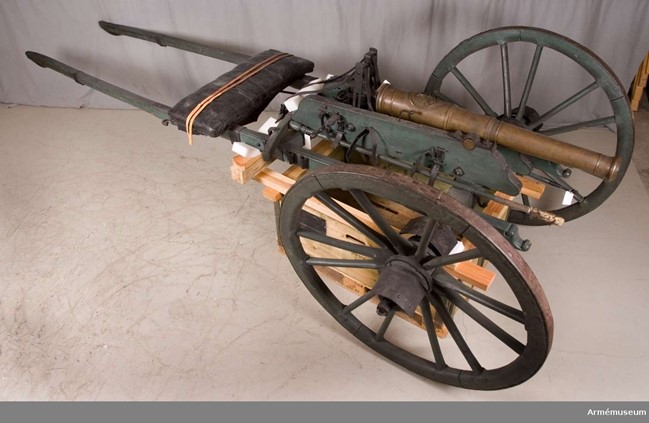
History can be fun; for example, when a war trophy in Sweden and the popular television series “Antiques Roadshow” can be combined to explain an American Revolutionary War legend. There are a number of books, articles, an actor impersonator, and even an U. S. Postal stamp from 1975 showing Peter Francisco carrying a cannon barrel to save it from falling into British hands at the Battle of Camden. Sadly, their stories of Peter carrying a barrel weighting 600 pounds, or even an amazing 1,100 pounds, are not close to true. Here is the likely story. The kind of barrel Peter actually carried is shown in the next picture. The barrel likely weighed between 200 and 300 pounds.
An original amusette is located at the Armémuseums’s magazine in Stockholm. This amusette was constructed in 1768 and captured by the Swedes in the battle at Berby in 1808. The following picture shows this amusette:
Like a modern-day Nathanael Greene or Edward Carrington, Andrew Waters spends his days trekking the waterways of the Carolina high country. Just like those famous military leaders, Andrew Waters does the surveying of these waterways and their tributaries for his day job; as a land and water conservationist.
During this career, Waters first learned about the “Race to the Dan” the pivotal retrograde movement in 1780 that saved Greene’s army from the pursuing British force under Lord Charles Cornwallis. Having the unique perspective from his training and an interest in the history of the time period, he had the perfect combination to pen a complete history of the “Race to the Dan.” Published by Westholme Publishing in October 2020, the title, To The End of the World, Nathanael Greene, Charles Cornwallis, and the Race to the Dan fills a much needed gap in the historiography of the the American Revolution in the southern theater.
This Sunday, at 7p.m. EDT, on Emerging Revolutionary War’s Facebook page, join us in an interview with Waters, discussing this book, Nathanael Greene’s leadership, and any questions you may have about this subject. Remember that favorite beverage and we look forward to you tuning as we welcome historian and author Andrew Waters to the next installment of the “Rev War Revelry.”
In the spring of 1778, General George Washington chose Major General Nathanael Greene to be the quartermaster general of the Continental army, replacing General Thomas Mifflin who had resigned the previous November. Greene was hesitant and wrote the quote that graces the title of this post. He was leery of giving up a field command to take a thankless job that faced a mountain of difficulties and was more administrative. From the start of his tenure in this important post, Greene brought about effective change. His never ending responsibilities included allocating resources, installing the right people into positions, and untangling contracts, transportation woes, and developing a concept, such as supply depots on potential campaign routes were vast improvements over what his predecessor accomplished.
Nathanael Greene
Greene though yearned to return to an active field command and through his close connection to Washington along with his due diligence as quartermaster, he was assigned command in the southern theater. His assignment was to replace Major General Horatio Gates as the head of Continental forces after the latter’s defeat at Camden, South Carolina in August 1780. Greene’s role in this position is well-documented and outside the scope of this post. One of the decisions he made, early on in his tenure as commander, paid huge dividends and is usually relegated to a passing few lines in most histories of the southern campaigns. What Greene wrote years earlier about “quartermaster in history” the quote that gives this piece its title, holds true in this instance as well.
On December 4, 1780, Greene wrote to Edward Carrington, then on assignment scouting the rivers and topography through North Carolina and southern Virginia, offering him a new assignment; that of quartermaster general for the southern army. After finishing his surveying of the rivers and water transportation, Carrington was ordered to head toward Greene’s forces, bringing supplies that had been gathered with him as well.
This decision, to place an officer of the caliber of Edward Carrington, in that position was a wise move. One that passes largely unheralded. A decision, though, that ultimately leads to success and eventual victory. In this case the momentous “Race to the Dan” that saved Continental forces, fatigued Lord Charles Cornwallis’ British forces, and played an early role in the latter’s move toward Virginia.
Emerging Revolutionary War welcomes guest historian Andrew Waters
Appearing this month at the Journal of the American Revolution (JAR) is an article I wrote on William “Bloody Bill” Cunningham and his infamous raid known as the “Bloody Scout.” The article attempts to provide a single-source narrative of the Bloody Scout and some of the contexts for it, although it is based on a previous article I wrote (though never published) that attempted to explore more deeply its sociological implications.
Anyone who comes to western South Carolina and has any interest in the American Revolution will soon encounter Bloody Bill. As I attempted to explain over at JAR, “without veering too deeply into sociological speculations, I can only say that his (Cunningham’s) presence is still palpable here, embedded in the cultural DNA. Though he may be only a curiosity in other parts of the United States, if he is known at all, in the South Carolina Upstate, it seems there will always be Bloody Bill.”
While delegates to the Second Continental Congress debated the matter of Independence in 1776, the British brought the war to Charleston, South Carolina. Defense of the city focused on Fort Sullivan, on Sullivan’s Island at the northern mouth of Charleston Harbor. Major General Henry Clinton, commanding an Army expedition against the Americans, was determined to exploit the fort’s vulnerabilities. He ultimately failed, but his effort, or lack thereof, prompted a British newspaper to craft a little ditty taunting the poor general.
Writing over thirty years after the fact, Henry “Light Horse Harry” Lee summed up the events of February 14, 1780 with the line, “Thus ended, on the night of the 14th of February, this long, arduous, and eventful retreat” (190). Upon hearing of General Nathanael Greene’s exploits in this movement, General George Washington wrote, “You may be assured that your Retreat before Lord Cornwallis is highly applauded by all Ranks and reflects much honor on your military Abilities.” (198).
What Lee would remember as “eventful” and Washington and fellow military ranks “highly applauded” is remembered today as the “Race to the Dan.” This retrograde movement, undertaken by Greene’s forces from South Carolina to the Dan River in southern Virginia, is sandwiched between the engagements at the Battle of Cowpens in January 1781 and the British pyrrhic victory at Guilford Court House in March 1781. Yet, this retreat may be on the turning points in the southern theater that led the British, under Lord Charles Cornwallis to his eventual demise at Yorktown in October 1781.
Great historians, such as John Buchanan is his monumental work The Road to Guilford Court House have covered with broad strokes this period of time but a dedicated study was much needed in the historiography of the American Revolution. Insert Andrew Waters, writer, editor, and conservationist, whose name may be familiar from previous works such as The Quaker and the Gamecock: Nathanael Greene, Thomas Sumter, and the War for the Soul of the South. His latest book, To The End of the World, Nathanael Greene, Charles Cornwallis, and the Race to the Dan, captures this important military movement while providing an expose on the leadership of Greene woven in. The title of the book is pulled from a quote by Brigadier General Charles O’Hara, Cornwallis’s second-in-command during this campaign. With a background in land conservation with a focus on river corridors and watersheds, Waters found a connection with Greene, who studied the various waterways—or ordered subordinates—to study the various rivers, to better understand the topography for military campaigns.
After a stint in Salisbury, North Carolina, Waters became fascinated with the Race to the Dan story and decided to plunge in to understanding this period of the American Revolution. He found that “the Race to the Dan is a remarkable tale, fit for cinema or an epic novel, and not only for its accounts of four narrow escapes across its four rivers” (xv). He was drawn “to its story” (xx) and any reader of the book is the beneficiary of that discovery.
Along with weaving in the innate leadership qualities of Greene, Waters brings to light the importance of military leaders not as well-known such as William Lee Davidson, William R. Davie, and Edward Carrington with more household names of Lee, Daniel Morgan, and Otho Holland Williams. Throw in the names of Cornwallis, O’Hara, and Banastre Tarleton, and the pantheon of American Revolutionary personas is complete.
In this approximate month-long retreat, Greene saved the American Revolution in the southern theater and set in motion the events that led to the climactic victory at Yorktown. Waters, with his 2020 publication, has now helped save the story of the Race to the Dan from its unintended lapse into obscurity.
Information:
Published: 2020 (Westholme Publishing)
264 pages, including index, footnotes, images, and maps






 Emerging Revolutionary War Era