From our friends at American Battlefield Trust (ABT). To learn more about the ABT, click here.
At stake are 31 acres associated with two Southern Campaign Revolutionary War battlefields, Hanging Rock in South Carolina and Guilford Courthouse in North Carolina.
At Hanging Rock, generous battlefield preservationists like you have already secured 141 acres. These 30 acres in the part of the battlefield where the initial Patriot attack began will add significantly to the land we have saved there already.
At Guilford Courthouse, the half-acre tract at stake may be small, but it’s part of a larger strategy to deal with the modern development crowding in on this battlefield from all points of the compass. Our plan is to buy up plots of battlefield land – including small ones and those with non-historic structures on them like this one – remove all non-historic structures and restore the battlefield. The Guilford Courthouse National Military Park has generously agreed to take responsibility for demolishing and removing the house on this plot, a considerable cost that we would typically need to cover. Continue reading “Rise and Fight Again for Southern Revolutionary History”→
From our friends at the Southern Campaigns of the American Revolution comes this announcement of a Corps of Discovery tour that will cover the battles mentioned above. Led by historians David P. Reuwer and Charles B. Baxley, this comprehensive tour will be held on May 4, 2019.
Joining Reuwer and Baxley will be Dr. Tray Dunaway who will talk about the restoration forestry that has taken place at Camden Battlefield that has returned the field to the approximate look it did during the battle in August 1780. Also part of the day will be the historians guiding the tour of Hobkirk’s Hill, which includes Bill Denton, Rick Wise, Tom Oblak, and Guy Wallace.
Updates on the Historic Camden Foundation and the Liberty Trail will be part of the day as well which will start at 10:00 a.m. at the Historic Camden Revolutionary War Site and conclude at around 4:00 p.m. after the touring of Hobkirk’s Hill.
The tours are free and more information about the day can be found here.
Hope you can join our friends and fellow historians in South Carolina on May 4th!
From our friends at American Battlefield Trust (ABT) comes the following announcement and call for assistance.
The first line of the announcement sums up the importance of this new initiative of the American Battlefield Trust:
“They secured our liberty. It’s time for us to honor their legacy.”
In a collaboration between the ABT, the National Park Service, and the South Carolina Battleground Trust, the joint initiative is to highlight the “tremendous significance of these places to American independence.” Their combined goal is to preserve 2,500 acres of American Revolutionary War battle lands in the Palmetto State.
As of the middle of this month, 308 acres of hallowed ground has been saved. The land protected are part of the battlefields of Camden and Eutaw Springs, which “bookend a period of incredible consequence to the American Revolution.”
This is a great start, but as that means, it is a beginning and the ABT will need all our help to make it happen. This new direction will bring preservation, education, and technology together into one investment and keep the effort going, until this land is saved for the present and future generations.
For those readers of ours that are already members, thank you. For those that are interested in learning more, click here.
To check out the various sites and history associated with the Liberty Trail, click here.
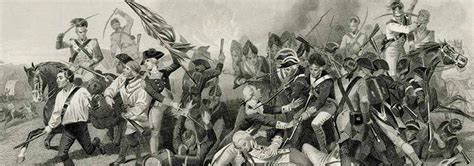
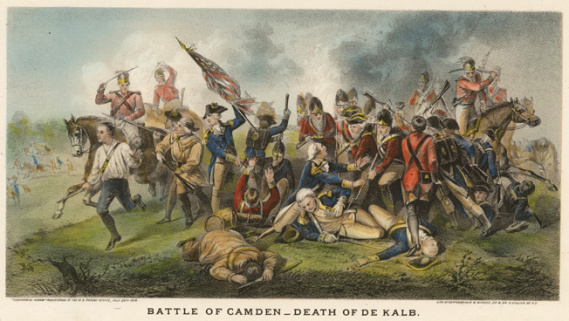
238 years ago today the United States military suffered one of its worst defeats. The Battle of Camden, fought on August 16, 1780 just a few miles north of Camden, SC was a total defeat for the American “Grand Army” under popular General Horatio Gates. The British under Lord Cornwallis inflicted nearly 1,900 casualties (out of 4,000) at a loss of only 300. One of the biggest losses was the death of General Baron Johann de Kalb, a popular foreign general in the American army. Though a strategic defeat for Gates, it was the retreat that would lead to Gates’ demise. As the militia broke and ran, Gates was caught up in the panic and fled the field as half of his army was still fighting.
Writing several days later from Hillsborough, NC Gates submitted his account of the battle to Congress. Already, reports of cowardice were starting to spread about Gates’ conduct during the battle. Gates decision to fight and his decision to leave the field during the battle have been debated ever since that August day in 1780. Below is a portion of Gates’ letter.
“In the deepest distress and anxiety of mind, I am obliged to acquaint your excellency with the defeat of the troops under my command. I arrived with the Maryland line, the artillery, and the North-Carolina militia, on the 13th instant at Rugeley’s, thirteen miles from Camden; and took post there, and was the next day joined by General Stevens, with seven hundred militia from Virginia…. Having communicated my plan to the general officers in the afternoon of the 15th, it was resolved to march at ten at night, to take post in a very advantageous situation, with a deep creek in front, seven miles from Camden; the heavy baggage, &c. being ordered to march immediately by the Waxhaw road. At ten the army began to march in the following order: Colonel Armand’s legion in front, supported on both flanks by Colonel Porterfield’s regiment, and the light infantry of the militia; the advanced guard of infantry, the Maryland line, with their artillery, in front of the brigades, the North-Carolina militia, the Virginia militia, the artillery, &c. and the rear guard. Having marched about five miles, the legion was charged by the enemy’s cavalry, and well supported on the flanks, as they were ordered, by Colonel Porterfield, who beat back the enemy’s horse, and was himself unfortunately wounded; but the enemy’s infantry advancing with a heavy fire, the troops in front gave way to the first Maryland brigade, and a confusion ensued, which took some time to regulate. At length the army was ranged in line of battle, in the following order: General Gist’s brigade upon the right, with his right close to a swamp, the North-Carolina militia in the center, and the Virginia militia, with the light infantry and Porterfield’s corps, on the left; the artillery divided to the brigades; and the first Maryland brigade as a corps de reserve, and to cover the can non in the road, at a proper distance in the rear. Colonel Armand’s corps were ordered to the left, to support the left flank, and oppose the enemy’s cavalry. At daylight the enemy attacked and drove in our light party in front, when I ordered the left to advance and attack the enemy; but to my astonishment, the left wing and North -Carolina militia gave way. General Caswall and myself, assisted by a number of officers, did all in our power to rally the broken troops, but to no purpose, for the enemy coming round the left flank of the Maryland division, completed the rout of the whole militia, who left the continentals to oppose the enemy’s whole force. I endeavoured, with General Caswall, to rally the militia at some distance, on an advantageous piece of ground, but the enemy’s cavalry continuing to harass their rear, they ran like a torrent, and bore all before them. Hoping yet, that a few miles in the rear they might recover from their panic, and again be brought into order, I continued my endeavour, but this likewise proved in vain. The militia having taken the woods in all directions, I concluded, with General Caswall [sic], to retire toward Charlotte.”
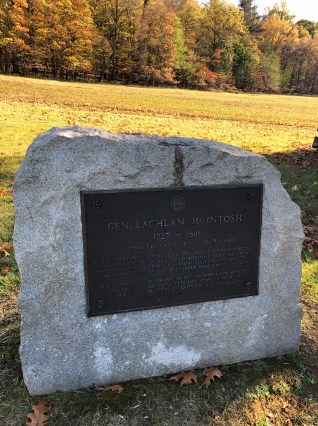
On a recent trip to Valley Forge National Historical Park I came across the monument to featured below, of a general that did not initially ring a bell in my memory. So I did a little investigating. The first name was intriguing. His story even more so. Especially how he came to spend the winter at Valley Forge.
Lachlan McIntosh Monument, Valley Forge National Historical Park (author collection)
Born near Raits, Badenoch, Scotland on March 17, 1725 and at the age 11, Lachlan, along with his family and approximately 100 other Scottish immigrants, landed in Georgia where they founded the town of New Iverness. Out of all the cruelties that could visit a family eking out a future on the frontier, the calamity that claimed Lacklan’s younger brother would have been far down the list. While swimming in the Altamaha River in 1737, Lewis McIntosh was killed by an American alligator. Continue reading “Lachlan McIntosh”→
With autumn just around the corner, cooler weather on the horizon, and the holidays quickly approaching. Some stores in the local area have Halloween, Thanksgiving, and Christmas decorations all for sale currently, Emerging Revolutionary War wanted to bring your attention to a few different Revolutionary War Era happenings to mark on your calendars. Continue reading “Upcoming Lectures, Talks, and/or Events”→
In the quaint South Carolina town of Winnsboro, a few miles off of current Interstate-77 sites a two-story stands one of the oldest dwellings in a town founded by Richard Winn of Virginia a few years before the start of the American Revolution.
Yet, it was during those hostilities that one of the more famous military leaders came to “Winnsborough” as it was sometimes listed on maps of the time. His name, Lord Charles Cornwallis, the overall commander of British forces in the Southern Colonies. He would use the house during the winter of 1780-1781.
The house itself is an enigma. The structure dates to pre-1776 obviously, but the builder and owner of the house is still not known. Yet, it is well document that the house did serve during the labeled “winter of discontent” for the British and Cornwallis.
Across the street resides the Mount Zion Institute which became quarters for British soldiers during that winter of 1780-1781.
After the conflict the property and house was deeded to Captain John Buchanan, a veteran of the American Revolution. Buchanan was part of the welcoming party for the Marquis de Lafayette when the Frenchman landed at Georgetown, South Carolina.
Although not open to the public, special requests will be entertained. Click here for the link below for more information on the house and also who to contact for those special arrangements.
Daughter’s of the American Revolution (D.A.R.) Monument, Eutaw Springs Battlefield (author collection)
In many ways, the battle of Eutaw Springs was a disappointment for both commanders. Greene’s troops at one point broke through the British lines, but they recovered, and the Americans failed to drive them off the field. Stewart, in a letter to Cornwallis, wrote that there were two things he would regret the rest of his life: the loss of an early morning supply gathering party and his lack of cavalry. Having them, he felt, would have enabled him to decisively defeat Greene. Probably both commanders, and many of their officers, reflected upon these events and second guessed themselves for the rest of their days. Although both armies fought well at Eutaw Springs, a clear cut victory eluded both of them. Continue reading “After Eutaw Springs”→
Emerging Revolutionary War is pleased to welcome back historian Bert Dunkerly, who is the co-author (with Irene B. Boland) of the upcoming book; “Eutaw Springs; The Final Battle of the American Revolution’s Southern Campaign” slated to be released this month.
Part One
The weather was warm and the men had been marching for days, but their morale was high. They had been through a lot recently: caught off guard and defeated at Hobkirk’s Hill, a month of grueling siege work – and for naught, at Ninety Six. Not to mention the engagements that many of them had fought in previously: Kings Mountain, Cowpens, Guilford Courthouse, and dozens of smaller battles.
Yet the army that General Nathanael Greene led forward on the morning of September 8, 1781, was confident and ready to come to grips with its adversary. Everyone from the private in the ranks on up to the commanding general knew that ahead lay an opportunity.
Battles in the Revolution were, in fact, rare opportunities for commanders. Engagements were the short, pulse-pounding events that broke up the monotony of marching and maneuvering. An army spent most of its time in garrison, in camp, or on the road. In battle the infrequent opportunity came to crush an opponent and influence the outcome of a campaign, or the war. These chances were few and far between.
“Eutaw Springs” by Benson Lossing
Both commanders at Eutaw Springs appreciated this fact. General Nathanael Greene’s forces had experienced a series of close calls at Guilford Courthouse, Ninety Six, and Hobkirk’s Hill. The American army fought well in all of these engagements, save Hobkirk’s Hill, yet they met defeat in every one. Greene hoped Eutaw Springs would put the finishing touches on his South Carolina campaign, and end it with a clear cut victory.[i]
Eutaw Springs was a rare chance for Greene to pick the time and place of engagement, array his forces to his choosing, and initiate the battle, and control its \tempo. It was the only set engagement of the campaign, other than Guilford Courthouse, in which Greene chose the ground and initiated the battle. Commanders do not often have this luxury, and Greene earnestly hoped to make the most of it. Continue reading “Eutaw Springs”→