In the western Maryland city of Frederick there is an innocuous looking brick building that stands in the historic downtown. The non-descript 20th century structure, near the corner of Market and 2nd Streets, is easily overlooked in a city full of stately Federal and Victorian-era homes. A closer look, however, gives a few tantalizing details of Frederick’s Revolutionary War past. A bronze plaque bears the following inscription:
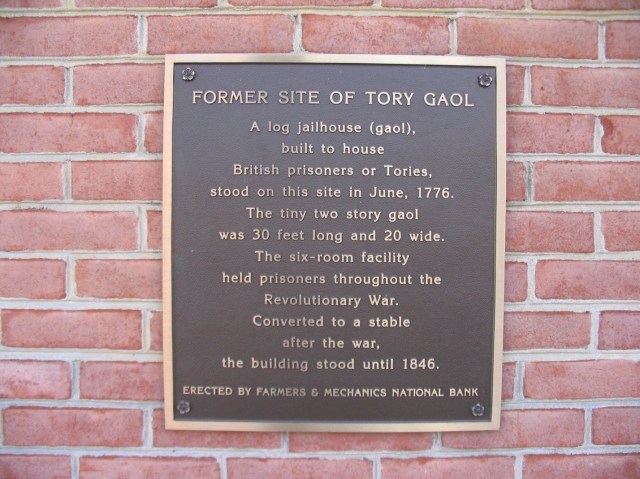
(Photo by Craig Swaim/HMDB.org)
Former Site of Tory Gaol
A log jailhouse (gaol),
built to house
British prisoners or Tories,
stood on this site in June, 1776.
The tiny two story gaol
was 30 feet long and 20 wide.
The six-room facility
held prisoners throughout the
Revolutionary War.
Converted to a stable
after the war,
the building stood until 1846.
At the start of the American Revolution Frederick was a prosperous market town, ideally situated in the fertile Monocacy River Valley. Roads radiated out in nearly every direction, connecting the growing town to major seaports like Baltimore and Georgetown, Maryland as well as frontier outposts like Cumberland, Maryland and Winchester, Virginia. Nearby farmland attracted settlers throughout the mid-eighteenth century, particularly German immigrants travelling south from neighboring Pennsylvania.[i] By 1745 a town had been laid out which served as the county seat for the entirety of western Maryland.
When war began in 1775 the people of Frederick were among the first in Maryland to join the patriot cause. Two companies of riflemen were raised in Frederick County in the summer of 1775, and departed Frederick for Boston on July 18th. Marching along with companies of Virginia they reached their destination in only 22 days, becoming the first southern troops to join the New Englanders besieging Boston.[ii]
Although support for war with Britain reached a fever pitch in the summer of 1775, some Fredericktonians still held out for reconciliation or even sought open collaboration with the British. In a scene that would be repeated in countless communities throughout the colonies, these Loyalists would suffer for their political convictions. In November 1775 a Pennsylvania-born Loyalist named John Connolly was stopped as he travelled through Frederick County with some Scottish associates. He was detained near Elizabethtown (modern Hagerstown) while the local Committee of Safety rifled through his belongings, and the search soon turned up incriminating evidence. Connolly was on his way through Maryland with hidden papers, including a commission from Lord Dunmore – then the Royal Governor of Virginia – to raise a regiment of natives and frontiersmen to harass the western settlements.[iii] George Mason wrote to General Washington, describing the plot:
” Majr Connelly was taken above Frederick Town in Maryland, in his way to the Indian Country and with him a Doctr Smith from Charles County & one Cameron, they are all now fast by the heels in the Goal of Frederick Town. Connelly we are told, had with him a Commission from Genl Gage to raise a number of Indians, & with them to penetrate, thro the Country towards Alexandria, in the spring, where he would be met by Lord Dunmore. Commissions for the other two were to be furnished hereafter.”[iv]
The hapless Loyalist and his would-be conspirators were detained in Frederick before eventually being sent on to Philadelphia.
Concern over Loyalist plots like Connolly’s was such that in December 1775 the Maryland Convention authorized £200 for the construction of a jail specifically for confining Loyalists. Located on 2nd Street, the building consisted of “a strong log jail…thirty feet long, twenty broad, to be lined with two-inch planks, two stories, with split logs and plank floors, the upper story divided into three rooms, with a stove in each.”[v] Construction was completed in May of the following year, and almost immediately prisoners were brought there for incarceration. The first group of “tories” imprisoned in Frederick were from North Carolina, but more quickly followed.[vi] By the summer of 1776 there were 27 Loyalist and British prisoners being held in Frederick’s “Tory Gaol” – so many that it was considered “a dreadful place…to be confined in, and so crowded at present that we fear it may be dangerous to their health.”[vii] Prisoners were transferred to the county jail opposite the courthouse in an attempt to relieve the overcrowding.
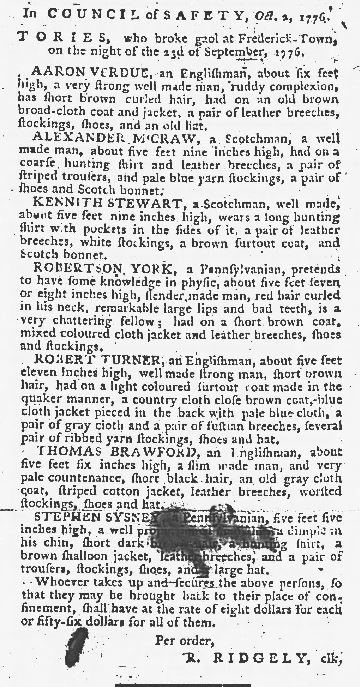
Advertisement for Loyalists who escaped the jail in Frederick on September 23, 1776 (Maryland Gazette. October 3, 1776)
As the war dragged on, Frederick continued to house an ever growing number of prisoners. In large part this was due to the town’s location far enough from the main theaters of the war to be relatively secure, but also centrally located between north and south. A group of more than 100 prisoners captured at Saratoga arrived in Frederick in December 1777 and were temporarily confined in the county jail while permanent quarters were being erected at forty miles to the west at Fort Frederick. On Christmas day these disgruntled British and German POWs set the jailhouse on fire and attempted to escape in the ensuing chaos but were gradually beaten back by guards under the command of Lt. William Beatty.[viii] The failed jail breakers were rounded up and sent to the Tory Gaol, where they stayed under the threat of execution if they attempted another escape.
The issue of prison overcrowding was partially resolved in 1781 with the completion of the Frederick Barracks. Begun in 1777, the large stone buildings were designed to house Maryland volunteers, but they were soon put to use holding German prisoners. As a result the buildings – one of which still stands today – earned the lasting sobriquet “Hessian Barracks”.[ix]

The so-called “Hessian Barracks” on the south side of Frederick. Built between 1777 and 1781 to house American soldiers, they were used to house British and German prisoners during the Revolutionary War. Prisoners from the Quasi War and War of 1812 were also held here. Later they served as a barracks and hospital during the Civil War. The existing structure is currently owned by the Maryland School for the Deaf. (Library of Congress)
In the next installment, we’ll take a look at the most infamous Loyalist plot to be uncovered in Maryland during the war and the trial that resulted…
[i] Tracey, Grace and Dern, John. Pioneers of Old Monocacy: The Early Settlement of Frederick County, Maryland, 1721-1743.
[ii] Scharf, Thomas. History of Western Maryland. pp 130-131.
[iii] Connolly, John. “A Narrative of the Transactions, Imprisonment, and Sufferings of John Connolly, an American Loyalist and Lieut. Col. in His Majesty’s Service” The Pennsylvania Magazine of History and Biography
Vol. 12, No. 3 (Oct., 1888), pp 310-324
[iv] Journal and Correspondence of the Maryland Council of Safety, August 29, 1775 to July 6, 1776. p 93
[v] Scharf. p 138
[vi] Steiner, Bernard. Western Maryland in the Revolution. pp 34-35.
[vii] Ibid. p 35
[viii] Scharf. p 141.
[ix] Maryland Historical Trust. https://mht.maryland.gov/nr/NRDetail.aspx?NRID=46





 “The study of history is an ongoing conversation between past and present from which we all have much to learn,” write Joseph Ellis in his new book, American Dialogue: The Founders and Us. The book serves as Ellis’s attempt to sit with several of the Founders and carry on that conversation, with “us,” the readers, as spectators. As John Adams so often did with his own books, we can engage in the conversation by writing notes in the margins and underlining passages, and we can even read the original works of the Founders ourselves. Knowing they were writing as much to history as to each other, they left behind a rich documentary legacy.


 Emerging Revolutionary War Era