When thirteen North American colonies rebelled against the British crown, the future state of Florida was not part of that movement. In fact, the settled part of the future 27th state of the United States was partitioned into East and West Florida. Both colonies also declined an invitation to send delegates to the Continental Congress.
East & West Florida colonies
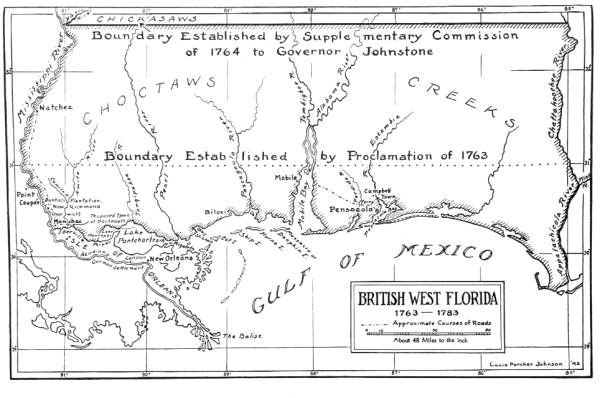
West Florida, spanned from slightly east of Pensacola, which was the capital, across to Louisiana and included parts of modern Alabama, Louisiana, Florida, and Mississippi. East Florida, spanned the rest of northern Florida from the Apalachicola River to the Atlantic seaboard and down the peninsula. The capital was located at St. Augustine, founded in 1565 by the Spanish.
During the American Revolution, both East and West Florida would play a role as the rebellion spread into a world conflict, bringing into the fighting the European nations of France and Spain. In East Florida, St. Augustine would send north British soldiers to assist in operations in Georgia and South Carolina and also house American prisoners, including three Signers of the Declaration of Independence; Arthur Middleton, Edward Rutledge, and Thomas Heyward, Jr. Other prisoners, both Americans and French were also confined to the town too.
On October 3, 1789, President George Washington issued a “Thanksgiving Proclamation” to the people of the United States. In this declaration, Washington designated “Thursday, the 26th day of November” to “the People of the United States a day of public thanks-giving.”
On Thursday, November 26, 2020, Emerging Revolutionary War will give to the “People of the United States” a live Facebook presentation of this proclamation at 7 p.m. EST.
courtesy of Mount Vernon
In addition to the reading of the proclamation, ERW invites you to gather questions and comments that you would want our historians to chat about, as we return on Sunday, November 29 with the next historian happy hour. Our historians will recap some of their favorite moments of research, of the annual trip, and some of the happenings on tap.
But, mostly, it will be an hour dedicated to good beer, good discussion, and staking opinions. So, wake up from that turkey coma by Sunday and click on over to our Facebook page for this “Rev War Revelry.”
Emerging Revolutionary War welcomes guest historian George Kotlik.
After the French & Indian War, the British Crown sought to regulate colonial westward settlement and expansion. This was done for a variety of reasons. First, British ministers believed that westward expansion would require administration over newly acquired territory.[1] British leaders also feared that unrestricted colonial expansion could lead to ungovernable colonies who would, over time, seek to split with Great Britain.[2] Most importantly, Britain had acquired Florida and almost all of the territory under New France east of the Mississippi River at the conclusion of the Seven Years’ War. British ministers sought to redirect western settlement towards Canada and the Florida’s.[3] Regulation of western land settlement also protected Indian lands from white encroachments. This measure sought to prevent further Indian wars.[4] The impositions placed on westward settlement infuriated colonial land speculators who sought to gain much wealth in acquiring western lands. After the Great War for Empire, George Washington and other veteran officers of that conflict were awarded land in exchange for their services to the Crown.[5] Many eyed lands in the Ohio Country, but after the October 7 Proclamation of 1763, most acreage in that vast wilderness lay out of reach. The account of Washington’s interest in North America’s western lands is popular and well-known. However, lesser known is the former British officer’s interest in West Florida land.[6]
Gnadenhutten. Pronounced with a silent “G” does not smoothly roll of the tongue. Nor is it a historical event that most people are aware of. Cue Eric Stener, historian with Emerging Revolutionary War, contributing historian to both the Journal of the American Revolution and Emerging Civil War while conducting a career in government and public policy, specializing on national security and aerospace.
And now specializing on the Massacre at Gnadenhutten. His latest publication, part of the Journal of American Revolution Books is a November 2020 release that examines the March 8, 1872 massacre of peaceful Native Americans under the tutelage of missionaries from the Church of the United Brethren. Conducted by western settlers, the atrocity caught the attention of revolutionaries such as Benjamin Franklin who wrote, “the abominable Murders committed by some of the frontier People on the poor Moravian Indians, has given me infinite Pain and Vexation.”
Although “ample incidents of good and evil on March 8, that summation does not explain what brought murderers and victims together on the banks of the Muskingum River in today’s Ohio.”
For that reason we turn to the next “Rev War Revelry” this Sunday, at 7 p.m. EST on our Facebook page as we discuss his latest work with author Eric Sterner. For more information or to purchase your copy of his book, click here.
We look forward to you joining us this Sunday for the next historian happy hour!
Although the American Revolutionary War staggered into a period of inaction after the Battle of Monmouth Court House in June 1778, General George Washington, in charge of all Continental forces, remained steadfast in New York until the late summer of 1781. Even though the principal actions of the war moved to the southern colonies, resulting in catastrophic losses at Charleston, Waxhaws, and Camden in 1780 through 1781, Washington did his utmost to quell British incursions, reinforce public opinion, and provide whatever succor he could from a distance. What is evidence of his mindset and depth of concern for this theater of operations?
Simple. Look at the general officers he dispatched south from the main army to help the American cause in the Carolinas and Virginia. The list includes some of the most trusted officers that served Washington.
First, Benjamin Lincoln, who met his fate at Charleston, but had served ably in the north, even working in the tense environment of the Saratoga campaign, between the volatile Benedict Arnold and the complacent Horatio Gates.
Second, Nathanael Greene, who had overcome growing pains, the recommendation to hold onto Fort Washington in New York in 1776 comes to mind, to swallowing his pride and taking the thankless job of quartermaster general during the winter that won the war at Valley Forge. Greene was probably second to Washington in understanding the political, social, economic, even the geographical components of warfare. Although a decisive battlefield victory constantly eluded him, his leadership at Guildford Court House set in motion Lord Charles Cornwallis’s eventual demise at Yorktown in October of that same year.
Moving into the Old Dominion, Washington dispatched Baron von Steuben with Greene to recruit, train, gather supplies, and provide the steady hand that the Prussian born leader had shown so admirably at Valley Forge. As inspector general of the Continental army, Washington’s orders sending the baron south was a major testament to the importance of stopping British incursions into Virginia.
Following the baron, was another European born officer, the Marquis de Lafayette, one of Washington’s favorites. This independent field command showed the growing confidence in the young Frenchman who responded admirably to the task at hand, doing what he can and for the most part, swallowing his brashness, except at Green Spring when he precipitously attacked what he thought was a rearguard of the British. Yet, his actions, coupled with the next general to be discussed, helped keep Cornwallis in the area of operations that would lead to his demise.
“Mad Anthony” Wayne and his Pennsylvania Continentals were also ordered south to join Lafayette in campaigning in Virginia. Wayne, arguably the best combat general in the Continental army, bordering on reckless to his critics though, had masterminded the storming of Stony Point, the last major action in the northern theater. Lafayette and he would be a solid tandem as they worked with limited resources and supplies in the summer of 1781 to contain the British.
Besides these general officers of high rank, “Light Horse” Harry Lee also was sent south to assist Greene and militia, most notably Francis Marion. The partnership between Lee and Marion worked as close to perfection as humanly possible and a model for regular and militia force combined operations.
Another cavalry commander that was sent for duty in the southern colonies was a second cousin of George Washington, William. In charge of light dragoons, mounted infantry who could dismount to fight as infantry, he served admirably in the southern army until his capture at the Battle of Eutaw Springs on September 8, 1781.
William Washington
This list, not intended to be exhaustive but just exploratory, is an example of the importance the southern theater had to the strategic mindset of George Washington. Although the Virginian was fixated on the recapture of New York City until the opportunity to ensnare Cornwallis at Yorktown presented itself, he provided an amazing array of officers of capability to quelling British intensions in the southern theater.
Feel free to comment below on other officers that were sent south that played vital role in the ultimate American victory in this theater of operations.
Yorktown, of course, wasn’t the end of the Revolutionary War. It wasn’t even the end of military action.
Take, for instance, the battle of Dill’s Bluff on James Island, outside Charleston—the last military action of the Revolution in South Carolina. The engagement took place on Nov. 14, 1782.
Join Emerging Revolutionary War this Sunday as we discuss the role of digital history in 2020 with another public history group: the Sons of History.
The Sons of History describe their concept via their website as:
“Literally, we are just two guys who love history. We also understand the importance of knowing history and learning from it. But more important than knowing and learning history, we believe we should be teaching it to others.” (https://www.thesonsofhistory.com/)”
Through a website, podcast, and social media, the Sons of History teach numerous aspects of American history to the general public in a similar fashion that ERW does.
We’ll discuss more who they are, why they got into doing digital history, what time periods they cover, and the powerful stories of the past that both ERW and Sons of History tell the public. Also, how and why they matter today.
So, set your schedule for Sunday evening and tune in at 7 pm ET on ERW’s Facebook page for the next historian happy hour.
Emerging Revolutionary War welcomes back guest historian Kevin Pawlak
On October 15, 1781, British General Charles Cornwallis penned a note to his superior officer General Sir Henry Clinton. Cornwallis told Clinton that American and French forces seized two redoubts, 9 and 10, along the York River the previous night. “My Situation now becomes very critical,” he glumly said. Before his army, entrenched outside of Yorktown, “shall soon be exposed to an Assault in ruined Works,” Cornwallis desperately sought to break the Allied stranglehold slowly bleeding his army. The general turned to Lt. Col. Robert Abercrombie to break the Allied lines anyway he could.
Map of the Allies’ Second Parallel and Abercrombie’s Sortie (from Jerome Greene, The Guns of Independence)
In the summer of 1780, Captain Henry Bird crossed the Ohio River with some 800 Native Americans from various British-allied tribes and two companies of soldiers from Detroit (roughly 50 Canadians and Tories and a mixed group of regulars from the 8th and 47th regiments) to invade Kentucky. More importantly, he brought two pieces of artillery, a three pounder and a six pounder. It was one of the largest and most substantial attacks into Kentucky during the American Revolution.
Bird’s goal was the Falls of the Ohio (today’s Louisville), which was critical to the American war effort on the frontier due to its critical position on the Ohio River. Bird rendezvoused with the great bulk of the Native Americans at the confluence of the Great Miami and Ohio Rivers, (west of today’s Cincinnati) to discover that they had other plans. Attacking fortified areas was less appealing than raiding small settlements and isolated farms, where the Indians might secure booty and terrorize the locals into abandoning Kentucky. Constituting the vast majority of the army, the Native Americans won out.
Starting on April 19, 2020, Emerging Revolutionary War debuted a “Rev War Revelry” on Sunday evenings. The goal was to create a virtual historian happy hour since the outbreak of COVID-19 curtailed many in-person gatherings at pubs, bars, historic venues, or conferences.
Every Sunday since, Emerging Revolutionary War historians, either by ourselves or with noted scholars and guest historians, have discussed, debated, and shared their viewpoints on a range of topics.
We have also listened to our audience and one of the consistent comments and/or suggestion has been to transfer the live videos from our Facebook page to a YouTube channel. Well, we have finally listened!
Emerging Revolutionary War now has a YouTube channel and all our “Rev War Revelry” videos are uploaded on them. There are two playlists for you to click through. One is titled “Author Interviews” and includes every author that has been interviewed on our program. The other category is simply listed “Rev War Revelry” and includes all the other round table historian happy hour discussions.
We hope you continue to enjoy our programs and subscribe to our channel. To head straight to our YouTube channel, click here.









 Emerging Revolutionary War Era