On October 4, 1777, General George Washington’s Continental Army struck the British outpost at Germantown, Pennsylvania. Less than a month after the Battle of Brandywine and approximately a week after the loss of their capital, Philadelphia.
Initially successful, Washington’s forces got bogged down by fog and British holdouts in a stone structure called Cliveden. What started so promising did end in a tactical defeat for the Americans. Yet, coming days before the climatic battle in New York, dubbed Saratoga collectively, the cause of American independence was buoyed.
Although outshone in the annals of history by Saratoga, the setback at Germantown proved decisive in the French court, especially with the French foreign minister, who saw that the simple fact that Washington could regroup following Brandywine and come within some bad luck and fog of defeating the British was testament to resolve of the American effort for independence.
To cut through the fog and discuss the campaign, engagement, and repercussions of the Battle of Germantown, Emerging Revolutionary War invites back historian and author Michael C. Harris this Sunday for the next installment of “Rev War Revelry” at 7pm EST on our Facebook page.
He will join a duo of ERW historians. In addition, his publication, Germantown: A Military History of the Battle of Philadelphia, October 4, 1777, is now available through the publisher, Savas Beatie, LLC. Click here to order.
We look forward to hearing your comments, questions, and/or opinions this Sunday. So, set a side an hour-ish–as you know historians can get to talking and lose track of time easily, especially when books are also involved–for this historian happy hour.
Emerging Revolutionary War welcomes guest historian Kevin Pawlak
New York state has a rich American Revolution history. Battlefields at Saratoga, Oriskany, Fort Ticonderoga, Long Island, and more dot the state’s connection to our nation’s founding. But growing up in the western part of the state, those sites were at least a few hours’ drive.
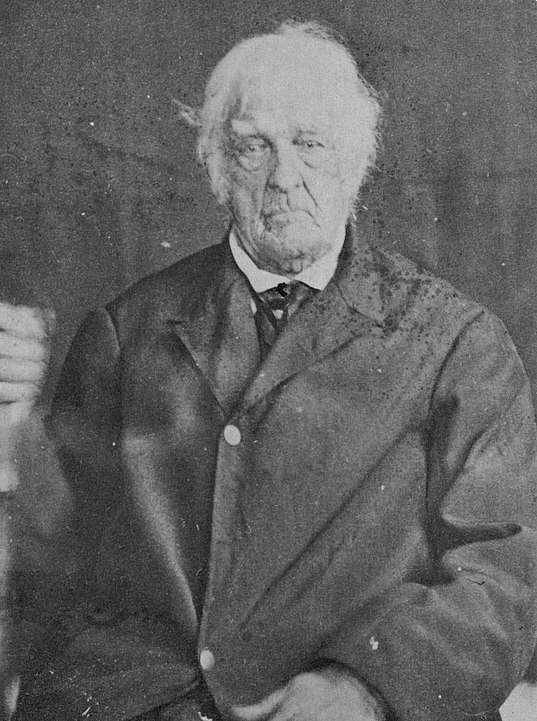
Recently, I discovered a neat story related to the American Revolution that was in my own home county—Orleans County. It is not a battlefield, though it is about a man who stood on those battlefields with George Washington’s Continental Army. Lemuel Cook, who died at the age of 107, spent the last thirty years of his life in the next town over from my hometown and died there. While he was not the last surviving veteran of the war for America’s independence, he was the last to claim a pension for his service.
Lemuel Cook
Ninety-one years prior to his death in 1866, the sixteen-year-old Connecticut native enlisted with the 2nd Continental Light Dragoons. He saw service with the dragoons at Brandywine and Yorktown.
Cook moved frequently after his service expired until he settled in Clarendon, New York in 1832. Cook’s devotion to the nation he helped create never waned until his dying days. He regularly attended town hall meetings and elections until a few years before his death. Souvenir seekers continually asked for the old veteran’s autograph, which he obliged. In 1861, a photographer captured this national treasure in a photograph.
Unfortunately, even Cook could not defeat Father Time. As he aged, his speech became “very fragmentary,” according to one newspaper. “He recalls the past slowly, and with difficulty, but when he has his mind fixed upon it, all seems to come up clear.” Despite his weariness, Cook’s spunk occasionally showed, “the old determination still manifesting itself in his look and words.” Specifically, during an interview in the midst of the American Civil War, Cook pounded his cane on the floor and proclaimed, “It is terrible, but terrible as it is the rebellion must be put down.” Incredibly, he lived to see the rebellion “put down” and died on May 20, 1866.
Cook’s grave, located in the Cook Cemetery on Munger Road in Clarendon, suffered damage in a windstorm in 2017 but was quickly fixed. In the same year, descendants and local historians unveiled a state historic marker alerting passersby to this unique niche of Revolutionary War history in a place far from the famous battlefields that achieved our nation’s independence.
Two riders rode determinedly to Benedict Arnold’s headquarters at the Robinson House across the Hudson River from West Point on the morning of September 25, 1780. The lead courier, Lt. Allen, who had initially been accompanying the captured “John Anderson,” carried with him the letters written by Lt. Col. Jameson informing Arnold of Maj. John Andre’s capture and his subsequent retrieval and return to the American camp at South Salem; the second rider possessed the incriminating papers found on Andre relating to West Point, as well as a newly signed confession the British officer had penned the day before admitting who he was. The second set of documents was meant for George Washington, who was to arrive at Robinson House to meet with Arnold and inspect the fortifications that day. It was a race against time between the two horsemen, and Arnold’s rider had the lead.
Washington was due to arrive at Robinson House for breakfast with Benedict and Peggy Arnold, but he chose to take a quick detour and inspect several American redoubts before continuing on his path from Fishkill, New York, where he had spent the evening. Instead, two of his aides, James McHenry and Samuel Shaw, were sent ahead to inform the couple to begin breakfast without him. Upon their arrival, the men sat down with the general to eat, informing him that the commander in chief would be there shortly. During this, Peggy remained upstairs.
After a few moments, Arnold excused himself from the table and stepped away to issue some daily orders. It was at this time when the walls of Benedict Arnold’s world began to close in on him. Lieutenant Allen had arrived with the news of Andre’s capture and transfer to the American camp at South Salem. The letter from Jameson also informed Arnold that the dispatches Andre carried were forwarded to Washington. If his treasonous plot had not yet been discovered, it was only a matter of time before it was. McHenry and Shaw had shown no signs of suspicion, but did Washington already know?
As the reality of the situation overtook Arnold, he ordered his horse saddled and his boat’s crew to man the vessel below on the Hudson, and told one of his aides, David Franks, that he was travelling upriver to West Point and would be back shortly—he was preparing to make a hasty escape. Before leaving Robinson House, he quickly found Peggy and explained to her that his life was in danger and he needed to leave (if Peggy was truly part of the plot, then what was actually said will probably never be known and was left out of later recollections to avoid incriminating her as well), he then mounted and spurred his horse down toward the river. After entering his barge, he ordered the crew to take him downriver to Stony Point, where he had business to attend to. As the vessel began to sail, an armed American boat passed closely by, and the quick-thinking Arnold told its crew to go up to Robinson House and inform Washington when he arrived that he would be back before dinner. They continued south, and even outran the other craft when it turned around and began to follow them in the other direction.
Arnold’s escape to the Vulture
When Arnold’s crew finally reached Stony Point, his request of them changed dramatically. Offering up two gallons of rum, he ordered his boatmen to carry him further downriver to the enemy vessel Vulture, which was originally supposed to carry Andre to the British lines. Instead, Arnold would be the one who boarded the boat and made his way to New York City, in the process taking the Americans who had just sailed him to safety as prisoners. Arnold’s defection was complete, but his plot to turn over West Point had been foiled.
An hour so after Arnold made his escape, Washington arrived at Robinson House. The commander in chief made his way across the river and was disgusted by the condition of the American defenses. The absence of Arnold perplexed him, but he did not think anything of it until he and his subordinates returned to the general’s headquarters and were greeted by the arrival of the second messenger carrying the Andre documents. Arnold’s treachery was thus revealed to the American high command, and immediately Washington ordered several aides to move downriver and see if the traitor’s vessel had been held up. It was too late, however. Arnold was gone, and as the reality of his betrayal began to set in for Washington (who had always been one of Arnold’s most ardent supporters) the general turned to the Marquis de Lafayette and asked him, “Whom can we trust now?”
Although Arnold had beat a hasty retreat to New York City, Peggy still remained behind at Robinson House. From the Vulture’s deck, her husband had scribbled off a message to Washington pleading with him for her safety and declaring her ignorance to the entire scheme. There are many versions of what transpired next, but according to the American officers at Robinson House, Peggy Arnold broke down in hysterics, seemingly going mad at the news of her husband’s treason. According to Col. Richard Varick, one of Arnold’s aides who was recovering from a fever in the house, a shriek was heard and the staff officer found Peggy with her hair “disheveled and flowing about her neck; [in] her morning gown with few other clothes remain[ing] on her—too few to be seen even by a gentleman of the family, much less by many strangers.” She then proceeded to ask if he had ordered her child to be killed and to “spare her innocent babe.”[1]
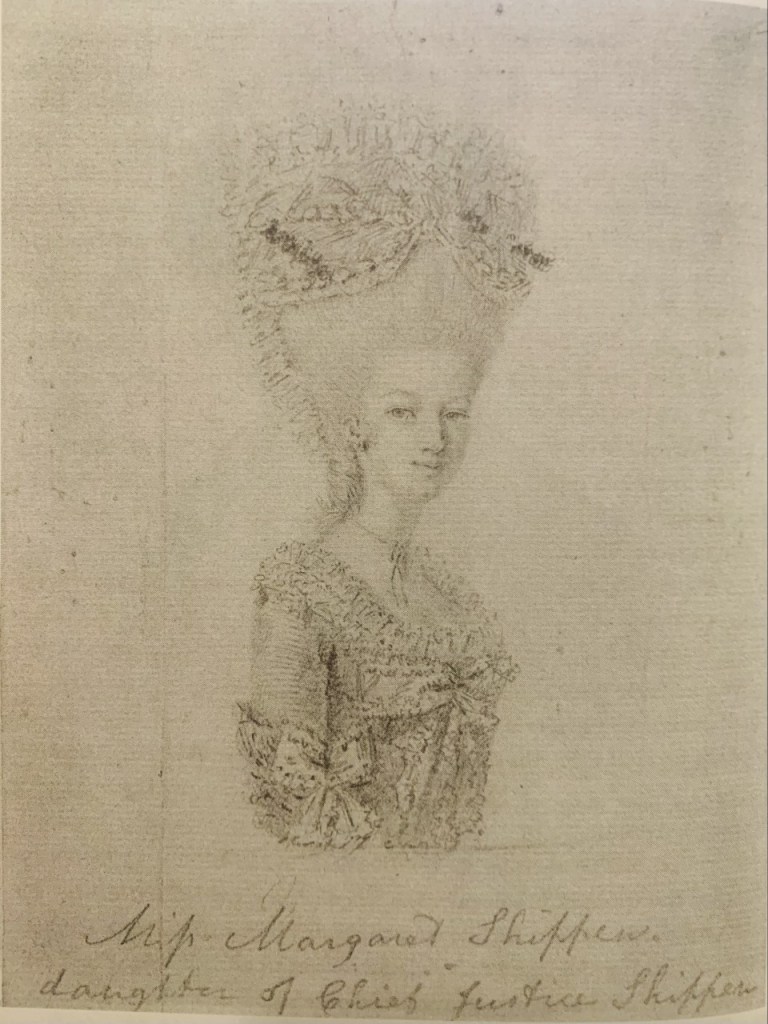
Pencil drawing of Peggy Shippen done by then Capt. John Andre during the British occupation of Philadelphia
It has been long debated if this was a genuine outburst of hysteria for Peggy, or if she was putting on a show to shield her own involvement in the plot. Multiple times Peggy was calmed down by the American officers arriving at the house, but her outbursts commenced again. Screaming about her husband, she was assured that he would return soon from West Point with Gen. Washington. Pointing to the ceiling she cried, “the spirits have carried [him] up there, they have put hot irons in his head!”[2] Then the hot iron went from Arnold’s head to her own and only Washington could remove it. With this, the general was brought in to see and she accused him of being an imposter. Peggy’s frenzy continued into the early evening when finally she regained control of herself and but still felt the despair of what had happened that day. If this was all a ploy, she had forced Washington, Lafayette, Alexander Hamilton, Varick, and countless to fall hook, line, and sinker for it. She was safe.
That evening, Washington and those who accompanied him sat down for dinner and pondered the gravity of the situation. It is impossible to image the anger, betrayal, despair, and heaviness that they must have felt. The American Hannibal was now the American Judas.
“Arnold has betrayed us. Whom can we trust now?”
[1] Quoted in Stephen Brumwell, Turncoat: Benedict Arnold and the Crisis of American Liberty (Yale University Press: New Haven, CT, 2018), 278.
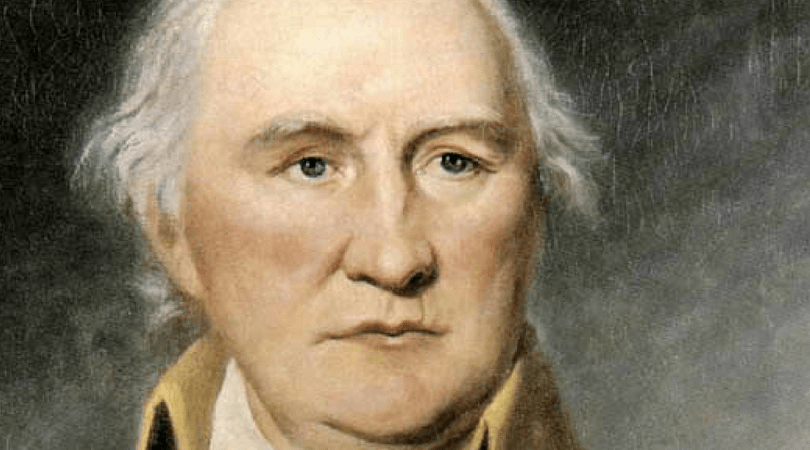
In the pantheon of American military leaders, Daniel Morgan’s place is definitely warranted. Innovative rifleman, heroic actions, backwoodsman, skillful tactician, and charismatic leader. He performed admirably at the Battle of Quebec in the winter of 1775, led the American forces at one of the climatic and complete victories of the war at the Battle of Cowpens in 1781, and distinguished himself in many a field and campaign in between.
For those reasons and a further discussion into the life and career of this American military hero, Emerging Revolutionary War invites you to listen and chime in during the next “Rev War Revelry” this Sunday at 7pm EST on our Facebook page.
In addition to the cadre of Emerging Revolutionary War historians, including Rob Orrison and Travis Shaw, there will be another talking head this weekend.
Joining ERW this Sunday will be historian Nathan Stalvey. He is the Director of the Clarke County Historical Association and a member of the Virginia Association of Museums Council. He started his 20-year career at the University of South Carolina’s McKissick Museum where he worked as the Curator of Traveling Exhibitions and Design. Nathan then served as the Director of Exhibitions and Head of Collections at the Louisville Slugger Museum & Factory in Louisville, Kentucky prior to his hiring in 2014 as the Director at CCHA. As Director, he oversees the operations of both a museum in downtown Berryville, as well as the historic 18th-century Burwell-Morgan Mill in Millwood.
As Daniel would have enjoyed an adult beverage in his day, make sure to bring one to this “Rev War Revelry” Sunday night!
Major Andre cautiously rode his horse through unfamiliar territory between American and British lines. It was a neutral zone wreathing with unforgiving bands of Cowboys and Skinners, but ground that Andre, garbed in civilian clothing, needed to cross in order to return to New York City. He had experienced several close brushes with American posts, and his guide, Joshua Smith, rather than risking any run-ins with Tories, had decided to turn around when they were some twenty miles from British lines. Andre was on his own for the final leg of the journey. All seemed to be going well until he arrived just outside of Tarrytown and three men with leveled muskets emerged from the bushes astride the path.
The capture of Major Andre during the morning of September 23, 1780 was the moment that Benedict Arnold’s plot to surrender West Point to the British officially unraveled, saving the garrison, the Hudson River, and potentially the revolutionary cause for the Americans. It was a moment that was entirely avoidable had Smith agreed to carry Andre back to the Vulture downriver rather than insisting on taking the overland route and subsequently abandoning the officer to the mercy of whatever lay between the opposing lines. Unfortunately, for Andre, his fate would be determined by a group of “volunteer militiamen,” but most likely crooked highwaymen.
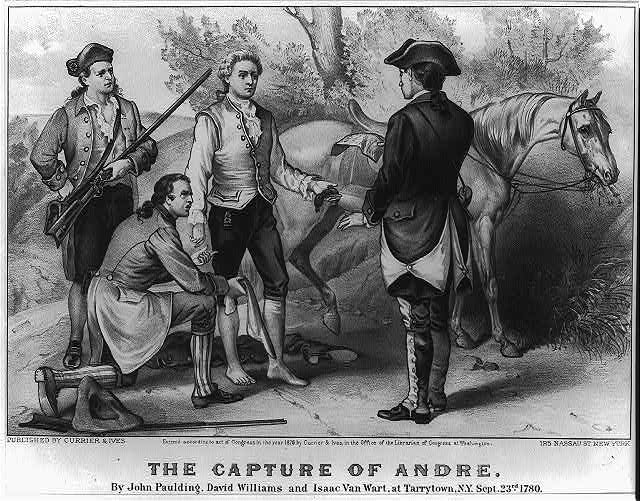
The meeting exchange that occurred between the British intelligence chief and the armed men blocking his path proved to be the most costly of the latter’s short life. Seeing that one of the militiamen was dressed in the green jacket of a Hessian jaeger, Andre incorrectly assumed that they belonged to his side, or the “lower party,” as he had asked them. The man, John Paulding, duped Andre, and answered in the affirmative. Relieved, the major revealed to them that he was in fact a British officer. Paulding then informed him that they were Americans, and after Andre handed him a pass written by Arnold, he threw it aside and began searching the rider, taking the valuables he carried with him. All this could have been ignored by Andre if they had then let him continue on to New York City, but the greedy militiamen then proceeded to remove the fine boots of a British officer he was wearing, and then his socks. What he was hiding underneath would be the evidence eventually needed to incriminate him and Arnold: documents relating to West Point and its defenses. The ragtag party of Americans had just nabbed themselves a spy.
A 19th century depiction of Andre’s capture. Library of Congress.
Following his capture, Andre was taken to the Continental camp at North Castle and turned over to Lt. Col. John Jameson of the 3rd Continental Dragoons, who examined the dispatches. Seeing Arnold’s name on the papers, Jameson was not about to accuse an American hero of conspiring with the enemy. Instead, he sent Andre with an escort back to Arnold’s camp and scribbled off a message to the general: “I have sent Lieutenant Allen with a certain John Anderson [Andre’s moniker] taken going to New York. He had a pass signed with your name. He had a parcel of papers taken from under his stockings, which I think of a very dangerous tendency … The papers I have sent to General Washington.”[1] It was only a matter of time before Arnold realized that his plot was about to be discovered.
Andre, however, would never make it back to Arnold’s headquarters. Later that day, Maj. Benjamin Tallmadge, Washington’s chief intelligence officer and famed leader of the “Culper Ring,” arrived in Jameson’s camp and after learning of the man carrying suspicious documents, convinced the lieutenant colonel to return the suspect to camp.
Riding back to Arnold with Lt. Allen, Andre must have felt relieved that he had dodged another bullet. Much to his dismay, the next day he would be turned around and delivered to Maj. Tallmadge, where his fate as a spy would be decided.
[1] Quoted in Stephen Brumwell, Turncoat: Benedict Arnold and the Crisis of American Liberty (New Haven, CT: Yale University Press, 2018), 269.
It was a meeting that decided the fates of Benedict Arnold and John Andre. Not necessarily because of what had been discussed, but because of the unraveling circumstances surrounding it. Within several days, Arnold would be fleeing his once beloved country’s cause to the safety of the British lines in New York City, and in less than two weeks, Andre, not as lucky, would be dead.
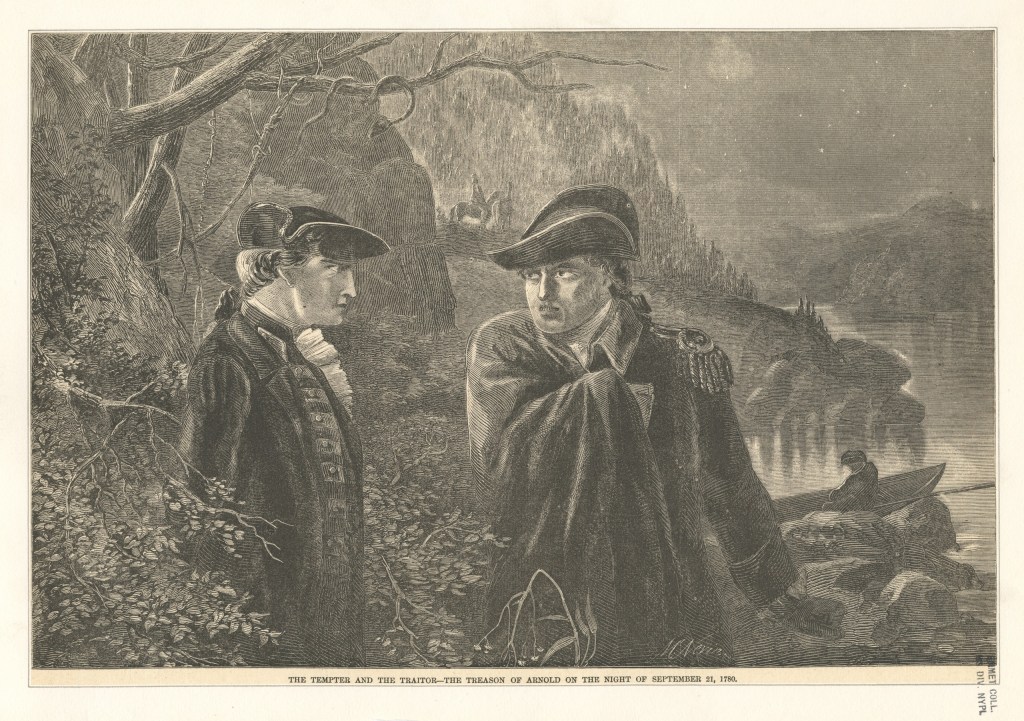
Not long after 1 a.m., September 22, 1780, Major Andre was rowed ashore near Haverstraw, New York, less than twenty miles below West Point. There, for several hours in the dark woods aside the Hudson River, he conversed with Arnold in a rendezvous that had been over a year in the making. His orders from Sir Henry Clinton stipulated that he was to confirm with Arnold “the manner in which he was to surrender himself, the forts, and troops…,” so the operation against West Point could be “conducted under a concerted plan between us … that the King’s troops sent upon this expedition should be under no risk of surprise or counter-plot.”[1] The British would attack the fortifications, and overwhelmed by superior numbers, Arnold would surrender the garrison and the river defenses.
“The Tempter and the Traitor.” Arnold and Andre’s Meeting near Haverstraw, NY. New York Public Library.
It is possible that another prize was discussed between the two men: the capture of George Washington. The American commander in chief was due to arrive to inspect the post on September 25 after meeting with the French high command at Hartford, Connecticut. Capturing West Point, as well as bagging Washington could spell an end to the rebellion once and for all.
After several hours, the meeting came to an end as daylight loomed. Waiting to procure some men to row Andre back to the Vulture, the vessel that was to return him to his own side, Arnold took the major to a house within the American lines. Everything seemed to be in order for the operation to be successfully executed now. That was until Continental artillery on the shore was directed by Col. James Livingston to open fire on the Vulture, forcing the craft to flee several miles downriver. Andre’s transportation back to New York City had been compromised. Though they did not know it yet, the plot to surrender West Point officially began to unravel. Arnold was now forced to send Andre back to British lines via an overland route through hostile territory.
[1] Quoted in Stephen Brumwell, Turncoat: Benedict Arnold and the Crisis of American Liberty (Yale University Press, New Haven, CT, 2018), 264.
George Washington’s first presidential cabinet included many luminaries of the American Revolutionary era; Thomas Jefferson as Secretary of State and Alexander Hamilton as Secretary of the Treasury to just name two. When studying the formation of the present United States government and the creation of cabinets that serve the president, we tend to gloss over it, as a sort of bygone conclusion, that this was a natural product out of this creation.
A closer reading of the United States Constitution, however, does not include the executive branch having a cabinet of secretaries to assist the president. George Washington, as first president, was entirely on his own in creating one, and the first cabinet meeting was not called into session until two and a half years into his first term.
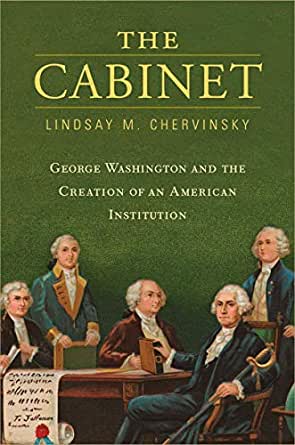
The creation of this American institution is the basis of this week’s “Rev War Revelry” as Emerging Revolutionary War welcomes historian and author Dr. Lindsay Chervinsky as she discusses the history in and surrounding her publication, The Cabinet, George Washington and the Creation of an American Institution.
When discussing the importance of the cabinet, Chervinsky said:
“The best way to better understand the creation of the presidency, presidential leadership, or Washington’s legacy is through the cabinet.”
But this story isn’t just one about the early Founding Era. As Chervinsky writes in her work, “we can’t evaluate the cabinet without examining Washington’s use of councils of war from the Revolution. He developed critical management strategies in the councils that he replicated as president. The war shaped Washington as president.”
Chervinsky is an early American historian and is currently the Scholar-in-Residence at the Institute for Thomas Paine Studies at Iona College and a Senior Fellow at the International Center for Jefferson Studies. In addition, she is teaches courses on the presidency at George Washington University’s School of Media and Public Affairs.
For a sneak peak into the book and its history, click here to access Chervinsky’s talk at the Virginia Historical Society.
Junction of Saint Mary’s, Saint Joseph’s, and Maumee Rivers/Kekionga (Indiana Historical Society)
The Revolutionary War has more than its share of adventurers, rogues, soldiers-of-fortune, and risk-takers. Augustin Mottin De La Balme combined all these characteristics in his person. In November 1780, they brought the Frenchman and his soldiers to a horrible end outside the Miami Village of Kekionga, near the confluence of the Saint Joseph, Saint Mary’s, and Maumee Rivers in modern Fort Wayne, Indiana.
La Balme was born in France in 1736, entered the Gendarmerie in 1757, served in the seven Years War, gained experience in the cavalry, received an army appointment in 1763, and retired with a pension in 1773. He wrote several books on cavalry training and tactics, but finding his fortunes stalled, left for America in 1777 with a letter of introduction from Benjamin Franklin, just one more French officer seeking rank, advancement, and his fortune in the war against Great Britain.[i] Major General William Heath, who met him in Boston, wrote Washington, “We swarm with French Officers at this Place, Two arrived in the Ship on Sunday at this Place They are much Superior to any that I have as yet Seen, One is an Engineer The other a Captain of Cavalry, They are Gentlemen of Education, Sense and Genius, The Captain has with him Two Treatises on the Discipline and management of the Horse, written by himself, and much Approved by all the Generals in the French Service.”[ii] Despite a glut of would-be foreign officers, La Balme received a commission as a Lieutenant Colonel and then Colonel and Inspector General of Cavalry. Dissatisfied with the appointment, he resigned, focused his attention on mobilizing Frenchmen still living in North America, and kept petitioning Congress to find useful work for him. Eventually, Congress tried to pay him off and send him home, but the French officer stayed, trying his hand at various schemes to contribute, including mobilizing Indians in Maine to attack the British. That short-lived campaign accomplished nothing, but resulted in La Balme’s capture and eventual escape.[iii]
The largest, in terms of military forces deployed, engagement in the American Revolutionary War occurred on September 11, 1777 in southeastern Pennsylvania. The Battle of Brandywine was a pivotal moment in the British campaign that captured the patriot capital in Philadelphia. With the anniversary of the engagement happening the Friday before, the Emerging Revolutionary War crew will make this engagement and campaign the focal point of Sunday’s “Rev War Roundtable with ERW.”
Joining the “Rev War Revelry” this Sunday, at 7pm on Emerging Revolutionary War’s Facebook page will be Michael C. Harris, historian and author of Brandywine: A History of the Battle that Lost Philadelphiabut Saved America, September 11, 1777, which was published and is available for purchase by Savas Beatie. Click here to order.
Besides authoring the history mentioned above, Harris has an upcoming release, on another important battle in Pennsylvania, Germantown, fought on October 4, 1777. Rumor on the street has it that he will be joining ERW at a future date to discuss this important battle and talk about his new book.
A bit of a background on Harris. He is a graduate of the University of Mary Washington and the American Military University. He has worked for the National Park Service in Fredericksburg, Virginia, Fort Mott State Park in New Jersey, and the Pennsylvania Historical and Museum Commission at Brandywine Battlefield. He has conducted tours and staff rides of many east coast battlefields. Michael is certified in secondary education and currently teaches in the Philadelphia region. He lives in Pennsylvania with his wife, Michelle and son, Nathanael.
Although the battle lost Philadelphia for the patriots, Harris does not hold back on the culprit for the setback:
“Washington failed the army, the army did not fail Washington.”
To hear the reasoning behind that emphatic quote we hope you join us this Sunday!
Benedict Arnold, the mere mention of the name seems permanently intertwined with the word “treason.” His name has even made it into popular vernacular, being called a “Benedict Arnold” as an insult. Yet, there is more to the man than just that infamous moment along the banks of the Hudson River in West Point, New York in 1780.
Prior to that turning point, Arnold was one of the greatest battlefield leaders the Americans had at that rank. His inspiring leadership on the field of battle at Saratoga led to a climactic charge and one of the greatest monuments to a leader on any hallowed ground. He survived the cold and assaults in Canada in the winter of 1776 as well.
After being a turncoat he was a menace in Virginia in 1781, raiding in Richmond and the Tidewater of Virginia. One of ERW’s historians will discuss Arnold’s role in the state capital of Virginia.
A lot to unpack and that is why this Sunday, at 7pm, live on our Facebook page, Emerging Revolutionary War historians will be joined by Dr. Powell, who spoke on the French and Indian War with us back in June, to discuss Benedict Arnold. So, bring those pre-conceived notions but an open mind to fully appreciate Arnold. This “Rev War Revelry” will discuss the before reasons for, and the after of his switching allegiances.






 Emerging Revolutionary War Era