William Griffith is a native of Branchburg, New Jersey and currently resides in Gettysburg, Pennsylvania. He received his BA in History from Shepherd University in 2014, and MA in Military History from Norwich University in 2018. His passion for history can be traced back to his first trip with his father to Fort William Henry along the southern shore of Lake George when he was five-years-old.
While completing his undergraduate studies at Shepherd, he spent his time as a volunteer with the Gettysburg Foundation and the George Tyler Moore Center for the Study of the Civil War, and also worked as an intern and substitute librarian at the David Library of the American Revolution. He has previously served as a historical interpreter at Fort Frederick State Park in Big Pool, Maryland, and was employed by the Gettysburg Foundation from 2017-2019. He currently serves as a full-time Gettysburg Licensed Battlefield Guide. When not indulging himself in military history, he can be found closely following his second passion – the New York Yankees.
William’s first book, The Battle of Lake George: England’s First Triumph in the French and Indian War, was released by The History Press on September 5, 2016. His next book, A Handsome Flogging: The Battle of Monmouth, June 28, 1778, will be released later this year as part of Savas Beatie’s Emerging Revolutionary War series.
He will be presenting his talk “A proud, indolent, ignorant self-sufficient set: The Colonists’ Emergence as a Fighting Force in the French and Indian War” at the September symposium.
Before the horrific terrorist attacks that struck the United States on September 11, 2001, this date in American history saw the longest single day engagement with the highest number of combatants during the entire American Revolution fought in southeastern Pennsylvania.
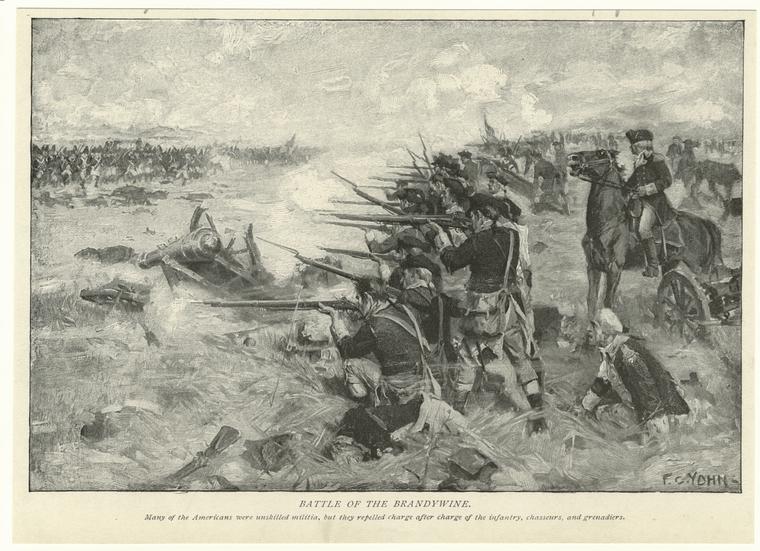
Known to history as the Battle of Brandywine, approximately 30,000 soldiers were involved and 1,887 became casualties, the majority, 1,300 being Americans. One of those 1,300 individuals was Reverend or Chaplain Joab Trout, from New Hampshire.
Battle of Brandywine (courtesy of NYPL)
The night before the engagement, he gave the following sermon beat the evening call on the eve of battle. And 242 years later the words still echo with a sense of patriotism and stoicism for a cause that was worth fighting and dying for. Below is the full sermon:
This is a post from September 2016. It focuses on a critical military action that occurred during the Battle of Lake George, 264 years ago, today:
When analyzing the key actions of a military engagement in order to pinpoint a decisive moment or turning point, one does not usually come across a retreat and/or rout that actually attributed to the success of an army. However, during the late morning of September 8, 1755, roughly three miles south of Lake George in New York’s Adirondack Mountains, a contingent of men from Connecticut and Massachusetts, and their Mohawk allies conducted quite possibly the first ever organized fighting retreat in American military history – one that would turn the tide of battle and save their army from potential destruction. It is easy for a maneuver like this to be overlooked, but without the crucial time bought for William Johnson’s provincial army at its encampment along the southern shore of the lake by Lt. Colonel Nathan Whiting’s courageous New Englanders, Baron de Dieskau’s French army may well have emerged victorious during the Battle of Lake George and subsequently pushed their way to Albany’s doorstep.
Around eight o’clock in the morning, September 8, 1755, a column of men 1,200 strong was marched out of William Johnson’s camp at the southern end of Lake George. The column’s destination was Fort Lyman, roughly fourteen miles to the south located beside the Hudson River (present-day Fort Edward, NY). There, intelligence gathered by Johnson’s army had placed the 1,500 strong French force led by Jean-Armand, Baron de Dieskau, which was believed to be preparing an assault against the 500 man garrison of New Hampshire and New York provincials.
The contingent of reinforcements dispatched from the English camp was under the overall command of Colonel Ephraim Williams, 3rd Massachusetts Provincial Regiment, and was comprised of his own regiment, 200 Mohawk Indians, and another 500 men of the 2nd Connecticut Provincial Regiment led by Lt. Colonel Nathan Whiting. The column marched south down the military road with the Mohawk at its head, followed by the Massachusetts men, and Whiting’s regiment taking up the rear.
Nathan Whiting, born in 1724 and a resident of Windham, was 31-years-old in 1755 and one of William Johnson’s youngest field officers. He was a graduate of Yale and a veteran of the Louisbourg expedition during King George’s War – service which earned him a lieutenant’s commission in His Majesty’s Forces. When hostilities between England and France erupted in 1754 he was commissioned as the 2nd Connecticut Provincial Regiment’s lieutenant colonel and was sent to Albany to serve as part of the Crown Point Expedition, an offensive designed to oust the French from the Lake Champlain-Lake George-Hudson River corridor. The regiment’s colonel, Elizur Goodrich, was ill and bedridden during the Battle of Lake George, so Whiting served as the unit’s field commander during his absence. Whiting was a loyal officer and earnestly dedicated to the cause in which he was fighting for. Before reaching the southern shore of the lake on August 28, he penned a heartfelt letter to his wife that epitomized his character: “… [P]ray make your Self as easy as possible[.] I know your D[aily] prayers are for my preservation[.] Let it be an article of them that it not be obtained by any unworthy means, but in the prosecution of the Duty I owe at this time to my Self, my Country & my God.”[1]
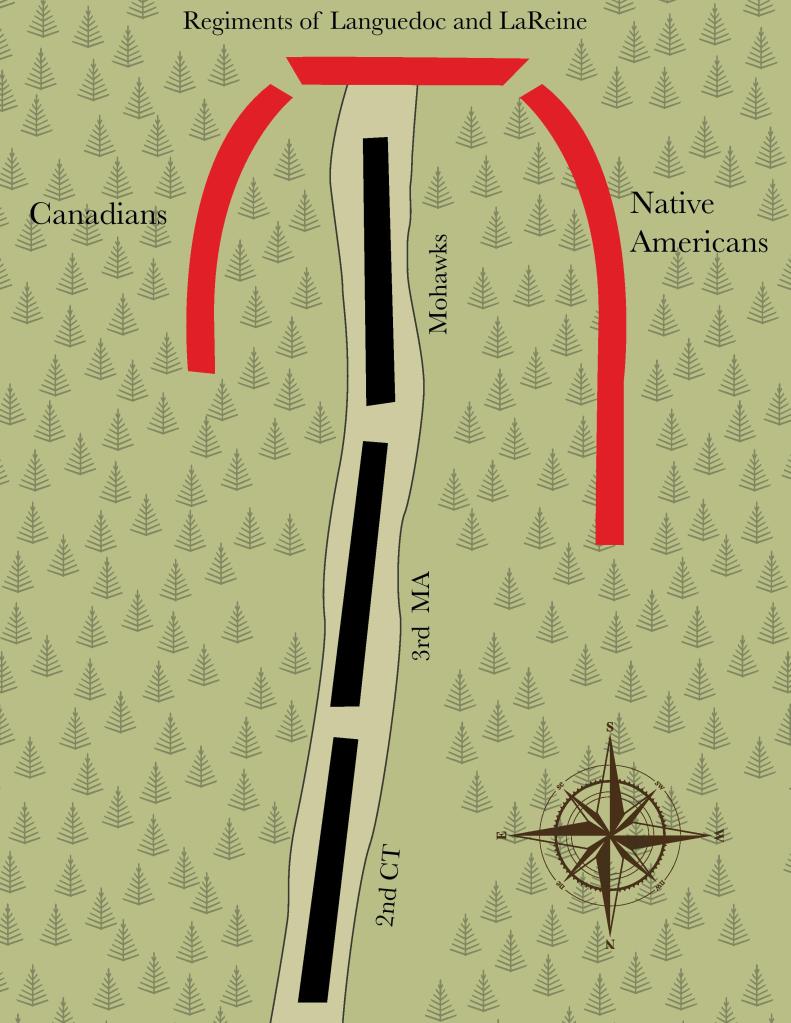
About two hours or so and three miles into the march to Fort Lyman, the forward ranks of Ephraim Williams’s column of reinforcements were ambushed by Dieskau’s native allies, Canadian militia, and regular grenadiers of the Regiments of Languedoc and La Reine. The French outside of Fort Lyman had earlier uncovered dispatches from a dead courier that was sent to inform the English outpost that reinforcements were going to be sent from the lake encampment to assist it in case of an attack. Using this intelligence, Dieskau marched his army up the military road towards Lake George and prepared an ambush to surprise the oncoming party of reinforcements. Although the ambuscade was initiated prematurely before the entire column could march into Dieskau’s hook-like formation, it still succeeded in throwing the English force into confusion and sent it scurrying back up the road to Lake George. Both Ephraim Williams and Chief Hendrick (commanding the Mohawk contingent) were killed during the confrontation and all order was lost, leaving Whiting, who was now the highest ranking officer on the field, to try to prevent a disaster.
The Bloody Morning Scout, 10:00 a.m. Map by Nicholas Chavez.
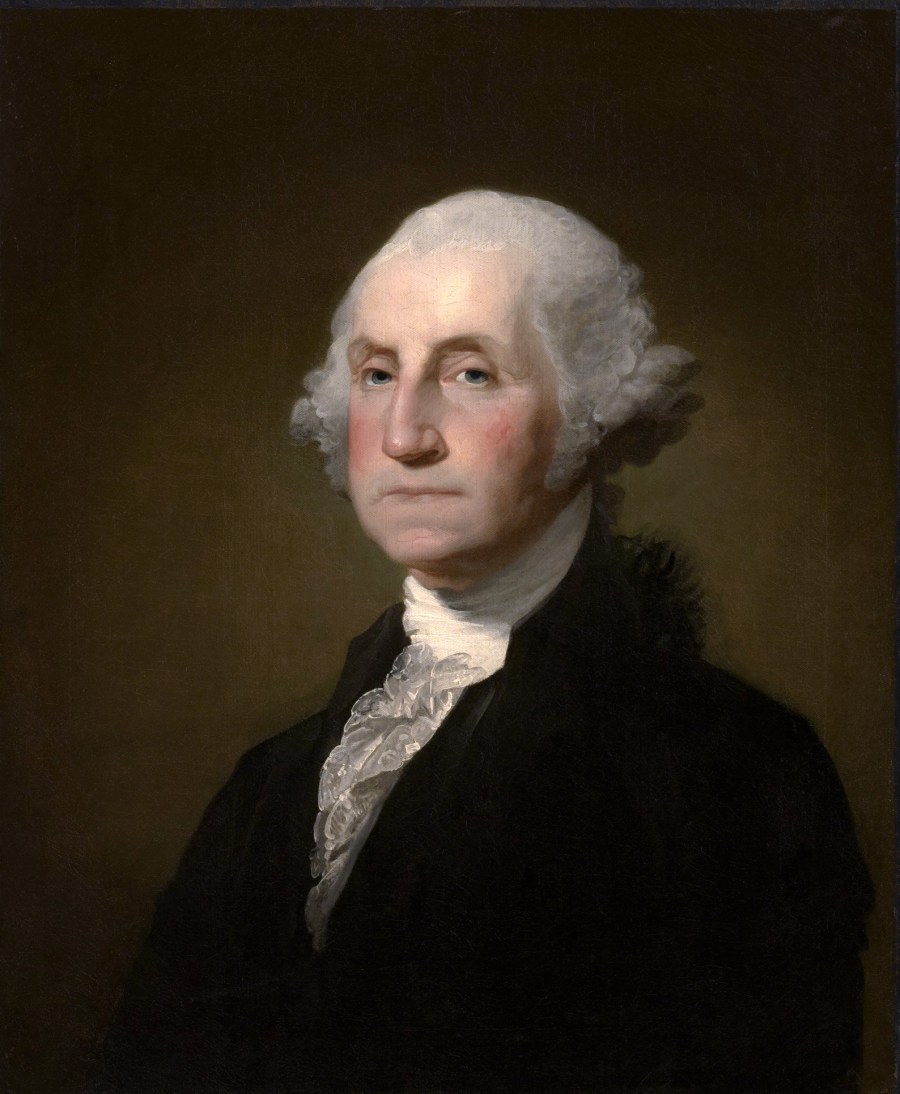
George Washington by Gilbert Stuart, 1797. Washington was a familiar face in Alexandria from his boyhood days until his death. (Wikimedia Commons)
Alexandria, Virginia, often thought of as merely a suburb of Washington, D.C., is actually one of the most historic towns in the United States. The town, founded in 1749, predates the nation’s capital and the nation itself. While most towns and cities (such as Charleston, Philadelphia, New York or Boston to name a few) set aside museums, parks, and houses where George Washington may have spent an evening or had a meal, Alexandria, Virginia has the distinction of being Washington’s hometown. Washington’s home, Mount Vernon, is only nine miles south of Alexandria. Washington literally helped survey and lay out the very streets of the town in 1748. Washington spent a considerable amount of time of his life with friends and family at Alexandria and became a leading citizen in the town.
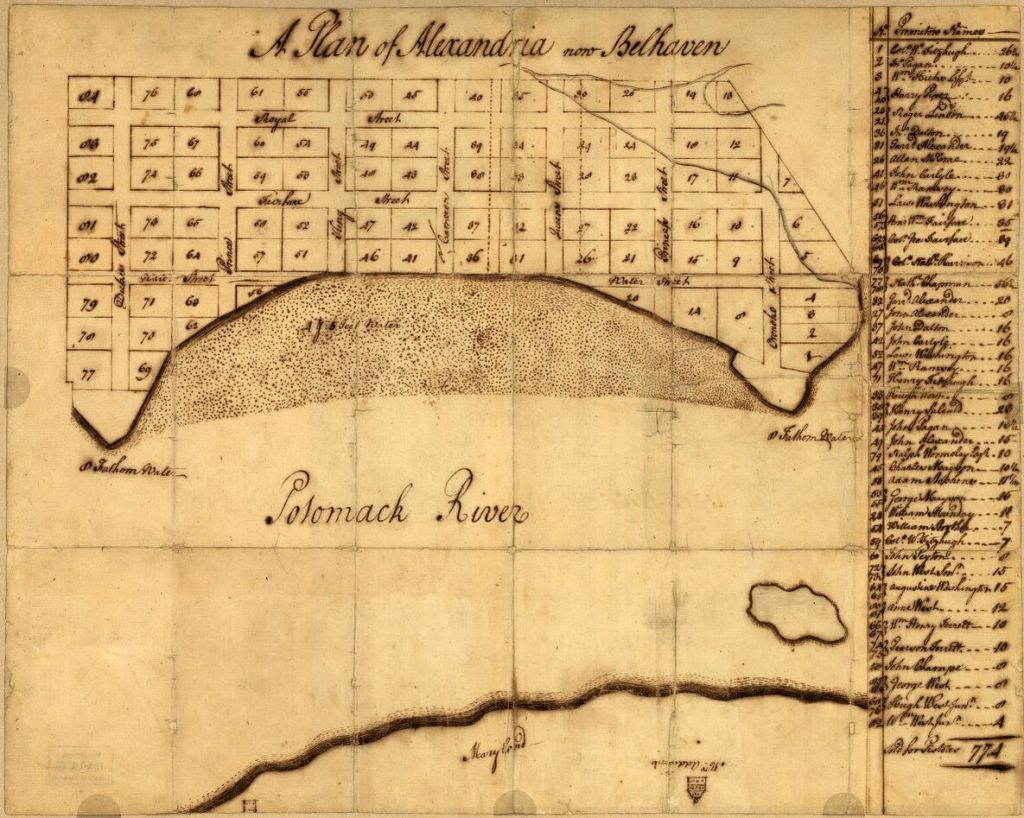
A map of Alexandria drawn by George Washington in 1749. (Library of Congress)Gadsby’s Tavern, where not only Washington, but John Adams, Thomas Jefferson and James Madison dined. (City of Alexandria)
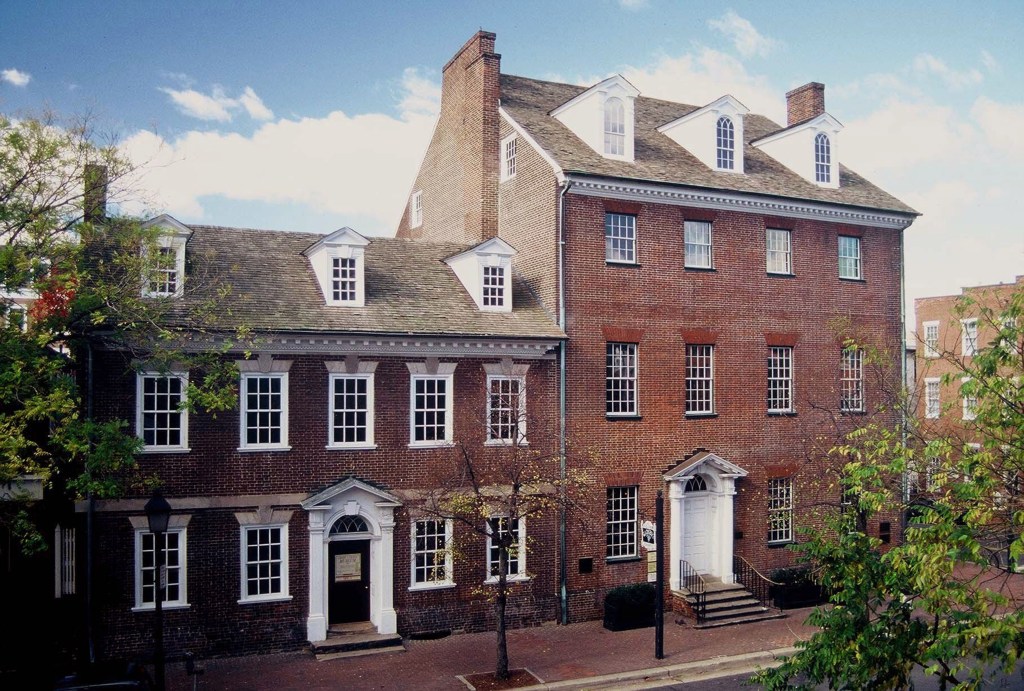
Today, visitors can see numerous places that had a close association with George Washington and the American Revolution there. Gadsby’s Tavern was where Washington dined frequently throughout his life and where he celebrated his birth night ball, a tradition that continues to this very day. Nearby, a replica of George Washington’s townhome sits today on Cameron Street where his original townhome once stood. Just two blocks from there is Christ Church, where Washington worshipped and was a vestryman. Despite the fact that this is a beautiful and historic building where Washington worshipped, the modern congregation there has sought to distance their association with Washington (because he was a slaveowner) by moving a plaque located in the church.
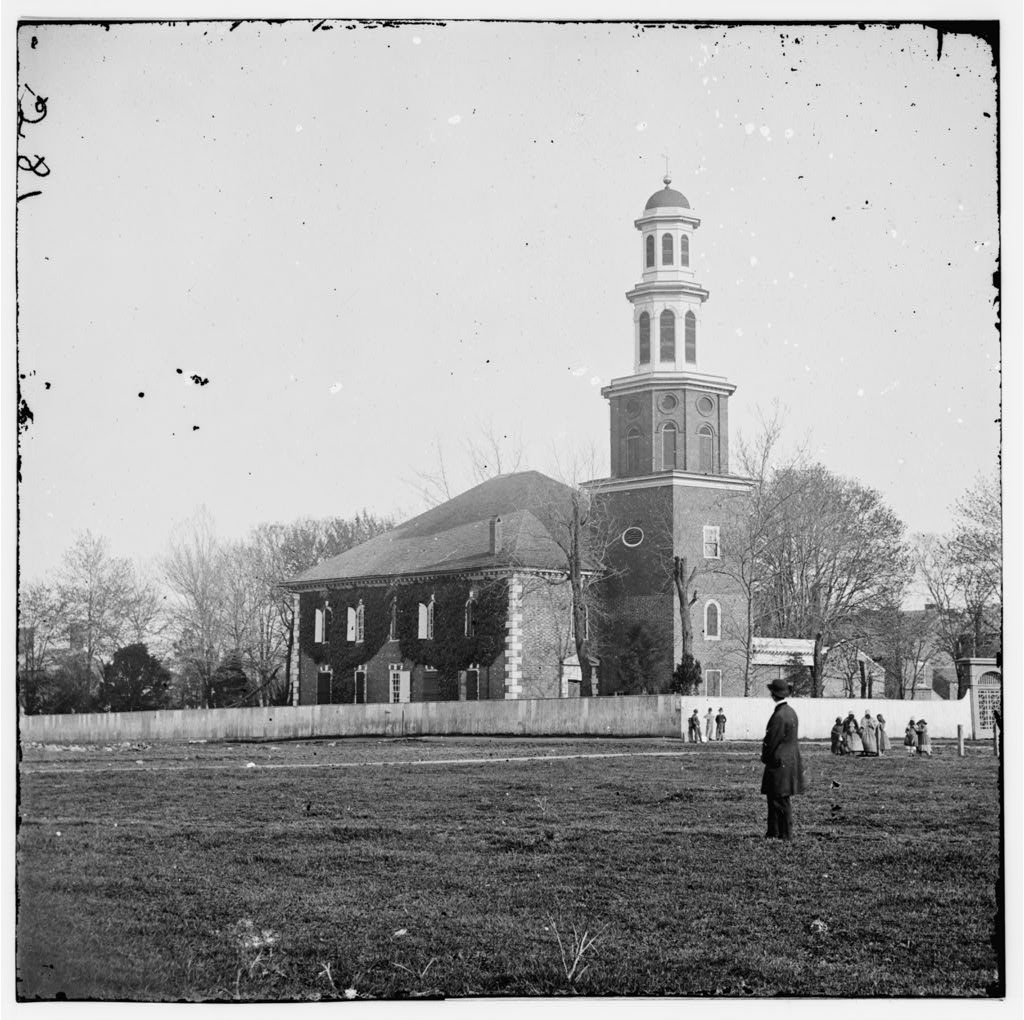
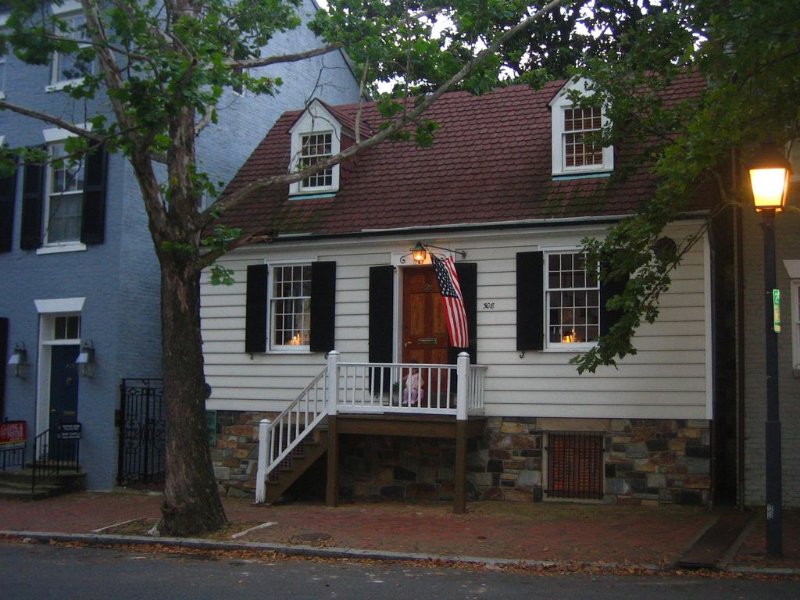
Christ Church as it appeared in 1861. (Library of Congress)A replica of Washington’s townhouse on the original site, which is actually available to stay at through vrbo. (TripAdvisor)
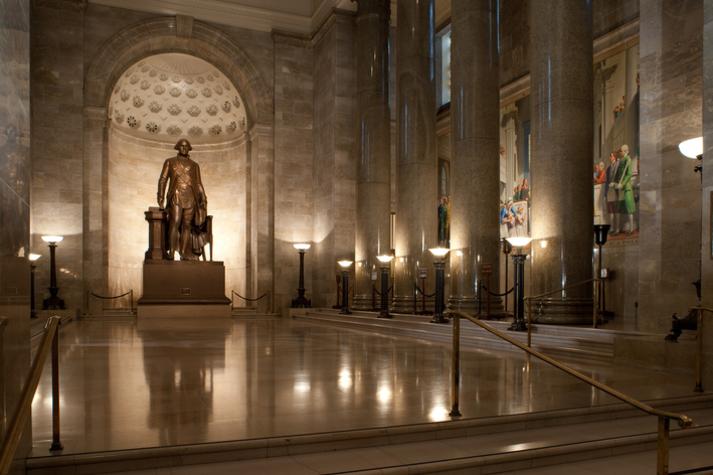
Washington was also a member of the local Masonic lodge. Today, the entire town of Alexandria is anchored on the west end by a massive Masonic Temple dedicated to memory of George Washington. Inside is a large statue of Washington and museum that includes many Washington relics and mementoes, including the trowel Washington used to lay the cornerstone of the U.S. Capitol building.
The interior of the Masonic Temple in Alexandria, Virginia, complete with a statue to Washington. (Visit Alexandria)
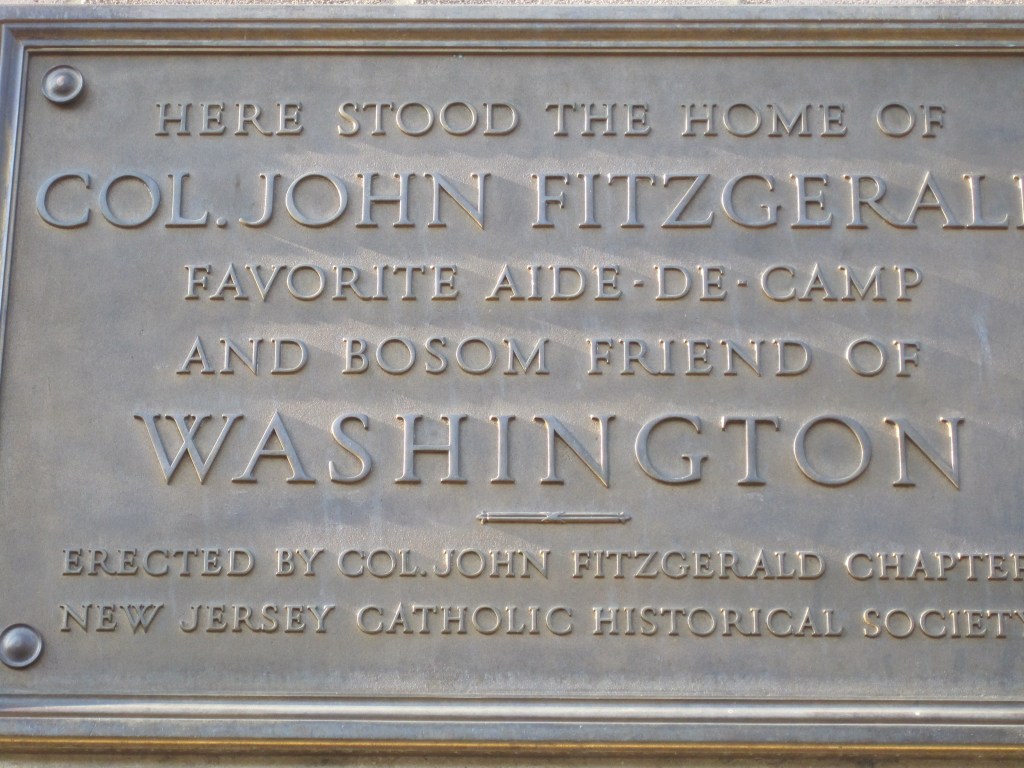
In addition to all of these Washington sites, the town of Alexandria has even more Revolutionary War history. The men from Alexandria largely joined the 3rd Virginia Regiment in 1776 when the war broke out. One of the town’s most prominent citizens was a “broad-shouldered Irishman” named John Fitzgerald. Fitzgerald would become a captain in the 3rd Virginia Regiment. In November of 1776, Fitzgerald was promoted to Lieutenant Colonel and joined Washington’s headquarters as an aide-de-camp. Fitzgerald would be by Washington’s side at Trenton, Princeton, Brandywine, Germantown, Valley Forge, and was wounded at Monmouth. While many Alexandrians would go on to fight in the war across the country, the war came to Alexandria in 1781. In April of 1781, a British raiding party was sailing up the Potomac River towards Alexandria. Col. John Fitzgerald rallied the local Virginia militia soldiers and marched down to Jones Point to scare off the British. The British never landed and sailed away. Later in life, Fitzgerald would become famous for founding the first Catholic Church in Virginia (St. Mary’s) and became mayor of the town. Today, multiple plaques in the city honor Col. Fitzgerald. While John Fitzgerald was undoubtedly a true hero of the Revolutionary War, the town has chosen to remove his name from a square on the waterfront because he was a slaveowner.
A plaque on King Street in Alexandria, Virginia for Col. John Fitzgerald. (Author’s Photo)
On the northern side of the town, a state historic marker
denotes the location of where part of Washington’s army encamped while marching
to Yorktown in 1781. In addition to
Christ Church, you can also visit the First Presbyterian Church, where memorial
services were held for Washington in 1799 and where his personal physician who
attended to him all his life, Dr. James Craik is buried. In the Churchyard you can also see the Tomb
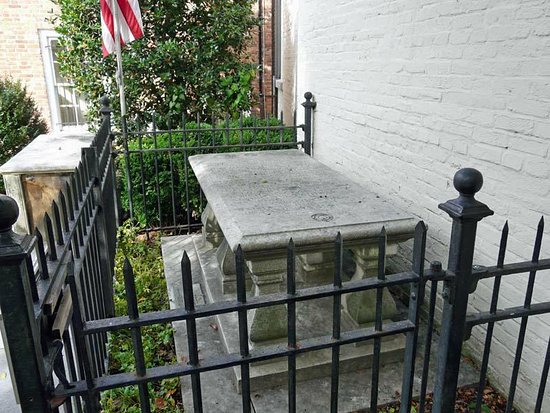
of the Unknown Revolutionary War Soldier.
The Tomb of the Unknown Revolutionary War Soldier. (TripAdvisor)
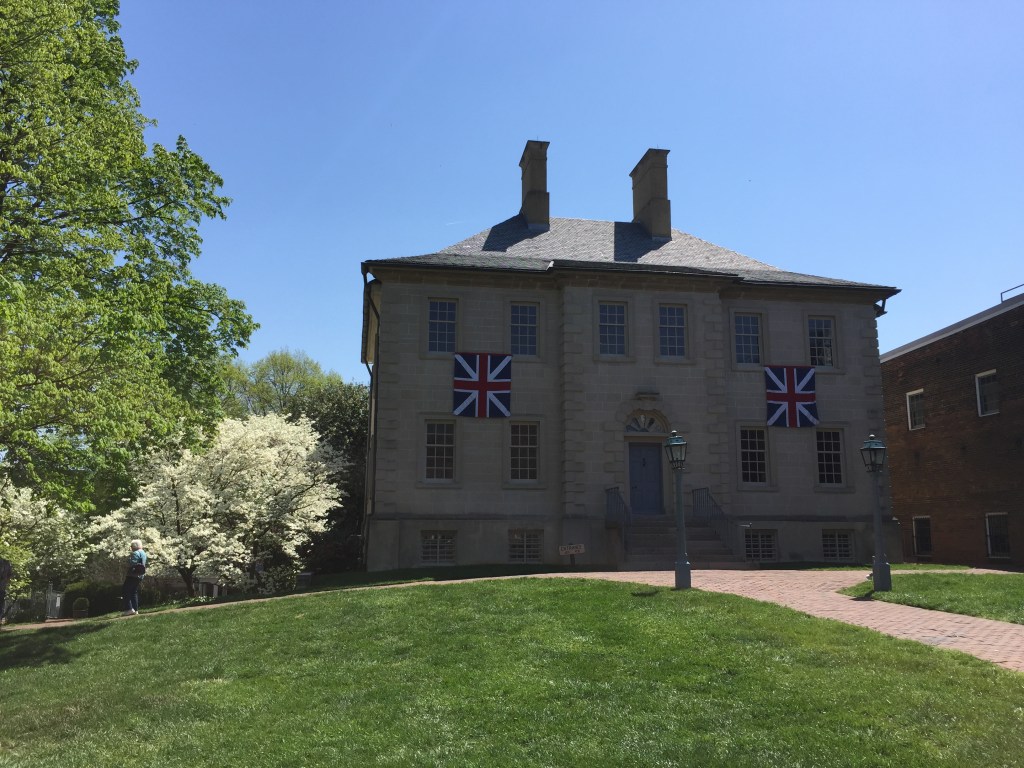
In Alexandria also stands Carlyle House, where General Edward Braddock launched his ill-fated expedition into Pennsylvania during the French and Indian War in 1755. It was also the home of George William Carlyle, a 17-year-old boy who valiantly died during the Revolutionary War in South Carolina at the Battle of Eutaw Springs in 1781. Another person who called Alexandria home, Light-Horse Harry Lee, served with Carlyle at the battle and described him as “the gallant young Carlyle of Alexandria.” Today, Light-Horse Harry Lee has a bar named after him today in Alexandria. In addition to his important service as an officer in the Revolutionary War, Lee became famous as the man who eulogized his fellow Alexandrian George Washington as “first in war, first in peace, and first in the hearts of his countrymen.” He was also the father of Robert E. Lee, who would grow up in Alexandria.
Carlyle House from the Front (Eric Sterner)
Robert E. Lee would attend the same church as Washington and married into Martha Washington’s family, making his home at nearby Arlington House (which was not only a home, but the nation’s first memorial to George Washington). Robert E. Lee said of Alexandria: “There is no community to which my affections more strongly cling than that of Alexandria, composed of my earliest and oldest friends, my kind school-fellows, and faithful neighbors.”
Alexandria’s expansive history associated with George Washington and the Revolutionary War is only rivaled by its important history during the American Civil War. Alexandria was the scene of the first deaths of that war in 1861 and was the longest occupied town in the war.
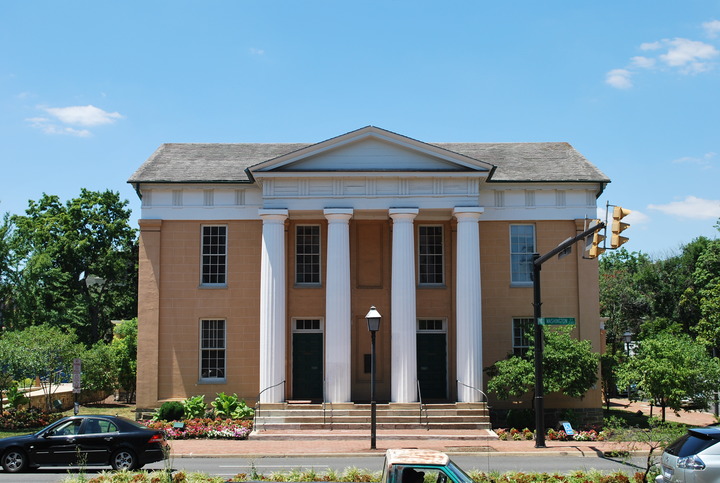
The Lyceum, Alexandria’s History Museum, where the inaugural Emerging Revolutionary War Symposium will be held on September 28, 2019. (City of Alexandria)
With such an extensive George Washington and Revolutionary War history, the town makes the perfect location for the inaugural Emerging Revolutionary War Symposium later this month. We hope you make the effort to come to this historic town and learn about how these men and women transitioned from colonists to Americans. While you are in town, we hope you get a chance to visit some of the numerous Revolutionary War and Washington sites!
Emerging Revolutionary War welcomes back guest historian Daniel T. Davis.
Last month, I heard Emerging Revolutionary War co-founder Phill Greenwalt remark “when you think about retreats, victory is a word that doesn’t come to mind.” The period of January 18 to February 14, 1781 is the exception to the rule. During this time frame, the American army under Maj. Gen. Nathanael Greene and the British under Charles, Lord Cornwallis, marched across the backcountry of the Carolinas. Known as the “Race to the Dan”, this episode between the engagements at Cowpens and Guilford Courthouse, is a largely forgotten but consequential even in the Southern Campaign of 1781.
In today’s fifth installment of the September 28, 2019 symposium Before They Were Americans interview series, Katherine “Kate” Egner Gruber takes the spotlight. Gruber is the special exhibition curator for the Jamestown-Yorktown Foundation. She earned her B.A. in historic preservation and classical humanities from the University of Mary Washington, and her M.A. in early American history from the College of William and Mary.
Employed by the Foundation as a curator since 2013, Kate Gruber has contributed to the development of the permanent galleries at the American Revolution Museum at Yorktown, including the award-winning signature film, Liberty Fever. As special exhibition curator, Gruber develops exhibitions for galleries at Yorktown and Jamestown Settlement, including “Tenacity: Women in Jamestown and Early Virginia,” open now through January 5, 2020 at Jamestown Settlement, and “Forgotten Soldier: African Americans in the Revolution,” open now through March 22, 2020 at Yorktown.
Kate Gruber will be presenting her talk “A Tailor-Made Revolution: Clothing William Carlin’s Alexandria” at the September symposium.
Sebastien Le Prestre de Vauban, Seigneur de Vauban, and finally Marquis de Vauban, as one of his biographies begins, is probably not a household name to many enthusiasts of American history. Especially since he died on March 30, 1707 and never set foot in the Western Hemisphere. However, he did have a nephew, Jacques Anne Joseph Le Prestre de Vauban who served as General Jean-Baptiste Rochambeau’s aide-de-camp during the war. So, there is a family connection.
Sébastien Le Prestre de Vauban (courtesy of Wikipedia)
Yet, he left his mark on places like Yorktown, Virginia, fought 74 years after his death and half-a-world away. French engineers, critical to eventual American victory in the American Revolutionary War, plied de Vauban’s craft and studied his text and learned from his exploits. Continue reading “Sébastien Le Prestre de Vauban”→
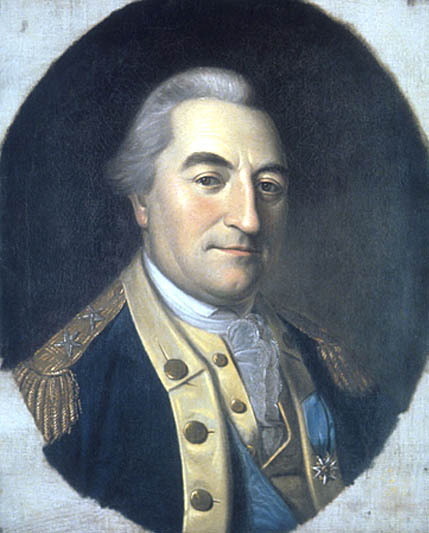
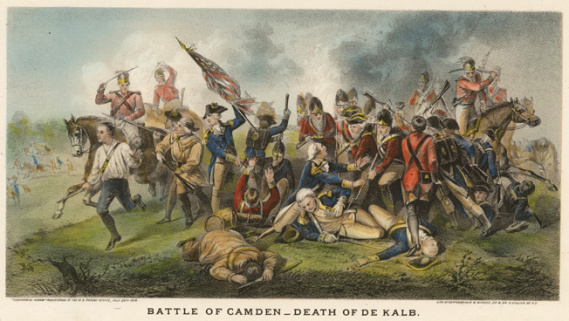
On this date in 1780, Johann von Robias, Baron de Kalb, died of wounds received three days earlier during the Battle of Camden, South Carolina.
de Kalb, born on June 19, 1721 in the Principality of Bayreuth, was in charge of the American right wing during the engagement at Camden, leading the premier units, the Delawareans and Marylanders, of General Horatio Gates’ Southern Army.
When the left and center of the American line disintegrated, de Kalb’s force had to beat a hasty retreat before becoming completely surrounded. During this juncture of the fighting, the Baron’s horse was shot out from under him and the German was thrown to the ground. Before he could gain his feet, he was hit with three musket balls and bayoneted multiple times by approaching British soldiers. The wounds would prove mortal. Continue reading ““De Kalb has died, as he has lived, the unconquered friend of liberty””→
Picking up the story of Camden from Thursday morning, we continue with Col. Otho
Gen. Gates believed his night march on August 15th would put his army in a great defensive position above Saunder’s Creek.
Holland Williams comments on the events on the evening of August 15th. As Gates’ army moved southward at night, a dangerous undertaking even with a professional army, notwithstanding an army mostly comprised of militia that had never fought as a cohesive unit. Williams documents the meals that the Americans ate that night before their march. When reading American accounts of Camden, most mention the impact on the evening August 15th meal had on the men and the army as a whole. Williams also mentions there is much criticisms of Gates’ plan, but no official opposition was brought to Gates. Reading Williams’ account gives us insight today into the events leading up to the disaster at Camden. When reading Williams’ narrative, it is not hard to believe that the Americans were marching to a defeat.
“Although there had been no dissenting voice in the council, the orders were no sooner promulgated than they became the subject of animadversion. Even those who had been dumb in council, said that there had been no consultation –that the orders were read to them, and all opinion seemed suppressed by the very positive and decisive terms in which they were expressed. Others could not imagine how it could be conceived, that an army, consisting of more than two -thirds militia, and which had never been once exercised in arms together, could form columns, and perform other manoeuvres in the night, and in the face of an enemy. But, of all the officers, Colonel Armand took the greatest exception. He seemed to think the positive orders respecting himself, implied a doubt of his courage –declared that cavalry had never before been put in the front of a line of battle in the dark–and that the disposition, as it respected his corps, proceeded from resentment in the general, on account of a previous altercation between them about horses, which the general had ordered to be taken from the officers of the army, to expedite the movement of the artillery though the wilderness. A great deal was said upon the occasion; but, the time was short, and the officers and soldiers, generally, not knowing, or believing any more than the general, that any considerable body of the enemy were to be met with out of Camden, acquiesced with their usual cheerfulness, and were ready to march at the hour appointed. As there were no spirits yet arrived in camp; and as, until lately, it was unusual for the troops to make a forced march, or prepare to meet an enemy without some extraordinary allowance, it was unluckily conceived that molasses, would, for once, be an acceptable substitute; accordingly the hospital stores were broached, and one gill of molasses per man, and a full ration of corn meal and meat, were issued to the army previous to their march, which commenced, according to orders, at about ten o’clock at night of the 15th. …. The troops of general Gates’ army, had frequently felt the bad consequences of eating bad provisions; but, at this time, a hasty meal of quick baked bread and fresh beef, with a desert of molasses, mixed with mush, or dumplings, operated so cathartically, as to disorder very many of the men, who were breaking the ranks all night, and were certainly much debilitated before the action commenced in the morning. …. “Continue reading ““Gentlemen, what is best to be done?” Gates Moves Towards Camden and Makes a Fateful Decision”→
Continuing with our forth installment for the September 28, 2019 symposium Before They WereAmericans build-up, today Dr. Peter R. Henriques will be highlighted. Dr. Henriques will be the keynote speaker for the symposium. He received his Ph.D. in history from the University of Virginia in 1971 and is Professor of History, Emeritus, from George Mason University. He taught American and Virginia history with a special emphasis on the Virginia Founding Fathers, especially George Washington.
His books include Realistic Visionary: A Portrait of George Washington, The Death of George Washington: He Died as He Lived, and a brief biography of George Washington written for the National Park Service. Realistic Visionary was recommended by Professor Joe Ellis as one of the five best books to understand our first President. He is a frequent contributor to American History Magazine and a regular presenter at Colonial Williamsburg, where he has given more than 25 talks. His current book project is entitled, “First and Always: A New Portrait of George Washington.”
He presented the Distinguished Lecture Series at Colonial Williamsburg, 2011-12, and was the 2012 winner of the George Washington Memorial Award given by the George Washington Masonic Memorial Association.





 Emerging Revolutionary War Era