Emerging Revolutionary War is honored to welcome historian Malanna Henderson to the blog. A biography of Mrs. Henderson is at the bottom of this post.
Historical records are generally written by men about men.
When most of us think about the role women played in the Revolutionary War, Betsy Ross comes to mind. Why did early historians choose to recognize the contributions of Betsy Ross instead of others? We all know the answer to that question. Her contribution was sewing the American flag. Sewing, a traditional “female” occupation, was elevated to heroic heights by the legacy of Ross. Most historians today don’t name Betsy Ross as the designer of the first American flag, but that’s another story.
Women whose contributions didn’t fall neatly into categories that weren’t exclusively defined as “feminine” were intentionally excluded; and yet, without their contributions, big and small during the years that the war ensued, the war could have raged on longer or dare I say, we might be flying the Union Jack instead of the Stars and Stripes.
Heroism has many forms.
On the home front women maintained the farms, took care of livestock and fed, clothed and educated their children while their husbands took up arms against the British. That was how most women supported the war effort. However, as in the Civil War women were camp followers, accompanying their husbands and sons to the battlefield. For these women, the army could supply food and protection since they could no longer support themselves after their men left for war. In the military camps, women nursed the sick and wounded, laundered and mended uniforms and cooked meals. At some time in the war, women were paid for providing these services.
Then there were women who chose to pursue more daring endeavors, like spying or binding their breast, cutting their hair and donning men’s clothing to enlist in the war under an alias.
Deborah Sampson (courtesy of Fold3 by Ancestry.com)
Our enthusiastic congratulations to Emerging Revolutionary War’s William Griffith on the release of his new book, The Battle of Lake George, England’s First Triumph in the French and Indian War. The book, published by Arcadia Publishing and The History Press, is now available for sale in books stores and online.
From the press release of the book,
“In the early morning of September 8, 1755, a force of French Regulars, Canadians and Indians crouched unseen in a ravine south of Lake George. Under the command of French general Jean-Armand, Baron de Dieskau, the men ambushed the approaching British forces, sparking a bloody conflict for control of the lake and its access to New York’s interior. Against all odds, British commander William Johnson rallied his men through the barrage of enemy fire to send the French retreating north to Ticonderoga. The stage was set for one of the most contested regions throughout the rest of the conflict. Historian William Griffith recounts the thrilling history behind the first major British battlefield victory of the French Indian War.”
Recently, ERW had the chance to sit down and talk with William about the book.
Q: This book fills an important gap in the French and Indian War, why has this campaign been overlooked for a publication like this?
W: I think that the Battle of Lake George has been overlooked for multiple reasons. When we think of the opening years of the French and Indian War we tend to immediately think of the events transpiring in western Pennsylvania (i.e. Jumonville Glen, Fort Necessity, and the Battle of the Monongahela), and do not really place Lake George at the forefront until the surrender of Fort William Henry in 1757. The significance of the Battle of Lake George has also been up for debate by historians, many whom believe it was a stalemate or inconsequential engagement, but in my opinion they are entirely incorrect. Because of these sentiments, when looking at the year 1755 the predominant focus has been placed on Braddock’s Defeat. Tragedy draws attention, and that is exactly what the Battle of the Monongahela was. Not only has scholarship relating to the Battle of Lake George been placed on the backburner to Edward Braddock, but it has also been pushed aside by the Siege of Fort William Henry and the subsequent “Massacre” – another tragic event. The Battle of Lake George is a prime example of history overshadowing history, and hopefully my book will be able to bring the event out of the darkness and into mainstream French and Indian War scholarship.
Q: Why did you choose the campaign to Lake George as your first book?
W: Even before I was born my family vacationed every year along the western shore of Lake George. When I was five years old my father brought me to my first historic site – Fort William Henry – and from then on my passion for history began to blossom. After that each trip to the lake during the summer caused my interest in upstate New York’s colonial history to grow and it soon became a big part of my life. There are some places on this earth that have the power to transport you to another time or place. Lake George is one of them. It truly forms a connection with people and for me, so did its history – especially the 1755 battle, which I could find no substantial work done on. In a quest for myself to learn more about the event, I determined in high school that when I was to write my first book it would be on the long neglected battle. I ended up writing it a lot sooner than I imagined I would.
Q:If there was only one thing a reader took away from this book, what would you want it to be?
W: An interest in the French and Indian War and a desire to learn more about this period in our history. If a visit to Amazon, the bookstore, or Lake George occurs after reading my work, then I succeeded.
Q:How accessible are the sites attributed to the campaign to visitation?
W:Extremely accessible. All three sites associated with the Battle of Lake George are preserved to some extent or at least enough so to interpret and visit. The battlefield of the main engagement fought during the afternoon is the largest and is preserved as the Lake George Battlefield Park at the southern end of the lake astride the reconstructed Fort William Henry and busy Lake George Village. Interpretation here is really bad though. Only one sign actually explains the 1755 battle although there is an impressive monument serving as the centerpiece of the site. Along present day Route 9 roughly three miles or so south of Lake George is the site of the morning engagement, the “Bloody Morning Scout,” and an obelisk dedicated to Colonel Ephraim Williams of the 3rd Massachusetts Regiment who was killed during the opening engagement. About a mile or so closer to the lake along Route 9 is a pond with signage interpreting it as “Bloody Pond,” the site of the final confrontation during the battle. It is possible that this could be the actual pond, but there is speculation that it was actually located several hundred yards further into the woods and is now dried up
Q:What is next book or publication you are working on?
W: I am currently not working on any publications. As I complete my master’s degree at Norwich University this next year and a half or so I plan on focusing on my studies, maybe doing a bit of research here and there when I am free. I do have aspirations to publish more, however, and would like to write a biography of George B. McClellan (my historical idol) focusing on his life from November 1862, when he was removed from command of the Army of the Potomac, to his death in 1885. I would also like to create some sort of guidebook for the Battle of Lake George, Siege of Fort William Henry, Battle of Carillon, and the 1759 British capture of Fort Ticonderoga.
Q:How does one get a copy?
W: The History Press usually distributes locally, so if you live in the upstate New York area near Albany/Lake George you can probably run down to your nearest bookstore and purchase one. If not, then it is available on Amazon and other major retailers online. If you happen to attend a signing or talk that I am doing then you can certainly also pick one up from me.
I was recently reading the superb book by Patrick O’Donnell on Washington’s Immortals, which brought me back to a talk I did about the same Marylanders in the American Revolution a few years back. Below is an excerpt of that talk and highlights the second last stand for a regiment with a tradition of being steadfast when deadly duty called.
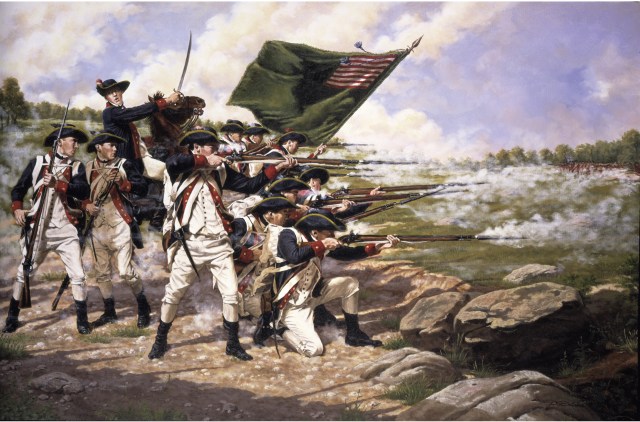
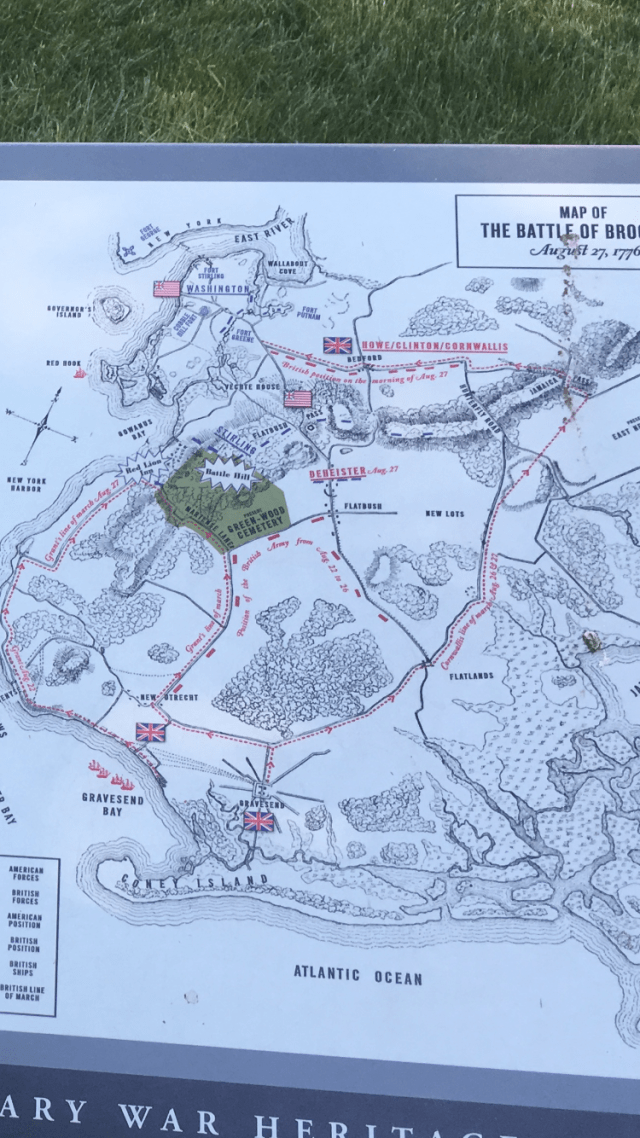
On March 15, 1781, approximately 20 men stood in the 1st Maryland Continental Regiment staring at the an eerie and familiar scene. It must have seemed that history was cruelly repeating itself once again. These men had survived the forlorn assault in New York in 1776, the ugly repulse at Camden in 1780, and now stood on third line of General Nathanael Greene’s defense at Guilford Court House.
Famous painting of the 1st Maryland at the Battle of Guilford Court House by H. CHarles McBarron, Jr.
Besides the 20 men who could be traced back to that fateful day in New York, the men that shouldered muskets in line with them were all veterans of indefinite periods of service as well.
The 1st Maryland and the men they confronted, 2nd Guards Battalion of Guards, were very similar, according to historian Lawrence Babits, who states that “the 1st Maryland was arguably one of the finest regiments produced by the Continental Army.
What ensued next was the defining moment of the battle and in essence the campaign. As the Guards officers gathered their men into a new line, the Marylanders came on at a rush. The Guards responded largely without specific commands…facing the oncoming Continentals, who fired several platoon volleys as they came. At a range of less than 12 yards, both lines fired again, so close that muzzle flashes overlapped into a wide sheet of flame and the heat from the volley could be felt.
Casualties mounted and at close range the musket balls shattered bone and even passed through the bodies of their targets.
Modern view from the location of Greene’s Third Line which the 1st Maryland held. Coming up the slight rise toward the photo was how the British approached.
The two sides then resorted to the bayonet and Williams recounted “the first Regiment embraced the opportunity…bayoneted and cut to pieces a great number of the British.”
Although the melee only lasted a few minutes, the Marylanders had checked the advance and with the dragoons of William Washington, allowed for Greene to begin to pull back and start the retreat. In another important position, Williams helped lead the rear-guard away from Guilford C.H. The Marylanders lost 15 killed, 42 wounded and 97 missing. Most of the missing could have came from the 2nd Maryland which broke in disorder on the left flank of the 1st Maryland.
Not only did the Marylanders suffer on that fateful March day in 1781, they did so with a lack of, well, everything. According to one inventory report, the entire regiment, numbering little over 300 men had not a single jacket, two-thirds were without proper footwear, and every man was destitute of a full complement of clothing. In addition, the men had served, fought courageously, and bled tremendously, without receiving one cent as pay.
A remarkable “band of brothers” that “held the line for independence.”
Which, in case you were wondering, was the name of the talk.
*Guilford Court House National Military Park is now preserved by the National Park Service, to plan your visit, click here.
*For information on Mr. O’Donnell’s book, click here.
Emerging Revolutionary War is honored to welcome guest historian Daniel Welch to the blog. A brief biography of Mr. Welch is at the bottom of the post.
Several weeks ago I decided to take my usual weekend off of visiting American Civil War battlefields to take a moment to explore some American Revolutionary War historic sites just several hours down the road. Since it was a rather last minute decision, I was not completely prepared before visiting other than some basic historical context and a vague idea of operating hours and things to do while at these historic sites. So, if you want to follow the Continental Army during their experiences in the fall and winter of 1777-1778 read on to help plan a great weekend day trip.
Battle of Brandywine
Sandy Hollow, Brandywine Battlefield
If you want to follow these events as they happened, and in chronological order, began your day at the Brandywine Battlefield Park Associates site. Walking the site is free, but there is a charge if you want to go through the museum or on a tour of one of two historic homes on the property. Their hours are constantly changing so make sure you check their website. (click here), before you plan your visit. To go on a house tour, view the film, and go through the museum there is an $8.00 charge; the museum and film alone is $5.00. I would suggest, if you have the time, to take in the film and museum. The film lasts approximately twenty minutes while a thorough look of the museum could take one an additional forty minutes. Between the film and museum, a firm foundation to the events of September 11, 1777 will be in place before you head out to other locations associated with the battle. The house tour is a guided tour through Washington’s headquarters on the property and is conducted by a volunteer at the site. The tour took over an hour and a half, and considering that the home had burned to the ground nearly 100 years ago and has been rebuilt and filled with modern reproductions, your time would be better spent going to other sites associated with the battle.
Birmingham Friend’s Meeting House plaque
Before leaving, make sure you pick up driving directions from the employees at the counter to get to Birmingham Friend’s Meeting House, and Sandy Hollow, the American’s second line of defense during the battle. Also, make sure to purchase the driving tour map of the battle of Brandywine. This map will take you to numerous other historic sites and homes within the Brandywine Valley that witnessed the events of that day. The cost is a mere $2.95. Plan an additional three to four hours to complete the driving tour.
Ultimately the battle proved to be an American defeat. Although he was defeated on the field, Washington and his generals were able to get large portions of the army to the rear through Polish General Pulaski’s assistance in covering the retreat. Despite the best maneuvers to save his army, Washington was unable to save Philadelphia and the city fell to the British just two weeks later on September 26, 1777. The British remained until June 1778.
Lunch
By now a late lunch would be in order. A great spot is the Black Powder Tavern. A tavern since 1746, it has a great Revolutionary War history, including a supposed visit by Washington himself. The restaurant’s name is related to a historical legend that none other than Von Steuben had ordered the tavern turned into a secret black powder magazine during the army’s pivotal winter at Valley Forge. The food here was great, as was the service and beer selection.
Valley Forge National Historical Park
Following the defeat at Brandywine in September, and another engagement at White Marsh in early December, General Washington looked to put his army into a more secure camp for the coming winter. Active military campaigning for 1777 in Pennsylvania was over. Just twenty miles northwest of Philadelphia, the Continental Army faced numerous challenges here including a lack of food and shelter. Disease also spread during their time at Valley Forge. By February 1778, approximately 2,500 soldiers had perished.
General Anthony Wayne Statue, Valley Forge National Historical Park
To begin your visit here, start at the visitor center. The museum has its challenges. There is no discernible narrative to the exhibits; rather, numerous cases with laminated pieces of paper hanging on the side with corresponding images and item descriptions. Although there are some unique items on display, if it is busy you could wait at a particular case for the laminated cards to know what you are looking at. After a perusal of the museum, take in the free film. Although it is rather dated it provides a great overview of the winter encampment, its challenges, and outcomes. Between the film and museum, plan on spending an hour at the visitor center.
If you have additional time, take in the one and only National Park Service Ranger program offered. It is a rather short program, in length and walking distance, from the visitor center to the reconstructed Muhlenberg Hut sites. The program also echoes what is presented in the film. Before leaving the visitor center, I recommend getting the auto tour cd, as well as any updates on road closures. The park is currently under a significant amount of construction that has closed some roads and altered the driving tour route. The suggested driving tour cd is two hours in length. This would be a time allotment for those visitors who do not stop at each site, get out of the car, and explore all the stops along the route. You will want to get out and explore monuments such as those to the New Jersey troops, National Memorial Arch, von Steuben, and Patriots of African American Descent. You will also want to explore the several historic homes within the park that were used during the encampment, such as Varnum’s Quarters, Washington’s Headquarters, and the Memorial Chapel. My explorations, coupled with the driving tour cd, lasted nearly five hours.
George Washington’s Headquarters (Isaac Potts House) at Valley Forge National Historical Park
Although it would be a long day, it can be done in one; however, if you wish to slow the pace of your visit, each site could be done on a separate day during your weekend. There is plenty of lodging in the area to accommodate this schedule. By visiting both of these historic areas and learning about the events of the fall through early spring 1777-1778, a greater picture can be viewed gleaned of military situation during the time period, as well as the tough composition of the Continental Army despite their defeats.
*Dan Welch currently serves as a primary and secondary educator with a public school district in northeast Ohio. Previously, Dan was the education programs coordinator for the Gettysburg Foundation, the non-profit partner of Gettysburg National Military Park, as well as a seasonal Park Ranger at Gettysburg National Military Park for six years. During that time, he led numerous programs on the campaign and battle for school groups, families, and visitors of all ages.
Welch received his BA in Instrumental Music Education from Youngstown State University where he studied under the famed French Hornist William Slocum, and is currently finishing his MA in Military History with a Civil War Era concentration at American Military University. Welch has also studied under the tutelage of Dr. Allen C. Guelzo as part of the Gettysburg Semester at Gettysburg College. He currently resides with his wife, Sarah, in Boardman, Ohio.
Two of the most significant battles of the war happened in the state of New Jersey; Trenton and Princeton. The harshest winter of the war for the Continental Army was at Morristown, New Jersey. Maybe it is only fitting that the largest American Revolution Round Table is also located in the Garden State.
North Jersey American Revolution Round Table
The North Jersey American Revolution Round Table is now on its ninth year as an organization and according to Secretary Rich Rosenthal, they are known for their “caliber of speakers and membership participation.”
Meetings are held the second Thursday of every month at the Washington’s Headquarters Museum Great Hall. All facets of the American Revolutionary War and era are discussed with, of course, “special emphasis” on New Jersey and Morristown’s role in the history of the United States.
Guests are certainly welcome. “We meet at a National Park facility [Morristown National Historical Park]–there is no admission!”
For more information, consult the following website by clicking here. An email newsletter is also available to keep up-to-date on events of the non-profit round table.
His name might not be too familiar, but he has the distinction of signing three of the most important documents of the American Revolutionary period; the petition to King George III of 1774, the Declaration of Independence, and the United States Constitution. His name?
George Read.
Born in the colony of Maryland on September 18, 1733 in the county of Cecil, the young Read was shortly thereafter on the move. His family, while George was an infant, resettled in New Castle, Delaware. When of school age, he attended Reverend Francis Allison’s Academy in New London, Pennsylvania, and one of his classmates was Thomas McKean, a future Signer of the Declaration of Independence as well. George moved on to study law in Philadelphia under the tutelage of John Moland. In 1753, George was admitted to the bar and the next year had settled back in New Castle, Delaware to practice. Continue reading “Six Signers Signing”→
Emerging Revolutionary War is honored to welcome guest historian David A. Powell to the blog. A biography of David is at the bottom of this post.
The Hudson Valley in upstate New York is one of my favorite historical places – which might come as a surprise to some, given that my usual historical beat is the 1861-1865 time-frame. There are a handful of Civil War related sites along the Hudson, but not many.
But for two centuries before our war between the states, the region was the pathway for commerce, settlement, and conflict. The banks of the Hudson, Lakes George and Champlain, and the St. Lawrence are all dotted with crucial reminders of a violent historical past.
Ruins of Crown Point
I’ve been to most of these sites; West Point, Bennington and Saratoga battlefields, the site of Fort William Henry, Crown Point, and plenty of other locations. One of them, however, fixes my attention beyond all others:
Interior of Fort Ticonderoga
Fort Ticonderoga.
The fort occupies a strategic place on Lake Champlain, were a land portage connects Champlain to Lake George, and ultimately, the Hudson River.
<Lake Champlain from Fort, looking south>
Originally called Carrillon by the French, who built it in 1755; the fort changed hands several times during the ensuing 25 years. It was unsuccessfully attacked by the British in 1758, and finally captured the next year, part of the British “Annus Mirabilis,” that string of decisive triumphs over the French that reached their crescendo with Wolfe’s victory at Quebec. Two decades later, it figured in the American Revolution; it was wrested from British control by Ethan Allen and Benedict Arnold in 1775. Its heavy artillery was sledged across many miles of Wilderness snow and ice to reinforce the Rebel army besieging Boston by Henry Knox, which forced the British to abandon that city. In 1776 Ticonderoga was a bulwark of the Patriot defenses on Lake Champlain. In 1777, it was easily re-captured by the British under Burgoyne, but returned to American control after Burgoyne’s disasters of Bennington and Saratoga.
Ticonderoga is fully restored now, owned and maintained by a private foundation that has done an outstanding job of presenting and preserving the Fort’s history. The town and the fort grounds are also dotted with interesting monuments, many erected by British regiments, mainly placed to honor their troops who fought in the Fort’s bloodiest single battle, that of 1758.
British General James Abercrombie led 17,000 troops – colonials and British regulars – against a much smaller garrison of between 4,000 and 5,000 French, Canadian Militia, and Indian Allies. The French, under the Marquis de Montcalm, defended an entrenched line outside of the fort walls, which Abercrombie obligingly assaulted. The British lost 2,000 men, and Abercrombie retreated.
My favorite monument at Ticonderoga is actually paired with another monument erected by the American Colonists in Westminster Abbey (left to right in picture below). They both commemorate the death of Lord George Howe, a Brigadier General in Abercrombie’s army (and elder brother to the Howes of Revolutionary War fame) who embraced irregular warfare.
Lord Howe Monument at Fort Ticonderoga
Memorial to George Augustus, Viscount Howe, in Westminster Abbey, London, England
Go spend an afternoon at Ticonderoga. You won’t be disappointed.
*David A. Powell is a graduate of the Virginia Military Institute (1983) with a B.A. in history. He has published numerous articles in various magazines, and more than fifteen historical simulations of different battles.
For the past decade, David’s focus has been on the epic battle of Chickamauga, and he is nationally recognized for his tours of that important battlefield. The result of that study was his first published book, The Maps of Chickamauga (Savas Beatie, 2009).
His latest book is Failure In The Saddle: Nathan Bedford Forrest, Joe Wheeler, and the Confederate Cavalry In the Chickamauga Campaign (Savas Beatie, 2011). He is currently working on a full length monograph of the battle of Chickamauga. The first volume of that work, entitled The Chickamauga Campaign: A Mad Irregular Battle, is scheduled for a 2014 release.
David and his wife Anne live and work in the northwest suburbs of Chicago, Illinois. He is Vice President of Airsped, Inc., a specialized delivery firm.
August 8, 2016—James and Dolley Madison at Montpelier, the Madisons’ home in Orange County, Virginia. Cast in bronze, the lie-sized statues were sculpted by Brooklyn-based artist Ivan Schwartz and unveiled May 27, 2009. Madison sits on one end of a bench that gives visitors room to sit next to him for a photo op.
Emerging Revolutionary War is honored to welcome guest historian Zach Whitlow. Zach’s biography is at the bottom of this post.
August marks the 202nd anniversary of the Burning of Washington. On the heels of their astounding victory at Bladensburg, a British incursionary force under Major General Robert Ross and Rear Admiral George Cockburn occupied the American capital for about 24 hours on August 24th & 25th, 1814. Besides a small ambush at the Sewall House on Capitol Hill, in which two corporals and General Ross’ horse was killed, the British encountered no resistance in the city whatsoever. The Union Jack was triumphantly raised: Washington had fallen. Soon it would burn.
The burned out shell of the White House following the British occupation of Washington. (The President’s House, by George Munger, 1814-1815)
What followed were events that literally burned themselves into the American psyche. To remember this bleak moment in history, rangers from the National Mall & Memorial Parks are leading a series of walking tours in the month of August. Beginning at the newly designated Belmont-Paul Women’s Equality National Monument (the site of the ambush), visitors walk a total of 2.5 miles and retrace the British advance down Pennsylvania Avenue. Through the program, the rangers will sift through the modern paved environment and tell the stories of long gone places, such as the newspaper offices of the National Intelligencer and Barbara Suter’s tavern. The tour will also feature some of the surviving remnants of that time, such as the Octagon Museum.
The walking tour begins at Belmont-Paul Women’s Equality National Monument (144 Constitution Ave NE, Washington, DC 20002) every Saturday in August at 3:00 pm. There will also be programs on Wednesday, August 24th and Thursday, August 25th at 3:00 pm. Please bring comfortable shoes and plenty of drinking water.
*Zach Whitlow has an M.A. in Museum Studies from the George Washington University, a B.A. in History from California State University, Long Beach, and three A.A. degrees from Fullerton College. A lifelong historian, he currently works for the National Park Service at the National Mall & Memorial Parks in Washington, DC and the Office of Historic Alexandria in Alexandria, VA. Prior to this, Zach worked at the National Archives, George Washington’s Mount Vernon, and the Queen Mary in Long Beach, CA. He currently lives in Alexandria, VA with his girlfriend Teresa and their two cats, Max and Lizzie.
The financier. Those two words explain the importance of Robert Morris, the Liverpool, England born Pennsylvanian transplant. As George Washington engineered the pivotal campaign that culminated in the actions at Trenton on Christmas Day 1776 and Princeton in early January, Robert Morris was the man who made it happen.
Born on January 20, 1734, Morris was a 13-year old lad when he sailed for the British North American colonies. He was headed to Oxford, Maryland where his father had emigrated prior to. While living on his father’s tobacco-growing plantation, Morris was afforded the opportunity to have a tutor and showed his mental prowess, advancing rapidly in his studies.
Outgrowing his tutor, Morris was sent to a family friend in Philadelphia where it was arranged the young man would become an apprentice in the shipping and banking of future Philadelphia mayor Charles Willing. When Willing died in 1754, Morris was made partner. He was only 24 years old at the time.
After the establishment of Willing, Morris, and Company on May 1, 1757, Morris was set about establishing himself firmly in the upper society of Philadelphia, the largest city in the 13 British colonies. Yet, it was not until he was 35 years old in 1759 when he wed Mary White, who hailed from a prominent Maryland family. In time, the family grew to include five sons and two daughters. That same year, Morris and his partner Thomas Willing organized the first non-importation agreement in which the slave trade was ended for good in the Philadelphia region.
Robert Morris (courtesy of our friends at The Society of the Descendants of the Signers of the Declaration of Independence, http://www.dsdi1776.com)
Even before his marriage, Morris was active in politics. In 1765 he had served on a committee comprised of local merchants. Formed in protest to the Stamp Act, Morris was chosen to mediate a mass town meeting of protesters. Even though he personally felt the new acts were unconstitutional, Morris was remained steadfastly loyal to Great Britain. Continue reading “Six Signing Signers”→