Emerging Revolutionary War welcomes guest historian Paul F. Soltis
250 years ago in 1775 John Wallace of Philadelphia was preparing to move. Born in Scotland in 1718, John was the youngest son of the minister of the Church of Scotland at Drumelizer in the Scottish Lowlands south of Glasgow and Edinburgh. While his eldest brother William would take over the ministry in the Kirk following their father’s death, John emigrated from Scotland to the colonies of British North America. Like many Scottish emigrants, Mr. Wallace entered the merchant trade, first in Newport, Rhode Island and eventually in Philadelphia where he met and married Mary Maddox of an established Philadelphia family.
At the opening of the Revolutionary War in 1775, John Wallace purchased 95 acres on the Raritan River in Somerset County, New Jersey from the Rev. Jacob Rutsen Hardenbergh, minister to the Dutch Reformed Churches of the upper Raritan River Valley. At this country estate he called “Hope Farm” Mr. Wallace built the largest home constructed in New Jersey during the Revolutionary War, perhaps “hoping” to escape the revolutionary ferment of Philadelphia. Midway between the British garrison at New York and the Continental Congress in Philadelphia, John Wallace instead found himself at the Crossroads of the American Revolution.
In the fall of 1778, the Continental Army arrived to this region of Somerset County where the Middle Brook flows into the Raritan River for the Middlebrook Cantonment of 1778-79. Nathanael Greene, Quartermaster General of the Continental Army, wrote on October 18, “Middle Brook is situate in a plentyful Country, naturally strong and difficult of access and surrounded with a great plenty of Wood. Great security will also be given to this Camp by the militia of the Country.” Col. Sidney Berry, a deputy quartermaster to Gen. Nathanael Greene, arranged with Mr. Wallace for use of the Wallace House at Hope Farm, a few miles west of the village of Middlebrook, as headquarters for George Washington.
For this week’s “Rev War Revelry” Emerging Revolutionary War ventures to the west to discuss the recently published book, “Till the Extinction of this Rebellion, George Rogers Clark, Frontier Warfare, and the Illinois Campaign of 1778-1779.” The author, Eric Sterner, is a contributor to the Emerging Revolutionary War, along with the author of An Anatomy of a Massacre: The Destruction of Gnadenhutten, 1782. When not writing history, Sterner had a career in government and public policy besides contributing to the literature and study of the American Revolutionary War era.
This book, published by Westholme Publishing, examines the viewpoints of the American, British, and Indigenous perspectives and illustrates the wide impact of the American Revolution on the peoples west of the Appalachian Mountains. What happened with Clark’s movements and campaign will lay the foundation for American expansion and the “opening of the West” following the American Revolution.
We hope you can join us for this historian happy hour this Sunday at 7 p.m. on our Facebook channel. If you miss it, we will post the revelry on our YouTube channel. Just search “Emerging Revolutionary War” to subscribe.
Emerging Revolutionary War welcomes guest historian Evan Portman
Overlooking the Grand Parade at Valley Forge National Historical Park is a statue almost as solid as the man it portrays. Baron von Steuben helped transform the American army into an effective and efficient fighting force in the winter of 1777-1778, but he also aided the country nearly a century and a half later. Yes, Baron von Steuben helped the United States through World War I—or at least the social turmoil on the home front.
Friedrich Wilhelm August Heinrich Ferdinand Steuben was born in Prussia (modern day Germany) in 1730 and served in the Prussian army through the Seven Years’ War. By 1775, Steuben had accrued a considerable amount of debt (despite his stature within the aristocracy), so he sought a foreign military appointment. Failing to catch the eye of the British, French, or Austrians, the Baron set his sights on the fledgling American government. Congress arranged for Steuben to be paid, depending on the outcome of the war, and sent him to the winter encampment at Valley Forge. There, he began drilling the Continental army and instituted better hygiene and sanitation practices. He also wrote a drill manual, which he published in 1779 as Regulations for the Order and Discipline of the Troops of the United States. After the encampment at Valley Forge, Steuben participated in the Southern Campaign of the Revolutionary War. After the Siege of Yorktown, Congress awarded the Baron a tract of land in New York where he died in 1794.
Joseph Galloway is best known as one of the preeminent and prominent Loyalists who remained in the American colonies through the majority of the American Revolution. Prior to the colonies declaring independence, especially during the First Continental Congress, Galloway was active in the debates that decided the path forward. Besides attending and being active in the discussions in Philadelphia he penned a pamphlet entitled A Candid Examination of the Mutual Claims of Great Britain and the Colonies.
Within the pages, he called African American slavery “the dangerous enemy within” and the “natural weakness” of the soon-to-be Southern states. If a division ensued, Galloway predicted that,
“If the colonies happen to vie and try their reciprocal strength with each other, the political force of the Northern Colonies will soon destroy the opulent force of the Southern.”
Furthermore, Galloway pointed to the colonies/states of Georgia, Maryland, North and South Carolina, and Virginia as vulnerable because of the institution of slavery. In a conflict without the overarching guidance by Great Britain, the division between Northern and Southern colonies/states would lead to a domestic civil war and the possibility that African American slaves would join the Northern effort in vanquishing their former owners.
Although Galloway was writing to prop support for remaining loyal to the British crown he foreshadowed accurately the rift that plagued the independent United States. In laying out his views, Galloway quite succinctly predicted what would happen in 78 years after independence was won by the United States.
Galloway left Philadelphia when the British evacuated the city in 1778 and left for England where he would position himself in a leading role for loyalists in exiles. He never returned to the United States. His succinct prediction of the future though proved eerily accurate.
Sources:
Disunion Among Ourselves, The Perilous Politics of the American Revolution by Eli Merritt
University of Michigan, Evans Early American Imprint Collection, click here for the link.
Emerging Revolutionary War welcomes the contribution of Eric Olsen, Park Ranger/Historian at Morristown National Historical Park
Military history tends to be a lot of “so and so’s” brigade advanced on the left wing, while “what’s his face’s” division withdrew.” Lots of movements of large faceless masses of soldiers. Personally, I prefer the little personal stories of individuals in the face of battle. Here is one such story from the battle of Monmouth in June 1778.
Sir Henry Clinton
I recently ran across this little tidbit in a July 7, 1778, letter written by the Adjutant General of the Hessian forces in America, Major Carl Leopold Baumeister. He described an incident during the battle of Monmouth involving the British commander in chief, Sir Henry Clinton. “General Clinton in the thickest fire, was saved by one of his adjutants, Captain Sutherland, when a rebel colonel aimed at him, but missed. Captain Sutherland’s horse was wounded. Another adjutant, Lloyd, stabbed the colonel.”
The story sounded vaguely familiar. Then I recalled something I’d read written by a British officer named Thomas Anbury. He was a prisoner of war, part of Burgoyne’s captured “Convention Army.” Anbury and the other prisoners were being held near Charlottesville, Virginia. At a place called Jones’s Plantation, Anbury related the following story on May 12, 1779,
“A very singular circumstance took place in that battle [Monmouth], which fully marks the coolness and deliberation, though in the heat of action, of Sir Henry Clinton: As he was reconnoitering, with two of his Aide de Camps, at the short turning of two roads, they met with an American officer, exceedingly well mounted upon a black horse, who, upon discerning them, made a stop, and looked as if he wished to advance to speak to them, when one of Sir Henry Clinton’s Aid de Camps fired a pistol at him, and he instantly rode off. Sir Henry was much displeased at his Aide de Camp, and censured him for being so hasty, adding, he was confident that the man wished to speak to him, and perhaps, might have given intelligence that would have been very essential, remarking, that when he was in Germany last war, and reconnoitering with Prince Ferdinand, a man rode up in a familiar manner, and gave such intelligence as decided the fate of the day.”
To read more about the Battle of Monmouth, check out “A Handsome Flogging, the Battle of Monmouth, June 28, 1778 by William Griffith, part of the Emerging Revolutionary War Series.
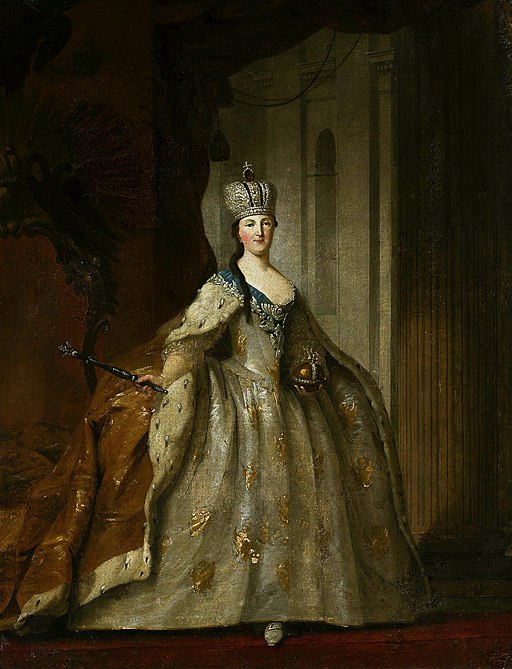
Catherine the Great By Ivan Argunov (Wikimedia Commons)
Catherine II, aka Catherine the Great, was one of the most dynamic and substantive monarchs of the eighteenth century. A wealth of contradictions characterized her reign. A reformer who corresponded regularly with the likes of Voltaire and Diderot, she was also a dedicated imperialist who divvyed up Poland in league with her neighbors and waged offensive wars to the south while colonizing as much of Siberia and Central Asia as she could. She seized power in a de facto coup, watched her rivals conveniently die, and embraced a Russian tradition of banishing unreliable or undesirable subjects, defined as those did not serve her interests, to Siberia. At the same time, she explicitly located the sovereignty of the nation among its people, sought to expand the number and classes of subjects with a role in administrative decision-making, and sincerely desired be seen as a what might be called a “democratic autocrat.”[1] So, one might expect Catherine’s Russia to have a mixed view of the American Revolution. As always, she was sure not to disappoint.
The years prior to Lexington and Concord were exhausting for Russia. In 1772, it completed the first partition of Poland in cooperation with Prussia and Austria. In 1774, it finally brought a six-year war with the Ottoman Empire to a successful resolution in the Treaty of Kuchuk-Kainarji, which expanded Russian territory in the south, giving it greater access to the Black Sea.[2] Throughout the period, Catherine dealt with a number of internal rebellions and uprisings built around phony claimants to her throne. By far the most dangerous was a Cossack uprising led by Emil Pugachev, who claimed to be Catherine’s deposed husband Peter III. He was caught at the end of 1774 and executed in 1775. When Britain’s North American colonies rebelled, it rated notice, but little attention in the Russian capital, St. Petersburg. Before too long Britain came calling, requesting 20,000 troops to suppress the rebellion. Catherine declined, but wrote a correspondent that she expected America to become independent in her lifetime.[3] Then her government turned toward its latest round of internal reform meant to improve the administration of its vast and growing territory. That might have been the end of it, but European politics intervened.
In the throes of the winter of 1778, spent at Valley Forge, General George Washington and his staff formulated a mountain of paperwork to multiple recipients of the American cause. On February 16, 1778, Alexander Hamilton composed a letter for the commander-in-chief of the Continental army to a gentleman who had moved from the military to the political ranks; George Clinton of New York.
George Clinton
He had seen service in the Hudson Highlands and had been commissioned a brigadier general in the Continental army on March 25, 1777. Later that same year both governor and lieutenant governor of New York, formally resigning the latter and accepting the former on July 30, 1777. In that capacity, he received the letter, excerpts below, from Valley Forge.
“It is with great reluctance, I trouble you on a subject, which does not properly fall within your province; but it is a subject that occasions me more distress, than I have felt, since the commencement of the war; and which loudly demands the most zealous exertions of every person of weight and authority, who is interested in the success of our affairs.”I mean the present dreadful situation of the army for want of provisions and the miserable prospects before us, with respect to futurity. It is more alarming, than you will probably conceive, for to form a just idea, it were necessary to be on the spot.2 For some days past, there has been little less, than a famine in camp. A part of the army has been a week, without any kind of flesh & the rest three or four days.3 Naked and starving as they are, we cannot eno⟨ugh⟩ admire the incomparable patience and fidelity of the soldiery, that they have not been, ere this, excited by their sufferings, to a general mutiny and dispersion. Strong symptoms however of discontent have appeared in particular instances; and nothing but the most active effort⟨s⟩ every where, can long avert so shocking a catastrophe.
Washington then asks for any help or supplies that Clinton can send his way, even though the army is outside the state lines of New York. Washington’s mindset is that the cause of the army in Pennsylvania is the cause of American independence and that Clinton, who had served would recognize that and do his utmost to provide what he can.
“I am calling upon all those, whose stations and influence enable them to contribute their aid upon so important an occasion, and from your well known zeal, I expect every thing within the compass of your power, and that the abilities and resources of the state over which you preside, will admit. I am sensible of the disadvantages it labours under, from having been so long the scene of war, and that it must be exceedingly drained by the great demands to which it has been subject, But though you may not be able to contribute materially to our relief, you can perhaps do something towards it; and any assistance, however trifling in itself, will be of great moment, at so critical a juncture, and will conduce to keeping the army together, ’till the Commissary’s department can be put upon a better footing, and effectual measures concerted to secure a permanent and competent supply. What methods you can take, you will be the best judge of; but if you can devise any means to procure a quantity of cattle or other kind of flesh, for the use of this army, to be at camp in the course of a month, you will render a most essential service to the common cause.“
Not only did Clinton receive this missive from Washington, dated February 16, but the following day Gouverneur Morris from a camp committee established by the Continental Congress also sent the New York governor a letter asking for any assistance he could provide for the army at Valley Forge.
These letters underscore the seriousness of the plight of the army encamped at Valley Forge as the winter slowly turned to spring. The action at Washington’s headquarters and from the camp committee helped create a path forward through that pivotal winter. To learn more about what transpired during those six months from December 1777 to June 1778, follow the link above to the “2022 Bus Tour” and join Emerging Revolutionary War on our second annual bus tour November 11-13, 2022.
The entire letter from Washington (Hamilton) to George Clinton can be found here.
244 years ago this week is when the Continental army, under the command of George Washington, marched into what would become their winter encampment as the year turned from 1777-1778. Recently, Phillip S. Greenwalt, one of the Emerging Revolutionary War historians was a “talking head” on a documentary about the Valley Forge encampment and what the soldiers and civilians faced during the ensuing six-month cantonment.
The documentary which features historians and park rangers is airing on Fox News Nation, the streaming service that is part of the Fox News network. Below is a screen shot of Phillip, who is also the author of Winter that Won the War, the Winter Encampment at Valley Forge, 1777-1778, which is part of the Emerging Revolutionary War Series published by Savas Beatie LLC.
So, if you need a break from the holiday specials that are airing, tune in for your history fix and learn more about the history at Valley Forge. If you want to dive even deeper into this period of the American Revolution, check out the link above labeled “2022 Bus Tour” and secure your tickets to join ERW at our second annual bus tour next November, which will include Valley Forge.
As the Continental Army marched into Valley Forge on December 19, 1777, staff officers under the commanding general had scoured the local area for a residence suitable for George Washington that winter. While discussions and negotiations were taking place, since the Continental Congress had decreed that the army had to ask and could not just commandeer private residences which was a chief complaint of the British policy prior to the war, Washington spent five nights in his marquee.
Afterwards Washington and his military family, later joined by Martha Washington, the general’s wife, moved into the Isaac Potts House for the remainder of the winter encampment.
This tent, called a marquee and served as headquarters, sleeping quarters, and dining area, was pitched in a field in the valley. The site is now marked by a stone monument and within the boundaries of Valley Forge National Historical Park.
On the second annual Emerging Revolutionary War Bus Tour, “The Rise of the American Army: Valley Forge and the Battle of Monmouth” from November 11 -13, 2022, this site, where Washington’s marquee tent was hoisted, will be one of the sites shown to tour participants.
To secure your spot, click here or the link on the banner at the top of this page.
During the winter encampment at Valley Forge, as thousands of men huddled around drafty wooden cabins, with dwindling supplies, and battled boredom and disease, a relief effort was organized hundreds of miles away.
George Washington, ensconced at the Potts House in the heart of the Valley Forge encampment, was very aware of the dire straights that his forces were exposed to. Throughout the winter he sent missives, directly and through intermediaries, discreetly asking for more aid, for supplies, for changes to military bureaucracy. He even consented to a delegation of congressmen to visit Valley Forge and see first-hand the situation in the winter of 1777-1778.
In a proverbial sense, he did not leave any stone unturned to try and ease the plight of his forces or continue to stay abreast of British designs, less than twenty-miles away in Philadelphia, Pennsylvania.
After hearing of the contributions of the Oneidas and Tuscaroras at the Battle of Oriskany in New York, Washington sent a letter of invitation for the Native Americans to visit his army. Approximately 50 warriors along with supplies made the few hundred mile journey from upstate New York to eastern Pennsylvania. They left their villages on April 25 and arrived on May 15,1778 in Valley Forge. The leaders of the Oneida party dined with Washington. Five days later some of the warriors participated in the engagement at Barren Hill under the Marquis de Lafayette. Six of the warriors gave their life in service to their ally.
In 2007 historian Joseph T. Glatthaar published a book about the Oneidas and their contributions to the American victory in the war. The title, in part, is Forgotten Allies. A fitting testament to the service and sacrifice this tribe underwent in their partnership with the fledgling American nation.
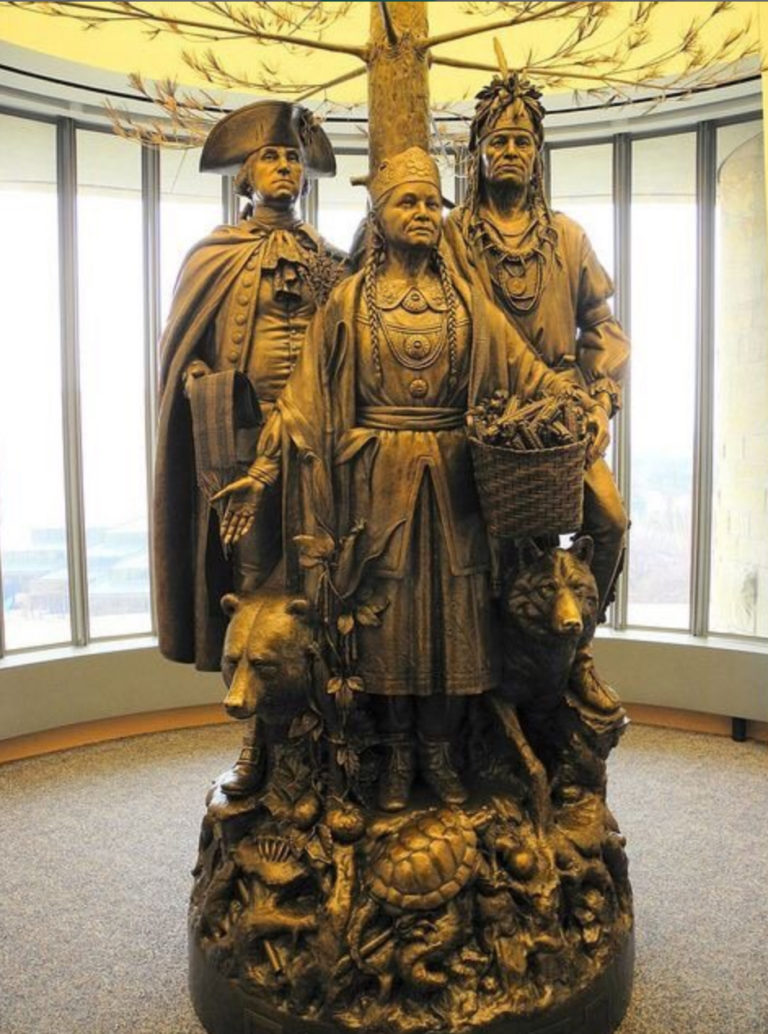
In 2004 a sculpture was completed of Polly Cooper, Chief Skenandoah, and George Washington (courtesy of King of Prussia Historical Society)
If the Oneidas were the “forgotten allies” than in the winter encampment at Valley Forge there was a forgotten woman that tramped south with her fellow Oneidas. Her name was Polly Cooper.
Along with the warriors, whom Washington wanted to serve as scouts, the Oneidas brought much needed supplies, including bushels of white corn. While the leaders dined at the Potts House, Cooper established a de-facto cooking show. She handed out the white corn to the soldiers and taught them how to use husks to make soup and ground grain to make it palatable.
This much needed food sources, along with an improved supply chain under quartermaster Nathanael Greene rounded out the bleak winter with the glimmer of hope for better supplies in the upcoming campaign season.
The Oneida, including Polly Cooper for her services, refused any and all payment. Friends help friends in need is what the Oneida told Washington and his officers. However, a tradition exists in the history of the Oneida nation. That story, passed down orally from generation to generation, highlights that Marth Washington, in her gratitude for what Polly Cooper did for the rank-and-file of the Continental army, presented the Oneida heroine with a shawl and bonnet.
Another account reads that Cooper was gifted a black shawl that she saw for sale in a store window. The Continental Congress appropriated the money for the clothing item and gifted it as their thanks to her. This shawl is still in the ownership of her descendants and has been loaned to the Oneida cultural center from time to time.
The black shawl that Polly Cooper received for her services to the Continental Army at Valley Forge (courtesy of the Oneida Indian Nation http://www.oneidaindiannation.org)








 Emerging Revolutionary War Era