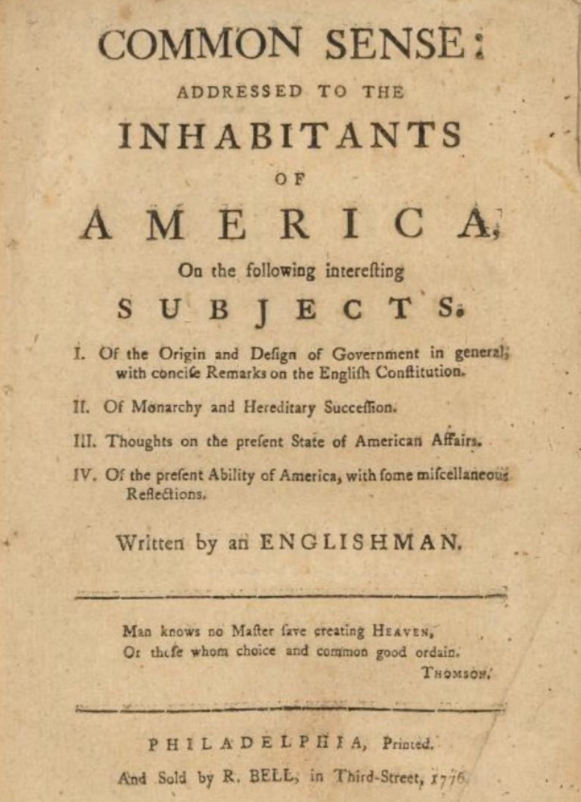
Virginian Landon Carter was vocal about the latest pamphlet sweeping through the American colonies in 1776. In several diary entries from the first four months of that momentous year, he commented on Common Sense, written anonymously “by an Englishman.” Carter described its contents in February as “rascally and nonsensical as possible, for it was only a sophisticated attempt to throw all men out of principles.” By April, as he continued to criticize the work, he reached a conclusion about its author: “I begin now more and more to see that the pamphlet called Common Sense, supporting independency, is written by a member of the Congress …” Carter could not have been further from the truth.
“An Englishman” was, in fact, an apt description for the author of Common Sense, first advertised to the American public on January 9, 1776, and first released on January 10. Thomas Paine was an Englishman—born there and, by most measures, matured there as a failure. He failed at his corset-making business. Teaching, collecting taxes, privateering, and working as a grocer—none of these occupations suited him either. He married twice (his first wife died in childbirth), and his second marriage collapsed. Amid this string of failures, Paine found success with the written word, which caught Benjamin Franklin’s attention in England in 1774. With little left for him in England, Paine embarked for America, arriving later that year. There, he scraped by as a writer, publishing essays in Philadelphia newspapers.
The “Shot Heard Round the World” on April 19, 1775, hurled the American colonies into a fever pitch and a war footing. But in the 18th century, slow travel and communication meant the news spread gradually. It took 21 days for word of the fighting at Lexington and Concord to reach the town of Mecklenburg, in Berkeley County, Virginia (now Shepherdstown, in Jefferson County, West Virginia).
On May 10, the citizens of Mecklenburg learned of the battles between colonial militiamen and British troops. Combined with reports that Virginia’s royal governor, Lord Dunmore, had seized gunpowder from the magazine in Williamsburg, the townspeople prepared to support their fellow patriots in any way they could.
Local militia members began to drill and ready themselves for action. On June 10, they gathered on the property of Colonel William Morgan, just outside of town, for a patriotic barbecue. Songs were sung, and those present made a solemn pledge to return to the same spot—Morgan’s Grove—fifty years later to commemorate the day.
The rallying point for the Beeline March
After the festivities, drilling resumed, though the men still wondered whether they’d truly be called to arms. That call came on June 14, when the Continental Congress resolved that “six companies of expert riflemen be immediately raised in Pennsylvania, two in Maryland, and two in Virginia.” Once formed and equipped, the companies were to “march and join the army near Boston, to be there employed as light infantry under the command of the chief Officer in that army.”
Virginia’s quota fell to two experienced frontiersmen: Daniel Morgan, who raised a company in Winchester, and Hugh Stephenson, who assembled his company at Mecklenburg. The recruits signed one-year enlistments.
Henry Bedinger, one of Stephenson’s men, noted that “none were received but young men of character, and of sufficient property to clothe themselves completely, find their own arms and accoutrements—that is, an approved rifle, handsome shot pouch and powder-horn, blanket, with such decent clothing as should be prescribed.” It took fewer than seven days to raise a full complement of 100 men. Only a delay in procuring enough rifles kept the company from marching immediately.
Stephenson and Morgan agreed to rendezvous in Frederick, Maryland, before continuing to Boston. Morgan’s men departed first, on July 15. Stephenson’s company followed from Morgan’s Grove on July 17.
“Morgan having the start, we used every exertion to overhaul him—in vain,” wrote Bedinger, “although we marched (always in single file) from 30 to 36 miles a number of days.”
Along the way, Stephenson’s men were greeted by cheering citizens and well-supplied with food. Their grueling pace—averaging over 20 miles per day—became legendary. Only two men failed to complete the full journey: one was court-martialed, the other accidentally wounded.
On August 11, after marching more than 500 miles in just 25 days, Stephenson’s company arrived in Cambridge, Massachusetts, just behind Morgan’s men. There, they halted before General George Washington.
Stephenson’s company reporting to General Washington at Cambridge (My Ride to the Barbecue)
As the riflemen presented arms, Bedinger recalled, the general “slowly rode by us looking attentively and affectionately at the soldiers from his native state. When he shook hands with our captain, it was said they both shed tears.”
The journey became known as the Beeline March for its quick and direct route to join the Continental Army. Fifty years later, on June 10, 1825, the veterans honored their pledge to return to Morgan’s Grove. Of the original company, only five men were still alive, and just two were able to attend the reunion. One of them was Michael Bedinger, who recalled the events of 1775 and sang “two patriotic songs…the very same that had been sung at that spot fifty years before.”
Today, two markers commemorate the Beeline March’s origin. In Morgan’s Grove Park, a 1988 monument marks the “Shepherdstown Rally Point.” Down the road, in Elmwood Cemetery, a 1932 monument erected by the Daughters of the American Revolution lists the names of the commissioned and non-commissioned officers of Stephenson’s company.
For a fledgling armed force preparing to challenge one of the world’s greatest military powers, the Beeline March demonstrated the resolve, discipline, and patriotic fervor of early American soldiers—and set a standard for those who would follow.
“No taxation without representation” was one of the political cries of American colonists before the American Revolution. While the slogan inspired colonial enmity of the British Parliament and spearheaded efforts by prominent Americans and Britons to achieve some form of representation in the British government, it fell on deaf ears of common British citizens, including one correspondent of The Newcastle Chronicle, published in Newcastle upon Tyne, Tyne and Wear, England.
250 years ago today, this unknown correspondent’s opinion of the matter was printed for British citizens to read and consider:
When we consider (says a correspondent) in our present dispute with America, that there are large manufacturing towns in England, who, though they have no direct representative, yet pay the same taxes as those who have; thatthere are many thousands of merchants, manufacturers and others in Britan, who never had a vote for a representative, and therefore cannot be said to have consented to the taxes imposed upon them by the constituent powers of the legislature; and when we consider that the people of the Isle of Man, who once had superior privileges to any province in America, are deprived of all trade but with Britain, and obliged to pay taxes by British acts, without having one representative in the British Parliament. When we consider these things, how ill grounded must the complaints of the Americans appear to every man of feafe, and how necessary does it become to exact that obedience from their fears, which is neither to be hoped from their gratitude nor from their justice.
In July 2024, Minute Man National Historical Park announced the discovery of five musket balls fired at Concord’s North Bridge on April 19, 1775. Park Ranger Jarrad Fuoss will join Emerging Revolutionary War on Sunday, January 5, 2025, at 7 pm, for a behind-the-scenes look at how the bullets were unearthed and will also provide a preview of the park’s 250th-anniversary events this April.
December 16, 1773, was deep into the rear-view mirror. A new year had begun, and February 1774 lay close to the horizon. Yet, for the British Parliament, the events of what later became known as the Boston Tea Party were still very much breaking news. Word had just reached London of what had happened in Boston. Now, how would the Crown and those in parliamentary power react to this shocking news?
Most contemporary sources of the period, as well as a litany of works in the historiography of the subject, contend that Britian’s reaction to what happened in December 1773, and thus their course in handling the situation in 1774, was done so prematurely and without much rational debate and discussion. Historian Jon Ferling suggests, “the myth arose that its government, under Prime Minister Frederick, Lord North, had acted in haste.” The myth had grown during the numerous setbacks the British later suffered during the war itself. And, in the wake of their ultimate defeat, many contemporaries across the pond argued that Britain’s leaders, “had failed to comprehend the gravity of the challenge,” i.e., using the military might of their nation to quell the rebellious colonies in 1774.
If one was to examine the proceedings of Parliament during this period 250 years ago, however, they would not find hasty decisions being made based on emotional reactions to the news out of Boston the previous month. This is especially so when the use of the country’s military resources was debated as an option to deal with the rowdy and disobedient Bostonians. Nothing could be farther for the truth contends Ferling, noting that the use of their military to enforce Crown law in the colonies began in the opening days of 1774, even before the throwing of the tea reached London. Not only was this thought discussed and debated in Parliament, but the reactions the colonists would have was also heavily considered. Some openly debated that such a strong application of Britain’s military in Boston, the Massachusetts Colony, and other coercive actions, may indeed spark yet another war in North America. These arguments were then quickly followed by questions of whether Britian could win in another conflict on this continent so soon after the French and Indian War; a conflict that had drained Britain’s finances and depleted her military ranks.
As January 1774 concluded 250 years ago, and February was just days away, these larger questions on how Parliament and the Crown should react to the Boston Tea Party and course-correct those in colonies in open rebellion against Britain were continually debated. It was not until March 1774 that a decision was made. North, and thus Parliament, opted to avoid the potential for outright war by utilizing their military might first. Instead, they chose a route of punitive measures, the Coercive Acts (also known as the Intolerable Acts). As part of this legislation, certain parts would solely focus on Massachusetts as punishment for the events of December 16, 1773, in Boston. These acts also included closing Boston Harbor until the destroyed tea’s worth had been repaid, and Gen. Thomas Gage, commander of the British Army in America, installed as the colonial governor of Massachusetts. Gage contended that these refractory Bostonians would “be lions while we are lambs; but if we take the resolute part, they will prove very meek, I promise you.”
In the end, however, this course of action was not made in haste at all, but rather after nearly four full months after the throwing of the tea in Boston harbor. And, one could argue that North and Parliament initially sought to refrain from the sole use of Britain’s military might, rather opting for legislative settlement to the issues that arose from Massachusetts. But, as history played out 250 years ago in 1774, as historian Ferling contends, “Britain, of course, miscalculated hugely.”
Join us this Sunday, October 15th at 7pm as we welcome Matthew Wilding, Director of Education and Interpretation at Revolutionary Spaces. Revolutionary Spaces manages the Old South Meeting House and the Old State House in historic Boston. We will discuss the history of the Old South Meeting House and its important role in the revolutionary movement in Boston (especially during the Boston Tea Party). We will also cover their plans for the 250th anniversary of the Boston Tea Party, including their new exhibit on the destruction of property in public protests.
Grab a drink and follow along as we start to gear up for the 250th anniversary of the Boston Tea Party with Emerging Revolutionary War!
On December 16, 1773, a protest orchestrated by the Sons of Liberty in Boston, Massachusetts turned words into action. Upset over recently passed legislation and the belief that “no taxation without representation” 116 people dumped 342 chests of tea owned by the British East India Company into Boston Harbor. The event was one of the milestones on the way to the American Revolution and American independence. As the Boston Tea Party, as it is known to history, closes in on its 250th anniversary, Emerging Revolutionary War will invite Evan O’Brien, the creative director for the Boston Tea Party Ships and Museum this Sunday, June 25, evening for the next “Rev War Revelry.”
We hope you can join us at 7 p.m. EDT on Emerging Revolutionary War’s Facebook page for a discussion of the history behind and on December 16, 1773 and the efforts to commemorate and interpret that time frame. If you are contemplating venturing up to Boston in December to be in the city for the 250th anniversary of this event, you will not want to miss this discussion, as Evan will share some of what the museum has been planning to commemorate when Boston Harbor became a “tea-pot.”
Emerging Revolutionary War welcomes guest historian Liz Williams, from Historic Alexandria, the host of the second annual symposium
When we planned our 2nd Annual Revolutionary War Symposium for 2020, our theme came easily – Hindsight is 2020. Little did we know that our cheeky title would take on a different meaning as we had to navigate a global pandemic. But I am excited that we can still offer our symposium (yes 6 months later) and virtual! In this format, we can zoom our experts to computers and smartphones across the country. And this year we have a great variety of topics – from Drunken Hessians to African American Continentals. Learn about Loyalists, battles in the Southern Theatre, and along a creek in southeastern Pennsylvania.
As we move toward the 250th anniversary of the nation, it is critical for us all to look with fresh eyes at our founding. At Gadsby’s Tavern Museum, we engage with the complexity and challenges of early America, many of which were rooted in what transpired before and during the Revolutionary War. By understanding our past, we can continue the work of creating a better United States for all.
The Symposium costs $40 per person, $20 OHA Members & Students and reservations can be made at AlexandriaVa.gov/Shop. Looking forward to seeing everyone on May 22!
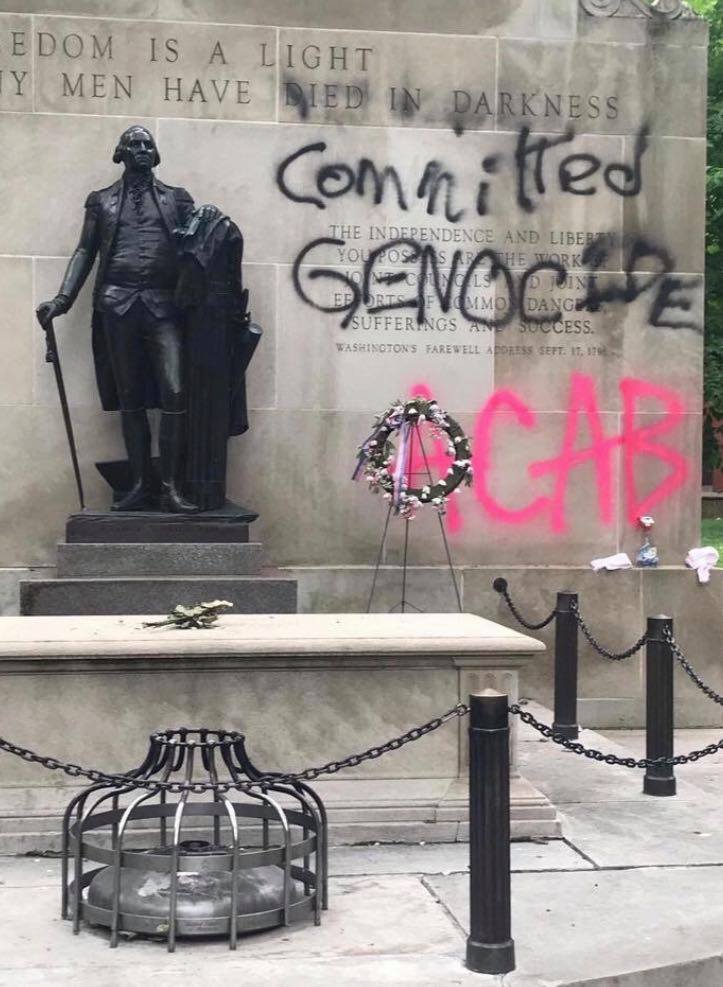
With the recent events facing our nation, American Revolutionary War monuments and memorials have an important role in demonstrating pride in our shared past and the highest ideals we value. Statues and monuments to the leaders and participants of the struggle for American independence today stand on battlefields, in courthouse squares and on historic sites all across this nation. While these statues depict very flawed and imperfect human beings, they memorialize the deeds and character that contributed to the creation of the nation we now live in.
These statues and monuments not only tell an important part of the nation’s founding, they are also artifacts of the eras in which they were constructed and how we have remembered our Revolutionary struggle, and how the ideals of the Revolution continue to live to this very day. Part of what we do at Emerging Revolutionary War is connect the past to the places today. Over the past few weeks we have seen localities remove or plan to remove statues honoring Caesar Rodney in Delaware and Philip Schuyler in New York. We have also seen statues of Marquis de Lafayette, Baron von Steuben, and Thaddeus Kosciusko vandalized in Washington, DC, a statue of George Washington vandalized in Boston, statues vandalized in Philadelphia of Washington and Benjamin Franklin, and the Tomb of the Unknown Revolutionary War in Philadelphia desecrated.
We feel it is important that all of the United States’ Revolutionary War statues and monuments are protected so they can continue to demonstrate our highest values and ideals and the tell the story of the important figures who shaped our nation. Without these monuments, we lose vital resources to tell the important stories of our past and help unite us in moving forward as a country. As the 250th anniversary of the American Revolution draws near, rather than the removal of monuments, we hope more monuments and memorials will be erected, especially for overlooked populations that also played a role in the founding of our nation. With this more comprehensive view of history in mind, a broader and more accurate story can be told to the American public. Emerging Revolutionary War will continue to trace the stories of the past and tie them to the places through these challenging times and we look forward to a better tomorrow.
A special announcement in the preservation world was made public today. The Civil War Trust, which the Campaign 1776 initiative spawned from, officially changed their name to the American Battlefield Trust. You can see their video announcement of the name change and what it means, here.
Emerging Revolutionary War sent an email inquiry to our friends at American Battlefield Trust to elaborate a little further on what this name change means and the impact to their current and future preservation efforts. Continue reading “A Very Special Message”→








 Emerging Revolutionary War sent an email inquiry to our friends at American Battlefield Trust to elaborate a little further on what this name change means and the impact to their current and future preservation efforts.
  Emerging Revolutionary War Era