Emerging Revolutionary War welcomes guest historian Drew Palmer. A biography follows at the end of this post.
What does it look like when veteran soldiers do not want to fight anymore? When morale plummets and the realities of war take their toll on men. This is exactly what happened to 150 men in the Maryland Line of the Continental Army in the late summer of 1780.
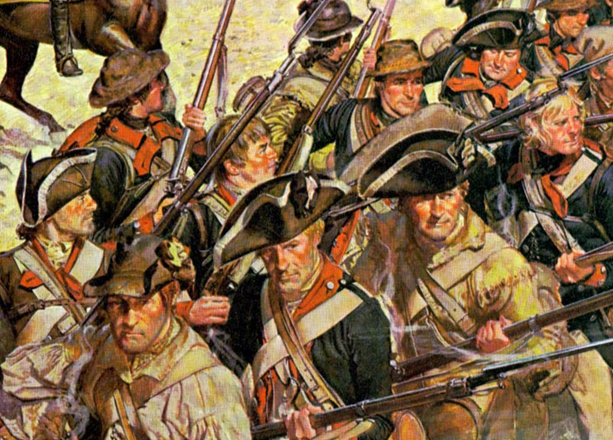
The 1st Maryland Regiment holds the line at the Battle of Guilford Courthouse, March 15, 1781
The continental regiments of Maryland that made up what became known as the “Maryland Line” or “Old Line State” had earned the reputation as a reliable, brave, and disciplined fighting force as early as 1776 after their actions in the Battle of Long Island.1 At the Battle of Camden on August 16, 1780, the 1st and 2nd Maryland Brigades offered a stout defense as Gen. Charles Cornwallis’s British force crashed into Continental soldiers from Maryland and Delaware. In the end, though, Maj. General Horatio Gates’s Southern Continental Army was completely routed from the field, with many of the Maryland Continental troops taken prisoner and held in the small village of Camden after the battle.2
The village of Camden, South Carolina, was an unpleasant place to be after the battle. The crowded conditions and brutal summer climate of South Carolina began to produce sickness amongst Cornwallis’s men and the American prisoners that were held in Camden. To prevent further sickness from spreading, Cornwallis decided to split the American prisoners held at Camden into divisions of around 150 men. These divisions were guarded by small detachments of the British army and marched from Camden to Charlestown, South Carolina.3 One detachment of the British 63rd Regiment of Foot escorted 150 prisoners of the 1st Maryland Brigade captured at Camden. The division made it to Thomas Sumter’s abandoned plantation at Great Savannah, about 60 miles northwest of Charleston. As the Maryland prisoners and their British guards halted for the night, militia commander Francis Marion received word from a Loyalist deserter that the Marylanders were nearby and decided to ambush the British element in hopes of freeing the Maryland prisoners.4 In the early morning hours of August 25, 1780, Marion’s militia attacked.
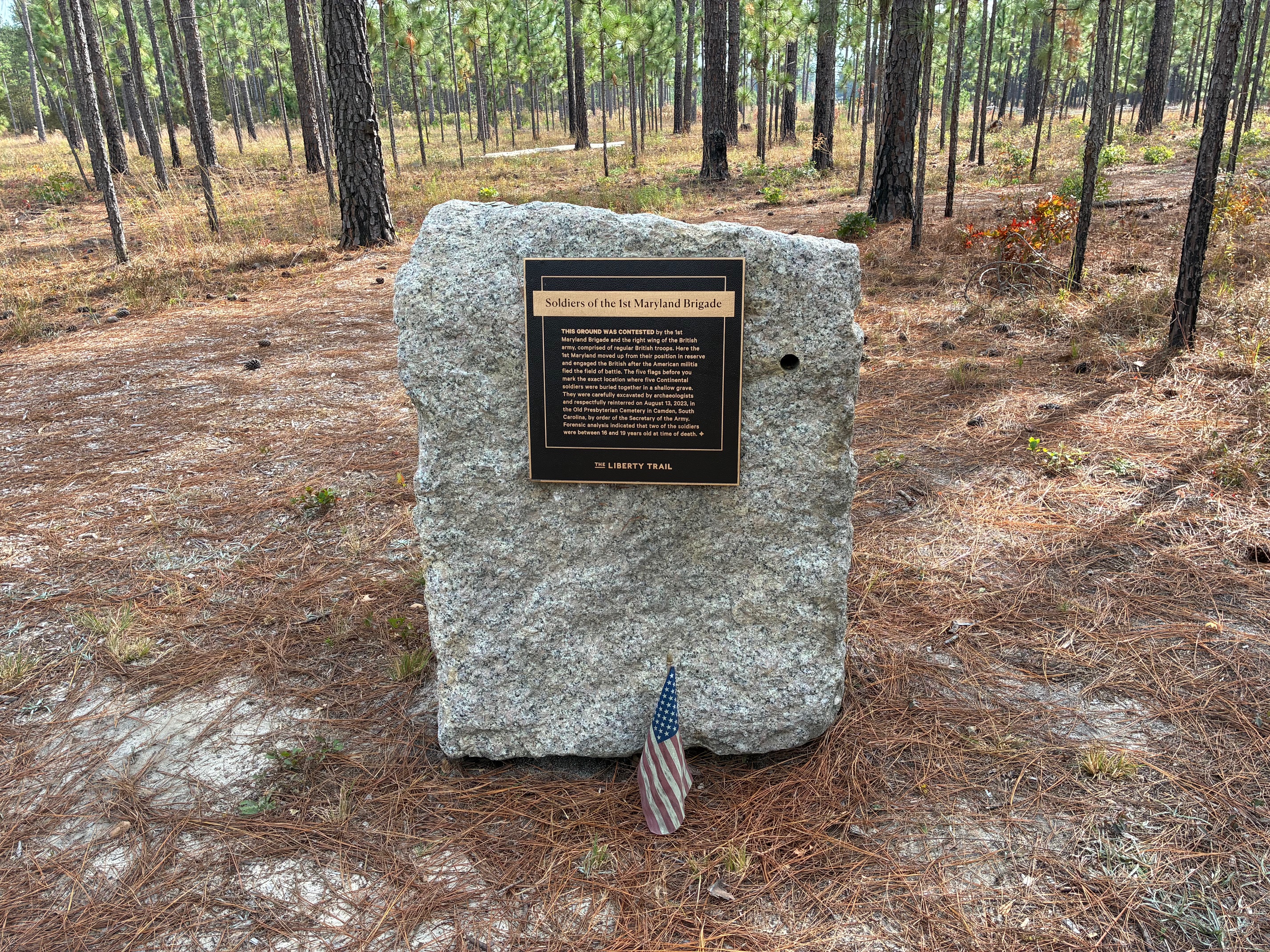
On Veteran’s Day in 2022, the American Battlefield Trust published the following article on their website “Archaeologists, Historians Unearth Remarkable Discovery at Camden Battlefield.” The Battle of Camden, fought in South Carolina on August 16, 1780, was a disastrous defeat for the American army, which suffered 1,900 casualties out of 3,700 engaged. Among those 1,900 approximate casualties were 5 Marylanders of the 1st Maryland Brigade. Over 242 years later, these five soldiers’ remains were found on the battlefield in a shallow grave. Another nine were found buried in other sites on the hallowed ground of Camden.
With forensic analysis and other research done in the ensuing months, a few facts about who these men were came to light. One of the most poignant discoveries was the age of two of the fallen Marylanders. Their ages were 16 to 19 years of age.
Although I have studied, lectured, and written about numerous engagements in two American wars, the simple fact of how young these soldiers were, as I read the memorial bronze plaque on the boulder monument, gives a deeper sense of sadness. Wars kill people of all ages, bullets don’t differentiate.
As we enter the holiday season and gather with friends and family, young and old, the fact that one of these soldiers, as young as 16, possibly, sacrificed his life, still name unknown, and lost to history for over 242 years. A family never knew what happened to their relation.
It is why it is invaluable that history continues to be studied. Archaeology is still important. And preservation of hallowed ground, like Camden, is worth preserving and interpreting. As you spend your holidays in the fashion that suits you, take a moment to think about a fallen soldier at Camden, in August 1780, sacrificed at sixteen.
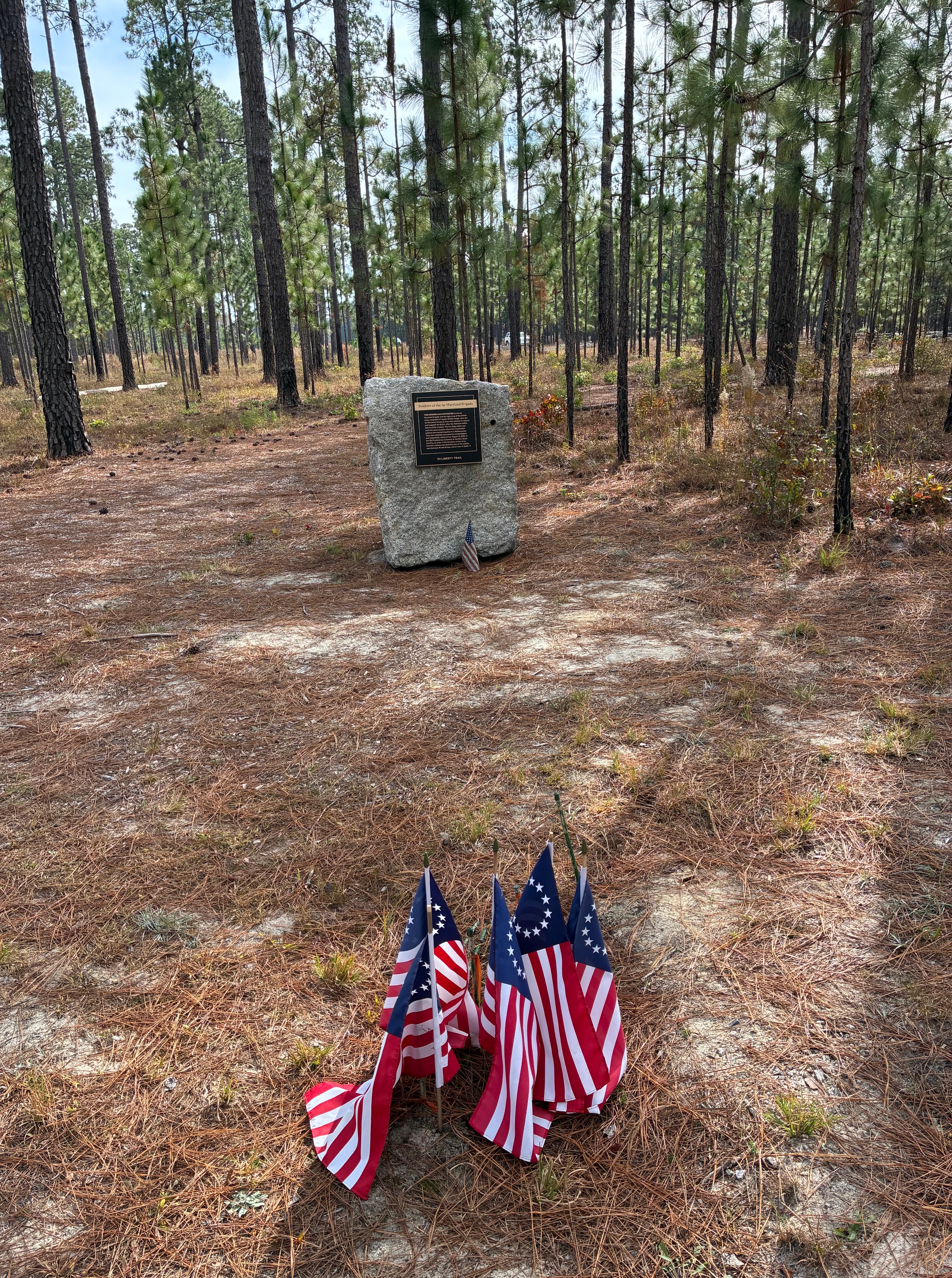
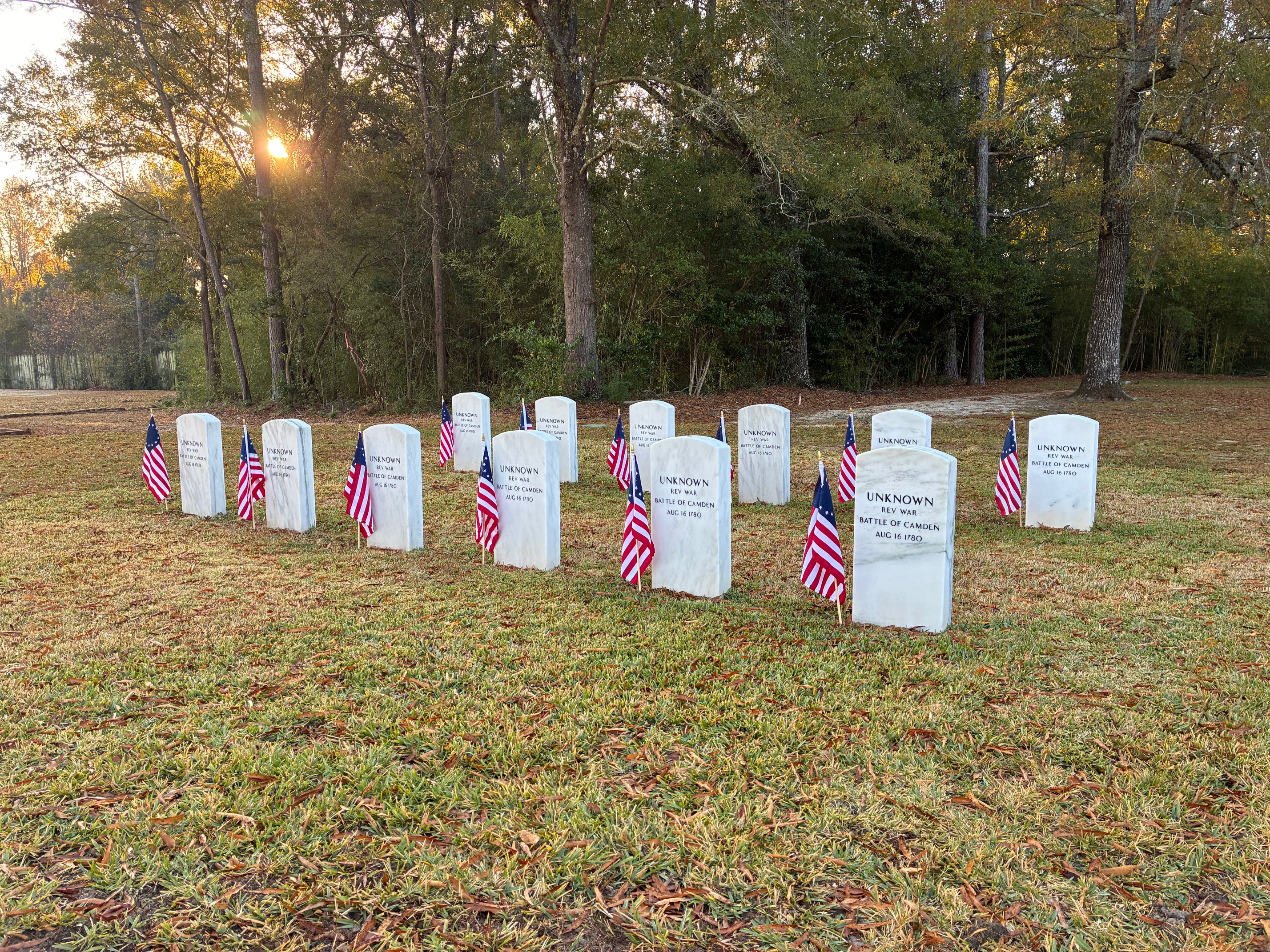
Monument to the MarylandersThe flags mark the location of the five remainsGravestones of nine American soldiers, their remains found on the Camden Battlefield, now in the Revolutionary War Memorial outisde Quaker Cemetery in Camden, SC.
I chose the long way to Revolutionary War history. Part of it can be blamed on the co-founders and early bloggers on ERW. They convinced me, a Civil War historian, to come to the “dark side,” and study the more pivotal, more complex, and more important era in American history. And thus I joined this merry band and “threw in” to start learning more about our turbulent founding. I can’t say that I am a master of this domain yet, but I’ve come a long in several years.
Today, however, as I walked through one of our country’s national cemeteries, one that does not have any dead from our War for Independence, I began thinking about the American consciousness and the path toward someone’s interest in our military history. I began by reflecting on my own experience and why I was drawn to study the Civil War. Certainly, visiting Civil War battlefields as a young child with a toy musket and kepi sold me easily enough to want me to pursue this field of study as a future career. But maybe it was also the impact of visual media. I could see my childhood heroes in pictures taken at the time, the wreckage of the battlefield, and the plight of dead and dying soldiers on those fields and at field hospitals.
So maybe the Revolutionary period does not garner the attention that study of later wars does as it lacks photographs, and for later conflicts, film, film with sound, and live frontline reporting on tv and the internet. But time may also factor into the perception of interest levels. Iraq, Afghanistan, Desert Storm, and Vietnam veterans are still with us, and although their numbers are marching into history, the Korean War and World War II generations. Their presence in our society makes the conflicts in which they served seem not so long ago, rather, more like recent history. As a public historian, however, when I have discussions regarding World War I and the Civil War it’s viscerally noticeable that modern society has a harder time making tangible connections to these moments in American history. It simply seems much further into the past, a long, long time ago to them. Maybe because there are no longer any living veterans from these wars. Bringing the Revolutionary War into the discussion only makes it seem even more remote from present day. The general public’s perception of time when thinking of this era might as well be the Dark Ages, but it is not even 250 years old yet. We are still a country in its infancy by world comparison. Thus, it’s a harder “sell” to the masses to become involved or interested in the Revolutionary War era outside of a cast of a few prominent characters, George Washington among the very top of that list.
Since April 2023, however, I have been on a crusade to change that thinking as I work with the public. The Revolutionary War was not that far away, and although we only have paintings and sketches from the war rather than photographs and live action film, it is enough to spark an interest and deeper appreciation and understanding. Perhaps, though, it is the tangible reminders of the war that can once and for all disprove the notion that this period is too far removed into the past to be relevant, worth note, or even remembrance.
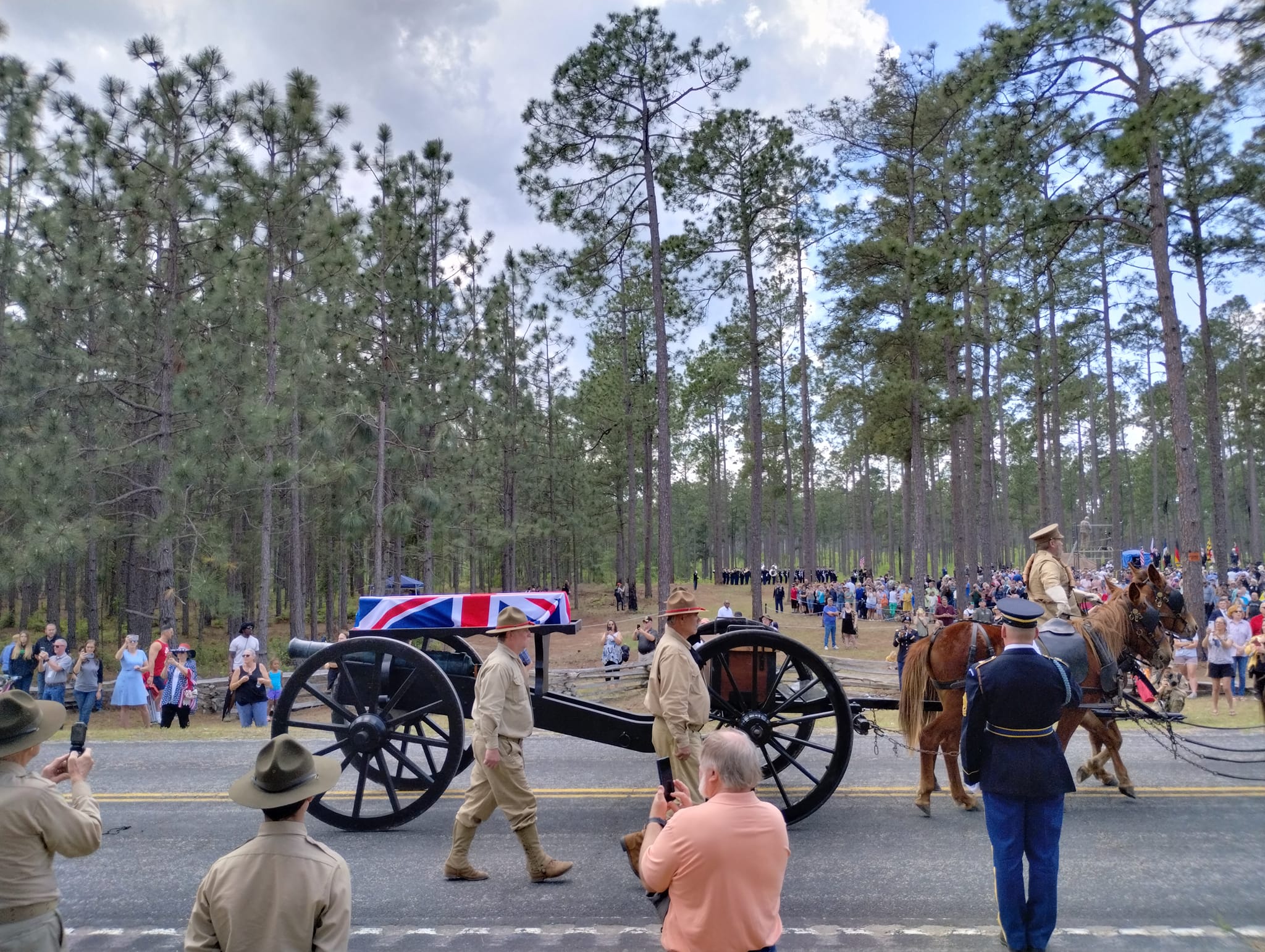
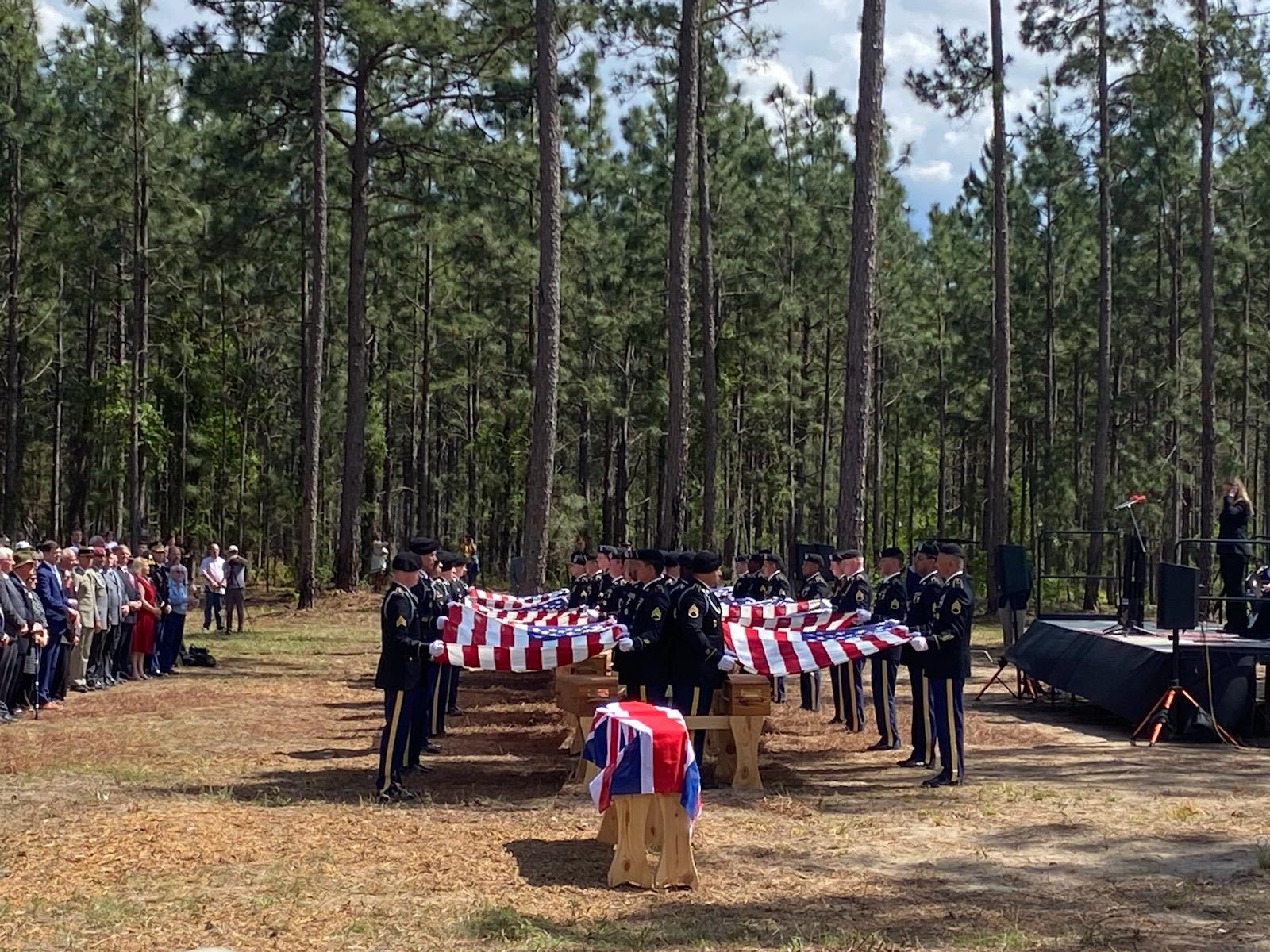
Nearly eighteen months ago I stood on the battlefield of Camden, fought August 16, 1780. I watched as horsedrawn caissons returned the remains of twelve Continental soldiers of the Maryland and Delaware regiments, one British Loyalist of a North Carolina regiment, and one Scottish Highlander, 71st regiment back to the battlefield. The remains had been discovered earlier in 2022. After a moving ceremony, among a massive crowd gathered to pay their respects, I was able to walk among the flag draped coffins, made of wood from the battlefield itself. I was standing mere inches from soldiers that had given their lives on that field 243 years earlier. The vail of time instantly dropped at that stark realization. The Revolutionary War was not far into the past, hemmed in among long lost American decades. Rather it was right in front of me, in the present, in the now. You could further walk the battlefield that April weekend. Four white flag markers denoted the four corners of where each set of remains were found on the battlefield. You could literally see the battle unfold before you, and now lay witness to where these men had died and fell all those years before.
I have had many powerful experiences at historic sites of the years. Standing or walking in the footsteps of historical giants, visiting gravesites, being present on anniversaries of important moments. But no experience was as powerful as this day. And so, on this day, I reflect on the battle of Camden, South Carolina. I reflect on that April day. And I reflect on the unfinished work that lay ahead during the 250th anniversary commemorations of the Revolutionary War as public historians. We must rededicate ourselves “to the great task remaining before us” to bring these pivotal, complex, and important moments of this era back into the American consciousness and to ensure it remains ever present for the next 250 years.
The following is from David Reuwer, who was a good friend of Charles Baxley and worked with Charles to help preserve and interpret the story of Camden, Hobkirk’s Hill and South Carolina in the American Revolution. Both men shared an unmatched level of passion and enthusiasm for history.
“I never heard that,” was a common cadence with which this practical lawyer and self-taught historian responded to new information about the American Revolution in South Carolina. He both challenged the statement maker to support it and welcomed the newbie into the fellowship of the Southern Campaigns. This is how Charles B. Baxley operated with both hands – one gladly shaking an entry to join our exploits and the other cautioning you to rise to ever higher and increasing standards. He would push, exacerbate, pull, and uplift you. The Southern Campaigns of the American Revolution was created in 2004 by Charles Baxley and David Reuwer when they delineated the tripod elements of scholarship, fellowship and fun. Charles defined scholarship as building blocks of historic research, inquisition and field evidence; fellowship as to include anyone who would cite source material gone before us while presently lifting others up around us; and fun as joyfully sharing one another’s knowledgeable victories as we pursued historic adventures.
The substantive virtue Charles practiced daily was broad inclusion – come and join us! There was always another chair at the table and more room for additional players according to him. However, you had to participate somehow, to care about the commonweal, and to help others with their project needs and requests. You had to give as well as take.
Charles suffered from PAD – project aggrandizement disorder – in that he cajoled and made each of us go deeper when all the rest of us thought it had been done. He could come up with endless lists of questions when everyone else considered the subject utterly exhausted. History was neither boring, stale nor irrelevant the way Charles viewed and worked it. History is an experience, as much about the present as it was about the past. We must place our “boots on the ground” – the actual locatable sites – in order to fulfill our duties of scholarship and fellowship. Only when a little more (or a lot) is known and understood, that we can pass on, have we accomplished the tasks before us responsibly to the future generations. Charles achieved much of this by writing, sending and responding to multiplicative emails and countless phone calls while sitting in his “war room” den at home late into the night and wee morning hours.
Charles was inherently an encourager of others making us to think hard about their historic project, to question everything, to counsel with others, to be in mentorship, and to ./explore new thinking about what one is doing. His queries to you could sometimes be unnerving but if you really worked for the answers, the growth toward historic truth was rewarding. No wonder he was awarded the Order of the Palmetto by Governor Mark Sanford in 2006; no surprise in 2022 that Governor Henry McMaster appointed him the Chairman of the South Carolina American Revolution Sestercentennial Commission (SC250). He was one of the key people who took on the gigantuan task of restoring South Carolina’s Revolutionary battlefield stories into their proper place in American history since 1856 when Senator Andrew Butler vociferously debated Charles Sumner of Massachusetts on the floor of the U.S. Senate.
It is true that he liked chairing the Round Tables with intervening commentary and being the centrifugal point-man in most other Revolutionary War conversations. His verbal editorials were always engaging and usually enlightening.
He liked playing “director” and was sincerely effectual at connecting people with other people and endeavors with other projects. His brain was way ahead of most other thinking minds, historically, and he courteously provoked when he did. Perhaps no other single person currently had as much comprehensive breadth-and-depth knowledge about the Revolution in SC as Charles. “Learning is not virtue but the means to bring us an acquaintance with it. Integrity without knowledge is weak and useless, and knowledge without integrity is dangerous and dreadful. Let these be your motives to action through life, the relief of the distressed, the detection of frauds, the defeat of oppression, and diffusion of happiness,” professed 38-year-old General Nathanael Greene, final military commander of the Southern Department during the Revolution. Charles embodied this learning for 70 plus years and shared this way to live with all the rest of us. If you were not about doing a task, he would assign you one. Charles often related that we were only as good as our current task, project or mission and persuasively demanded that we focus on it for the purpose of sharing it with others.
Our State has lost one most caring advocate of the Revolutionary founding 1770-1783 era – a hero of history. For him, it was about accurately working the historic puzzle and conclusively moving the story forward in truth. Most substantively, many of us State residents, numerous thousands of 250th out-of-state tourists, and untold future generations of all Americans will HEAR and HAVE HEARD of South Carolina’s significant persons, places, battles, and events of the Southern Campaigns because of Charles B. Baxley. Mirroring Christopher Gadsden, he lived for “What I can do for my country, I will do.”
Emerging Revolutionary War welcomes guest historian Eric Wiser to the blog.
This is a brief story of my first and memorable visit to the Camden Battlefield in South Carolina this September past. I am a husband and father living in the suburbs of Chicago. I make my living as an accountant. As rewarding as my career has been, it’s my strong interest in early American history that stirs my imagination. My pilgrimage to Camden was part of a visit to my friend Phil Kondos who moved to eastern Georgia with his family over a decade ago. Phil is a gifted musician and wonderful father and happens to share a mutual love of history. This narrative of our visit will hopefully inspire others to place Camden Battlefield on their bucket list.
My interest in the Battle of Camden mostly derives from having a Patriot ancestor who fought there. Pvt. Michael Wiser, a 23-year-old grist miller from Frederick County, Maryland, was with the First Maryland Brigade and captured by the British at Camden.[i]
“Given the order to defend the American withdrawal from Long Island, the Maryland Line saved the Continental Army from annihilation in the first major battle of the war.” wrote historian Ryan Polk.
Tench Tilghman, staff officer to George Washington and a native Marylander wrote about his fellow soldiers, “bore the palm…by behaving with as much Regularity as possible.”
Furthermore, if you Google “Battle of Guilford Court House” the image used by Wikipedia depicts an artist’s rendition of the 1st Maryland defending Nathanael Greene’s last line during the March 1781 engagement. The particular image is below.
The Continental Maryland Line was one of the preeminent stalwarts of the American army, both in the northern and southern theaters of the war. Join Emerging Revolutionary War historians in a discussion about the men from the Old Line State and their military acumen during the American Revolutionary War. The discussion will also highlight their memory and memorialization. We hope you can join us Sunday at 7 p.m. EST on the Facebook page of Emerging Revolutionary War.
Though it is most commonly associated with its Civil War history, Jefferson County, West Virginia, boasts a large amount of Revolutionary War history, too. One does not have to travel far in the county to stumble on a Washington family home (there were ten, seven still stand) or find Washington family members buried in the Zion Episcopal Cemetery in Charlestown, the county seat (this cemetery supposedly boasts more Washington family graves than any other place in the United States).
Beyond Washington, though, Jefferson County can claim at least two other well-known Revolutionary War generals on its citizen rolls: Horatio Gates and Charles Lee. Both of their countryside estates still stand today but are privately owned.
Traveller’s Rest (Library of Congress)
Traveller’s Rest, built by Horatio Gates in 1773, stands west of Kearneysville in the western section of the county. Gates employed carpenter John Ariss for the wooden portions of the construction project, a man who also worked on many of the local Washington homes. Gates lived at Traveller’s Rest until his service in the Continental Army took him away from his home. Following his defeat at the Battle of Camden in 1780 and his subsequent sidelining by the Continental Congress, Gates returned to his plantation, where he lived quietly. In 1790, the former general freed his slaves, sold the house, and moved to New York, where he died in 1806.
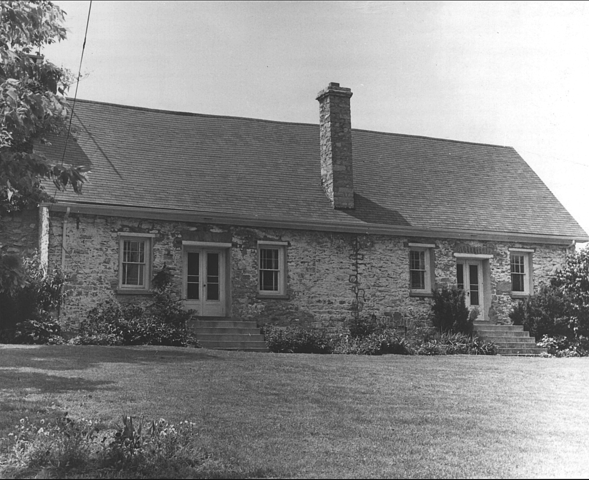
Three miles south of Gates lived Charles Lee at Prato Rio, a Portuguese phrase meaning “Stream on the meadow.” Lee did not build his home but purchased the 1733 structure in 1774 after some urging from Gates. Following his own sacking in the wake of the Battle of Monmouth, Lee returned to his home in 1779, a place he referred to as “The Hut.” Lee spent his last years there quietly surrounded by his three dogs, Father, Son, and Holy Ghost. Supposedly, when he learned of a possible visit from George Washington, Lee attached a note to his door that read, “No dinner cooked here to-day.”
Lee’s house was less conventional than Gates’ home. The inside contained no walls—only chalk lines delineated the different rooms. Lee remarked, “I can sit in any corner, and give orders, and overlook the whole, without moving my chair.”
Prato Rio (West Virginia State Historic Preservation Office)
While both homes can be seen from public roads today, they are not open to the public. Please respect the owners’ privacy.
Join us as we discuss the excavation and successful recovery of the remains of 14 veterans of the August 16, 1780, Battle of Camden with James Legg and Steven Smith, Ph.D., the lead archeologists of the Camden Re-Burial Project which began in September 2022. We will discuss the indepth research conducted and the precise archaeological work that was done on the battlefield. Also learn about the reburial ceremony and where the soldiers were finally laid to rest.
This is a great opportunity to learn about a rare discovery on a American Revolutionary War battlefield. The Camden battlefield is a great archaeological site that is revealing multiple stories and helping historians piece together a better understanding of the battle. Grab a drink and join us on our Facebook page for a great evening of archaeology and history!
Major General Horatio Gates, “Hero of Saratoga” was tasked with saving the American effort in the south. Credit NPS
On August 15, Maj. Gen. Horatio Gates began to finalize his plans to move against Camden, SC. Gates, appointed as the new commander of the Southern Department the previous month, believed the British garrison in Camden was weak. Gates was receiving intelligence gathered by partisan commander Thomas Sumter who was acting in and around Camden. He informed Gates that the American army outnumbered the British post and that a large portion of the men at Camden were taken ill and not fit for duty (on this account, Sumter was correct). Sumter did not provide the intelligence that Lord Cornwallis was now in Camden with reinforcements and was taking personal command of the British force in Camden.
Modern day image of the area at Rugeley’s Mills, with modern day Flat Rock Road following the historic trace of the Great Wagon Road. Credit Rob Orrison
With this information, Gates felt confident in his ability to take on the British in Camden. He developed a plan that involved a three-part movement. He would leave his force south to Saunder’s Creek (about six miles north of Camden) and establish a strong defensive position. He also ordered Francis Marion and his men to the southeast. Gates wanted Marion to take command of the Williamsburg militia, watch the British movements, and destroy boats in the Santee River that a defeated Cornwallis might need to retreat from Camden to Charleston. The third prong he ordered a few days earlier on August 13. Gates, under the encouragement of Thomas Sumter, decided to send 100 Maryland Continentals and 300 Carolina militiamen (as well as two brass three pounders) to join Sumter and move down the western side of the Wateree. From this location Sumter could attack supplies and reinforcements going into Camden from Ninety Six to the west. Gates’s confidence was evident.
South Carolina militia Brig. Gen Thomas Sumter. Credit New York Public Library
As Gates made his final disposition to move south, Sumter’s militia along with his Continental detachment met some success west of Camden. The Wateree River flowed south just one mile west of Camden. Near the important Wateree Ferry that served the major route west from Camden, Loyalist Lt. Col. James Cary built a small fort on his farm near the ferry. Sumter was aware of the fort and decided to see if he could capture it. When Col. Thomas Taylor of Sumter’s command launched the attack, most of the defenders inside were asleep, and the others were deceived by Patriot militia dressed just like those occupying the fort. The Loyalists immediately surrendered. Sumter reported that his men killed 7 and captured 30 prisoners, including Cary. Also included in the loot were 38 wagons of supplies and nearly 300 head of cattle. After capturing Cary’s Fort, Sumter was also able to attack and capture a relief column from Ninety Six to Camden. Sumter’s spoils from this attack numbered nearly 70 prisoners and numerous wagons. Sumter also reaffirmed his earlier intelligence to Gates by writing that the British in Camden “do not exceed two thousand, and not as many as one thousand of the militia, who aregenerally sickly, and much dispirited.” Sumter’s intelligence, though not accurate, gave Gates encouragement on the upcoming movement toward Camden. At 10pm on August 15, Gates had his army on the road south towards Camden.
Gates was flush with optimism, at that same time Cornwallis had his army on the road north. Though the British forces were about half the size of Gates, they were more than Gates expected and consisted of some of the best men in the British army led by one of their most accomplished generals. Soon, due to a twist of fate, these two armies collided along the Great Wagon Road in the long life pine forest of South Carolina. The result was one of the worst days in the history of the United States Army.
Authors Rob Orrison and Mark Wilcox’s new book “All That Can Be Expected: The Battle of Camden and the British High Tide in the South, August 16, 1780” is due out August, 2023 and available at: https://www.savasbeatie.com/
This Sunday, August 6th at 7pm join ERW series editor Dan Welch and authors Rob Orrison and Mark Wilcox as they discuss one of the worst defeats in American history, the Battle of Camden. How did the hero of Saratoga end up the scapegoat in the south? Learn how a coincidence led to a great British victory. And how did the Patriots recover from such a large defeat and find a path to victory a year later? Orrison and Wilcox will also discuss their upcoming book “All That Can be Expected, The Battle of Camden”. Grab a drink and join us to learn more about the Battle of Camden!
All Rev War Revelries can be found LIVE on our Facebook page, or a week later on our You Tube and Spotify channels.






 Emerging Revolutionary War Era