Emerging Revolutionary War welcomes back guest historian and park ranger Eric Olsen. Ranger Olsen works for the National Park Service at Morristown National Historical Park. Click here to learn more about the park.
What do poor health, a dead mother, a need to shop for new clothes, a pregnant wife, army business, a wife’s mental illness, family financial problems, and a desire to see family and old friends all have in common?
They are all reasons officers gave for asking for furloughs during the winter encampment of 1779-1780.
While the regulations and the various orders issued give us a general idea of the problems related to furloughs, we can get a different viewpoint by looking closer at the different Divisions, Brigades, and individuals who made up the army. The individual soldiers’ correspondence can also give us a more personal take on the furlough story. This paper will be far from comprehensive. It will just cover the furloughs that turn up in the surviving documentation. To make it easier to follow I have grouped the numbers and correspondence regarding furloughs by divisions and brigades.
Emerging Revolutionary War welcomes guest historian Riley Sullivan, Professor of History at San Jacinto College in Houston, Texas.
While many might be familiar with famed engagements at places like Bunker Hill, Saratoga, and Yorktown during the Revolutionary War, few are familiar with the actions that took place near New London, Connecticut in September of 1781. However, for the people of Connecticut, the battles that took place near Groton Heights and New London have been immortalized as a campaign highlighted by treachery and massacre. Largely, this interpretation has been adopted due to the commander of the British forces who engaged in this raid, Benedict Arnold.
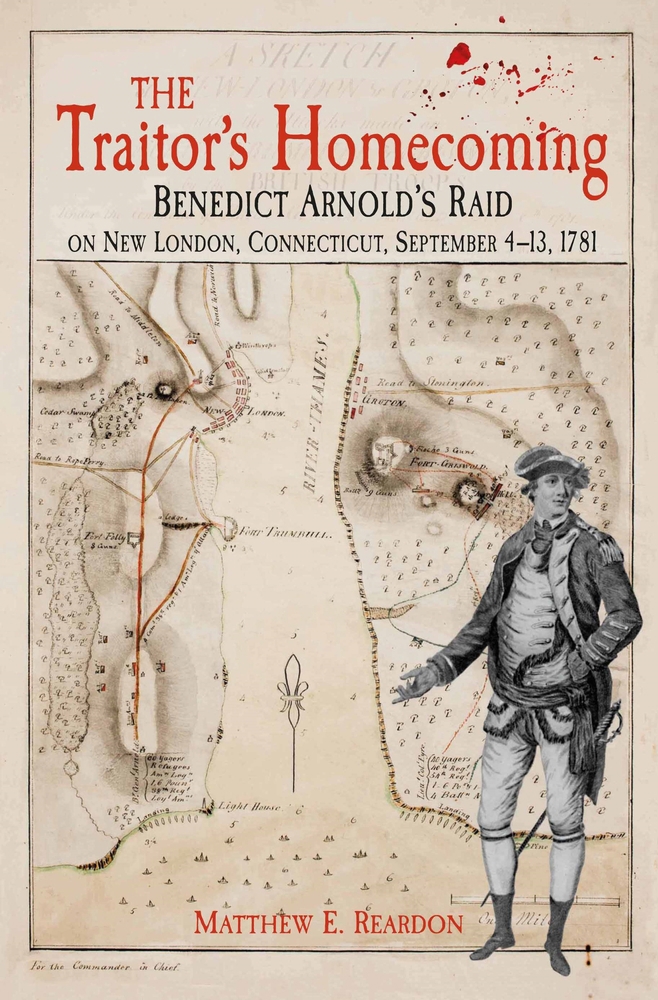
Perhaps no other name in American History brings about more scorn than that of Benedict Arnold. Having defected to the British cause late in the Revolutionary War, for Americans at the time–and even today–he is viewed as a modern day Judas. However, with such infamy ultimately comes much misinterpretation of this historical figure and the events he was involved in. In Matthew E. Reardon’s recent study The Traitor’s Homecoming, he attempts to undo much of this misinterpretation. Drawing on previously unused primary sources, Reardon constructs an engaging argument that challenges the traditional view of Arnold’s conduct in the New London raid.
To construct this narrative of the New London raid, Reardon attempts to place into context the setting of the New London raid. By this stage in the war, the conflict in New York had been a state of stalemate for the previous few years. However, with Generals Washington and Rochambeu’s combined Franco-American forces on the move, the British commander in the region, Henry Clinton—informed by faulty intelligence as Reardon demonstrated—was convinced that an attack on New York was imminent. As a result, to divert Washington’s attention away from a possible attack on New York, Clinton authorized Arnold to lead a contingent of British troops to attack the vulnerable Connecticut coastline.
New London made the ideal target for a British raid as it had been a hotbed for commerce and privateering for the Patriot cause. To conduct such a raid, Clinton turned to Arnold as he was both a native of Connecticut and familiar with the New London area. Largely only being contested by militia behind a number of forts that guarded approaches to both the town and the Thames River, Arnold’s combined force of Loyalists, Hessian Jaegers, and British regulars made quick work of the Patriot militia throughout the campaign. Even with New London in their hands, outside events–notably Clinton’s realization that Washington was moving on Cornwallis at Yorktown–led to Arnold having to relinquish his gains. However, with the high casualties suffered by both sides during the raid, coupled with the burning of much of the town, the events “cemented Benedict Arnold’s reputation for villainy.” (x)
When considering the traditional interpretation of Arnold’s raid on New London, Reardon makes it clear throughout his work that a “distorted interpretation” of the events had emerged (ix). From veterans to the Groton Battle Monument at Fort Griswold Battlefield State Park, the events that took place in Connecticut in 1781 have been enshrined as a massacre of Connecticut militia at the hands of Arnold. However, when looking at contemporary letters, diaries, and later pension records, Reardon demonstrates that there are some noticeable gaps within the traditional account of this campaign. In particular, when examining the death of Colonel William Ledyard–who was alleged to have been killed while attempting to surrender–Reardon concluded that through these sources, the traditional accounts accepted proved to be inconsistent with contemporary accounts of the campaign.
But, even with these inconsistencies, this is not to say that the fighting at Fort Griswold and the subsequent burning of New London was less than brutal. Reardon wrote that “the immediate reaction of the community was shock” and that “for many it was beyond comprehension.” (339) To no surprise, this sheer shock of the fighting coupled with Arnold’s involvement led to this distorted narrative of the campaign.
Through the examination of contemporary letters, diaries, and later pension applications, Reardon is able to reconstruct in great detail the events of Arnold’s New London raid and offer an unbiased narrative. By providing these fresh sources in The Traitor’s Homecoming, Reardon effectively builds on the existing literature of the subject and demonstrates how public perception can lead to the misinterpretation of historical events like that of the New London raid.
Details:
Matthew E. Reardon, The Traitor’s Homecoming: Benedict Arnold’s Raid on New London, Connecticut, September 4-13, 1781. Published by: Savas Beatie LLC. Summer 2024. 448 Pages.
*Check out Emerging Revolutionary War’s YouTube page as well for a “Rev War Revelry” interview with author Matthew E. Reardon.*
On Friday, April 21, 1775, word arrived in New Haven, Connecticut, regarding the fighting at Lexington and Concord. The Revolutionary War had begun, and thousands of militiamen from Massachusetts and the surrounding colonies in New England were converging around Boston to lay siege to the British army bottled up in the city. The next day, New Haven’s militia unit, the Governor’s Second Company of Guards, or Second Company, Governor’s Foot Guards, prepared to march to Cambridge.
Garbed in “A scarlet coat of common length, the lapels, cuffs and collars of buff and trimmed with plain silver wash buttons, white linen vest, breeches and stockings, black half leggins and small, fashionable and narrow ruffled shirt,” the Foot Guards made for quite the appearance. At the head of the 65-man-strong company was Captain Benedict Arnold, a leading member in revolutionary New Haven.
Arnold, 34-years-old at the outbreak of the war, had not stood pat during the decade leading up to April 1775. He was a member of the Sons of Liberty, and on multiple occasions, led mobs against the pro-monarchy members of the community. His leadership and zeal were recognized in March 1775 when he was elected captain of the militia. Like so many other patriots throughout the colonies, the shots fired at Lexington and Concord on April 19 would catapult Arnold onto a path to glory, and unfortunately for the country, later treason.
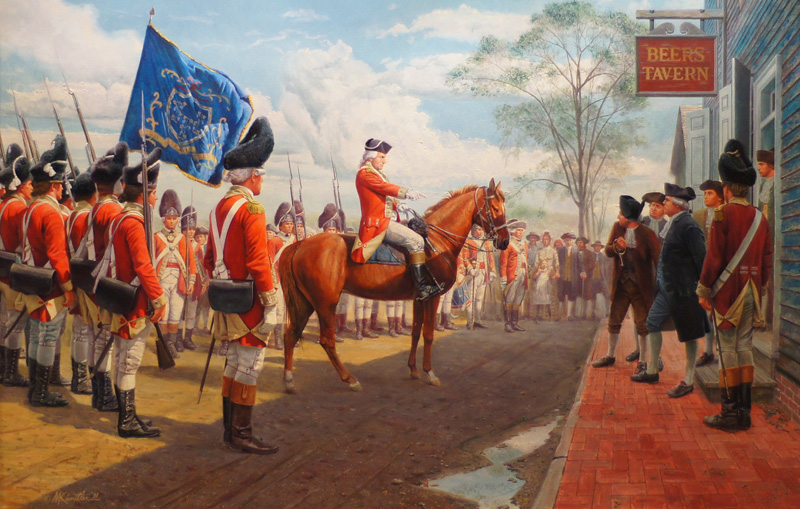
When the news arrived in town the evening of April 21, fifty-eight members of the Foot Guards voted to march to the assistance of their New England brethren. The next morning, Captain Arnold assembled the men on the New Haven Green, where the powder house was located. The doors were locked, and the keys to the stores in possession of New Haven’s Selectmen. Just off the green, at the intersection of College and Chapel Streets, stood Beers Tavern, where the Selectmen were gathered and discussing the town’s response to the recently received news.
The Foot Guards positioned themselves outside the building, while Arnold banged on the door demanding the keys to the powder house. The Selectmen refused to turn them over until official orders arrived. “None but the Almighty God shall prevent my marching,” Arnold passionately assured them. His forceful persuasion worked. The storehouse was opened, and the militia retrieved the necessary ammunition, flints, and powder. Once equipped, Arnold led his men out of New Haven and began a three-day march to Cambridge to join the fight.
Benedict Arnold Demands the Powder House Key by Mort Künstler
Idleness was not in Benedict Arnold’s nature, and upon arriving within the army’s camp, he approached the Massachusetts Committee of Safety with a proposal to lead an expedition against the British-held Ford Ticonderoga situated between Lake George and Lake Champlain in New York. The fort helped defend the crucial waterway system running north-south from Canada and housed cannon that could be vital to the patriot cause. The committee’s chairman, Dr. Joseph Warren, backed the plan and it was approved. On May 3, Arnold was promoted to colonel in the service of Massachusetts (not Connecticut) and was ordered to raise a force in western New England to accomplish the mission. The future hero of Saratoga and traitor to American liberty spurred his horse out of Cambridge and set his sights on taking “America’s Gibraltar.”
Although 1781 is most known for the pivotal and successful victory at Yorktown, action in the American Revolution unfolded throughout the eastern seaboard. In early September 1781, Benedict Arnold returned to the land of his birth to lead a raid on New London and the port that harbored preying privateers.
During this raid, the American militia under Lieutenant Colonel William Ledyard especially, stoutly defended Fort Griswold until overcome by superior numbers. The town of New London was also torched and saw a rarity like the battle of Trenton, in that combatants fought through the very streets of the town.
Capturing all this and uncovering new primary sources, Matthew Reardon weaves a narrative that balances military history, from the fighting to the strategies, with the impact on New London and Connecticut. His book, “The Traitor’s Homecoming, Benedict Arnold’s Raid on New London, Connecticut, September 4 – 13, 1781” was recently published by Savas Beatie, LLC. Matthew is a native of northeastern Connecticut and is a public educator along with being a command historian for the Connecticut Military Department. He can be reached for inquiries on speaking engagements or how to purchase the book here.
The book will be the focus of this week’s “Rev War Revelry.” We hope you can join us on our Facebook page on Sunday, 7 p.m. EDT.
*Note* This “Rev War Revelry” will be recorded in advance as the Emerging Revolutionary War crew will be in Lexington and Concord, Massachusetts for the 4th Annual Emerging Revolutionary War bus tour.
On this date in 1775, an early victory was secured for the American cause along the western shore of Lake Champlain in New York. Led by Colonel Benedict Arnold and Ethan Allen, over eighty men surprised and overwhelmed Fort Ticonderoga’s garrison, capturing the strategic stronghold and much needed supplies and cannon for the Americans. On May 22, the Pennsylvania Packet reported on the news received from the north:
On Wednesday evening last arrived here, John Brown, Esq; from Ticonderoga, express to the General Congress, from whom we learn, that on the beginning of this instant, a company of about fifty men, from Connecticut, and the western part of Massachusetts, and joined by upwards of one hundred from Bennington, in New-York government, and the adjacent towns, proceeded to the eastern side of Lake Champlain, and on the night before the 11th current, crossed the Lake, with 85 men, (not being able to obtain craft to transport the rest,) and about daybreak invested the fort, whose gate, contrary to expectation, they found shut, but the wicker open, through which, with the Indian war whoop, all that could, entered one by one, others scaling the wall on both sides of the gate, and instantly secured and disarmed the sentries, and pressed into the parade, where they formed the hollow square; but immediately quitting that order, they rushed into the several barracks on three sides of the fort, and seized on the garrison [commanded by Captain William Delaplace], consisting of two officers, and upwards of forty privates, whom they brought out, disarmed, put under guard, and have since sent prisoners to Hartford, in Connecticut. All this was performed in about ten minutes, without the loss of a life, or a drop of blood on our side, and but very little on that of the King’s troops.
In the fort were found about thirty barrels of flour, a few barrels of pork, seventy odd chests of leaden ball, computed at three hundred tons, about ten barrels of powder in bad condition, near two hundred pieces of ordnances of all sizes, from eighteen pounders downwards, at Ticonderoga and Crown Point, which last place, being held only by a corporal and eight men, falls of course into our hands.
By this sudden expedition, planned by some principal persons in the four neighboring colonies, that important pass is now in the hands of the Americans, where we trust the wisdom of the Grand Continental Congress, will take effectual measures to secure it….
The story of the capture of Fort Ticonderoga is as confusing as it is epic. Arnold, a Connecticut man, held a colonel’s commission to take the fort from the Massachusetts Committee of Safety, but he rode ahead to be part of the action without the men he was ordered to raise for the expedition; and Ethan Allen and his Green Mountain Boys of the Hampshire Grants were anti-New York and in search of their own glory after being asked to join a separately organized assault on the fort by Colonel Edward Mott sanctioned by Connecticut.
Ethan Allen demands the surrender of Fort Ticonderoga in this dramatized illustration. NYPL
The irony of all of this is that each plan formulated by those involved was done entirely without the advice or consent of New York, the very colony whose boundaries the fort was within. This occurred all during the commencement of the Second Continental Congress when New York was still weary of escalating hostilities with the King. Regardless of the awkward and unconcerted circumstances, it is undeniable that the fort’s capture helped secure victory for the Americans during the siege of Boston when fifty-eight pieces of ordnance were transported to assist General Washington in driving the British out of the city. Whether or not Allen heroically demanded Capt. Delaplace to surrender, “In the name of the Great Jehovah and the Continental Congress!” as is remembered (he almost definitely did not), is an entirely different question.
On December 16, 1773, Bostonians dumped 340 chests holding 92,000 pounds or 46 tons of East India Company tea into the harbor. Due to the distance news had to travel across the Atlantic Ocean and then for the gears of government to crank a response, it was not until March of 1774 that Lord Frederick North, his administration, and Parliament passed the Coercive Acts.
The Coercive or Intolerable Acts as they were referred to in the American colonies were actually four acts in total, including the Boston Port Act, which closed the port to all commerce, the Massachusetts Government Act, restricting town meetings and changed the governor’s council to an appointed body, the Administration of Justice Act, which gave immunity to British officials from prosecution in Massachusetts, and lastly the Quartering Act, ordering colonists to house British troops when demanded.
Side note: A fifth act, the Quebec Act extended freedom of worship to Canadian Catholics and this decree was looped into the Intolerable Acts by the colonists.
Understandably the response in Massachusetts was one of defiance, protest, and angst and the acts are credited with promoting momentum toward independence. What was not truly appreciated by the British government was the outcry from other colonies.
On this date in 1774, the town of Farmington, Connecticut showed what the passage of the Coercive Acts meant. On May 19, a handbill, a small printed advertisement or notice, was distributed around the town inviting the inhabitants to a gathering to honor “the immortal Goddess of Liberty.”
Northwest View of Farmington from Round Hill – John Warner Barber, 1836
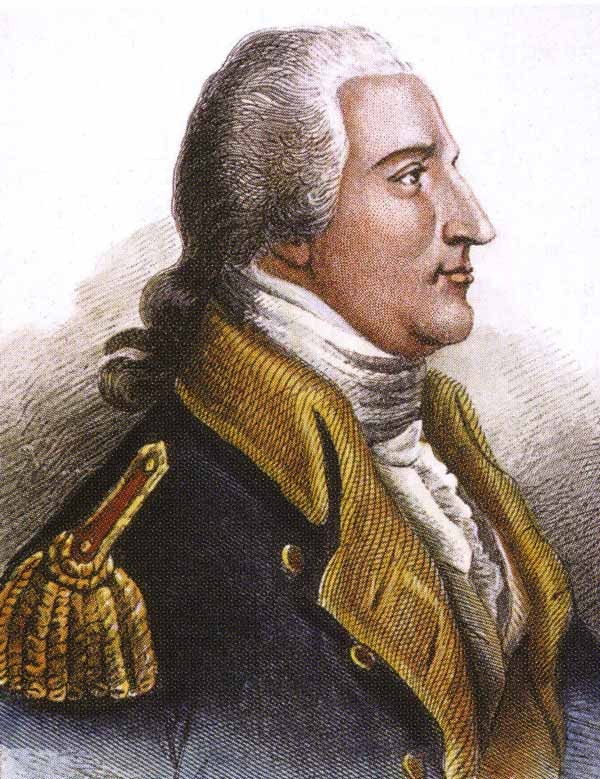
After turning coat, Benedict Arnold received a commission as a brigadier general in the British army as part of the deal that he made in order to betray his country.
In August 1781, George Washington decided to shift forces in order to attack the army of Lt. Gen. Lord Charles Cornwallis in Virginia. Washington began pulling troops from the New York area. Lt. Gen. Sir Henry Clinton, the British commander-in-chief in America, realized on September 2 that Washington’s tactics had deceived him, leaving him unable to mobilize quickly enough to help Cornwallis. Further, there was still a significant force of Continentals facing him in front of New York, and Clinton did not feel that he could detach troops to reinforce Cornwallis as a result.
Instead, Clinton decided to launch a raid into Connecticut in the hope of forcing Washington to respond. Clinton intended that this be a raid, but he also recognized that New London could be used as a permanent base of operations into the interior of New England. Clinton appointed Arnold to command the raid because he was from Connecticut and knew the terrain.
Arnold commanded about 1,700 British solders, divided into two battalions. Lt. Col. Edmund Eyre commanded a battalion consisting of the 40th and 54th Regiments of Foot and Cortland Skinner’s New Jersey Volunteers, a Loyalist unit. Arnold himself commanded the other battalion, made up of the 38th Regiment of Foot and various Loyalist units, including the Loyal American Regiment and Arnold’s American Legion. Arnold also had about 100 Hessian Jägers, and three six-pound guns. This was a formidable force anchored by the three Regular regiments. Continue reading “The Battle of Groton Heights, September 6, 1781: The Fort Griswold Massacre”→




 Instead, Clinton decided to launch a raid into Connecticut in the hope of forcing Washington to respond. Clinton intended that this be a raid, but he also recognized that New London could be used as a permanent base of operations into the interior of New England. Clinton appointed Arnold to command the raid because he was from Connecticut and knew the terrain.
 Emerging Revolutionary War Era