“The Old Wagoner” and the Beginning of the American Revolution

In honor of the 250th anniversary of the Battle of Quebec, we reshare guest historian Scott Patchan’s post on Daniel Morgan during the Canadian Campaign of 1775. This post originally posted in December 2015. 

When the situation deteriorated to outright rebellion against the crown, Morgan raised a regiment of crack riflemen from Frederick County, and marched them to Boston in twenty-one days to take part in the siege of Boston. There, he served under his former commander from the French and Indian War, General George Washington. Morgan learned the hard way that orders must be followed. He once allowed his riflemen to exceed orders in firing upon British positions at Boston. Washington called Morgan on the disobedience, and Daniel thought that he would be cashiered from the army. Washington, however, relented the next day, but Morgan had learned a valuable lesson about following orders.
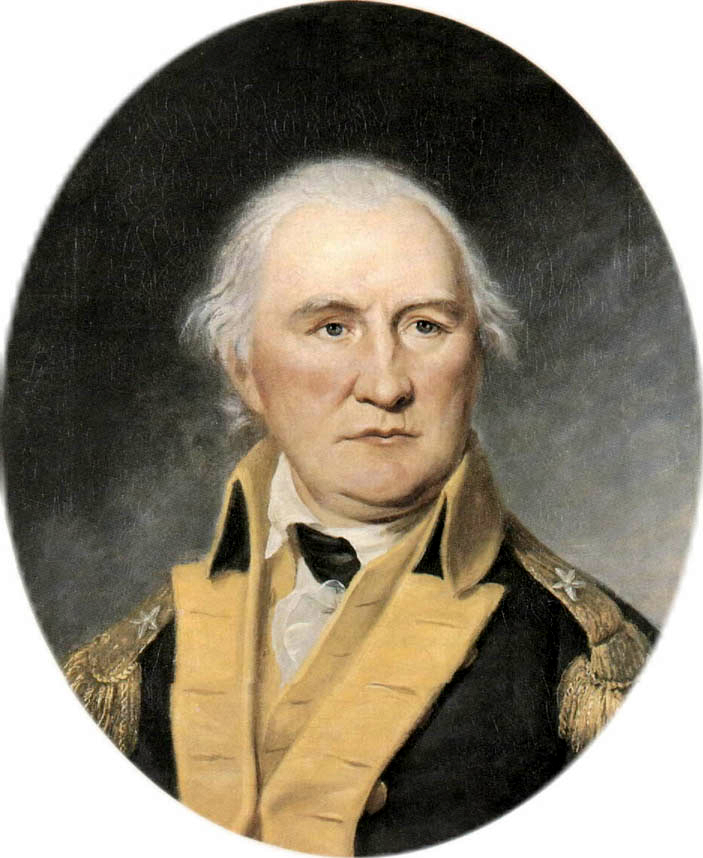
Daniel Morgan in the American Revolution

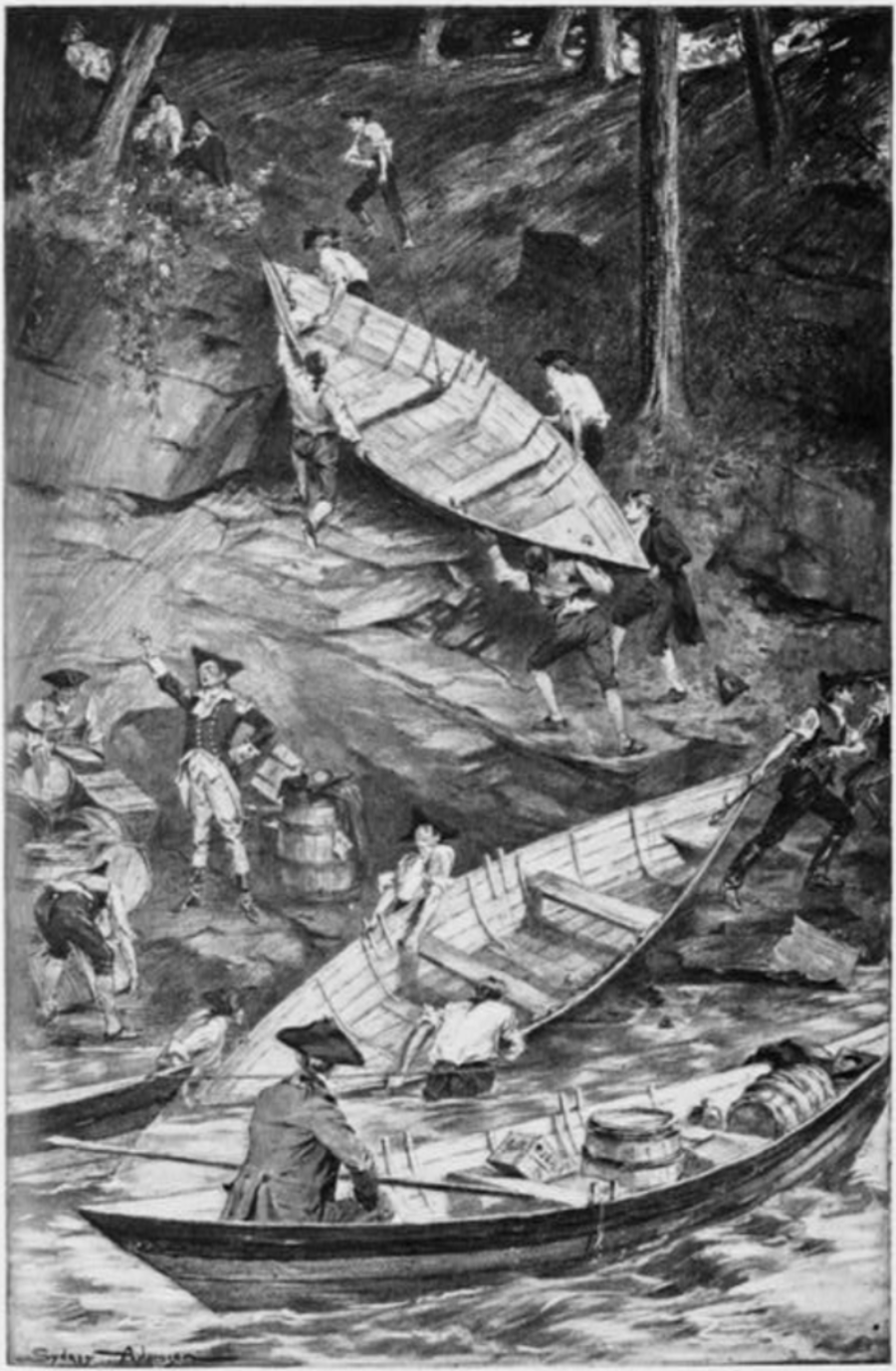
In the fall of 1775, Washington sent Morgan as commander of three companies of Continental riflemen on a mission to capture Quebec from the British. Morgan’s command marched with the column of Colonel Benedict Arnold. They traversed the Maine wilderness, rowing up stream to the “Great Carrying Place,” where carried their canoes and bateaux for great distances overland to another series of streams and lakes that took them to Quebec. As the cold weather set in, sickness and hunger overtook the column and Arnold sent those unfit for duty back to the rear. After covering 350 miles, the American arrived in front of Quebec in early November, surprising the British.

Although Morgan wanted to attack immediately and utilize the element of surprise, he was overruled and the small American force besieged Quebec, waiting for another column under General Richard Montgomery to arrive from the Hudson Valley. When a British party sallied forth and captured one of Morgan’s riflemen on November 18, Arnold believed the British would come out and fight in the open. As such, Arnold drew up his army in front of the fortifications to meet them. They declined his offer and instead looked down on the ragamuffin Americans from the ramparts and exchanged taunts and catcalls. The overall situation frustrated the irascible Morgan, and when his men complained that Arnold was not giving the riflemen their fair share of rations, the “Old Wagoner” violently argued with Arnold, and nearly came to blows with the future traitor. Morgan departed Arnold, leaving him with angry warning about poor treatment of the riflemen. From that time forward, Morgan’s command always received their fair share of the army’s rations.

Montgomery’s column arrived on December 5, and the Americans commenced setting up his mortars and artillery outside of Quebec. The Americans finally attacked during a snowstorm in the early morning darkness of December 31, but their force numbered only 950 men. Arnold’s column came under fire as it moved toward the ramparts of Quebec, and a musket ball struck Arnold taking him out of action. Although Morgan was not the senior officer, the others insisted that he take command, having seen actual combat which they had not. Morgan later noted that this “reflected credit on their judgment.” At Morgan’s order, his riflemen rushed to the front, armed with both their Pennsylvania rifles and a spontoon for the assault while some carried ladders to storm the walls. They quickly drove a small force of British away and closed in on the walls.
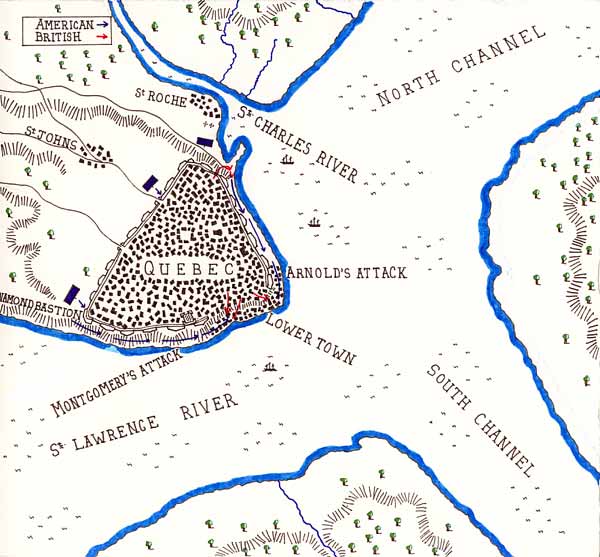
Map of Battle of Quebec, 1775 (courtesy of British Battles)
Map of Battle of Quebec, 1775
(courtesy of British Battles)

Morgan ordered the men up the ladders and first one gingerly began the climb. Morgan sensed his hesitancy, pulled him down and scaled it himself, shouting, “Now boys, Follow me!” The men instantly complied, and Morgan reached the top of the wall where a volley of musketry exploded, knocking him back to the snow-covered ground. The burst burnt his hair and blackened his face; one ball grazed his cheek and another pierced his hat; but Morgan was otherwise unhurt. Stunned he laid motionless on the ground for a moment, and the attack stopped, his men thinking him dead. But he soon stirred and clambered up the ladder to the cheers of his men who followed suit. This time he stopped before reaching the top, and hurtled himself over the rampart into the midst of the enemy. He landed on a cannon and injured his back and found British bayonets levelled at him from all directions. While the British focused on Morgan, his riflemen poured over the wall and came to his rescue, driving off Morgan’s would-be impalers.  Morgan kept up a close pursuit of the British who offered weak resistance to the attacking riflemen. Although Morgan had broken into Quebec, the main body of Arnold’s division failed to follow the riflemen over the wall and exploit the opportunity at hand. Morgan captured much of the lower portion of Quebec with only two companies of his riflemen. He later described the breakdown that occurred:

“Here, I was ordered to wait for General Montgomery, and a fatal order it was. It prevented me from taking the garrison, as I had already captured half of the town. The sally port through the (second) barrier was standing open; the guard had left it, and the people were running from the upper town in whole platoons, giving themselves up as prisoners to get out of the way of the confusion which might shortly ensue. I went up to the edge of the upper town with an interpreter to see what was going on, as the firing had ceased. Finding no person in arms at all, I returned and called a council of war of what few officers I had with me; for the greater part of our force had missed their way, and had not got into the town. Here I was overruled by sound judgment and good reasoning. It was said in the first place that if I went on I should break orders; in the next, that I had more prisoners than I had men; and that if I left them they might break out and retake the battery we had just captured and cut off our retreat. It was further urged that Gen. Montgomery was coming down along the shore of the St Lawrence, and would join us in a few minutes; and that we were sure of conquest if we acted with caution and prudence. To these good reasons I gave up my own original opinion, and lost the town.”

Montgomery never arrived; he had been killed in the first blast of musketry against his column, and his command broke. As time went on, the British regained their composure and pushed back against Morgan’s command. Morgan went back and brought up 200 New Englanders who joined the riflemen as they attempted to renew the attack. Now, the previously undefended point, was well manned, and daylight illuminated the paucity of Morgan’s numbers. Nevertheless, Morgan pressed them back further into the town to an interior fortification. A brave British officer led a counterattack, but Morgan personally shot him dead and disrupted the assault. Nevertheless, the time for action had passed. The British had become aware that Morgan’s was the only active American force in the city and closed in around him. In the meanwhile, additional British forces reoccupied the gates Morgan had initially taken and trapped him in the city. Morgan had no choice but to surrender his small command.
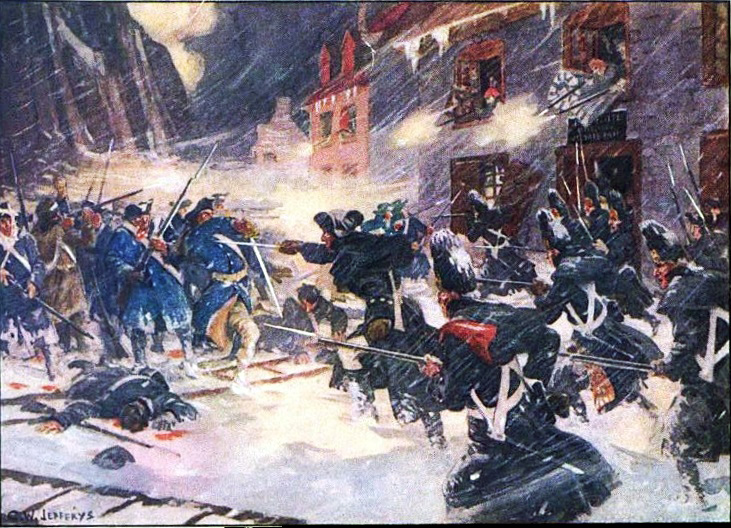
One artist's depiction of the Battle of Quebec, 1775. Both forces are wearing blue overcoats. (courtesy of British Battles)
One artist’s depiction of the Battle of Quebec, 1775. Both forces are wearing blue overcoats.
(courtesy of British Battles)

Morgan and the other officers enjoyed a liberal captivity with generous quarters in a seminary. The British officers visited them often and remained on friendly terms with the Americans. Morgan developed a dislike for some of his fellow officers whom he regarded as dishonest and scheming, and his fighting skills were brought to bear on at least one occasion when several men teamed up against big Dan Morgan. The imprisonment ended when the British returned the American officers on September 24, 1776, in New Jersey. Morgan returned to his wife and two daughters at his home outside of Battletown or Berryville, where he awaited his proper exchange. While there, he named his home “Soldier’s Rest,” as he recuperated from the trials of the taxing expedition to Quebec.  The war was still young, and the Continental Army would soon be calling upon his services again. A special command of riflemen was being organized and Morgan would be its commander.
Rev War Revelry: The 1775 Canadian Campaign

Join us this Sunday, December 14th at 7pm as we return LIVE for this Rev War Revelry on the Canadian Campaign of 1775. We will discuss Arnold, Montgomery, Morgan and others on America’s attempt to capture Montreal, Quebec and create a “14th state.” From Arnold’s arduous march to Quebec through the wilds of Maine to Montgomery’s capture of Montreal, our historians Alex Cain and Mike Cecere will cover the entire campaign and answer the question “was the capture of Canada possible?”

This fall and winter mark the 250th anniversary of the campaign and the battles of Montreal and Quebec, and both of our speakers have taken part in the commemorative events. Grab a drink and watch live on our Facebook page, also add questions in the chat.

A Peculiar Beginning to the Canadian Campaign: Benedict Arnold and the Great Awakening at Newburyport – September 20, 1775

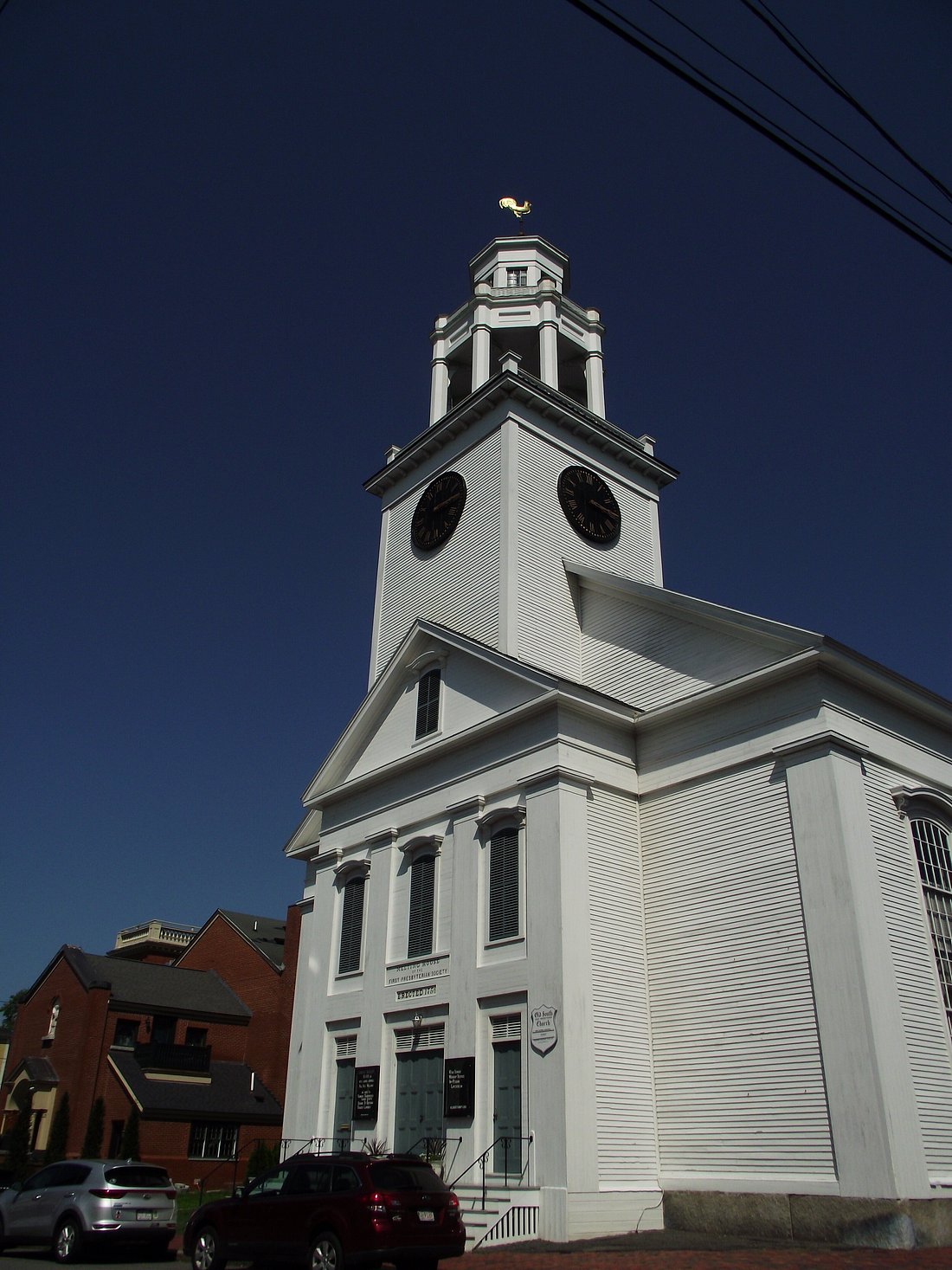
Modern view of the “Old South
Presbyterian Church, Newburyport, MA

As Benedict Arnold assembled his small army of 1,100 men in Newburyport for his bold cooridinated strike on Canada (with General Richard Montgomery attacking via Montreal), there was one last stop before the men boarded the boats in the Merrimack River. From here they would hug the coast on their way to Maine, then overland to Quebec. It was a bold strategy for the inexperienced army and army commander. Though the was just started in April, and peace was still spoken by many political leaders, Washington approved this first American offensive. Strike the British forces in the Canadian colonies, with the hope of encouraging their northern colonial neighbors to join their cause.

Arnold felt it was appropriate that his mission have the blessing of God, so hundreds of men squeezed into the First Presbyterian Church (now called Old South Presbyterian Church). One of the largest churches in the city, it was the spiritual home of the Great Awakening in New England. Here, evangelist preacher George Whitefield, preached from when the church was built in 1756 until his death in 1770. Whitefield was buried in the crypt of the church. His fame was well known to Arnold and others, Whitefield is considered one of the founders Methodism and a great public speaker.

What men could not fit into the church pressed up against the doors and windows. Today’s service, held on Wednesday, September 20, was a dedication service. To bless the men and their task at hand. Reverand Samuel Spring, a popular orator in his own right, and he was now to serve as chaplain of Arnold’s small army on its way to Canada.

The scene was recounted in J. T. Headley’s, 1864 “The Chaplains and Clergy of the Revolution“:

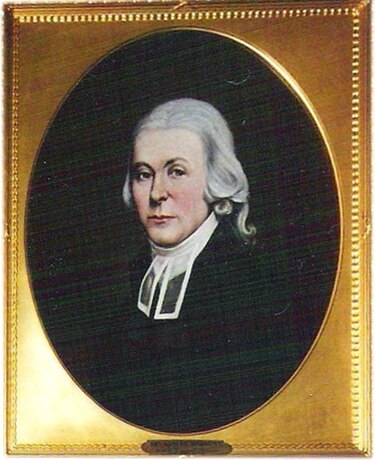
Reverand Samuel Spring

“There sat the fearless Arnold, the bold rifleman, Morgan, and a host of other brave men, who, notwithstanding their dauntless courage, felt that the perils of the untrodden, mysterious wilderness, they were about to penetrate, might be too great for human energy and endurance, and the hour come, that their only hope would rest in the God whose spirit the chaplain [Samuel Spring] invoked as their guide and stay. The citizens, who crowded the gallery, never forgot that sermon. It became the talk of the place, and was the cause of his eventually settling over them as their pastor.”

After the sermon, a surreal experience took place. Soon, someone on Arnold’s staff wanted to go to the crypt and see the tomb of Whitefield. Headley quoted Rev. Spring:

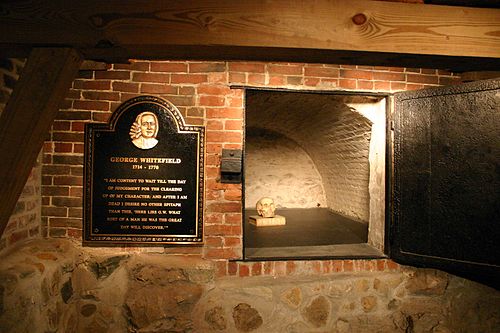
“I preached over the grave of Whitefield. After the service the general officers gathered around me. Some one requested a visit to Whitefield’s tomb. The sexton was hunted up, the key procured, and we descended to his coffin. It had lain in the tomb six years, but was in good preservation. The officers induced the sexton to take off the lid of the coffin. The body had nearly all returned to dust. Some portions of his grave-clothes remained. His collar and wristbands, in the best preservation, were taken and carefully cut in little pieces, and divided among them.”

A modern view of the crypt of Rev.
George Whitefield

Headley continued; “The chaplain, with the haughty Arnold, the chivalrous Morgan, and group of officers, gathered in the dark vault around the tomb of Whitefield, formed a scene worthy of a painter. The clank of steel had a strange sound around the sainted sleeper, while the hallowed atmosphere filled all hearts with solemn awe and reverence.”

Now, with their good luck token from the grave of Whitefield, Arnold and his staff made their way to the shore where his men were boarding their boats in the Merrimack River. Arnold and his men saw their mission blessed by God, and wanted to tie their cause with that of the Great Awakening. They believed their cause was right and just. The process of visiting a tomb and taking pieces of a dead man’s clothing may seem a tad bit of “macbre” to us today, to Arnold it was a way to bless his mission. One that he believed would bring him and his men glory.

The Beeline March Begins 250 Years Ago

The “Shot Heard Round the World” on April 19, 1775, hurled the American colonies into a fever pitch and a war footing. But in the 18th century, slow travel and communication meant the news spread gradually. It took 21 days for word of the fighting at Lexington and Concord to reach the town of Mecklenburg, in Berkeley County, Virginia (now Shepherdstown, in Jefferson County, West Virginia).

On May 10, the citizens of Mecklenburg learned of the battles between colonial militiamen and British troops. Combined with reports that Virginia’s royal governor, Lord Dunmore, had seized gunpowder from the magazine in Williamsburg, the townspeople prepared to support their fellow patriots in any way they could.

Local militia members began to drill and ready themselves for action. On June 10, they gathered on the property of Colonel William Morgan, just outside of town, for a patriotic barbecue. Songs were sung, and those present made a solemn pledge to return to the same spot—Morgan’s Grove—fifty years later to commemorate the day.

The rallying point for the Beeline March

After the festivities, drilling resumed, though the men still wondered whether they’d truly be called to arms. That call came on June 14, when the Continental Congress resolved that “six companies of expert riflemen be immediately raised in Pennsylvania, two in Maryland, and two in Virginia.” Once formed and equipped, the companies were to “march and join the army near Boston, to be there employed as light infantry under the command of the chief Officer in that army.”

Virginia’s quota fell to two experienced frontiersmen: Daniel Morgan, who raised a company in Winchester, and Hugh Stephenson, who assembled his company at Mecklenburg. The recruits signed one-year enlistments.

Henry Bedinger, one of Stephenson’s men, noted that “none were received but young men of character, and of sufficient property to clothe themselves completely, find their own arms and accoutrements—that is, an approved rifle, handsome shot pouch and powder-horn, blanket, with such decent clothing as should be prescribed.” It took fewer than seven days to raise a full complement of 100 men. Only a delay in procuring enough rifles kept the company from marching immediately.

Stephenson and Morgan agreed to rendezvous in Frederick, Maryland, before continuing to Boston. Morgan’s men departed first, on July 15. Stephenson’s company followed from Morgan’s Grove on July 17.

“Morgan having the start, we used every exertion to overhaul him—in vain,” wrote Bedinger, “although we marched (always in single file) from 30 to 36 miles a number of days.”

Along the way, Stephenson’s men were greeted by cheering citizens and well-supplied with food. Their grueling pace—averaging over 20 miles per day—became legendary. Only two men failed to complete the full journey: one was court-martialed, the other accidentally wounded.

On August 11, after marching more than 500 miles in just 25 days, Stephenson’s company arrived in Cambridge, Massachusetts, just behind Morgan’s men. There, they halted before General George Washington.

Stephenson’s company reporting to General Washington at Cambridge (My Ride to the Barbecue)

As the riflemen presented arms, Bedinger recalled, the general “slowly rode by us looking attentively and affectionately at the soldiers from his native state. When he shook hands with our captain, it was said they both shed tears.”

The journey became known as the Beeline March for its quick and direct route to join the Continental Army. Fifty years later, on June 10, 1825, the veterans honored their pledge to return to Morgan’s Grove. Of the original company, only five men were still alive, and just two were able to attend the reunion. One of them was Michael Bedinger, who recalled the events of 1775 and sang “two patriotic songs…the very same that had been sung at that spot fifty years before.”

Today, two markers commemorate the Beeline March’s origin. In Morgan’s Grove Park, a 1988 monument marks the “Shepherdstown Rally Point.” Down the road, in Elmwood Cemetery, a 1932 monument erected by the Daughters of the American Revolution lists the names of the commissioned and non-commissioned officers of Stephenson’s company.

For a fledgling armed force preparing to challenge one of the world’s greatest military powers, the Beeline March demonstrated the resolve, discipline, and patriotic fervor of early American soldiers—and set a standard for those who would follow.

Rev War Revelry: Women of the Revolution with Saratoga Historian Lauren Roberts

Join us this Sunday at 7 pm as we welcome Saratoga historian Lauren Roberts. Lauren will discuss with us the upcoming as we discuss their upcoming Women in War Symposium and Bus Tour hosted by the Saratoga County 250th Commission. The third Annual Women in War Symposium will be held on May 4, from 8:15 a.m. to 3:30 p.m. at the Old Saratoga American Legion Post, located at 6 Clancy St. As an enhancement to the Symposium, a bus tour of historic sites will be offered on May 5.

Lauren will also discuss some of the topics being covered at the Symposium and some of the diverse history in Saratoga that relates to the American Revolution. We all know about the Battle of Freeman’s Farm and Bemis Heights, but how many know about the “witch of Saratoga”? Grab a drink and join us this Sunday night at 7pm on our Facebook page for a fun and insightful discussion into the great work that Saratoga County is doing to commemorate “America’s Turning Point.”

Rev War Revelry: New Book on the Battle of Camden “All That Can be Expected: The Battle of Camden and the British High Tide in the South”

This Sunday, August 6th at 7pm join ERW series editor Dan Welch and authors Rob Orrison and Mark Wilcox as they discuss one of the worst defeats in American history, the Battle of Camden. How did the hero of Saratoga end up the scapegoat in the south? Learn how a coincidence led to a great British victory. And how did the Patriots recover from such a large defeat and find a path to victory a year later? Orrison and Wilcox will also discuss their upcoming book “All That Can be Expected, The Battle of Camden”. Grab a drink and join us to learn more about the Battle of Camden!

All Rev War Revelries can be found LIVE on our Facebook page, or a week later on our You Tube and Spotify channels.

July 17, 1775: The Start of the Beeline March

“The Shot Heard Round the World” on April 19, 1775, put the American colonies into a fever pitch and a war footing, but 18th-century travel limitations naturally caused that word to spread slowly. It did not reach the town of Mecklenburg, in Berkeley County, Virginia (now Shepherdstown, in Jefferson County, West Virginia) for 21 days. On May 10, Mecklenburg’s citizens learned of the fights between colonists and British soldiers at Lexington and Concord. Coupled with news of Virginia royal governor Lord Dunmore’s removal of powder from the magazine in Williamsburg, Mecklenburg’s citizens prepared to offer whatever aid they could to their fellow beleaguered colonists.

The rallying point for the Beeline March

The militia in Mecklenburg strapped on their accouterments and began to drill. On June 10, the drilling militia was welcomed to the property of Colonel William Morgan, just outside town, for a barbecue. Songs were sung and all those present made a pledge that they would return to the same spot in Morgan’s Grove fifty years from that day.

Following the patriotic fanfare, the men returned to drilling, wondering if they might have the chance to face the British. A decision made in far-off Philadelphia soon promised Berkeley’s militiamen that chance. On June 14, the Continental Congress declared that “six companies of expert riflemen, be immediately raised in Pennsylvania, two in Maryland, and two in Virginia.” Once formed and equipped, “each company…shall march and join the army near Boston, to be there employed as light infantry, under the command of the chief Officer in that army.”

The Virginia companies went to Daniel Morgan, who organized his company in Winchester, and Hugh Stephenson, the leader of the company rendezvousing at Mecklenburg. Joining soldiers signed one-year enlistments. Henry Bedinger, one of Stephenson’s men, recorded that “none were received but young men of Character, and of sufficient property to Clothe themselves completely, find their own arms, and accoutrements, that is, an approved Rifle, handsome shot pouch, and powder-horn, blanket, with such decent clothing as should be prescribed.” It took less than seven days to raise each company to the strength of 100 men. Only the delay in getting enough rifles to arm the entire Mecklenburg company prevented them from leaving immediately after filling the ranks.

Once mustered, Stephenson and Morgan agreed to meet in Frederick, Maryland, and march to Boston together. On July 15, Morgan’s men marched first, stealing a step on the Mecklenburg men, who left Morgan’s Grove on July 17. “Morgan having the start we used every exertion to overhaul him, in Vain, altho’ we marched (always in single file) from 30 to 36 miles a number of days,” said Bedinger.

Food and cheering citizens greeted Stephenson’s men along the march and kept their marching feet moving at the blistering pace needed to catch Morgan. Only two men failed to make the entire march (one was court-martialed, and the other was accidentally wounded). On August 11, after a march of over 500 miles in 25 days and just behind Morgan’s men, Stephenson’s company halted in front of General George Washington in Cambridge. When the Mecklenburg riflemen saw the general, they “presented their arms to him as he slowly rode by us looking attentively and affectionately at the soldiers from his native state. When he shook hands with our captain, it was said they both shed tears.”

Stephenson’s Company reporting to General Washington at Cambridge (My Ride to the Barbecue)

The march has gone down in history as the Beeline March due to the quick and direct nature of the expedition to augment the Continental forces in front of Boston. Fifty years later, the pledge made on June 10, 1775, was kept, though the numbers of Stephenson’s company were considerably smaller. Five decades after the march, only five participants still lived; just two returned to Morgan’s Grove to commemorate the feat. One of them was Michael Bedinger, who recorded his experiences in the Beeline March. At the anniversary ceremony, he sang “two patriotic songs…the very same that had been sung at that spot fifty years before.”

Today, two markers commemorate the Beeline March’s genesis. In Morgan’s Grove Park, a marker dedicated in 1988 marks the “Shepherdstown Rally Point” (Mecklenburg was later renamed Shepherdstown). Down the road from the park in Elmwood Cemetery, a 1932 monument erected by the Daughters of the American Revolution sits with the names of the commissioned and non-commissioned officers of Stephenson’s company.

For a burgeoning armed force that was seeking to stand up to one of the world’s most powerful military forces, the Beeline March showed the spirit of the American soldier in the early days of the Revolutionary War.

“That his northern laurels would be turned into southern willows” Major General Horatio Gates Arrives to take command in North Carolina, July 25, 1780

Opportunity knocked for Horatio Gates with the fall of Charleston, South Carlina in May 1780. A devastating loss for the Americans, with nearly 6,000 men of the Southern Army under Benjamin Lincoln surrendered to Sir Henry Clinton. Unless something wasn’t done soon, the entire southern colonies could fall and the revolution along with it. Congress needed someone who could inspire men to join the war effort and a trusted leader with a positive record. Washington put Nathaniel Greene’s name forward, but Congress in a rare move went against Washington’s wishes and appointed Horatio Gates as commander of the Southern Department on June 13th

Major General Horatio Gates, ca. 1794 by Gilbert Stuart

The road from his victory at Saratoga to the Southern Department wasn’t an easy one for Gates. He sought independent field command and many believe he wanted Washington’s position as commander in chief. His allies in Congress and the Continental Army lobbied heavily on Gates’ behalf and were able to have Gates appointed to the powerful Board of War (the defacto Department of Defense). Though an important role (and serving as Washington’s civilian superior), Gates believed he belonged in the field.  Though his role in the famous “Conway Cabal” is still debated today, he was implicated via letters in criticizing Washington’s leadership. Whether his involvement was real or not, the relationship between him and Washington (and Washington’s inner circle) was seriously damaged. Due to the situation, Gates resigned from the Board of War and accepted appointment as department commander of the Northern Department. In this role he was responsible to look after the New York Highlands and watch from British incursions from Canada or New York city. Gates was unhappy in this role and proposed another American invasion of Canada. Washington and Congress disagreed and rejected his plans. He disliked his task of dealing with enemy native tribes in the region and dragged his feet in following orders. Finally, that fall, Gates took command of American forces in New England with his headquarters in Boston. Though excited by this appointment, he quickly realized that this post was not where the action would be. The British left Boston in 1776 and since the city was peaceful and not a welcome place for a man seeking glory and military action. Finally, after much frustration, Gates asked to return to his farm in Virginia and arrived there by December 1779. Gates found himself a hero without an army and continued to brood over his situation.

Continue reading ““That his northern laurels would be turned into southern willows” Major General Horatio Gates Arrives to take command in North Carolina, July 25, 1780”

“Rev War Revelry” Battle of Cowpens

On January 17, 1781, General Daniel Morgan and his mixed force of Continental soldiers and militia defeated the British under the command of Lieutenant Colonel Banastre Tarleton. This victory for the patriots in northwestern South Carolina had major implications on the southern theater and the main British force under General Lord Charles Cornwallis. The battle, named after the use of the fields in which it was fought, Cowpens, also included one of the only instances in American history of a successful double envelopment.

On Sunday, at 7 p.m. EDT, Emerging Revolutionary War will be joined by American Battlefield Trust’s Kristopher White, Deputy Director of Education and Daniel Davis, Education Manager, in a discussion about the history and preservation of the Battle of Cowpens.

Round out your January weekend by joining us on our Facebook page for this live historian happy hour.

Review: To The End of the World, Nathaniel Greene, Charles Cornwallis, and the Race to the Dan by Andrew Waters

Writing over thirty years after the fact, Henry “Light Horse Harry” Lee summed up the events of February 14, 1780 with the line, “Thus ended, on the night of the 14th of February, this long, arduous, and eventful retreat” (190). Upon hearing of General Nathanael Greene’s exploits in this movement, General George Washington wrote, “You may be assured that your Retreat before Lord Cornwallis is highly applauded by all Ranks and reflects much honor on your military Abilities.” (198).

What Lee would remember as “eventful” and Washington and fellow military ranks “highly applauded” is remembered today as the “Race to the Dan.” This retrograde movement, undertaken by Greene’s forces from South Carolina to the Dan River in southern Virginia, is sandwiched between the engagements at the Battle of Cowpens in January 1781 and the British pyrrhic victory at Guilford Court House in March 1781. Yet, this retreat may be on the turning points in the southern theater that led the British, under Lord Charles Cornwallis to his eventual demise at Yorktown in October 1781.

Great historians, such as John Buchanan is his monumental work The Road to Guilford Court House have covered with broad strokes this period of time but a dedicated study was much needed in the historiography of the American Revolution. Insert Andrew Waters, writer, editor, and conservationist, whose name may be familiar from previous works such as The Quaker and the Gamecock: Nathanael Greene, Thomas Sumter, and the War for the Soul of the South. His latest book, To The End of the World, Nathanael Greene, Charles Cornwallis, and the Race to the Dan, captures this important military movement while providing an expose on the leadership of Greene woven in. The title of the book is pulled from a quote by Brigadier General Charles O’Hara, Cornwallis’s second-in-command during this campaign. With a background in land conservation with a focus on river corridors and watersheds, Waters found a connection with Greene, who studied the various waterways—or ordered subordinates—to study the various rivers, to better understand the topography for military campaigns.

After a stint in Salisbury, North Carolina, Waters became fascinated with the Race to the Dan story and decided to plunge in to understanding this period of the American Revolution. He found that “the Race to the Dan is a remarkable tale, fit for cinema or an epic novel, and not only for its accounts of four narrow escapes across its four rivers” (xv). He was drawn “to its story” (xx) and any reader of the book is the beneficiary of that discovery.

Along with weaving in the innate leadership qualities of Greene, Waters brings to light the importance of military leaders not as well-known such as William Lee Davidson, William R. Davie, and Edward Carrington with more household names of Lee, Daniel Morgan, and Otho Holland Williams. Throw in the names of Cornwallis, O’Hara, and Banastre Tarleton, and the pantheon of American Revolutionary personas is complete.

In this approximate month-long retreat, Greene saved the American Revolution in the southern theater and set in motion the events that led to the climactic victory at Yorktown. Waters, with his 2020 publication, has now helped save the story of the Race to the Dan from its unintended lapse into obscurity.

Information:

Published: 2020 (Westholme Publishing)

264 pages, including index, footnotes, images, and maps