From all of us here at Emerging Revolutionary War, we want to wish you and yours a “Happy Thanksgiving.” Below is the official proclamation by President George Washington dedicating a day of “public thanksgiving.” in 1789.
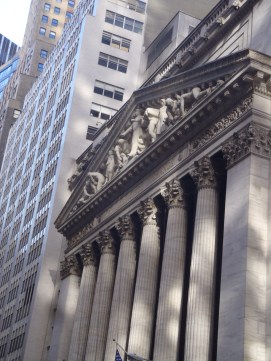
Federal Hall, New York City, where George Washington was sworn in as president in 1789.
By the President of the United States of America. a Proclamation.
Whereas it is the duty of all Nations to acknowledge the providence of Almighty God, to obey his will, to be grateful for his benefits, and humbly to implore his protection and favor—and whereas both Houses of Congress have by their joint Committee requested me “to recommend to the People of the United States a day of public thanksgiving and prayer to be observed by acknowledging with grateful hearts the many signal favors of Almighty God especially by affording them an opportunity peaceably to establish a form of government for their safety and happiness.”
Now therefore I do recommend and assign Thursday the 26th day of November next to be devoted by the People of these States to the service of that great and glorious Being, who is the beneficent Author of all the good that was, that is, or that will be—That we may then all unite in rendering unto him our sincere and humble thanks—for his kind care and protection of the People of this Country previous to their becoming a Nation—for the signal and manifold mercies, and the favorable interpositions of his Providence which we experienced in the course and conclusion of the late war—for the great degree of tranquillity, union, and plenty, which we have since enjoyed—for the peaceable and rational manner, in which we have been enabled to establish constitutions of government for our safety and happiness, and particularly the national One now lately instituted—for the civil and religious liberty with which we are blessed; and the means we have of acquiring and diffusing useful knowledge; and in general for all the great and various favors which he hath been pleased to confer upon us.
and also that we may then unite in most humbly offering our prayers and supplications to the great Lord and Ruler of Nations and beseech him to pardon our national and other transgressions—to enable us all, whether in public or private stations, to perform our several and relative duties properly and punctually—to render our national government a blessing to all the people, by constantly being a Government of wise, just, and constitutional laws, discreetly and faithfully executed and obeyed—to protect and guide all Sovereigns and Nations (especially such as have shewn kindness unto us) and to bless them with good government, peace, and concord—To promote the knowledge and practice of true religion and virtue, and the encrease of science among them and us—and generally to grant unto all Mankind such a degree of temporal prosperity as he alone knows to be best.
Given under my hand at the City of New-York the third day of October in the year of our Lord 1789.
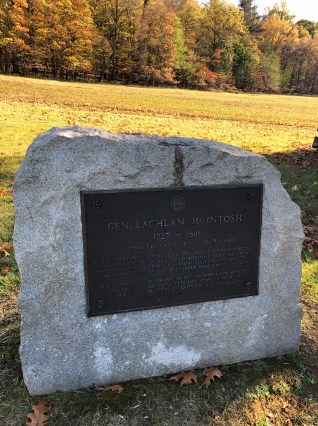
On a recent trip to Valley Forge National Historical Park I came across the monument to featured below, of a general that did not initially ring a bell in my memory. So I did a little investigating. The first name was intriguing. His story even more so. Especially how he came to spend the winter at Valley Forge.
Lachlan McIntosh Monument, Valley Forge National Historical Park (author collection)
Born near Raits, Badenoch, Scotland on March 17, 1725 and at the age 11, Lachlan, along with his family and approximately 100 other Scottish immigrants, landed in Georgia where they founded the town of New Iverness. Out of all the cruelties that could visit a family eking out a future on the frontier, the calamity that claimed Lacklan’s younger brother would have been far down the list. While swimming in the Altamaha River in 1737, Lewis McIntosh was killed by an American alligator. Continue reading “Lachlan McIntosh”→
Andersonville. Bataan. Auschwitz. All conjure up images of disillusion, devastation, and death.
All are infamously known as harsh prisoner-of-war camps. When those words are read, images flash through your mind and memory of hollow faces attached to gaunt bodies staring blankly in the direction of the cameraman.
With Robert P. Watson’s new history, The Ghost Ship of Brookly, An Untold Story of the American Revolution, one can add another word to the lexicon of prison camp vernacular.
If you follow Campaign 1776, the initiative by our friends at Civil War Trust, you are familiar with the saga over the Princeton Battlefield. Now you have a chance to help as well.
Battle of Princeton, Death of Mercer by Trumbull (courtesy of Yale University)
Happen to be around Boston this weekend? Or live within traveling distance? Check out the special event happening this weekend from Sunday, July 23rd through Monday, July 24th at the U.S.S. Constitution Museum and Charlestown Navy Yard.
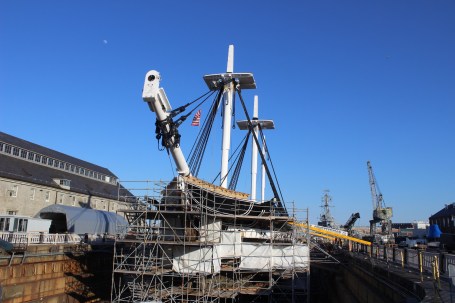
The U.S.S. Constitution, the oldest commissioned naval vessel still afloat will set sail again. Launched in 1797 and named by President George Washington, the vessel is a wooden-hulled, three-masted heavy frigate. She has been dry-docked since May 18, 2015 but will return to the water on July 23rd.
“Old Ironsides” the U.S.S. Constitution, photo taken April 2016 (author collection)
The event, co-sponsored with the National Parks of Boston will have a full-plate of free, family-fun events starting at 4:00 p.m. on Sunday and continuing into the morning hours of Monday.
For a full-listing of these events, including information about the museum, and answers to a few frequently answered questions, click here.
For those that cannot make it live to the re-launch, the event will be live on Facebook video streams at 4:00 p.m. and 6:00 p.m. along with live video streams throughout the night of the major events. Check out the Facebook site for the museum by clicking here.
As I stood in Independence Hall, in the room where the Founders debated the Declaration of Independence, I suddenly started thinking of the opening scene from the musical 1776, when John Adams cries for independence while everyone else complains about either the heat or the flies. “Won’t somebody open up a window?” one of the delegates pleads. “Too many flies!” others respond, shouting him down. Adams is advocating the most lofty of ideas but everyone else is mired in their own personal discomfort. What a great metaphor.
To stand in that room where Adams and the other delegates worked was a privilege. The tour group consisted of 50 people or so, so there was no opportunity for quiet reflection. There was no sublime, transcendent moment of awe or epiphany. The tour guide could not even tell me which table Adams sat at except “toward the back over here somewhere.” Continue reading “Standing in the Room Where American Was Born”→
In southeast Pennsylvania on September 11, 1777, the largest battle, by number of combatants, was fought between the British forces under Lord General William Howe and the Continental and militia forces under General George Washington. After the day long engagement, one of the bloodiest of the entire American Revolution, approximately 1,900 men were killed, wounded, or captured. Washington lost 8% of his entire force that day, Howe 4%.
Brandywine, A Military History of the Battle that Lost Philadelphia but Saved America, September 11, 1777
Yet, the Battle of Brandywine has been eclipsed by the history that followed shortly thereafter the bloody engagement. Fifteen days after the battle along Brandywine Creek, Howe’s British and Hessian forces will capture Philadelphia and Washington’s army will spend the pivotal 1777-1778 winter at Valley Forge. Although the battle has been the subject of a few histories and folded into larger campaign studies, Michael C. Harris’s book-length treatment is the first to take an analytical and discerning eye to the engagement and separate myth from fact. Published by Savas Beatie, LLC, in 2014 in hardcover, the book has now been released in paperback. Continue reading “Review: Brandywine, A Military History of the Battle that Lost Philadelphia but Saved America, September 11, 1777 by Michael C. Harris”→
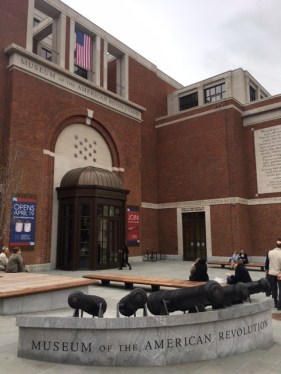
On April 19, 2017, symbolic in American Revolutionary War history, the Museum of the American Revolution opened in Philadelphia, Pennsylvania. The weekend before, I had the chance, to get a “sneak peak” of the new museum.
Museum of the American Revolution
I left thoroughly impressed as the museum fills in a critical need for telling this utmost important era in our nation’s history. Yet, the development of exhibits along with the myriad of learning styles and technology underscores the need in this 21st century to be approachable and inclusive to reach various levels of interest that the visitor may have.
Greeting visitors as they approach are a few murals depicting well-known scenes of the American Revolution–including the symbolic “Crossing of the Delaware” and the “Signing of the Declaration of the Declaration.” Along with one of the most important sections of the Declaration of Independence.
After entering the museum the exhibit area is on the second floor, beginning with the build-up to the war and ending with a nod to the upholding of the revolutionary ideals. Broken up into four segments, the exhibits cover the period of the “Road to Independence” from 1760-1775, “The Darkest Hour” 1776-1778, “A Revolutionary War” 1778-1783, and ending with “A New Nation” 1783 to present-day. A must-see is the short 15-minute film that is centered on George Washington’s command tent, which is shown behind the screen at the conclusion of the film.
Yet, do not shirk the exhibits, which include the a portion of the last remaining “Liberty Tree” from Annapolis, Maryland that fell during a hurricane a few years back. Small movie theaters dot the exhibit area depicting different aspects of the war and history. The Oneida Native Americans, the first allies of the United States are also prominently–and rightfully–highlighted as to their contributions.
Another of the interesting components of the museum is the use of interpretive questions, including “Why were they called Hessians?” with an accompanying multi-dimensional map that shows the different German principalities that contributed troops to the British war effort. Another interesting panel discusses the first use of acronym “USA.”
The museum’s display collection of artifacts is also truly amazing. From a few of the first flags carried by units in the war, to the aforementioned “Liberty Tree”, to a portion of the famous North Bridge, in Concord, Massachusetts.
Combined with the interactive displays, the chance to walk onto a privateer ship, and the assortment of artifacts on display, the museum exhibit area caters to all levels of enthusiasts and can definitely absorb a few hours of your time.
North Bridge segment
With the museum main attractions situated on the second floor, the first floor of the museum is free to house the orientation film, a cafe, and the gift shop. If you have never been to Philadelphia, the museum is another highlight to add to your bucket list itinerary. If you have ventured to the “City of Brotherly Love” before, the museum provides an excellent reason to journey back.
For information on the museum, including programs, exhibits, and the admission fee, click here.
Looking for something to do midweek? Enjoy a Wednesday night at Shenandoah University and learn about an aspect of early American history.
“The Pox and the Covenant” by Tony Williams
If in the lower Shenandoah Valley or can make the trek, join Shenandoah University’s History Fellows in welcoming Tony Williams, senior fellow at the Bill of Rights Institute, for a guest lecture.
Author of five books on the Early American history and holds a Bachelor of Arts in history from Syracuse (NY) University and a Master of Arts in United States history from Ohio State University. After a successful 15-year teaching career at the middle and high-school level, he became the Program Director at the Washington, Jefferson, & Madison Institute in Charlottesville, Virginia in 2014.
The lecture will be held at Henkel Hall, Hester Auditorium and will begin at 7 p.m. Williams will have his books for sale after the talk, including the title that bears the lecture’s name.
For information and questions, please contact Jonathan Noyalas, Chair of the Shenandoah University’s History Fellows at (540)-665-4501 or jnoyalas01@su.edu.
If interested in other events at Shenandoah University of this nature, check out the link here.
Emerging Revolutionary War welcomes back guest historian Malanna Henderson
Part One
“It is not for their own land they fought, not even for a land which had adopted them, but for a land which had enslaved them, and whose laws, even in freedom, oftener oppressed than protected. Bravery, under such circumstances, has a peculiar beauty and merit.” – Harriet Beecher Stowe.
The words spoken by “the little woman who wrote the book that started this Great War,” so said Abraham Lincoln, according to legend, upon meeting Mrs. Stowe sometime in 1862, rang true for black patriots in the Civil War as well as those in the Revolutionary War.
The Smithsonian tome, The American Revolutionary War: A Visual History quotes a Hessian officer in 1777, as saying, “No regiment is to be seen in which there are not Negroes in abundance and among them are able-bodied and strong fellows.”
In every battle of the Revolutionary War from Lexington to Yorktown; black men, slave and free, picked up the musket and defended America; and yet, many historians as well as visual artists have omitted their contributions in the history books and their images on canvases depicting historic battles. The need for white historians to “overlook,” “underestimate,” and or “erase,” these sacrifices is a gross negligence that distorts and misrepresents American history; and furthermore, it continues to disenfranchise the patriotic heroes of the past and malign the self-image of millions of Americans today simply because of the color of their skin.
Black soldiers have always fought two wars simultaneously; wars declared by their government and the unspoken wars at home for liberty, equality and before the Civil War, for citizenship.
What kind of men fight for the liberty of others when their own liberty isn’t guaranteed?
True patriots: James Armistead Lafayette was one such person.
James Armistead Lafayette (1760-1832) Blackpast.org
Slaves serving in the rebel military was a question that manifested itself early amongst the colonial government agencies. Their presence rankled many, while others welcomed them and praised their bravery. Some men of color had fought gallantly and with distinction as they stood alongside their white compatriots, defenders of liberty on the Lexington Green in April of 1775.
For instance, in the Battle of Bunker Hill, Peter Salem, a slave, served with courage under fire, as varying accounts reported. Salem was introduced to George Washington as “the man who shot Pitcairn,” the British Royal Marine Major who shouted to his men before Salem shot him down, “The day is ours.” Despite the competence and bravery of such men on the battlefield their exploits didn’t convert the wide-spread reluctance of most colonists to accept black men as soldiers.
General George Washington, Commander-in-Chief of the Continental Army, harbored the same common prejudices of the southern-planter ruling class of which he was a member. In July, he instructed recruiters “not to enlist any stroller, negro, or vagabond, or person suspected of being an enemy to the liberty of America.” Commanders in each colony and regiment made up their own minds. Some ignored his command. Their decision was based on need and experience. Those who had already served successfully with black militia and minutemen may have seen no cause to alter their regiments.
By December of 1776, Washington back-pedaled on his decision, allowing for black veterans of Lexington, Concord and Bunker Hill to serve; but of the slave, he maintained his objection. However, some junior officers appreciated the contributions of blacks. Col. John Thomas wrote John Adams on October 24, 1775, “We have negroes, but I look upon them as equally serviceable with other men, for fatigue (labor); and, in action many of them have proven themselves brave.”
As the war raged on, the necessity for able-bodied men settled the question. White soldiers, who usually served for only a few months to a year, mustered out, died or were wounded; while others deserted. Black soldiers who expected to receive their freedom if they served were in the war for the duration. This was a positive factor for the commanding officers who had to re-train all new recruits. Around five-thousand blacks served in the Revolutionary War as soldiers. However, a vast unknown number provided a myriad of support services.
Another reason the colonials reconsidered enlisting blacks was the bold military tactic that occurred in November of 1775. Lord Dunmore, the last royal governor of Virginia, ratified a proclamation freeing all indentured servants and slaves of rebels if they would fight for the British. Thousands of people fled the plantations to gain their freedom. This single act struck a devastating blow on two fronts, it threaten their economic stability and increased the tension between master and slave, with the master fearing slave revolts and the permanent loss of their property. Moreover, it upset the social order. Enslaved men serving alongside whites put them on an equal footing in the battlefield, which violated the white supremacy dogma that governed current thought and practice.
Born into slavery on December 10, 1748, in New Kent, Virginia to owner William Armistead, James enlisted in the Revolutionary War under General Marquis de Lafayette in 1781. His owner was a patriot and most likely received the bonus James would have gotten for enlisting had he been free or white. Enlistment bonuses comprised of money, land or slaves.
By the time Armistead entered the war, the efforts of Benjamin Franklin and other colonial agents had secured a military and economic alliance with the French. A long-time imperial rival of British expansion, the French provided naval ships, money and personnel.
Marquis de Lafayette (born Marie Joseph Paul Yves Roch Gilbert du Motier) was a descendant of ancient French nobility. His father, a colonel in the French Grenadiers had died in the Seven Year’s War (known as the French and Indian War in America) when the young nobleman was only two years old. The political ideals of liberty and equality espoused by the colonials matched his beliefs and fired his military ambitions. Perchance, his yearning to play a role in America’s fight for independence from British rule may have been spawned by a desire to avenge his father’s death.
Since Lord Dunmore’s Proclamation, it was easy for Armistead to gain access in the enemy camps as a runaway slave seeking his freedom. While providing varied services to the British, he gained the confidence of Brigadier General Benedict Arnold, who by now had defected to the British. He charged Armistead with scouting, foraging and spying. Armistead was able to comfortably go between both camps, in essence becoming a double spy. He carried false and misleading information to the British but provided accurate intelligence on the movement of British forces and details of their military strategies to General Lafayette.
When Arnold left Virginia, Armistead was able to deceive General Charles Cornwallis as well, who rampaged through parts of Virginia and burned Richmond, the capital. He sent Colonel Banastre Tarleton to capture the entire legislative assembly, which included Daniel Boone, Patrick Henry and the governor. The plan was thwarted by an astute young man named Jack Jouett. Although, a few were apprehended, among them Daniel Boone; Jouett’s actions prevented the British from arresting the biggest prize: Governor Thomas Jefferson.
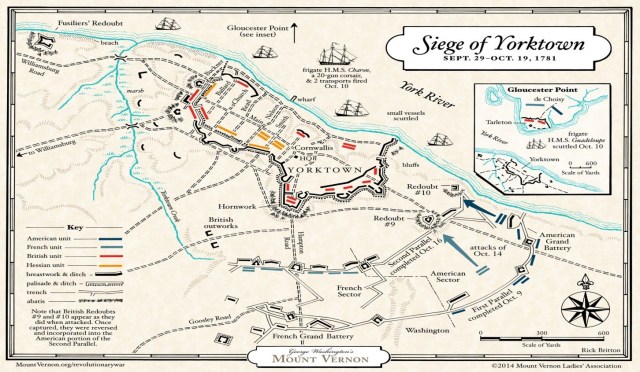
By early August, Cornwallis had made plans to establish fortifications in Yorktown, expecting reinforcements to increase his troops of approximately nine-thousand.
General Washington, in the meantime, had joined forces with Comte de Rochambeau to recapture New York. With intelligence supplied by James Armistead, they learned that Cornwallis was in Yorktown waiting for military support. French Admiral de Grasse, with a fleet of about twenty-eight naval ships, was on his way to the Chesapeake from St. Dominick (present-day Haiti). A plan to surround Cornwallis by land and sea appeared possible. The French naval fleet, along with the Washington’s Continental and Rochambeau’s French forces, headed to the enemy’s headquarters. Once Washington reached Yorktown, General Lafayette’s regiment joined him. Thus, Armistead’s accurate and meticulous reports were vital to the American victory that culminated in Yorktown on October 19, 1781.
Later Cornwallis met the Marquis at his headquarters and was flabbergasted to find his spy James Armistead present.
The Treaty of Paris in 1783 severed ties from Britain, the mother country, and established America as an independent nation. That same year, the Act of 1783 was passed freeing slaves who had fought in the Revolutionary War on their masters’ behalf. However, it excluded slave-spies. Ergo, James Armistead, who risked his life by providing information to help win the freedom of many, was himself denied freedom. Was his life in less danger operating under subterfuge as a spy amongst the British than it would have been, had he served as a soldier on the battlefield? I think not. Had his espionage been discovered, he surely would have had to forfeit his life.
After the war, Armistead was returned to slavery. Even his own master didn’t have the legal right to free him because of the Act of 1783, omitting slave-spies from emancipation.
When learning of his compatriot’s status, the Marquis penned a certificate to the Virginia legislator in October of 1784 imploring them to grant Armistead his freedom, declaring:
“This is to Certify that the Bearer By the Name of James Armistead Has done Essential Services to me While I had the Honour to Command in this State. His Intelligences from the Ennemy’s Camp were Industriously Collected and More faithfully deliver’d. He properly Acquitted Himself with Some Important Commissions I Gave Him and Appears to me Entitled to Every Reward his Situation Can Admit of. Done Under my Hand,” Richmond, November 21st 1784.
The legislator didn’t act upon the request straightaway. However, again in 1786, James Armistead applied for his freedom and it was duly granted on January 9, 1787, with a fair compensation to his master, William.
In honor of his benefactor, James Armistead added Lafayette to his surname. After emancipation, he moved a short distance south of New Kent, near Richmond, Virginia and acquired forty acres of less than suitable farmland. He married and had a family. He even owned slaves. History doesn’t tell us if he bought enslaved relatives to free them or if they were bought to farm his land as field hands.
It wasn’t until 1819 that he applied to the state legislature for financial assistance to ease his poverty. This time, the response was immediate; he received $60 and an annual pension of $40 for his service during the Revolutionary War.
Unlike James Armistead Lafayette, many blacks who worked as laborers, guides, messengers and spies were not as fortunate. Whether they were pressed into service or willingly answered the call, most neither received their freedom nor wages for their behind-the-scene contributions to the war.
In 1824, the Marquis de Lafayette visited the United States and was lauded as a hero of the American Revolutionary War in Richmond with festivities and a parade. Spying Armistead in the crowd, it is said he halted the procession, dismounted from his horse and embraced his old comrade.
Kareem Abdul-Jabbar and Alan Steinberg Black Profiles in Courage: A Legacy of African-American Achievement. (New York: William Morrow and Company, Inc.1996) pages 32-34.
Col. Michael Lee Lanning (Ret.) Defenders of Liberty: African Americans in the Revolutionary War. (New York: Kensington Publishing Corp. 2000) pages 45-46; 130




 As I stood in Independence Hall, in the room where the Founders debated the Declaration of Independence, I suddenly started thinking of the opening scene from the musical 1776, when John Adams cries for independence while everyone else complains about either the heat or the flies. “Won’t somebody open up a window?” one of the delegates pleads. “Too many flies!” others respond, shouting him down. Adams is advocating the most lofty of ideas but everyone else is mired in their own personal discomfort. What a great metaphor.


 Another of the interesting components of the museum is the use of interpretive questions, including “Why were they called Hessians?” with an accompanying multi-dimensional map that shows the different German principalities that contributed troops to the British war effort. Another interesting panel discusses the first use of acronym “USA.”



 Emerging Revolutionary War Era