Emerging Revolutionary War welcomes guest historian Drew Palmer. A biography follows at the end of this post.
What does it look like when veteran soldiers do not want to fight anymore? When morale plummets and the realities of war take their toll on men. This is exactly what happened to 150 men in the Maryland Line of the Continental Army in the late summer of 1780.
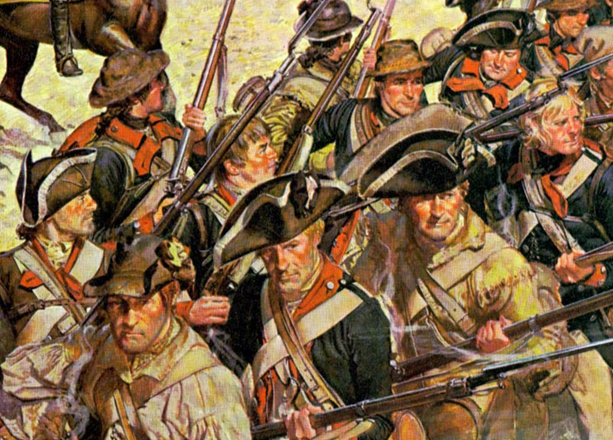
The 1st Maryland Regiment holds the line at the Battle of Guilford Courthouse, March 15, 1781
The continental regiments of Maryland that made up what became known as the “Maryland Line” or “Old Line State” had earned the reputation as a reliable, brave, and disciplined fighting force as early as 1776 after their actions in the Battle of Long Island.1 At the Battle of Camden on August 16, 1780, the 1st and 2nd Maryland Brigades offered a stout defense as Gen. Charles Cornwallis’s British force crashed into Continental soldiers from Maryland and Delaware. In the end, though, Maj. General Horatio Gates’s Southern Continental Army was completely routed from the field, with many of the Maryland Continental troops taken prisoner and held in the small village of Camden after the battle.2
The village of Camden, South Carolina, was an unpleasant place to be after the battle. The crowded conditions and brutal summer climate of South Carolina began to produce sickness amongst Cornwallis’s men and the American prisoners that were held in Camden. To prevent further sickness from spreading, Cornwallis decided to split the American prisoners held at Camden into divisions of around 150 men. These divisions were guarded by small detachments of the British army and marched from Camden to Charlestown, South Carolina.3 One detachment of the British 63rd Regiment of Foot escorted 150 prisoners of the 1st Maryland Brigade captured at Camden. The division made it to Thomas Sumter’s abandoned plantation at Great Savannah, about 60 miles northwest of Charleston. As the Maryland prisoners and their British guards halted for the night, militia commander Francis Marion received word from a Loyalist deserter that the Marylanders were nearby and decided to ambush the British element in hopes of freeing the Maryland prisoners.4 In the early morning hours of August 25, 1780, Marion’s militia attacked.
“Given the order to defend the American withdrawal from Long Island, the Maryland Line saved the Continental Army from annihilation in the first major battle of the war.” wrote historian Ryan Polk.
Tench Tilghman, staff officer to George Washington and a native Marylander wrote about his fellow soldiers, “bore the palm…by behaving with as much Regularity as possible.”
Furthermore, if you Google “Battle of Guilford Court House” the image used by Wikipedia depicts an artist’s rendition of the 1st Maryland defending Nathanael Greene’s last line during the March 1781 engagement. The particular image is below.
The Continental Maryland Line was one of the preeminent stalwarts of the American army, both in the northern and southern theaters of the war. Join Emerging Revolutionary War historians in a discussion about the men from the Old Line State and their military acumen during the American Revolutionary War. The discussion will also highlight their memory and memorialization. We hope you can join us Sunday at 7 p.m. EST on the Facebook page of Emerging Revolutionary War.
Emerging Revolutionary War welcomes back guest historian Karl G. Elsea
When visiting Revolutionary War battlefields there are often replica field guns (sometimes with original barrels) on the grounds. What is often not shown is the equipment needed for the gun to get to the field. That movement required horse(s) and harness and a limber. An earlier article provided information on Patriot limbers. This article concerns the horse harness.
NPS Yorktown, Author’s photo. Original 4-pounder barrel on reproduction carriage
There are inventories and paintings that show British harness used during the war. Muller’s A Treatise of Artillery shows the horse harness hook-ups on British limbers for medium and heavy artillery, and it is somewhat unique. The British hook-up appears more restrictive as to horse size. The cart-saddle used by the British was ubiquitous. It seems reasonable that the Patriots would have used the same harness with the exception of the specialized hook-up hardware on the limber. The following part of a Philipp Loutherbourg painting of Warley Camp detailing a review in 1778 clearly shows the cart-saddle with chain on the thill horse and the rest of the British harness.
From our friends at American Battlefield Trust (ABT). To learn more about the ABT, click here.
At stake are 31 acres associated with two Southern Campaign Revolutionary War battlefields, Hanging Rock in South Carolina and Guilford Courthouse in North Carolina.
At Hanging Rock, generous battlefield preservationists like you have already secured 141 acres. These 30 acres in the part of the battlefield where the initial Patriot attack began will add significantly to the land we have saved there already.
At Guilford Courthouse, the half-acre tract at stake may be small, but it’s part of a larger strategy to deal with the modern development crowding in on this battlefield from all points of the compass. Our plan is to buy up plots of battlefield land – including small ones and those with non-historic structures on them like this one – remove all non-historic structures and restore the battlefield. The Guilford Courthouse National Military Park has generously agreed to take responsibility for demolishing and removing the house on this plot, a considerable cost that we would typically need to cover. Continue reading “Rise and Fight Again for Southern Revolutionary History”→
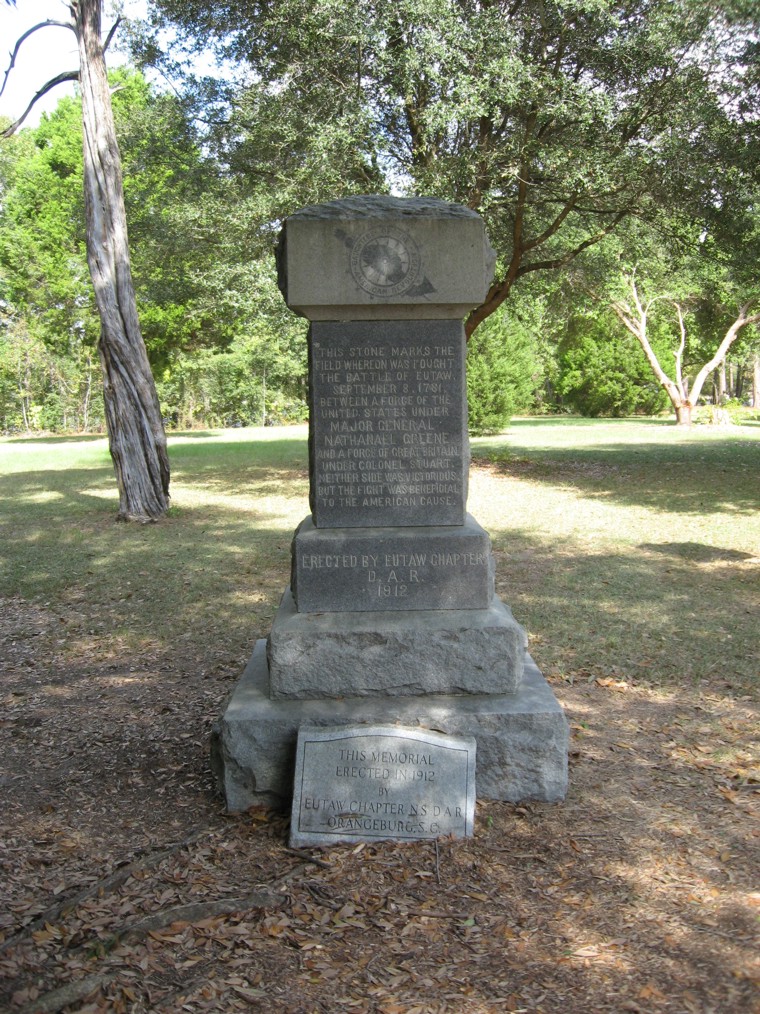
Daughter’s of the American Revolution (D.A.R.) Monument, Eutaw Springs Battlefield (author collection)
In many ways, the battle of Eutaw Springs was a disappointment for both commanders. Greene’s troops at one point broke through the British lines, but they recovered, and the Americans failed to drive them off the field. Stewart, in a letter to Cornwallis, wrote that there were two things he would regret the rest of his life: the loss of an early morning supply gathering party and his lack of cavalry. Having them, he felt, would have enabled him to decisively defeat Greene. Probably both commanders, and many of their officers, reflected upon these events and second guessed themselves for the rest of their days. Although both armies fought well at Eutaw Springs, a clear cut victory eluded both of them. Continue reading “After Eutaw Springs”→
Emerging Revolutionary War is pleased to welcome back historian Bert Dunkerly, who is the co-author (with Irene B. Boland) of the upcoming book; “Eutaw Springs; The Final Battle of the American Revolution’s Southern Campaign” slated to be released this month.
Part One
The weather was warm and the men had been marching for days, but their morale was high. They had been through a lot recently: caught off guard and defeated at Hobkirk’s Hill, a month of grueling siege work – and for naught, at Ninety Six. Not to mention the engagements that many of them had fought in previously: Kings Mountain, Cowpens, Guilford Courthouse, and dozens of smaller battles.
Yet the army that General Nathanael Greene led forward on the morning of September 8, 1781, was confident and ready to come to grips with its adversary. Everyone from the private in the ranks on up to the commanding general knew that ahead lay an opportunity.
Battles in the Revolution were, in fact, rare opportunities for commanders. Engagements were the short, pulse-pounding events that broke up the monotony of marching and maneuvering. An army spent most of its time in garrison, in camp, or on the road. In battle the infrequent opportunity came to crush an opponent and influence the outcome of a campaign, or the war. These chances were few and far between.
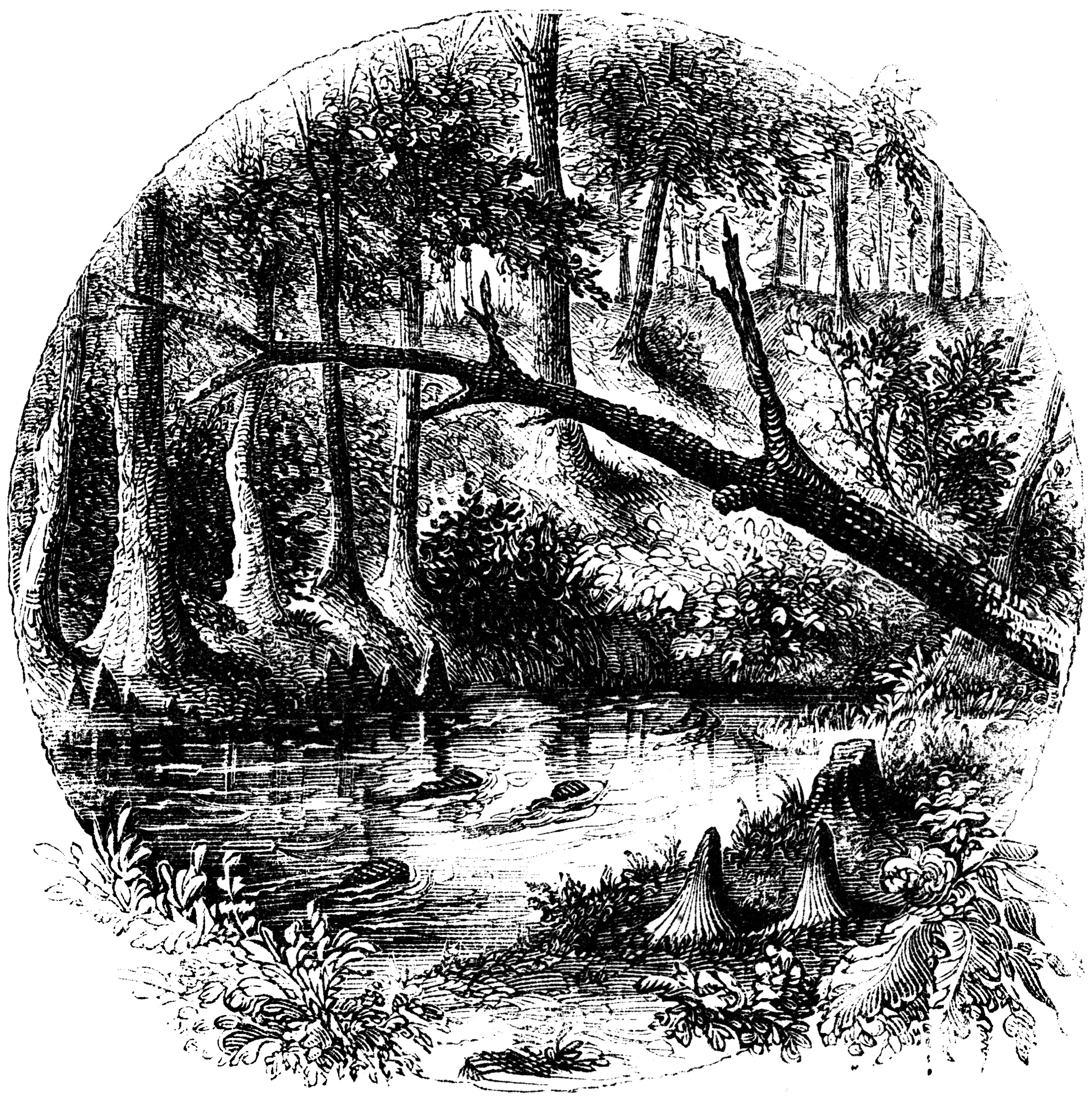
“Eutaw Springs” by Benson Lossing
Both commanders at Eutaw Springs appreciated this fact. General Nathanael Greene’s forces had experienced a series of close calls at Guilford Courthouse, Ninety Six, and Hobkirk’s Hill. The American army fought well in all of these engagements, save Hobkirk’s Hill, yet they met defeat in every one. Greene hoped Eutaw Springs would put the finishing touches on his South Carolina campaign, and end it with a clear cut victory.[i]
Eutaw Springs was a rare chance for Greene to pick the time and place of engagement, array his forces to his choosing, and initiate the battle, and control its \tempo. It was the only set engagement of the campaign, other than Guilford Courthouse, in which Greene chose the ground and initiated the battle. Commanders do not often have this luxury, and Greene earnestly hoped to make the most of it. Continue reading “Eutaw Springs”→
As a general statement, most people don’t think of the Revolutionary War as a testing ground for battlefield tactics. That assumption would not be correct. In fact, the Revolutionary War proved beyond doubt that traditional European set-piece battlefield tactics were largely ineffective against a determined enemy that was not bound by the traditional rules of war. As just one example, the extremely effective hit and run tactics used by the Minutemen to harass and deplete the British forces that marched to Lexington and Concord that were based on the tactics used by Native American fighters prove this beyond doubt. The British Regulars had no experience or training in dealing with these tactics, and they suffered as a result.
Also, in the European model, wherein gentlemen fought wars and assiduously avoided civilian casualties, it was considered impolite and improper to target the other side’s officers during the course of battle. American forces refused to comply with these rules, causing serious losses among the ranks of British officers, and the British had to adapt to these tactics also.
Another tactic adopted by American officers proved to be incredibly effective during the campaigns in the South in 1781. Brig. Gen. Daniel Morgan and Maj. Gen. Nathanael Greene, in particular, made extremely effective use of the defense in depth in carrying out their Fabian strategy during the Southern Campaigns of the Revolutionary War.
A Fabian strategy—named for its most famous practitioner, the Roman dictator, Quintus Fabius Maximus Verruscosus—avoids pitched battles and frontal assaults in favor of wearing down an opponent through a war of attrition and indirection. While avoided decisive battles, the side employing a Fabian strategy harassed the enemy through skirmishes to inflict losses, disrupt supply, and affect enemy morale. Typically, the employment of this strategy suggests that the side adopting it believes that time is on its side. George Washington was absolutely convinced that a Fabian strategy would ultimately wear down the British, and he was right.
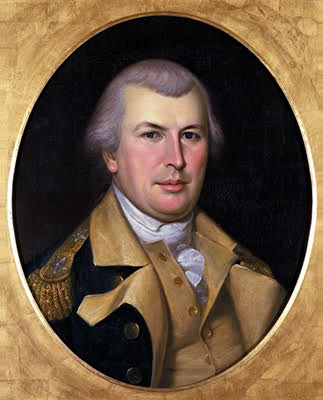
General Nathanael Greene, who mastered the Fabian strategy in the Southern Campaign of 1781
His protégé, Greene, also believed that a Fabian strategy was the way to defeat the British. Faced with the task of defending a large swath of the South with a small army, he had little choice. His subordinate, Brig. Gen. Daniel Morgan, a rough but extremely effective amateur soldier, pioneered the use of a defense in depth at the Battle of Cowpens in January 1781, and Greene then used it on a larger scale at the Battle of Guilford Courthouse about sixty days later. That two untrained amateur soldiers could develop and use such a tactic so effective demonstrates their genius.
A defense in depth, also known as a deep or elastic defense, seeks to delay, rather than prevent, the advance of an attacker, buying time and inflicting additional casualties by trading time for space. Instead of facing an attacker with a single, strong defensive position, a defense in depth relies upon the tendency of an attack to lose momentum and cohesion over time as it covers a larger area. Thus, a defender can yield lightly defended territory in an effort to outstrip an attacker’s logistics or spread out a numerically superior attacking force. Once that attacker has lost momentum, or has become spread out to hold territory, well-planned and well-placed counterattacks can be directed at the attacker’s weak points, with the objective of causing attrition warfare or driving the attacker back to its original starting position.
A conventional defensive strategy concentrates all of a defender’s military resources in a well-defended front line, which, if breached by an attacker, would expose the remaining troops in danger of being flanked, cut off, and surrounded, and leaving lines of supply, communications, and command vulnerable to being cut.
By contrast, a defense in depth requires that defenders deploy their resources, such as prepared fortifications, earthworks, and additional forces at and well behind the front line. Once an attacker breaches the weaker initial position, it continues to meet resistance as it presses on. As the attacker penetrates further, its flanks become vulnerable, and if the advance stalls, the attacking force can find itself completely surrounded and subject to being destroyed or forced to surrender. Thus, a defense in depth is particularly effective against an attacker that can concentrate its force to attack a small number of places along an extended defensive position.
In a well-designed and properly implemented defense in depth, the defending forces fall back to a succession of prepared positions designed to inflict a heavy price on the advancing enemy while minimizing the risk of being overrun or outflanked. By delaying the enemy’s advance, a defense in depth neutralizes manpower advantages and the element of surprise, and buys time for additional forces to be readied for well-timed counterattacks. A well-designed defense in depth will use its forces in mutually supporting positions and in appropriate roles. In this scenario, poorly trained soldiers—such as militiamen—can be used in static positions at the front line, while more experienced and better-trained soldiers can form a mobile reserve, or man the ultimate defensive position to be defended. Further, a well-designed defense in depth will make good use of the natural advantages offered by terrain features and other natural obstacles such as streams, ponds, etc.
General Nathanael Greene, who mastered the Fabian strategy in the Southern Campaign of 1781
There are disadvantages associated with the defense in depth. For one thing, constantly retreating can take a toll on the morale of defending forces. Further, these forces also require a high degree of mobility to accommodate those retreats, and also the space to do so.
Morgan designed and implemented a very effective defense in depth at Cowpens that proved so effective that Greene adopted that tactic and, while he lost the Battle of Guilford Courthouse, the heavy losses his army imposed on Lord Cornwallis’ army prompted Greene to note that the British, “have met with a defeat in a victory.”
For the next year and a half, until he was exchanged for a British officer captured in the Battle of Saratoga, Williams faced an ordeal that would continue to haunt him for the rest of his life. Initially treated as a gentleman because of his officer status, the first few months of his imprisonment passed in relative ease. The ease of the beginning months of his captivity was the norm for officers taken in civilized 18th century viewed warfare. Williams’ early imprisonment showed the gentleman status he had attained through his rise in the military ranks. During this time, an anecdote reinforces this point.
While in prison in New York, he became acquainted with a Major Ackland of the British military. The two became fast friends. Williams, under the auspices of his imprisonment, was able to move freely through the city of New York with this new friend.The friendship was confirmed when after dining with Major Ackland he was invited to attend an assembly. This was the term used to describe a fashionable ball of the period. When arriving at the ball, the reception that Major Williams received was so contemptuous and full of scorn that it attracted the attention of Major Ackland who replied: “Come, Williams, this society is to ill-bred for you and me; let us go home.” The account shows the personable demeanor and gentlemanly qualities that Williams espoused. This quote only tells half the story. The other half of the account transpired after Major Ackland returned to England that makes this story so worthy.
Upon Ackland’s return to England attended a mass dinner and one of the topics broached was the questionable courage of the American military. The major defended Americans so vehemently that he was issued a duel by a fellow British officer. This led to his demise, with a fatal gunshot wound to the head. To defend the abilities of Americans to such an extreme depicted the immense respect and valued friendship that blossomed between the two officers. Along with showing the respect and admiration that constituted the friendship was the fact that Williams reached a level where he could fraternize with gentlemen of pre-war higher social classes. In addition he was an amiable companion and a worthy military adversary in the views of British counterparts.
A sketch of one of the prison complexes used in New York City by the British to house American soldiers.
The imprisonment of Williams took a drastic turn to the worse when an accusation of espionage surfaced against him. According to the General Phillips, the commandant of New York, Major Williams was in the habit of communicating to General Washington all the information to be collected from the British camp by means of emissaries employed for that purpose. Williams was seized as soon as the accusation was leveled against him and was denied a chance to provide a defense or refutation of the charges. He was placed in the provost jail in New York, in a room about sixteen square feet. The prison cell had poor ventilation and was best described as “disgustingly filthy.”Here Williams languished for approximately eight months; the last of the fifteen months he was a prisoner of war. Although the spying was never verified and for all intents probably a false accusation, Williams’ “naturally fair constitution…was much impaired” by this ordeal.
After his exchange in January 1778, Williams took command of the 6th Maryland Regiment and Williams would see action at Monmouth Court House in the summer of that same year.
Williams headed south with the Maryland Continentals to aid the Southern Department and relieve the American garrison at Charleston, South Carolina. Unfortunately, the American reinforcements arrived too late to lift the siege.
The reinforcements did make it in time for another American military disaster; the Battle of Camden. Plucked as adjutant general for Horatio Gates, the American commander, Williams was powerless to stop the route of march that Gates chose to move the American army from North Carolina to South Carolina.
The condition of the troops, fatigued from the march along with other difficulties, mixed with very limited rations would prove fatal tomorrow to the American effort at Camden. What ensued the following day was the death of General Kalb, the lost of over 1,000 American soldiers, and the ruin of Gates military career as a field commander. The way the battle unfolded would haunt Williams for the rest of his life, which was recorded in a written component for the Papers of Nathanael Greene. He remembered how the “great majority of the militia fled without firing a shot.” This was a significant issue because the militia comprised two-thirds of the total force of Gates! Williams, along with the survivors were left to question the reasons behind the campaign, the strenuous marching, and the condition they were led into battle with.
Williams took part in the strategic move north across the Dan River in Southern Virginia, part of Nathanael Greene’s strategic maneuvering in the face of British Lord Charles Cornwallis’ British forces. Able to recuperate and refit his army across the watery boundary from the British, Greene planned the strategy that would lead Williams and the rest of the Americans back to North Carolina and to a place called Guilford Court House.
After serving a stint as a commander of light infantry, Williams played a pivotal role in the March 15, 1781 Battle of Guilford Court House. Serving in the last line, where other Marylanders of the 1st Maryland Continentals played a decisive role in saving Nathanael Greene’s American army, Williams helped lead the rear-guard away from Guilford Court House.
Williams would continue to serve admirable in future engagements at Hobkirk’s Hill and Eutaw Springs. In the later stages of 1781 Williams was given command of the 1st Maryland Regiment, the same unit that the famous painting below depicted at the Battle of Guilford Court House.
1st Maryland Continentals at Battle of Guilford Court House
In January 1783, Williams received notice that Congress had approved his promotion to brigadier general on account of his merit and service in the Southern Theater Campaigns.
Approimately halfway through that same month, on the 16th, Williams retired from the army.
After almost eight years of arduous service, Williams, like the nation he helped create by his service was a changed being. The changes were numerous, first being the obvious, that he had shown tremendous progress in climbing the officer ranks, from lieutenant in 1775 to brigadier general in 1783. Secondly, and possibly the most important he had endured through numerous campaigns and some of the bloodiest battles of the war, from Fort Washington in New York to Camden in South Carolina.
Williams return to civilian life saw him appointed as commissioner of the Port of Baltimore and he was active in the Society of Cincinnati, the society created to preserve the fellowship of former officers of the American army during the Revolution.
In 1786 Williams married Mary Smith and became a father to four sons, settling on the banks of the Potomac River where he tried his hand at farming.
Springfield Farm, home of Otho Holland Williams (courtesy of HMDB.org)
With his friendship to George Washington, Williams had his appointment as commissioner of the Port of Baltimore renewed and then in 1792 was approached by Henry Knox, Secretary of War in Washington’s administration (and at the behest of Washington) to see whether he would accept a commission as brigadier general in the regular army.
Although the position would have made Williams the second highest ranking officer in the military, he declined the position because he had no ambition for the position and also his health was poor.
Williams died on July 15, 1794. He was 45 years old. His health never recovered from the strains of imprisonment and the fatigues of war.
The town of Williamsport, Maryland, which would play a prominent role in the Gettysburg Campaign of 1863 was named after him and where he was laid to rest.







 Emerging Revolutionary War Era