Emerging Revolutionary War welcomes back guest historian Dan Davis
Like my last post at Emerging Revolutionary War on the “Race to the Dan”, the origins of this post lie in a conversation with blog co-founder, Phill Greenwalt. The topic of our discussion revolved around the aftermath of the British victory at the Battle of Camden. The engagement ultimately brought two American officers to the Southern Theater: Nathanael Greene and Daniel Morgan. Greene accepted the position as the new head of the Southern Department’s co two months to the day after the battle while commanding the post at West Point, New York. Morgan’s story, however, is much more fascinating.
In the spring of 1779, George Washington created a light infantry corps within the Continental Army. Such a command fit Morgan’s skillset. He previously commanded the army’s provisional rifle corps. Additionally, Morgan, then a colonel, had compiled a record that arguably warranted elevation to brigadier general. After fighting broke out at Lexington and Concord, Morgan led a rifle company to the aid to the American army besieging Boston. Morgan participated in Col. Benedict Arnold’s Canadian Expedition and was captured during the assault on Quebec. He also played a critical role in the Battles of Saratoga. Morgan’s home state of Virginia, however, had met its quota for general officers and a vacancy was not available.
On June 30, 1779, Morgan learned Brig. Gen. Anthony Wayne received command of the new corps. With his pride devastated, Morgan traveled to Philadelphia. There, on July 19, Congress read his resignation.
Billy Griffith, Kevin Pawlak, Rob Orrison and Mark Maloy at George Washington’s HQ in Newburgh, NY
Just over two weeks ago, ERW historians Billy Griffith, Phillip Greenwalt, Mark Maloy, Rob Orrison and Kevin Pawlak took a long weekend trip up to upstate New York. This was the fourth year that ERW authors have gotten together to take a “field trip” to see sites related to the French and Indian War and the American Revolution.
The trips not only serve as chances for research, but also to make new connections with public historians working in the American Revolution era. Along the way, we posted several videos from locations to give our followers an idea of some of the great places to visit out there. Again, our goal is to not just share this history, but to get people to visit these great sites.
Sites visited on the first day included the Stony Point Battlefield, where Americans under Gen. Anthony Wayne over ran a surprised British outpost. Reading about this action almost rings empty until you stand on the ground. Looking at the steep terrain that Wayne’s men climbed after traversing through a wetland, it is hard to imagine how the Continentals were able to take the British fort with so few casualties. Later that day we made a quick stop at George Washington’s headquarters in Newburgh. Here Washington lived from April 1782 to August 1783 and where he learned of the cease fire with the British, wrote his now famous circular letter to the colonial governors on his vision for the new government. Most importantly, here Washington responded to the Newburgh Conspiracy of his officers looking to possibly over throw the civil government. This site is also important in the history of the museum field as it is the first publicly owned historic site in the United States, opened in 1850 as a museum. A worthwhile nearby site, the New Windsor Cantonment site, preserves the camp site of the Continental Army during the 1782-1783 time period. Several of the buildings are rebuilt, including the Temple of Virtue, where Washington made his impassioned speech to his officers (with the assistance of his glasses) to diffuse their discontent with Congress.
The morning of the second day of the trip was spent visiting sites around Lake George, NY, including some much over looked French and Indian War sites. That afternoon sites along the upper Hudson including the site of the murder of Jane McCrea, Fort Edward and sites in Albany.
Park Interpreter Bob Hoar explains the terrain of the battlefield
Early Sunday morning, a quick trip to the Bennington Battlefield State Park was highlighted with a great personal tour by Bob Hoar. The battlefield is well preserved and interpreted. Bob also shared some of his research into reinterpreting the battlefield using first person accounts and the landscape. Again, understanding the landscape of these places creates such a better understanding.
The majority of the day on Sunday was spent at Saratoga National Historical Park, posting several Facebook Live videos from various points across the battlefield. Also a special visit to the surrender site in Schuylerville which was recently preserved and opened as a memorial by the Friends of Saratoga Battlefield. A great preservation victory that adds to the overall story of Saratoga.
One of the highlights of the trip took place on Monday, where we received a behind the
Curator Matthew Keagle gave a behind the scenes tour of Fort Ticonderoga’s amazing collection storage.
scenes tour by Fort Ticonderoga staff. We started by learning about the military interpretive program by Ron Vido, Military Programs Supervisor. Anyone who has visited Fort Ticonderoga knows about their quality interpretive staff and programs. Ron also shared with us their plans to slowly restore the Carillon Battlefield (1758), which will be a great addition to the understanding of North America’s bloodiest battle before the Civil War. That afternoon we were treated to a behind the scenes tour of Fort Ticonderoga’s collections storage by Curator Matthew Keagle. The Fort has been collecting 18th century items for nearly 100 years. Their collection is one of the largest collection of 18th century military artifacts in the United States. From a Continental knapsack to an original copy of Baron von Steuben’s drill manual, the collection on display is only a small portion of what the museum owns. Matt also shared the museum’s ongoing work to digitize their collection for the purpose of research. The day was capped off by a visit to one of the best preserved battlefields in the United States, Hubbardton. Fought as part of the Saratoga Campaign, this is Vermont’s only battlefield. The landscape at the foot of the Green Mountains is amazing and the viewsheds are near pristine. A nice state park and visitor center are there to help explain the events of July 7, 1777.
Thank you to all the people that assisted us in this trip and all the sites that were nice enough to host us. We will be posting more on the blog in the future focusing on some of the stories around these amazing sites. Again, we encourage you to take the time to visit all these places. History books are great, but there is no substitute for being in the footsteps of history
Picking up the story of Camden from Thursday morning, we continue with Col. Otho
Gen. Gates believed his night march on August 15th would put his army in a great defensive position above Saunder’s Creek.
Holland Williams comments on the events on the evening of August 15th. As Gates’ army moved southward at night, a dangerous undertaking even with a professional army, notwithstanding an army mostly comprised of militia that had never fought as a cohesive unit. Williams documents the meals that the Americans ate that night before their march. When reading American accounts of Camden, most mention the impact on the evening August 15th meal had on the men and the army as a whole. Williams also mentions there is much criticisms of Gates’ plan, but no official opposition was brought to Gates. Reading Williams’ account gives us insight today into the events leading up to the disaster at Camden. When reading Williams’ narrative, it is not hard to believe that the Americans were marching to a defeat.
“Although there had been no dissenting voice in the council, the orders were no sooner promulgated than they became the subject of animadversion. Even those who had been dumb in council, said that there had been no consultation –that the orders were read to them, and all opinion seemed suppressed by the very positive and decisive terms in which they were expressed. Others could not imagine how it could be conceived, that an army, consisting of more than two -thirds militia, and which had never been once exercised in arms together, could form columns, and perform other manoeuvres in the night, and in the face of an enemy. But, of all the officers, Colonel Armand took the greatest exception. He seemed to think the positive orders respecting himself, implied a doubt of his courage –declared that cavalry had never before been put in the front of a line of battle in the dark–and that the disposition, as it respected his corps, proceeded from resentment in the general, on account of a previous altercation between them about horses, which the general had ordered to be taken from the officers of the army, to expedite the movement of the artillery though the wilderness. A great deal was said upon the occasion; but, the time was short, and the officers and soldiers, generally, not knowing, or believing any more than the general, that any considerable body of the enemy were to be met with out of Camden, acquiesced with their usual cheerfulness, and were ready to march at the hour appointed. As there were no spirits yet arrived in camp; and as, until lately, it was unusual for the troops to make a forced march, or prepare to meet an enemy without some extraordinary allowance, it was unluckily conceived that molasses, would, for once, be an acceptable substitute; accordingly the hospital stores were broached, and one gill of molasses per man, and a full ration of corn meal and meat, were issued to the army previous to their march, which commenced, according to orders, at about ten o’clock at night of the 15th. …. The troops of general Gates’ army, had frequently felt the bad consequences of eating bad provisions; but, at this time, a hasty meal of quick baked bread and fresh beef, with a desert of molasses, mixed with mush, or dumplings, operated so cathartically, as to disorder very many of the men, who were breaking the ranks all night, and were certainly much debilitated before the action commenced in the morning. …. “Continue reading ““Gentlemen, what is best to be done?” Gates Moves Towards Camden and Makes a Fateful Decision”→
Two hundred and thirty nine years ago today from his camp at Rugeley’s Mill, SC, American General Horatio Gates issued the following orders to his Southern Army to move on to the British post of Camden, SC.
“The sick, the extra artillery stores, the heavy baggage, and such quartermaster’s stores, as are not immediately wanted, to march this evening, under a guard, to Waxaws. To this order the general requests the brigadier generals, to see that those under their command, pay the most exact and scrupulous obedience. Lieutenant Colonel Edmonds, with the remaining guns of the park, will take post and march with the Virginia brigade, under General Stevens; he will direct, as any deficiency happens in the artillery affixed to the other brigades, to supply it immediately; his military staff, and a proportion of his officers, with forty of his men, are to attend him and await his orders. The troops will be ready to march precisely at ten o’clock, in the following order, Continue reading ““troops will observe the profoundest silence upon the march…” Gen. Gates’ Orders on August 15, 1780″→
On the morning of March 15, 1783, George Washington strode into the “New Building” or “Temple” as the structure was referred as, to address the assembled officers of the Continental Army. He asked General Horatio Gates if he could have the floor to say a few words and when he unfolded his pieces of paper on the podium, the words lost their importance.
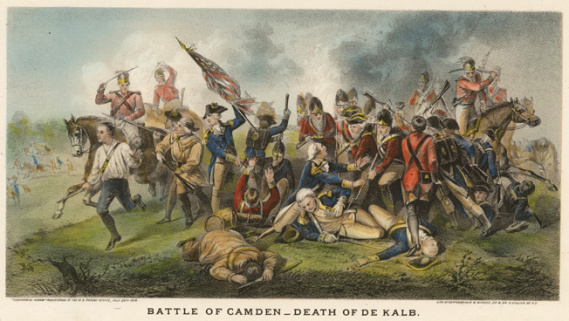
238 years ago today the United States military suffered one of its worst defeats. The Battle of Camden, fought on August 16, 1780 just a few miles north of Camden, SC was a total defeat for the American “Grand Army” under popular General Horatio Gates. The British under Lord Cornwallis inflicted nearly 1,900 casualties (out of 4,000) at a loss of only 300. One of the biggest losses was the death of General Baron Johann de Kalb, a popular foreign general in the American army. Though a strategic defeat for Gates, it was the retreat that would lead to Gates’ demise. As the militia broke and ran, Gates was caught up in the panic and fled the field as half of his army was still fighting.
Writing several days later from Hillsborough, NC Gates submitted his account of the battle to Congress. Already, reports of cowardice were starting to spread about Gates’ conduct during the battle. Gates decision to fight and his decision to leave the field during the battle have been debated ever since that August day in 1780. Below is a portion of Gates’ letter.
“In the deepest distress and anxiety of mind, I am obliged to acquaint your excellency with the defeat of the troops under my command. I arrived with the Maryland line, the artillery, and the North-Carolina militia, on the 13th instant at Rugeley’s, thirteen miles from Camden; and took post there, and was the next day joined by General Stevens, with seven hundred militia from Virginia…. Having communicated my plan to the general officers in the afternoon of the 15th, it was resolved to march at ten at night, to take post in a very advantageous situation, with a deep creek in front, seven miles from Camden; the heavy baggage, &c. being ordered to march immediately by the Waxhaw road. At ten the army began to march in the following order: Colonel Armand’s legion in front, supported on both flanks by Colonel Porterfield’s regiment, and the light infantry of the militia; the advanced guard of infantry, the Maryland line, with their artillery, in front of the brigades, the North-Carolina militia, the Virginia militia, the artillery, &c. and the rear guard. Having marched about five miles, the legion was charged by the enemy’s cavalry, and well supported on the flanks, as they were ordered, by Colonel Porterfield, who beat back the enemy’s horse, and was himself unfortunately wounded; but the enemy’s infantry advancing with a heavy fire, the troops in front gave way to the first Maryland brigade, and a confusion ensued, which took some time to regulate. At length the army was ranged in line of battle, in the following order: General Gist’s brigade upon the right, with his right close to a swamp, the North-Carolina militia in the center, and the Virginia militia, with the light infantry and Porterfield’s corps, on the left; the artillery divided to the brigades; and the first Maryland brigade as a corps de reserve, and to cover the can non in the road, at a proper distance in the rear. Colonel Armand’s corps were ordered to the left, to support the left flank, and oppose the enemy’s cavalry. At daylight the enemy attacked and drove in our light party in front, when I ordered the left to advance and attack the enemy; but to my astonishment, the left wing and North -Carolina militia gave way. General Caswall and myself, assisted by a number of officers, did all in our power to rally the broken troops, but to no purpose, for the enemy coming round the left flank of the Maryland division, completed the rout of the whole militia, who left the continentals to oppose the enemy’s whole force. I endeavoured, with General Caswall, to rally the militia at some distance, on an advantageous piece of ground, but the enemy’s cavalry continuing to harass their rear, they ran like a torrent, and bore all before them. Hoping yet, that a few miles in the rear they might recover from their panic, and again be brought into order, I continued my endeavour, but this likewise proved in vain. The militia having taken the woods in all directions, I concluded, with General Caswall [sic], to retire toward Charlotte.”
For the next year and a half, until he was exchanged for a British officer captured in the Battle of Saratoga, Williams faced an ordeal that would continue to haunt him for the rest of his life. Initially treated as a gentleman because of his officer status, the first few months of his imprisonment passed in relative ease. The ease of the beginning months of his captivity was the norm for officers taken in civilized 18th century viewed warfare. Williams’ early imprisonment showed the gentleman status he had attained through his rise in the military ranks. During this time, an anecdote reinforces this point.
While in prison in New York, he became acquainted with a Major Ackland of the British military. The two became fast friends. Williams, under the auspices of his imprisonment, was able to move freely through the city of New York with this new friend.The friendship was confirmed when after dining with Major Ackland he was invited to attend an assembly. This was the term used to describe a fashionable ball of the period. When arriving at the ball, the reception that Major Williams received was so contemptuous and full of scorn that it attracted the attention of Major Ackland who replied: “Come, Williams, this society is to ill-bred for you and me; let us go home.” The account shows the personable demeanor and gentlemanly qualities that Williams espoused. This quote only tells half the story. The other half of the account transpired after Major Ackland returned to England that makes this story so worthy.
Upon Ackland’s return to England attended a mass dinner and one of the topics broached was the questionable courage of the American military. The major defended Americans so vehemently that he was issued a duel by a fellow British officer. This led to his demise, with a fatal gunshot wound to the head. To defend the abilities of Americans to such an extreme depicted the immense respect and valued friendship that blossomed between the two officers. Along with showing the respect and admiration that constituted the friendship was the fact that Williams reached a level where he could fraternize with gentlemen of pre-war higher social classes. In addition he was an amiable companion and a worthy military adversary in the views of British counterparts.
A sketch of one of the prison complexes used in New York City by the British to house American soldiers.
The imprisonment of Williams took a drastic turn to the worse when an accusation of espionage surfaced against him. According to the General Phillips, the commandant of New York, Major Williams was in the habit of communicating to General Washington all the information to be collected from the British camp by means of emissaries employed for that purpose. Williams was seized as soon as the accusation was leveled against him and was denied a chance to provide a defense or refutation of the charges. He was placed in the provost jail in New York, in a room about sixteen square feet. The prison cell had poor ventilation and was best described as “disgustingly filthy.”Here Williams languished for approximately eight months; the last of the fifteen months he was a prisoner of war. Although the spying was never verified and for all intents probably a false accusation, Williams’ “naturally fair constitution…was much impaired” by this ordeal.
After his exchange in January 1778, Williams took command of the 6th Maryland Regiment and Williams would see action at Monmouth Court House in the summer of that same year.
Williams headed south with the Maryland Continentals to aid the Southern Department and relieve the American garrison at Charleston, South Carolina. Unfortunately, the American reinforcements arrived too late to lift the siege.
The reinforcements did make it in time for another American military disaster; the Battle of Camden. Plucked as adjutant general for Horatio Gates, the American commander, Williams was powerless to stop the route of march that Gates chose to move the American army from North Carolina to South Carolina.
The condition of the troops, fatigued from the march along with other difficulties, mixed with very limited rations would prove fatal tomorrow to the American effort at Camden. What ensued the following day was the death of General Kalb, the lost of over 1,000 American soldiers, and the ruin of Gates military career as a field commander. The way the battle unfolded would haunt Williams for the rest of his life, which was recorded in a written component for the Papers of Nathanael Greene. He remembered how the “great majority of the militia fled without firing a shot.” This was a significant issue because the militia comprised two-thirds of the total force of Gates! Williams, along with the survivors were left to question the reasons behind the campaign, the strenuous marching, and the condition they were led into battle with.
Williams took part in the strategic move north across the Dan River in Southern Virginia, part of Nathanael Greene’s strategic maneuvering in the face of British Lord Charles Cornwallis’ British forces. Able to recuperate and refit his army across the watery boundary from the British, Greene planned the strategy that would lead Williams and the rest of the Americans back to North Carolina and to a place called Guilford Court House.
After serving a stint as a commander of light infantry, Williams played a pivotal role in the March 15, 1781 Battle of Guilford Court House. Serving in the last line, where other Marylanders of the 1st Maryland Continentals played a decisive role in saving Nathanael Greene’s American army, Williams helped lead the rear-guard away from Guilford Court House.
Williams would continue to serve admirable in future engagements at Hobkirk’s Hill and Eutaw Springs. In the later stages of 1781 Williams was given command of the 1st Maryland Regiment, the same unit that the famous painting below depicted at the Battle of Guilford Court House.
1st Maryland Continentals at Battle of Guilford Court House
In January 1783, Williams received notice that Congress had approved his promotion to brigadier general on account of his merit and service in the Southern Theater Campaigns.
Approimately halfway through that same month, on the 16th, Williams retired from the army.
After almost eight years of arduous service, Williams, like the nation he helped create by his service was a changed being. The changes were numerous, first being the obvious, that he had shown tremendous progress in climbing the officer ranks, from lieutenant in 1775 to brigadier general in 1783. Secondly, and possibly the most important he had endured through numerous campaigns and some of the bloodiest battles of the war, from Fort Washington in New York to Camden in South Carolina.
Williams return to civilian life saw him appointed as commissioner of the Port of Baltimore and he was active in the Society of Cincinnati, the society created to preserve the fellowship of former officers of the American army during the Revolution.
In 1786 Williams married Mary Smith and became a father to four sons, settling on the banks of the Potomac River where he tried his hand at farming.
Springfield Farm, home of Otho Holland Williams (courtesy of HMDB.org)
With his friendship to George Washington, Williams had his appointment as commissioner of the Port of Baltimore renewed and then in 1792 was approached by Henry Knox, Secretary of War in Washington’s administration (and at the behest of Washington) to see whether he would accept a commission as brigadier general in the regular army.
Although the position would have made Williams the second highest ranking officer in the military, he declined the position because he had no ambition for the position and also his health was poor.
Williams died on July 15, 1794. He was 45 years old. His health never recovered from the strains of imprisonment and the fatigues of war.
The town of Williamsport, Maryland, which would play a prominent role in the Gettysburg Campaign of 1863 was named after him and where he was laid to rest.
Baron Frederich Wilhelm August Heinrich Ferdinand Steuben or Frederich Wilhelm Ludolf Gerhard Augustin von Steuben or more simply Baron von Steuben, may be the most recognizable German to serve with the American army during the American Revolution.*
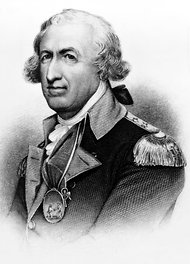
Portrait of Baron Johann de Kalb (by Charles W. Peale)
His merits, pedigree, and how he came to America has been questioned and studied by many scholars and historians.
Another German has not fared so well in terms of recognition of his invaluable services to the American cause.
This post is about that other German-speaking military officer. He did something von Steuben did not.
Baron Johann von Robais de Kalb not only offered his services to the fledgling American Continental Army, he also gallantly gave his life for his adopted-cause.
Born June 19, 1721 in Huttendorf, near Erlangen in Bavaria, de Kalb led a life of privilege, learning multiple languages before earning a commission in the French army in the Loewendal Regiment. He served admirably in the War of Austrian Succession and the Seven Years War, in the later, he won the Order of Military Merit and gained his baronetcy.






 Emerging Revolutionary War Era