War of 1812 – 210 Years Ago (and Change)

First, thank you all for understanding with the technical difficulties of yesterday’s potential Facebook Live.

Over this past weekend, the 210th anniversary of the Battle of Bladensburg and the Burning of Washington by British troops took place. In a potential future tour, I was scouting out locations around our nation’s capital that are connected with the year 1814. Although some of the sites have been rebuilt, some of the history is preserved in museums, and one of the places is still occupied by the president of the United States, there is still a lot of history underfoot related to the War of 1812.

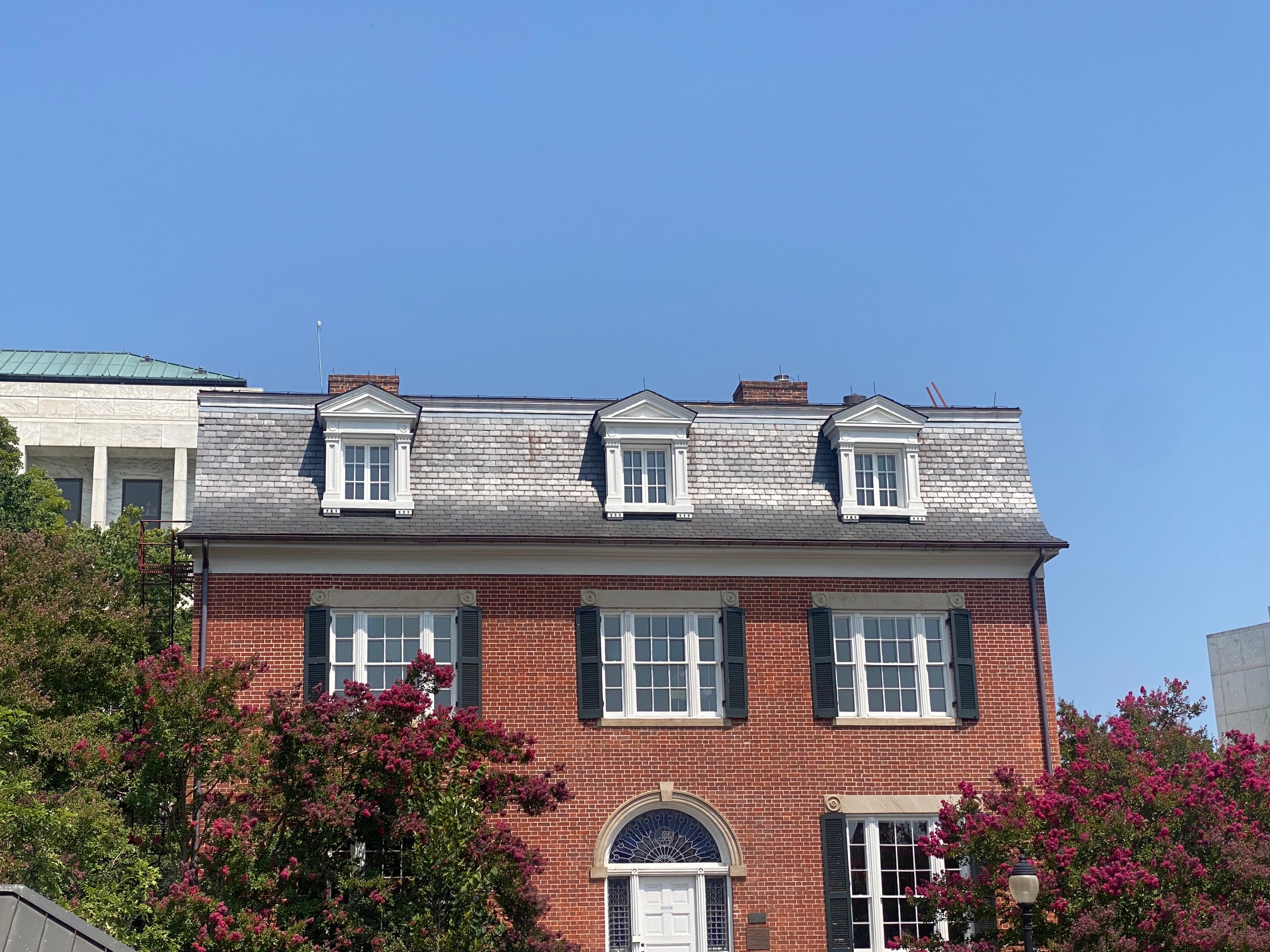
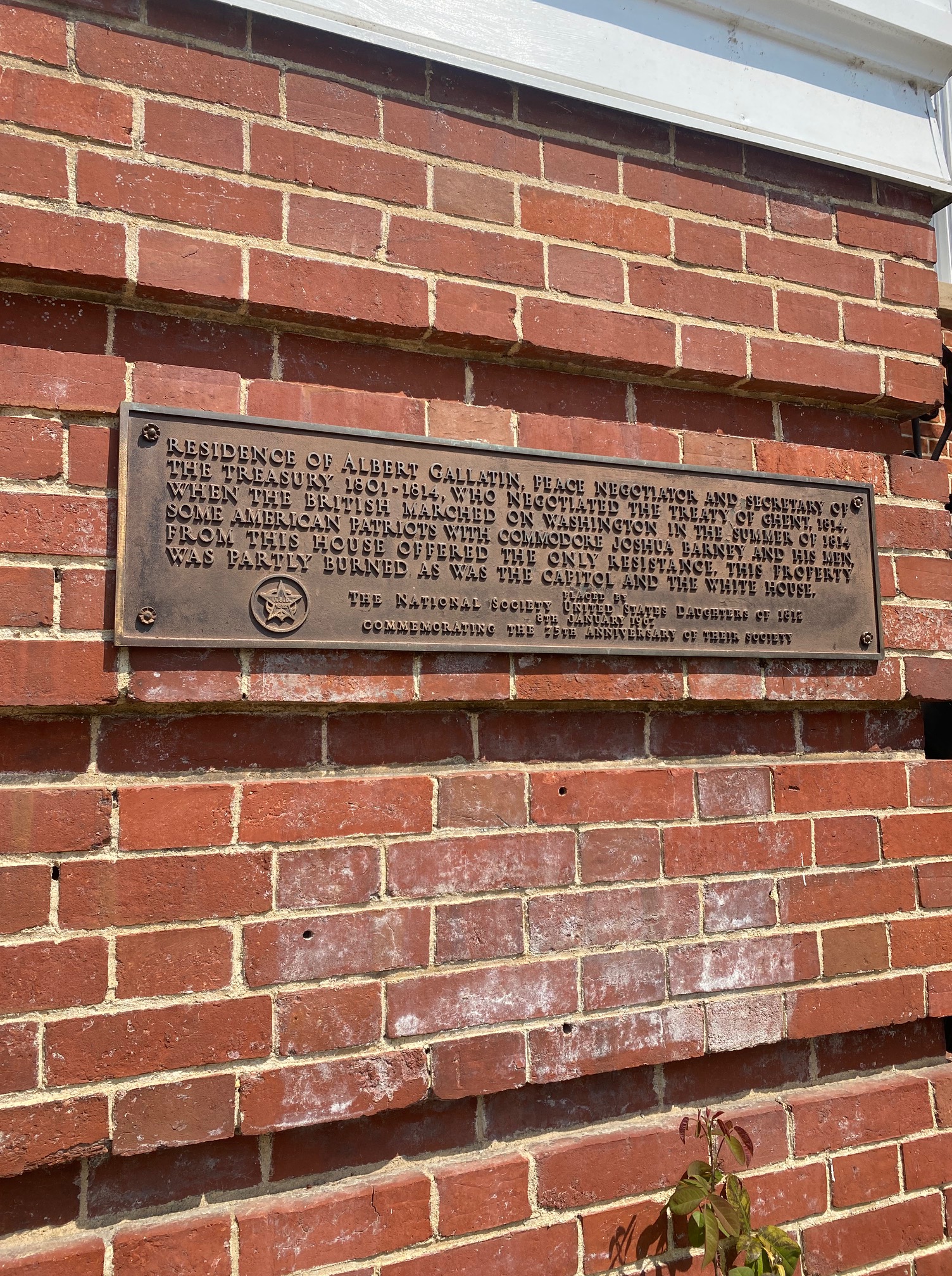
Some of that history is below. Robert Sewall built a house sometime between 1800 on 2nd and Maryland Avenue Northeast but with an inheritance from an uncle’s passing moved to southern Maryland. He rented the property to Albert Gallatin, who would serve as treasury secretary under both Presidents Thomas Jefferson and James Madison. In 1813, Gallatin left to become one of the United States peace commissioners in Ghent, Belgium charged with negotiating a treaty to end the War of 1812. William Sewall, Robert’s son, took responsibility for the house at that point. William served with Commodore Joshua Barney during the War of 1812 and records do not indicate he ever lived at the residence.

During the British march into the city, a group of Barney’s men took refuge in the residence and fired shots at the enemy column. Two British soldiers were killed and the horse of Major General Robert Ross was also struck. Ross ordered men into the structure to clear the snipers but not finding the culprits, the infantrymen burnt the property in retaliation. This would be the only private property burnt during the British incursion into Washington.

The property remained in the Sewall family, the house was rebuilt in 1820 and is now the Belmont-Paul Women’s Equality National Monument, a unit of the National Park Service.
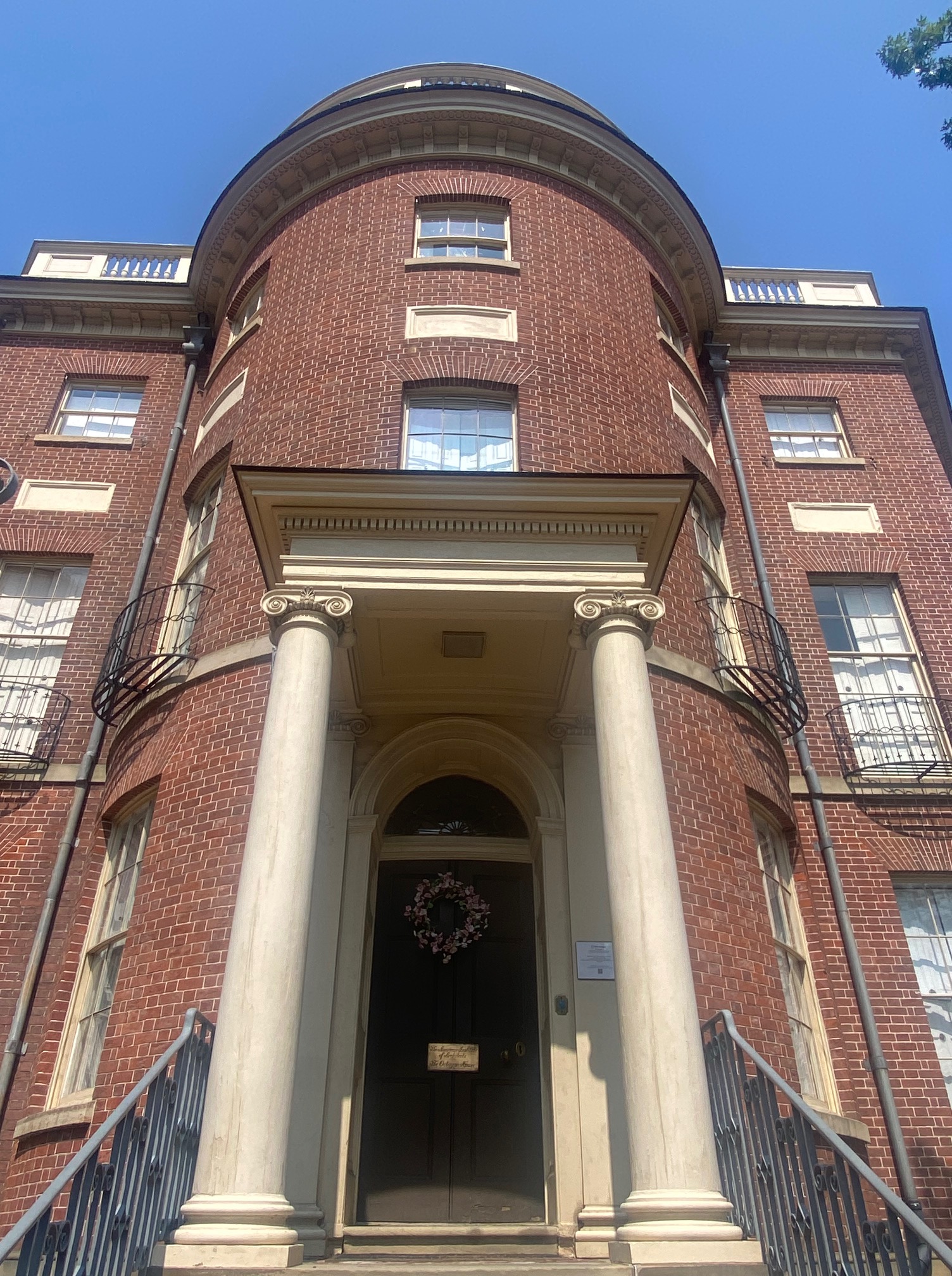
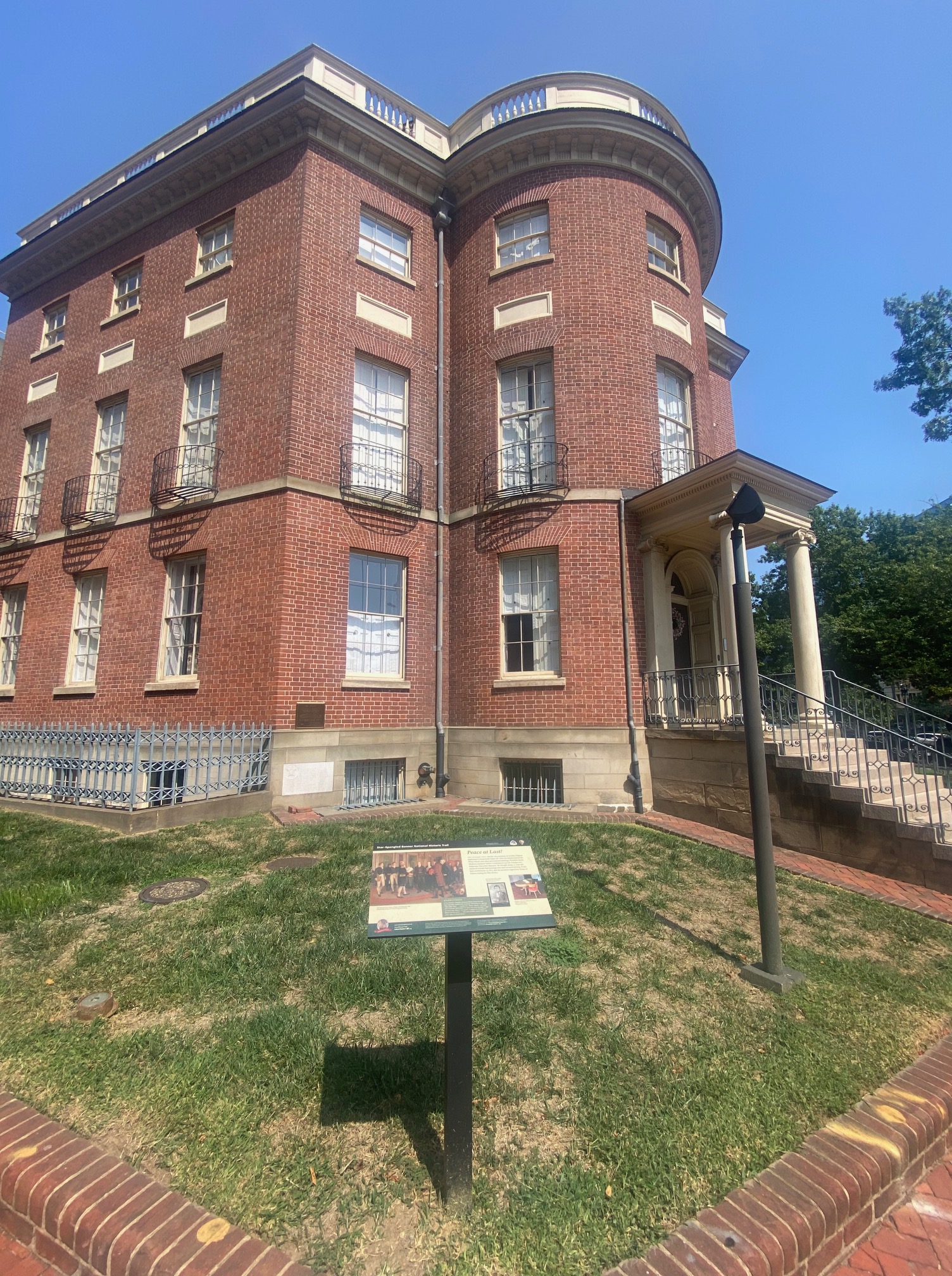
After returning to Washington, the Madison’s took residence here, in the house of John Tayloe III. On September 8, 1814, the Madison family moved in and in an upstairs room, the president received the peace treaty negotiated in Ghent, Belgium. He ratified the treaty in the upstairs study on February 17, 1815. When the Madison family vacated the quarters, six months after moving in, Tayloe received $500 in rent from their stay.
War!

On this date, in 1812, President James Madison, the fourth president of the United States of America, signed declared war on Great Britain, to go into effect the next day. This is the date Madison signed the measure into law, after sending it to Congress on June 1.

The wording, in its entirety, is below:

BY THE PRESIDENT OF THE UNITED STATES OF AMERICA
A PROCLAMATION
Whereas the Congress of the United States, by virtue of the constituted authority vested in them, have declared by their act bearing date the 18th day of the present month that war exists between the United Kingdom of Great Britain and Ireland and the dependencies thereof and the United States of America and their Territories:
Now, therefore, I, James Madison, President of the United States of America, do hereby proclaim the same to all whom it may concern; and I do specially enjoin on all persons holding offices, civil or military, under the authority of the United States that they be vigilant and zealous in discharging the duties respectively incident thereto; and I do moreover exhort all the good people of the United States, as they love their country, as they value the precious heritage derived from the virtue and valor of their fathers, as they feel the wrongs which have forced on them the last resort of injured nations, and as they consult the best means under the blessing of Divine Providence of abridging its calamities, that they exert themselves in preserving order, in promoting concord, in maintaining the authority and efficacy of the laws, and in supporting and invigorating all the measures which may be adopted by the constituted authorities for obtaining a speedy, a just, and an honorable peace.
In testimony whereof I have hereunto set my hand and caused the seal of the United States to be affixed to these presents. Done at the city of Washington, the 19th day of June, 1812, and of the Independence of the United States the thirty-sixth. By the President:
JAMES MADISON.
JAMES MONROE,
Secretary of State.

*Transcript courtesy of the Miller Center at the University of Virginia.*

Lost and Found: The Cycles of Loss and Recovery of Brooklyn’s Prison Ship Martys Monument and the Men It Commemorates

Emerging Revolutionary War welcomes a guest post from historian Keith J. Muchowski. Keith is a librarian and professor at New York City College of Technology (CUNY) in Brooklyn. He blogs at thestrawfoot.com.

The plaque dedicated King Juan Carlos I in June 1976 today tucked in a corner of the visitor center. Courtesy Author

King Juan Carlos I arrived in Brooklyn’s Fort Greene Park on Saturday June 5, 1976 to great fanfare. The thirty-eight-year-old monarch had ascended to the Spanish throne just seven months previously, two days after the death of Francisco Franco. The new leader was determined to reform his nation after three and a half decades of strongman rule. Juan Carlos I’s ancestor, King Carlos III, had helped the colonists achieved their independence nearly two centuries previously with his supply of money, matériel, and men. Many of those Spaniards made the ultimate sacrifice; well over one hundred of them alone perished in British prison ships moored off Brooklyn Wallabout Bay during the war.[i] Now King Juan Carlos I was in the outer borough to recognize them, dedicate a tablet to his fallen countrymen, and help his American hosts celebrate the bicentennial of their independence. The entombed Spaniards were among the over 11,500 men commemorated by the Prison Ship Martyrs Monument. The king’s visit in the mid-1970s was the latest in a series of public commemorations of the prison ship dead dating back over a century and a half. Some of the institutions that did so much to recognize the martyrs, such as the Society of St. Tammany, are today long gone. Others however very much remain. The Society of Old Brooklynites, a civic organization founded in 1880 when Brooklyn was still an independent municipality, has been holding events since the late nineteenth century.

Continue reading “Lost and Found: The Cycles of Loss and Recovery of Brooklyn’s Prison Ship Martys Monument and the Men It Commemorates”

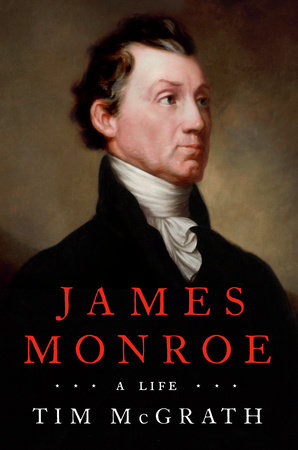
Review: James Monroe: A Life by Tim McGrath (New York: Dutton, 2020)

Mcgrath Bio of MonroeTim McGrath has written two award-winning winning books about the early history of the United States Navy: Give Me a Fast Ship and John Barry.  For his third book, he switched gears to tackle an oft-overlooked soldier, lawyer, politician, and president: James Monroe.  In what will likely be the definitive Monroe biography, McGrath tackles the entirety of our fifth president’s life.  Born in 1758, Monroe joined the American army in the Revolution’s early days until he was sidelined with a serious wound at Trenton.
As McGrath tells it, the story of Monroe’s early life was a constant search for a mentor and sponsor, which eventually landed him on William “Lord Stirling” Alexander’s staff.  It was enough to bring him the attention and lukewarm friendship or support of many of the army’s leading lights and the country’s future leaders, but not enough to really launch his career.  Eventually, he landed a legal apprenticeship with Virginia’s Governor Thomas Jefferson.  It changed Monroe’s life, giving him a path forward professionally, politically, and intellectually.

Continue reading “Review: James Monroe: A Life by Tim McGrath (New York: Dutton, 2020)”

ERW Weekender: In the Footsteps of James Madison

Emerging Revolutionary War welcomes guest historian Kate Bitely 

In the Foot Steps of James Madison.

A view of the front yard of Montpelier
A view from the front yard of Montpelier (author collection)

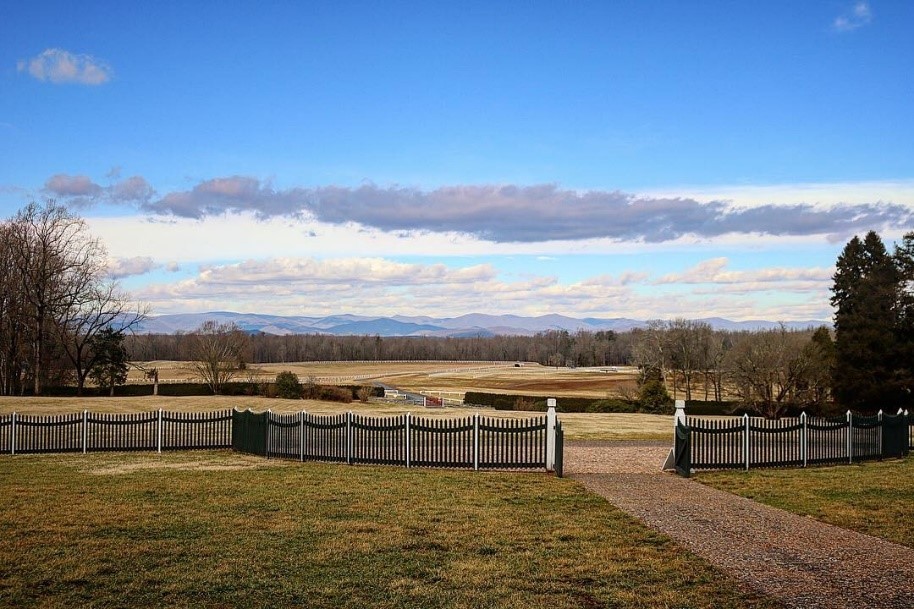
Spring is finally here in Virginia and if you are looking for a place to explore that offers a great outdoor experience, get in the car and head to Montpelier, in Orange Virginia. James Madison’s plantation home offers visitors a glimpse of what life was like in colonial America.   Be sure to start your trip with the feature film in the welcome center that provides highlights of Montpelier’s lengthy history dating back to the mid 1700’s.  The preserved property has something to offer everyone including hikes, gardens, and a breath-taking view of the blue ridge mountains. The grounds are filled with opportunities to learn about our nation’s early history and the impact it still has on our country today. Continue reading “ERW Weekender: In the Footsteps of James Madison”

Independence and Contradiction: Our Founding Slaveholders

Emerging Revolutionary War welcomes guest historian Michael Aubrecht. A biography of Mr. Aubrecht is attached below. 

In 2011 an exhibit titled “Slavery at Jefferson’s Monticello: Paradox of Liberty” started running at the Smithsonian’s American History Museum from January 27, 2012 – October 14, 2012. This somewhat controversial exhibition explored slavery and enslaved people in America through the lens of Jefferson’s plantation and was a collaborative effort between the Thomas Jefferson Foundation at Monticello and the African American History and Culture Museum in Washington DC. It helped to instigate public discussion about the dichotomy between the Founders and freedom. The paradox of course is that Thomas Jefferson drafted the Declaration of Independence and called slavery an “abominable crime,” yet he was a lifelong slaveholder. The exhibition provides a glimpse into the lives of 6 slave families living at Monticello and reveals how the paradox of slavery in Jefferson’s world is relevant for generations beyond Jefferson’s lifetime.

founders-presidents-slaveowners
Founders, presidents, slave-owners

Continue reading “Independence and Contradiction: Our Founding Slaveholders”

Standing in the Room Where American Was Born

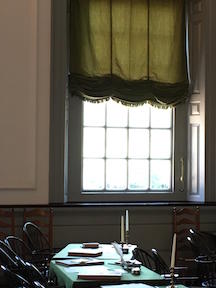
Indep Hall WindowAs I stood in Independence Hall, in the room where the Founders debated the Declaration of Independence, I suddenly started thinking of the opening scene from the musical 1776, when John Adams cries for independence while everyone else complains about either the heat or the flies. “Won’t somebody open up a window?” one of the delegates pleads. “Too many flies!” others respond, shouting him down. Adams is advocating the most lofty of ideas but everyone else is mired in their own personal discomfort. What a great metaphor.
To stand in that room where Adams and the other delegates worked was a privilege. The tour group consisted of 50 people or so, so there was no opportunity for quiet reflection. There was no sublime, transcendent moment of awe or epiphany. The tour guide could not even tell me which table Adams sat at except “toward the back over here somewhere.”  Continue reading “Standing in the Room Where American Was Born”

“The Pox and the Covenant: The Curious History of Science and Religion in Colonial Boston”

Looking for something to do midweek? Enjoy a Wednesday night at Shenandoah University and learn about an aspect of early American history.

17022231_10158247490885542_2027414006029973125_n
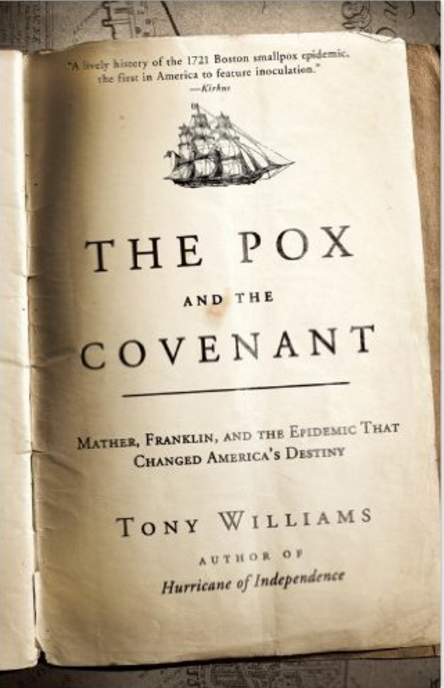
“The Pox and the Covenant” by Tony Williams

If in the lower Shenandoah Valley or can make the trek, join Shenandoah University’s History Fellows in welcoming Tony Williams, senior fellow at the Bill of Rights Institute, for a guest lecture.

Author of five books on the Early American history and holds a Bachelor of Arts in history from Syracuse (NY) University and a Master of Arts in United States history from Ohio State University. After a successful 15-year teaching career at the middle and high-school level, he became the Program Director at the Washington, Jefferson, & Madison Institute in Charlottesville, Virginia in 2014.

The lecture will be held at Henkel Hall, Hester Auditorium and will begin at 7 p.m. Williams will have his books for sale after the talk, including the title that bears the lecture’s name.

For information and questions, please contact Jonathan Noyalas, Chair of the Shenandoah University’s History Fellows at (540)-665-4501 or jnoyalas01@su.edu.

If interested in other events at Shenandoah University of this nature, check out the link here.

James Monroe at War

RevWarWednesdays-header


Part Two

With an excess of officers in the Continental Army and little prospect of getting a field command, James Monroe resigned his commission in 1779.  He became a Lieutenant-Colonel of Virginia forces, but was unable to recruit enough men to form a new regiment.  In 1780 he went to North Carolina as a military observer for Governor Thomas Jefferson, with whom he had begun the study of law. Continue reading “James Monroe at War”