Kentuckians knew 1777 as the “Bloody Sevens” due to the severity and frequency of Native American attacks. Those raids were difficult in the spring, but only intensified after June, when Henry Hamilton, a Detroit-based lieutenant governor of Quebec, executed his orders to actively promote and support Native American offensives across the Ohio River. In particular, war parties from the Ohio and Great Lakes Indian nations allied with Britain crossed the Ohio and struck the region’s three largest towns: Harrodsburg, Boonesborough, and St. Asaph’s/Logan’s Fort. Of the three, the last was the smallest by far, and yet it was the scene of some of the year’s most dramatic moments.
In the spring of 1775, Benjamin Logan led a surveying party into Kentucky and established a “town” of sorts—mostly surveyor’s huts—that they dubbed St. Asaph’s. For his part, Logan built a log cabin and planted a corn crop that later established his land claim. Logan’s group did not remain long as Kentucky was already under attack, but he and several others, including his family, eventually returned in March 1776.[1] A raid on Boonesborough that summer prompted the St. Asaph’s residents to begin fortifying their town. Logan’s family left for the additional safety of Boonesborough, but he remained behind with several enslaved people to continue working on the fort.
Fortified towns were typically established by building two lines of cabins in parallel lines with their fronts face one another. Windows were limited to the front and perhaps the sides, but the rear wall was solid with narrow firing slits. Gaps in between cabins were then closed by digging a trench and standing cut posts in them upright, then filling in the trench and creating a wall. It was a fast means of quickly building a fort. More robust defenses would include blockhouses at the corners with overhanging rooms on a second story enabling defenders to fire down and along walls. There would be a substantial gate on one side and then perhaps a sally port or two along the walls or in a corner blockhouse. The common area between the rows of cabins would often have common buildings and facilities, such as a smithy, herb gardens, a powder magazine, etc. Several buildings, ranging from cabins to storehouses and horse stalls, might remain outside the walls. Residents of the community would then retreat into town when concerned about attack. Logan moved his family back to the fortifying town in February.[2] Logan took the additional step of digging a trench to a nearby spring to create a secure water supply. He then covered it and it was sometimes referred to as a tunnel, even though it was not completely underground.[3] The fort at St. Asaph’s, now more widely known as Logan’s Fort, was completed just in time.
The summer of 1776 was tense on the Kentucky frontier. Since the spring, Shawnee raids from north of the Ohio had increased, with tribesmen raiding the white settlements with the intention of driving the settlers east, back across the mountains.
By the late spring, hardly more than 200 Americans remained in Kentucky, most forting up in the settlements south of the Kentucky River at Harrodsburg, Logan’s Station, and Boonesborough as war parties ranged nearby. Years later, an old settler remembered the rancid conditions of long confinements in “a row or two of smoky cabins, among dirty women and men with greasy hunting shirts.” By the summer, conditions in the forts were almost unbearable as supplies of salt and meat began to run low.
On the quiet Sunday afternoon of July 14, 1776, 13-year-old Jemima Boone, daughter of frontiersman Daniel Boone, slipped out of the log gates of Boonesborough with her friends Elizabeth (Betsy) and Frances (Fanny) Calloway. Tired of the confinement of the fort, the three girls untied the lone canoe of the settlement and pushed out into the Kentucky River for an old-style joy ride. Jemima would remember years later that her father had warned her to stay near the cabins and never cross to the other side of the river.
Betsy Calloway, 16, guided the canoe but it was soon caught up in the current and taken downstream toward the northern bank. A small mixed war party of Shawnees and Cherokees were watching the settlement from the woods across the river. They had been in the area for at least a week when they spotted the girls in the canoe. As the craft got close to the shore a warrior jumped into the river and grabbed the towline. Understanding immediately the danger they were in all three girls began to scream. The warriors brought the canoe to shore and quickly made signs to the girls of what would happen if they continued screaming. But the sounds had already alerted the settlers in the fort.
It was Sunday, the Sabbath and, as was his normal custom, Daniel Boone was lying down for his Sunday afternoon nap when he heard the commotion from out in the fort. Running out of his cabin in his bare feet, Boone joined with Richard Calloway, father of Betsy and Fanny, and several other men of the settlement as they eventually made their way to the opposite shore of the river and began tracking the war party as it made its way towards the crossing of the Licking River at the upper Blue Licks.
One of the Cherokee men in the party was named Scolacutta but known to the Americans as Hanging Maw. He knew Daniel Boone and his family and spoke a bit of English. He recognized Jemima as Boone’s daughter. Hanging Maw laughed at the joke they were playing on old Boone, Jemima remembered many years later, and confirmed they were headed for the Shawnee towns north of the Ohio. If the party managed to get across the big river, the rescue of the girls would most likely become impossible. As they were forced along the trail, the three girls dug their heels into the earth or dropped bits of material from their clothing; anything to give signs to anyone who may be following that they were on the right path.
By the morning of the second day, Boone and his party were roughly 10 miles behind the kidnappers. Now with a pretty good idea of where the war party was heading and understanding that, continuing to follow the tracks would slow them down considerably, Daniel Boone made the decision to break from the trail and speedily head for the Blue Licks. It was certainly a gamble but the men with Boone trusted his judgment. The Kentuckians moved out, setting a jogging pace.
As they got closer to the war party, the rescuers began finding the signs left for them by the kidnapped girls. They also came across muddled waters at a creek crossing, a dead snake along the trail and finally the carcass of a recently butchered buffalo calf. They knew they were getting close. Boone figured the warriors would stop to cook at the next water they came across. At a branch known today as Bald Eagle Creek, east of the current town of Sharpsburg, KY, the trail ended. Boone divided his party, with four men going up stream and four heading down.
After two days of hard travel with no sign of pursuit, the warriors began relax a bit. They would soon cross the Licking River and link up with other war parties so they began feeling confident. They made camp and began to roast the buffalo meat. The terrified girls were exhausted by being on the march. The camp was in a small, open glen. As the warriors lolled about the girls were sitting near the cook fire. Suddenly, Jemima Boone heard a noise in the brush. The sound caught the attention of one of the Shawnees who looked up but, seeing nothing, returned to his work. Glancing up along the nearby ridge, Jemima suddenly caught sight of her father. The girl remembered he was “creeping upon his breast like a snake.” Around 100 yards or so apart, the father and daughter locked eyes. Boone gave a quick signal for the girl to remain quiet.
The rest of Boone’s party were gathered up on the ridge when, in a fit of excitement, one of them fired his rifle down into the camp. Before she heard the shot, Fanny Calloway saw blood spurt from the chest of the warrior standing next to the campfire. He managed to hobble off into the brush. “That’s Daddy!” Jemima cried as she and the other girls hit the ground with shots filling the air from the rescue party above. Boone’s party rushed down into the camp among the startled warriors. Those tribesmen not hit by rifle fire managed to escape into the woods. All at once the terrible ordeal was over, for both father and daughter. “Thank Almighty Providence, boys,” Boone said, “for we have the girls safe. Let’s all sit down by them now and have a hearty cry.” Jemima Boone would long remember that “there was not a dry eye in the company.”
The story of the kidnapping and rescue would be retold in the Boone and Calloway families for generations. In the 19th century, historian Lyman Draper collected accounts of the story from at least forty people. This would become one of the most famous episodes in the life of Daniel Boone and provide the inspiration for author James Fenimore Cooper in his novel “The Last of the Mohicans”.
The American Revolution in the east has its share of founding fathers while war in the west has its share of legendary characters. Few could claim to be both. Isaac Shelby was born in western Maryland in 1750 and migrated with his family farther south and west in 1770, near Bristol Tennessee. Shelby in Lord Dunmore’s War and became a surveyor for North Carolinian Richard Henderson’s Transylvania Company, created to secure land west of the Appalachians just before the American Revolution. (Daniel Boone was the best known of Henderson’s surveyors).
When the Revolution broke out, Shelby served first with the Virginians and then accepted roles handling logistics for Virginians, Continentals, and North Carolinian units operating along the frontier. Organizational structures were fluid along the Appalachians, more often centered around communities and available manpower than formal state boundaries, and Shelby participated in a variety of actions against British and Loyalist forces in North and South Carolina. The personal nature of the partisan conflict eventually led Shelby and others on the frontier, including John Sevier, to organize the so-called “Overmountain Men” in a pursuit of Loyalists led by British Major Patrick Ferguson. The two sides eventually clashed in the Battle of King’s Mountain, a resounding victory for American forces in October 1780.
In 1774, frontiersman James Harrod led a surveying party from western Pennsylvania to the region south of the Ohio River known as Kentucky. The group laid out a small fort, started their first buildings, and staked out claims to larger farms beyond the town’s walls but left the area with the start of Dunmore’s War between Virginia and the Shawnee Native Americans living north of the Ohio.
Old Fort Harrod Interior
Harrod returned in the spring of 1775 with a group of settlers. Greater numbers made a larger fort and town necessary. Harrod’s return to the area coincided with the outbreak of the American Revolution, which quickly led renewal of intense fighting between Native Americans and whites living on the American frontier. British support for the Native Americans, particularly after 1777, made Kentucky an extraordinarily dangerous place to live. Together with Boonesborough and Logan’s Station, Harrodstown, also known as Harrodsburg, constituted the bulk of white settlement in Kentucky during the war’s early years.
“[T]he poor Kentucky people, who have these twelve months past been confined to three forts, on which the Indians made several fruitless attempts. They [the Indians] have left us almost without horses sufficient to supply the stations, as we are obliged to get all our provisions out of the woods. Our corn the Indians have burned all they could find the past summer, as it was in cribs at different plantations some distance from the garrisons, & no horses to bring it in on. At this time we have not more than two months bread,–near 200 women & children; not able to send them to the inhabitants; many of those families are left desolate, widows with small children destitute of necessary clothing.”
Despite continuing violence on the frontier, the prospect of land and escaping the war in the east led immigration into Kentucky to outpace population outflows while military success under George Rogers Clark ensured that the frontier settlements survived and increased.
Harrodsburg became the capital of Kentucky County when Virginia asserted ownership of the area and is still the seat of Mercer County. To commemorate Kentucky’s frontier history, the state established Old Fort Harrod State Park, which encompasses a recreated fortified town complete with period buildings, furnishings, and crops. Living historians and artisans demonstrate the 18th century skills needed to survive and flourish far from the eastern seaboard. Several exhibits help explain the frontier experience before, during, and after the American Revolution. Additionally, the park incorporates several later buildings as a museum of local history and monuments to George Rogers Clark and Abraham Lincoln’s family.
Old Fort Harrod exterior curtain wall with blockhouse
Jack Jouett was Thomas Jefferson’s Paul Revere, most famous for riding pell mell through the night to warn Virginia’s governor in 1781 that Banastre Tarleton and his men were on their way to Charlottesville to capture the governor and Virginia’s General Assembly. Given Tarleton’s reputation for speed, surprise, and route, Jouett had to ride down back roads and country lanes with low hanging-trees, cattle paths, and foot paths to get ahead of the British officer with enough time to warn Virginia’s government-in-exile. https://emergingrevolutionarywar.org/2016/08/02/jack-jouett-midnight-rider-of-the-south/ Unlike Revere, whom the British famously captured, Jouett arrived in Charlottesville with enough time for Jefferson and most legislators to escape.
Jack Jouett House with earlier stone kitchen visible at the rear
It’s a great story and Jouett makes it into standard biographies of Jefferson, histories of the war in Virginia, or campaign studies of Cornwallis and Tarleton. But, Jouett’s story doesn’t end there. Like many veterans—Jouett served in the Virginia militia—he headed west, over the Appalachians, in search of land and new opportunities. The next year found Jouett in Kentucky County, Virginia. Despite the bloodletting that went on in Kentucky during the Revolution, families continued to flock there. Shortly after his arrival, he married, eventually fathering twelve children. Given Kentucky’s exploding growth, the Virginia legislature divided Kentucky County into Lincoln, Jefferson, and Mercer counties and the people of Lincoln county elected Jouett as their representative in the Virginia General Assembly. But, at heart, he remained a Virginia farmer, raising crops and livestock. Sadly, he continued the practice of slavery, eventually owning twenty-five people.
Historical Marker at Jack Jouett House in Versailles, Kentucky
In 1797, Jouett and his family bought a 530-acre farm in Woodford County and built one of Kentucky’s earliest brick homes, a step up from the log and stone buildings many settling the frontier built on their arrival. Reflecting the period, it adopted design features from Virginia with a central hall and parlor and bedrooms in a half-floor attic. The building included an earlier stone-walled kitchen built in the 1780s. Jouett eventually moved away to Bath County in 1809 and died in 1822. The house 1797 house, however, remains and was restored between 1972-1978 and opened for public tours in 1978. Many of the interior contents are from the period and a small museum telling Jouett’s story in Virginia and Kentucky is in a separate building nearby. It is not far from Lexington or some of Kentucky’s other Revolutionary War sites like Harrodsburg or Boonesborough. It can be visited at:
Jack Jouett House Historic Site 255 Craig’s Creek Road Versailles, Kentucky 40383 (859) 873-7902
It is best to visit the location’s website (http://jouetthouse.org) or call ahead for operating hours.
In the summer of 1780, Captain Henry Bird crossed the Ohio River with some 800 Native Americans from various British-allied tribes and two companies of soldiers from Detroit (roughly 50 Canadians and Tories and a mixed group of regulars from the 8th and 47th regiments) to invade Kentucky. More importantly, he brought two pieces of artillery, a three pounder and a six pounder. It was one of the largest and most substantial attacks into Kentucky during the American Revolution.
Bird’s goal was the Falls of the Ohio (today’s Louisville), which was critical to the American war effort on the frontier due to its critical position on the Ohio River. Bird rendezvoused with the great bulk of the Native Americans at the confluence of the Great Miami and Ohio Rivers, (west of today’s Cincinnati) to discover that they had other plans. Attacking fortified areas was less appealing than raiding small settlements and isolated farms, where the Indians might secure booty and terrorize the locals into abandoning Kentucky. Constituting the vast majority of the army, the Native Americans won out.
Recently I had the chance to travel through Lexington, Kentucky en route to western Kentucky and to see the sites associated with the Fort Donelson campaign in the American Civil War.
In Frankfurt, Kentucky, Simon Bolivar Buckner, the Confederate general who surrendered the Tennessee fort, is buried.
Little did I know that a stone’s throw away, literally, is the grave of Daniel Boone. A fascinating find, if I would have researched a little more, I probably would have realized who all was buried in that cemetery in the state capital of Kentucky.
There, on a bluff, above the Kentucky River, lies Daniel and his wife Rebecca. The great frontiersman and pioneer who took settlers through the Cumberland Gap. One of the first folk heroes of American history.
Never know what you may stumble upon, when on a history excursion!
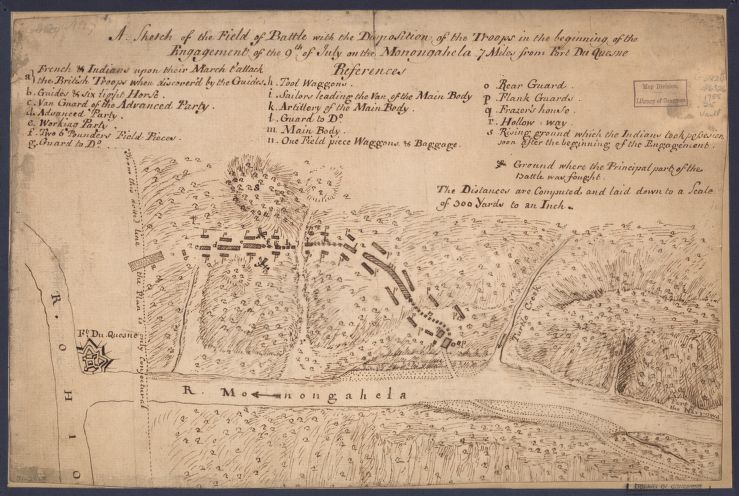
Nicholas Cresswell left Alexandria for the Illinois Country on March 16, 1775, his correspondence as yet unknown to the local Committee of Safety. The Ohio River served as a highway to the west, so he headed for its origin at Pittsburgh. Along the way, he stopped to visit the battlefield where French and Indian forces defeated Major General Edward Braddock in July, 1755. Cresswell and his traveling companions found “great numbers of bones, both men and horses. The trees are injured, I suppose by the Artillery…the greatest slaughter seems to have been made within 400 yards of the River…We could not find one whole skull, all of them broke to pieces in the upper part, some of them had holes broken in them about an inch diameter, suppose it to be done with a Pipe Tomahawk.”[i]
Initial Dispositions of the Battle of the Monongahela. Cresswell walked the battlefield on his way to Pittsburgh in 1775. (Library of Congress)




 Emerging Revolutionary War Era