On this date 167 years ago, the infamous siege of Fort William Henry raged along the southern shore of Lake George, New York. For nearly a week the British and Colonial garrison inside the fort and outside its walls had endured through a near hopeless situation. Casualties had mounted, guns and mortars had burst from incessant firing, and the French siege lines had crawled to within 150 yards of the northwest bastion. Reinforcements were not coming to relieve the defenders. The following day, Lieutenant Colonel George Monro had little choice but to surrender his force under honorable terms to the French commander, General Montcalm. On August 10, the column marched out of the fort and nearby entrenched camp in route to Fort Edward. French-allied Indians fell upon the soldiers, and the women and children who accompanied them, and the “massacre” of Fort William Henry ensued.
The following letter with news relating to the siege, was written to George Washington on August 8, 1757. The author was Beverley Robinson, a Virginian who through marriage inherited a large swath of land in the Hudson Highlands of New York. During the Revolution, Robinson remained loyal to the Crown and was made colonel of the Loyal American Regiment in 1777. He was directly involved in the plot to turn Benedict Arnold. Through reasons not clear, Robinson and Washington became acquainted enough beforehand that during the French and Indian War, the former wrote the young Virginia soldier frequently.
“New York 8th Augt 1757
Dr Sir
The inclosed Lettrs came to my hands Yesterday by a Vassill from Halifax, they will I suppose give you all the News from that Quarter. Except the Arriva⟨l of⟩ the Highlanders wh. has been since they were wrote, all well and in good Order Lord Loudoun had not Left Halifax a fortnight ago.
we are now under the greatest apprehensions for fort Wm Henry having Certain Accots that it is Besieged by a Large Body of French & Indians & Mr Mont Calm himself at the head of them. a fryday Last the Express came away from fort Edward & they were then Very hotly Engaged—our Liut. Governer went up Last week to forward the Militia. Genl [William] Johnson was gone up with two thousand Militia & 100 Indians, and the Militia was going up from the adjacent Counties. Col. Young Command at Wm Henry he had Just got into that place with a Reinforcement of 1000 men. we hope the Best. I am Dr Sir Yr Humble Sert
[1] “To George Washington from Beverley Robinson, 8 August 1757,” Founders Online, National Archives, https://founders.archives.gov/documents/Washington/02-04-02-0239. [Original source: The Papers of George Washington, Colonial Series, vol. 4, 9 November 1756 – 24 October 1757, ed. W. W. Abbot. Charlottesville: University Press of Virginia, 1984, pp. 367–368.]
On this date 266-years ago, the infamous Massacre at Fort William Henry took place along the southern shore of Lake George, New York. After a week-long siege by the Marquis de Montcalm’s army of French Regulars, Canadians, and Native Allies, the British and Provincial garrison inside and outside the walls of Fort William Henry capitulated. The terms of surrender that followed were more than honorable. British, Colonial Provincials (from Massachusetts, New Hampshire, New Jersey, and New York) and their camp followers would be allowed to withdraw, under French escort, to Fort Edward with full honors of war and were allowed to keep their muskets and a lone symbolic cannon. These men were not allowed to serve again for 18 months, and French prisoners were ordered to be turned over within the next three months.
On August 10, the column left the entrenched camp outside the fort (within modern-day Lake George Battlefield State Park) and entered the military road that would take them south to Fort Edward over a dozen miles away. What transpired next has been made famous by the novel and movie adaptations of James Fenimore Coopers The Last of the Mohicans. The French-allied Native Americans fell upon the column and the “Massacre” ensued. By the end of it, an estimated 185 men, women, and children had been killed, with countless others drug off in captivity.
Montcalm Trying to Stop the Massacre, 1877.
The British colonies were outraged. Those viciously attacked at the rear of the column were colonial provincials. The event became a rallying cry. What follows is a contemporary reaction from New York written in the wake of the Siege of Fort William Henry and reprinted in the Maryland Gazette on September 1, 1757. Its contents are extremely graphic in nature:
New-York, August 22
FORT WILLIAM HENRY, being on the third Instant besieged by a great Army of the French, was on the 9th Instant, after a vigorous Resistance, obliged to yield to the superior Force of the Enemy. Thus far is certain; but as to some Circumstances attending what follows, we wait for Confirmation. What at present is generally received among us, as Truth is, That the Enemy consisted of at least Eight Thousand Men; some make the Number much great, and carry it even to Fourteen or Fifteen Thousand: That the greatest Part were REGULAR TROOPS, to these were added about a Thousand FRENCH INDIANS, and that the Rest of their Army were CANADIANS. That our Garrison consisted of between two and three Thousand: That they sustained the Siege till they could hold no longer, and had burst the greatest Part of their Cannon, and spent almost all their Ammunition. How many of the Garrison were lost in the Siege, is not yet known (some say about One Hundred) nor the Number of the Enemy that were slain (but it is said about fourteen or fifteen Hundred:) That the Fort submitted upon a Capitulation, with Leave to march out with their Arms and Baggage, some Ammunition, one Piece of Cannon, and all the Honours of War. That the French IMMEDIATELY after the Capitulation, MOST PERSIDIOUSLY, let their INDIAN BLOOD-HOUNDS loose upon our People; whereupon a few ran off with their Arms, and light Cloathing that they had upon their Backs during the Siege, and were pursued by the Indians six or seven Miles on their Way to Fort-Edward; all the rest were despoiled of their Arms;—The most were stripped stark-naked; many were killed and scalped, Officers not excepted. All the English Indians and Negroes in the Garrison were seized, and either captivated or slain. The Throats of most, if not all the Women, were cut, their Bellies ripped open, their Bowels torn out, and thrown upon the Faces of their DEAD or DYING Bodies; and ‘tis said, that all the Women are murdered one Way or other: That the Children were taken by the Heels, and their Brains beat out against the Trees or Stones, and not one of them saved. Some of the Fugitives that reached New-York on this Day, affirm this, as what they saw, in the whole, or in great Part, executed before they escaped: The Report of such Cruelty and barbarity could hardly be believed, were we not assured of the terrible Massacre of several Hundreds of General BRADDOCK’s wounded men; of whom we hear not of one that survived the Carnage; were we not ALSO assured of the Murder of all the Sick and Wounded of the Garrison at Oswego, not withstanding the previous Capitulation.
‘Tis certain that the Growth of the British Colonies has long been the grand Object of FRENCH ENVY; and ‘tis said that their Officers have Orders from their Superiors, to check it at all Events, and to that End, to make the present War as bloody and destructive as possible! ‘Tis evident, that all their Measures tend the Way. Who can tell, that One of the Two Hundred that fell into their Hands in the last Month near Ticonderoga, has been spared? And is not every News-Paper still stained with the innocent Blood of Women and Children, and of unarmed Sufferers, who were plowing their Land, or gathering their Harvest, on our Frontiers?
To what a Pitch of Perfidy and Cruelty is that French Nation arrived! Would not an ancient Heathen shudder with Horror, on hearing so hideous a Tale! Is it the MOST CHRISTIAN KING that could give such Orders? Or could the most savage Nations ever exceed such French Barbarities! Besides this, was it ever known in the Pagan World, That Terms of Capitulation were not held inviolably sacred!
Surely, if any Nation under the Heavens was ever provoked to the most rigid Severities in the Conduct of a War, it is ours!—It is hard for an Englishman to kill his Enemy that lies at his Feet begging his Life: But will it not be STRICTLY JUST, and ABSOLUTELY NECESSARY, from henceforward, that we (for our own Security and Self-preservation, and to prevent the further shedding on innocent Blood) make some severe Examples of our inhuman Enemies when they fall into our Hands? Will not our armed Men be obliged for the future to reject all Terms of Capitulation, and not to as Quarter; but on the contrary, to fell their Lives as dear as they can! CONSIDER OF IT, my Countrymen, TAKE ADVICE, AND SPEACK YOUR MINDS….
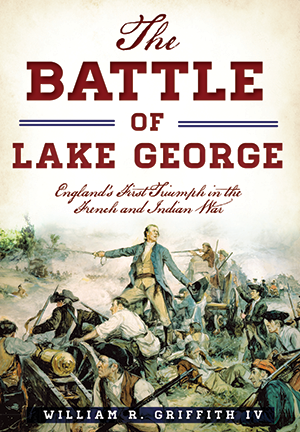
To usher in the month of May, Emerging Revolutionary War returns to the French and Indian War for a discussion with author and historian Billy Griffith on his book, “The Battle of Lake George: England’s FirstTriumph in the French and Indian War.
On September 8, 1755, two armies clashed along the southern shore of Lake George in New York’s Adirondack Mountains. The battle between William Johnson’s force of colonial provincials and Mohawk allies and Baron de Dieskau’s French and Native American army would decide who possessed the lower part of the strategic water highway system that connected New York City with Quebec.
Join ERW historian Billy Griffith for a discussion about this crucial event in the early stages of the French and Indian War that can be considered one of the first true “American” victories against professional foreign troops. We look forward to you joining us, at 7 p.m. EDT on our Facebook page for the next historian happy hour.
With the turkey eaten, Black Friday shopping completed, and a slate of American football watched, and prior to cyber Monday beginning, Emerging Revolutionary War invites you to tune in for a historian happy hour. This week “Rev War Revelry” returns to the French and Indian War and welcomes as guests Lake George Battlefield Park Alliance President John DiNuzzi and the Board of Trustee Member Lyn Hohmann.
The discussion will entail their organizations effort to preserve and interpret one of the America’s most historical places and hallowed ground.
“The Lake George Battlefield Park was the scene of major battles during the French and Indian War and American Revolutionary War, and the home of Fort George, a key anchor of first British and then American military strategies in those world-changing conflicts. Enveloped by the natural beauty of the Adirondack Mountains in the town of Lake George, the site’s history reflects its prominence as part of the crucial Hudson River-Lake George-Lake Champlain corridor in the mid-to-late 18th Century.”
The Lake George Battlefield Park Alliance’s effort to commemorate the ground is so invaluable to telling the overall story. Joining the two guest historians and preservationists will be ERW historian Billy Griffith who is an author on a book with the HistoryPress on the actions around Lake George.
Grab that last remaining beer, tune in to our Facebook page this Sunday, at 7 p.m. EDT, and hear the amazing work being done in New York. How else would you want to round out the holiday weekend?
On this date in 1775, an early victory was secured for the American cause along the western shore of Lake Champlain in New York. Led by Colonel Benedict Arnold and Ethan Allen, over eighty men surprised and overwhelmed Fort Ticonderoga’s garrison, capturing the strategic stronghold and much needed supplies and cannon for the Americans. On May 22, the Pennsylvania Packet reported on the news received from the north:
On Wednesday evening last arrived here, John Brown, Esq; from Ticonderoga, express to the General Congress, from whom we learn, that on the beginning of this instant, a company of about fifty men, from Connecticut, and the western part of Massachusetts, and joined by upwards of one hundred from Bennington, in New-York government, and the adjacent towns, proceeded to the eastern side of Lake Champlain, and on the night before the 11th current, crossed the Lake, with 85 men, (not being able to obtain craft to transport the rest,) and about daybreak invested the fort, whose gate, contrary to expectation, they found shut, but the wicker open, through which, with the Indian war whoop, all that could, entered one by one, others scaling the wall on both sides of the gate, and instantly secured and disarmed the sentries, and pressed into the parade, where they formed the hollow square; but immediately quitting that order, they rushed into the several barracks on three sides of the fort, and seized on the garrison [commanded by Captain William Delaplace], consisting of two officers, and upwards of forty privates, whom they brought out, disarmed, put under guard, and have since sent prisoners to Hartford, in Connecticut. All this was performed in about ten minutes, without the loss of a life, or a drop of blood on our side, and but very little on that of the King’s troops.
In the fort were found about thirty barrels of flour, a few barrels of pork, seventy odd chests of leaden ball, computed at three hundred tons, about ten barrels of powder in bad condition, near two hundred pieces of ordnances of all sizes, from eighteen pounders downwards, at Ticonderoga and Crown Point, which last place, being held only by a corporal and eight men, falls of course into our hands.
By this sudden expedition, planned by some principal persons in the four neighboring colonies, that important pass is now in the hands of the Americans, where we trust the wisdom of the Grand Continental Congress, will take effectual measures to secure it….
The story of the capture of Fort Ticonderoga is as confusing as it is epic. Arnold, a Connecticut man, held a colonel’s commission to take the fort from the Massachusetts Committee of Safety, but he rode ahead to be part of the action without the men he was ordered to raise for the expedition; and Ethan Allen and his Green Mountain Boys of the Hampshire Grants were anti-New York and in search of their own glory after being asked to join a separately organized assault on the fort by Colonel Edward Mott sanctioned by Connecticut.
Ethan Allen demands the surrender of Fort Ticonderoga in this dramatized illustration. NYPL
The irony of all of this is that each plan formulated by those involved was done entirely without the advice or consent of New York, the very colony whose boundaries the fort was within. This occurred all during the commencement of the Second Continental Congress when New York was still weary of escalating hostilities with the King. Regardless of the awkward and unconcerted circumstances, it is undeniable that the fort’s capture helped secure victory for the Americans during the siege of Boston when fifty-eight pieces of ordnance were transported to assist General Washington in driving the British out of the city. Whether or not Allen heroically demanded Capt. Delaplace to surrender, “In the name of the Great Jehovah and the Continental Congress!” as is remembered (he almost definitely did not), is an entirely different question.
Billy Griffith, Kevin Pawlak, Rob Orrison and Mark Maloy at George Washington’s HQ in Newburgh, NY
Just over two weeks ago, ERW historians Billy Griffith, Phillip Greenwalt, Mark Maloy, Rob Orrison and Kevin Pawlak took a long weekend trip up to upstate New York. This was the fourth year that ERW authors have gotten together to take a “field trip” to see sites related to the French and Indian War and the American Revolution.
The trips not only serve as chances for research, but also to make new connections with public historians working in the American Revolution era. Along the way, we posted several videos from locations to give our followers an idea of some of the great places to visit out there. Again, our goal is to not just share this history, but to get people to visit these great sites.
Sites visited on the first day included the Stony Point Battlefield, where Americans under Gen. Anthony Wayne over ran a surprised British outpost. Reading about this action almost rings empty until you stand on the ground. Looking at the steep terrain that Wayne’s men climbed after traversing through a wetland, it is hard to imagine how the Continentals were able to take the British fort with so few casualties. Later that day we made a quick stop at George Washington’s headquarters in Newburgh. Here Washington lived from April 1782 to August 1783 and where he learned of the cease fire with the British, wrote his now famous circular letter to the colonial governors on his vision for the new government. Most importantly, here Washington responded to the Newburgh Conspiracy of his officers looking to possibly over throw the civil government. This site is also important in the history of the museum field as it is the first publicly owned historic site in the United States, opened in 1850 as a museum. A worthwhile nearby site, the New Windsor Cantonment site, preserves the camp site of the Continental Army during the 1782-1783 time period. Several of the buildings are rebuilt, including the Temple of Virtue, where Washington made his impassioned speech to his officers (with the assistance of his glasses) to diffuse their discontent with Congress.
The morning of the second day of the trip was spent visiting sites around Lake George, NY, including some much over looked French and Indian War sites. That afternoon sites along the upper Hudson including the site of the murder of Jane McCrea, Fort Edward and sites in Albany.
Park Interpreter Bob Hoar explains the terrain of the battlefield
Early Sunday morning, a quick trip to the Bennington Battlefield State Park was highlighted with a great personal tour by Bob Hoar. The battlefield is well preserved and interpreted. Bob also shared some of his research into reinterpreting the battlefield using first person accounts and the landscape. Again, understanding the landscape of these places creates such a better understanding.
The majority of the day on Sunday was spent at Saratoga National Historical Park, posting several Facebook Live videos from various points across the battlefield. Also a special visit to the surrender site in Schuylerville which was recently preserved and opened as a memorial by the Friends of Saratoga Battlefield. A great preservation victory that adds to the overall story of Saratoga.
One of the highlights of the trip took place on Monday, where we received a behind the
Curator Matthew Keagle gave a behind the scenes tour of Fort Ticonderoga’s amazing collection storage.
scenes tour by Fort Ticonderoga staff. We started by learning about the military interpretive program by Ron Vido, Military Programs Supervisor. Anyone who has visited Fort Ticonderoga knows about their quality interpretive staff and programs. Ron also shared with us their plans to slowly restore the Carillon Battlefield (1758), which will be a great addition to the understanding of North America’s bloodiest battle before the Civil War. That afternoon we were treated to a behind the scenes tour of Fort Ticonderoga’s collections storage by Curator Matthew Keagle. The Fort has been collecting 18th century items for nearly 100 years. Their collection is one of the largest collection of 18th century military artifacts in the United States. From a Continental knapsack to an original copy of Baron von Steuben’s drill manual, the collection on display is only a small portion of what the museum owns. Matt also shared the museum’s ongoing work to digitize their collection for the purpose of research. The day was capped off by a visit to one of the best preserved battlefields in the United States, Hubbardton. Fought as part of the Saratoga Campaign, this is Vermont’s only battlefield. The landscape at the foot of the Green Mountains is amazing and the viewsheds are near pristine. A nice state park and visitor center are there to help explain the events of July 7, 1777.
Thank you to all the people that assisted us in this trip and all the sites that were nice enough to host us. We will be posting more on the blog in the future focusing on some of the stories around these amazing sites. Again, we encourage you to take the time to visit all these places. History books are great, but there is no substitute for being in the footsteps of history
Our enthusiastic congratulations to Emerging Revolutionary War’s William Griffith on the release of his new book, The Battle of Lake George, England’s First Triumph in the French and Indian War. The book, published by Arcadia Publishing and The History Press, is now available for sale in books stores and online.
From the press release of the book,
“In the early morning of September 8, 1755, a force of French Regulars, Canadians and Indians crouched unseen in a ravine south of Lake George. Under the command of French general Jean-Armand, Baron de Dieskau, the men ambushed the approaching British forces, sparking a bloody conflict for control of the lake and its access to New York’s interior. Against all odds, British commander William Johnson rallied his men through the barrage of enemy fire to send the French retreating north to Ticonderoga. The stage was set for one of the most contested regions throughout the rest of the conflict. Historian William Griffith recounts the thrilling history behind the first major British battlefield victory of the French Indian War.”
Recently, ERW had the chance to sit down and talk with William about the book.
Q: This book fills an important gap in the French and Indian War, why has this campaign been overlooked for a publication like this?
W: I think that the Battle of Lake George has been overlooked for multiple reasons. When we think of the opening years of the French and Indian War we tend to immediately think of the events transpiring in western Pennsylvania (i.e. Jumonville Glen, Fort Necessity, and the Battle of the Monongahela), and do not really place Lake George at the forefront until the surrender of Fort William Henry in 1757. The significance of the Battle of Lake George has also been up for debate by historians, many whom believe it was a stalemate or inconsequential engagement, but in my opinion they are entirely incorrect. Because of these sentiments, when looking at the year 1755 the predominant focus has been placed on Braddock’s Defeat. Tragedy draws attention, and that is exactly what the Battle of the Monongahela was. Not only has scholarship relating to the Battle of Lake George been placed on the backburner to Edward Braddock, but it has also been pushed aside by the Siege of Fort William Henry and the subsequent “Massacre” – another tragic event. The Battle of Lake George is a prime example of history overshadowing history, and hopefully my book will be able to bring the event out of the darkness and into mainstream French and Indian War scholarship.
Q: Why did you choose the campaign to Lake George as your first book?
W: Even before I was born my family vacationed every year along the western shore of Lake George. When I was five years old my father brought me to my first historic site – Fort William Henry – and from then on my passion for history began to blossom. After that each trip to the lake during the summer caused my interest in upstate New York’s colonial history to grow and it soon became a big part of my life. There are some places on this earth that have the power to transport you to another time or place. Lake George is one of them. It truly forms a connection with people and for me, so did its history – especially the 1755 battle, which I could find no substantial work done on. In a quest for myself to learn more about the event, I determined in high school that when I was to write my first book it would be on the long neglected battle. I ended up writing it a lot sooner than I imagined I would.
Q:If there was only one thing a reader took away from this book, what would you want it to be?
W: An interest in the French and Indian War and a desire to learn more about this period in our history. If a visit to Amazon, the bookstore, or Lake George occurs after reading my work, then I succeeded.
Q:How accessible are the sites attributed to the campaign to visitation?
W:Extremely accessible. All three sites associated with the Battle of Lake George are preserved to some extent or at least enough so to interpret and visit. The battlefield of the main engagement fought during the afternoon is the largest and is preserved as the Lake George Battlefield Park at the southern end of the lake astride the reconstructed Fort William Henry and busy Lake George Village. Interpretation here is really bad though. Only one sign actually explains the 1755 battle although there is an impressive monument serving as the centerpiece of the site. Along present day Route 9 roughly three miles or so south of Lake George is the site of the morning engagement, the “Bloody Morning Scout,” and an obelisk dedicated to Colonel Ephraim Williams of the 3rd Massachusetts Regiment who was killed during the opening engagement. About a mile or so closer to the lake along Route 9 is a pond with signage interpreting it as “Bloody Pond,” the site of the final confrontation during the battle. It is possible that this could be the actual pond, but there is speculation that it was actually located several hundred yards further into the woods and is now dried up
Q:What is next book or publication you are working on?
W: I am currently not working on any publications. As I complete my master’s degree at Norwich University this next year and a half or so I plan on focusing on my studies, maybe doing a bit of research here and there when I am free. I do have aspirations to publish more, however, and would like to write a biography of George B. McClellan (my historical idol) focusing on his life from November 1862, when he was removed from command of the Army of the Potomac, to his death in 1885. I would also like to create some sort of guidebook for the Battle of Lake George, Siege of Fort William Henry, Battle of Carillon, and the 1759 British capture of Fort Ticonderoga.
Q:How does one get a copy?
W: The History Press usually distributes locally, so if you live in the upstate New York area near Albany/Lake George you can probably run down to your nearest bookstore and purchase one. If not, then it is available on Amazon and other major retailers online. If you happen to attend a signing or talk that I am doing then you can certainly also pick one up from me.




 Emerging Revolutionary War Era