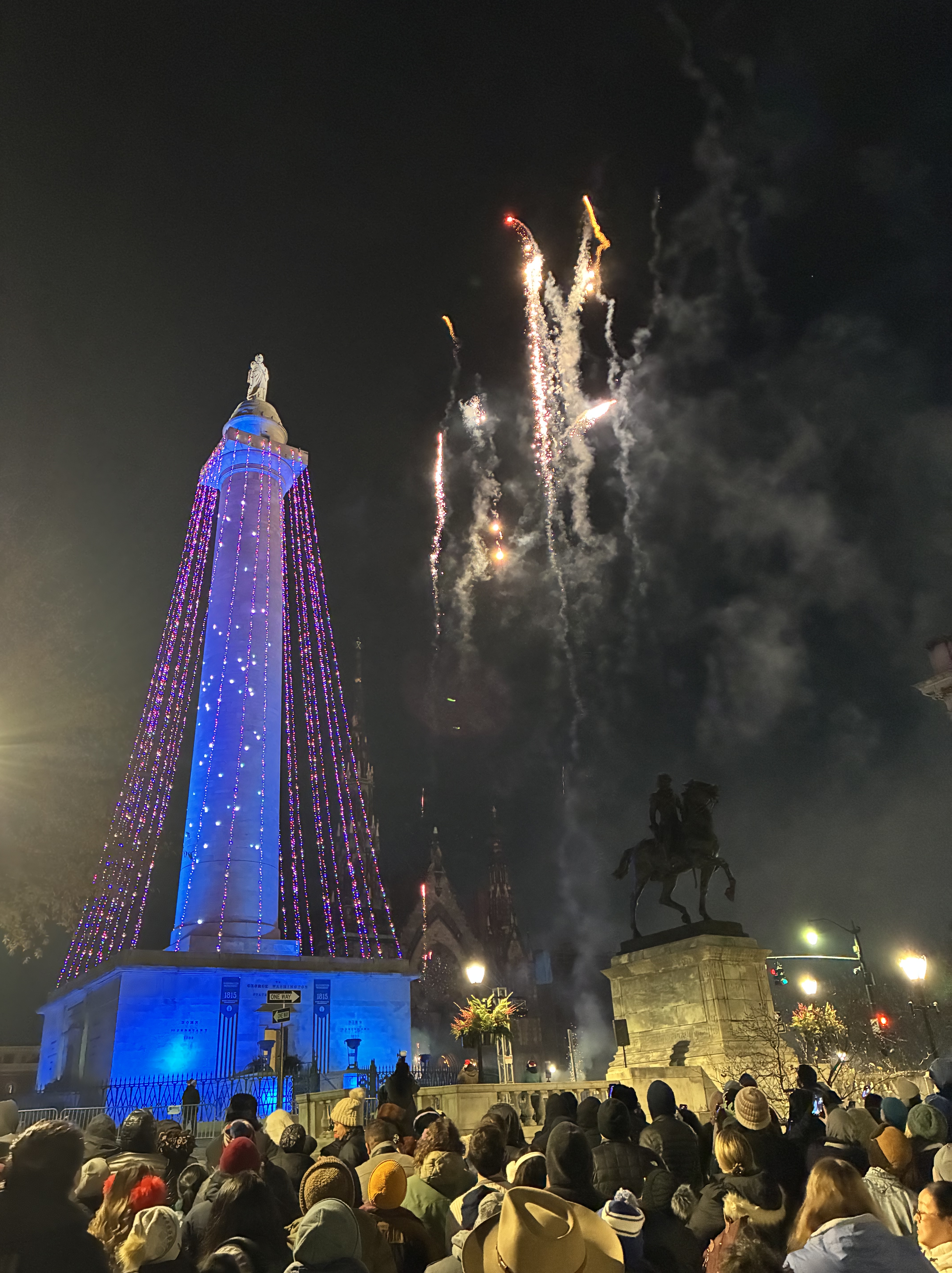
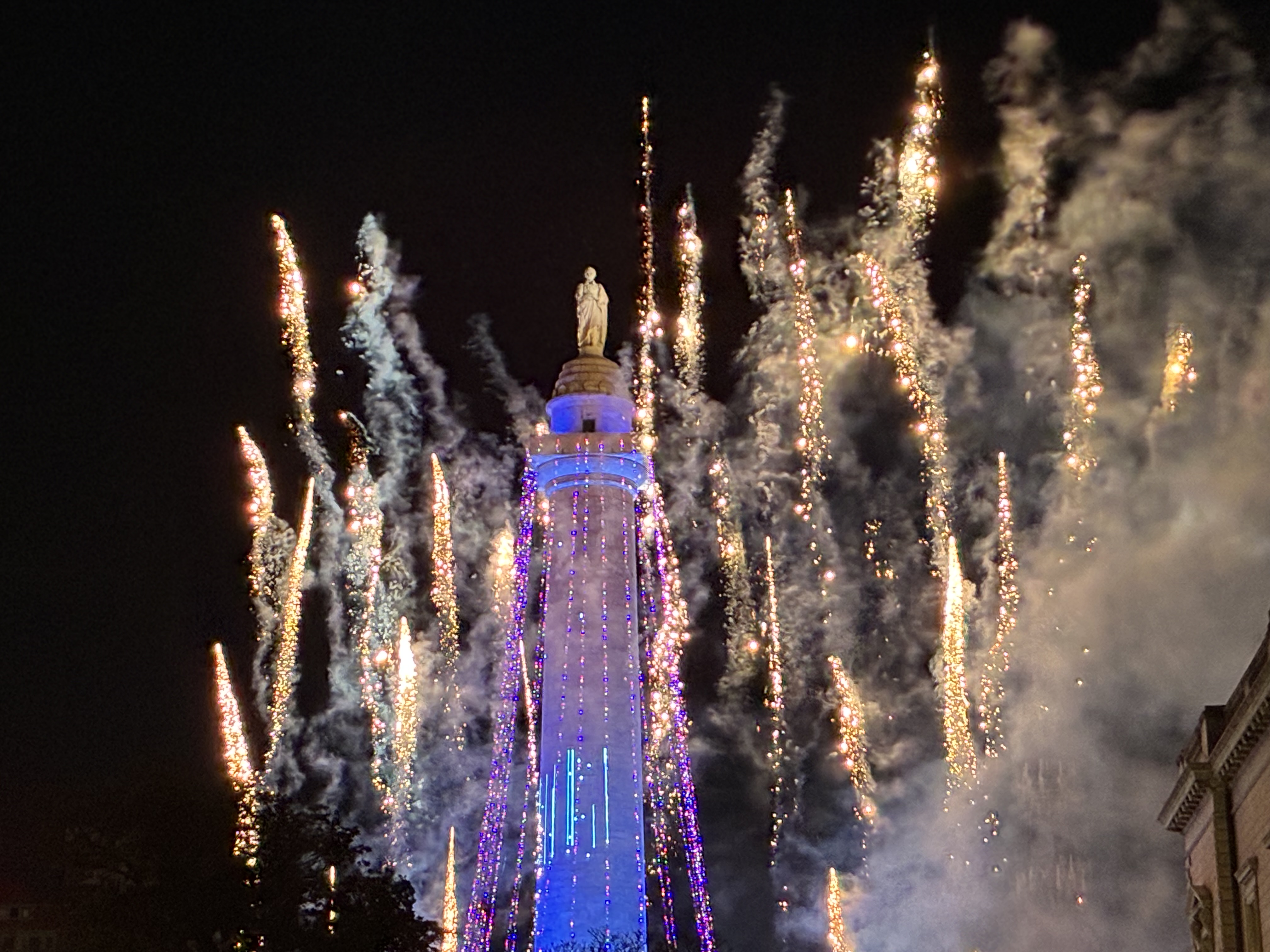
On the first Thursday of December, the unofficial kick-off to the holiday season takes place in Baltimore, Maryland. This year, on December 4, was the 54th year of the celebration. The 178-foot-tall George Washington Monument, the construction of which started on July 4, 1815, and was completed in 1829, is graced with lights and fireworks that light up the city sky about the figure of Washington.
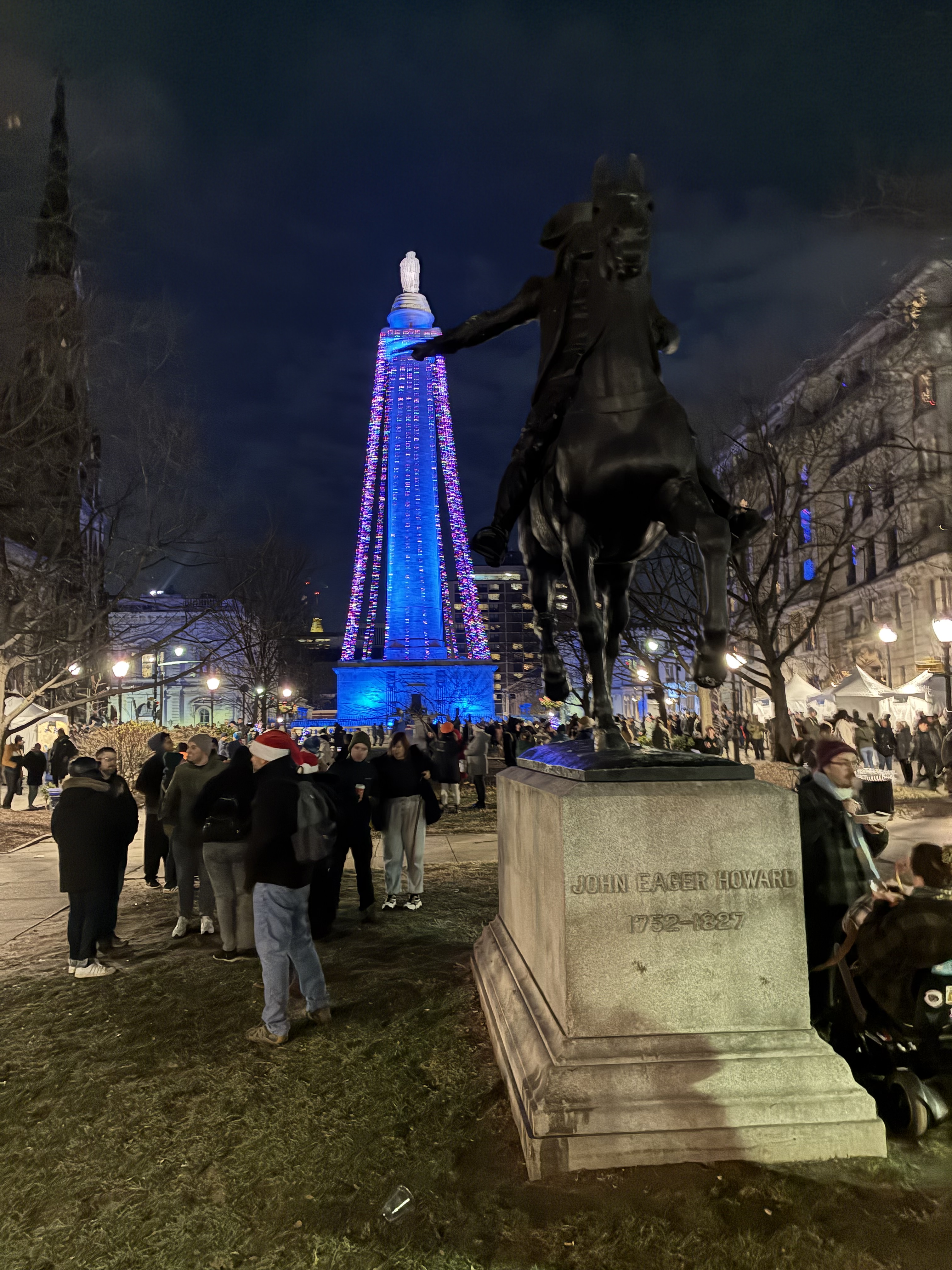
On both sides of the Washington Monument stand two equestrian statues grace the grounds. One is of a local American Revolutionary War hero, John Eager Howard, born in Baltimore County in 1752. On the other side is honorary American, the Honorable Marquis de Lafayette.
If you peer to the left of the Howard equestrian statue photo, you see the spire of a Victorian Gothic church. Built in 1872, the church stands on the location of the Howard residence. On January 11, 1843, Francis Scott Key died there, at the age of 63.
If you celebrate, Emerging Revolutionary War hopes your holiday season kicks off grandly as well. If I may, if looking for a gift for that history enthusiast, check out the Emerging Revolutionary War storehere. Or the Emerging Revolutionary War Series, here.
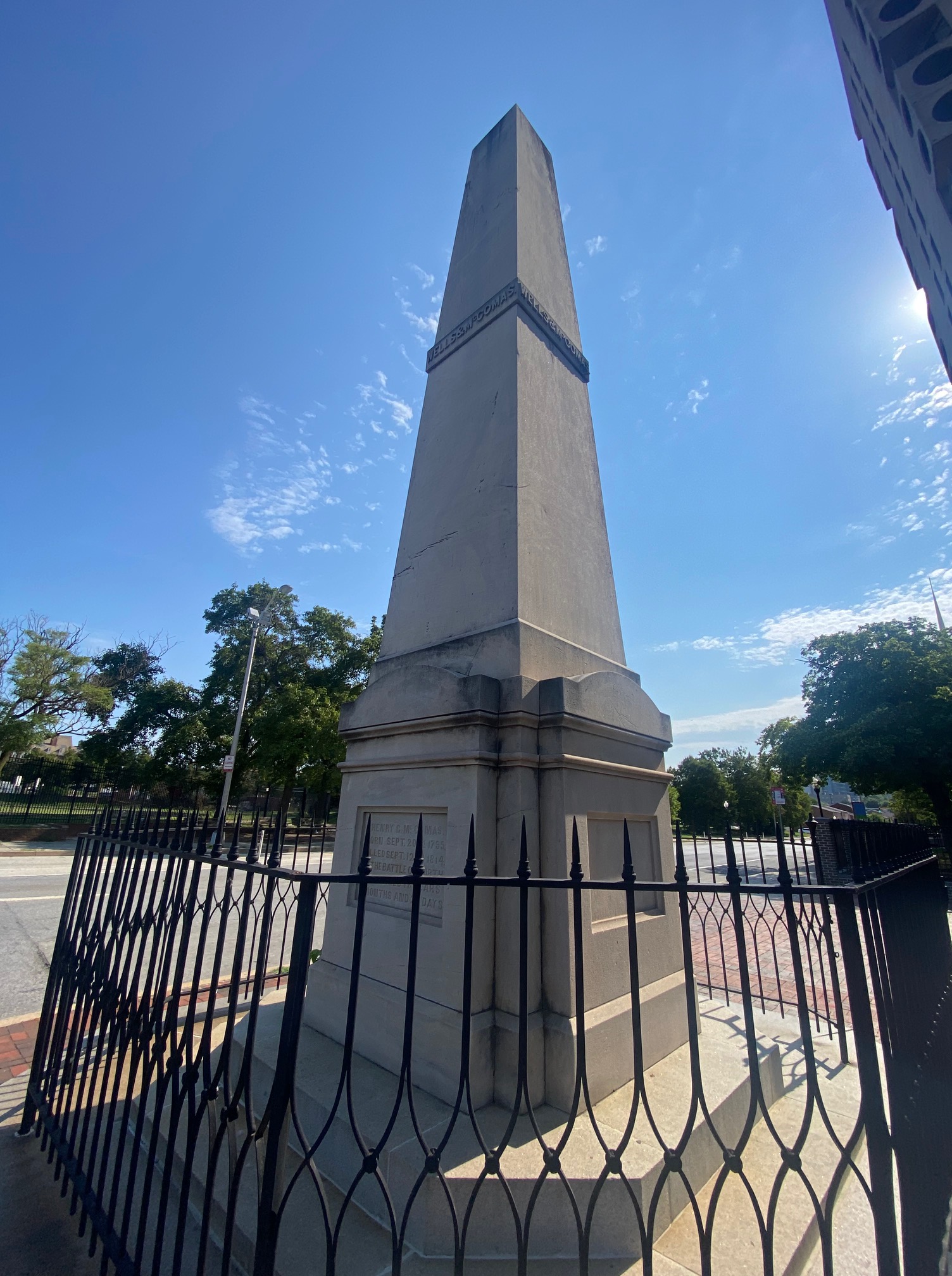
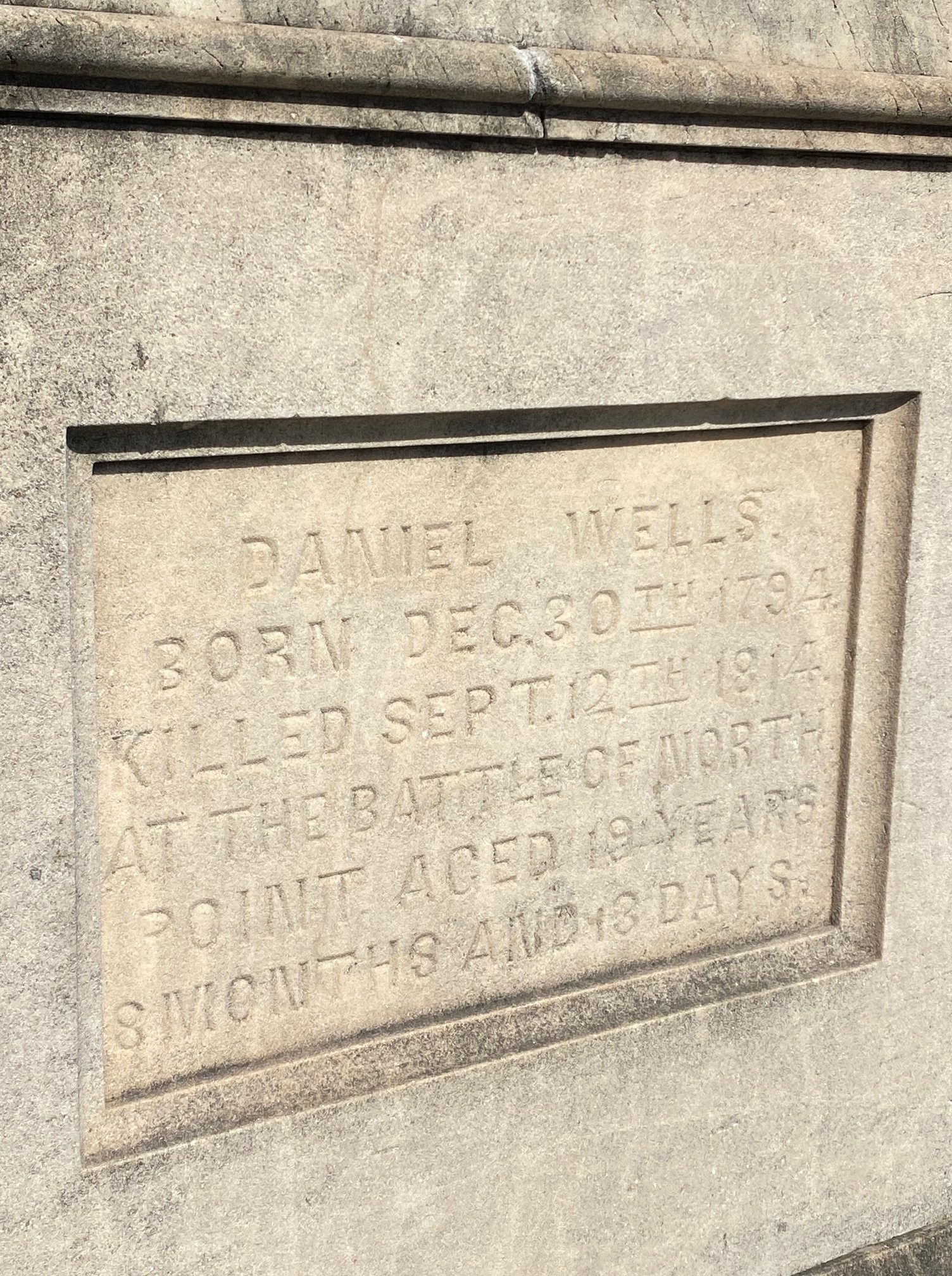
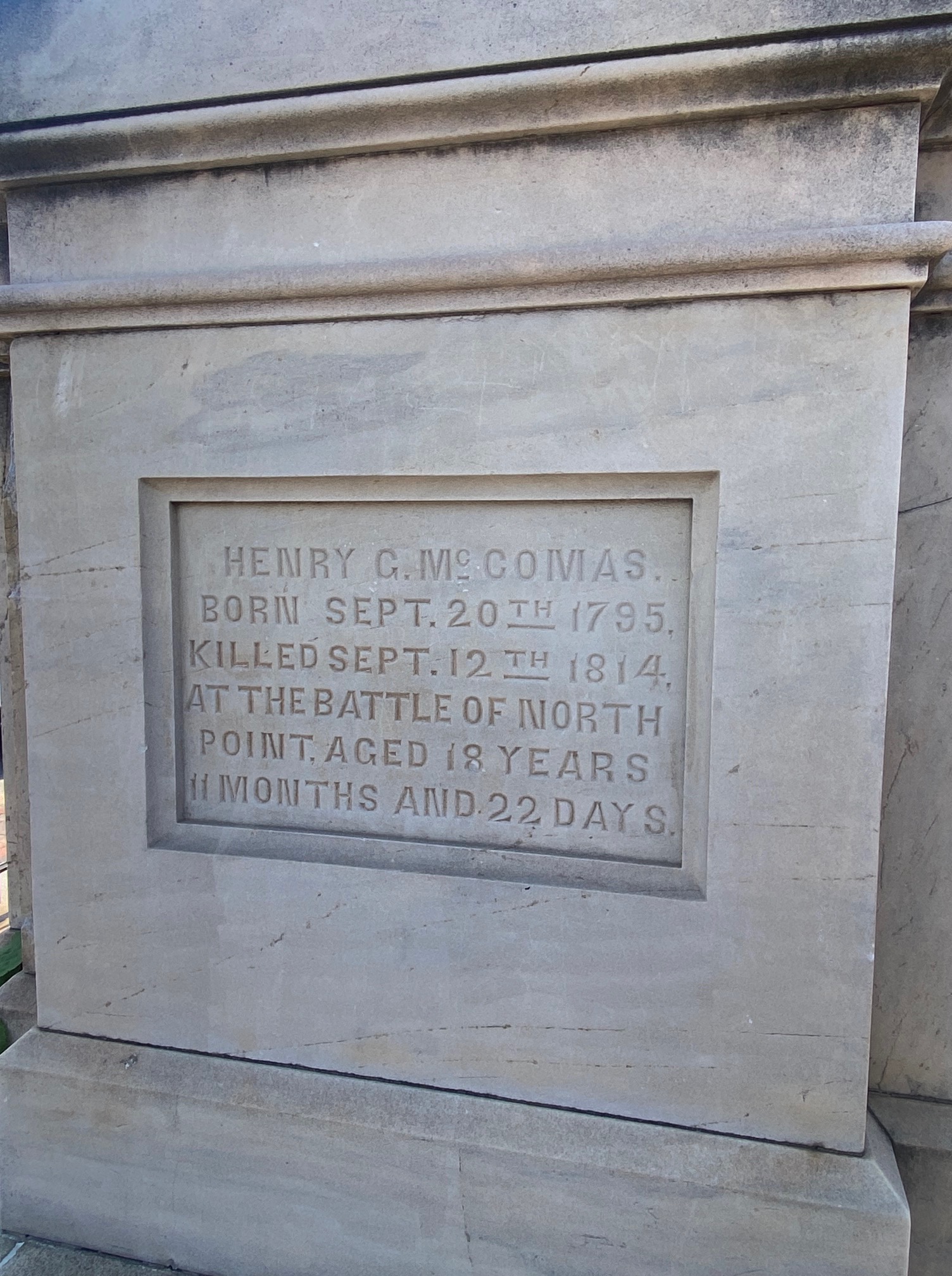
Situated along East Monument Street is a stone monument surrounded by a black iron fence. A wayside informational marker is placed right outside the fence. Underneath this monument rests the remains of Daniel Wells and Henry McComas. On September 12, 1814, one of their firearms changed the entire scope of the Battle of North Point, part of the Chesapeake Bay Campaign during the War of 1812.
Both young militia members, sent to the frontlines to skirmish and harass the approaching British infantry, fired a musket round that slammed through the left elbow and into the chest of Major General Robert Ross, British land commander, mortally wounding him. Both Wells and McComas, aged 19 and 18 respectively, would be killed during the day’s fighting. A third soldier, Aquila Randall, also slain that day, has his own small monument and crediting him with firing the fateful shot.
Although most historians credit either Wells or McComas. Both soldiers were reinterred here, the second time their remains had been moved, in 1858 when the monument was completed and a funeral song and dramatic play rounded out the day’s commemoration.
The site is part of the Star-Spangled Banner National Historic Trail. To learn more about the trail, click here.
Fredericktown, Maryland, August 1, 1775, a gentleman on business wrote to his contact in Philadelphia the following observation of a company of volunteers answering the call to head north to Boston to join what would become the Continental Army
“Notwithstanding the urgency of my business, I have been detained three days in this place by an occurrence truly agreeable. I have had the happiness of seeing Captain Michael Cresap marching at the head of a formidable company of upwards of 130 men, form the mountains and backwoods, painted like Indians, armed with tomahawks and rifles and dressed in hunting shirts and moccasins, and though some of them had travelled near eight hundred miles from the banks of the Ohio, they seemed to walk light an easy and not with less spirit than at the first hour of their march. Health and vigour, after what they had undergone, declared them to be intimate with hardships and familiar with danger. Joy and satisfaction, were visible in the crowd that met them. Had Lord North been present, and been assured that the brave leader could raise thousands of such to defend his country, what think you, would not the hatchet and block had intruded upon his mind? I had an opportunity of attending the Captain during his stay in Town, and watched the behavior of his men, and the manner in which he treated them; for it seems that all who go out to war under him do not only pay the most willing obedience to him as their commander, but in every instance of distress look up to him as their friend or father. A great part of his time was spent in listening to and relieving their wants, without any apparent sense of fatigue and trouble. When complaints were before him he determined with kindness and spirit, and on every occasion condescended to please without losing is dignity.”
esterday the Company were supplied with a small quantity of powder from the magazine, which wanted airing, and was not good for rifles ; in the evening, however, they were drawn out to show the gentlemen of the town their dexterity at shooting. A clap board, with a mark the size of a dollar, was put up ; they began to fire at it off band, and the bystanders were surprised, few shots being made that were not close to or in the paper. When they had shot for a time in this way, some lay on their backs, some on their breast or side, others ran twenty or thirty steps, and firing, appeared to be equally certain of the mark. With this performance the company were more than satisfied, when a young man took up a board in his hand, not by the end, but by the side, and holding it up, his brother walked to the distance, and very coolly shot into the white ; laying down bis rifle, he took the board, and holding it as it was held before, the second brother shot as the former had done. By this exercise I was more astonished than pleased. But will you believe me, when I tell you, that one of the men took the board, and placing it between hia legs, stood with his back to the tree while another drove the centre. What wonld a regular army of considerable strength in the forests of America do with one thousand of these men, who want nothing to preserve their health and courage but water from the spring, with a little parched corn, with what they can easily procure in hunting ; and who wrapped in their blankets, in the damp of night, would choose the shade of a tree for their covering, and the earth for their bed.”
Although a depiction of the 1st Maryland at Guilford C.H in 1781 some of these men are dressed similar to the riflemen mentioned above (wikipedia)
*Account is in “Papers Relating Chiefly To the Maryland Line During the Revolution” Thomas Balch, editor. pgs. 6-7.
“Given the order to defend the American withdrawal from Long Island, the Maryland Line saved the Continental Army from annihilation in the first major battle of the war.” wrote historian Ryan Polk.
Tench Tilghman, staff officer to George Washington and a native Marylander wrote about his fellow soldiers, “bore the palm…by behaving with as much Regularity as possible.”
Furthermore, if you Google “Battle of Guilford Court House” the image used by Wikipedia depicts an artist’s rendition of the 1st Maryland defending Nathanael Greene’s last line during the March 1781 engagement. The particular image is below.
The Continental Maryland Line was one of the preeminent stalwarts of the American army, both in the northern and southern theaters of the war. Join Emerging Revolutionary War historians in a discussion about the men from the Old Line State and their military acumen during the American Revolutionary War. The discussion will also highlight their memory and memorialization. We hope you can join us Sunday at 7 p.m. EST on the Facebook page of Emerging Revolutionary War.
Tell me I am not the only one that randomly goes on a car ride to a random town in their home state to just “see what is there?”
Regardless, that is what I decided to do on a sunny late April Sunday afternoon. I ended up in Rockville, Maryland. The town astride I-270 today was also on a major thoroughfare during both the 18th and 19th centuries that brought armies from the area, like General Edward Braddock’s in 1755 or General Jubal Early’s in 1864.
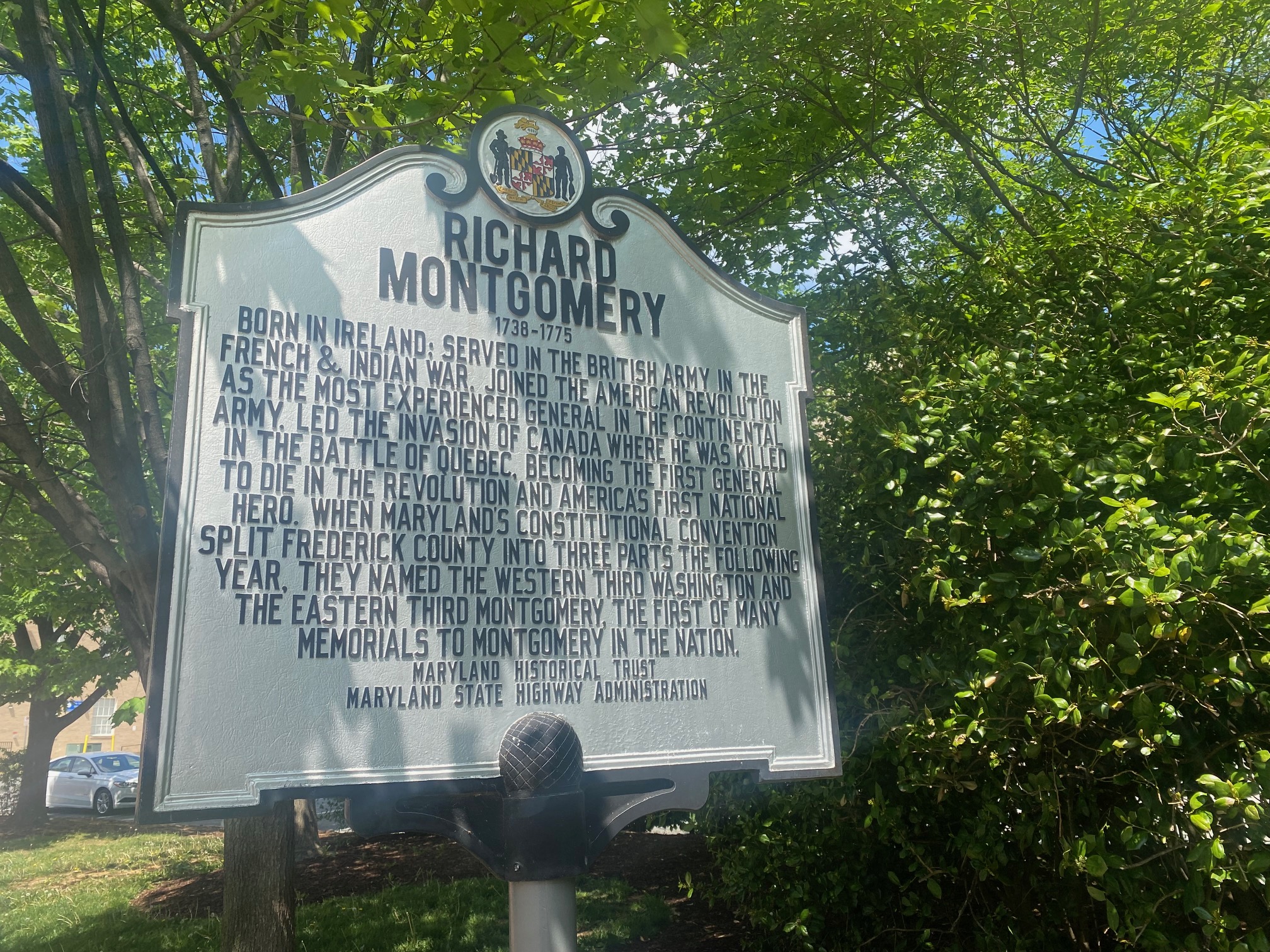
However, a different historical sign attracted my attention on this excursion.
I read the title and the first line, Richard Montgomery…Born in Ireland. Served..” Which was all I could read as I slowly drove by, since it is near the court house and county government buildings. Even though it was a Sunday still not wanting to speed through. So…Naturally, I pulled over, as evidenced by the vehicle you see in the background!
I knew Montgomery, as the sign reads, died at the Battle of Quebec in a futile attempt to take the city for the American cause. He was the first general–Continental–to die in the cause of American independence.
On September 6, 1776 Thomas Sprigg Wootton, who hailed from Rockville, introduced legislation in the Maryland Constitutional Convention to separate the Frederick County into three. The upper or most western half, to become Washington County, named in honor of George Washington and the lower half, or most eastern, to be named Montgomery, in honor of Richard Montgomery. The remaining middle portion would retain the name Frederick. This may be the first recorded instance in the rebellious British colonies of names of counties, towns, or cities that did not refer to something in British history or famous persons. Another act of defiance at the beginning of the American Revolution!
With a random Sunday excursion one never knows what one will find. History is all around us, beckoning to be explored.
On August 19, 1780 the United States lost one of the most influential foreign officers that fought for the new nation during the American Revolution. Johann von Robais, Baron de Kalb migrated to the United States along with the Marquis de La Fayette in 1777. A Prussian born solider who fought in the Seven Years War, de Kalb quickly became a respected leader. In the summer of 1780, de Kalb was commanding the Maryland and Delaware Continental Line in Maj. Gen. Horatio Gates’ southern army. One of the best trained and disciplined units in the Continental Army, de Kalb commanded the left of Gates’ line at the Battle of Camden on August 16, 1780. The battle was more of a rout, as the British rolled up the Virginia and North Carolina militia on the field, leaving the Continentals in a desperate fight for survival. After being shot three times and bayoneted several times, de Kalb was taken from the battlefield to Camden. His wounds were mortal and he died three days later.
Baron de Kalb monument in Annapolis, MD
The reaction to his death was immediate and the respect everyone had for him was evident. Cornwallis and other British officers showed great respect for de Kalb and gave him a proper military burial. Washington, Gates and other Continental officers mourned the loss of the Prussian officer. Soon after the war a movement began to move de Kalb’s remains to another place in Camden with a larger monument. In 1825, Lafayette laid the cornerstone for a new monument above his new interment in front of the Bethesda Presbyterian Church. This memorial was designed by Robert Mills, a noted architect of the time.
De Kalb grave site in Camden, SC
Maryland especially took an interest in remembering de Kalb. His command of the Maryland Line and his bravery leading the men at Camden were important to Marylanders after the war. In 1780, Congress authorized a monument to be built in Annapolis to honor de Kalb, but it was not until 1886 that it was finally constructed on the grounds of the Maryland state house. In the early 20th century, the Daughters of the American Revolution placed a memorial stone on the Camden battlefield marking de Kalb’s death (supposedly marking the spot but this is still debated today). Recently in 2021, Camden unveiled a new statue to de Kalb at the new Revolutionary War Visitor Center.
The memory of de Kalb extended beyond memorials and monuments. In the late 18th century and early 19th century, states started to honor de Kalb naming counties and towns after him. A total of six counties in the United States are named after Baron de Kalb, located in Alabama, Georgia, Illinois, Indiana, Missouri and Tennessee. There are six towns/cities in the United States named for de Kalb located in Illinois, Mississippi, Missouri, New York, Ohio, Texas and West Virginia.
New statue to de Kalb at the Revolutionary War Visitor Center in Camden, SC
But one of the most recognizable memorials to de Kalb and his Maryland Continentals is one that most people don’t even know as a memorial. In southern Baltimore where the large railroad yards were located, many of the streets were named after battles and individuals in the Southern Campaign of the American Revolution. Streets such as Washington, Lee, Howard, Eutaw and Camden. The large rail yard in this area was known as Camden Yards. In 1992, the Baltimore Orioles opened their new baseball stadium in the area of the old railyards next to the old B and O Railroad warehouse. The name was hotly debated, but then Maryland Governor William Donald Schaefer wanted to keep “Camden Yards” in the stadium name and eventually won out. The stadium today is called Oriole Park at Camden Yards, but most people now refer to it as “Camden Yards.” Though de Kalb would not recognize the game being played, he would recognize the name of the stadium and the state that was the home of so many of the men that followed him into battle at Camden. So next time you watch a baseball game at Camden Yards, think of de Kalb and those men at the Battle of Camden.
CONFINEMENT hail! in honour's justest cause.
True to our King, our Country, and our Laws;
Opposing anarchy, sedition, strife,
And every other bane of social life.
These Colonies of British freedom tir'd,
Are by the frenzy of distraction fir'd;
Rushing to arms, they madly urge their fate,
And levy war against their parent state.
Surrounding nations, in amazement, view
The strange infatuation they pursue.
Virtue, in tears, deplores their fate in vain;
And Satan smiles to see disorder reign;
The days of Cromwell, puritanic rage,
Return'd to curse our more unhappy age.
We friends to freedom, government and laws;
Are deem'd inimical unto their cause:
In vaults, with bard and iron doors confin'd,
They hold our persons, but can't rule the mind.
Act now we cannot, else we gladly wou'd;
Resign'd we suffer for the public good.
Success on earth sometimes to ill is given,
To brave misfortunes is the gift of Heaven.
What men could do we did, our cause to serve,
We can't command success, but we'll deserve.

--- Dr. John Smyth
The American frontier west of the Appalachian mountains was a fluid place in 1775. Settlers, officials, and Native Americans were all struggling to decide where their loyalties and interests lay, with the British government in London, colonial governments, or the rebelling Americans organizing themselves to determine their own fates. Individuals often switched sides as the war unfolded
One man who was a constant in his loyalty to the crown was Dr. John Connolly of Pittsburgh. Before the Revolution, he had led Virginia’s efforts as Lord Dunmore’s agent to seize control over the Forks of the Ohio and assert its claims westward, even receiving a promise of land in far-off Kentucky. When the fighting started in Massachusetts, he developed a plan to mobilize Native Americans and Britain’s far-flung military forces on the frontier to attack Pittsburgh and then march on Virginia. Dunmore and General Gage both approved. So, Connolly and two loyalists, Allen Cameron of South Carolina and Dr. John Smyth of Maryland, plus Connolly’s enslaved servant travelled surreptitiously through Maryland, hoping to reach Detroit via Pittsburgh, the Ohio River, the Wabash River, and then anther overland trek. Local patriots recognized them outside Hagerstown, Maryland and the trio was promptly arrested on the night of November 19. A quick hearing by the local Committee of Safety decided to ship them off to Frederick, where a more thorough investigation revealed Connolly’s plan. Continue reading “Poet in a Patriot Prison”→
The War of 1812 is considered by some historians as the end of the American Revolutionary Era. From the conflict, the United States will find a war hero and future president, Andrew Jackson and a poem by lawyer Francis Scott Key that turns into our national anthem.
But, the origins of the war, the military actions that spread around the United States, from Louisiana to the nation’s capital, to the invasion of Canada, and on the high seas are largely overlooked. There are numerous reasons for this.
That, in part, is why, this Sunday, at 7pm EST, on ERW’s Facebook page, the next historian happy hour “Rev War Revelry” will be focused on this important conflict. Join ERW historian Phillip S. Greenwalt along with the following guest historians for an hour-ish discussion of the three-year war.
Joining Phill will be;
Dan Davis, of the American Battlefield Trust, who has lectured on Andrew Jackson and the Battle of New Orleans. He is also a full-time historian with Emerging Civil War.
Also, formerly of Fort McHenry National Monument and Historic Shrine, and now working for the National Park Service in the Washington D.C. area, guest historian Jim Bailey will be the second of three guest historians.
Leaving the best for last, okay pun intended, as all three guest historians are great. But in all seriousness, the third guest historian joining for this revelry will be George Best. He is a park ranger for the National Park Service at Harper’s Ferry National Historical Park and volunteers as the Communications Coordinator for the Friends of Maryland’s War of 1812.
We look forward to you joining with your thoughts, comments, and questions this Sunday on our Facebook page (there will be an event post for you to use as a reminder) as we discuss this three-year conflict that had reverberations for many years afterwards.
Emerging Revolutionary War is pleased to welcome back historian Bert Dunkerly, who is the co-author (with Irene B. Boland) of the upcoming book; “Eutaw Springs; The Final Battle of the American Revolution’s Southern Campaign” slated to be released this month.
Part One
The weather was warm and the men had been marching for days, but their morale was high. They had been through a lot recently: caught off guard and defeated at Hobkirk’s Hill, a month of grueling siege work – and for naught, at Ninety Six. Not to mention the engagements that many of them had fought in previously: Kings Mountain, Cowpens, Guilford Courthouse, and dozens of smaller battles.
Yet the army that General Nathanael Greene led forward on the morning of September 8, 1781, was confident and ready to come to grips with its adversary. Everyone from the private in the ranks on up to the commanding general knew that ahead lay an opportunity.
Battles in the Revolution were, in fact, rare opportunities for commanders. Engagements were the short, pulse-pounding events that broke up the monotony of marching and maneuvering. An army spent most of its time in garrison, in camp, or on the road. In battle the infrequent opportunity came to crush an opponent and influence the outcome of a campaign, or the war. These chances were few and far between.
“Eutaw Springs” by Benson Lossing
Both commanders at Eutaw Springs appreciated this fact. General Nathanael Greene’s forces had experienced a series of close calls at Guilford Courthouse, Ninety Six, and Hobkirk’s Hill. The American army fought well in all of these engagements, save Hobkirk’s Hill, yet they met defeat in every one. Greene hoped Eutaw Springs would put the finishing touches on his South Carolina campaign, and end it with a clear cut victory.[i]
Eutaw Springs was a rare chance for Greene to pick the time and place of engagement, array his forces to his choosing, and initiate the battle, and control its \tempo. It was the only set engagement of the campaign, other than Guilford Courthouse, in which Greene chose the ground and initiated the battle. Commanders do not often have this luxury, and Greene earnestly hoped to make the most of it. Continue reading “Eutaw Springs”→
Baron Frederich Wilhelm August Heinrich Ferdinand Steuben or Frederich Wilhelm Ludolf Gerhard Augustin von Steuben or more simply Baron von Steuben, may be the most recognizable German to serve with the American army during the American Revolution.*
Portrait of Baron Johann de Kalb (by Charles W. Peale)
His merits, pedigree, and how he came to America has been questioned and studied by many scholars and historians.
Another German has not fared so well in terms of recognition of his invaluable services to the American cause.
This post is about that other German-speaking military officer. He did something von Steuben did not.
Baron Johann von Robais de Kalb not only offered his services to the fledgling American Continental Army, he also gallantly gave his life for his adopted-cause.
Born June 19, 1721 in Huttendorf, near Erlangen in Bavaria, de Kalb led a life of privilege, learning multiple languages before earning a commission in the French army in the Loewendal Regiment. He served admirably in the War of Austrian Succession and the Seven Years War, in the later, he won the Order of Military Merit and gained his baronetcy.








 Emerging Revolutionary War Era