Emerging Revolutionary War welcomes guest historian Eric Sterner.
In February 1778, Brigadier General Edward Hand, commanding Continental forces at Fort Pitt on the American frontier, launched what may be one of the oddest campaigns of the American Revolution, more famous for its fecklessness than any benefit to the American war effort. Born in Ireland, Hand arrived in the colonies with the 18th Royal Irish Regiment as a surgeon’s mate. He eventually left service in 1774 and set up a medical practice in Philadelphia. The siege of Boston found him among the besiegers as Lieutenant Colonel of a Pennsylvania Rifle Battalion. He fought under Washington on Long Island, at White Plains, and then Princeton, after which Washington successfully pursued the rank of Brigadier for him before sending him to Pittsburgh.[1] Hand arrived in June, 1777, finding just two companies of the 13th Virginia.[2] As was often the case on the frontier, Fort Pitt was under-garrisoned and Continental officers would have to scrounge constantly for troops, largely relying on local militia forces to defend the frontier.
General Edward Hand (courtesy of Ohio History Central)
Hand hoped to conduct a campaign to the west, driving toward British power at Detroit, but was unable to raise sufficient forces that fall. Instead, he settled for a trip down the Ohio to ensure local garrisons were in proper order.[3] Around Christmas, Hand received information that the British had established a small magazine on the Cuyahoga River, likely somewhere close to where it empties into Lake Erie in the current city limits of Cleveland.[4] As December gave way to January and February, Hand resolved to do something about it. At the beginning of the month, he wrote Colonel William Crawford, formerly of the 13th Virginia, currently of the Pennsylvania militia and a well-respected local leader, entreating the colonel to undertake an expedition: “As I am credibly informed that the English have lodged a quantity of arms, ammunition, provision, and clothing at a small indian Town, about one hundred miles from Fort Pitt to support the savages in their excursions against the inhabitants of this and the adjacent counties, I ardently wish to collect as many brave, active lads as are willing to turn out, to destroy this magazine. Every man must be provided with a horse, and every article necessary to equip them for the expedition, except ammunition, which, with some arms, I can furnish.”Continue reading “General Edward Hand: The Squaw Campaign”→
From a Pennsylvania State Historical Commission marker, one quickly can find out the importance of Osborne Hill to the Battle of Brandywine, fought on September 11, 1777.
Osborne Hill Marker (courtesy of Keith Smith, hmdb.org)
The hillside was the site of British General William Howe’s post in which he coordinated and commanded the different components of the British and Hessian forces that day. The battle opened the way for the British conquest of Philadelphia and was the largest, in terms of manpower fighting, of any American Revolutionary War battle.
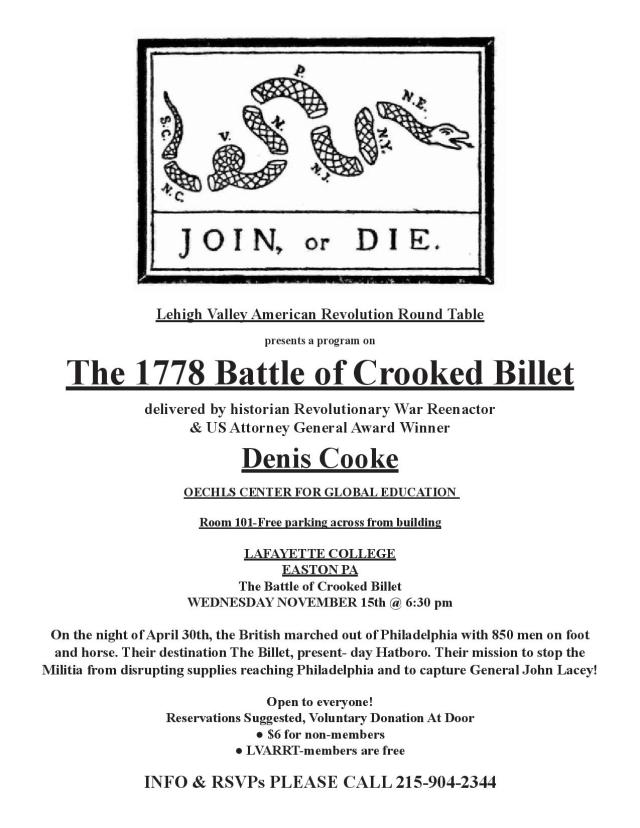
Join our friends at the Lehigh (PA) Valley American Revolution Round Table on Wednesday, November 15, 2017 at 6:30 p.m. at the Oechls Center for Global Education at Lafayette College in Eastern, Pennsylvania. The topic is the battle mentioned above.
Noted historian, reenactor, and U.S. Attorney General Denis Cooke will be the speaker. See flyer below for further details.
Reviewed by guest historian Robert “Bert” Dunkerly.
Lord Dunmore’s War remains one of the murkier events of the Colonial era. Historian Glenn F. Williams has produced a book that will set the standard for the study of this conflict.
Dunmore’s War, the Last Conflict of America’s Colonial Era by Glenn F. Williams
Dunmore’s War, The Last Conflict of America’s Colonial Era by Williams, explains the complexity of the conflict and goes into detail analyzing the intertwined diplomatic and military events. The late 1760s and early 1770s were a fascinating and complex time on the frontier. Violence from the French and Indian War and Pontiac’s War had subsided, tribes were shifting alliances, settlers were moving into the region, and the colonies were still adjusting to the new realities following the Treaty of Paris. The British regulations that would trigger colonial resistance were already coming, and tensions were slowly building. Yet the issues which dominated the attention of most colonists were inter colonial rivalries, such as that between Virginia and Pennsylvania.
Emerging Revolutionary War is honored to welcome guest historian Daniel Welch to the blog. A brief biography of Mr. Welch is at the bottom of the post.
Several weeks ago I decided to take my usual weekend off of visiting American Civil War battlefields to take a moment to explore some American Revolutionary War historic sites just several hours down the road. Since it was a rather last minute decision, I was not completely prepared before visiting other than some basic historical context and a vague idea of operating hours and things to do while at these historic sites. So, if you want to follow the Continental Army during their experiences in the fall and winter of 1777-1778 read on to help plan a great weekend day trip.
Battle of Brandywine
Sandy Hollow, Brandywine Battlefield
If you want to follow these events as they happened, and in chronological order, began your day at the Brandywine Battlefield Park Associates site. Walking the site is free, but there is a charge if you want to go through the museum or on a tour of one of two historic homes on the property. Their hours are constantly changing so make sure you check their website. (click here), before you plan your visit. To go on a house tour, view the film, and go through the museum there is an $8.00 charge; the museum and film alone is $5.00. I would suggest, if you have the time, to take in the film and museum. The film lasts approximately twenty minutes while a thorough look of the museum could take one an additional forty minutes. Between the film and museum, a firm foundation to the events of September 11, 1777 will be in place before you head out to other locations associated with the battle. The house tour is a guided tour through Washington’s headquarters on the property and is conducted by a volunteer at the site. The tour took over an hour and a half, and considering that the home had burned to the ground nearly 100 years ago and has been rebuilt and filled with modern reproductions, your time would be better spent going to other sites associated with the battle.
Birmingham Friend’s Meeting House plaque
Before leaving, make sure you pick up driving directions from the employees at the counter to get to Birmingham Friend’s Meeting House, and Sandy Hollow, the American’s second line of defense during the battle. Also, make sure to purchase the driving tour map of the battle of Brandywine. This map will take you to numerous other historic sites and homes within the Brandywine Valley that witnessed the events of that day. The cost is a mere $2.95. Plan an additional three to four hours to complete the driving tour.
Ultimately the battle proved to be an American defeat. Although he was defeated on the field, Washington and his generals were able to get large portions of the army to the rear through Polish General Pulaski’s assistance in covering the retreat. Despite the best maneuvers to save his army, Washington was unable to save Philadelphia and the city fell to the British just two weeks later on September 26, 1777. The British remained until June 1778.
Lunch
By now a late lunch would be in order. A great spot is the Black Powder Tavern. A tavern since 1746, it has a great Revolutionary War history, including a supposed visit by Washington himself. The restaurant’s name is related to a historical legend that none other than Von Steuben had ordered the tavern turned into a secret black powder magazine during the army’s pivotal winter at Valley Forge. The food here was great, as was the service and beer selection.
Valley Forge National Historical Park
Following the defeat at Brandywine in September, and another engagement at White Marsh in early December, General Washington looked to put his army into a more secure camp for the coming winter. Active military campaigning for 1777 in Pennsylvania was over. Just twenty miles northwest of Philadelphia, the Continental Army faced numerous challenges here including a lack of food and shelter. Disease also spread during their time at Valley Forge. By February 1778, approximately 2,500 soldiers had perished.
General Anthony Wayne Statue, Valley Forge National Historical Park
To begin your visit here, start at the visitor center. The museum has its challenges. There is no discernible narrative to the exhibits; rather, numerous cases with laminated pieces of paper hanging on the side with corresponding images and item descriptions. Although there are some unique items on display, if it is busy you could wait at a particular case for the laminated cards to know what you are looking at. After a perusal of the museum, take in the free film. Although it is rather dated it provides a great overview of the winter encampment, its challenges, and outcomes. Between the film and museum, plan on spending an hour at the visitor center.
If you have additional time, take in the one and only National Park Service Ranger program offered. It is a rather short program, in length and walking distance, from the visitor center to the reconstructed Muhlenberg Hut sites. The program also echoes what is presented in the film. Before leaving the visitor center, I recommend getting the auto tour cd, as well as any updates on road closures. The park is currently under a significant amount of construction that has closed some roads and altered the driving tour route. The suggested driving tour cd is two hours in length. This would be a time allotment for those visitors who do not stop at each site, get out of the car, and explore all the stops along the route. You will want to get out and explore monuments such as those to the New Jersey troops, National Memorial Arch, von Steuben, and Patriots of African American Descent. You will also want to explore the several historic homes within the park that were used during the encampment, such as Varnum’s Quarters, Washington’s Headquarters, and the Memorial Chapel. My explorations, coupled with the driving tour cd, lasted nearly five hours.
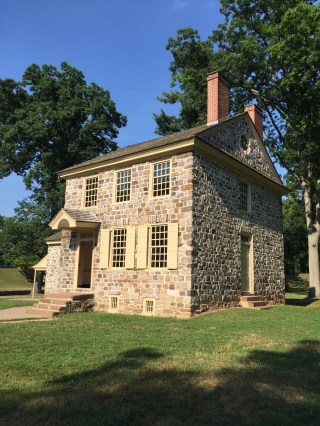
George Washington’s Headquarters (Isaac Potts House) at Valley Forge National Historical Park
Although it would be a long day, it can be done in one; however, if you wish to slow the pace of your visit, each site could be done on a separate day during your weekend. There is plenty of lodging in the area to accommodate this schedule. By visiting both of these historic areas and learning about the events of the fall through early spring 1777-1778, a greater picture can be viewed gleaned of military situation during the time period, as well as the tough composition of the Continental Army despite their defeats.
*Dan Welch currently serves as a primary and secondary educator with a public school district in northeast Ohio. Previously, Dan was the education programs coordinator for the Gettysburg Foundation, the non-profit partner of Gettysburg National Military Park, as well as a seasonal Park Ranger at Gettysburg National Military Park for six years. During that time, he led numerous programs on the campaign and battle for school groups, families, and visitors of all ages.
Welch received his BA in Instrumental Music Education from Youngstown State University where he studied under the famed French Hornist William Slocum, and is currently finishing his MA in Military History with a Civil War Era concentration at American Military University. Welch has also studied under the tutelage of Dr. Allen C. Guelzo as part of the Gettysburg Semester at Gettysburg College. He currently resides with his wife, Sarah, in Boardman, Ohio.
I grew up in a suburb of Reading, Pennsylvania. Reading is the county seat of Berks County, and is located about sixty miles northwest of Philadelphia. Reading is an old town; Richard and Thomas Penn, the sons of William Penn, founded the town in 1743. It is situated on the banks of the Schuylkill River, and has always been an important logistics center as a result. German immigrants settled much of Berks County, and many in the area spoke the language. Today, Reading remains the gateway to the so-called Pennsylvania Dutch region.
There’s a part of the east side of the city, situated at the base of Mt. Penn, the dominating high ground that overlooks the city, called Hessian Camp. This is what a local newspaper writer said about that part of town a few years ago: “Reading’s Hessian Camp section is arguably the city’s finest neighborhood. Mansions line the curvy, hilly streets…The neighborhood, tucked into the side of Mount Penn, is hidden from the hustle and bustle of the downtown.” My mother’s favorite aunt and uncle lived in Hessian Camp.
Historical marker for the “Hessian Camp”
A historical marker erected by the Commonwealth of Pennsylvania in Hessian Camp stands out. As a child, I thought it an odd name, so I started asking questions. I eventually learned that it was the site of a Hessian prisoner of war camp during the Revolutionary War. That satisfied my youthful curiosity, but as an adult who has traveled back to Reading regularly since moving away in 1983, I retained my interest in it and remained curious about it. Consequently, I decided to tackle it and see what I could learn of it. Eventually, the story took shape.
After George Washington crossed the Delaware River and surprised Hessian mercenaries at the Battle of Trenton, the Hessian prisoners of war were take inland for detention. Due to the heavy German presence in Reading, it was a perfect place to house these men because so many of the locals spoke the language and could converse with these men. They also hoped that the Hessians would desert and take up residence—and perhaps their loyalty—with the Patriot cause. Further, as a result of Reading’s location, it would require a determined campaign to free the prisoners of war.
The initial prisoners of war were housed in a temporary prison along the banks of the Schuylkill River. They spent a cold, rough winter, and many died of disease and/or cold. After the Battle of Saratoga, when it became obvious that more Hessian prisoners of war would be heading to Reading for detention, the local citizenry demanded that the POW’s be moved to a more remote location. The original campsite was about 12 acres in size, and housed about 1,000 detainees—about the same as the permanent population of Reading. There was plenty of fresh water from a spring and plenty of lumber to construct huts, so the site was chosen.
There are two surviving accounts from German POW’s housed in Reading. Johann Bense, from the Duchy of Brunswick, arrived in Reading on June 16, 1781:
On the bank of the Schuylkill, we had been camping on a meadow in the open air for 8 weeks and were plagued by the great heat during the day and by rain and cold during the night. On August 9, we marched from the Schuylkill via Reading onto a high, rocky mountain.
We were supposed to build barracks there. But because we did not want to agree to that right away, but rather made ourselves straw huts, we were treated very severely. A sharp command from the corporal forced us to build the barracks and it was our good fortune because all our straw huts were consumed by fire on October 21, 1781.
Therefore, those who had not yet completed their barracks, had to do more now to get them ready. Through that, the men got some freedom to go into the country and work and so they kept their supplies. They are read out twice a month [report for roll call twice a month].
On April 26, 1782, we received money, linen trousers, shirts, and 1 pair of shoes from Lieutenant du Roi [of the Regiment Prinz Friederich]. Now, our situation was pretty good.
It did not last long, however, that they locked us up and all who were in the country and worked there, had to come in [to the city].
In the month of July, they read us an order from Congress. Any one of us wanting to be free, and that immediately, should give 80 silver talers [one British pound was worth 5 5/6 talers] as ransom and if he did not have that much money, a citizen should pay it for him with whom he should work in bondage for 3 years.
But if we wished to enter service with them [in the American army], each would get 8 silver talers as gratuity and after the end of the war, he would be given 100 acres of land. This now was voluntary, to be sure, but because our men did not want to agree to that, we were treated very harshly.
Since a few of us deserted, 356 men [of ours] were suddenly taken to the Reading jail and because there was not enough room, they had to lie in the court yard in the rain and the cold. They had to buy wood and water.
Two hundred of our men were sent to the prison in Lancaster; the artisans were also taken there. Afterwards another 100 men were taken into prison, among them was myself. Because a few non-commissioned officers deserted, 42 sergeants and non-commissioned officers were also taken to jail. These had to lie in the cellar and below in the dungeon [at Lancaster]. Many of our men who could not stand it entered [American] service or sold themselves as indentured slaves for 3 years. The rest, who had been prisoners since September 11, were let out on December 16 but each had to give 1 taler.
The non-commissioned officers were let out after 17 days but because some deserted right away again, those having been in jail before were quickly taken back to prison and had to remain there up to the exchange.
Some of our men took up service on a pirate ship which was captured immediately at its departure from Philadelphia, and taken to New York. In the last year of our captivity, we thus were the most wretched and most miserable men. None of us could go out and none of the inhabitants were allowed to see us…
On February 13, we had our first news of peace [from a Hessian Quartermaster]. We continued being in doubt until finally in March a French ship arrived in Philadelphia with the same message. It was made known to us at the barracks on the 26th that there was peace with France, Spain, Holland, and England and now we were daily hoping for our release. . . On April 16 in the afternoon, the non-commissioned officers came out of the city jail and [returned] to the barracks.
On April 21, which was also the second day of Easter, at 12 Noon, 13 cannon shots were fired for the 13 free colonies. The whole city was illuminated in the evening and fires were made on April 24. In the morning the English Commissary Maclean came to give us each a blanket. Other staff officers came and we prisoners found out we would march to New York.
Bense departed Reading on May 3, 1783, and by May 10, had arrived in New York City. He eventually returned home to the Duchy of Brunswick,
The second account comes from a letter by Sgt.-Maj. Samuel Vaupel, who served in the Leib Company, Erbprinz Regiment of Hessen-Hanau. He reported to his commanding officer, Lt. Col. Lentz, in New York:
Your Excellency, I have a report to humbly send you, also a resolution from the Board of War of Congress and the address of Captain Thomas Bowen. From these, your Excellency will see in what a depressing situation we are in….We were told everyone must choose to either buy himself free or join the American service. The king would not help us, and our prince did not want us… Nobody [from the ranks] responded to this reading and speech. It was immediately ordered that now nobody could leave camp and the proclamation read three times daily. But our people pretty much stuck together.
On August 7, 1782, we were visited by Major-General [Benjamin] Lincoln and Brigadier-General [Moses] Hazen from Lancaster. The Corps had to form up and we were reviewed but they didn’t speak. They rode our regimental street and around the barracks, then went on to Reading.
On the morning of the 10th instant, Brigadier-General Hazen returned with a German Captain [Anthony] Selin from his regiment. The troops had to turn out again and form a circle. The General spoke, which was translated by the above mentioned captain. We should choose to either make ourselves free by paying 80 Dollars or join the American army; the King of England did not care enough about us to exchange us or pay for our provisions; they cannot provide for us any longer when they have problems feeding their own men; and if we continue refusing to make our decision, serious measures will be taken.
After the speech we NCOs said that we could not agree to these conditions, and asked if he would allow two NCOs from our Corps to go to New York to report these conditions to our commanding officer. If he says all hope is gone and doesn’t need us any longer, then every man can do as he wishes. The general’s answer was: He wanted to report it to Congress, but we have not heard anything as of now and don’t expect to.
The above mentioned Captain Selin is Swiss-born and cannot be described badly enough; he was introduced to us as our commander. The new captain called together all the NCOs and gave orders that nobody will dare go 10 paces beyond the post without being termed a deserter and when the provost guard calls and they don’t stop, the guard should fire on them
The water is located just outside the post, but nobody may go for it alone. The NCO of the guard has to call for water and one of his armed guards goes along to the well. This captain has ordered the guard to allow nobody out of camp, not even a woman or child, without permission. [Some of for-hire soldiers were allowed to have wives and children with them.]
He also said he has forbidden the local residents into the camp. It is not permitted to openly bring us an apple. Since all this did not help, the above mentioned captain announced the NCOs were to blame for the lack of enlistments – that they discouraged the men from enlisting.
This lasted until September 7, when he unexpectedly came to the barracks at daybreak and gave the order to march; our people were to go to the mountain with sack and pack. We all packed our things and when we were formed up on the barracks mountain, the captain went from right to left without saying anything. Finally, with the Brunswickers, he began pulling young people from the ranks.
When he came to our regiment he only said the married men and NCOs should step forward. The remainder dressed ranks, were turned right and joined up with the Brunswickers to march to the jail in Reading.
There were 142 men of our regiments and 158 Brunswickers, 300 in all. They filled up the jail and the remainder had to camp in the jail yard. The first day these people had to pay 2 pence for a pail of water and also had to pay for firewood to cook with. They were in this jail through the 10th instant.
On the 11th instant 102 men from the regiment and 84 Brunswickers were taken to the jail in Lancaster.
On the 24th instant, 21 men from the regiment and 25 Brunswickers were again taken to the jail in Lancaster. There is now nobody from the regiment in the Reading jail except the baker Muller from the Lt. Colonel’s Company.
Private Wiskermann of the Leib Company was employed in Reading by a rich widow. On September 2, the captain had him brought in from the widow and asked him to enlist, buy himself free, or be sent to an underground prison or dungeon as the English call it. He decided he would rather be free and the above mentioned madam, named Mifflin, ransomed him.
Fourteen men from the regiment who were employed at an iron smelter, have returned to the barracks. On September 23, 10 of these men were taken to the Reading jail. The other 4 men remained sick in the barracks; the other 10 men were taken, with others, on September 24 to Lancaster. They also had to each pay the jail keeper in Reading 1/4 Dollar for the one night lodging.
Concerning us here in the barracks, we expect daily and hourly to go to the jail. Captain Selin indicated, when the others went to jail, that at the slightest incident or attempt at desertion, the others would also go into the jail. We have to hear daily from this captain how our tyrannical prince no longer needs us and that we will not get any more clothing or money from him. We collectively humbly beg your Excellency to have mercy on us and rescue us from this unhappy and depressing situation.
Should this be impossible, we beg you to have the grace to send us uniforms, blankets, and money. Otherwise it will be impossible to withstand the coming winter as our blankets are torn and so little firewood is issued that we can’t make the fires small enough. . . nobody is allowed out to gather firewood.
Sergeant-Major Vaupel ransomed himself on or about December 8, 1782. His fate is unknown. The fates of the poor German soldiers sent to fight in North America remains a fascinating mystery.
Other than large, handsome houses, there is nothing left of the Hessian campsite in Reading. The historical marker and the name of the neighborhood are the only reflection of the former occupants of the area. However, the presence of those prisoners of war was among the earliest things to draw my interest in the Revolutionary War.
A map showing the location of the Hessian POW camp in Reading, PA.
In the lowest depths of one of the coldest winters in the American Revolution, the Continental Army uncovered the dedication that the core of the military movement had.
Suffering was beyond comparison.
The cause was supply, the crux of many an army before and after the Revolutionary War. The issue started from the top, the quartermaster general position.
“The lack of a competent, effective quartermaster general for the period from October 10, 1777 to May 2, 1778 threatened the Continental Army’s existence more than the enemy” wrote author and historian Herman O. Benninghoff, II.
His bold proclamation is chillingly on-point.
That time frame coincided with the approximately same length of time George Washington’s forces were at Valley Forge.
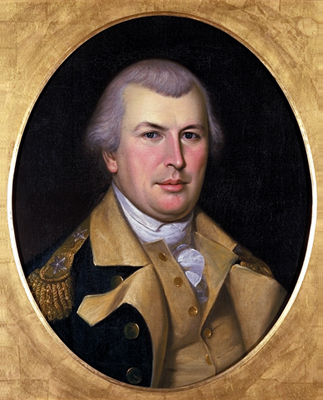
Nathanael Greene would become Quartermaster General in March 1778 during the encampment at Valley Forge
On January 5, 1778, Nathanael Greene, who would soon be tapped as quartermaster general of the Continental Army, wrote to fellow officer General Alexander McDougall;
“The troops are worn out with fatigue, badly fed, and almost naked. There are and have been thousands of the Army without shoes for months past. It is difficult to get sufficient supplies to cloath the Army at large.”
Moving directly to Valley Forge from active campaigning, the soldiers arrived with their supplies in a deplorable condition. Shoes had been torn to shreds with the long marches and many of the men had nothing but rags to wrap feet in. Shortly after arriving, the army numbered approximately 12,000 men under arms, yet 4,000 of these men, 1/3rd of Washington’s entire force, was deemed “unfit for duty” because a lack of supplies.
Another 1,100 would desert because of the horrid conditions of the winter encampment; no food, no pay, and barely clothes to keep warm.
Another 2,000 died of disease, including typhus, pneumonia, and other “camp fevers” which categorized a whole assortment of various ailments. Medicine was almost non-existent and lack of proper sanitation played a major role as well.
A delegate to the Confederation Congress was informed by an informant in Valley Forge that “a great portion of the soldiers are in a very suffering condition for want of necessary clothing, and totally unfit for duty.”
The suffering of the soldiers for a want of simple, basic clothing, becomes even more painful with the following realization by John Marshall, serving as an officer at Valley Forge, and the same Marshall who would become the Supreme Court Justice.
“In a desert which supplies not the means of subsistence, or in a garrison where food is unattainable, courage, patriotism, and habits of discipline, enable the soldier…..but to perish in a country abounding with provisions, requires something more than fortitude.”
One artist’s depiction of what the encampment at Valley Forge looked like
That is what is most astonishing, that there were surpluses to be attained, but Continental currency had depreciated to the point that by late 1777 and early 1778 it was at an exchange rate of four Continental dollars to one dollar of hard specie. By 1779 that ratio would be 30 to 1.
To further complicate matters, the Continental Army did not even have the wagons to gather the materials. In mid-February, a report from camp to Henry Laurens, president of the Confederate Congress, deplored of the “want of Waggons & the like.”
Out of the depths of this despair, where cries of “No Meat, No Meat” rent the air as soldiers voice their frustration, came a self-proclaimed baron.
This man would leave a lasting impression on the make-up of the army, second only to George Washington.
His assessment of the army upon his arrival amazed him, the “fortitude of the common soldiers and that no army in Europe would hold together and endure under such deprivations of food and clothing and shelter.”
That prognosis shows the depth of commitment that boiled in the hearts of the dedicated survivors of the cold, hunger, and privations of Valley Forge.
The army was ready to be molded and with his arrival, Baron Friedrich Wilhelm von Steuben would turn out to be the right guy at the right juncture in time. The Continental Army, held together by George Washington, would be transformed by this new inspector general.
Valley Forge would be the elixir of change for the army and the revolution.









 Emerging Revolutionary War Era