Canadian Invasion: The Occupation of Montreal

In the fall of 1775, 250 years ago, the American Revolutionaries invaded Canada. It was hoped that a 14th colony could be added to the effort. Members of the Continental Congress felt that Canada’s majority French Catholic population was unhappy with British rule, and would welcome the chance to join them. Conquering Canada would also remove the potential for a British invasion from the north.

General Richard Montgomery led forces from New York State north, and by November 13 captured Montreal. He and most of his troops departed for Quebec on November 28, where they joined forces with General Benedict Arnold to attack that city. General David Wooster remained in command at Montreal.

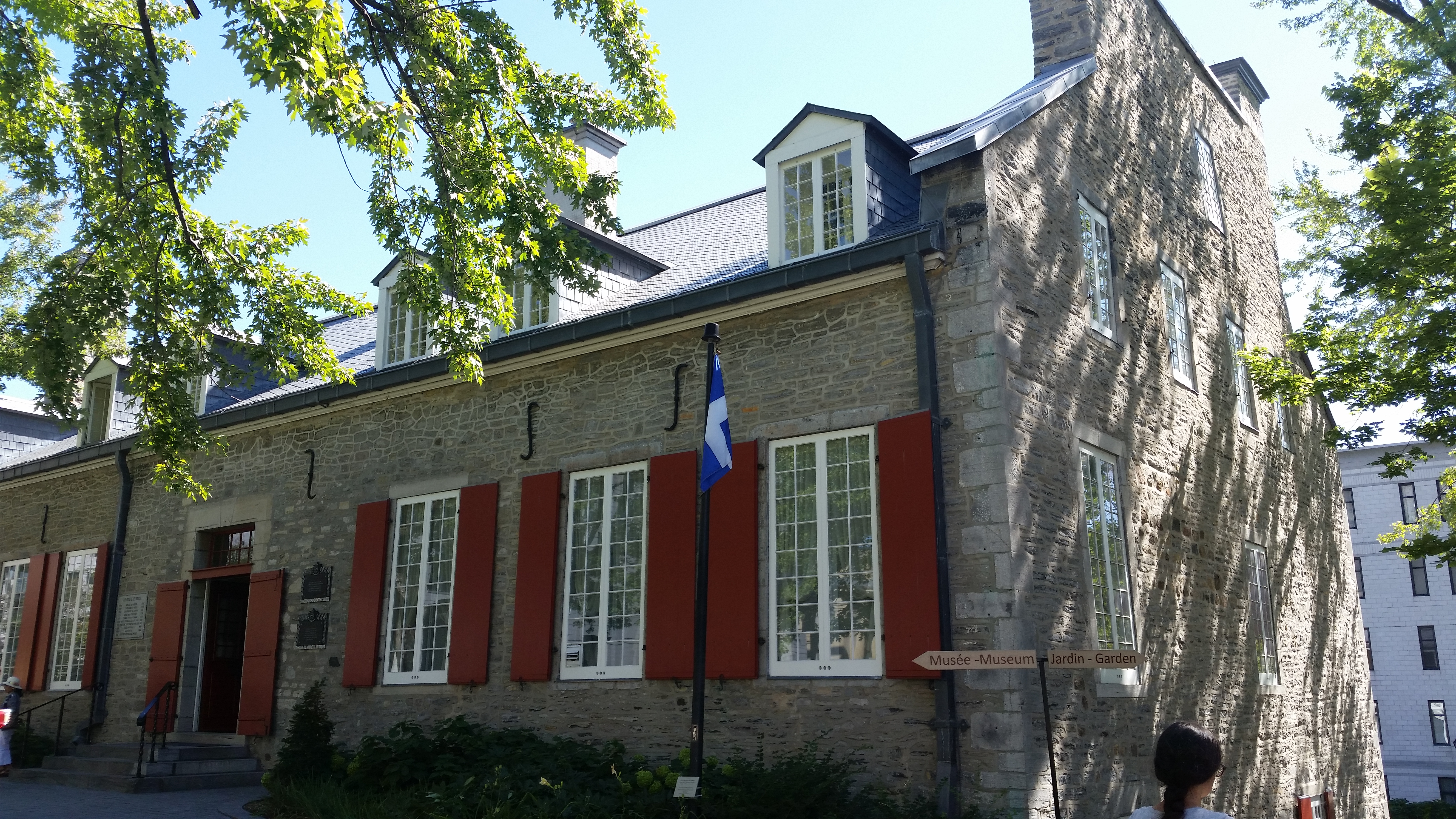
The Chateau Ramezay in the center of the town became headquarters for the occupying Continental Army. In the meantime American forces were defeated at Quebec on December 31, with General Montgomery killed.

Chateau Ramzey. Author Photo.


By spring, Montreal was under the command of Colonel Moses Hazen, a resident of the Province of Quebec. He tried to raise troops for the Continental army, but only about 500 joined his Canadian Regiment.

With about 10,000 people, Montreal was the fifth largest city in North America. While residents initially welcomed the Americans, they soon saw them as invaders and occupiers. Uncertainty about the economy, American intentions, and the defeat at Quebec all caused Canadians to gradually lose support for the Americans. For the Continental troops stationed here that winter, it must have been a dreary, cold, and depressing experience.


View of Montreal and its Walls in 1760. Image Source: Pictorial Field-Book of the American Revolution by Benson Lossing (1860).

On April 29, 1776 a delegation from the Continental Congress arrived, which included Benjamin Franklin, Samuel Chase, Charles Carroll, and Carroll’s cousin, John Carroll, Catholic priest. It was hoped that a priest would give the American cause more legitimacy with the Canadians. Upon arriving, General Arnold had his troops salute the Congressional delegation.

Charles Carroll wrote, “On our landing, we were welcomed by General Arnold in the most courteous and friendly manner and conducted to the headquarters where a society of women and gentlemen of distinction had assembled. As we were on our way from our landing site to the General’s house, the cannon of the citadel thundered in our honour as commissioners of the Congress.”

It was all a failure. The Canadians were unwilling to throw off British rule, which guaranteed religious freedom and protection of their language and culture. On May 11, 1776, Franklin departed, saying it would have been easier if the Americans had tried to buy Canada than invade it.

Arnold and his troops occupied Montreal until June 15, when British forces advancing from Québec forced their evacuation. For seven months, the largest town in Canada was under American military occupation.

Today one of the few reminders of the American occupation is the Chateau Ramezay, built in 1705. It had been the Governor’s mansion during British rule and was the seat of Government until 1849. It is now a museum. Also visible are the old stone walls that surrounded the city. These fortifications defended the town in 1763 during the French and Indian War, and again in 1775 and 1776.

Eighteenth century fortifications at Montreal. Author Photo.

The Adams Family Memorials in Quincy’s Merrymount Park

I want to take a moment to give a shout out to the Quincy Historical Society in Quincy, Massachusetts.

For my upcoming ERW Series book on John Adams in the Revolution, Atlas of Independence, I included an appendix that highlights a number of Adams-related sites in his hometown of Quincy: his birthplace; the home he first lived in with Abigail; his later-in-life home, Peacefield; the “Church of the Presidents,” which includes his crypt; and several other cool spots.

One of the places I direct people is to Merrymount Park, which features two monuments to Adams and members of his family. The newer of the two consists of a statue of John that stands across a small plaza from a dual statue of Abigail and a young John Quincy. The distance symbolizes the distance between John and his family for much of his public life.

Sculptor Lloyd Lillie created the Abigail and John Quincy statues first, in 1997. They stood together in downtown Quincy along Hancock Street. John was installed across from them in 2001, separated by traffic. When the city redesigned downtown and created the new Hancock-Adams Commons in 2022, the statues were relocated to Merrymount Park to join an older monument already standing there.

That older monument was a little harder to investigate.

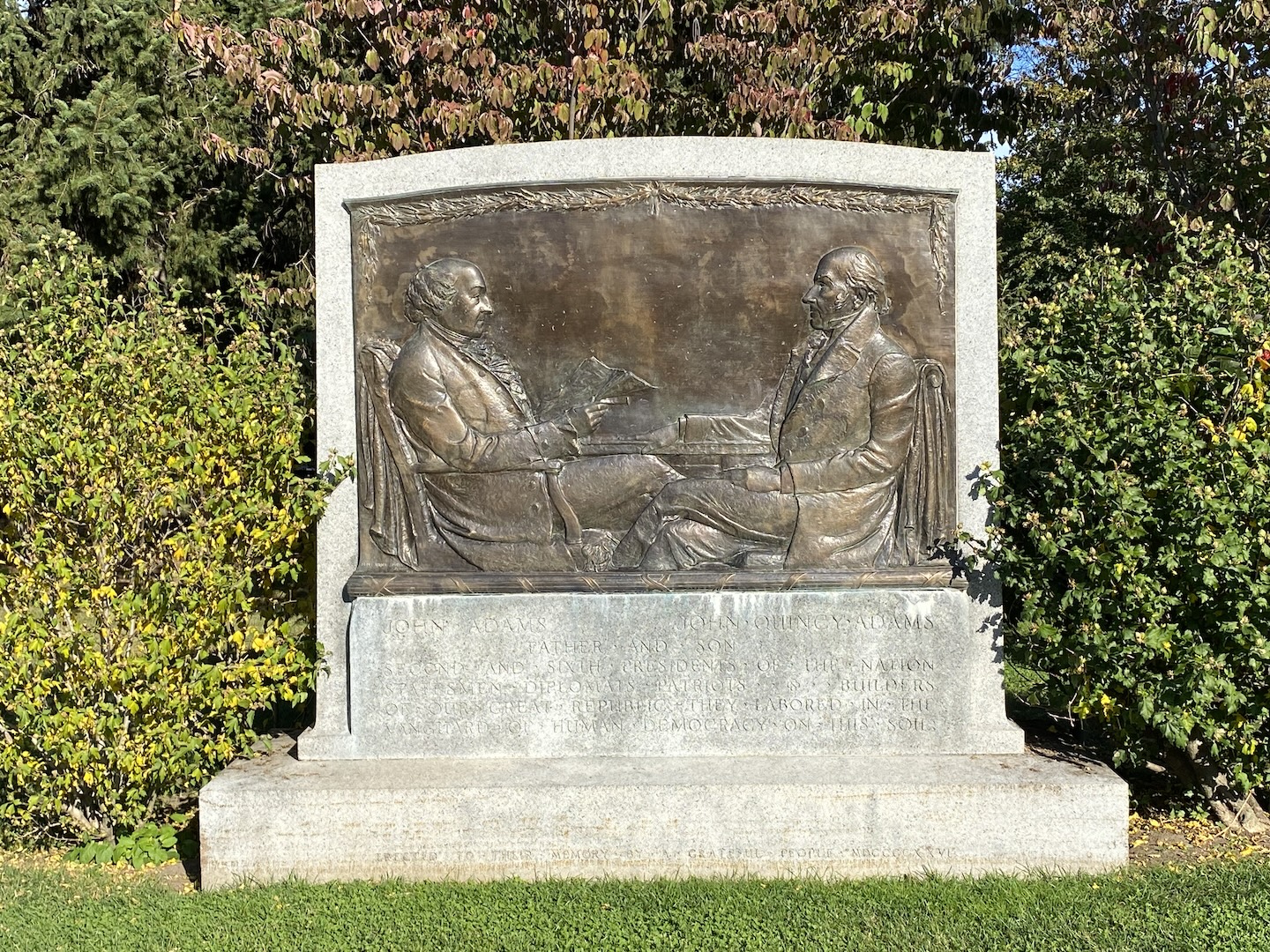
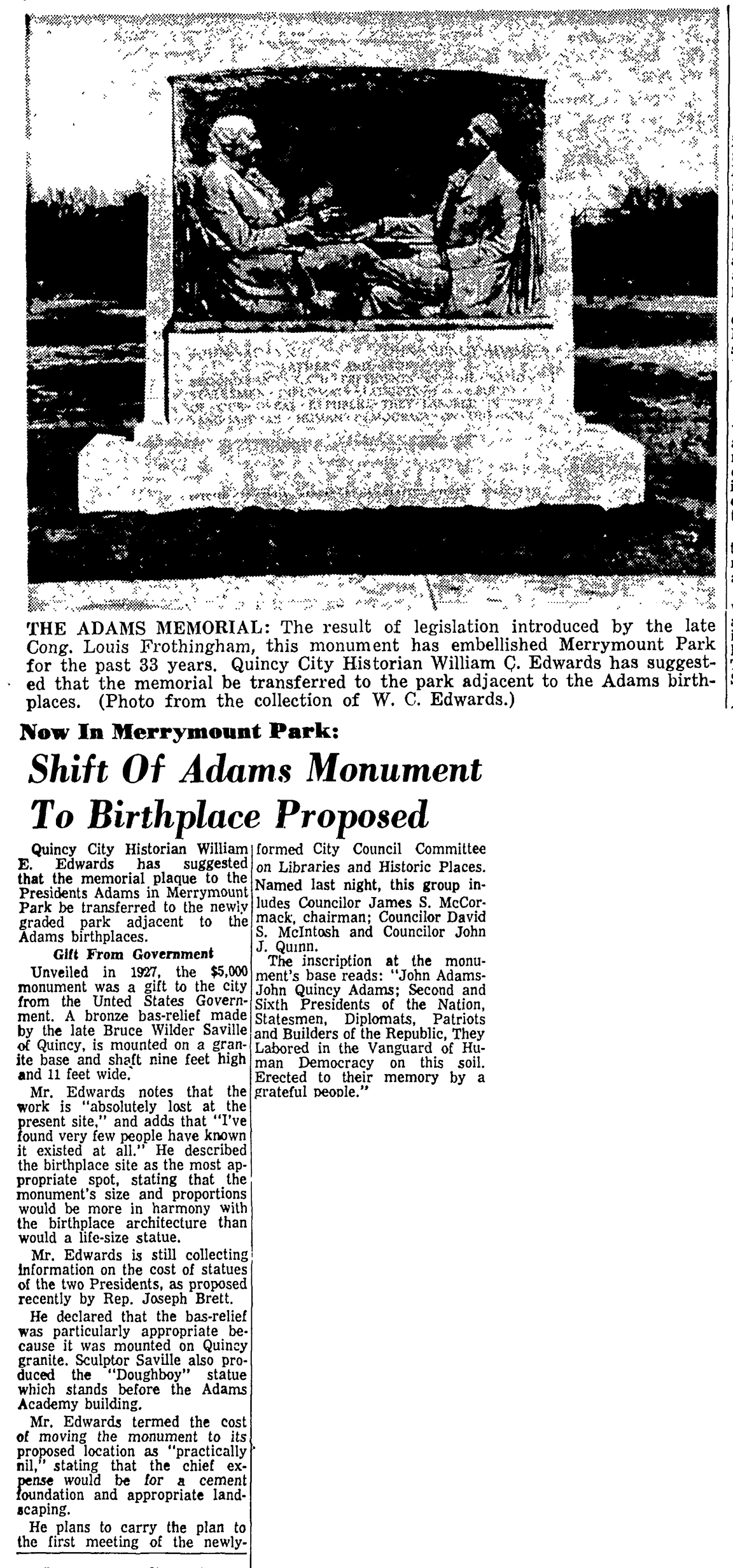
The monument itself is made from Quincy granite, a longtime staple of the local economy. A bas relief bronze tablet mounted on the granite shows John and an adult John Quincy—both as presidents—seated together for an imagined conversation with each other. An inscription reads: “Father and Son, Second and Sixth Presidents of the Nation, Statesmen, Diplomats, Patriots, and Builders of our great Republic, they labored in the vanguard of human democracy on this soil.”

Beyond that, I knew the memorial had once been moved to the site where the John and John Quincy birthplaces stand along Franklin Street, but I didn’t know when and I didn’t know when the monument came back to Merrymount. I couldn’t even find the year of the monument’s dedication or the name of the sculptor. The internet didn’t seem to know these things, and none of my reference materials referenced them.

And so it was that I reached out to the Quincy Historical Society to see if they might have anything in their archives that could help me out.

Archivist Mikayla Martin went above and beyond to assist, sending me a neat little bonanza of stuff! Since she sent me more material than I had room for in the book, I thought I’d take the opportunity to share my windfall here so that you, too, could benefit from the Quincy Historical Society’s kindness.

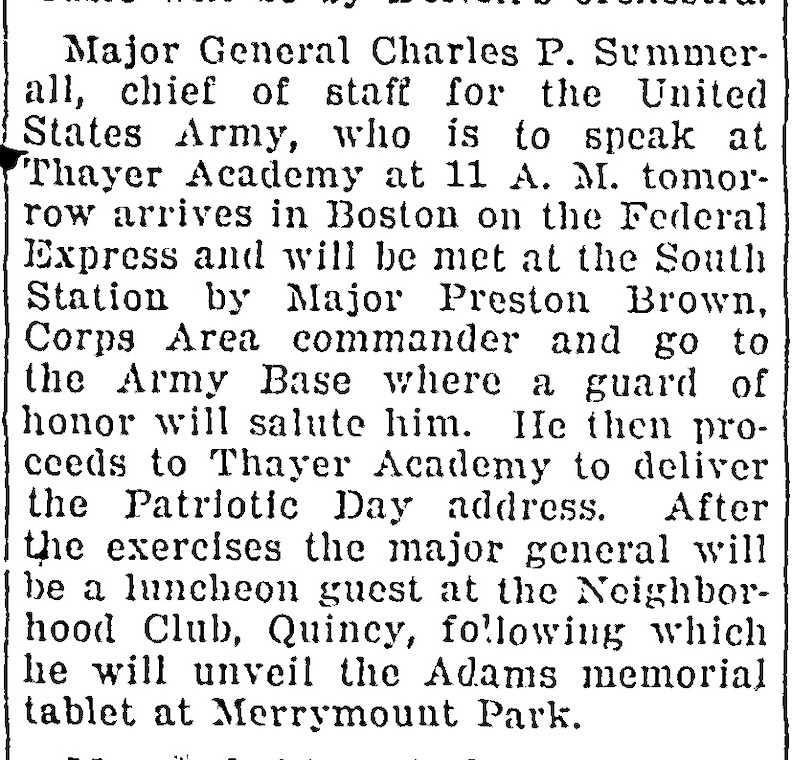
The memorial, as it turned out, was dedicated in 1927. The chief of staff of the United States Army at the time, Maj. Gen. Charles P. Summerall, served as master of ceremonies for the event, according to a clipping from the Patriot Ledger the historical society sent me:

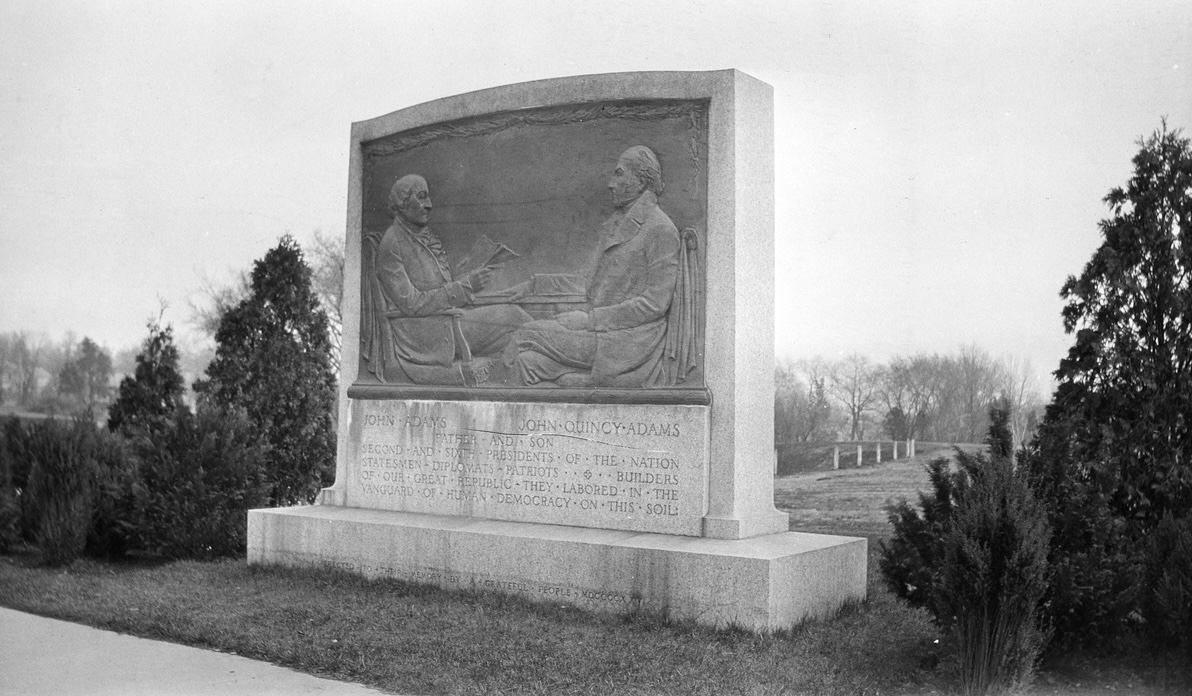
Photographer Warren S. Parker captured this image of the Adams Memorial on April 18, 1929. (courtesy of the Quincy Historical Society)

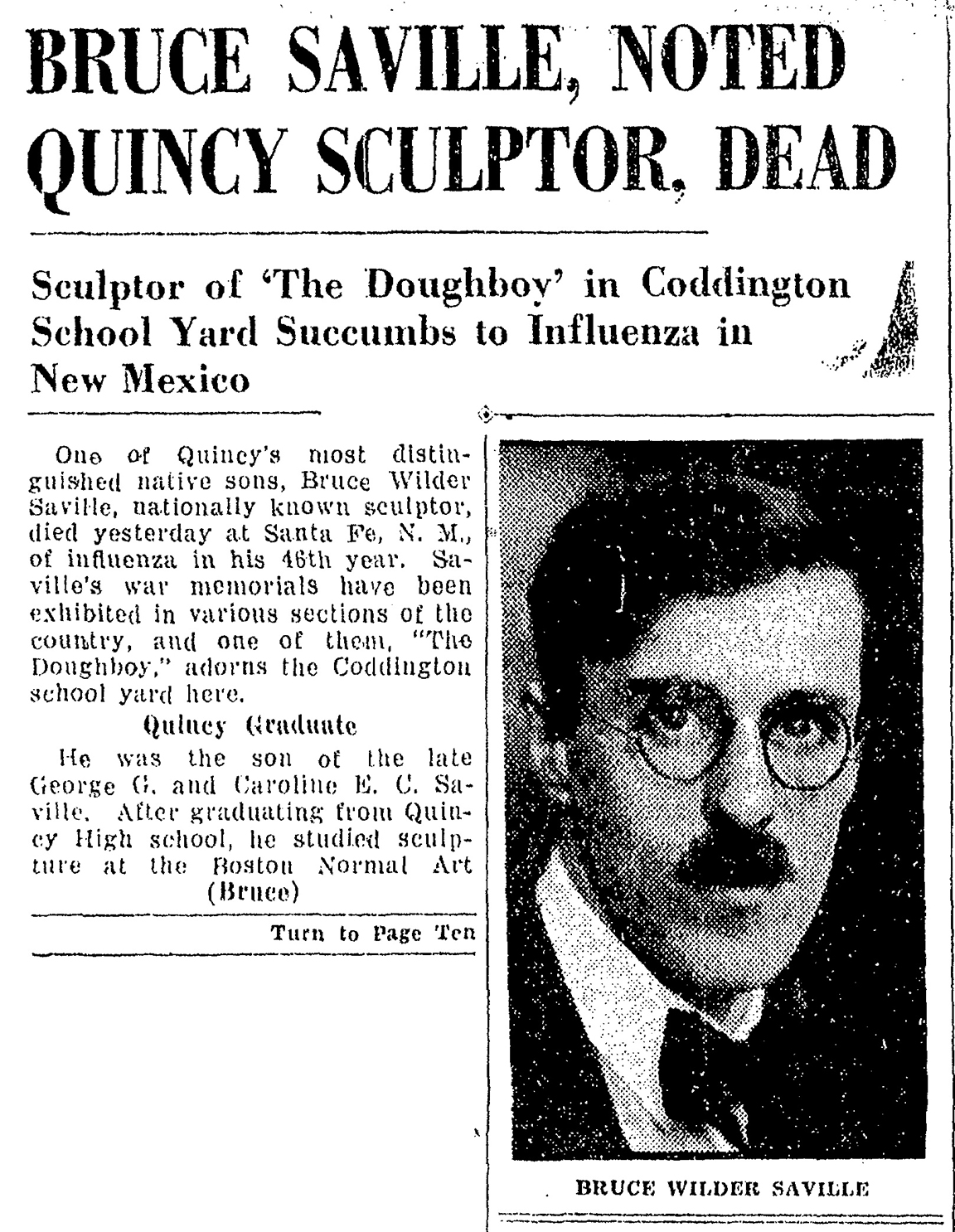
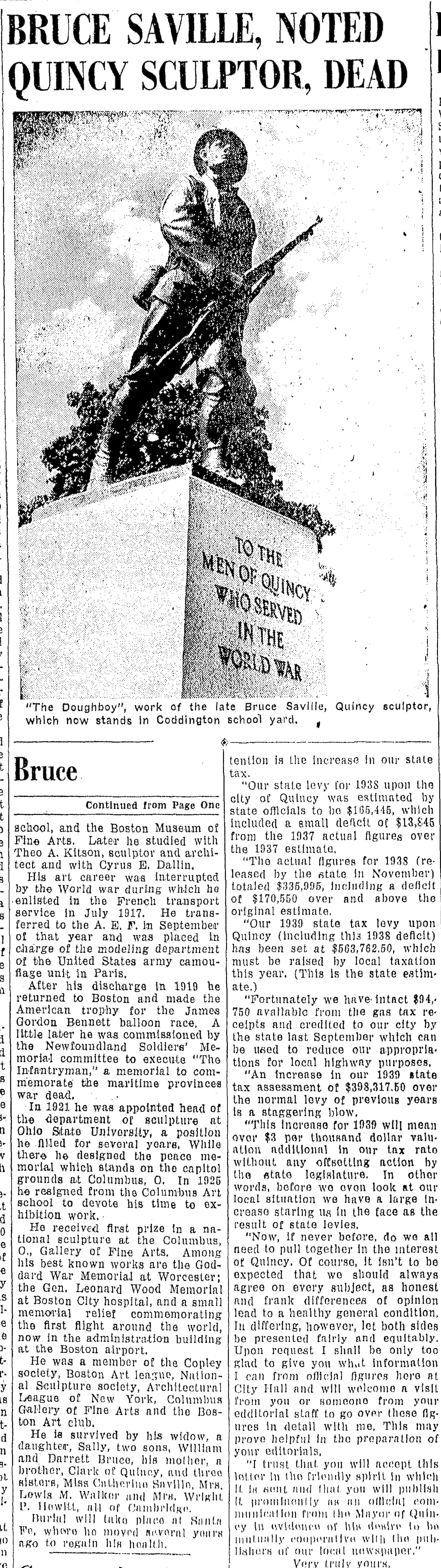
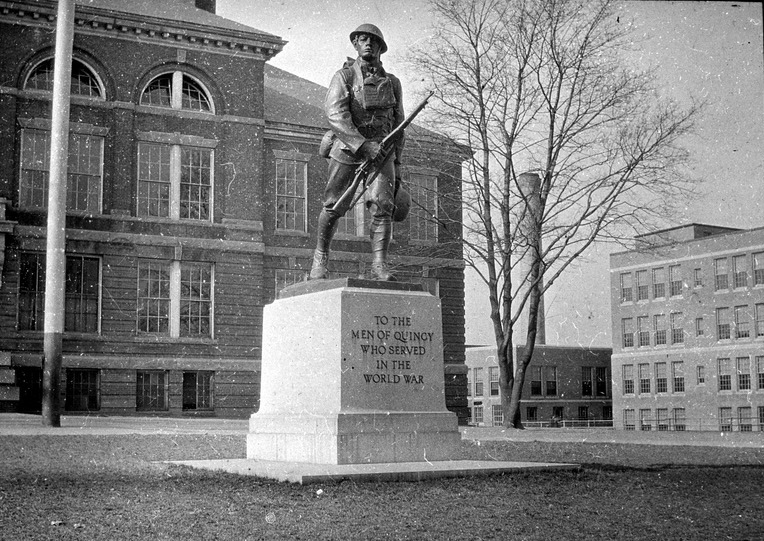
The Patriot Ledger hailed the memorial’s sculptor, Bruce Wilder Saville, as “One of Quincy’s most distinguished native sons.” Saville was best known in town for another of his works, the WWI “Doughboy” Memorial that stood in front of the Coddington School. The Quincy Historical Society included Saville’s obituary from the Patriot Ledger, which I’ll reproduce below, along with a photo of the Doughboy Memorial that the society sent me.

Another newspaper clipping revealed that the $5,000 memorial was a gift to the city of Quincy from the U.S. government. In 1961, city leaders voted to move the monument to the Adams birthplaces, but when the NPS took over management of the site 1979, the city returned the monument to Merrymount Park. I’ll reproduce a newspaper article related to that, as well (see below).

Every monument and memorial has a story of its own, and I find those stories fascinating. They can tell us a lot about the people they honor as well as the people who are doing the honoring.

Please consider supporting your own local historical society (and, if you’re so inclined, please consider supporting the Quincy Historical Society while you’re at it). Organizations like this provide invaluable services to researchers everywhere, but more importantly, they carry the torch for the history in your own back yard.

“Void of Common Sense” George Washington and Guy Fawkes Day, 1775

In November 1775, as the American colonies were deep in rebellion against Britain, General George Washington faced not only the British army but also the task of shaping a new American identity. One revealing moment came on November 5, 1775, when Washington, then commander-in-chief of the Continental Army, issued an order forbidding his soldiers from celebrating Guy Fawkes Day, also known as Pope’s Day in colonial New England. This event—often overlooked in histories of the Revolution—offers insight into Washington’s leadership, his moral sensibilities, and his vision for the cause of American independence.

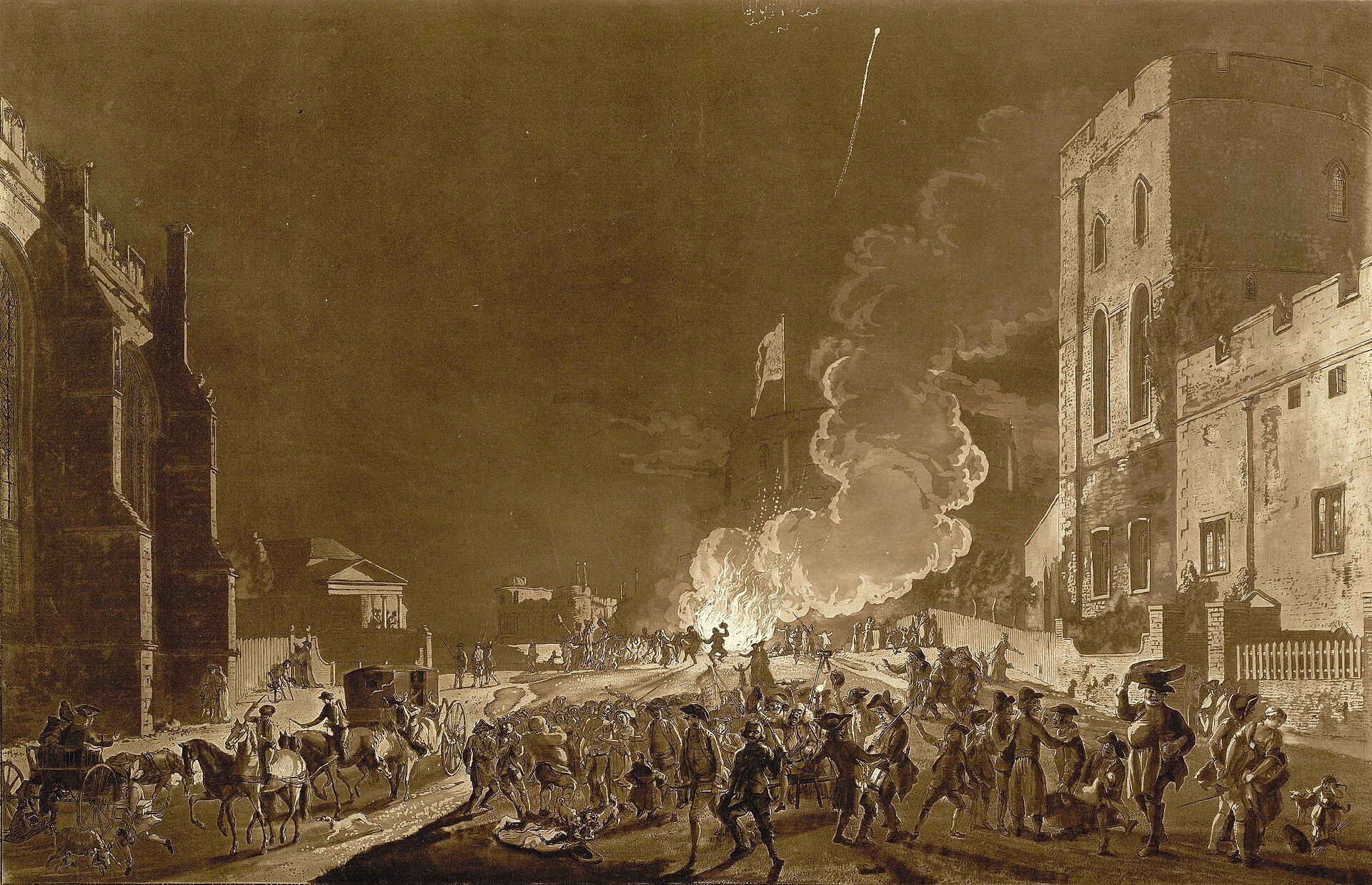
Guy Fawkes Night at Windsor Castle, 1775

Guy Fawkes Day had long been an English and colonial holiday commemorating the failed Gunpowder Plot of 1605, when Catholic conspirator Guy Fawkes attempted to blow up Parliament and assassinate King James I. In Protestant England and its colonies, November 5 became a day of noisy anti-Catholic demonstrations, bonfires, and the burning of effigies of the Pope and Fawkes. In Boston and other colonial towns, rival street gangs—often from the North and South Ends—would parade effigies, fight, and engage in destructive celebrations. It was, in short, a day of raucous Protestant triumphalism and sectarian hatred.

By 1775, however, the American Revolution had changed the stakes. The Continental Army, drawn from thirteen diverse colonies, was fighting not merely as British subjects in revolt but as Americans united against tyranny. Washington recognized that this unity could not rest on religious prejudice. Moreover, the colonies were seeking crucial support from Catholic France and from Catholic Canadians in Quebec. Anti-Catholic displays risked alienating potential allies. Thus, on November 5, 1775, Washington issued a General Order that firmly condemned the planned festivities.

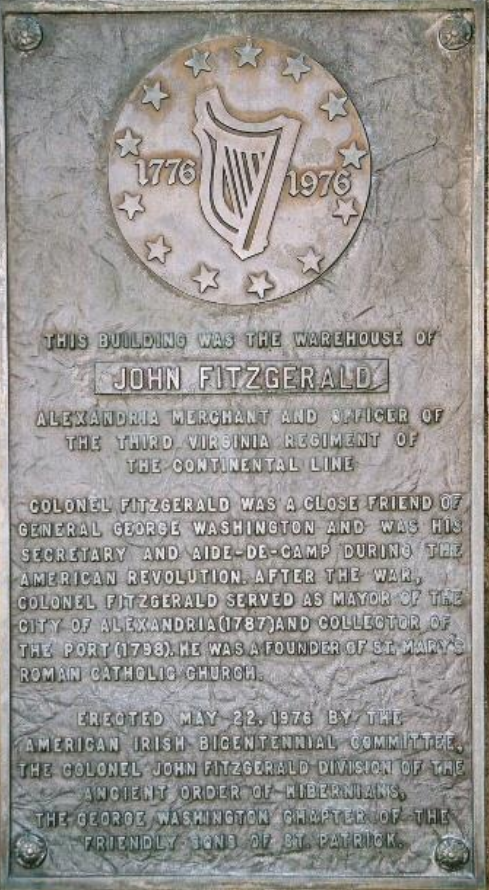
John Fitzgerald, an Irish Catholic immigrated to Alexandria in 1773. He became good friends with Washington and like many other Catholics, provided great service to Washington. For a time he served as an aide-de-camp to Washington.

Washington’s order read, in part, that “at such a juncture, and in such circumstances, to be insulting their religion is so monstrous, as not to be suffered or excused.” He called on his troops to remember that “we are contending for the rights of mankind” and that the cause required dignity and respect for all faiths. The general’s tone combined moral rebuke with strategic foresight. By discouraging Pope’s Day, he sought to replace narrow sectarian loyalties with a broader, inclusive patriotism.

This moment also reflects Washington’s character and leadership style. He understood the importance of discipline and order in an army composed largely of volunteers. The elimination of destructive, drunken celebrations helped reinforce his insistence on professionalism. But more importantly, Washington saw the American cause as grounded in universal principles of liberty and justice—principles incompatible with the kind of bigotry Pope’s Day embodied.

In retrospect, Washington’s handling of Guy Fawkes Day in 1775 stands as an early statement of religious tolerance in American political life. His decision to forbid anti-Catholic celebrations prefigured later American commitments to freedom of conscience and the separation of church and state. What might have seemed a minor disciplinary order was, in fact, a symbolic act of leadership: it transformed an old English custom of division into an American lesson in unity. Through it, Washington began to shape not just an army, but a nation.

The Patriot Martyrs of April 19, 1775

Yesterday marked the 250th anniversary of the first battles of the American Revolution.  The Battles of Lexington and Concord were brutal and vicious.  More than 40 American colonists were killed in the fighting.  These were the first martyrs in the cause for American liberty.  Here are the stories of some of those men who shed their blood on that fateful day for our freedom.

Jonathan Harrington was one of the few dozen men in the Lexington militia who stood on the Lexington Green when the first British troops arrived at sunrise on April 19, 1775.  He lived with his wife and child in a home that was located on the Green.  After a shot was fired, the British soldiers opened fire on the American militiamen.  As they were dispersing, Harrington was shot through the chest.  He crawled towards his house and died within sight of his home.  Local legend says he crawled to his own doorstep and died at the feet of his wife and child.

Sign on the Harrington house which still stands in Lexington, MA today.

Isaac Davis was the captain of the Acton minutemen. The Acton minutemen marched more than 5 miles to Concord in the early morning hours of April 19.  After seeing smoke from the town, the minutemen marched down towards the North Bridge and the British soldiers guarding the opposite side fired a volley at the minutemen.  This volley was high and may have been a warning shot.  The next volley was fired into the minutemen.  Private Abner Hosmer was shot through the head and killed.  Davis was shot through the chest, his blood splattering the men around him.  Seconds later the American colonists were given the command to fire on British soldiers for the very first time.

The Acton Monument stands over the graves of Isaac Davis, Abner Hosmer, and James Hayward.

James Hayward was part of the Acton company that joined in the running battle back towards Boston.  During the battle soldiers from both sides stopped to get water at local wells.  At one point a British soldier went to the well by the Fiske house to get a drink of water.  At the same time, Hayward was heading there too.  The two saw each other and raised their muskets.  The British soldier said, “You are a dead man!” Hayward replied, “So are you.” They both fired at the same time. The British soldier was killed instantly.  Hayward was hit, with splinters of his powder horn going into his side.  He died not long after.

The site of the Fiske well, where James Hayward and a British soldier died.

Jason Russell was a 58-year-old man living in the village of Metonomy (present day Arlington, Massachusetts) and was preparing to defend his home on the road back to Boston. People were telling him to leave the area, but Russell refused and exclaimed “An Englishman’s home is his castle!” As the British column came down the road, Russell and a dozen militiamen began to fire into redcoats.  Unfortunately for Russell and the other militiamen, the British had deployed flankers to clear out many of the houses along the road.  The colonists were taken by surprise and retreated into the house.  Russell was unable to run and was bayonetted to death by the British troops on his front doorstep.  The British entered the house and hand to hand fighting occurred inside the house.  Two British soldiers and eleven militiamen were killed.

A painting depicting the death of Jason Russell at the Jason Russell House (Arlington Historical Society)

Jason Winship and Jabez Wyman decided to sit in the Cooper Tavern and have a drink.  The fighting in Metonomy became extremely brutal.  Even unarmed civilians got caught up in the carnage.  As British arrived at the Cooper Tavern, the tavern owners fled into a cellar.  Winship and Wyman did not stand a chance. The owners noted that: “the King’s regular troops under the command of General Gage, upon their return from blood and slaughter, which they had made at Lexington and Concord, fired more than one hundred bullets into the house where we dwell, through doors, and windows,…The two aged gentlemen [Winship and Wyman] were immediately most barbarously and inhumanly murdered by them, being stabbed through in many places, their heads mangled, skulls broke, and their brains out on the floor and walls of the house.”

Samuel Whittemore was a 78-year-old man who lived in Menotomy.  He prepared to fight the British troops marching along the road.  He carried a musket, two pistols and a sword.  As some British soldiers moved to get Whittemore, he shot one with his musket, then killed two with his pistols and then drew his sword to fight them.  The British soldiers shot off part of his face off, clubbed him and bayoneted him fourteen times, leaving him for dead. Amazingly, he survived and live for another eighteen years, dying at the ripe age of 96.

A monument for Smauel Whittemore in Arlington, MA.

One of the last people to die that day was 65-year-old militiaman James Miller.  As the British were making it back to Charlestown, James Miller and some men fired into the retreating soldiers.  British soldiers ran towards the militia.  Miller’s compatriots fled and entreated him to do the same.  Miller replied, “I am too old to run.”  The British opened fire and killed Miller.

These stories are only a few of the dozens who died that day.  You can find these and many other stories (and where they happened!) in “A Single Blow” by Robert Orrison and Phill Greenwalt, one of seven books that are part of the Emerging Revolutionary War book series published by Savas Beatie.

Today the remains of the men who were killed on Lexington Green now lie there under a monument that was erected in 1799, not long after the successful conclusion of the Revolutionary War.  The epitaph on that monument still speaks to the heroism and valor of these first Americans to fall in the Revolutionary War:

“The Blood of these Martyrs,
In the cause of God & their Country,
Was the Cement of the Union of these States, then
Colonies; & gave the spring to the spirit. Firmness
And resolution of their Fellow Citizens.
They rose as one man to revenge their brethren’s
Blood and at the point of the sword to assert &
Defend their native Rights.
They nobly dar’d to be free!!”

Review: “The Ride: Paul Revere and the Night That Saved America” by Kostya Kennedy

“LISTEN, my children, and you shall hear
Of the midnight ride of Paul Revere,
On the eighteenth of April, in Seventy-five”

Henry Wadsworth Longfellow penned the poem, “Paul Revere’s Ride” in 1860. Now as America moves toward celebrating the 250th anniversary of Paul Revere’s famous ride, which happened on this date in 1775, another literary work has hit the market on this very topic.

Published on March 25 by Kostya Kennedy, Chief of Premium Publishing at Dotdash Meredith, with a lengthy career in writing, teaching, and journalism. The book reads like Revere’s ride, a fast-paced, descriptive overview of the man, events, and memories around the night of April 18, 1775. For those who have read David Hackett Fischer’s book, published in 1994, you may not find anything groundbreaking or new. However, that is not the point I feel in this book.

Kennedy pens this to get the reader hooked. Sets of rhetorical questions, “what-if” scenarios, and descriptive writing make the reader feel that they are in the environs of Boston or on the routes to Lexington traversed by Revere. Oh, and Kennedy does not forget Dawes, Prescott, and others who also played prominent roles in April 1775.

History enthusiasts and content experts may find a few shortcomings and errors, such as Kennedy continuing to use “Royal” when discussing the British Army. Since the English Civil War, the British Army has lost the right to use “Royal” in front of it. A few times, he labels the “British” as coming when the colonists would have used “Regulars” or “Redcoats.” Lastly, falling into the ag-old myth that Lexington had minutemen and a militia, the town just had the latter. Trivial things that do not impact the flow of the narrative.

A highlight to me, though, is the final sections about the memory of that day. Including a great insert of an interview with the direct descendant of Paul Revere and a comical anecdote about Paul Revere III being pulled over for speeding in Lexington, Massachusetts one year on April 18.

The book is a great read on the anniversary of Paul Revere’s Ride. Take it from me, I read the book in a day! Descriptive, vivid, and convince you that if you have not been, a trip to Boston and the Massachusetts countryside should be in your near future.

Published by: St. Martin’s Press, March 25, 2025
Images, sources, 282 pages

On this date…The Jay Treaty

On this date in history…

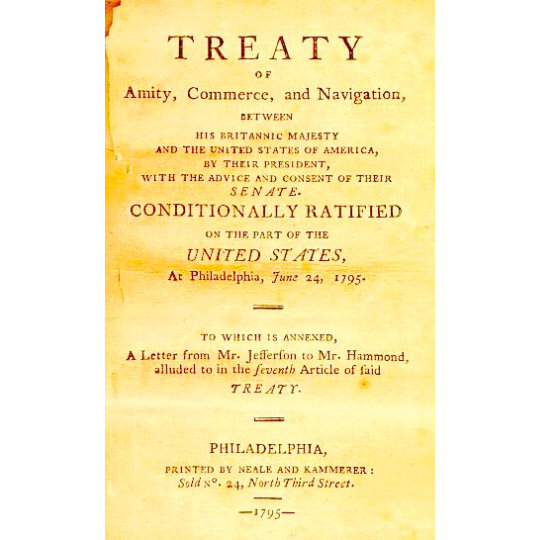
On November 19, 1794, John Jay, representing George Washington’s administration, affixed his signature to a document bearing his name in history. The Jay Treaty. Although the official name of the pact was “The Treaty of Amity, Commerce, and Navigation, Between His Britannic Majesty and the United States of America.”

The treaty’s aim was to resolve outstanding issues from the conclusion of the American Revolutionary War and facilitate economic trade. Although some of the clauses were not fulfilled completely and another war, the War of 1812, erupted because of it, the treaty did serve a purpose. The agreement ushered in a decade of trade between the two countries and gave the fledgling nation a chance to gain footing, a major concern for George Washington, as first president. The treaty also cemented the promise that Great Britain would vacate the forts in the Northwest Territory and agreed to arbitration on the boundary between Canada and the United States and the pre-American Revolutionary War debt.

Yet, the treaty was divisive. Even Jay remarked that he could find his way in the dead of night by the illumination of his own effigy. The treaty angered the French as that country was amid its revolutionary throes, and bitterly divided the nation. Out of it came the separation into two political parties, the Federalists, who supported the treaty, and the Democratic-Republicans who stood opposed to it.

The treaty was ratified by the Senate on June 24, 1795, with an exact two-thirds majority, 20 to 10 along with being passed by William Pitt the Younger, prime minister of Great Britain and his government, and took effect on February 29, 1796.

Historian Joseph Ellis wrote that the Jay Treaty was “a shrewd bargain for the United States” and “a precocious preview of the Monroe Doctrine.” As one of Washington’s most fervent wishes, the treaty “postponed war with England until America was economically and politically more capable of fighting one.”

Touring the Sites of Lexington and Concord

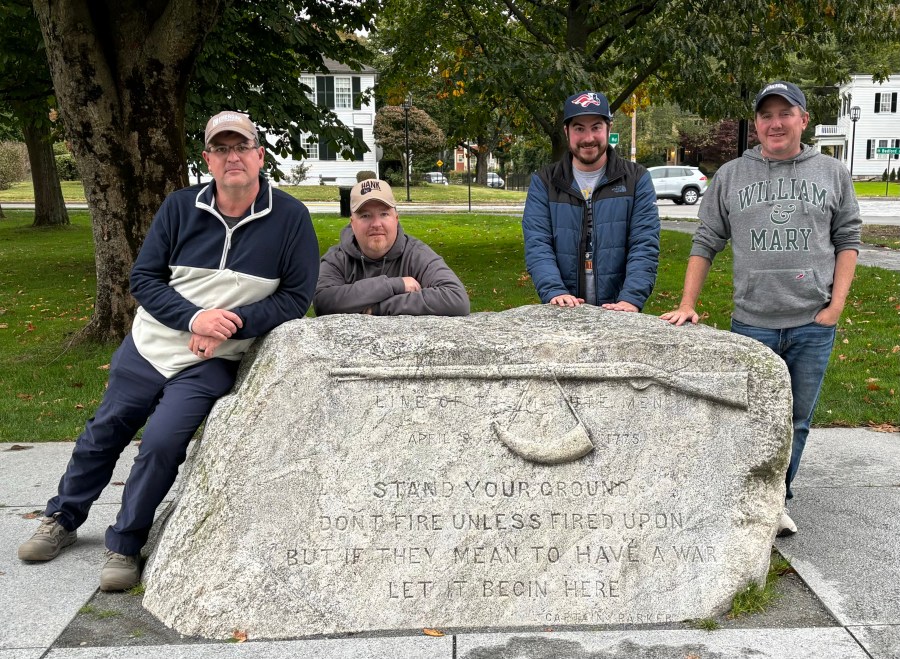
Last weekend, Emerging Revolutionary War wrapped up our fourth annual bus tour. Our previous tours covered Trenton, Princeton, Monmouth, Valley Forge, and Charleston. This year we went to where the whole war started: Lexington and Concord on the eve of the 250th anniversary of the battles. We had a jam-packed weekend with a fully sold out 56 passenger bus. As most places close down in November in Massachusetts, we chose to move this year’s tour from our usual Veterans Day weekend, to Columbus Day weekend. Here is a brief overview of how the weekend went:

Continue reading “Touring the Sites of Lexington and Concord”

Announcing our 2025 ERW Bus Tour…. Philadelphia Campaign of 1777 with Michael Harris!

We are excited to announced our FIFTH annual ERW bus tour will be on November 7-9, 2025 and will cover the 1777 Philadelphia Campaign.

Author and historian Michael Harris will join us as we cover the fall of 1777 campaign. The British Army under Gen. William Howe made a concerted effort to take the American capital of Philadelphia. George Washington and the Continental Army fought major actions at Brandywine and Germantown in an effort to hold and take back the city. The tour will cover sites associated with the Philadelphia Campaign, such as Brandywine, Germantown, Paoli and others.

Tickets are $250 per person and will include Friday night lecture at the host hotel, all day bus tour on Saturday and half day bus tour on Sunday. A lunch is included for Saturday.

Our host hotel is the Holiday Inn Express and Suites – King of Prussia. Lodging is NOT included in the registration fee. A room bloc has been established under the name of “Emerging Revolutionary War.” A link will be provided in the future for hotel lodging.

Join us for our FIFTH annual tour as we take on the beginning of the American Revolution just a few months before the 250th anniversary. Learn about the dramatic events that led to some of the bloodiest days in the American Revolution. There is no better way to experience history than to stand in the footsteps of where it happened!

To register, visit: https://www.eventbrite.com/e/battles-for-the-capital-1777-philadelphia-campaign-bus-tour-tickets-1048228358237?aff=oddtdtcreator

For more questions, please email emergingrevolutionarywar@gmail.com.

“Boston Harbor a Teapot this Night!”

With three ships sitting at Griffins Wharf in Boston Harbor laden with tea, the Sons of Liberty were quickly running out of time on December 16, 1773. At the stroke of midnight, twenty days would have past since the first ship arrived in the harbor. At that time, customs officials would seize the cargo, the tax would be paid, and the British government would have been successful in forcing the colonists to pay a tax they did not consent to. The British would have demonstrated their power over the colonists. The colonists’ rights as Englishmen were at stake. Whereas the tea cosignees had resigned in New York and Philadelphia, the ones in Boston refused to resign and the Governor was refusing to allow the ships to leave the harbor.

On December 16, the leaders of Boston held a meeting they referred to as the “Body of the People.” Because of the large amount of interest in the issue, more than 5,000 people attended this meeting at the Old South Meeting House in Boston (the largest venue in the city). At the meeting was William Rotch, the owner of the ship Dartmouth which was the first ship to enter the harbor and would be the first to be seized by the customs officials on December 17. Rotch wanted to protect his property and see if the Governor would allow him to sail out of the harbor. The meeting recessed to let him go to the Governor outside of Boston and request the ability to leave the Harbor. Governor Hutchinson said he could not allow the Dartmouth to leave. After the meeting had reconvened in the Old South Meeting House, Rotch returned to Boston at about 6 p.m. and told the crowd that the Governor would not let the tea return. This news was responded to with loud cries and shouting.

At that moment, Samuel Adams declared “This meeting can do nothing further to save the country.” After saying this, people heard Indian war whoops coming from the crowd and outside the building. Another person declared “Boston Harbor a teapot this night!” The people then began exiting the building and heading down to Griffins Wharf a few blocks away. Down at the wharf, men (some disguised as Mohawk Indians) began boarding the three ships. Approximately one hundred men boarded the ships and quickly got to work pulling up the large tea chests to the decks and dumping the tea into the cold water below. Crowds gathered and watched the men work for nearly two hours as they methodically worked to destroy all the tea on board the ships.

The men were careful to not destroy any other property except the tea. They also refused to steal any of the tea, punishing anyone who made an attempt. It was low tide and the tea started to pile up out of the water and needed to be mashed down into the water and mud.

British regulars were stationed at nearby Castle William, but they were not called down to the ships out of fear of insitigating a similar event as the Boston Massacre that occurred three years earlier. The British navy, posted in the harbor also made no attempt to stop the destruction. Some Royal Navy sailors watched the events on Griffins Wharf with some trepidation.

Once all 342 chests of tea had been tossed overboard, the destroyers left and the crowd dispersed. In all, they had destroyed 46 tons of tea on the ships.

The event would have major repurcussions as the British determined to repsond to the event with brute force and would ultimately result in the Revolutionary War less than two years later. John Adams wrote: “This Destruction of the Tea is so bold, so daring, so firm, intrepid and inflexible, and it must have so important Consequences, and so lasting, that I cant but consider it as an Epocha in History.”

Learn more about the events happening to commemorate the 250th anniversary of the Boston Tea Party by visiting https://www.december16.org/.

You can learn more about Boston in the Revolutionary War by reading Rob Orrison and Phill Greenwalt’s book A Single Blow, part of the Emerging Revolutionary War book series.

“Rev War Roundtable with ERW” Brandywine Campaign

The largest, in terms of military forces deployed, engagement in the American Revolutionary War occurred on September 11, 1777 in southeastern Pennsylvania. The Battle of Brandywine was a pivotal moment in the British campaign that captured the patriot capital in Philadelphia. With the anniversary of the engagement happening the Friday before, the Emerging Revolutionary War crew will make this engagement and campaign the focal point of Sunday’s “Rev War Roundtable with ERW.”

Joining the “Rev War Revelry” this Sunday, at 7pm on Emerging Revolutionary War’s Facebook page will be Michael C. Harris, historian and author of Brandywine: A History of the Battle that Lost Philadelphia but Saved America, September 11, 1777, which was published and is available for purchase by Savas Beatie. Click here to order.

Besides authoring the history mentioned above, Harris has an upcoming release, on another important battle in Pennsylvania, Germantown, fought on October 4, 1777. Rumor on the street has it that he will be joining ERW at a future date to discuss this important battle and talk about his new book.

A bit of a background on Harris. He is a graduate of the University of Mary Washington and the American Military University. He has worked for the National Park Service in Fredericksburg, Virginia, Fort Mott State Park in New Jersey, and the Pennsylvania Historical and Museum Commission at Brandywine Battlefield. He has conducted tours and staff rides of many east coast battlefields. Michael is certified in secondary education and currently teaches in the Philadelphia region. He lives in Pennsylvania with his wife, Michelle and son, Nathanael.

Although the battle lost Philadelphia for the patriots, Harris does not hold back on the culprit for the setback:

“Washington failed the army, the army did not fail Washington.”

To hear the reasoning behind that emphatic quote we hope you join us this Sunday!