Prisoner of Washington and Napoleon: A Brief Sketch of Charles O’Hara

If not for his connections to some of the most famous commanders and events of 18th-century military history, British general Charles O’Hara might only get a passing mention in many history books. He still hardly gets more than that.

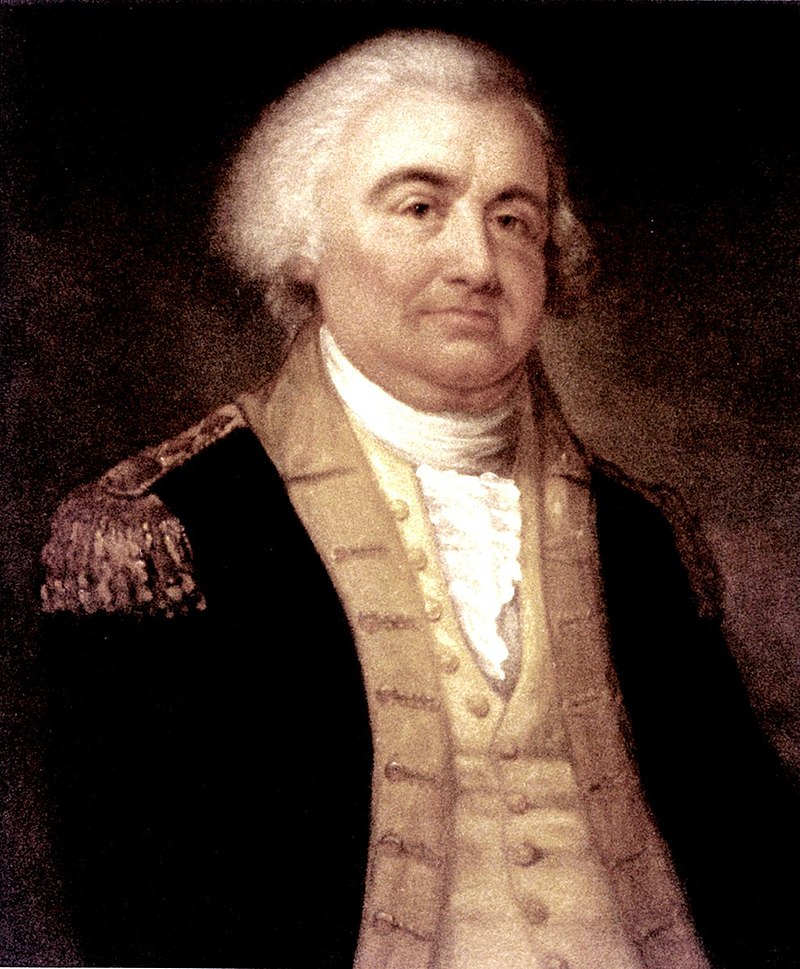
Charles O’Hara

Charles O’Hara came into this world unceremoniously as the illegitimate son of James O’Hara, a British baron. The younger O’Hara cut his teeth in military matters at the young age of 12 in the 3rd Dragoons before receiving an officer’s appointment in the Coldstream Guards. He served in an officer’s capacity in Germany, Portugal (with Charles Lee), and Africa. O’Hara was strict but liked by the men who served under him.

O’Hara’s years of military service brought him to North America in July 1778. Lieutenant General Henry Clinton appointed him to command the troops at Sandy Hook, New Jersey, to protect New York City because of his engineering skills and a recommendation from Admiral Richard Howe. Two years later, O’Hara wound up under the command of Lord Charles Cornwallis in the Southern theater. He performed ably there, leading the pursuit of Cornwallis’ army toward the Dan River in early 1781 and leading the British counterattack at the Battle of Guilford Courthouse. O’Hara led from the front and received two wounds to show for it. His nephew died during the battle.

At Yorktown, O’Hara drew the duty of surrendering Cornwallis’ army to General George Washington and Comte de Rochambeau. As the surrendering British columns approached the Allied lines, O’Hara asked to see Rochambeau. Whether this was a slight against Washington or not is unclear, but Rochambeau referred him to Washington. O’Hara apologized to Washington and explained why Cornwalls was not in attendance. Then, O’Hara handed Cornwallis’ sword to Washington, who refused it and passed O’Hara along to Benjamin Lincoln. O’Hara handed the sword to Lincoln. He looked it over, held it for a brief moment, and returned it to O’Hara. The surrender of the British army then began.

After dining with Washington following the surrender proceedings at Yorktown, O’Hara became Washington’s prisoner until receiving his exchange on February 9, 1782. He returned to England with Cornwallis’ praise and a promotion to major general. Back home in England, O’Hara fell into hard financial times from a gambling debt and ran away from them to mainland Europe. In stepped his old friend and commander Charles Cornwallis, who helped O’Hara offset the debts.

O’Hara received another promotion in 1792 to lieutenant general and lieutenant governor of Gibraltar, a post he long desired. There, misfortune found him once more when he faced the young Napoleon Bonaparte on the battlefield of Toulon. On November 23, 1793, the defeated O’Hara surrendered to Napoleon.

Labeled an insurrectionist, O’Hara found himself in prison in Luxembourg. During his nearly two years there, he befriended American Thomas Paine until his exchange in August 1795. Ironically, the man exchanged for him was the Comte de Rochambeau. He once again took the post of Governor of Gibraltar, where he died in 1802 from the effects of his war wounds suffered two decades earlier. 

Despite taking part in one of the most famous events of the Revolutionary War, O’Hara has faded into general obscurity even though he bears the distinction of being the only person to surrender to both Washington and Napoleon. 

He is featured regularly on the screen in The Patriot, but most people likely do not even know the character’s name or backstory. There is plenty more to be told in his story.

Abercrombie’s Sortie

Emerging Revolutionary War welcomes back guest historian Kevin Pawlak

On October 15, 1781, British General Charles Cornwallis penned a note to his superior officer General Sir Henry Clinton. Cornwallis told Clinton that American and French forces seized two redoubts, 9 and 10, along the York River the previous night. “My Situation now becomes very critical,” he glumly said. Before his army, entrenched outside of Yorktown, “shall soon be exposed to an Assault in ruined Works,” Cornwallis desperately sought to break the Allied stranglehold slowly bleeding his army. The general turned to Lt. Col. Robert Abercrombie to break the Allied lines anyway he could.

Map of the Allies’ Second Parallel and Abercrombie’s Sortie (from Jerome Greene, The Guns of Independence)
Continue reading “Abercrombie’s Sortie”

The Other Great Artilleryman

Mention the words “artillery” and “American Revolution” and what name instantly pops into your mind? Henry Knox.

Rightfully so.

Yet, like George Washington, Knox needed competent officers under him to successfully organize, train, lead, and develop the artillery arm of the Continental Army.

Enter John Lamb.

John Lamb
John Lamb

Born on the first day of 1735 in New York City, he was destined to rebel. The reason he was even born in New York City was due to the fact that his father, a convicted burglar had been sentenced for deportation to the colonies in the 1720s.

His early upbringing saw him become a prosperous wine merchant and he quickly ingratiated himself into the burgeoning patriot movement by becoming an integral part of the Sons of Liberty in New York City.  Continue reading “The Other Great Artilleryman”

“Rev War Roundtable with ERW” Lays Siege at Yorktown

After our sojourn to the French and Indian War last Sunday, “Rev War Roundtable with ERW” returns to the American Revolution this weekend at 7 p.m. EST. Join Emerging Revolutionary War and a guest historian as they discuss, comment, and chat about the pivotal Siege of Yorktown in 1781.

Although the war did not officially end with the capitulation of Lord Charles Cornwallis’ German and British forces on October 19, 1781, the major loss reverberated in in both the colonies and the halls of Parliament. The euphoria on one side of the Atlantic will be matched in this happy hour historian discussion, with no set agenda, and your comments, toasts, thoughts, opinions, and questions will be strongly encouraged.

Joining ERW will be Kirby Smith, formerly of Colonial National Historical Park and currently a Training Instructor for the Department of Defense. He is a 16-year veteran of the United States Army and is native of the Yorktown area. Kirby is also an expert on the Battle of Green Spring that occurred during the summer of 1781 and can be considered part of the Yorktown Campaign. This last major land battle prior to the siege featured such military luminaries as Marquis de Lafayette, Anthony Wayne, Lord Cornwallis, and the infamous Banastre Tartleton.

Besides Kirby, Kate Gruber, Special Collections Curator for the Jamestown-Yorktown Foundation and Mark Maloy a National Park Service ranger will be joining the happy hour discussion.

As we bid adieu to the month of May, let’s all grab a drink and discuss the beginning of the end of the American Revolution. We invite you to join us in our virtual tavern via our Facebook page this Sunday.

Saving 1862 Battlefield Land But Really Saving Land From the Siege of Yorktown

Emerging Revolutionary War would like to thank Drew Gruber, for bringing this connection to our attention.

During the May 5th, 1862 Battle of Williamsburg as Confederate soldiers ran down into what would be called the bloody ravine they ran headlong into men from New Jersey, New York, and Massachusetts. In an effort to push the Union soldiers out of the ravine and sweep them from the field brigade after brigade was sent into the fight. Among those was four Virginia regiments under AP Hill. After leaving the relative safely of the City they deployed in some form of a line and pitched down into the ravine too. 

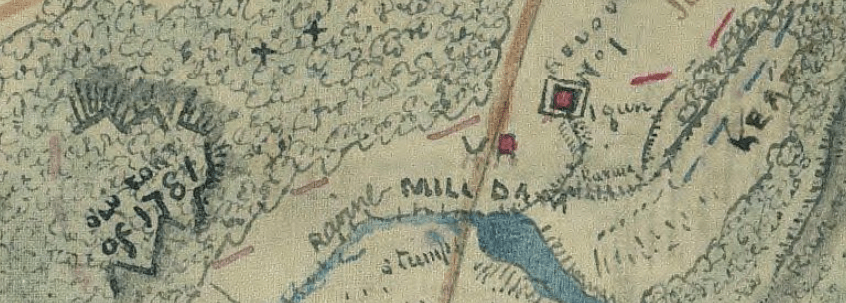
Portion of the map of the Battle of Williamsburg, showing the land the American Battlefield Trust is currently working to purchase (map courtesy of LOC)

In the ravine hand-to-hand combat, fallen trees, driving rain, and the thick smoke made communication almost impossible and command fell on company commanders to keep the battle moving in their favor. Among the men in Hill’s brigade fighting down in the bloody ravine was Tipton Davis Jennings of the 11th Virginia Infantry. His account of the fighting here at Williamsburg will be of particular interest to your readers of the ERW blog. 

Writing in 1897 his “Incidents in the Battle of Williamsburg” appeared in the Confederate Veteran Magazine. In fact Kate and I covered this in an earlier ERW post titled, Revolutionary Memory. (click here to read that post). 

“Just then,” he wrote, “we happened upon what was apparently an ancient line of grass-grown earthworks. We learned afterward that portions of Washington’s line of entrenchment were yet discernible thereabouts. And so it is possible that we ragged ‘Rebs’ were actually defending the same works were [sic] once stood the ragged continental ‘Rebs’ fighting, the hessian of Europe, as we were now, some eighty years later. So doth history repeat itself.”

At first glance is this a cool anecdote and yet rather odd. However, when you consult french maps from the Williamsburg region created during the Yorktown Campaign you’ll find references to Mulhenburg’s “lights” camped in this very area. Moreover, almost hidden in plain sight on one of Sneden’s 1862 maps is and “Old Fort of 1781.” Civil War soldiers seemed wholly cognizant of the Revolutionary landscape around them and like Jennings used it to spur on their cause(s). 

Yesterday, on the 158th anniversary of the May 5th, 1862 battle the American Battlefield Trust launched a campaign to save the 29 acres over which Jennings charged. Perhaps it is this very same ground where the original cast of “ragged continental ‘Rebs'” also campaigned. Click here to read about that initiative and for further information on how to donate.

Using the King’s Highway to Trap a King’s Army

A few weeks ago, heading to the airport after the first Emerging Revolutionary War symposium, fellow ERW historian Rob Orrison made a pit stop in a residential neighborhood in Prince William County, Virginia.

To the average traveler to the Ronald Reagan International Washington National Airport this slight detour would not be normal. Yet, for two historians of early American history, these detours are rarely common.

This particular detour took us to a portion of the King’s Highway that has been preserved by the Prince William County Historic Preservation Division. Along this stretch soldiers in the French Army under Comte de Rocambeau and Continentals under General George Washington traversed on their way to Yorktown to entrap the British under General Lord Charles Cornwallis.

Thus, one king’s soldiers, King Louis XVI took a route named for monarch to assist rebels in trapping the ground forces of another king, that of Great Britain by using a road named for the British monarch. Interesting to think about the naming of the road in those terms.

Portions of this route are still preserved today, other sections have been modernized and blacktopped to be Route 1.

Below are a few photos I snapped, including the size 14 Nike shoe belonging to yours truly, re-enacting marching down the thoroughfare like the patriots of 1781.

Sébastien Le Prestre de Vauban

Sebastien Le Prestre de Vauban, Seigneur de Vauban, and finally Marquis de Vauban, as one of his biographies begins, is probably not a household name to many enthusiasts of American history. Especially since he died on March 30, 1707 and never set foot in the Western Hemisphere. However, he did have a nephew, Jacques Anne Joseph Le Prestre de Vauban who served as General Jean-Baptiste Rochambeau’s aide-de-camp during the war. So, there is a family connection.

Sebastien_le_Prestre_de_Vauban
Sébastien Le Prestre de Vauban (courtesy of Wikipedia)

Yet, he left his mark on places like Yorktown, Virginia, fought 74 years after his death and half-a-world away. French engineers, critical to eventual American victory in the American Revolutionary War, plied de Vauban’s craft and studied his text and learned from his exploits. Continue reading “Sébastien Le Prestre de Vauban”

Press Release: Victory at Yorktown

ABT

Breaking on Friday, the 237th anniversary of the surrender of British Lord Charles Cornwallis’ surrender at Yorktown, there was another victory.

The American Battlefield Trust announced the successful acquisition of 49 acres of “hallowed ground associated with the 1781 battle.”

The full press release is at the link below!

Victory at Yorktown!

George Washington; October 17, 1781

While reading background on the siege and victory at Yorktown, Virginia in October 1781, I came across the following passage written by historian Jerome Greene.

     “The officer was then quickly escorted to Washington’s headquarters in a nearby house,       where he delivered Cornwallis’s message: “I propose a Cessation of Hostilities for 24             hours, & that two Officers may be appointed by each side, to meet at Mr. Moore’s house         to settle terms for the Surrender of the Posts of York & Gloucester.” One can only                   imagine the emotions coursing through Washington’s body as he read these words.”

That last line is what really struck me.

Every image we have of George Washington depicts a stoic expression staring back out of us. Historians have a few instances from a long life of the Washington behind the marble, behind the self-imposed restraint, that he crafted for posterity.

However, he was human, he did have a fiery temper and he was a passionate person. One of the reasons he strove so hard to mask those emotions, to keep them in check, to keep perspective, and to persevere.

Those competing inclinations would have been bubbling at the surface on October 17, 1781, when that written communication was handed to him outside Yorktown, Virginia. What that moment must have been like, for Washington, for the French and American forces, and for all those fighting in favor of American independence.

Jerome Greene wondered about it. I am curious about it. Are you?


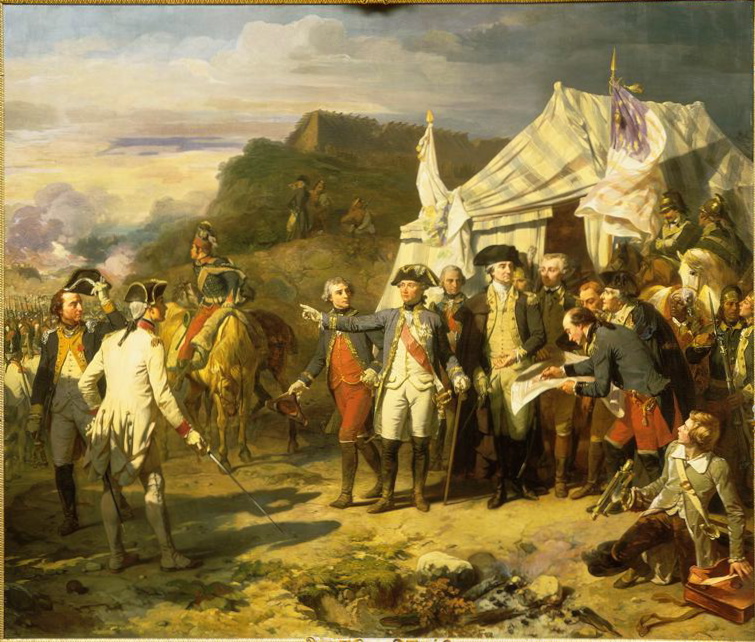
Siège_de_Yorktown_(1781)
Siege of Yorktown 1836

Three American Revolutionary War Luminaries

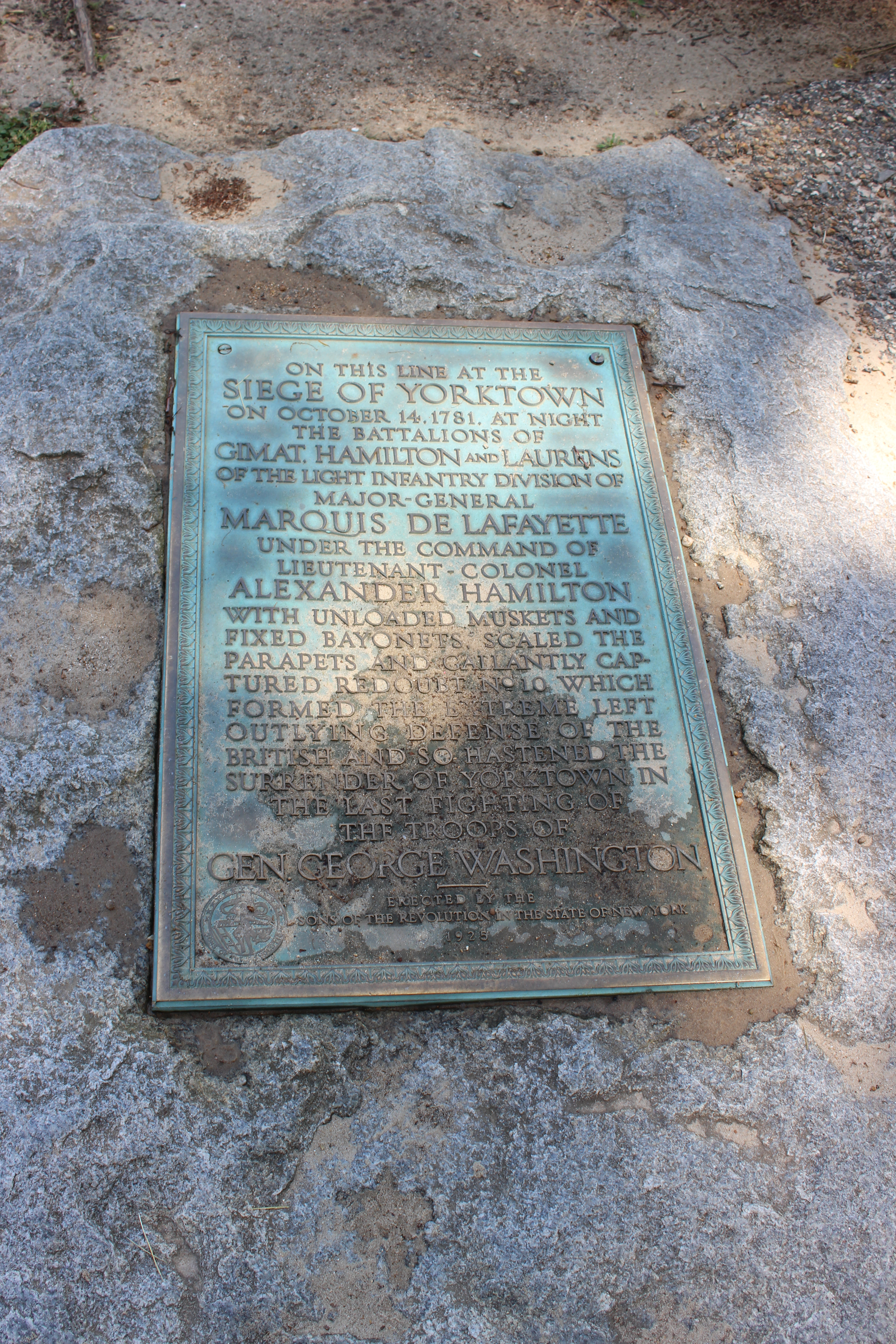
A few years ago I had the opportunity to visit Yorktown National Battlefield. This evening I was scrolling through my cache of American Revolution photos on an external hard drive, when I came across the picture below.

IMG_5993

A simple monument to three luminaries of the American Revolution. Three brilliant young men, one of which, John Laurens, would fall in one of the last small engagements of the war.

Could you imagine the conversation between the three that fateful October evening of 1781?