Last week, Emerging Revolutionary War‘s Phillip S. Greenwalt wrote a review of the above mentioned book. To find that review click here. Recently, through email, Emerging Revolutionary War had a chance to interview the author. The questions and his responses are below.
Thomas Jefferson, Marquis de Lafayette, two household names from the American Revolutionary War. One the author of Declaration of Independence and one of the great political minds of the era. The other, a Frenchman, enamored with the ideals of the rebelling colonies of British North America who risked a maritime crossing, was wounded at Brandywine, and served both on the field of battle and the international sphere to help achieve American independence.
That much is known about these two gentlemen, icons of history. How about their friendship, one that spanned decades and brought both men through times of personal and professional difficulties. Although years separated visits and both men were well into adulthood before making their respective acquaintance, the friendship helped cement the bond between countries, from aid during the American Revolution to a thankful nation celebrating the return of the Marquis in the mid-1820s.
This friendship has finally been captured in narrative form by historian Tom Chaffin, author of other historical works and biographies in a book published by St. Martin’s Press in 2019.
When you mention the name “Charles Lee” in many Revolutionary War circles, one immediately thinks of Maj. Gen. Charles Lee. Though there was another Charles Lee and it can be argued provided more contributions to the United States than the British born military general.
Charles Lee, Courtesy of Department of Justice
Charles Lee was born in 1758 on his father’s plantation Leesylvania in Prince William County, Virginia. The 2,000-acre farm that sat on the Potomac River and neighbored other Potomac River families such as the Fairfaxes, Washingtons and Masons. Charles’ father, Henry Lee II, a political colleague and friend of George Washington, Charles was one of eight siblings and five males that would solidify the Lee family’s role as leaders in politics and society. Continue reading “George Washington’s “Favorite” Charles Lee”→
When one mentions the word “Orlando” what is the first thought to pop into your head?
Universal?
Or maybe two words; “Disney World or Walt Disney?”
In all likelihood, the name Francis Wayles Eppes, is not one of the people you would associate central Florida with. You may even be asking, who is Francis Wayles Eppes.
Francis Wayles Eppes
Born on September 20, 1801, Francis was the only surviving child of Thomas Jefferson’s daughter Maria and her husband, John Wayles Eppes. When his mother died in 1804, his grandfather, the third president of the United States at the time, took young Francis under his care and the child resided at Monticello, Jefferson’s Virginia estate.
As young Francis grew, he spent time at Poplar Forest, Jefferson’s estate near Lynchburg, Virginia, which was bequeathed to him by his grandfather after the grandson married Mary Elizabeth Randolph in 1822. Francis, prior to marriage, studied law at both Georgetown College and South Carolina College.
With the death of his father and grandfather within three years of each other; 1823 and 1826 respectively, Francis and his wife joined the movement south, leaving Virginia for sunny Florida.
Initially settling outside Tallahassee and was instrumental in the formation of one of the first Episcopalian churches in the Florida territory, when he donated $500 to a construction of St. John’s Episcopal Church. He was a vestrymen, delegate to the Episcopalian convention in Florida, and also secretary of the local diocese for many years.
After a long public service record in Tallahassee, including serving as intendant or mayor of the capital for a few terms and being an early proponent of a school of higher learning–Jefferson-esque–which became the precursor to Florida State University, Eppes relocated to central Florida in 1869.
Even in his 60’s, Eppes stayed active, becoming a citrus farmer and was part of the group that founded the Cathedral Church of St. Luke in Orlando, the first Episcopal church in the growing town.
Eppes’s home in Orlando. Plaque on front porch reads; “Site and home of Francis Eppes Grandson of President Thomas Jefferson Original House Built in 1868 Marker Placed by Orlando Chapter NSDAR December 3, 1998”
A historian, writing about Eppes’s contributions of that era summarized the Virginian in the following words; “Through the 40’s, 50’s, and 60’s [1800s] there were few civic, religious, or educational affairs in which he did not have a prominent part.”
On May 30, 1881, Francis Wayles Eppes passed away at his home and would be buried in Greenwood Cemetery. He was 79 years old.
Emerging Revolutionary War welcomes guest historian Michael Aubrecht. A biography of Mr. Aubrecht is attached below.
In 2011 an exhibit titled “Slavery at Jefferson’s Monticello: Paradox of Liberty” started running at the Smithsonian’s American History Museum from January 27, 2012 – October 14, 2012. This somewhat controversial exhibition explored slavery and enslaved people in America through the lens of Jefferson’s plantation and was a collaborative effort between the Thomas Jefferson Foundation at Monticello and the African American History and Culture Museum in Washington DC. It helped to instigate public discussion about the dichotomy between the Founders and freedom. The paradox of course is that Thomas Jefferson drafted the Declaration of Independence and called slavery an “abominable crime,” yet he was a lifelong slaveholder. The exhibition provides a glimpse into the lives of 6 slave families living at Monticello and reveals how the paradox of slavery in Jefferson’s world is relevant for generations beyond Jefferson’s lifetime.
As I stood in Independence Hall, in the room where the Founders debated the Declaration of Independence, I suddenly started thinking of the opening scene from the musical 1776, when John Adams cries for independence while everyone else complains about either the heat or the flies. “Won’t somebody open up a window?” one of the delegates pleads. “Too many flies!” others respond, shouting him down. Adams is advocating the most lofty of ideas but everyone else is mired in their own personal discomfort. What a great metaphor.
To stand in that room where Adams and the other delegates worked was a privilege. The tour group consisted of 50 people or so, so there was no opportunity for quiet reflection. There was no sublime, transcendent moment of awe or epiphany. The tour guide could not even tell me which table Adams sat at except “toward the back over here somewhere.” Continue reading “Standing in the Room Where American Was Born”→
Leading up to the anniversary of April 19, 1775, we will be sharing some short remembrances from a few people who are from Lexington and Concord.This installment is by Rich Gillespie, a native of Lexington, Massachusetts.
If you live in Lexington, Massachusetts, the beginning of the American Revolution is an essential piece of life. The Minuteman statue dominates the center of town, the village green where the Alarm List stood to face the Regulars is much as it once was, the Town Seal seen on your friendly snowplow quotes Sam Adams’ comment to John Hancock upon hearing the firing—“Oh, What a glorious morning for America!”, and the high school’s team is predictably the Minutemen. The British marched to and from Concord within 150 yards of my 4th grade classroom, and the spring field trip was to the key sites of Lexington and Concord. My first job (as was my sister’s) was guiding visitors on Lexington Green.
Hip-hip Huzzah-Haughty British troops leave Lexington (author collection)
Looking for something to do midweek? Enjoy a Wednesday night at Shenandoah University and learn about an aspect of early American history.
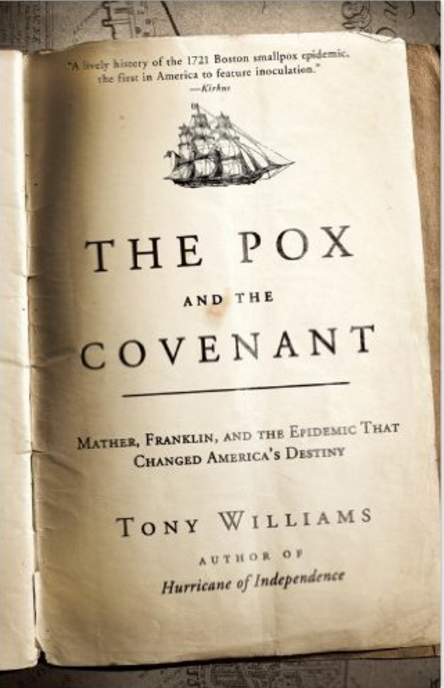
“The Pox and the Covenant” by Tony Williams
If in the lower Shenandoah Valley or can make the trek, join Shenandoah University’s History Fellows in welcoming Tony Williams, senior fellow at the Bill of Rights Institute, for a guest lecture.
Author of five books on the Early American history and holds a Bachelor of Arts in history from Syracuse (NY) University and a Master of Arts in United States history from Ohio State University. After a successful 15-year teaching career at the middle and high-school level, he became the Program Director at the Washington, Jefferson, & Madison Institute in Charlottesville, Virginia in 2014.
The lecture will be held at Henkel Hall, Hester Auditorium and will begin at 7 p.m. Williams will have his books for sale after the talk, including the title that bears the lecture’s name.
For information and questions, please contact Jonathan Noyalas, Chair of the Shenandoah University’s History Fellows at (540)-665-4501 or jnoyalas01@su.edu.
If interested in other events at Shenandoah University of this nature, check out the link here.
On February 1, 2017 at 7:00 p.m. join Emerging Revolutionary War’s Derek Maxfield for the launch of the “Historical Horizons Lecture Series” sponsored by the Genesee Community College History Club.
Two of the most important men in American History are John Adams and Thomas Jefferson. From the time they met in Philadelphia in 1775 until their deaths in 1826, these two men had a most fascinating relationship; much of the time it was one of admiration and love, but it was interrupted by a period of intense partisan strife that nearly ended the friendship. Come hear the intriguing story of how the friendship was restored.
The lecture is part of the Historical Horizons Lecture Series sponsored by the GCC History Club. Get the complete spring semester line-up here: https://gcchistoricalhorizons.wordpress.com/
All events are FREE and open to the public at the Genesee Community College Batavia campus, room T102 of the Conable Technology Building.






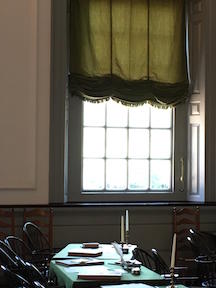 As I stood in Independence Hall, in the room where the Founders debated the Declaration of Independence, I suddenly started thinking of the opening scene from the musical 1776, when John Adams cries for independence while everyone else complains about either the heat or the flies. “Won’t somebody open up a window?” one of the delegates pleads. “Too many flies!” others respond, shouting him down. Adams is advocating the most lofty of ideas but everyone else is mired in their own personal discomfort. What a great metaphor.

 Emerging Revolutionary War Era