

To help celebrate America’s 250th birthday this year, St. Bonaventure University’s History Department will present a series of public programs through March and April—and Emerging Revolutionary War is taking part. From John Adams and Revolutionary-era Boston to George Washington’s long shadow, presenters will invite audiences to reconsider how we remember the Revolution today. And all programs will be available to watch live on Zoom and later on YouTube.

“July Fourth this year will mark 250 years since the Declaration of Independence was finalized,” says Dr. Phillip Payne, chair of the history department. “We wanted to invite members of the community to join us in commemorating that event. It’s a question we can all think about: what does the American Founding mean to us today?”
The programs, which are free and open to the public, will each begin at 7:00 p.m. Light refreshments will be served. The programs will also be available to watch via Zoom; for Zoom links, visit the history department’s blog, https://bonashistorydept.blogspot.com/.
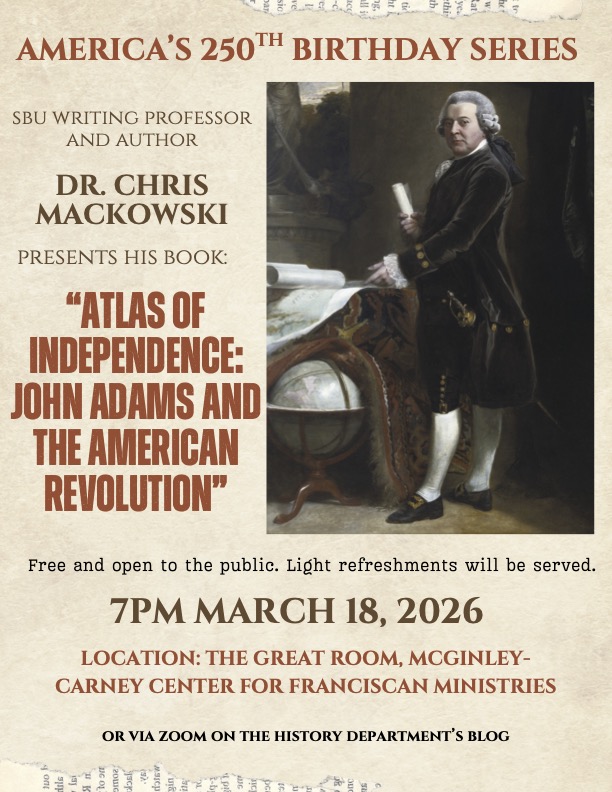
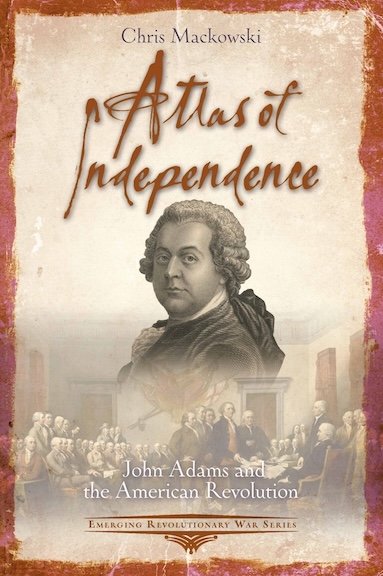
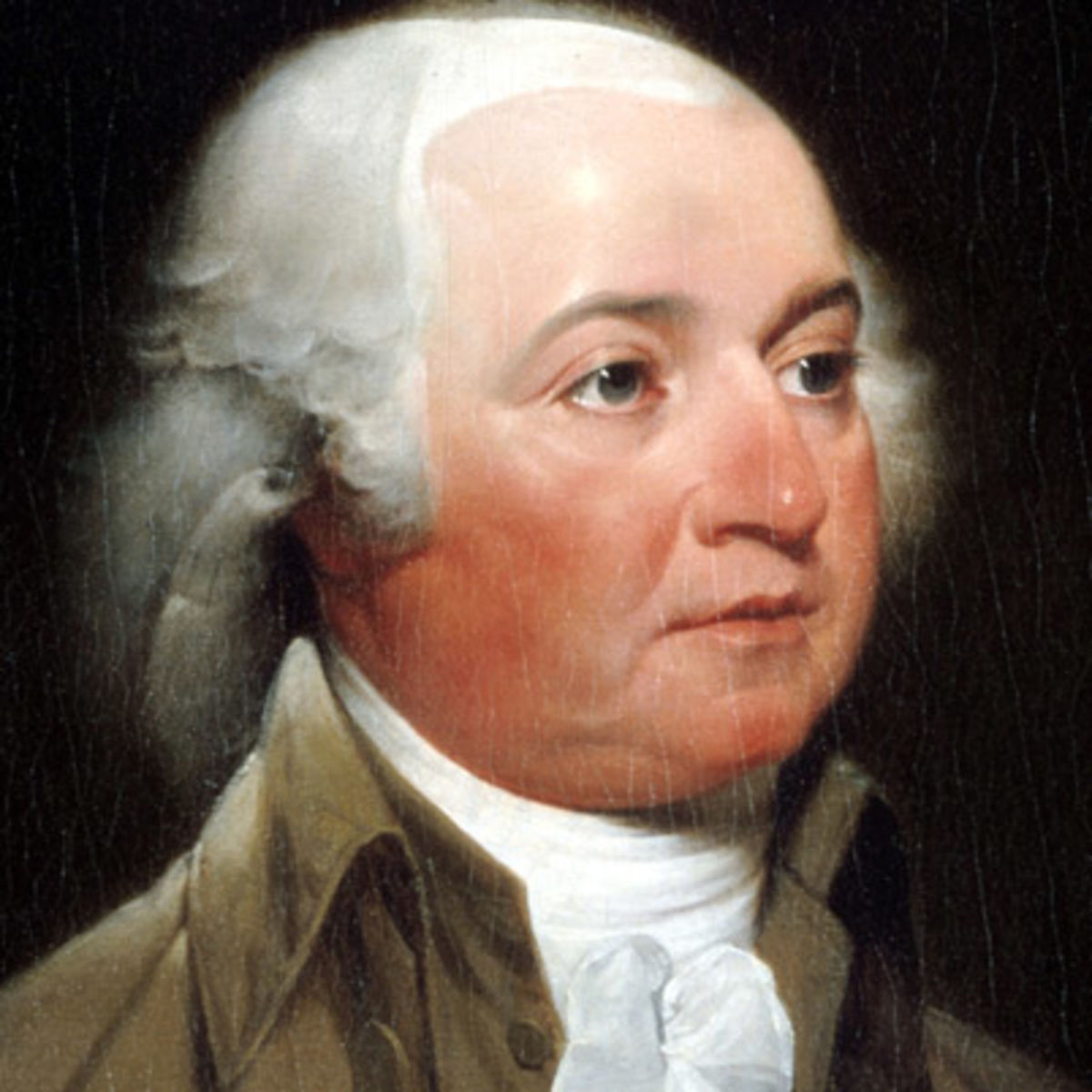
Wednesday, March 18: “Atlas of Independence: John Adams and the American Revolution,” Dr. Chris MackowskiLocation: The Great Room, McGinley-Carney Center for Franciscan Ministries Center
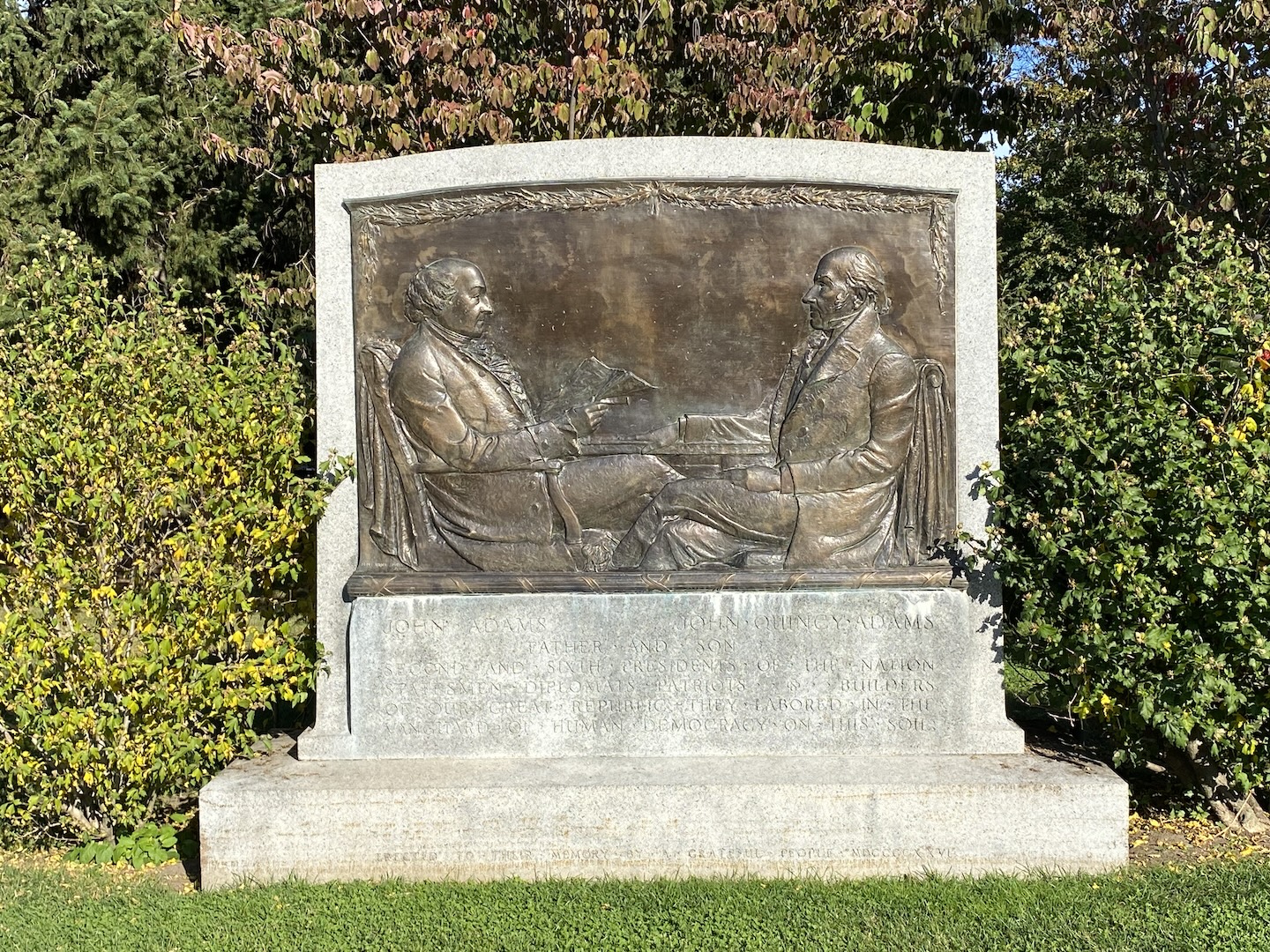
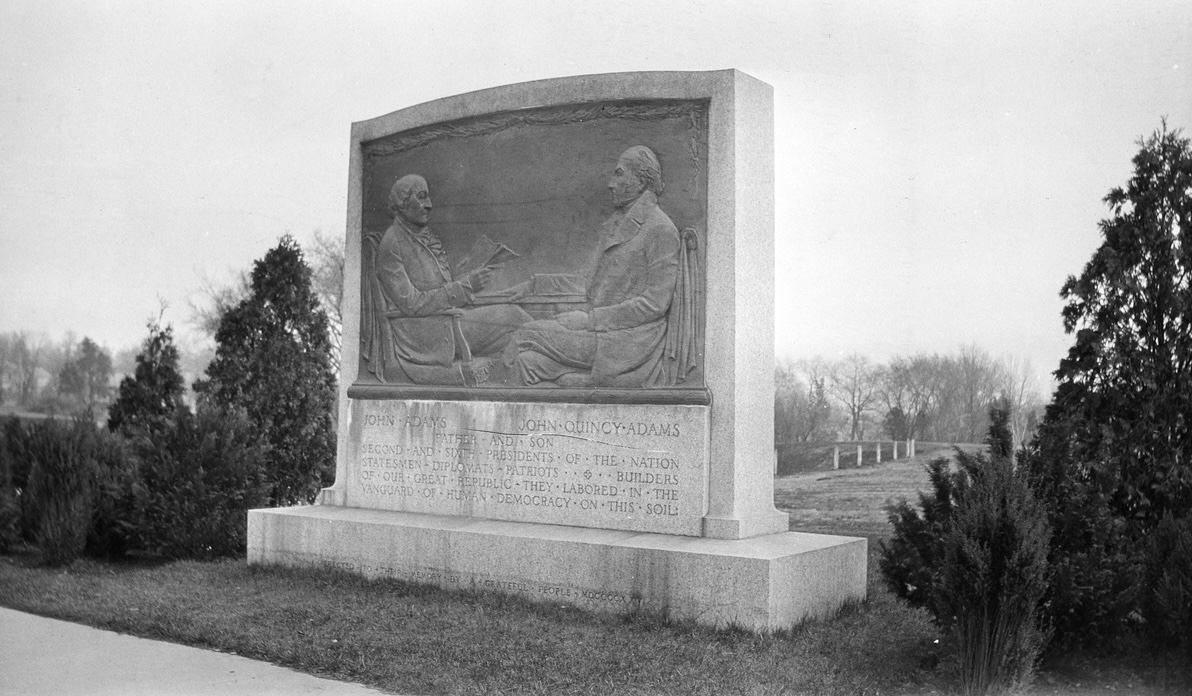
When the Continental Congress approved the Declaration of Independence, no one doubted who was responsible. “The man to whom the country is most indebted for the great measure of independence is Mr. John Adams,” said one delegate. “I call him the Atlas of American independence.” Born of humble means outside Boston, Massachusetts, Adams’s work ethic led him to become one of the colony’s most successful attorneys. Yet he burned with a powerful ambition and yearned for more. “I never shall shine, till some animating Occasion calls forth all my Powers,” he fretted. Festering tensions with Great Britain provided the occasion Adam longed for, and soon he found himself at the center of the storm, thrust onto the national stage where all his “Powers” transformed him into the intellectual architect of American independence. Perhaps more than any other American, he rose to the historical moment, urging his contemporaries into the unknown future.
Mackowski is a writing professor in St. Bonaventure’s Jandoli School of Communication and the author of the new book Atlas of Independence: John Adams and the American Revolution.
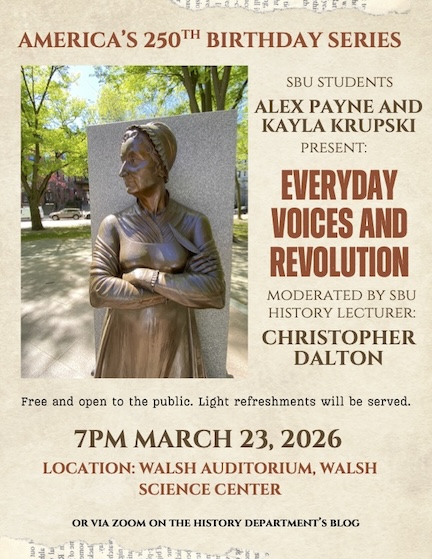
Monday, March 23: “Everyday Voices and Revolution,” student research panel moderated by Prof. Christopher Dalton
Location: Walsh Auditorium
This student research panel turns to the Revolution as it was actually lived. What did resistance sound like? How did politics enter the home? One student explores the world of sailors’ and commoners’ poetry and popular songs, showing how music at sea helped shape identity, protest, and revolutionary feeling. Another examines the daily realities faced by Loyalist and Patriot women, revealing how domestic labor, family loyalty, and survival became deeply political. By bringing together sound and household life, this panel invites us to reconsider the American Revolution not simply as a political rupture, but as a transformation of ordinary experience.
The panel will feature presenter Alex Payne speaking on “The Record of Thought of Oppressed People During the Age of Revolution” and Kayla Krupski, speaking on “Maintaining the Chaos: The Complexities of Domestic Life for Loyalist and Patriot Women Amidst the American Revolution – 1752-1789.”
Dalton, a senior lecturer in St. Bonaventure’s history department, supervises student work in the Historical Methods and Historiography class.
Krupski is a junior history major from Hamburg, NY, with a minor in classics.
Payne is a junior Theology and Franciscan Studies and History double-major from Shinglehouse, PA, with a minor in classics.
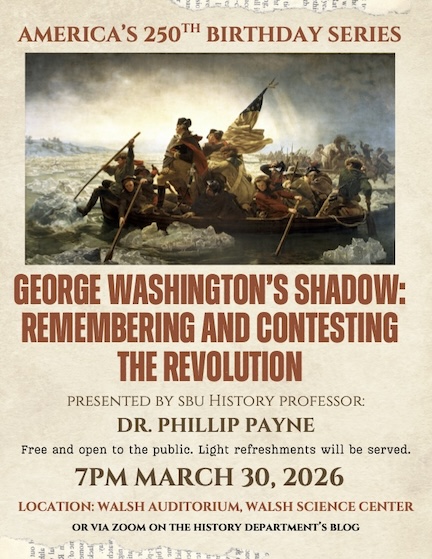
Monday, March 30: “George Washington’s Shadow: Remembering and Contesting the Revolution,” Dr. Philip Payne
Location: Walsh Auditorium
As we approach the 250th anniversary of the Declaration of Independence, we are reminded that there are political stakes beyond the simple pleasures of the Fourth of July with its emphasis on picnics, fireworks, and hot dogs. From such ideological distant perspectives as Constitutional originalism and the 1619 Project, Americans live in the shadow of the founding moment. For a generation (if not more), George Washington stood as an exemplar of republican virtue, but our recent culture wars have fractured the meaning and legacy of the Revolution. This, as we will learn, is nothing new.
Payne is a professor of history and the chair of St. Bonaventure’s History Department. One of his primary areas of interest is in the ways in which Americans remember their own history.
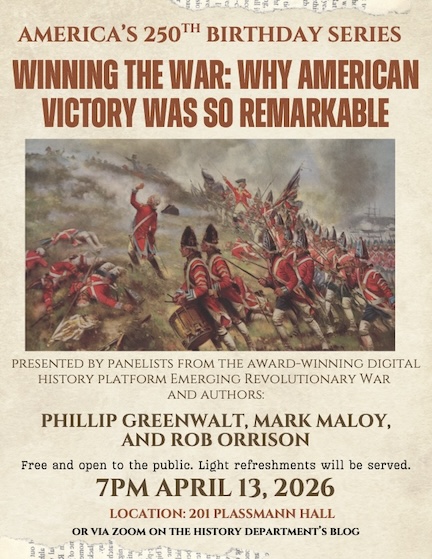
Monday, April 13: “Winning the War: Why American Victory was So Remarkable,” panel discussion with historians from Emerging Revolutionary War
Location: 201 Plassmann Hall (note the different location from other programs in the series)
American victory in the Revolution seems inevitable to us now, but at the time and on the battlefields, victory seemed anything but assured. How did America overcome the odds, particularly after several decisive defeats? Join a panel of historians from the award-winning digital history platform Emerging Revolutionary War (ERW) for an interactive discussion about key military moments that kept the dream of independence alive. Panelist include:
- Phill Greenwalt, author of The Winter that Won the War: The Winter Encampment at Valley Forge, co-author of A Single Blow: The Battles of Lexington and Concord, and co-author of the forthcoming A Hard-Bought Victory: The Battle of Bunker Hill
- Mark Maloy, author of Victory or Death: The Battles of Trenton and Princeton, To the Last Extremity: The Battles for Charleston, and a forthcoming book on the battles for New York City
- Rob Orrison, co-author of All That Can Be Expected: The Battle of Camden and A Single Blow: The Battles of Lexington and Concord
Greenwalt and Maloy are both historians with the National Park Service, and Orrison serves as ERW’s chief historian.
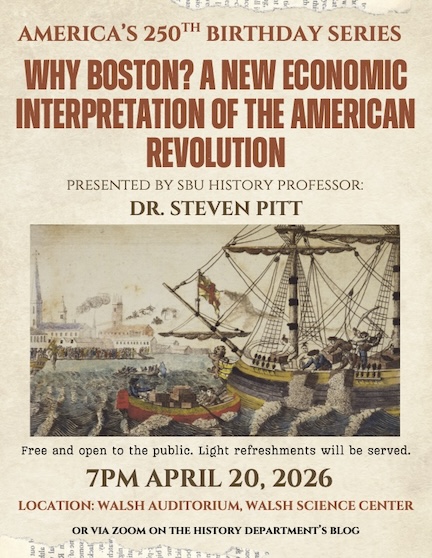
Monday, April 20: “Why Boston? A New Economic Interpretation of the American Revolution,” Dr. Steven Pitt
Location: Walsh Auditorium
The sparks of revolution swirled in Boston, and the language of liberty coursed through its streets in the decade leading up to the Declaration of Independence. The Stamp Act Crisis, Townshend Acts boycotts and riots, the Boston Massacre, the Boston Tea Party, and the Intolerable Acts reinforced and compounded grievances over economic decline, taxation, Navigations Acts enforcement, impressment, and imperial overreach. The port became the epicenter of resistance with the rise of the Sons of Liberty and eventual converts like John Adams. But why Boston? Why not Philadelphia, New York, or Charleston, SC? The answer lies in Boston’s unique and complex religious, political, military, and economic trajectory that promised opportunity but led to frequent disillusionment. At every turn, Bostonians from all classes tried to escape rigged economic systems (sometimes even systems they created), but conflicting internal desires and external forces thwarted their plans and shifted economic power to neighboring ports. By 1775, economic self-preservation propelled Bostonians onto the revolutionary path.
Pitt is an associate professor of history at St. Bonaventure, focusing on colonial and Revolution-era America.
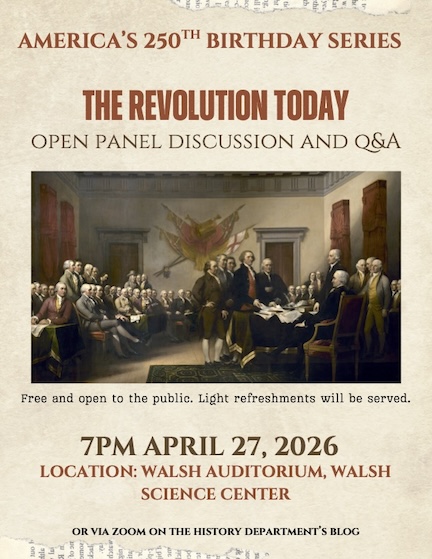
Monday, April 27: “The Revolution Today,” open panel discussion
Location: Walsh Auditorium
After spending five weeks exploring the American Revolution, our historians will gather for a final panel discussion and open Q&A with the audience. What themes have emerged from our series? What questions have the Founders raised for us? What does the American Revolution mean to us today? What is our own role in remembering America’s 250th birthday? Join us to take part in the conversation.
St. Bonaventure University’s America 250 Series is sponsored by the History Department, the Jandoli School of Communication, and Emerging Revolutionary War. For more information, contact Dr. Phil Payne at ppayne@sbu.edu. Zoom links for the programs are available here.


 Emerging Revolutionary War Era