“Rev War Revelry” Revolutionary Blacks, Discovering the Frank Brothers, Discussion with Dr. Shirley L. Green

Approximately 5,000 African-American or Black soldiers fought for the patriot cause in the American Revolution. Some joined state militias, some joined the Continental Army, and some sailed the seas with the fledgling navies of the United Colonies. William and Benjamin Frank were two of those 5,000. Both were free Blacks from Rhode Island who enlisted in the 2nd Rhode Island Regiment in 1777. Their father was a veteran of the French and Indian War, so the family was well-established in military tradition.

The 2nd Rhode Island fought and defended Fort Mercer during the campaigns of 1777 and survived harsh winters at Valley Forge and Morristown before returning to Rhode Island to literally defend the hearth and home from the British. Author and historian Dr. Shirley L. Green, adjunct professor at the University of Toledo, a 26-year veteran of the law enforcement community, and current Director of the Toledo Police Museum in Ohio, “takes the reader on a journey based on her family’s history, rooted in its oral tradition.”

Her book Revolutionary Blacks, Discovering the Frank Brothers, Freeborn Men of Color, Soldiers of Independence was published by Westholme Publishing in November 2023.

Furthermore, Dr. Green puts “together the pieces of the puzzle through archival research, interviews, and DNA evidence” to authenticate and expand the family history. The end result is a very readable and needed addition to the historiography of the American Revolution. Her ability to tell “a complex account of Black life during the Revolutionary Era demonstrates that free men of color…demonstrates that free men of color shared with white soldiers the desire to improve their condition in life and to maintain their families safely in postcolonial North America.”

Emerging Revolutionary War looks forward to an engaging and informative discussion with Dr. Green, this Sunday, at 7 p.m. EDT on our Facebook page. We hope you can tune in for this next episode of Emerging Revolutionary War’s “Rev War Revelry.”

For more information about the book and to order a copy, click here.

Tour Opportunity with Historian Michael Harris on Battle of the Clouds and Battle of Paoli

On May 25th, kick off your Memorial Day weekend this year with a Revolutionary Tour led by me. Highlights of this half day tour will include the Battle of the Clouds locations, the Paoli Battlefield, and a visit to Valley Forge to discuss the September 18, 1777 skirmish that took place there.

This car pooling tour will leave from Valley Forge at 8am and end at the same location.

Cost: $35 per person.

I will have copies of my books available to be signed as well (cost of any books additional).

A minimum of 10 people will need to pre-register for this tour to take place.

There is no registration limit though.

To participate, please contact me directly. mharris28thpa@gmail.com

On This Date in 1778: A Treaty with France

On this date in 1778, the fledgling American states officially found their great ally in France. The signings of the Treaty of Alliance and Treaty of Amity and Commerce gave new life to the cause of independence from Britain as Louis XVI pledged his support to the Americans.

An economic and military alliance with Britain’s age-old adversary had been long in the making.  Early in the conflict, the French were hesitant to openly support the rebellion, instead opting to provide covert aid in the form of ammunition, weapons, and clothing. Following the adoption of the Declaration of Independence in July 1776, Benjamin Franklin of Pennsylvania, Silas Deane of Connecticut, and Arthur Lee of Virginia, were dispatched overseas to Versailles to engage in diplomatic talks with the French foreign minister, Charles Gravier, comte de Vergennes. The success of these discussions would hinge on the battlefield performances of the American armies.

The following year was full of ups and downs for the Northern Army and Main Army. Although George Washington, commanding the latter force, had lost yet another major city when Philadelphia fell to the British in September 1777, his earlier victories at Trenton and Princeton had already impressed those on the other side of the Atlantic Ocean. Furthermore, in October, an audacious offensive by Washington against the British at Germantown, though ultimately a defeat, demonstrated promise to the French that the Americans could sustain the conflict. In the end, however, it was the Northern Army’s victory over General John Burgoyne at Saratoga and the subsequent surrender of over 6,000 British and German soldiers on October 17 that secured the alliance.

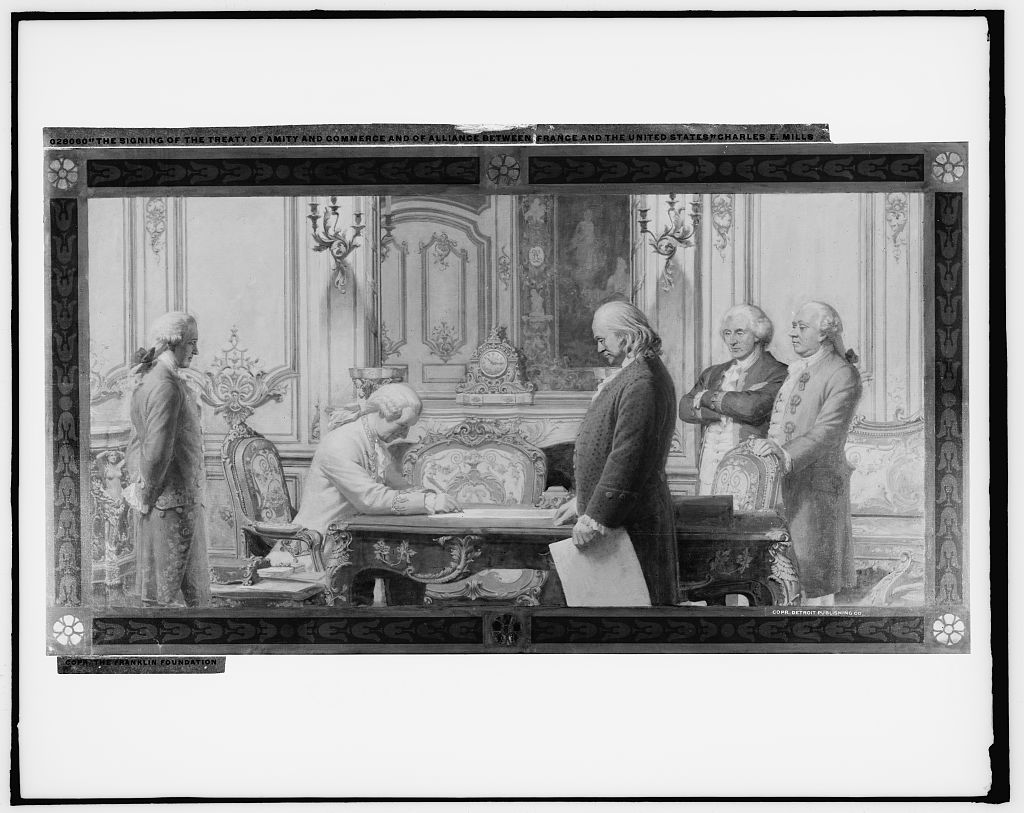
The Signing of the Treaty of Amity and Commerce and of Alliance between France and the United States. Photograph of a painting by Charles E. Mills. c[between 1900 and 1920], Library of Congress

When news arrived of the American triumph at Saratoga, Vergennes worked feverishly to persuade King Louis XVI that the time had come to openly support the fight against Britain. On February 6, 1778, the Treaties of Alliance and of Amity and Commerce were officially signed. At its conclusion, Deane and Franklin hastily penned a letter to President Henry Laurens of the Continental Congress to inform the governing body of the world-changing news:

Passy, near Paris, Feby. 8th. 1778.

Honourable Sir,                    

We have now the great Satisfaction of acquainting you and the Congress, that the Treaties with France are at length compleated and signed. The first is a Treaty of Amity and Commerce, much on the Plan of that projected in Congress; the other is a Treaty of Alliance, in which it is stipulated that in Case England declares War against France, or occasions War by attempts to hinder her Commerce with us, we should then make common Cause of it, and join our Forces and Councils, &c. &c. The great Aim of this Treaty is declared to be, to “establish the Liberty, Sovereignty, and Independency absolute and unlimited of the United States as well in Matters of Government as Commerce.” And this is guaranteed to us by France together with all the Countries we possess, or shall possess at the Conclusion of the War; In return for which the States guarantee to France all its Possessions in America. We do not now add more particulars, as you will soon have the whole by a safer Conveyance; a Frigate being appointed to carry our Dispatches. We only observe to you and with Pleasure; that we have found throughout this Business the greatest Cordiality in this Court; and that no Advantage has been taken or attempted to be taken of our present Difficulties, to obtain hard Terms from us; but such has been the King’s Magnanimity and Goodness, that he has proposed none which we might not readily have agreed to in a State of full Prosperity and established Power. The Principle laid down as the Basis of the Treaty being as declared in the Preamble “the most perfect Equality and Reciprocity,” the Privileges in Trade &c. are mutual and none are given to France, but what we are at Liberty to grant to any other Nation. On the whole we have abundant Reason to be satisfied with the Good Will of this Court and the Nation in general, which we therefore hope will be cultivated by the Congress, by every means that may establish the Union, and render it permanent. Spain being slow, there is a separate and secret Clause by which she is to be received into the Alliance upon Requisition; and there is no doubt of the Event. When we mention the Good Will of this Nation to our Cause we may add that of all Europe, which having been offended by the Pride and Insolence of Britain, wishes to see its Power diminished. And all who have received Injuries from her are by one of the Articles to be invited into our Alliance. With our hearty Congratulations, and our Duty to the Congress, we have the honour to be, very respectfully, Sir Your most obedient humble Servants

B Franklin

Silas Deane[1]

When news of the treaties finally reached the American army encamped at Valley Forge, Gen. Washington designated May 6, 1778 as a day for “rejoicing throughout the whole Army.”


[1] “Franklin and Silas Deane to the President of Congress, 8 February 1778,” Founders Online, National Archives, https://founders.archives.gov/documents/Franklin/01-25-02-0487. [Original source: The Papers of Benjamin Franklin, vol. 25, October 1, 1777, through February 28, 1778, ed. William B. Willcox. New Haven and London: Yale University Press, 1986, pp. 634–635.]


Rev War Revelry: “Their Immortal Honour Made a Brave Defense” Maryland Continental Line

“Given the order to defend the American withdrawal from Long Island, the Maryland Line saved the Continental Army from annihilation in the first major battle of the war.” wrote historian Ryan Polk.

Tench Tilghman, staff officer to George Washington and a native Marylander wrote about his fellow soldiers, “bore the palm…by behaving with as much Regularity as possible.”

Furthermore, if you Google “Battle of Guilford Court House” the image used by Wikipedia depicts an artist’s rendition of the 1st Maryland defending Nathanael Greene’s last line during the March 1781 engagement. The particular image is below.

The Continental Maryland Line was one of the preeminent stalwarts of the American army, both in the northern and southern theaters of the war. Join Emerging Revolutionary War historians in a discussion about the men from the Old Line State and their military acumen during the American Revolutionary War. The discussion will also highlight their memory and memorialization. We hope you can join us Sunday at 7 p.m. EST on the Facebook page of Emerging Revolutionary War.

Share your history with Emerging Revolutionary War!

Emerging Revolutionary War is open to submissions from our readership. Guest submissions can also lead to membership. Articles of varied length and photo essays are welcome. Please be advised that we do not pay for any article submissions. Emerging Revolutionary War is 100% non-profit. We do offer to promote you and your work to the best of our ability, while offering an outlet to explore new ideas and improve as a writer/historian.

We are looking to establish long-term relationships with writers who conduct excellent research and provide a fresh look at an old subject. Any articles that the author submits should offer a new interpretation of or newly discovered information on significant events.

Guest submissions are subjected to a blind peer review process. Members of our editorial board, whose identities are kept anonymous, read and comment on posts. However, they do not necessarily offer a simple up-or-down judgment. In keeping with our mission to provide a platform for emerging voices, our board sees its role as a developmental entity. The board’s general approach is to try and find a way their way to “yes.” This often involves several rounds of revisions based on feedback provided by the board. While there is no guarantee of publication, if an author is willing to put in the time and make a good-faith effort at incorporating feedback, the board is willing to continue helping authors develop pieces.

Word count should be in the 800-1500 range for consideration. Please submit guest posts as Word Document attachments by email to emergingrevolutionarywar@gmail.com with “Guest Post Submission” in the subject line.

Authors will receive an e-mail acknowledgment when their submission has been received. The review process may take up to two/three weeks. Once the process is complete, an editor will contact the author to report the outcome. Just because you submit an article does not mean we will post the article. If your writing is accepted for publication, you will be asked to sign a form stating that the article is your own work and allowing Emerging Revolutionary War to retain first digital rights.

To be considered for authorship, please keep in mind the following guidelines:

  • Any and all topics on the broadly-defined Revolutionary War era are welcomed (French and Indian War, colonial era, American Revolution, War of 1812).
  • If submitting a proposal, be specific about what your article will focus on. Include an outline of the story idea and a professional biography.
  • Any first-time article should be no more than 1,500 words.
  • All works must contain footnotes or endnotes in either Chicago or MLA format or a section citing works referenced.
  • All work must be original by the submitting author.
  • Articles should not be of a general nature but should be written to be enjoyed by a general audience.
  • Articles should have strong leads. The first few paragraphs must capture readers, hold on to them, and then propel them into a story.
  • Article submissions must contain an author’s brief professional biography.
  • Submissions are subject to modification and editorial board review, with the editors having final approval.
  • Previously published work may be considered as long as the author owns the copyright. Previously published submissions must be identified as such at the time of submission.
  • We request authors send at least one image for use in the article, whether taken themselves, within public domain, or from elsewhere with clear publication permission. Any photos or photo essays should set the scene, showing specific items of interest as they relate to your narrative. They must come with captions and photo credits.
  • Please submit all articles in a titled Word or Google Docs document (not PDF). Be sure to put the author’s name at the beginning of the piece.

If you have a passion and love for early American history and an interest in research and writing, we love the opportunity for ERW to help you share that passion!

“Rev War Revelry” American Triumph with Tom Hand

Welcome to the first “Rev War Revelry” of 2024! To kick off the new year, Emerging Revolutionary War is joined by Tom Hand, author, historian, and founder of Americana Corner. However, in the later stages of 20234, Tom added published book author to his lengthy list of accomplishments. His book, American Triumph is now available via his website.

The book, “masterly blends the personal experiences and historic milestones” of three luminaries of the early Republic, Benjamin Franklin, George Washington, and John Adams. The book, with a plethora of graphics, sidebars, and informational tidbits aims to provide a “captivating collection of stories” for the “everyday American.”

We look forward to a lively and friendly discussion with Tom. Hope you can tune in, to Emerging Revolutionary War’s Facebook page at 7 p.m. EDT this Sunday, January 7th.

Rev War Revelry: “God Save Benedict Arnold” with Author Jack Kelly

Join us this Sunday evening at 7:00 p.m. on our Facebook page for an author interview with Jack Kelly to discuss his new book, God Save Benedict Arnold: The True Story of America’s Most Hated Man.

Benedict Arnold committed treason― for more than two centuries, that’s all that most Americans have known about him.

Yet Arnold was much more than a turncoat―his achievements during the early years of the Revolutionary War defined him as the most successful soldier of the era. GOD SAVE BENEDICT ARNOLD tells the gripping story of Arnold’s rush of audacious feats―his capture of Fort Ticonderoga, his Maine mountain expedition to attack Quebec, the famous artillery brawl at Valcour Island, the turning-point battle at Saratoga―that laid the groundwork for our independence.

Arnold was a superb leader, a brilliant tactician, a supremely courageous military officer. He was also imperfect, disloyal, villainous. One of the most paradoxical characters in American history, and one of the most interesting. GOD SAVE BENEDICT ARNOLD does not exonerate him for his treason―the stain on his character is permanent. But Kelly’s insightful exploration of Arnold’s career as a warrior shines a new light on this gutsy, fearless, and enigmatic figure. In the process, the book offers a fresh perspective on the reasons for Arnold’s momentous change of heart.

Conquering a Continent: The Battle of Quebec, September 13, 1759

This article by ERW’s William Griffith first appeared on the American Battlefield Trust’s website on January 4, 2021. The original link can be found here.

The French and Indian War was in its fifth full year, and the tables had turned in Britain’s favor. As the larger conflict, the Seven Years’ War, raged throughout the globe, in North America, the British were one swift strike away from conquering the continent. The French in the Ohio River Valley, Great Lakes region, and Upstate New York had been thrown back on their heels and sent scurrying north into Canada leaving the road open for a British thrust against Montreal and Quebec. For the summer of 1759, the latter city, the capital of New France, would be placed in the crosshairs by an army commanded by Major General James Wolfe. If Quebec, situated along the most important water highway in Canada, the Saint Lawrence River, should fall, the French in North America would be squeezed into the region around Montreal. Pending any catastrophic failures by Britain’s army and navy and their allies elsewhere in the world, it would only be a matter of time than before New France was conquered.

James Wolfe and His Army

Thirty-two year old James Wolfe had served in the British Army for almost eighteen years when he was given command of the roughly 9,000-man force that was tasked with defeating the French in and around Quebec City in 1759. He was hard-nosed and did not always get along with his subordinate generals, Robert Monckton, George Townshend, and James Murray. The previous year he had been a brigadier general under Jeffry Amherst during the successful siege and capture of the fortress city of Louisbourg in Nova Scotia, and afterward led a campaign of destruction against the fishing villages of the Gulf of Saint Lawrence. He then returned to England and secured a major generalship and command of the Quebec expedition. He arrived in Halifax in April 1759 and began training his force and preparing plans for his campaign.

Wolfe’s army was composed predominantly of professional British soldiers. Several hundred North American ranger units also complimented his force, which he described as, “… the worst soldiers in the universe.” He did not have much respect for colonial troops. On June 26, Wolfe’s men began landing at Ile d’Orleans in the middle of the Saint Lawrence River just to the east of Quebec City. Across the river, the French commander, the Marquis de Montcalm, prepared to oppose them.

The Marquis de Montcalm and Quebec’s Defenders

Louis-Joseph, Marquis de Montcalm, had been in command of France’s regular troops in North America since 1756. During that time he had put together an impressive string of victories at places like Fort Oswego, Fort William Henry, and Fort Carillon. As the attack on Quebec loomed, he was given command of all military forces on the continent, including the Canadian militia and marines. The previous harvest had not been good in Canada, and his army and the civilians in the city were on short rations, but relief came during the spring of 1759 when ships arrived carrying food and supplies. With this, Montcalm was determined to hold onto the city at all costs. He dug trenches outside the city and along the Saint Lawrence’s northern shoreline extending for nearly ten miles, welcoming a frontal assault from Wolfe. His army, consisting of over 3,500 French regular troops, included thousands more Native American allies and Canadian militiamen who were not accustomed to fighting in open fields against professional enemy soldiers. This important disadvantage would play a large part in Montcalm’s ultimate defeat.

An engraving of Montmorency
An engraving of General James Wolfe’s failed attack on the Montmorency River, July 31, 1859. Library of Congress

The Campaign

When General Wolfe’s army began landing at Ile d’Orleans and subsequently Point Levis (directly across the river from the city) to the east of Quebec, he had initially hoped to force a landing on the northern shore just a few miles downstream at Beauport. However, he quickly discovered that Montcalm had heavily fortified the landing site, throwing a monkey wrench into his plans. This did not deter Wolfe, however, and by July 12, he had placed ten mortars and cannon at Point Levis and began bombarding the city itself. More guns were brought up and the bombardment continued for weeks in an effort to demoralize those within Quebec City.

The best chance to defeat Montcalm was to force him out of his defenses and into an open field battle. Wolfe understood that his vigorously trained and superior disciplined regular troops would have the upper hand against lesser-numbered French regulars and their militia. His first attempt to accomplish this occurred on July 31, when he landed a force of grenadiers, light infantry, and rangers near Montmorency Falls further downstream from Beauport hoping to ford the Montmorency River and reach a position in the rear of the French lines. It failed miserably. Montcalm guessed correctly that an attack was coming from that direction and rushed men there to meet the enemy. The river’s tide prevented Wolfe from getting all of his troops in position on time and frontal assaults launched from the beach were beaten back with heavy losses. The British retreated, leaving behind 443 men killed and wounded. The first attempt to force a landing on the Quebec side of the river had failed, but it would not be the last. Wolfe turned his attention further upriver, where he hoped his prospects for victory would be more fruitful.

The Plains of Abraham

As the weeks passed following the debacle at Montmorency, the British probed the northern shore west of Quebec for a secure landing spot. During this time, Wolfe grew sick with a severe fever and kidney stones and believed his days were numbered. He recovered enough, however, to begin moving his army upriver about eight miles from the city not far across from Cap Rouge. It was decided that the landing would be made at Anse au Foulon, where a narrow gap and trail led to the top of the cliffs just two miles west of the city.

At four in the morning, September 13, Lieutenant Colonel William Howe (who would serve as the commander of the British Army in America during the Revolutionary War) came ashore with the light infantry and surprised and overwhelmed the enemy outpost above the landing site. The conditions for rowing the army into position that early morning had been perfect for Wolfe. Montcalm was caught off guard.

After securing the landing zone, Wolfe began moving his attack force of roughly 4,400 regulars onto the Plains of Abraham, an open field about a mile wide and a half a mile long in front of the city’s western defenses. Responding to the threat as quickly as could be done, Montcalm rushed some 1,900 French regulars and 1,500 militiamen and Native Americans to meet the British line. This was the open field fight that Wolfe had been yearning for ever since the campaign began.

A painting of the death of General Wolfe
Benjamin West’s depiction of the death of British General James Wolfe during the Battle of Quebec, painted in 1770. Wikimedia Commons

As the French commander formed his men up in a line of battle, the British waited patiently across the field to receive their attack. Montcalm ordered his troops forward, and almost immediately his militiamen’s lack of experience and training in open combat became apparent as their formations wavered and some failed to advance close enough to the enemy line to fire effectively. One British participant described what happened next:

The French Line began … advancing briskly and for some little time in good order, [but] a part of their Line began to fire too soon, which immediately catched throughout the whole, then they began to waver but kept advancing with a scattering Fire.—When they had got within about a hundred yards of us our Line moved up regularly with a steady Fire, and when within twenty or thrity yards of closing gave a general [fire]; upon which a total [rout] of the Enemy immediately ensued.

The battle was over in just fifteen minutes as the British swept forward, claiming the field and capturing hundreds of prisoners. Both sides each lost over 600 men killed and wounded, including both respective commanders. Wolfe was mortally wounded and died a hero on the field. Montcalm, too, was hit by grapeshot in the abdomen and died the next morning. Five days later, Quebec surrendered. The French retreated further downstream to Montreal, attacked and failed to retake Quebec the next spring, and surrendered in whole on September 8, 1760, effectively ending all major military operations in North America during the French and Indian War. The battle for the continent between Britain and France was over.

Rev War Revelry: “For Britannia’s Glory and Wealth” with Author and Historian Glenn Williams, PhD

Join us this Sunday night at 7pm as we welcome Glenn F. Williams, PhD to our popular Sunday night Rev War Revelry! Glenn will examine the political and economic causes of the American Revolution beginning at the end of the Seven Years War / French and Indian War through the resistance movements. He will dispel or clarify some of the popular beliefs about the grievances that eventually led the thirteen colonies to break with the Mother Country. This will be a timely discussion as we approach the 250th anniversary of the Boston Tea Party. Glenn Williams is a retired U.S. Army officer that until recently also enjoyed a “second career” as a military historian. He retired as a senior Historian after 18 years at the U.S. Army Center of Military History and 3 1/2 years as the historian of the American Battlefield Protection Program of the U.S. National Park Service.

Grab your favorite drink and tune in, we will be live so feel free to drop your questions in the live chat. If you are not able to tune in on Sunday, the video will be placed on our You Tube and podcast channels.

Rev War Revelry: Old South Meeting House and the Boston Tea Party

Join us this Sunday, October 15th at 7pm as we welcome Matthew Wilding, Director of Education and Interpretation at Revolutionary Spaces. Revolutionary Spaces manages the Old South Meeting House and the Old State House in historic Boston. We will discuss the history of the Old South Meeting House and its important role in the revolutionary movement in Boston (especially during the Boston Tea Party). We will also cover their plans for the 250th anniversary of the Boston Tea Party, including their new exhibit on the destruction of property in public protests.

Grab a drink and follow along as we start to gear up for the 250th anniversary of the Boston Tea Party with Emerging Revolutionary War!